Social Studies Resources for Homeschooling: A 2026 Parent's Guide
There are more homeschooled children in the United States right now than there are students in Catholic schools. The National Home Education Research Institute’s 2026 synthesis of Census Pulse and 23-state administrative data puts the 2024–25 K-12 homeschool population at roughly 3.408 million students, about 6.26 percent of the school-age population and nearly double Catholic-school enrollment. The federal National Household Education Survey uses a tighter definition and lands at 3.4 percent homeschooled (5.2 percent counting full-time virtual), still up sharply from 3.7 percent before the pandemic. Whichever number you trust, the picture is the same. This is a structural shift the country has now lived with for five years, and a lot of parents are now the social studies department for their own kids.
This guide is for those parents. It walks through the social studies resources actually worth your time, organized by what they do, with honest notes on cost and fit. The frame throughout is that social studies is the hardest homeschool subject to resource well, and the reasons are worth understanding before you spend a dollar.
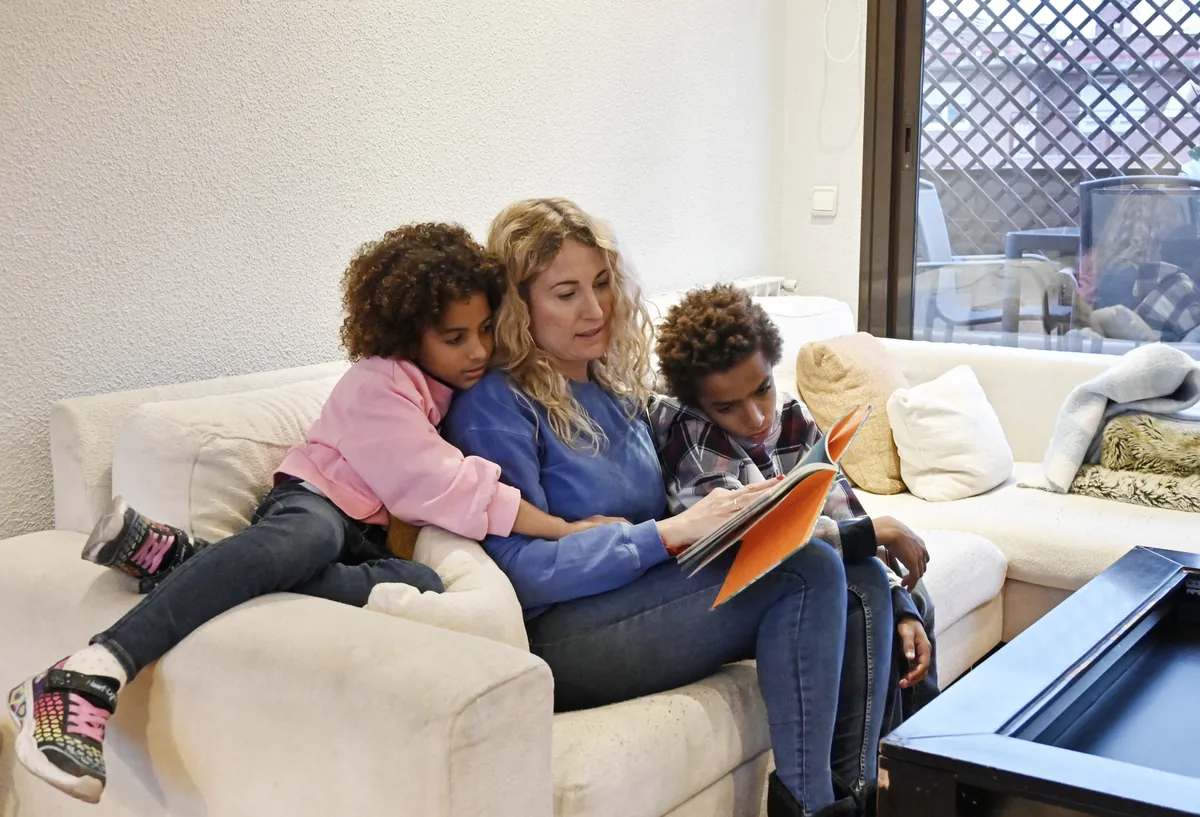
Photo: Oscar del Pozo, CC BY 4.0 , via Wikimedia Commons .
Why social studies is the trickiest subject to homeschool
Math has a right answer and a clear sequence. Reading has decodable texts and leveled readers. Social studies has none of that tidiness, and it carries something the other subjects do not: it is the most ideologically contested part of the curriculum. How you teach the American founding, slavery, Indigenous history, and the country’s wars depends heavily on what you believe those events mean. That is why the homeschool market splits its social studies materials into secular and faith-based lines in a way it does not split its math.
For a parent, this has a practical consequence. You cannot just buy “the good history curriculum” the way you might buy a well-reviewed math program. You have to decide what perspective you want the materials to carry, and then you have to do something the textbook companies cannot do for you, which is teach your child to ask hard questions of the evidence rather than swallow one account of it. The NCES data shows why parents push hardest here: concern about the school environment was the single most-cited reason for homeschooling (83 percent of families named it, 28 percent ranked it first), and a desire to control how their children learn ran close behind. Social studies is where that desire shows up most concretely, because it is the subject where every framing choice is also a values choice.
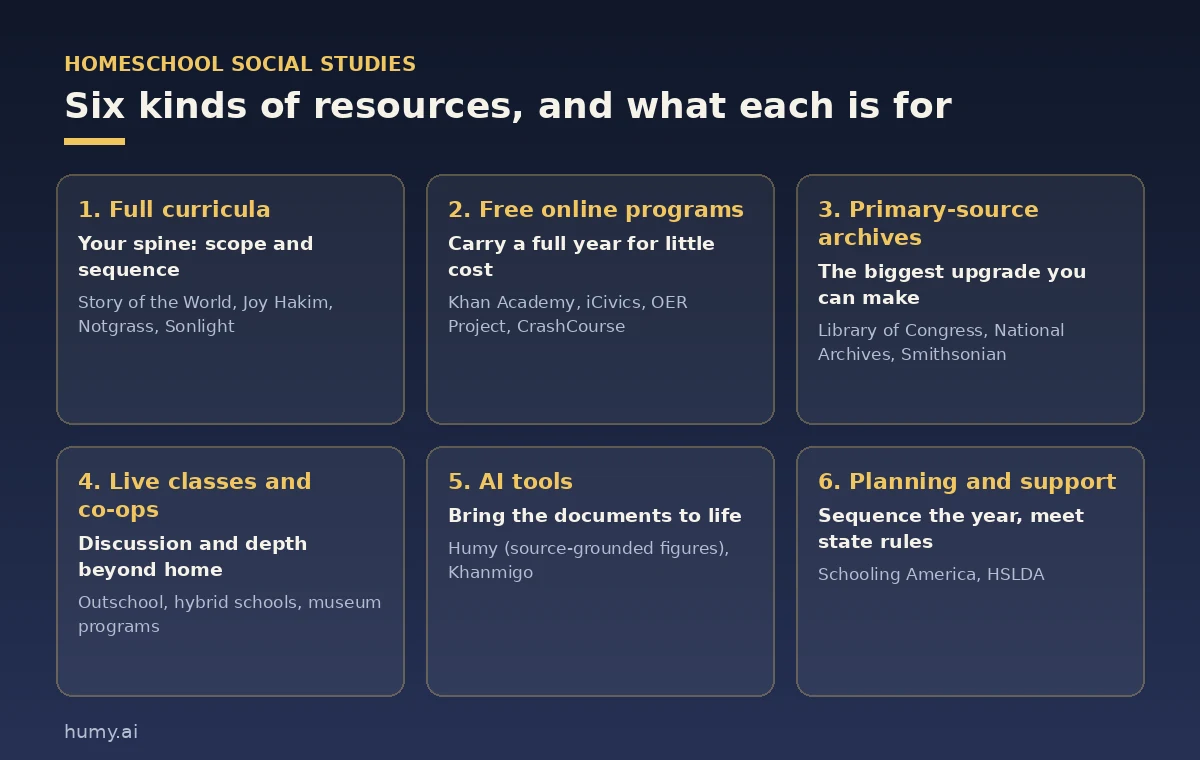
The resources below are grouped so you can build something coherent, not a pile of disconnected subscriptions. You will not need all of them. You will probably want one main curriculum for scope and sequence, a couple of free primary-source archives, and one or two tools that put a child in real contact with documents.
Full curricula: your spine
A spine curriculum gives you scope, sequence, and a week-by-week plan so you are not assembling history from scratch every Sunday night. The market divides cleanly.
On the secular side, Susan Wise Bauer’s Story of the World is the most widely used elementary option, running roughly $15 to $45 a volume plus an activity book, with a classical, chronological approach across four volumes. For older students, Joy Hakim’s A History of US (an eleven-volume narrative history) reads like good nonfiction, not a textbook. Pandia Press’s History Quest and History Odyssey, Oak Meadow, BookShark (the secular sibling of Sonlight), and Blossom and Root’s A River of Voices (which centers Indigenous, Black, and women’s perspectives) round out the secular field. Gallopade’s state-standards-aligned materials are useful if you need to match a specific state’s expectations for record-keeping.
On the faith-based side, Notgrass History (grades 1–12, roughly $70 to $110 per course, integrating Bible, literature, and primary sources) and Sonlight’s literature-rich all-subject packages (which start around $500 and run higher for full grade-level kits) are the heavyweights. My Father’s World, Mystery of History, Veritas Press for classical Christian families, BiblioPlan, and the Catholic Textbook Project for grades 5–12 serve specific traditions within that market.
A spine is worth buying. Just treat it as the floor of your social studies program. The free archives below carry the subject the rest of the way.
Free and low-cost online programs
You do not need to pay for the core of a strong social studies education. Several free programs are good enough to anchor a year.
Khan Academy offers free, standards-aligned World History, US History, US Government and Politics, and Civics across the K-12 range, and its Khanmigo AI tutor (about $4 a month or $44 a year for families, free for verified teachers) walks students through material with Socratic questioning rather than handing over answers. iCivics , founded by the late Supreme Court Justice Sandra Day O’Connor, is the standard for free civics and government games and lessons, and it is genuinely engaging for middle schoolers who think government is boring. The OER Project , funded by Bill Gates, provides the free, secular, standards-aligned Big History Project and World History Project courses with full teacher support. CrashCourse on YouTube fills gaps with short, energetic video surveys of US and world history, government, and economics. Between them, these four can carry a full year of social studies for a motivated family at close to zero cost.

Primary-source archives: the part that matters most
If you take one thing from this guide, take this. The single biggest upgrade you can make to a homeschool history program is teaching your child to work with primary sources, and the best primary-source archives in the world are free.
The Library of Congress Teachers programs offer more than 15 million digitized items, including curated Primary Source Sets with teacher’s guides, the Chronicling America historical newspaper archive, and the Veterans History Project. The National Archives’ DocsTeach puts thousands of lesson-ready primary sources online with built-in activities, and its Citizen Archivist program lets your child do real transcription work on historical documents. The Smithsonian Learning Lab opens up millions of objects across 21 museums, including the National Museum of African American History and Culture’s digital resources.
For structured ways to use these documents, the Stanford History Education Group’s Reading Like a Historian curriculum, now run by the Digital Inquiry Group, offers free document-based lessons built around a central historical question, and TeachingHistory.org (the Roy Rosenzweig Center’s National History Education Clearinghouse) vets lesson plans for quality. The Digital Public Library of America , Yale’s Avalon Project of foundational documents, and the Internet Archive fill out a research library that costs nothing and rivals what most universities had a generation ago.
Primary sources are demanding, though. A 19th-century speech or a colonial-era legal document is hard for a 12-year-old to read cold, which is where the next two categories earn their place.
Live classes, co-ops, and museums as curriculum
Homeschooling no longer means a parent alone at a kitchen table. The model has loosened, and roughly 44 percent of homeschool households now have at least one child in another setting too, according to an EdChoice and Harvard analysis .
Outschool runs live online classes (advertised at more than 140,000 of them, priced from about $5 to $50) taught by independent educators for ages roughly 1 to 18, which is useful when your child wants to go deep on a topic outside your own expertise. Co-ops and hybrid schools, often around $3,000 a year (about a third the cost of private school), give kids a group to debate history with, which matters for a discussion-driven subject. The Nomadic Professor produces travel-based history video courses for families who want something more cinematic.
Museums have quietly become some of the best free curriculum on the internet. Colonial Williamsburg’s Electronic Field Trips, the National Constitution Center’s Interactive Constitution, Mount Vernon’s Digital Encyclopedia, and the United States Holocaust Memorial Museum’s IWitness platform are built for exactly this audience. A homeschool history unit anchored in a museum’s primary-source collection plus a couple of its lessons is often stronger than a purchased textbook chapter.

Photo: Oscar del Pozo, CC BY 4.0 , via Wikimedia Commons .
AI tools: the category where most options fail
This category is changing the fastest, and it is also where a parent needs the most discernment, because not every AI tool belongs anywhere near a child’s history education.
The risk is specific and documented. General-purpose chatbots invent historical detail when they lack sourced data. UNESCO’s 2024 report AI and the Holocaust: Rewriting History?, produced with the World Jewish Congress, documented generative AI fabricating events that never happened, and a 2025 Cornell study found ChatGPT flattening the moral weight out of Holocaust survivor testimony. A raw chatbot asked to “be Abraham Lincoln” will produce confident sentences with no anchor in anything Lincoln actually wrote. For a subject built on evidence, that fails the basic test.
What a homeschool family actually needs is a tool grounded in real documents, with the parent in control of the framing. Humy is built for exactly that. A child can read a Frederick Douglass speech from the Library of Congress, then turn around and question Douglass about it, and the chat stays anchored to the documentary record. There are more than 1,200 figures available the same way, in more than 50 languages, behind a shared link that does not require a student account. It does not write your child’s essays. It gives a one-student household the conversational partner that a classroom gets for free.
For families who want a worldview-aware approach, the source-grounded design matters more than it might first appear. Because the figures draw from real documents and the parent sets the framing, a secular family and a faith-based family can both use the same tool and bring their own emphasis to the unit, without inheriting one publisher’s interpretation baked into a textbook.
Khan Academy’s Khanmigo, mentioned above, is the other AI tool worth a homeschool parent’s trust, particularly for its Socratic tutoring across history and civics. Beyond those two, treat AI tools with caution and always check what a tool is actually grounded in before you put it in front of your child.
Planning and support: you do not have to figure this out alone
The hardest part of homeschooling social studies is often not the content but the planning: sequencing a year, matching materials to a child’s level, and keeping records your state will accept.
Schooling America is a community of parents and teachers built around this practical side of homeschooling, plus webinars and peer support. Its core offering is a one-on-one consultation with a consultant who has real classroom experience and builds a personalized plan around your specific child, including curriculum picks, tools, daily routines, and state-accepted records.
The Homeschool Legal Defense Association (HSLDA ) is the standard reference for the legal requirements that vary state by state, which matter more in social studies than people expect because some states specify civics or state-history requirements.
How to put it together
A workable homeschool social studies year does not need every resource here. A strong, low-cost version looks like this. Pick one spine for scope and sequence (secular or faith-based, your call). Anchor each unit in one or two primary sources from the Library of Congress or DocsTeach. Use a source-grounded AI conversation or a museum lesson so your child can ask real questions of the documents. Have your child write a short evidence-based response at the end of each unit, in their own words, because the writing is where the learning consolidates. Add a co-op or an Outschool class when your child wants to go deeper than you can take them.
That sequence costs very little, it travels across grade levels, and it teaches the thing social studies is actually for: weighing evidence and forming a defensible view, instead of memorizing someone else’s.
A clear-eyed note on outcomes
Parents researching this often want to know whether homeschooling “works” academically. The honest answer is that the evidence is directionally positive but methodologically limited, and serious people on all sides agree about the limitation. NHERI’s reviews report homeschooled students scoring 15 to 25 percentile points above public-school peers on standardized tests, but critics including the Coalition for Responsible Home Education correctly point out that those studies rely on volunteer samples that overrepresent advantaged families. The most rigorous recent work, the Cardus Education Survey , uses a random sample and finds long-term homeschoolers reporting the highest life-satisfaction and lowest anxiety of any school sector, while also finding lower bachelor’s-degree attainment for some groups. What this means for a parent is that outcomes are not guaranteed by the label. The quality of what you do day to day decides them. Strong materials, real primary sources, and genuine discussion decide the result.
If you want to see what a source-grounded historical conversation looks like for your own child, on a topic you are teaching this month, try Humy free and run one lesson. Pick a document you already plan to assign, let your child interview the person who wrote it, and read the transcript afterward. That is the fastest way to judge whether the tool belongs in your rotation.