Humy 2.5 – Herodotus: Learning from the Sources Themselves
In 1985, Steve Jobs told an audience that Alexander the Great’s education made him jealous. Alexander had Aristotle as his tutor. Watch the clip.
Print was the consolation, Jobs said. It let him read what Aristotle wrote with nobody standing in between: direct access to the source material, which he thought was the foundation the West is built on. A professor can add to that. But a page only speaks in one direction. Jobs could put no question to Aristotle and get anything back.
So he described a tool nobody had built yet. Something interactive, able to hold a thinker’s worldview, that would let a student ask Aristotle a question and get an answer.
That hope has two halves, and Humy has only ever delivered the second one. Our figures answer. What they could not do was hand the student the source material itself, unmediated, and let them check the answer against it.
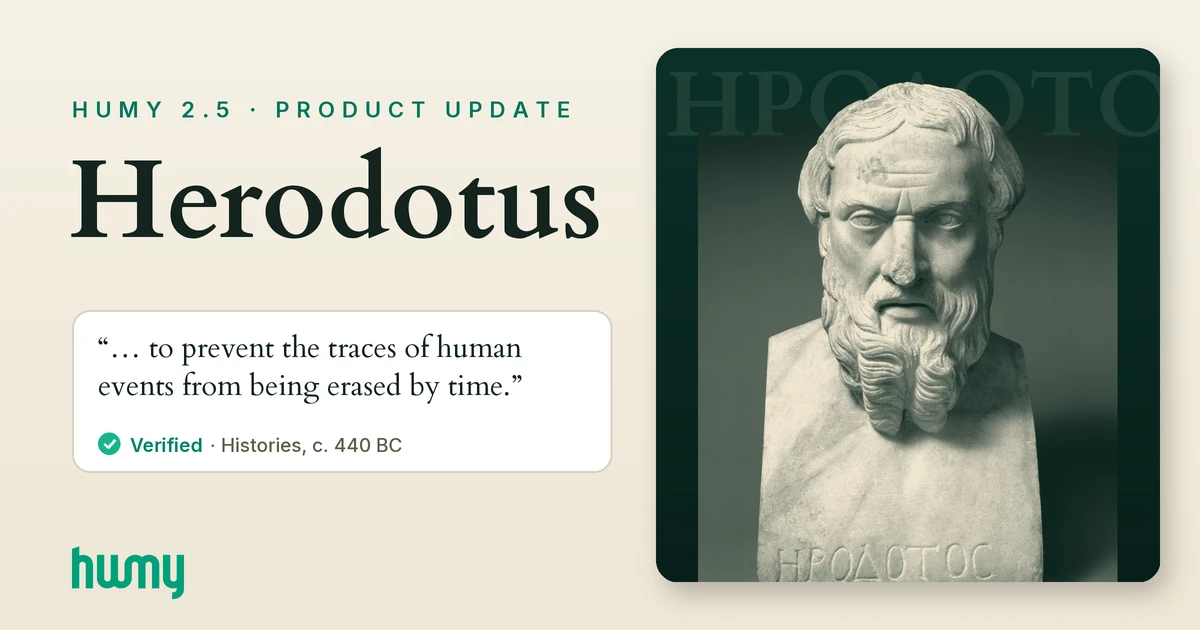
Today we’re introducing Humy 2.5, an update we call Herodotus, after the Greek historian. A purpose of his main work was “to prevent the traces of human events from being erased by time.” Humy’s AI historical figures can now read, search, and quote the actual traces: the letters, books, speeches, photographs, and artifacts that people left behind.
Humy.ai 2.5 Herodotus is available today to every school on Humy, on free and paid plans alike, and the first universities are piloting it with their own collections. The new Sources workspace is live at portal.humy.ai/ai/sources .
What’s new in Humy 2.5 – Herodotus
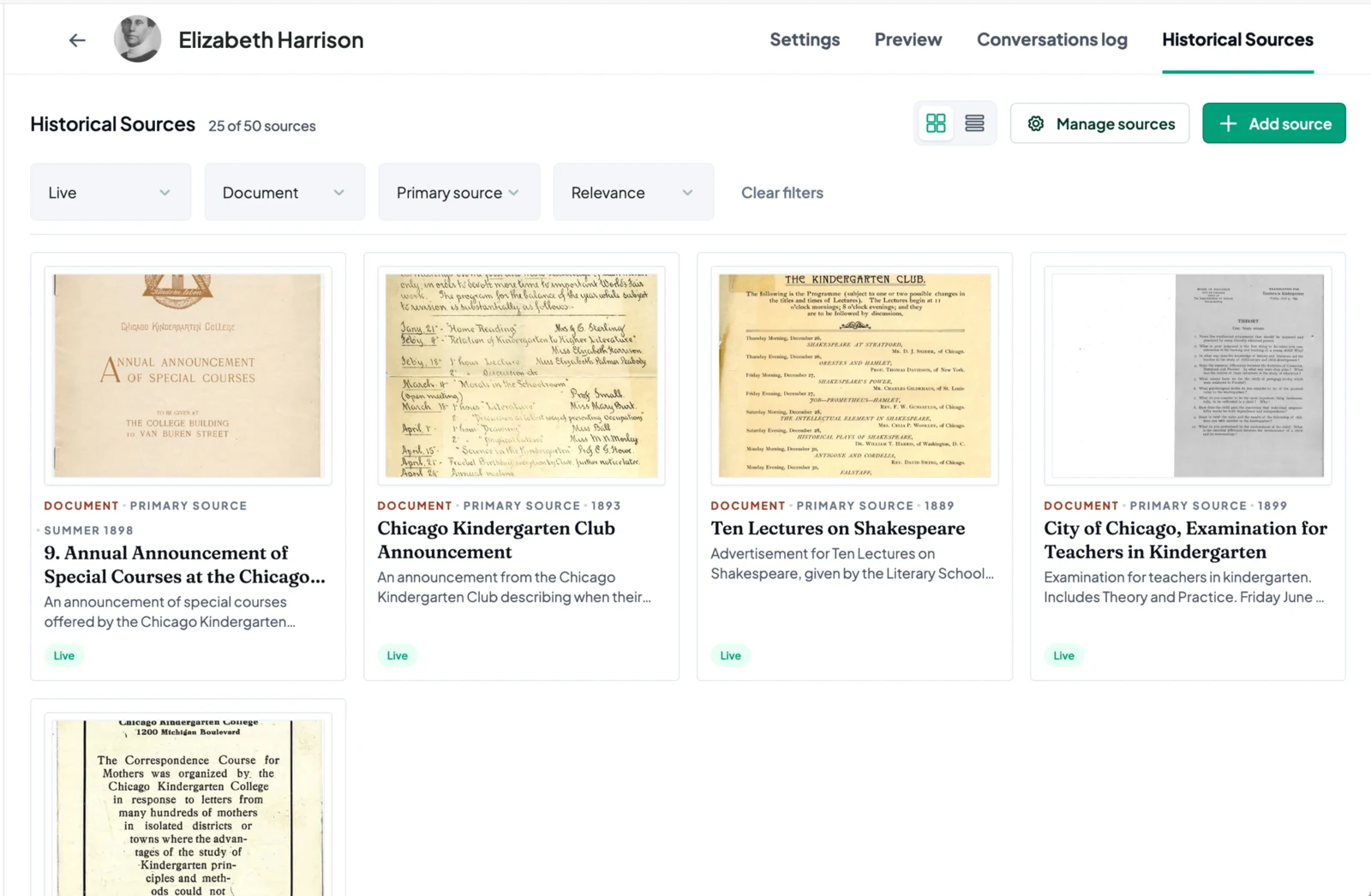
An archive for every figure. You can now attach up to 50 primary sources to any figure: scanned books and articles, handwritten letters, paintings, photographs, audio recordings of speeches, even 3D-scanned museum artifacts. A new curation workspace lets you upload, organize, transcribe, and review everything in one place. You also decide who sees each source: keep it private to your account or share it across your entire institution, and your figures can draw on shared sources curated by the Humy team as well.
Transcription that reads handwriting. Most historical documents are scans with no text layer. Humy now transcribes them with Gemini 3.1 Pro. We deliberately process one page per call to keep quality high, up to 1,000 pages per source. Transcription uses credits, and you approve an estimated cost before a single page runs. Pages that contain only digitizer boilerplate are detected and skipped, and you are never billed for them.
Conversations grounded in the archive. When a student asks a question, the figure runs an agentic search loop: it can list its sources, search them, and read the relevant passages before it answers with quotes and references. Current retrieval is a full-text BM25 search built with Orama, an open-source search library. The index is built in memory for each conversation and rebuilt whenever a source changes.
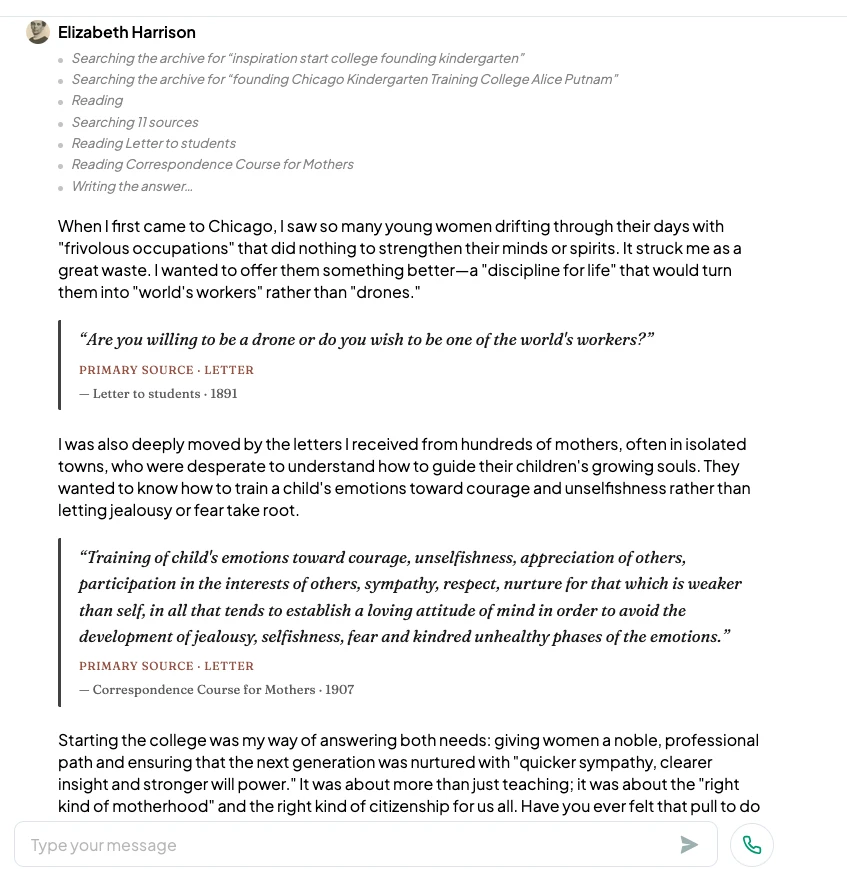
The AI never writes the quotes. This is the part of Herodotus we’re most proud of. To cite a passage, the model emits only an anchor with information about which part of the document is quoted. Our backend then resolves that anchor against the original source material. The model cannot fabricate a quotation, because it never writes one. If you see a formatted quote, it came from a historical source, not from the model’s internal knowledge.
Open the original. Every quote and reference links back to its document. Click it, and the source opens right inside Humy, where you can read the AI transcription and page through the original scanned document. Checking a claim against the primary source takes one click.
Private by design. The in-memory keyword search is also a privacy decision: student messages are never sent to an additional third-party service to query search indexes. Retrieval runs on our servers, one conversation at a time.
Here is what that adds up to for the people we build for.
1. For history teachers
Primary-source analysis sits in every state framework, and it is the part of the job that eats your evenings: finding documents, checking transcriptions, adjusting reading levels. Then students paste the question into a general chatbot that answers confidently, cites nothing, and occasionally invents a quotation.
Herodotus turns source work into a conversation with guardrails. Assign a figure with a curated archive, and a student can ask Lincoln about a specific line of the Gettysburg Address and get the actual line, quoted verbatim, with the document it came from, one click away from the original page.
Grounding now covers assignments too, so the same source discipline applies when the work counts toward a grade.
One more thing teachers asked for: control and transparency over the AI itself. You and your school’s admins decide which AI model your students can use. And before the first message, every student sees a short “How to use AI responsibly” screen showing which models power the figure, how many sources it draws on, and who created it, in every language Humy supports. It doubles as a built-in media-literacy moment, and it gives you a straight answer when a parent or principal asks what exactly the class is talking to.
2. For university professors
Every history department teaches source criticism. Getting students to actually sit with primary documents is harder: the archive feels intimidating, the handwriting is illegible, and the best material lives in special collections that few undergraduates ever open.
Herodotus lets you build a figure from your institution’s own collection and put the archive inside the conversation. Three universities are piloting this now:
- National Louis University (Chicago, US)
- University of Wisconsin–River Falls (US)
- Private University of Education, Diocese of Linz (Austria)
For the paid pilot at National Louis University, we created an AI simulation of the university’s founder, Elizabeth Harrison, from 25 of her writings, photographs, and documents provided by the university’s library. Students in an educational leadership course now interview the founder about her own words.
Because every quote is verified against the original and tied to its source, students can check the figure: open the cited document, read the transcription next to the scanned page, and compare what the simulation says with what the document says. That is source criticism, practiced rather than described.
If your library holds a collection worth teaching from, email us at hello@humy.ai, and we will build a pilot with you.
3. For museums and exhibitions
A label card holds about 60 words. Visitors’ questions don’t stop at 60 words, and the documents that could answer them usually sit in storage, or in a digitized collection nobody browses.
With Herodotus, an exhibition figure can draw on the institution’s own material: paintings, photographs, audio recordings, scanned documents, and 3D-scanned artifacts. Visitors scan a QR code next to a display, or use a kiosk or an embedded page, and ask the exhibition’s central figure about a specific object. The answer quotes the museum’s own records, with the reference attached. Your curators control which sources are shared and which stay private to your institution.
We have run figures in exhibitions before; South Florida PBS used Humy interviews in its Pharaohs exhibition . Herodotus is the piece that lets an exhibition figure speak from the collection rather than about it. See what that looks like on the gallery floor on our AI for museums page. Planning an exhibition around a collection? Write to hello@humy.ai.
4. For history enthusiasts
If you love history, you know the gap between reading about a person and reading them. Summaries flatten. General chatbots fill the gaps with confident inventions. The real letters and diaries are scattered across archives, locked behind paywalls, or written in a hand you can’t decipher.
On Humy, figures with a source archive now answer from it and show you where each quote comes from. Open the document and you can read the passage in its original context, transcription on one side, scanned page on the other.
You can also build your own. Upload a public-domain memoir, a local archive’s scans, or your grandmother’s letters; Gemini 3.1 Pro handles the handwriting; then interview the author about what they actually wrote. Your sources stay private to your account unless you choose to share them.
New AI models under the hood
This update also brings new models across the platform. Teachers and school admins control which model students can use, and every figure discloses its models before the first message:
- Gemini 3.5 Flash now powers figure conversations and the agentic source search.
- Gemini 3.1 Pro handles page-by-page transcription, including historical handwriting.
- Gemini 3.1 Flash Live powers real-time voice calls, with smoother turn-taking, live Listening/Thinking/Speaking indicators, and calls of up to 10 minutes.
- Gemini 3.1 Flash-Lite can be used instead of Gemini 3.5 Flash to save Humy tokens.
Also in this release
- Higher limits. Free: 3 custom-made figures, assignments, and collections (up from 2). Pro: 50 of each (up from 15). Enterprise: up to 500 assignments.
- Reliability fixes. We fixed a bug that could show a blank page on older iPhones and iPads, and chats now retry automatically when an AI provider has a bad moment instead of asking you to start over.
What’s next
Over the coming months, we will keep polishing Humy, add more curated sources to the platform, and work with new school, university, and museum partners, so that more students can learn from the sources and come away with a sharper understanding than textbooks or general AI tools can offer.
If you run a school, university, museum, or archive and want to bring your collection into Humy, reach out at hello@humy.ai.
Herodotus wrote so the traces of human events would not be erased by time. Our job is to make sure the next generation goes looking for them, and finds them one question away.