For university faculty & departments — Humy 2.6

Your students will ask an AI about tonight’s reading. Ours has to show them the page.

A Humy figure answers out of the archive you load: the set text, the week’s article, your special collections. Every quote it returns is copied out of that document, and one click opens the page.

30 minutes · scoped to one course you already teach · no obligation

Plate I — Product walkthroughRun time 02:14
AI historical figures
1,200+
Every era and discipline
Languages
50+
Text and live voice
Faculty and institutions
25
19 professors, 6 universities
Assignment formats
5
Interview · Debate · Simulation · SAQ · Essay

Something is already answering questions about the reading you set. It has never opened the edition you assigned.

94% of UK undergraduates now use generative AI on assessed work, and slightly more lean towards AI sources (37%) than towards traditional ones (33%). HEPI/Kortext, Student Generative AI Survey 2026 (1,054 UK undergraduates, self-reported, December 2025)

Per-course tutors

Build the tutor from the reading list you already assign.

  1. 01

    Load the reading list you already assign

    Before term

    Up to 50 sources and 1,000 pages each. Scans with no text layer are transcribed page by page, historical handwriting included.

  2. 02

    Publish an edition scoped to the course

    Week by week

    Each edition carries its own reading level, language and instructions, so one reading list serves a survey course and a graduate seminar at once.

  3. 03

    Students argue with the text, not a search box

    At 11pm

    The figure searches what you loaded and answers from what it finds. Click the quotation and the document opens at that page, passage highlighted.

The men are set on at five, and the youngest among them I judged to be no more than nine years of age.

J. Aldworth, inspector, Report on the Employment of Children · Second series, 1841 · p. 74 · illustrative

The AI never types a quote. It marks the passage; our system copies the words out of your document and discards anything that is not a character-for-character match.

A university seminar working from primary sources with Humy
Plate II — Seminar room, step 03With faculty pilot

Strongest where the deliverable is an argument from evidence: history and social studies, political science, literature, and schools of education.

Also included

Five assignment formats
Interview, debate, simulation, short answer and essay, including DBQ, LEQ, FRQ and SAQ. Generated, editable, auto-graded against criteria you set.
LMS-ready and embeddable
Canvas, Blackboard and Moodle. Embed by iframe, share a link, or print a QR code for the lecture hall.
Conversation logs and exports
Full transcripts per student, searchable and exportable as PDF or CSV.
Live voice calls
Up to ten minutes with natural turn-taking. Useful for oral-history practice and mock interviews.
Enterprise sign-in, including SSO
Email, Google, Apple and Microsoft by default. Institutional SSO on request, via Auth0 by Okta.
Privacy your registrar can check
FERPA and GDPR aligned, with signed data-processing agreements in 16 US states. Student access is anonymous; no conversation trains a model.


Measured, not asserted

Your discipline grades the citation.So we tested ours and published it.

1,250 open questions, put to a curated archive of seventeen documents. We then checked every quote it produced against the original page.

97%
more of our benchmark's rubric checks passed than the same model with no documents attached
0
quotes Humy made up
0
highlights that landed on the wrong passage
0
quotes taken from anything but the figure's own documents

All 1,323 quotes in our August 2026 internal benchmark, checked against the originals; one citation among them opened nothing, and we report it rather than round it away. Behind the 97%: 58.2% of the rubric checks passed with the documents attached, against 29.6% without. These figures are for the single configuration scored here, Humy source search running on Gemini 3.6 Flash, and not for every configuration we ran.

What the benchmark does not cover

The sentences around a quote are still written by the AI. In the same test, roughly one answer in eight carried an invented date or reference in that surrounding text. The quote itself is always real. That gap is precisely why the document sits one click away. Read the full test.

The evidence we do not have

No study shows that Humy improves what a student learns. Our benchmark measures sourcing only, and a supplier’s own benchmark is weak evidence by design. Ask every vendor on your shortlist for theirs, ourselves included.

Student recruitment

The enquiry that arrives at 11pm does not wait until Monday.

The same build works for the enrolment office. A guide made from your prospectus, aid explanations and institutional archive answers the question in front of it, shows the passage it used, and says plainly when your material does not cover something.

  1. Enquiry

    The transfer-credit question

    Two years of community college behind them, and the policy lives in a PDF written for registrars. The form promises a reply in two working days.

  2. Offer

    What the aid letter actually means

    Grant against loan, renewable against one-year, what happens below full time. The questions are specific, they arrive at once, and they arrive at night.

  3. Deposit

    The weeks when nobody calls

    Between the offer and the first day the institution goes quiet and the second thoughts do not. The sector calls this summer melt.

  4. Arrival

    Everything after yes

    Housing, orientation, the immunisation form, the requirement nobody reads until week one. The same questions every year, to whoever picks up.

It runs embedded on a programme page, linked from the applicant email sequence, or printed as a QR code, in 50+ languages. Build your founder instead of a support bot and an applicant meets the place through the people who made it.

Being straight about it: we have six universities among our paying customers, and admissions is a newer deployment for us than teaching. Ask us what we have run and what we have not.

In the field

Teach from the collectionyour library already holds.

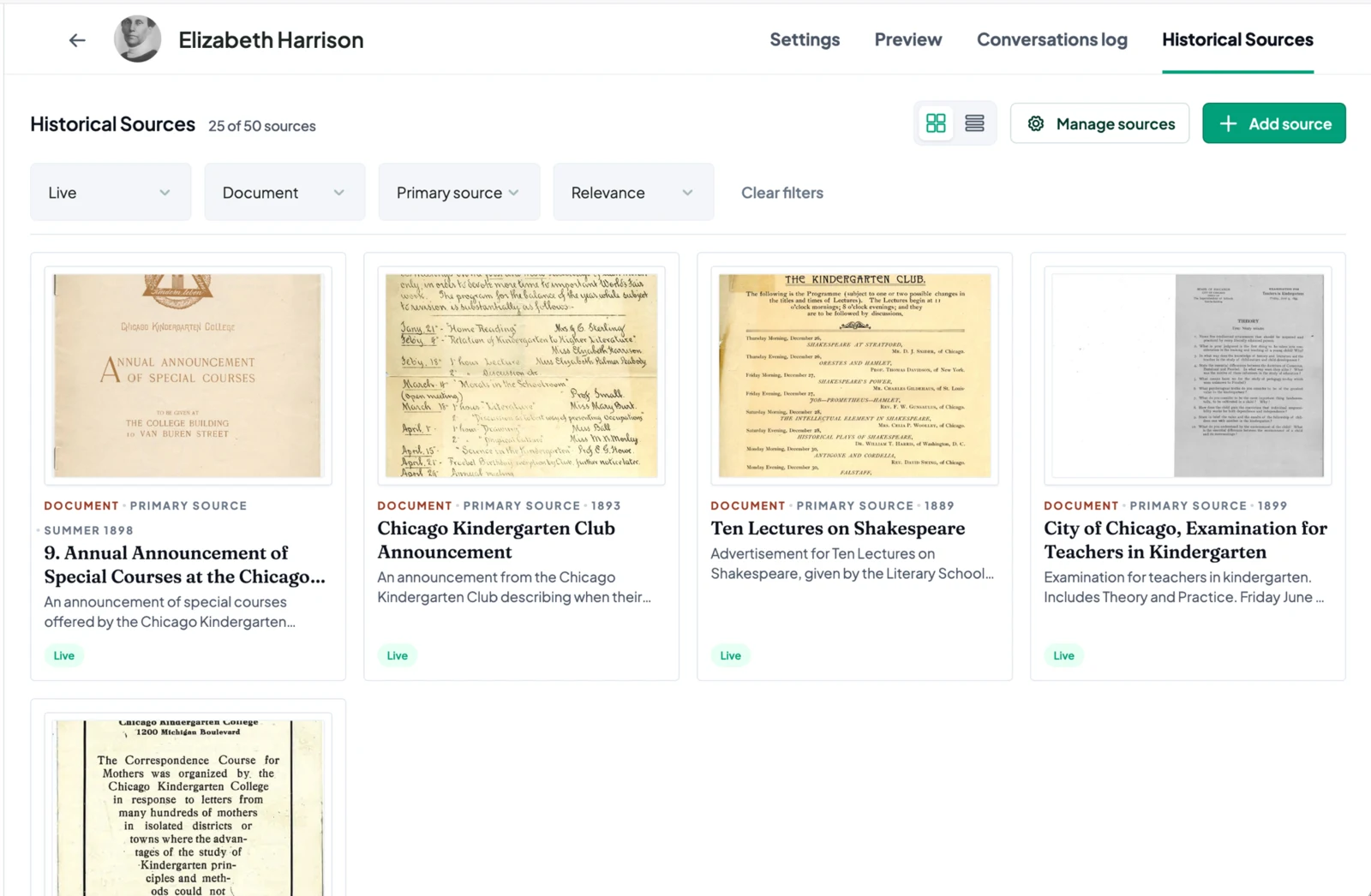
The Historical Sources workspace for Elizabeth Harrison, showing 25 curated primary sources from the National Louis University library
Plate III — the Sources workspace25 documents
01Paid pilot · National Louis University · Chicago

Interviewing the founderabout her own words.

The library supplied 25 of Elizabeth Harrison's writings, photographs and documents, and we built the university's founder from those and nothing wider. Students in an educational leadership course now question her about what she wrote, and open the cited page to check. Source criticism gets practised, not described.

  1. 02

    University of Wisconsin–River Falls

    United States

    Collection-based figures in development with the university.

  2. 03

    Private University of Education, Diocese of Linz

    Austria

    Collection-based figures in development with the university.

  3. Note

    Collection-based figures are built with our team and are not self-serve. If your library keeps one worth teaching from, write to hello@humy.ai.

I introduced Humy as part of my student project and was surprised by the high level of engagement from my students. It added completely new dimensions to the project.

Jasper Nordling

Project Director, Berghs School of Communication

In educational programs at

Berghs School of CommunicationHyper IslandHES-SO University, SwitzerlandNational Louis UniversityUniversity of Wisconsin–River Falls
Next term

Start with one course and one reading list.

Two ways in. Per-student billing stops making sense once a whole cohort is on it, so past a single seminar the licence is usually cheaper.

Path one — the department licenses it

Departmental or institutional licence

Priced against faculty and student volume, from one department up to the whole institution, with library collections in scope. Every quote carries a pilot plan.

  • 30-minute walkthrough with a faculty success lead
  • A figure built from one reading you already assign
  • A sample assignment, auto-graded against your criteria
  • How we ran our benchmark, in writing, for the committee that will ask
  • A conversation-log export from the pilot cohort
Frequently asked

Questions, briefly answered.

  • Humy is a web-based educational platform — successor to Hello History — that lets students hold in-depth conversations with 1,200+ AI historical figures. A figure can be given an archive of curated primary sources and scholarly references, which it searches during the conversation and quotes with a reference back to the document students can open.

  • Humy runs on the same frontier models as any AI tool. The difference is where the answer comes from: a Humy simulation searches an archive your team curates, not the open web. When it cites a passage, our system copies the words straight out of your document and checks them letter by letter. The AI never types a quote itself, so a quote cannot be made up, and students can open the source and read the typed-out text beside the scanned page.

  • Yes. Humy works with Canvas, Blackboard, and Moodle. You can embed it in course pages via iframe, share a direct link, or print a QR code for lecture hall access. SSO with school accounts is available on request, via Auth0 by Okta.

  • Five: Interview (live conversation with a figure), Debate (up to ten figures at once), Simulation (students role-play inside a historical moment), Open Questions (short answer / SAQ), and Essay (DBQ, LEQ, FRQ, concept application). Each assignment is generated, editable, and auto-graded against a grading guide you write. Source grounding applies inside assignments too, so the same evidence discipline holds when the work counts toward a grade.

  • Every student conversation is logged in full. Faculty can review transcripts to verify originality. You can also disable copy-paste, cap the number of attempts per question, and require named access. Student data is never used for AI training.

  • That is the most common way faculty use it. You load the readings you actually assign — the set text, the article on the week's topic, the documents in the course reader. The figure answers from those and quotes the page a student is meant to have read. Because a version carries its own instructions and reading level, the same reading list can support a Socratic tutor for a survey course and a harder interlocutor for a seminar. A professor can set this up alone, without a department decision.

  • Either. A single instructor can start free and upgrade a personal account at $129 per year, and departments and institutions can license centrally with pricing scoped to faculty and student volume. A growing number of courses run the other way round: the professor decides the tutor is part of the course and students take their own subscriptions, the way they would buy a set text. Ask us on a call and we will lay out both.

  • Yes. Upload biographies, primary sources, transcripts, images, and video, and attach up to 50 sources to a single figure. Scans without a text layer are transcribed page by page, including historical handwriting, up to 1,000 pages per source; transcription uses credits and you approve an estimated cost first. Each source can stay private to your account or be shared across your whole institution. You can also publish multiple versions of the same Humy — a graduate-seminar edition and an intro-survey edition — each with its own reading level, instructions, and language.

  • That is what our university pilots do. Three institutions are piloting collection-based figures now: National Louis University (Chicago), the University of Wisconsin–River Falls, and the Private University of Education, Diocese of Linz in Austria. At National Louis we built an AI simulation of the university's founder, Elizabeth Harrison, from 25 of her writings, photographs, and documents supplied by the university library. These are built with our team rather than self-serve — if your library holds a collection worth teaching from, email hello@humy.ai and we will scope a pilot with you.

  • Flexible — based on faculty and student volume. We work with individual departments and with institution-wide deployments. Contact us for a quote scoped to your needs.

  • Yes. Students can access Humy through anonymous links — no accounts, emails, or passwords required. Where you do require named access, FERPA and GDPR controls apply. Source retrieval runs on our own servers, so student messages are not sent to an additional third-party service to query search indexes. Student data is never used for AI training.

  • Yes, and it is one of the reasons institutions widen from a single department. A guide made from your prospectus, your aid explanations and your own archive answers a prospective student at the hour they are actually reading, shows the passage it used, and says plainly when your material does not cover the question. It can also introduce the institution through the people and the moments that made it, which a support bot cannot do. Be aware that admissions is a newer deployment for us than teaching, so ask what we have run and what we have not.

  • No. It can be a person, an event, or a place, and all three are built the same way: a name, a short description, and the documents you attach. A seminar can question the figure on the reading list, step inside the convention or the trial the week turns on, or ask about the site an excavation report describes. Historical figures are the best-known case and what our ready-made library of 1,200+ is stocked with, but they are one case, not the limit.

  • Yes. Individual faculty can start with a free instructor account. When you're ready to expand to your department, our team will help with onboarding, custom Humies, and a quote.

Still curious? Write to us at hello@humy.ai.