Source-grounded AI for museums, galleries & historic sites

Turn a placard into a conversation.

Visitors interview a figure, an event, or the site itself — and the AI never writes a quotation. Every line is copied from a record your curators approved and opens to that record in one tap.

30 minutes · scoped to your exhibition or permanent gallery · no obligation

60,000
visitors across a single eight-month exhibition run
50+
languages of interpretation, text or live voice
1 tap
from any quotation to the record it was copied from
Product walkthroughRun time 02:14

A visitor gives the object about half a minute, and the label answers whichever question its writer guessed at.

Half a minute barely moved between the 2001 study and its 2017 replication. Smith, Smith & Tinio, 2017 (average 28.6 seconds per work, Art Institute of Chicago) Attention is not the problem. The phone they would use to ask is already in their hand.

Measured, not asserted

Nothing we build can inventa quotation from your collection.

This is the first thing a curator asks, and it should be. We put the design through an internal benchmark in August 2026: 1,250 questions put to a figure built on a curated archive, with everything it produced published.

quotes Humy made up
0quotes Humy made up
highlights that landed on the wrong passage
0highlights that landed on the wrong passage
quotes taken from anything but the figure's own sources
0quotes taken from anything but the figure's own sources

We checked all 1,323 quotes from that benchmark against the original documents; one citation opened nothing, and we report it rather than round it away. The counts are for a single configuration, Humy’s own source search running on Gemini 3.6 Flash.

The honest limit, because a curator will ask: the sentences around a quotation are still written by the AI. In the same benchmark, roughly one answer in eight carried an invented date or reference there. The quotation itself is always real. That is why the record sits one tap away. Read the full test.

From the collection to the gallery floor

Built by your curators,out of your own records.

  1. 01

    Your curators choose the subject and its records

    A person, the event a gallery commemorates, or the site the visitor is standing in. Up to 50 records each, up to 1,000 pages apiece, handwriting transcribed page by page.

  2. 02

    Nothing publishes until your team signs it off

    They read the finished build in the curation workspace. It answers only from the documents they loaded, so material a community has asked you to hold back stays out by never going in.

  3. 03

    The visitor asks at the object

    A QR code on the label, a kiosk you already own, or an iframe on the microsite. 50+ languages, text or live voice, nothing to download.

The kiln was drawn on the Tuesday and the whole setting lost, near three hundred pieces, for want of a steady heat.

Josiah Peake, works foreman, Pottery Works Day Book · 3 October 1841 · Acc. 1978.44.2 · illustrative

Tap the quotation and the record opens at the page, with the passage highlighted where the figure took it. A Humy introduces itself as an AI simulation built by the museum, never as a member of staff, and every conversation is logged for your interpretation team.

Conversations are never used to train models. Data is held in the US or Sweden, on Azure.

Interpretation that keeps up

Change the interpretation without rebuilding the gallery.

A Humy is a set of source records and instructions your curators control. Revising it is an afternoon in the workspace, not a line in next year’s capital budget.

New scholarship
An attribution shifts or a date is revised. Replace the source record, and the next visitor gets the current reading.
Loans and rotations
A late loan arrives, a light-sensitive work rotates off display. The interpretation follows the objects instead of contradicting them.
Evaluation
The conversation log shows which questions your panels are not answering. Acting on it is an edit, not a reprint.
New audiences
Publish a family edition beside a specialist one from the same build, each with its own reading level and language.
Touring
Nothing is bolted to the building, so the show carries it to the next venue and the microsite keeps it after closing.

One argument we are not making

AAM’s national snapshot found 55% of museums seeing fewer visitors than in 2019, against 49% the year before. AAM National Snapshot, 2025 (511 museum directors; self-reported, not counted at the door) Better interpretation does not fix that, and we will not pretend otherwise. Buy this because changing what a gallery says becomes an edit.

What we have built

Two builds that have met the public.

South Florida PBSSouth Florida PBS

Egyptian Pharaohs:from Cheops to Ramses II

After winning a competitive 2025 bid, Humy built AI Hatshepsut, a figure visitors questioned about one of Egypt's most remarkable rulers. Grounded in 60+ curated artifacts and her documented biography, she cited the source of whatever she quoted.

Visitors met her on a gallery kiosk and on the exhibition microsite, before and after the visit.
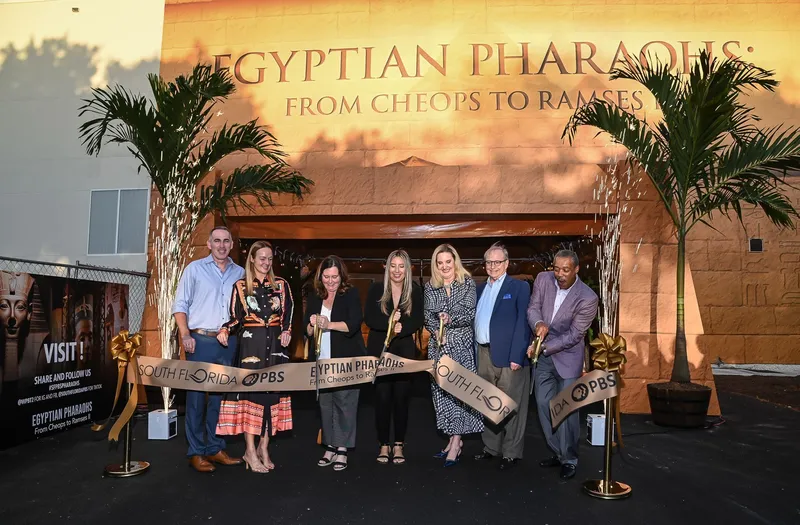
Opening of the Egyptian Pharaohs exhibition at South Florida PBS, where visitors questioned an AI Hatshepsut
Egyptian Pharaohs, opening nightSouth Florida PBS, 2025
Languages, voice or text
50+
Curated artifacts
60+
In-gallery & online
Kiosk + web
Exhibition run
8 months
Read the full storyRun closed 2026

Archive portrait of a Nigerian statesman in a black cap and white agbada, one of the figures in the M & M Academy experienceBlack and white archive portrait of a bespectacled Nigerian leader in an embroidered agbada, photographed beside an aircraftArchive portrait of a smiling Nigerian woman in a large dark gele headwrap, photographed against an open sky
M & M Academy — Nigeria

A hybrid museum bringing Nigerian history into conversation

Open online today, with an on-site visitor experience still in development. Audiences question key figures from Nigerian history, and the events those figures lived through, including in local languages.

  • 60 historical figures
  • 20 historical events
  • Local languages
Visit M & M Academy ↗
Booking a walkthrough

Put the accuracy questionto a live figure.

Thirty minutes. We will show you what this looks like in one gallery, across a permanent collection, and on a show that travels, and you can try to break it while we watch.

No obligation. Exhibition builds are scoped with our team, and pricing is quoted once we have seen the show.

Frequently asked

What curators ask before the first object.

  • Humy is a web-based platform that lets museums and cultural institutions build immersive, conversational experiences with historical figures. A figure can be given an archive of primary sources your curators approve — accession and archive records, photographs, paintings, audio — which it searches during the conversation and quotes with the reference attached, so the experience stays anchored to your curatorial narrative.

  • Three ways: a QR code on an object label or wall panel, a direct link shared in marketing and the members' newsletter, or an iframe embedded in your exhibition microsite or a gallery kiosk. No app download. Each surface can be configured for anonymous access or to require a visitor's name — your choice per surface.

  • Both. Visitors can type a question and receive richly formatted text with images, references, and tables. They can also start a real-time voice call with the figure, powered by Gemini 3.1 Flash Live, and have a natural spoken conversation of up to 10 minutes — the same Humy, two modes. Images and rich formatting are not available during a voice call.

  • No. Humy is built to augment curatorial expertise, not replace it. Your curators provide the sources and the interpretive direction. Humy extends that expertise to every visitor in their language, around the clock — freeing front-of-house staff to focus on high-value, in-person interpretation.

  • An audio guide plays a fixed script and has to be re-recorded for every language and every reading level. A Humy figure answers the question the visitor actually asked, in 50+ languages, at the reading level you set — and it can go deeper for the visitor who wants more without holding up the gallery. There is no hardware to buy, clean, charge, or replace: visitors use the phone already in their pocket.

  • No. Humy runs in the browser. Print a QR code for an object label, embed an iframe in your exhibition microsite, run it on a kiosk you already own, or share a link in a marketing email. There is nothing for visitors to download and nothing new for your team to maintain on the gallery floor.

  • Yes. Because the experience is a link, a QR code, or an iframe rather than installed hardware, a figure built for a temporary show travels with it to the next venue and can stay open on the microsite after the show closes. Pricing is scoped the same way — a single exhibition run, a permanent gallery, or an institution-wide deployment.

  • You edit the sources, and the figure changes with them. New scholarship, a reattributed object, a correction a visitor points out, a loan that arrives late: each of those is a change in the curation workspace rather than a reprint, a re-record, or a call to the fabricator. Interpretation that would otherwise be fixed for the life of an installation stays current between capital projects, and a figure built for a temporary show can be revised and reused when it tours.

  • Yes. Publish a separate edition of the same figure for school visits — its own reading level, instructions, and language — and turn on named entry for that QR code or link so the group's conversations are identifiable. Teachers can also use the same figures for pre-visit and post-visit work from the classroom.

  • It depends on how much of your collection you want the figure to draw on, but a focused exhibition figure is typically ready in a few weeks: we scope it with your curators, curate and transcribe the sources together, then your team tests it before the QR codes go up. Write to hello@humy.ai and we will scope the timeline against your opening date.

  • A figure answers out of the archive your curators select. When it quotes a passage, the model emits only an anchor pointing at part of a document and our backend resolves it against the original — the model never writes the quotation itself, and every quote links back to the record it came from. Ordinary conversation runs on a light, fast tier, and archive-grounded answers move up to a stronger one for reliable multi-turn source search. As with any AI system the surrounding prose is model-generated, so we make the underlying document one click away rather than asking visitors to take it on trust.

  • Up to 50 sources per figure: scanned books and articles, handwritten letters, catalogue and archive records, paintings, photographs, audio recordings of speeches, and 3D-scanned artifacts. Scans without a text layer are transcribed page by page with Gemini 3.1 Pro, including historical handwriting, up to 1,000 pages per source. Transcription uses credits and you approve an estimated cost before any page is processed.

  • Your curators do, source by source. Each one can stay private to your institution or be shared across it, and figures can additionally draw on sources curated by the Humy team if you want them to. Everything is managed in one curation workspace where your team uploads, organizes, transcribes, and reviews the material.

  • Yes. Our team builds tailor-made Humies alongside your curators using your biographies, transcripts, images, and video. You can also publish multiple editions of the same Humy — a family edition, a scholar's edition, a tour-group edition — each with its own reading level, instructions, and language.

  • Every conversation is logged in the dashboard. You can export the full history as PDF or CSV. Our data team can also prepare custom reports — most-asked questions, language distribution, visitor journeys — to feed summative evaluation, label and panel revisions, docent briefings, funder reports, and future programming.

  • Pricing is flexible — from a single exhibition run to a permanent gallery or an institution-wide deployment. Contact us for a quote scoped to your needs.

Still curious? Write to us at hello@humy.ai.