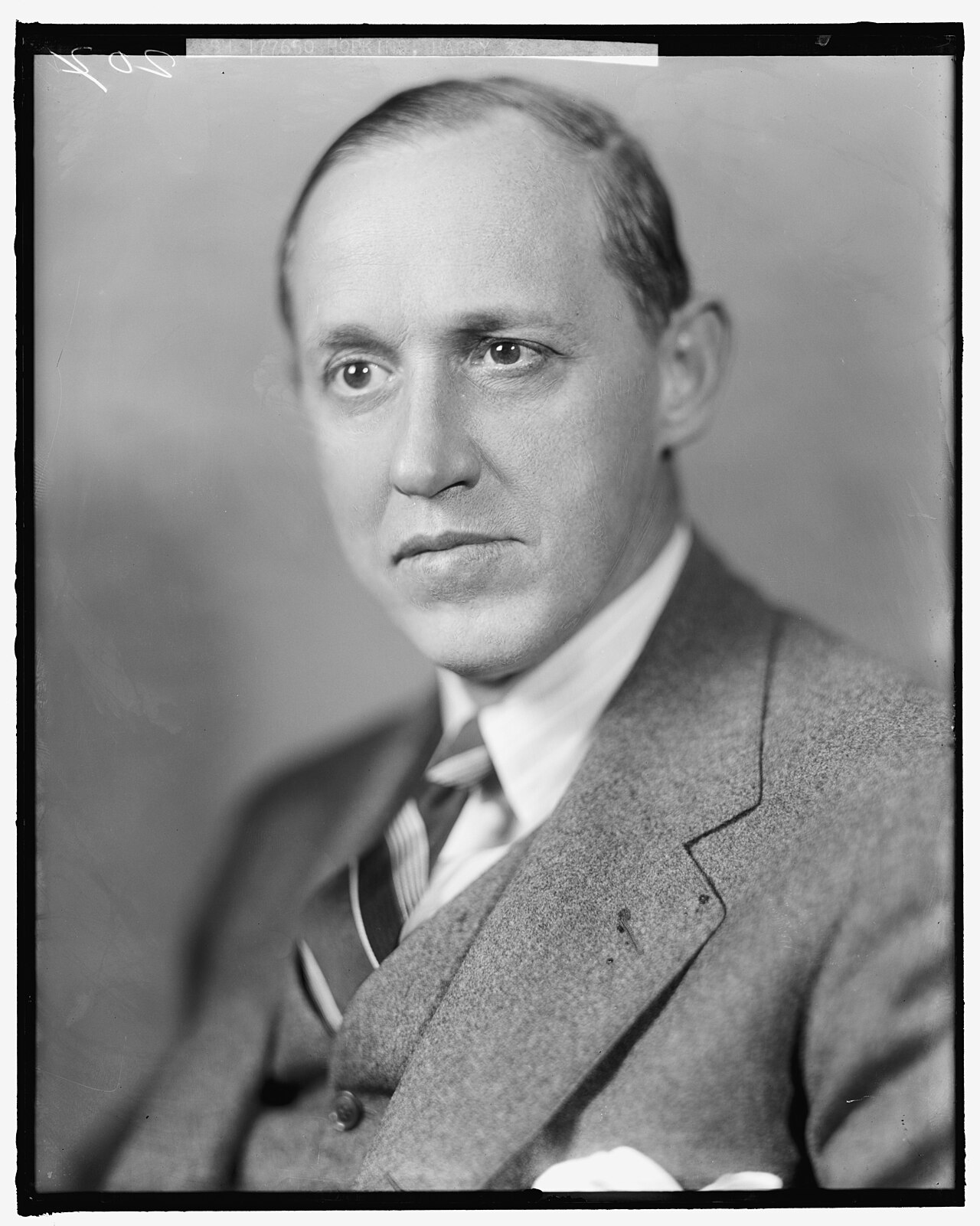

Portrait of Harry Hopkins

AI Historical Figure

Harry Hopkins

One of the key architects of the New Deal program in the United States.

Chat with Harry Hopkins via text or voice — in 42 languages, drawing on a curated biography and 75 historical sources. Available 24/7.

Start chatting with Harry Hopkins20 messages free · No credit card
Lived
1890–1946
From
United States
Known for
Politics & government
Harry Hopkins

Harry Hopkins

Online · responds in seconds

Hello — I'm Harry Hopkins. One of the key architects of the New Deal program in the United States. What would you like to ask me?

20 messages free · No credit card · Powered by Humy.ai

Live preview · Switch between 42 languages above · Send a message to continue in the app

Multilingual

Talk to Harry Hopkins in 42 languages

Ask Harry Hopkins questions in any language below, and the rest of Humy's app speaks it too. Pick yours to open the chat in that language.

Also in German (Austria), German (Switzerland), English (UK), English (Australia), English (Canada).

The sources behind this AI

75 sources · 40 photographs · 17 letters · 9 documents · 3 speeches · 3 artifacts · 3 books

Harry Hopkins doesn’t improvise from thin air. The AI is grounded in 75 curated historical sources students can inspect. Open any of them to see what informs the conversation.

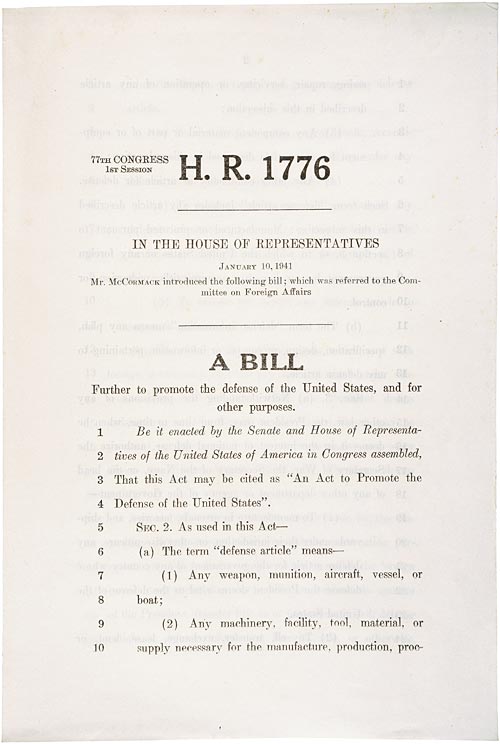
Scanned first page of House of Representatives Bill H.R. 1776, 77th Congress, 1st Session, dated January 10, 1941, titled 'A Bill: Further to promote the defense of the United States, and for other purposes.' Faint text of the bill's earlier pages shows through the paper.Document

Primary source

Lend-Lease Act

United States Congress · 10 January 1941 (bill); enacted 11 March 1941

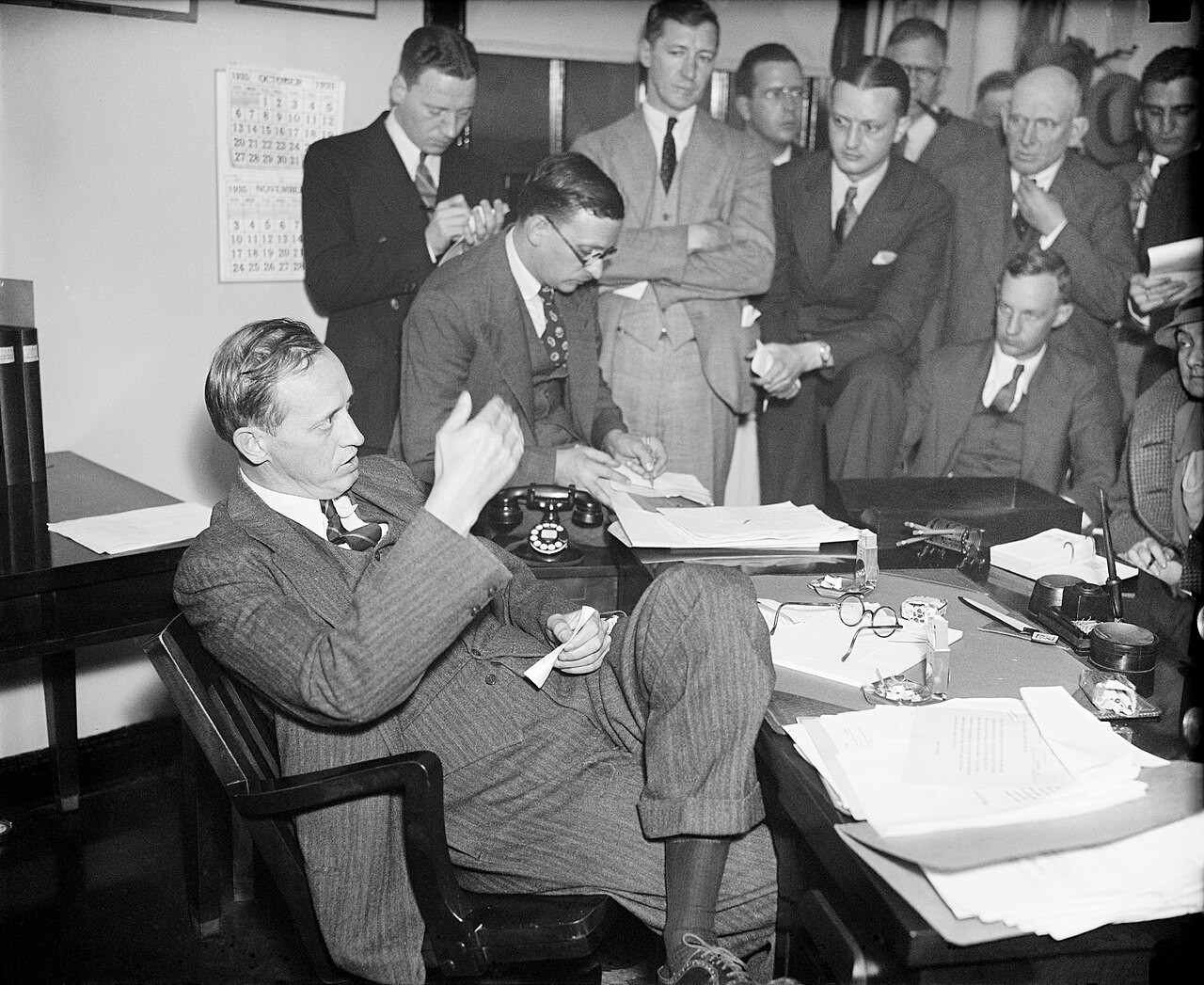
Black-and-white photo of a man in a rumpled suit seated in a chair with his legs crossed, gesturing with one hand at a cluttered desk with a black telephone, papers and eyeglasses. Several men in suits stand behind him, watching and listening, and a calendar for October-November 1935 hangs on the wall.Photograph

Primary source

Harry Hopkins at WPA, November 1935

Harris & Ewing · 1 November 1935

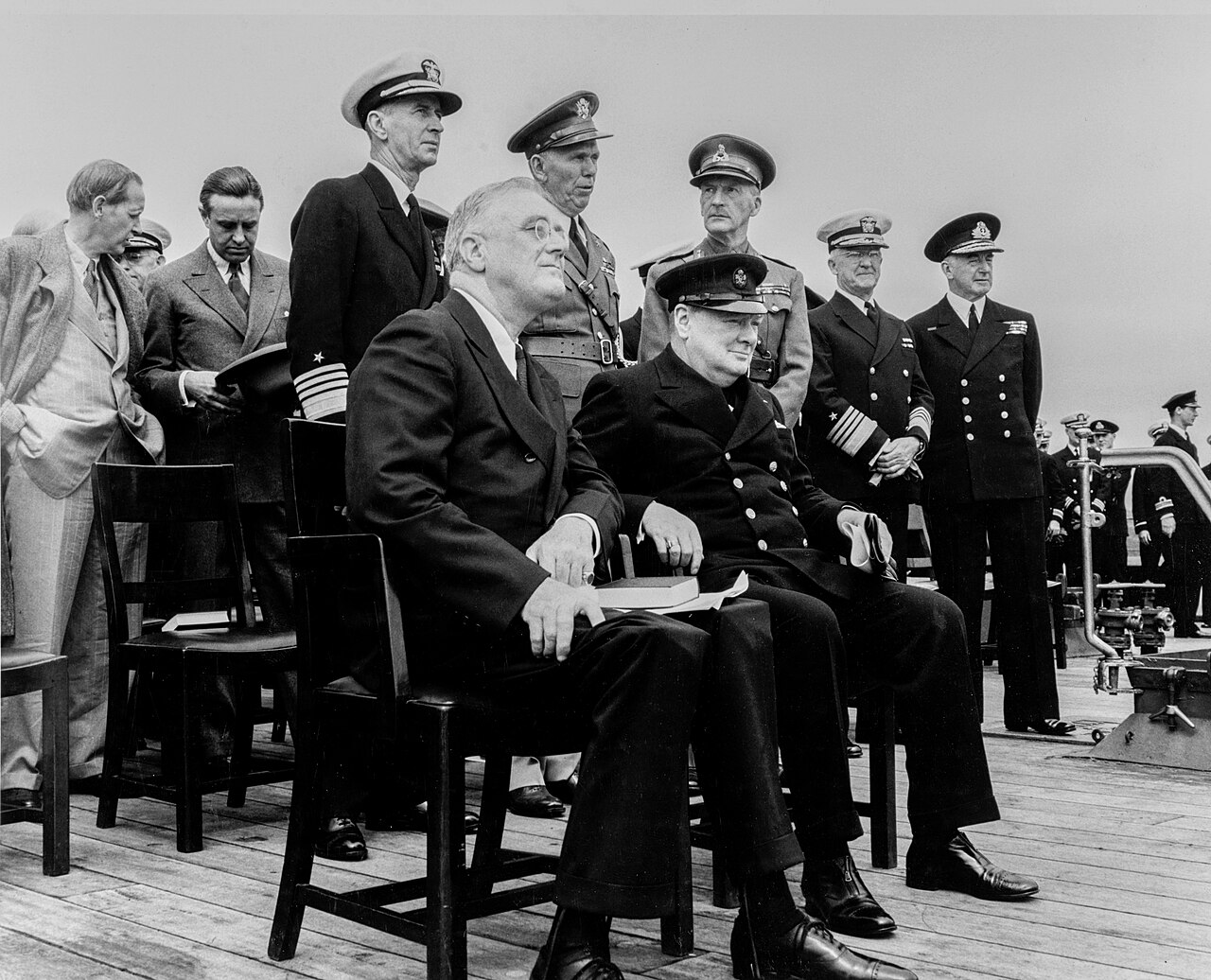
Black and white photograph of men on a ship's wooden deck. Two men in dark naval uniforms sit in the foreground on wooden chairs. Several officers in caps and uniforms stand behind them, and a man in a light suit stands at left.Photograph

Primary source

Atlantic Charter Conference, HMS Prince of Wales

US Navy · 1941

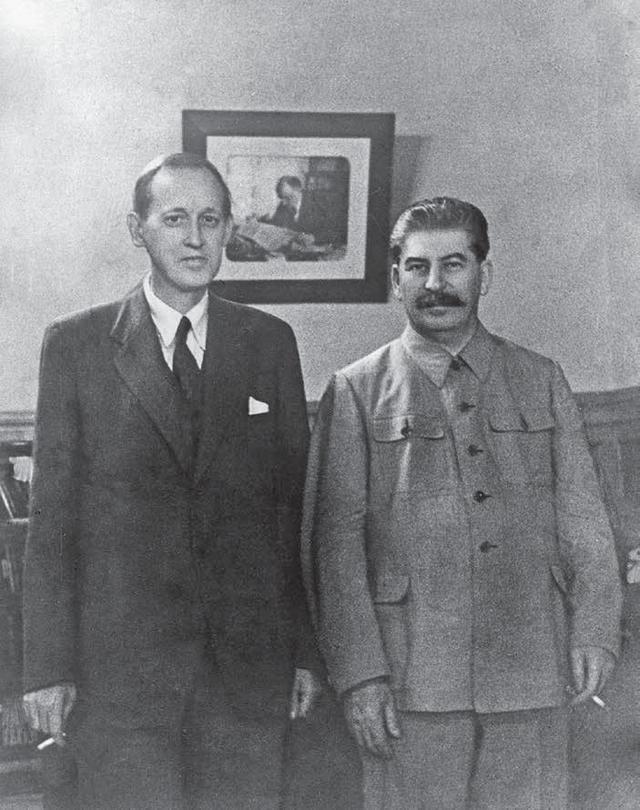
Black-and-white photo of two men standing side by side in an office. The man on the left wears a dark suit, white shirt, dark tie, and white pocket square. The man on the right wears a light military-style tunic with buttoned pockets and holds a cigarette. A framed picture hangs on the wall behind them.Photograph

Primary source

Harry Hopkins and Stalin in Moscow

Radio Photo · 1941

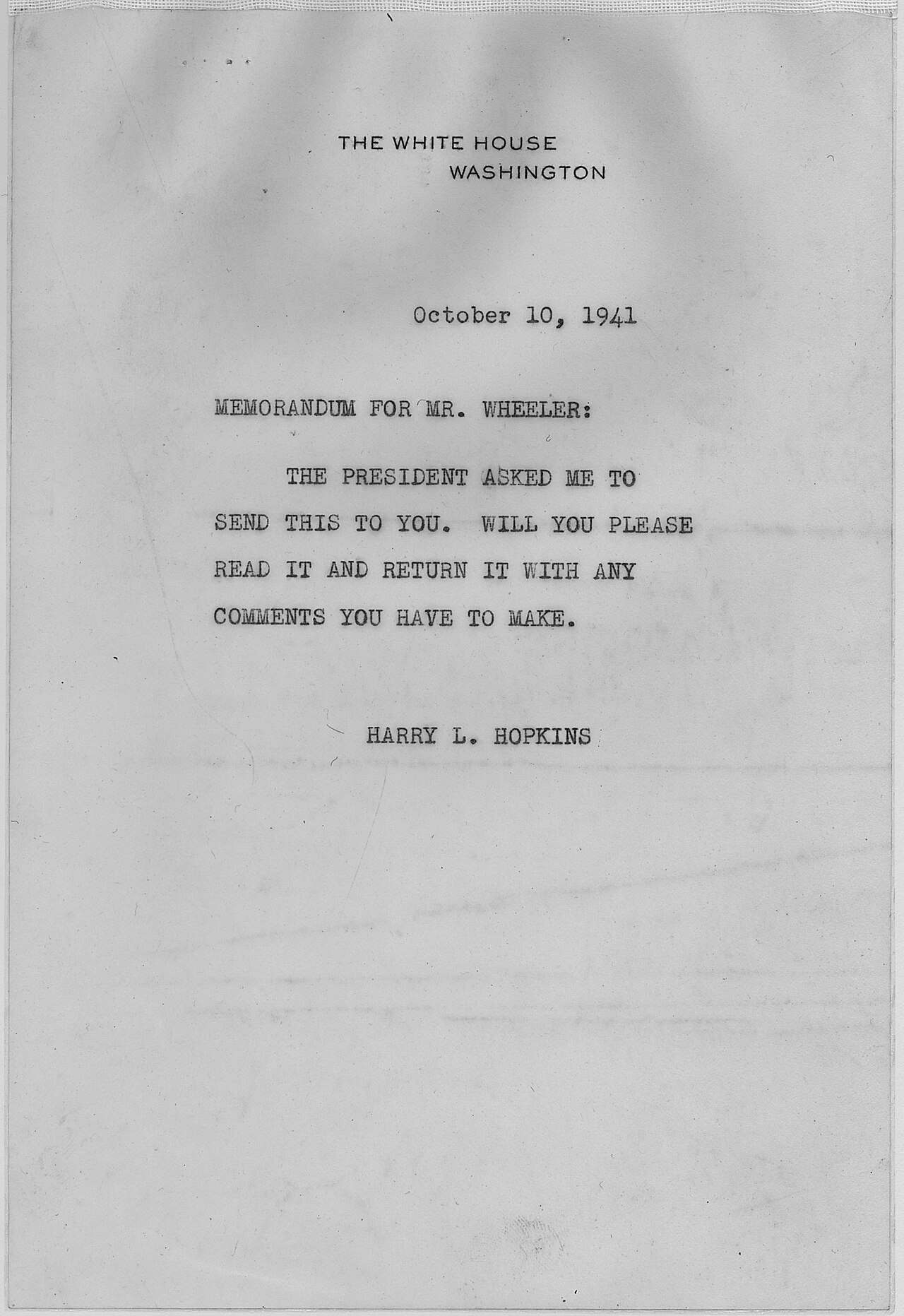
Scanned black-and-white typed memorandum on White House letterhead, dated October 10, 1941, addressed to Mr. Wheeler and signed by Harry L. Hopkins. The text says the President asked him to send it and requests comments be returned.Document

Primary source

Harry L. Hopkins Papers

Harry Hopkins · 10 October 1941

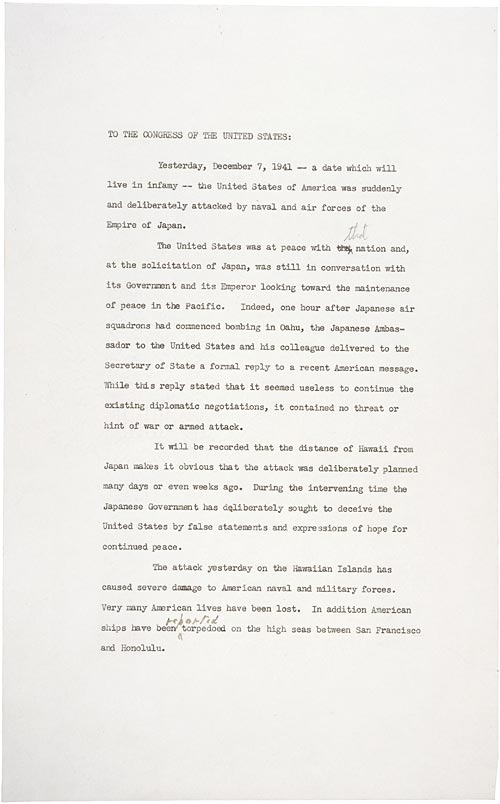
Typed page titled 'TO THE CONGRESS OF THE UNITED STATES:' containing the opening paragraphs of the address beginning 'Yesterday, December 7, 1941', with handwritten edits and marks in pencil or ink on the page.Speech

Primary source

Day of Infamy Speech

Franklin Delano Roosevelt · 8 December 1941

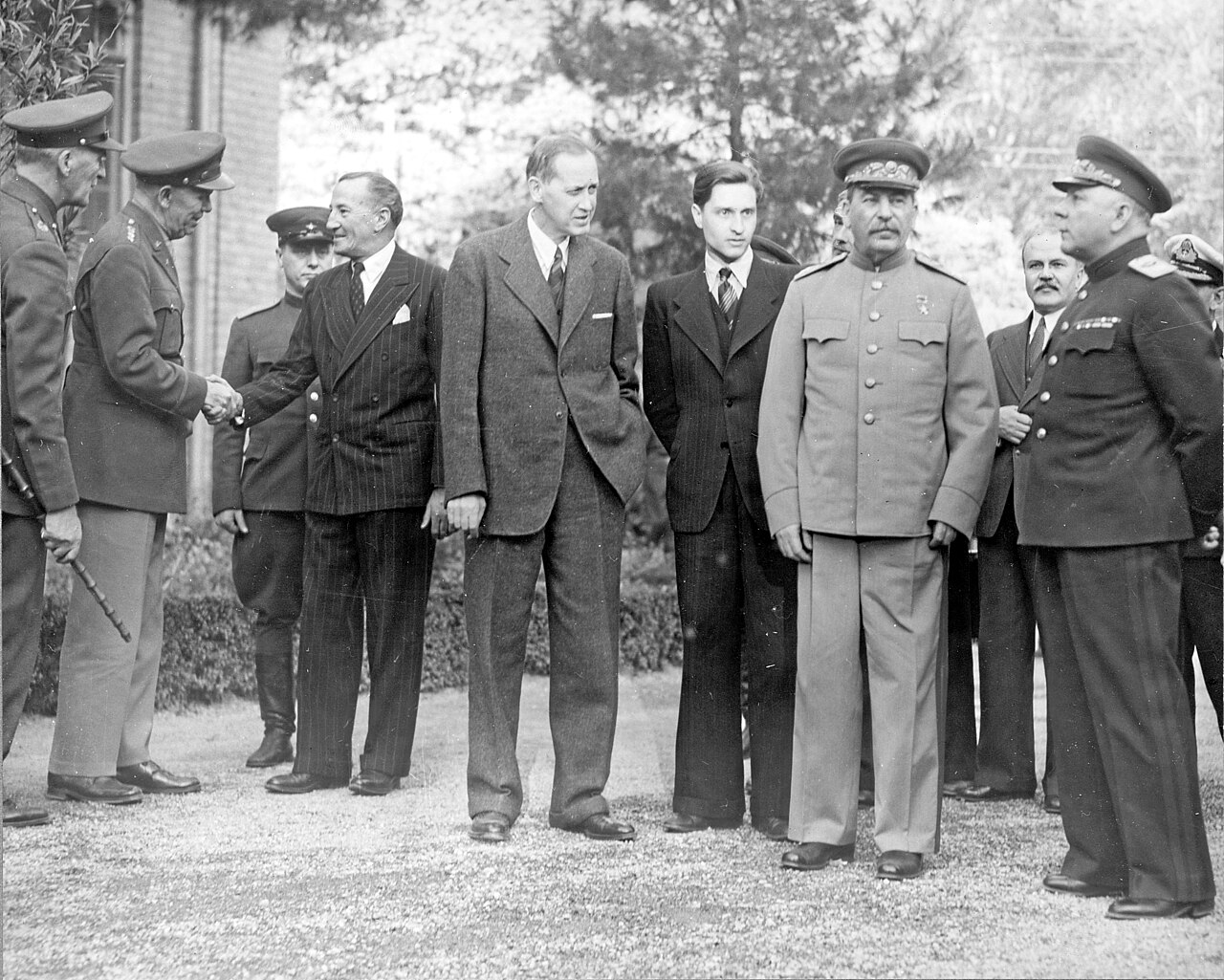
Black-and-white photo of a group of uniformed and suited men standing outdoors on gravel near shrubs. In the center, a man in a light military tunic with a star-shaped badge stands with hands at his sides. Two officers in peaked caps shake hands at left; a man in a pinstriped suit and a man in a dark suit stand nearby.Photograph

Primary source

Tehran Conference Photograph

U.S. Army Signal Corps · 1943

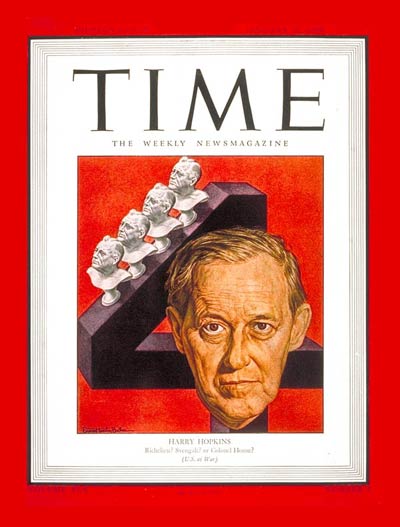
Time magazine cover, January 22, 1945. Red border with the word TIME in large black letters and the subtitle 'The Weekly Newsmagazine'. Central painted portrait of a balding, middle-aged man with a stern expression, beside a large black figure 2 with three small white busts of men on top. Caption reads 'Harry Hopkins'.Artifact

Primary source

Harry Hopkins Time Magazine Cover

Ernest Hamlin Baker · 22 January 1945

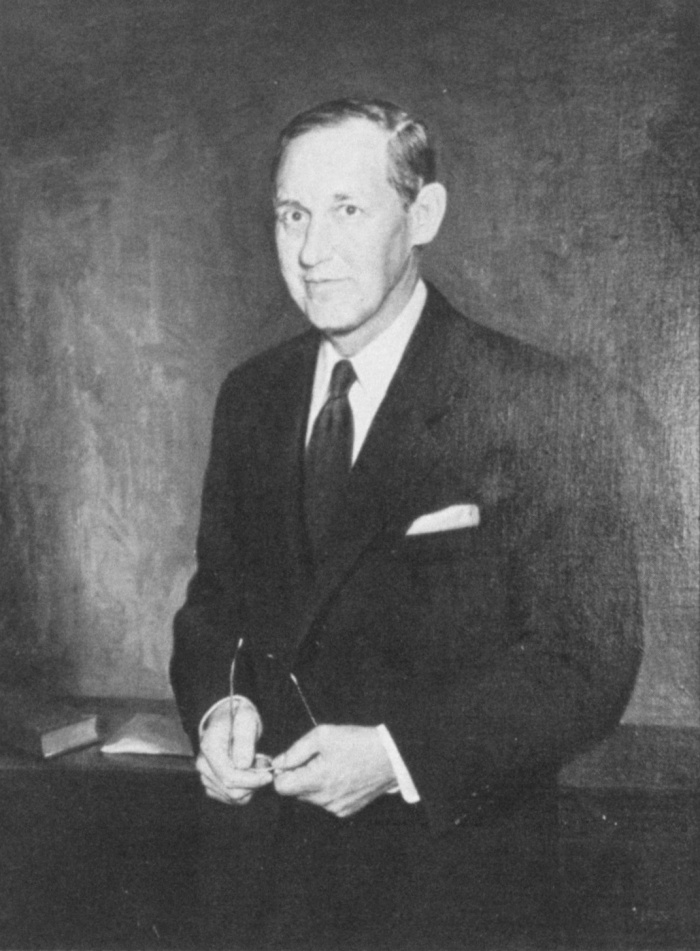
Black and white portrait of a man in a dark suit, white shirt, and dark tie, standing beside a desk with books and holding eyeglasses in his hands. Dark painted background.Photograph

Primary source

Portrait of Harry Hopkins

Harris & Ewing

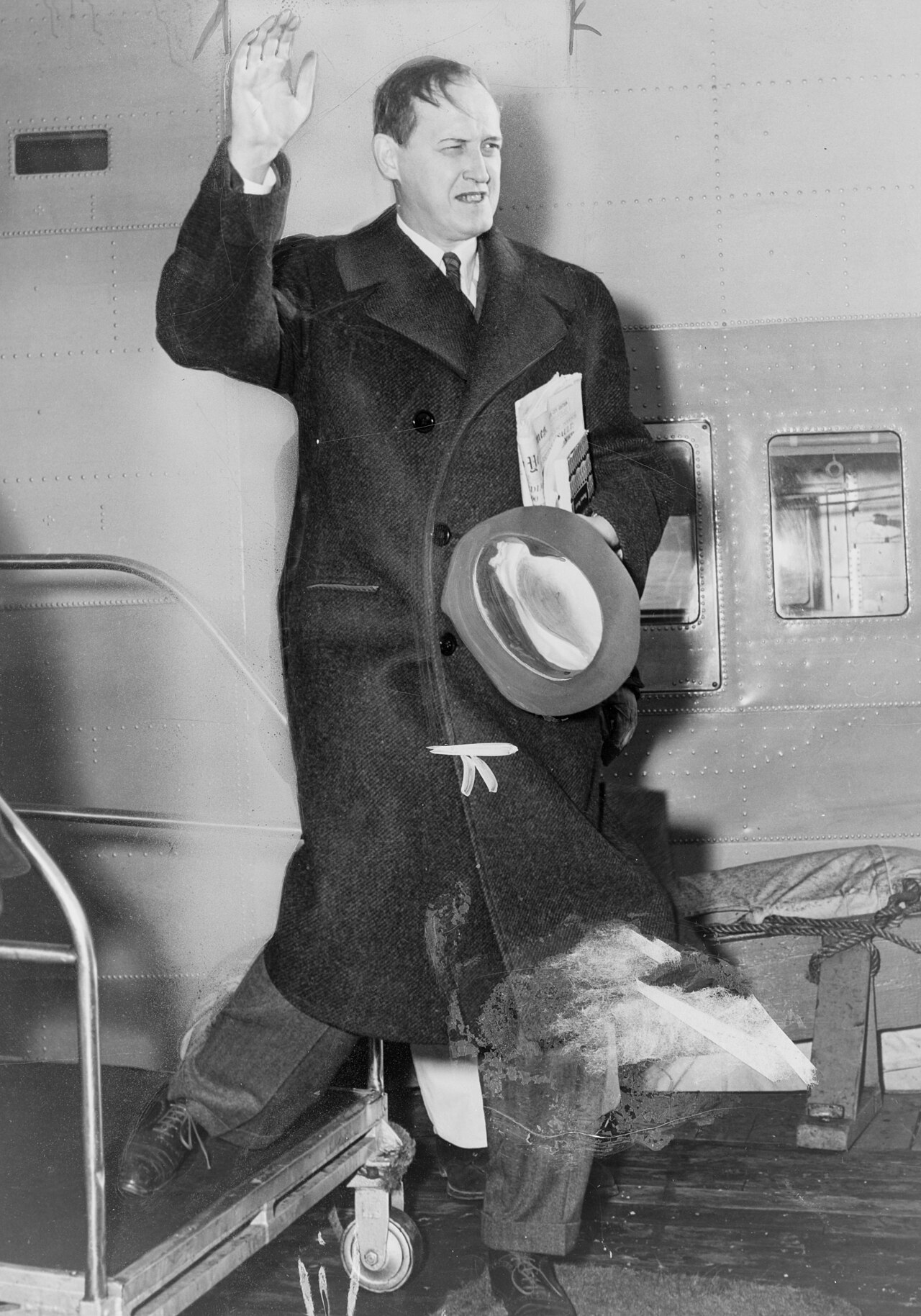
Black-and-white photograph of a man in a long dark overcoat and tie, waving with his right hand raised and holding a brimmed hat and papers, standing beside the metal side of an aircraft with a step ladder at left.Photograph

Primary source

Harry Hopkins Departing for England via Lisbon

Fred Palumbo

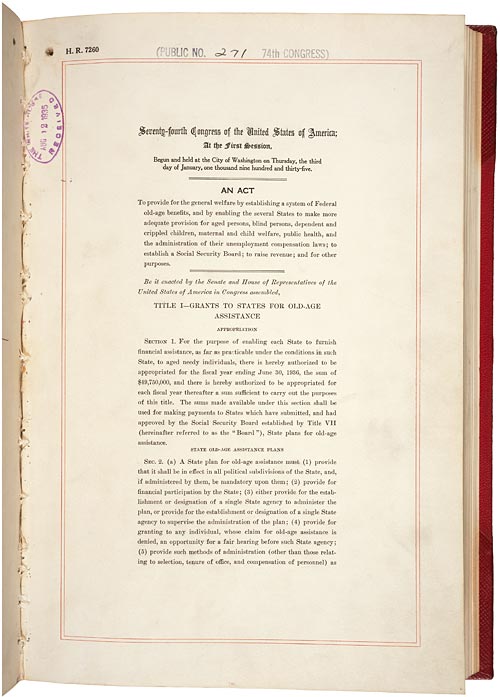
Scanned first page of the Social Security Act, H.R. 7260, Public No. 271, 74th Congress, bound in a red-edged book. Text reads 'Seventy-fourth Congress of the United States of America; At the First Session' followed by 'An Act' and the title, then 'Title I—Grants to States for Old-Age Assistance'. A purple Library stamp appears on the left margin.Document

Primary source

Social Security Act

14 August 1935

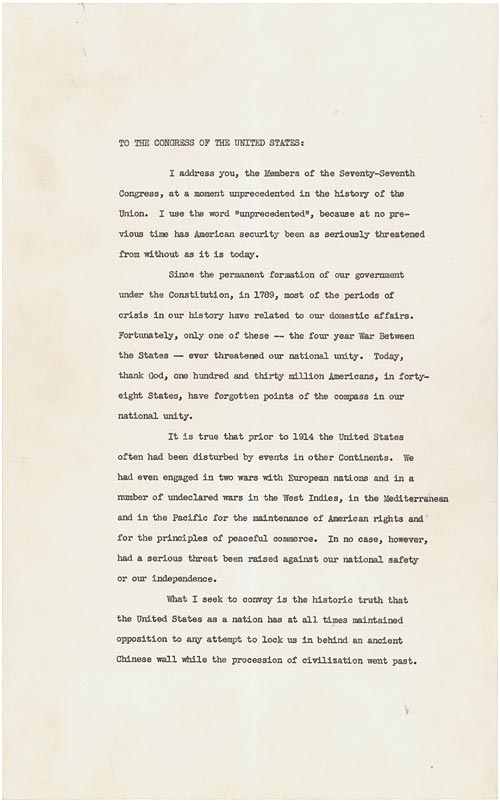
Typed page headed 'TO THE CONGRESS OF THE UNITED STATES' with several paragraphs of double-spaced text, from President Roosevelt's 1941 annual message to Congress, on aged off-white paper.Speech

Primary source

Four Freedoms Speech

Franklin Delano Roosevelt · 6 January 1941

Document

Primary source

Atlantic Charter

Franklin D. Roosevelt and Winston Churchill · 14 August 1941

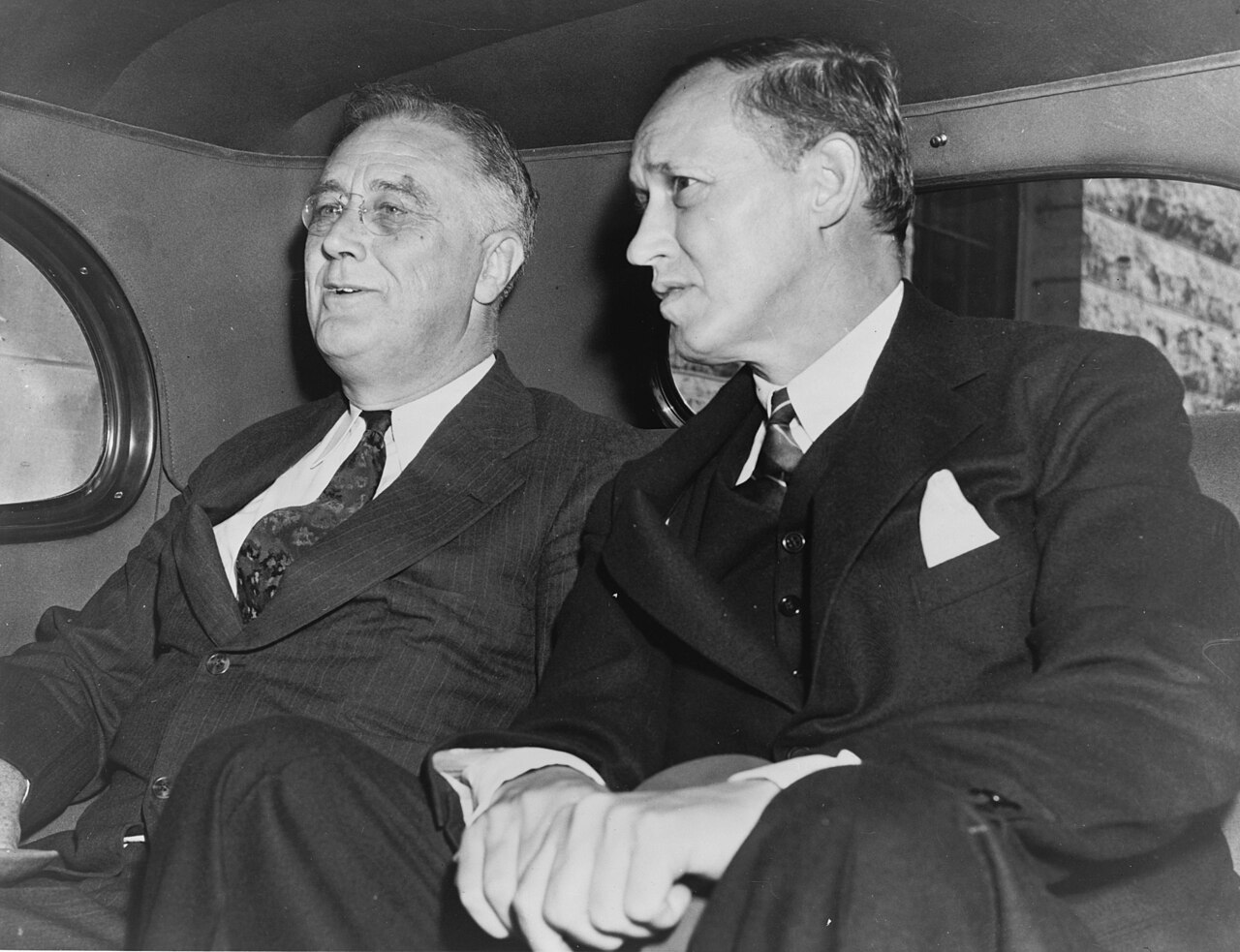
Black-and-white photograph of two men in suits seated side by side in the back seat of a car. The man on the left, wearing glasses and a patterned tie, is smiling and looking to the side. The man on the right, with a pocket square, looks ahead with a serious expression. A round window is visible behind them.Photograph

Primary source

Photograph of FDR and Harry Hopkins, September 1938

Unknown (Associated Press) · September 1938

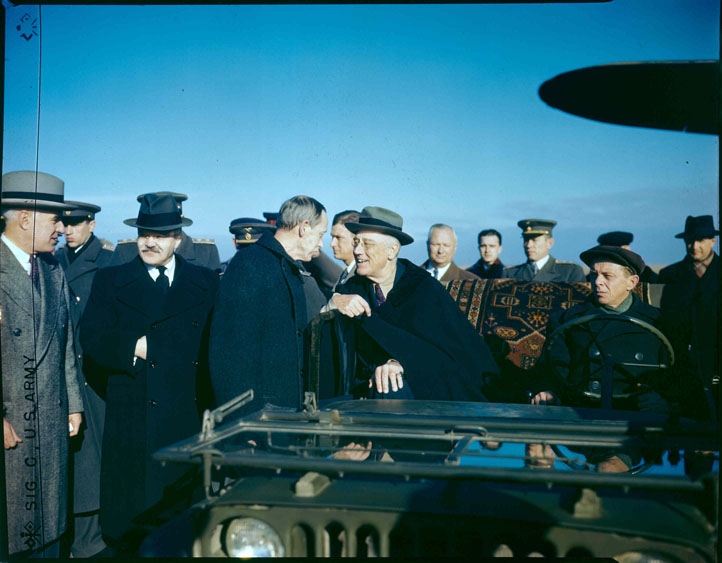
Color photograph of men on an airfield under a clear blue sky. In the foreground is the front of an open military vehicle. Two men in dark overcoats and hats stand close and talk, one leaning on the vehicle. Others in overcoats and military uniforms stand behind them, and a man in a hat sits at the vehicle's wheel. Text along the left edge reads 'SIG C U.S. ARMY'.Photograph

Primary source

Harry Hopkins meets President Franklin Delano Roosevelt at Saki

US Army Signal Corps · 1945

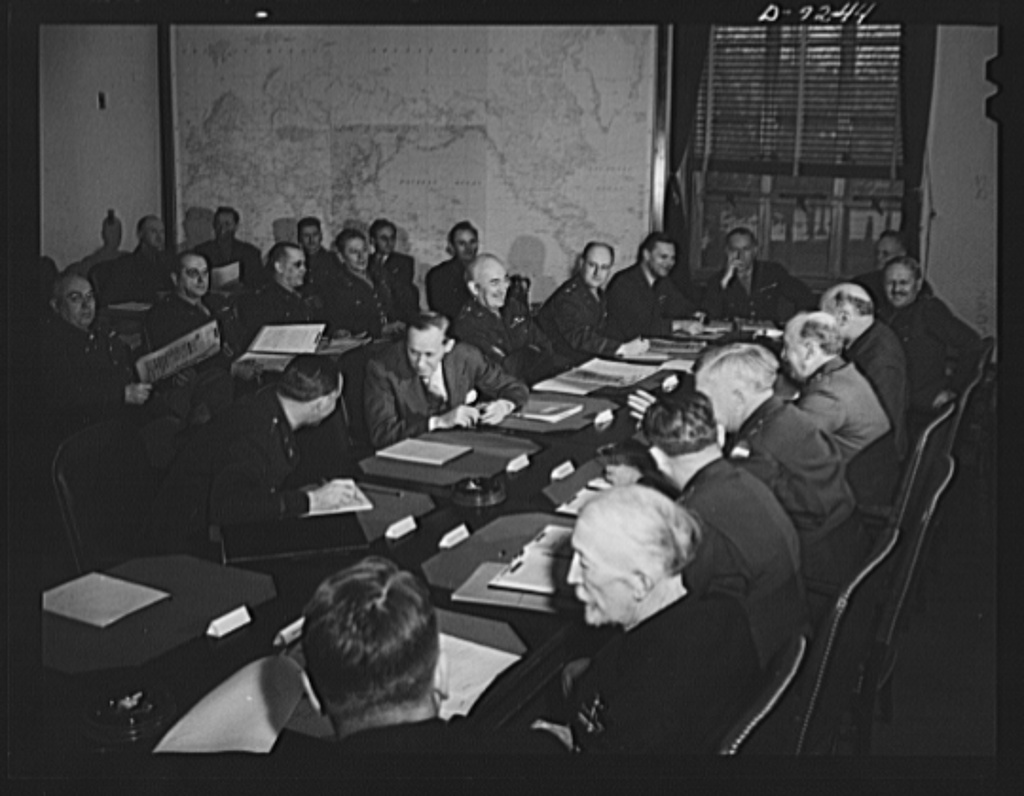
Black-and-white photograph of a group of uniformed military officers and men in suits seated around a long conference table in a room with a large wall map and venetian blinds. Papers, pads, and pencils lie on the table; several men in the background stand or sit along the walls.Photograph

Primary source

Combined Munitions Assignments Board meeting

Office of War Information

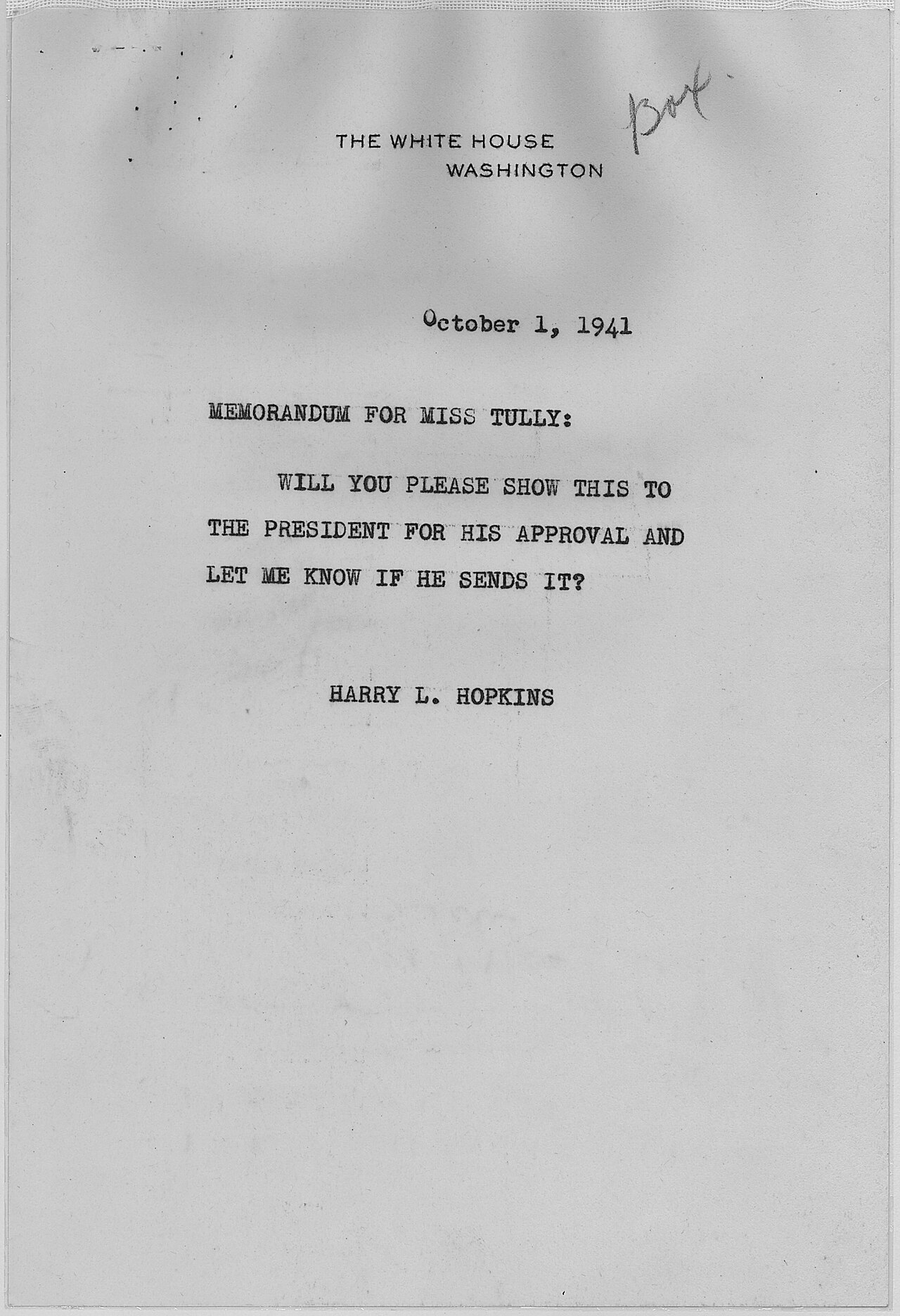
Scanned black-and-white typed memorandum on White House letterhead, dated October 1, 1941, addressed to Miss Tully, asking her to show it to the President for approval and let Hopkins know if he sends it. Signed Harry L. Hopkins. A handwritten note appears in the upper right.Letter

Primary source

Harry Hopkins to Grace Tully

Harry Hopkins · 1 October 1941

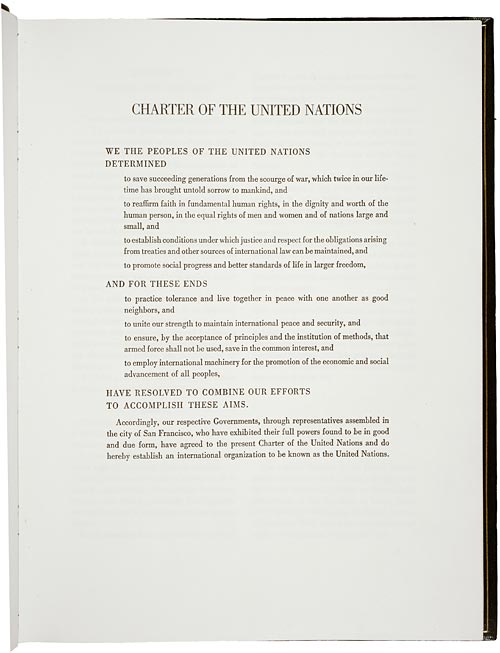
Scanned page of the United Nations Charter with the title 'Charter of the United Nations' at top, followed by the preamble text beginning 'We the peoples of the United Nations determined' on a white page with a dark border at right.Document

Primary source

United Nations Charter

26 June 1945

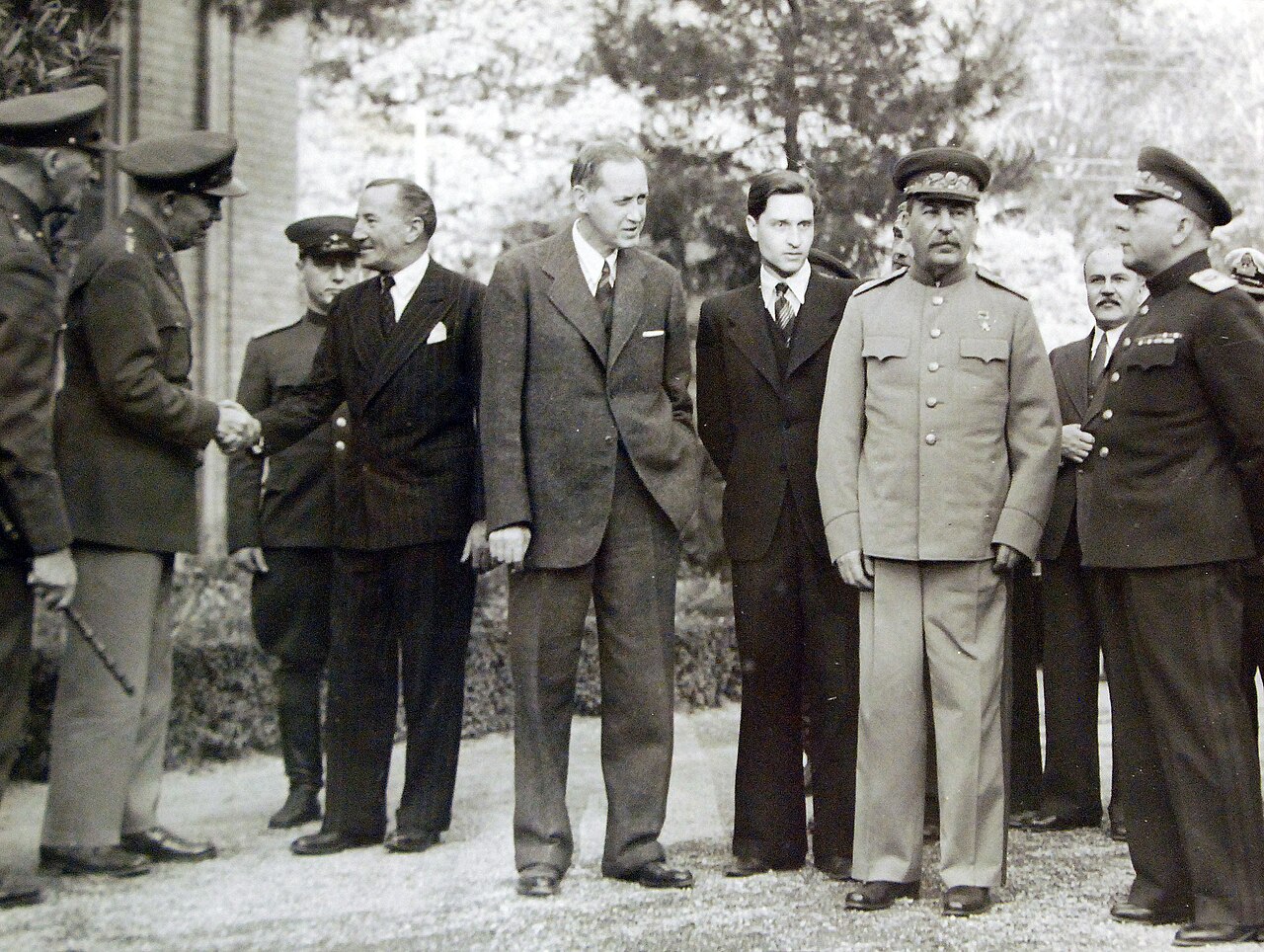
Black-and-white photo of men outdoors on a gravel path beside a building and shrubs. In the left foreground, a uniformed officer in a peaked cap shakes hands with a man in a suit. Behind them stand several men in suits and military uniforms. Stalin, in a high-collared military tunic and cap, stands second from right, beside a uniformed officer on the far right.Photograph

Primary source

General Marshall, Sir Archibald Clark Kerr, and Marshal Stalin at Tehran Conference

National Museum of the U.S. Navy · 28 November - 1 December 1943

Document

Primary source

Executive Order 9066

Franklin Delano Roosevelt · 19 February 1942

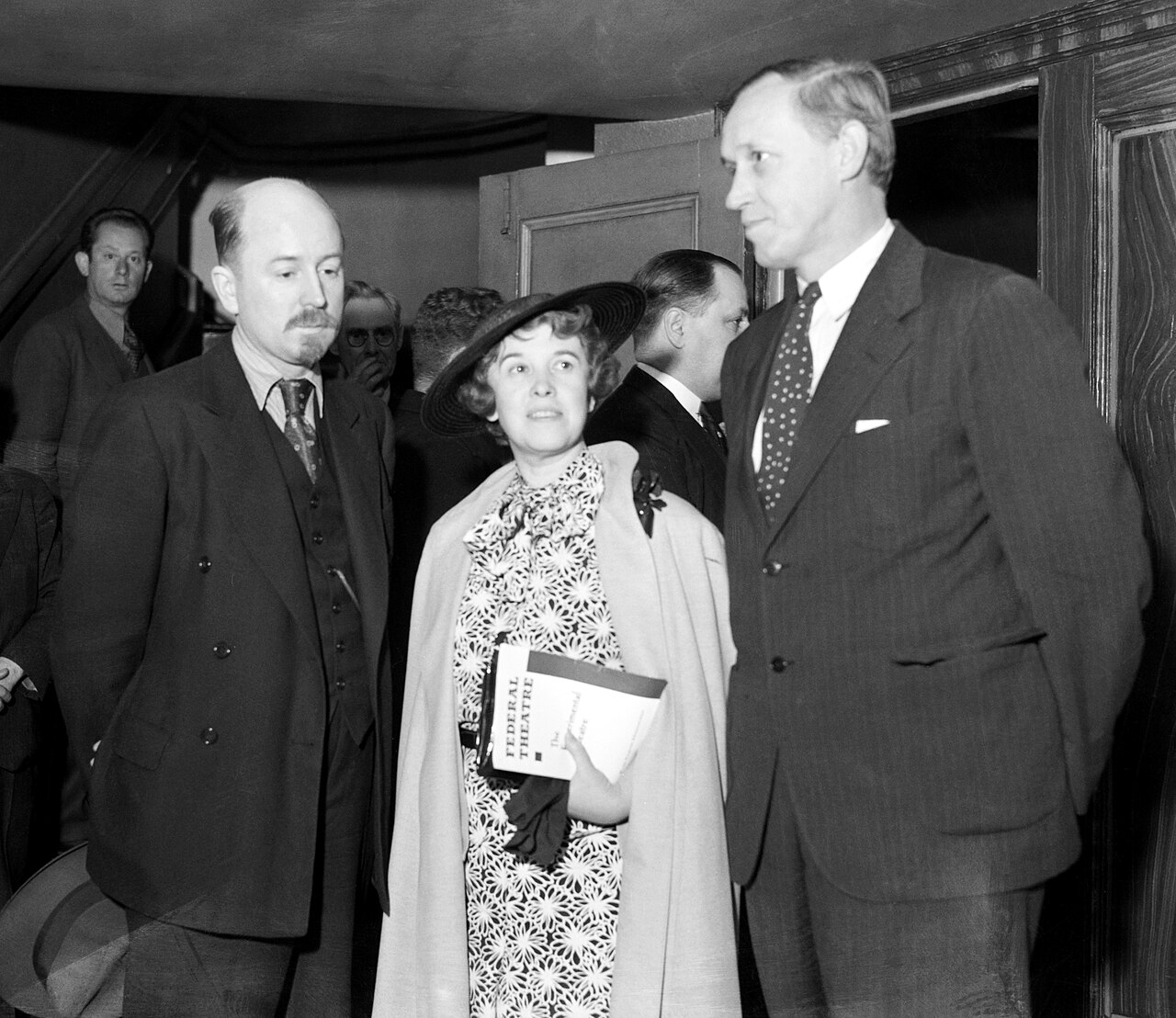
Black and white photograph of three people standing in a dim doorway. On the left, a balding man with a mustache wears a suit and tie. In the center, a woman in a wide-brimmed hat, patterned dress and light coat holds a program labeled Federal Theatre. On the right, a man in a dark suit and polka-dot tie stands with hands in pockets. Other people are visible behind them.Photograph

Primary source

Chalk-Dust-Geddes-Flanagan-Hopkins

Federal Theatre Project

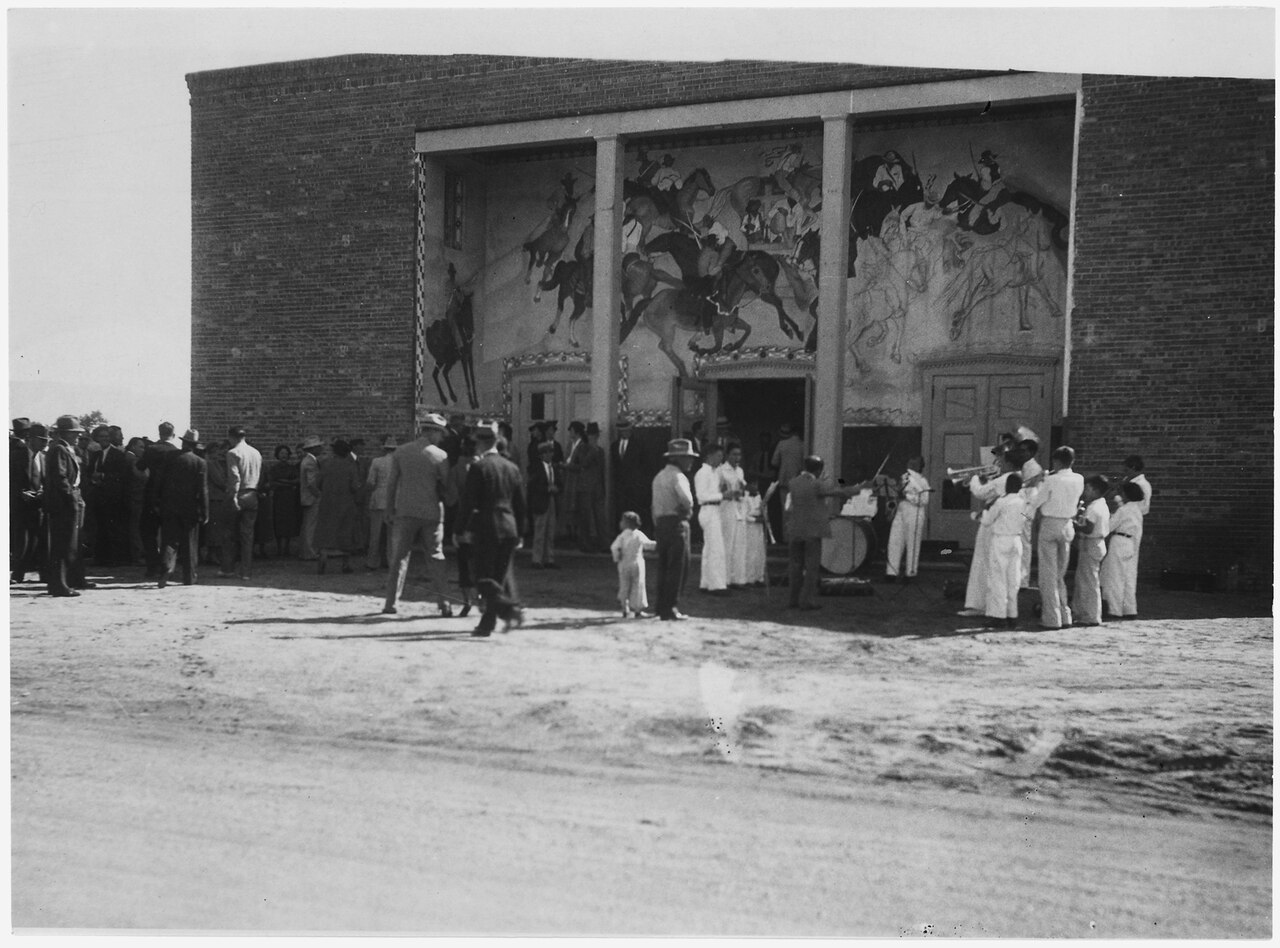
Black-and-white photograph of a brick building with a large painted mural of horsemen across its facade, flanked by columns. A crowd of men and women in hats and suits stands at left, while a small group of uniformed musicians in white, including trumpet players and a drummer, performs at right. A small child stands near the crowd in the foreground.Photograph

Primary source

Harry Hopkins at WPA Arts Museum in New Mexico

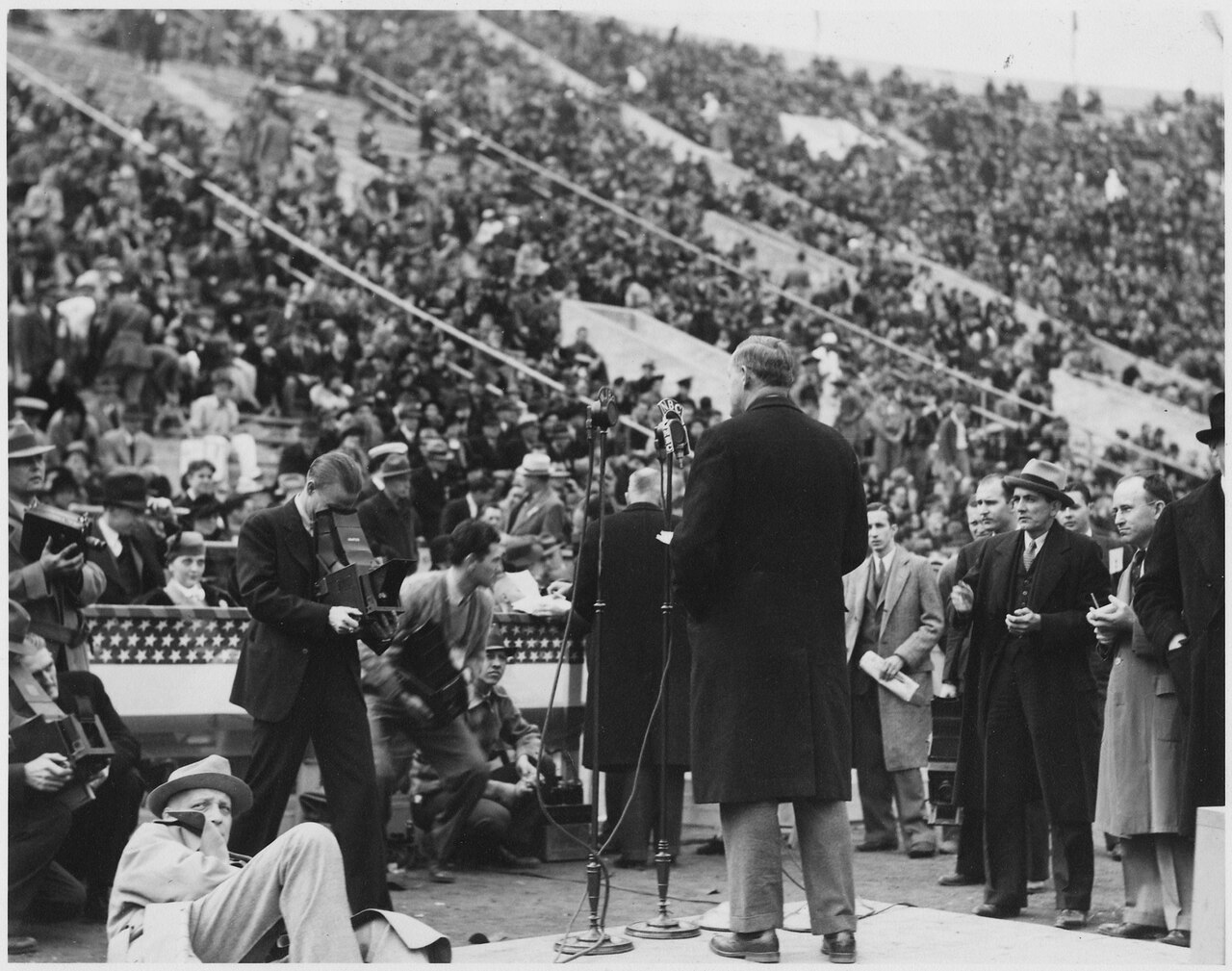
Black and white photograph of a man in a long overcoat seen from behind, speaking at microphones on a stadium platform. A large crowd fills the stands, and photographers and men in hats stand nearby.Photograph

Primary source

LSU Stadium Dedication, Hopkins Speaking

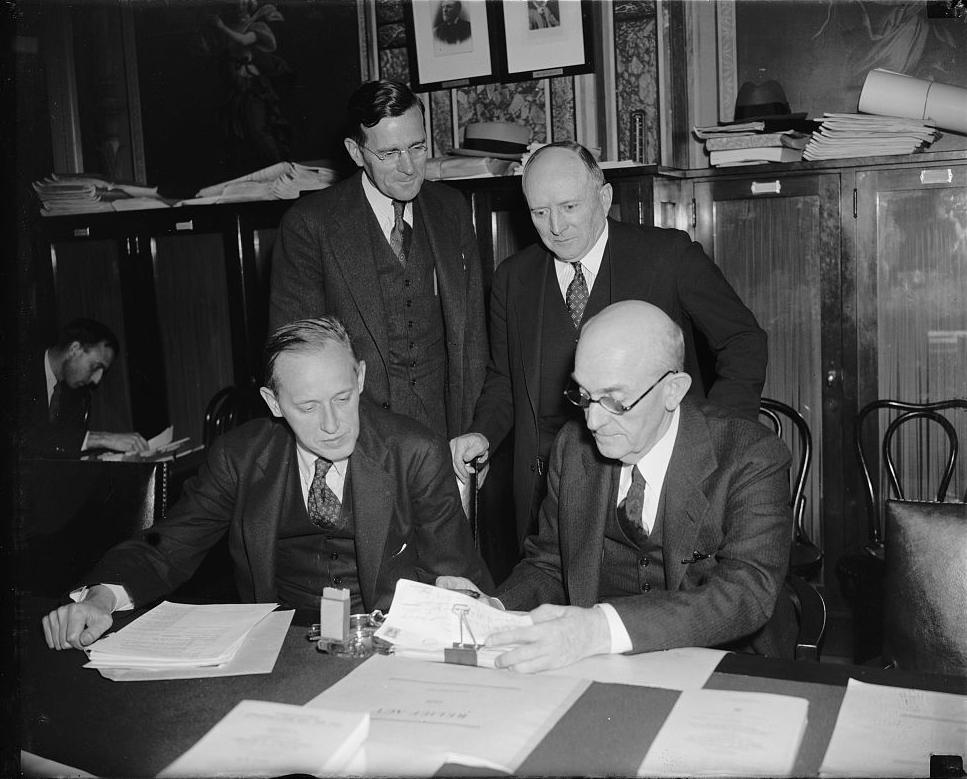
Black and white photograph of four men gathered around a table covered with papers. A seated man in a suit and glasses studies documents, while a seated man in glasses and a striped tie leans in beside him. Two men stand behind them, one in a dark suit with glasses, the other in a suit and patterned tie. Another man sits in the background at a desk, and framed portraits hang on the wall.Photograph

Primary source

W.P.A. Administrator Appears Before Senate Appropriations Committee

Harris & Ewing

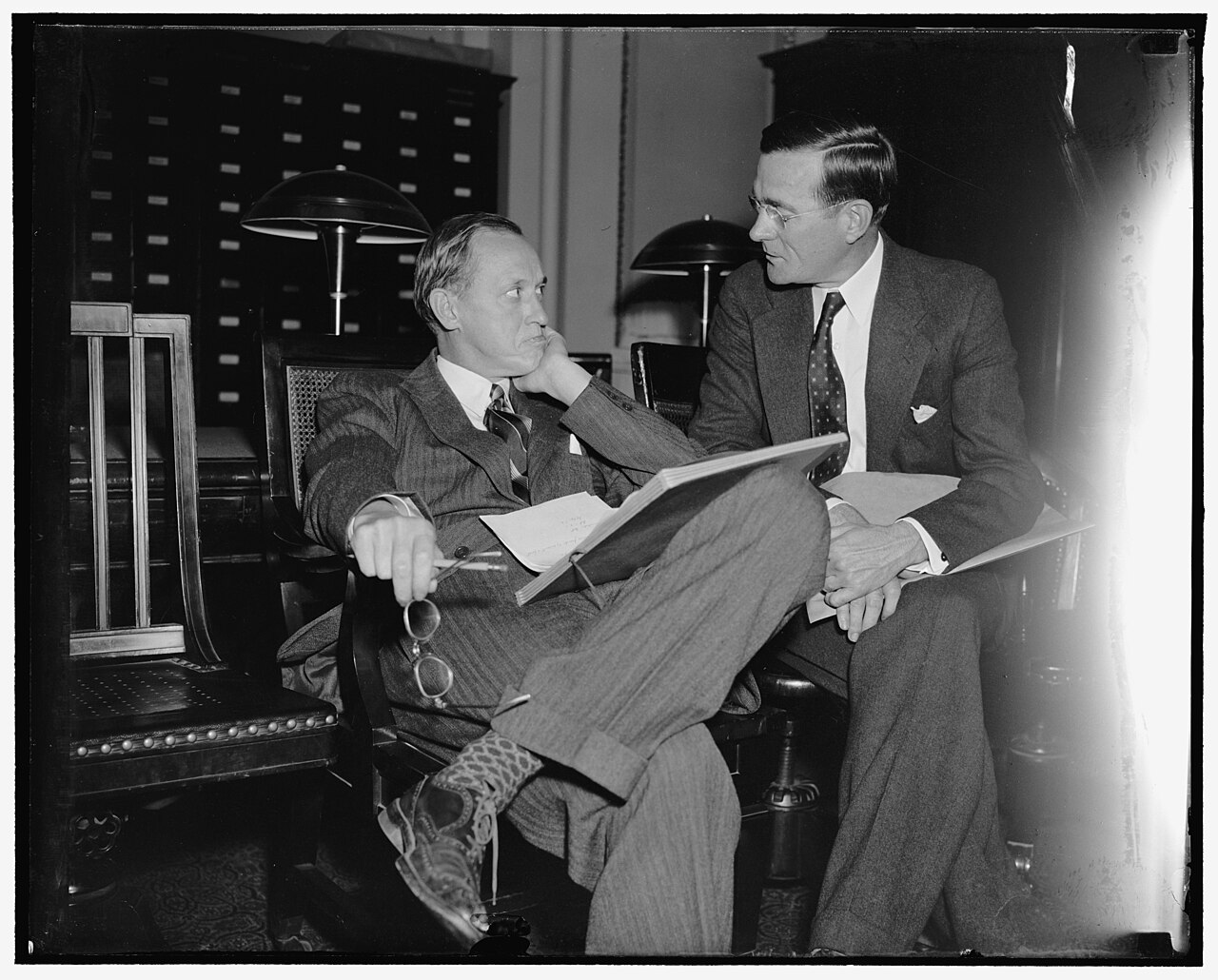
Black-and-white photograph of two men seated indoors in a dim office with filing cabinets and desk lamps behind them. The man on the left, in a striped suit with eyeglasses in hand, rests his chin on his hand and holds a folder across his crossed legs. The man on the right, in a suit and polka-dot tie with rimless glasses, sits beside him holding papers and looks toward him.Photograph

Primary source

Last Minute Huddle

Harris & Ewing · 20 April 1938

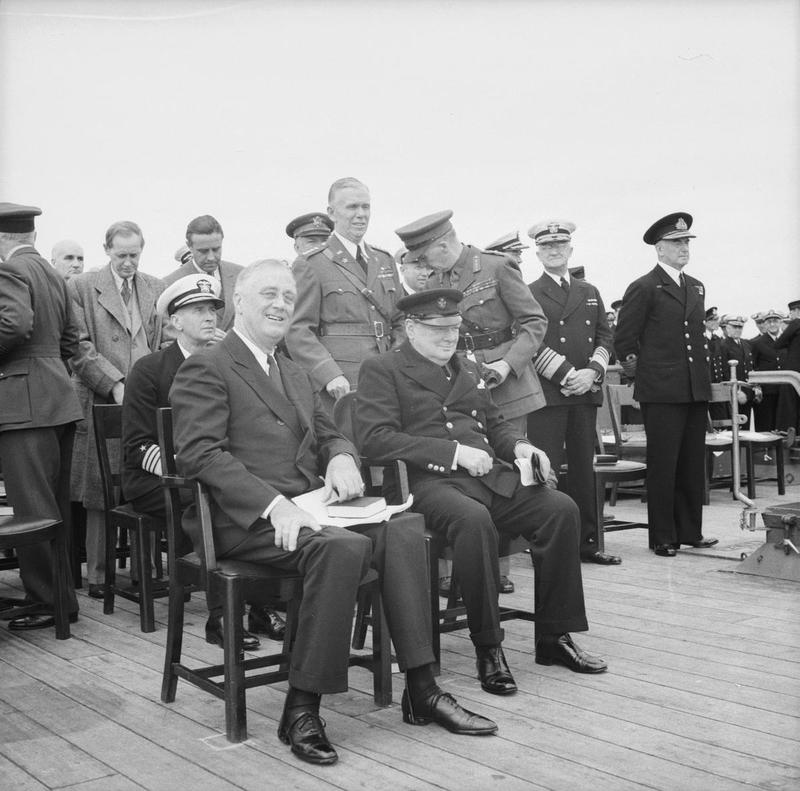
Black and white photograph of two men seated on a wooden deck in front of a group of uniformed and civilian men. The man on the left in a dark suit smiles and holds papers. The man on the right in a dark naval-style suit and peaked cap sits with hands near a small book. Standing behind them are officers in caps and uniforms, and a civilian in a light coat. Ship rails and a sky are visible.Photograph

Primary source

Winston Churchill as Prime Minister: Atlantic Conference, 1941

Captain Horton, War Office official photographer · August 1941

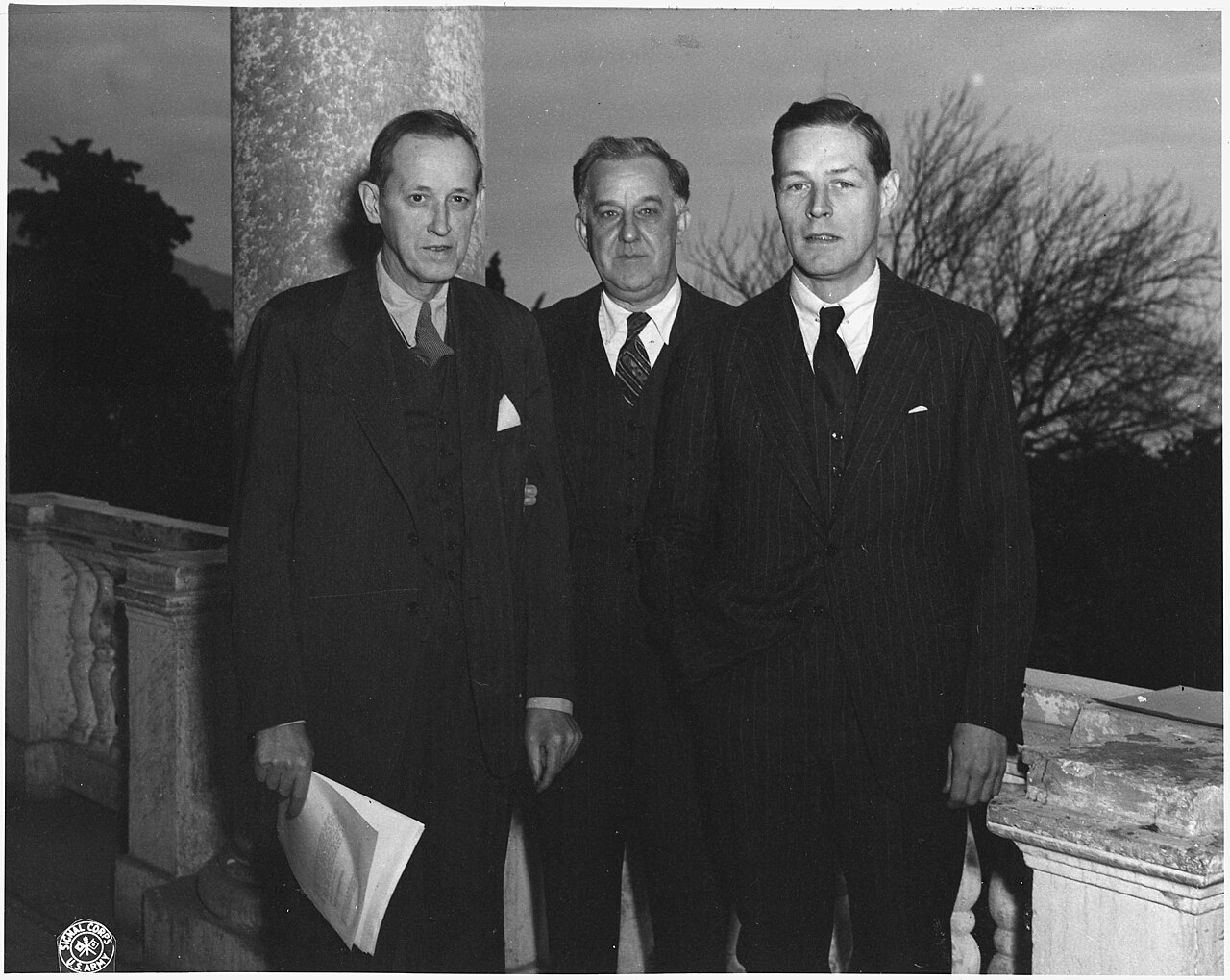
Black-and-white photograph of three men in dark suits standing on a stone balcony before a column and bare trees. The man on the left holds a folded paper; the man in the middle wears a tie and pocket square; the man on the right wears a pinstripe suit.Photograph

Primary source

Harry Hopkins, Steve Early, and Chip Bohlen at the Livadia Palace

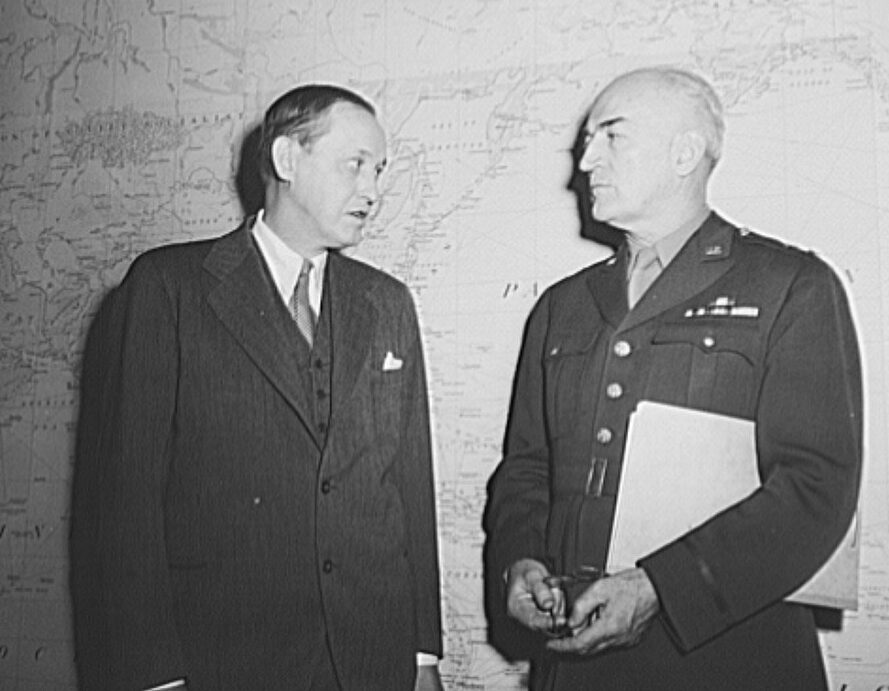
Black and white photograph of two men standing in front of a large wall map. The man on the left wears a dark pinstriped three-piece suit and tie. The man on the right wears a military uniform with buttoned jacket and insignia, holding a folder and eyeglasses, and they face each other in conversation.Photograph

Primary source

Harry Hopkins and Major General J.H. Burns at the Munitions Assignments Board

US Office of War Information · February 1943

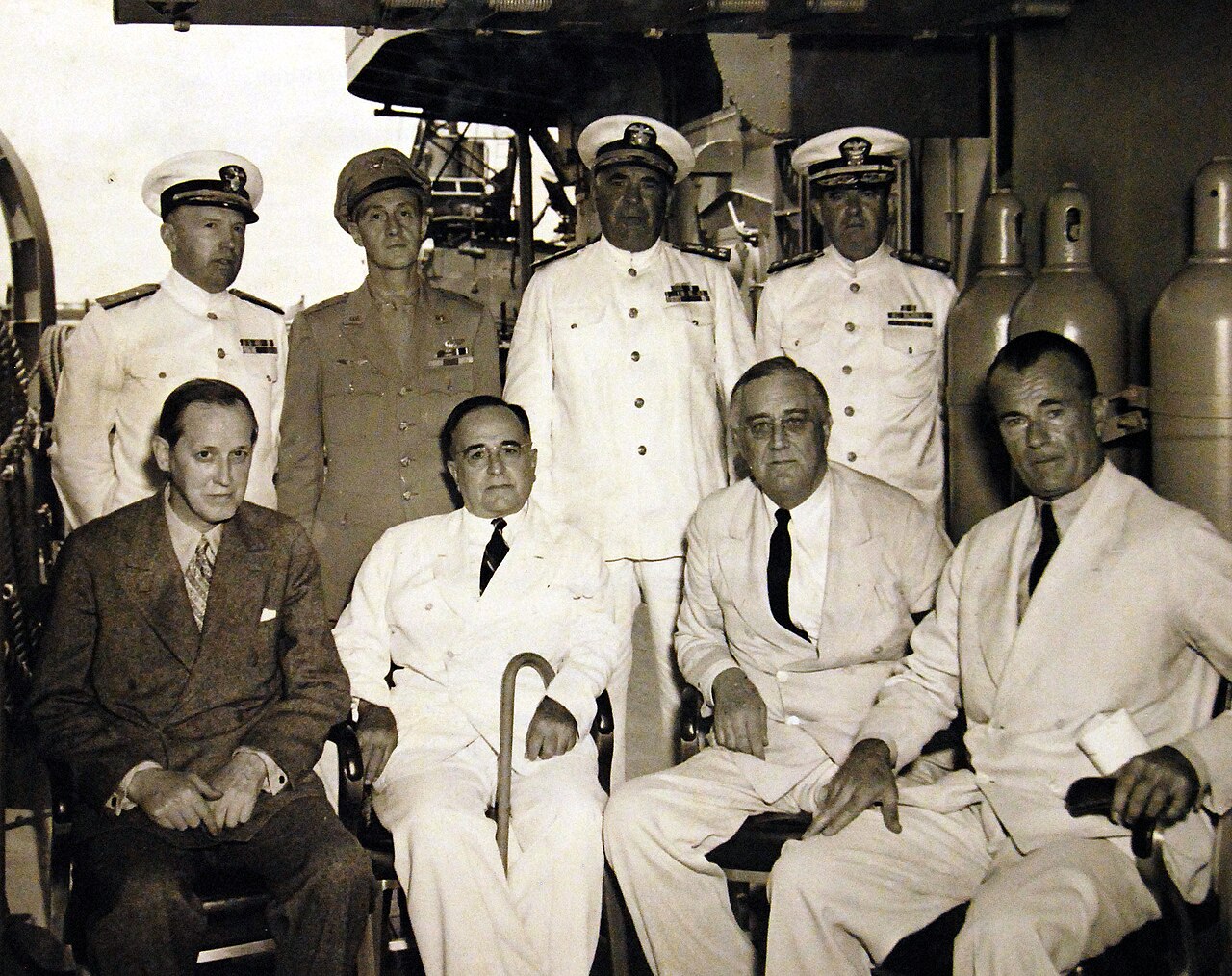
Black-and-white photograph of seven men posed on a ship deck. Four seated in front: a man in a dark suit at left, a man in white uniform with cane, a man in a white suit, and a man in a light suit at right. Three officers in white naval uniforms and one in khaki stand behind, beside gas cylinders and ship equipment.Photograph

Primary source

President Roosevelt and President Vargas Aboard USS Humboldt

Office of War Information · January 1943

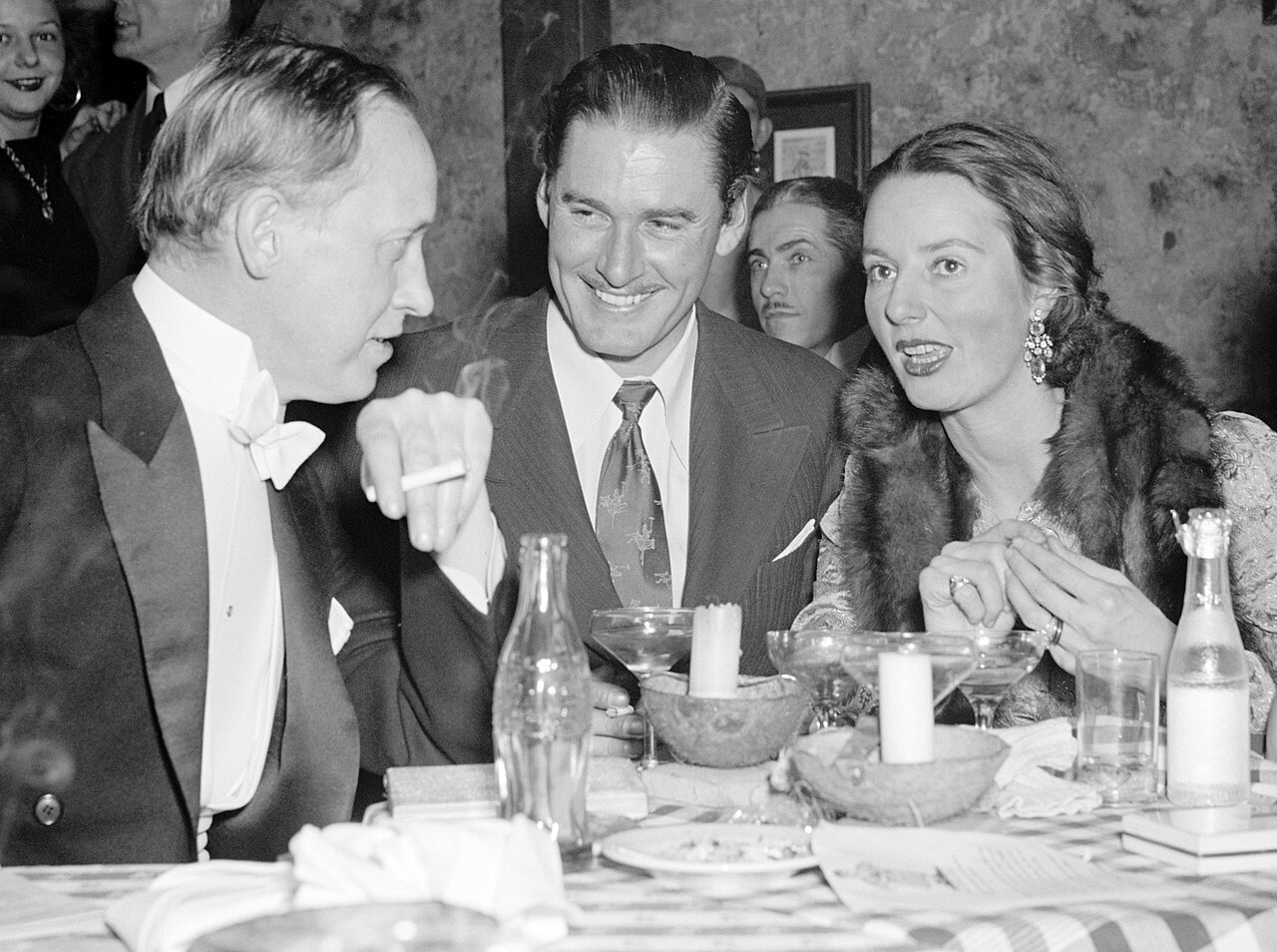
Black-and-white photo of three people seated at a dining table in a supper club. On the left, a man in a tuxedo and bow tie holds a cigarette and talks. In the center, a smiling man in a suit and patterned tie leans in. On the right, a woman in a fur stole and drop earrings speaks while another man with a mustache looks on from behind. Candles, glasses, and bottles sit on the table.Photograph

Primary source

Hopkins, Errol Flynn and Liz Whitney at Supper Club Opening

Harris & Ewing · 8 February 1939

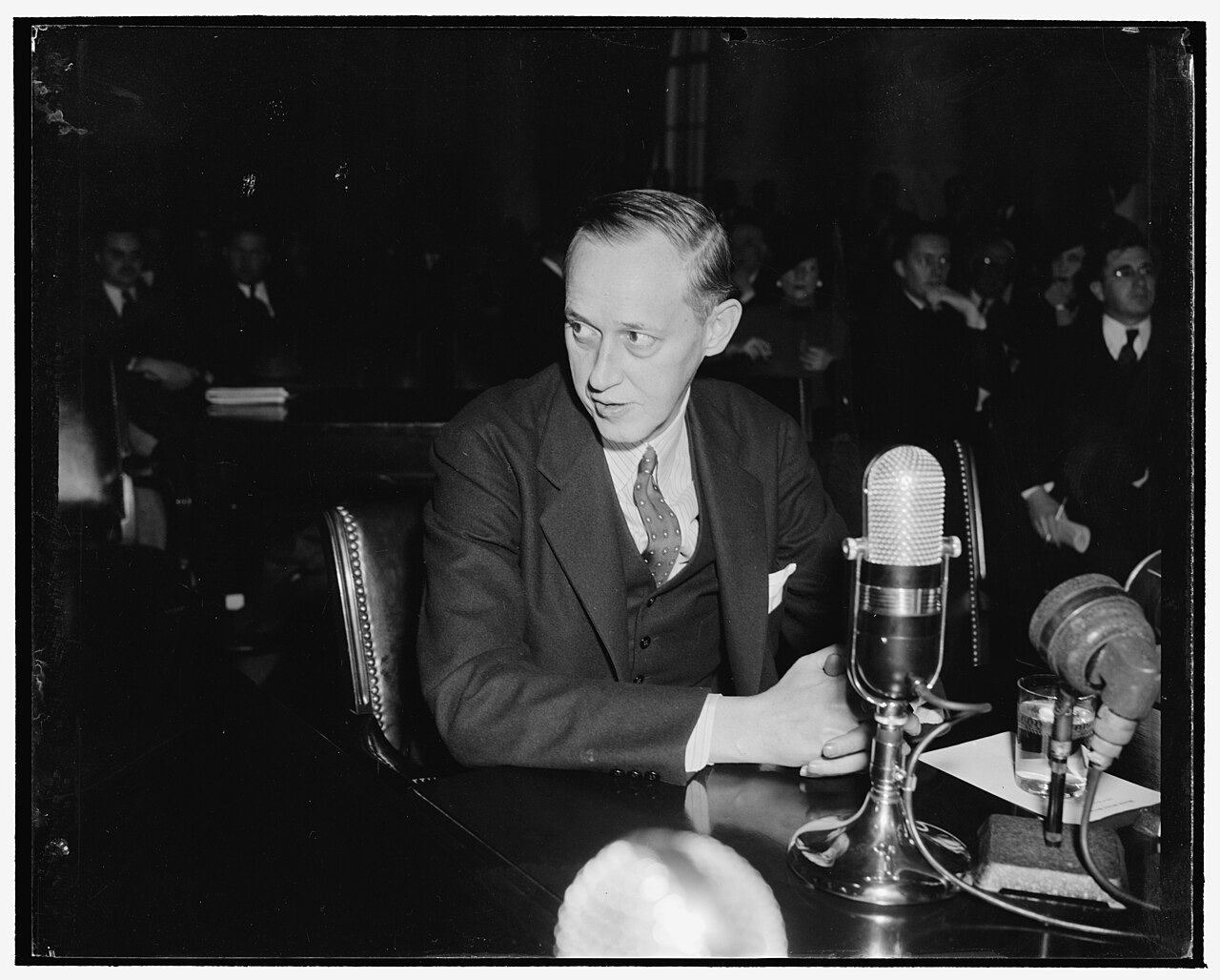
Black-and-white photograph of a man in a dark suit, vest, and dotted tie seated at a polished table, leaning forward with hands clasped, speaking into a large microphone. Spectators sit in the dark background.Photograph

Primary source

Harry Hopkins Portrait Photograph

Harris & Ewing

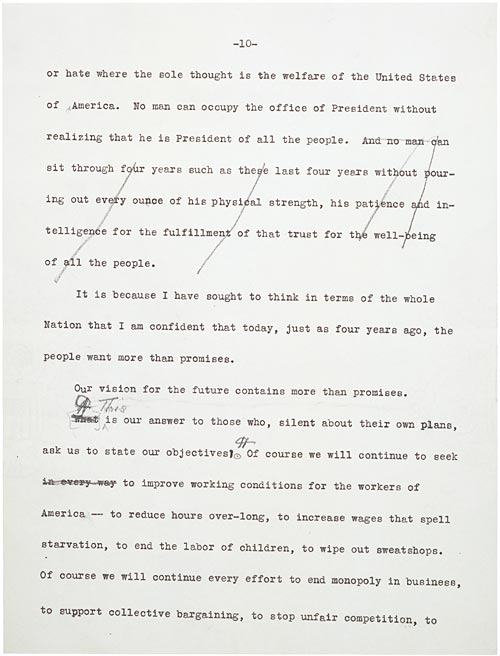
Typed page numbered 10 of a speech draft with handwritten corrections and strikeouts in ink, including a strikethrough of the words 'in every way' and marginal insertion marks. Text discusses the welfare of the United States, the presidency, and improving working conditions.Speech

Primary source

President Franklin Roosevelt's Radio Address Unveiling the Second Half of the New Deal

Franklin D. Roosevelt · 31 October 1936

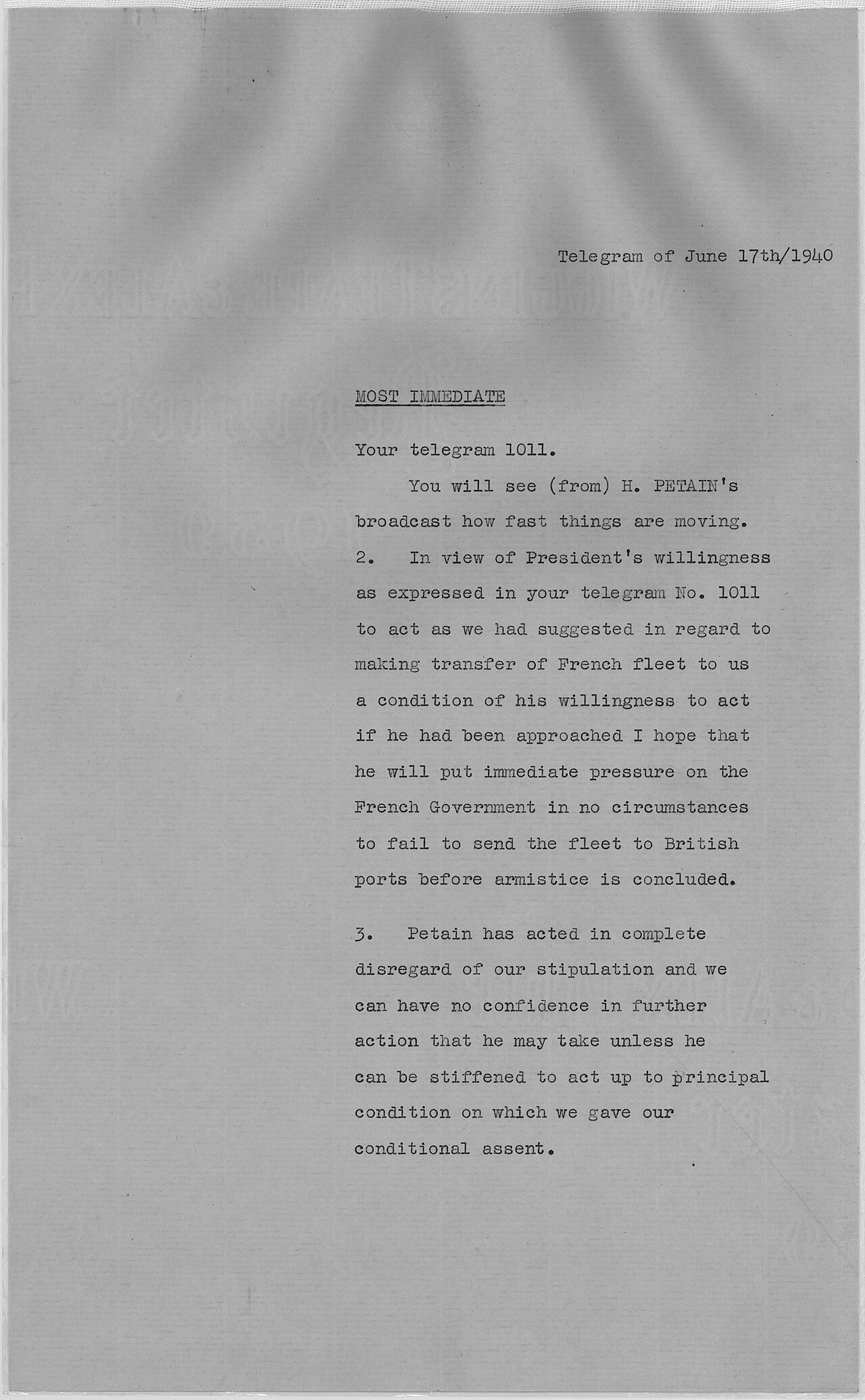
Scanned typed telegram dated June 17th, 1940, marked MOST IMMEDIATE, with two numbered paragraphs about French fleet transfer and Marshal Petain's conduct. The page has a faint watermark-like background.Letter

Primary source

Winston Churchill to Harry Hopkins, 17 July 1940

Winston Churchill · 17 July 1940

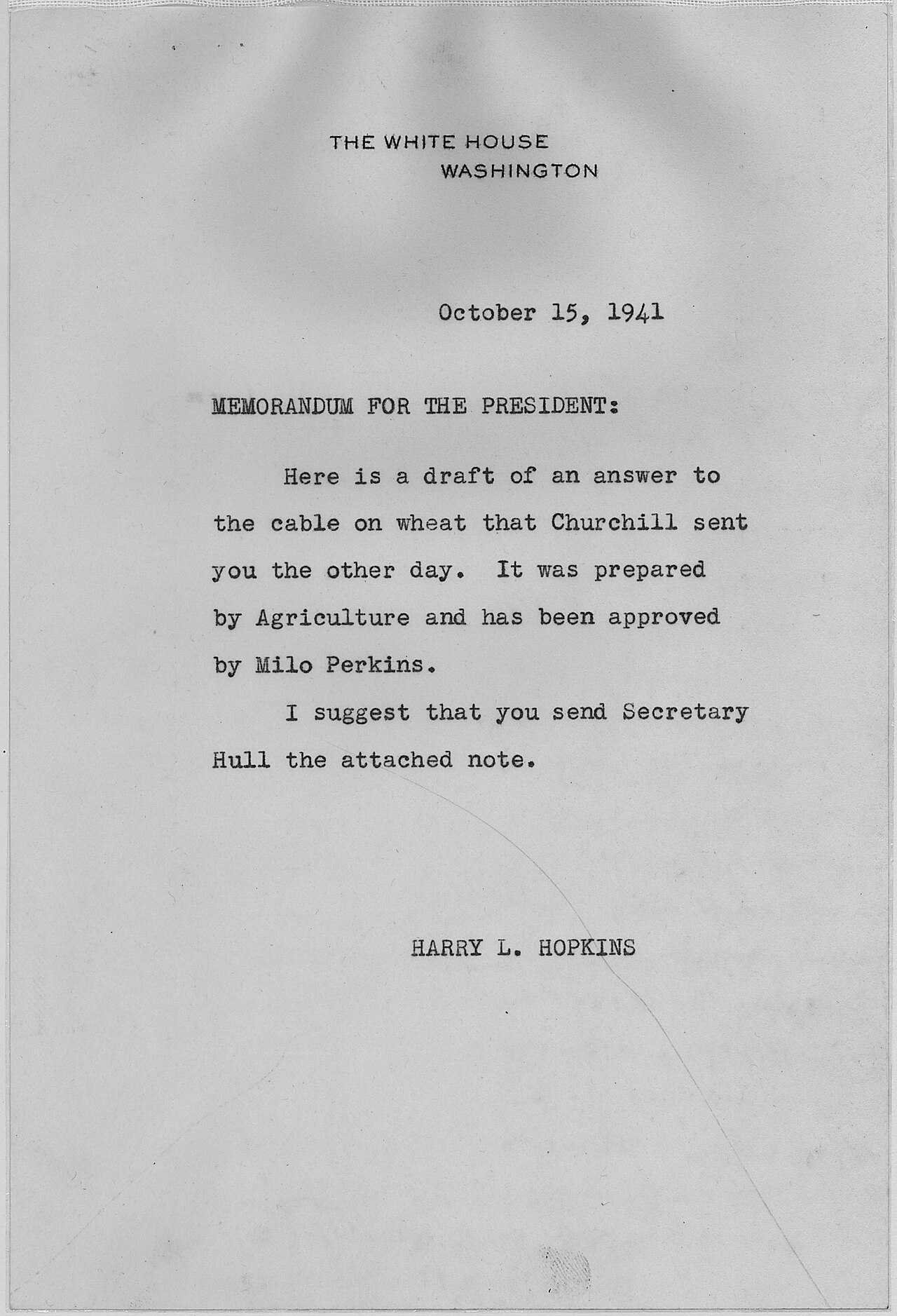
Typed memorandum on White House letterhead, dated October 15, 1941, addressed to the President, offering a draft answer to Churchill's cable on wheat and suggesting a note to Secretary Hull. Signed Harry L. Hopkins.Letter

Primary source

Harry Hopkins to Franklin D. Roosevelt, 15 October 1941

Harry Hopkins · 15 October 1941

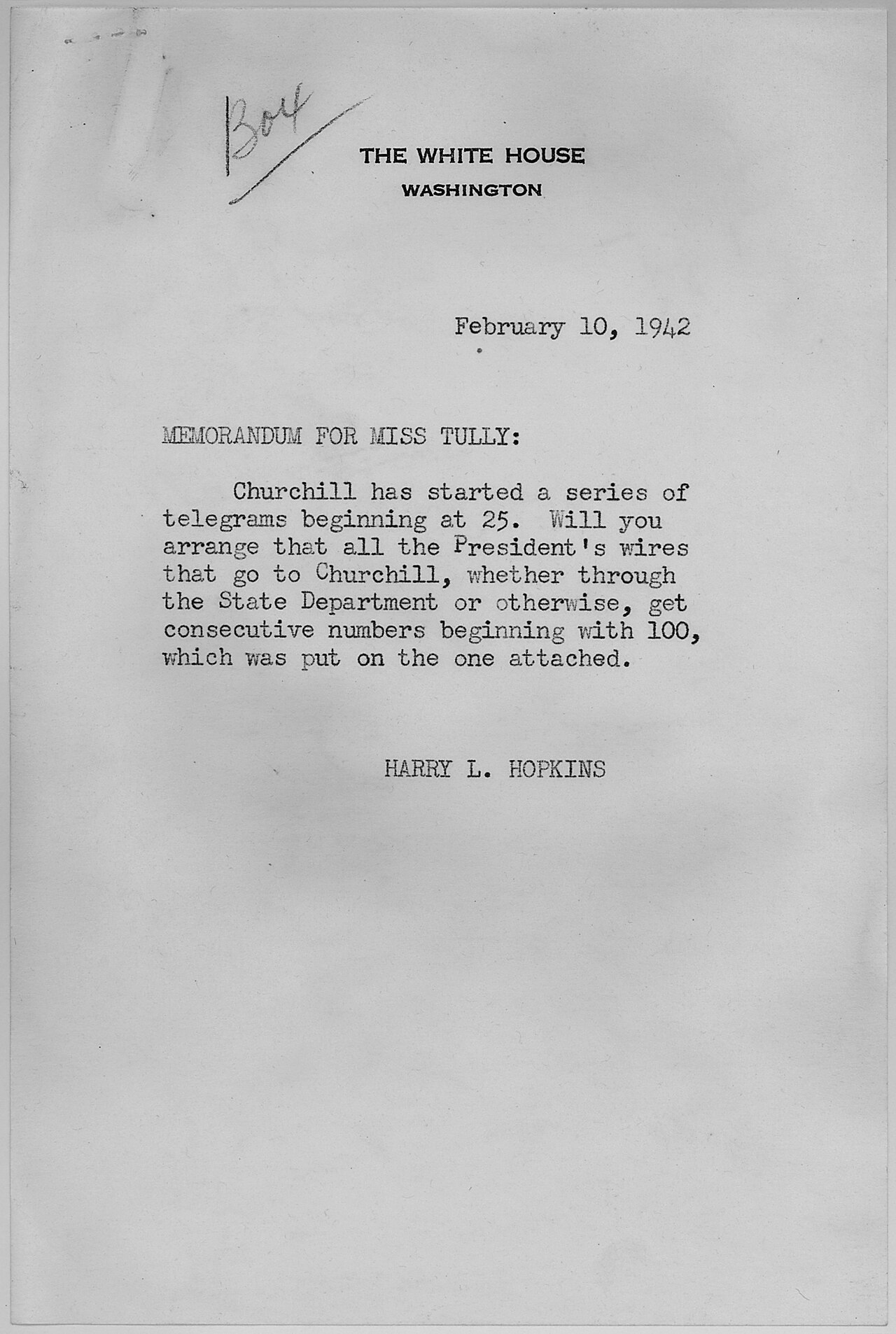
Scan of a White House memorandum dated February 10, 1942, addressed to Miss Tully and signed by Harry L. Hopkins. It asks that the President's wires to Churchill receive consecutive numbers beginning with 100. A handwritten 'Box' note appears at top left.Letter

Primary source

Harry Hopkins to Grace Tully, 10 February 1942

Harry Hopkins · 10 February 1942

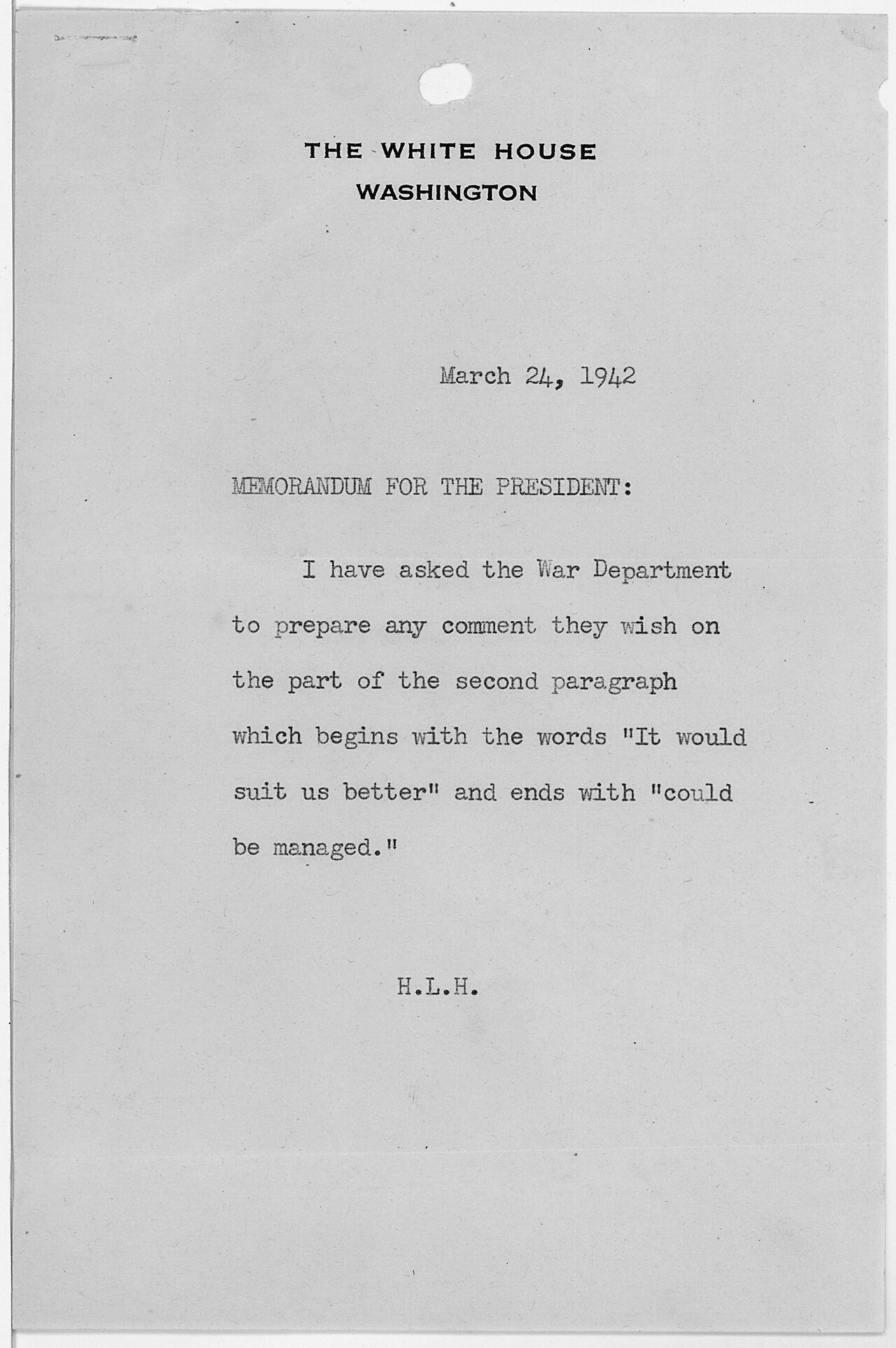
Typed White House memorandum dated March 24, 1942, addressed to the President. It asks the War Department to prepare comment on a paragraph beginning 'It would suit us better' and ending 'could be managed.' Signed with initials H.L.H.Letter

Primary source

Hopkins to Franklin D. Roosevelt, 24 March 1942

Harry Hopkins · 24 March 1942

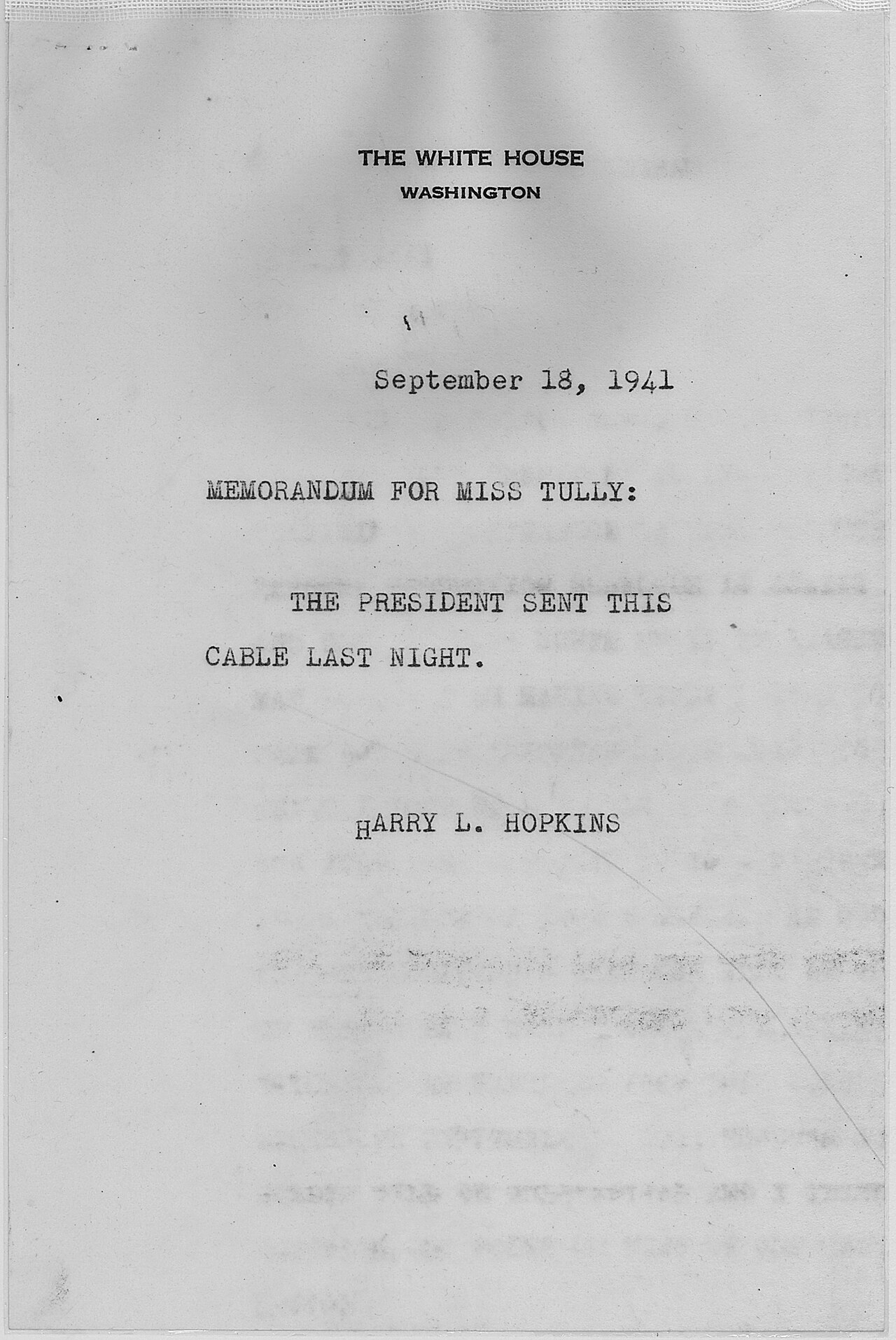
Scanned black-and-white typed memorandum on White House letterhead, reading 'THE WHITE HOUSE WASHINGTON', dated September 18, 1941, addressed 'MEMORANDUM FOR MISS TULLY' with the text 'THE PRESIDENT SENT THIS CABLE LAST NIGHT', signed 'HARRY L. HOPKINS'.Letter

Primary source

Harry Hopkins to Grace Tully, 18 September 1941

Harry Hopkins · 18 September 1941

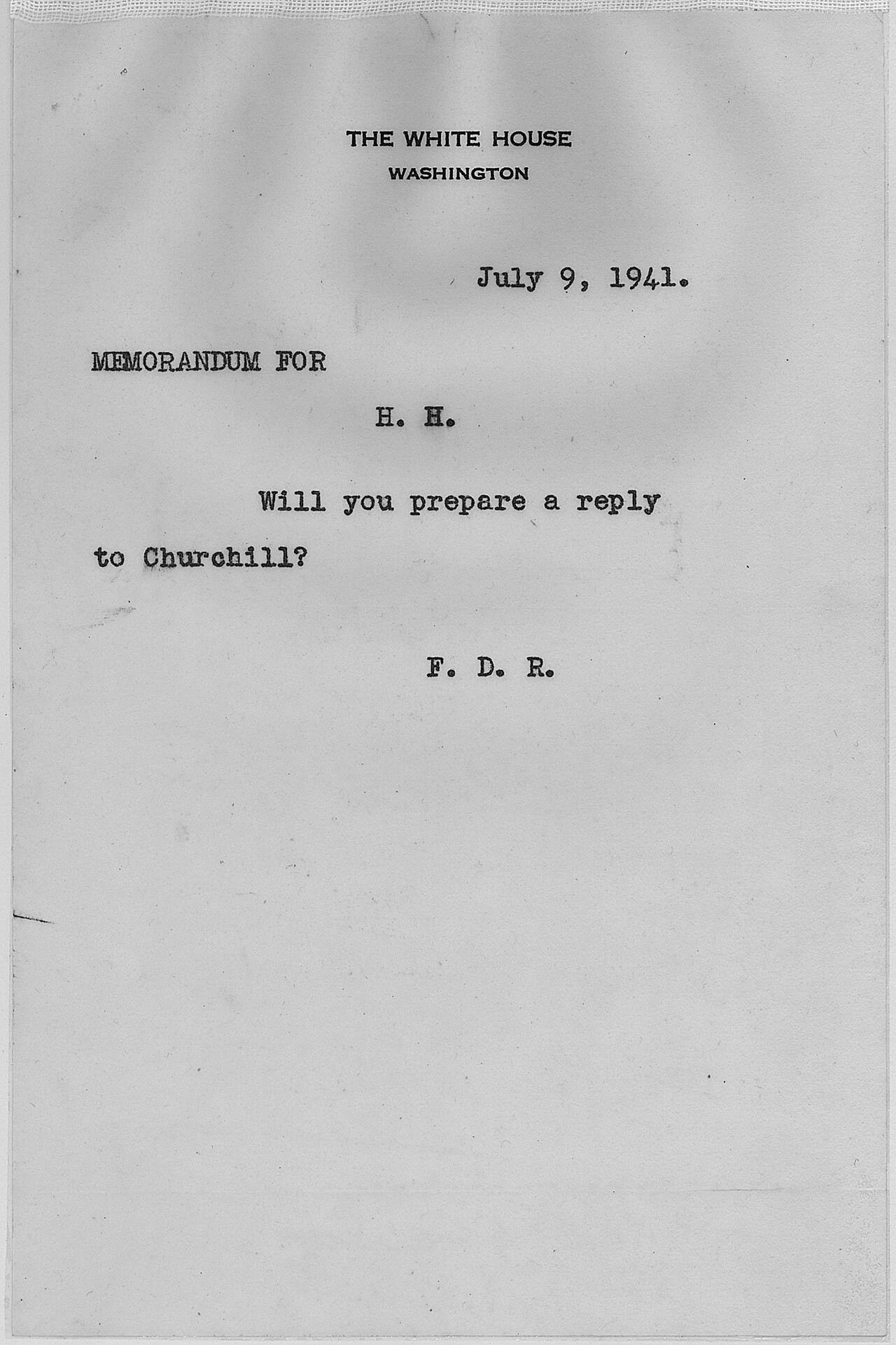
Black-and-white scan of a typed White House memorandum on plain paper. Header reads THE WHITE HOUSE, WASHINGTON; dated July 9, 1941. Reads: MEMORANDUM FOR H. H. Will you prepare a reply to Churchill? Signed F. D. R.Letter

Primary source

Franklin D. Roosevelt to Harry Hopkins, 9 July 1941

Franklin Delano Roosevelt · 9 July 1941

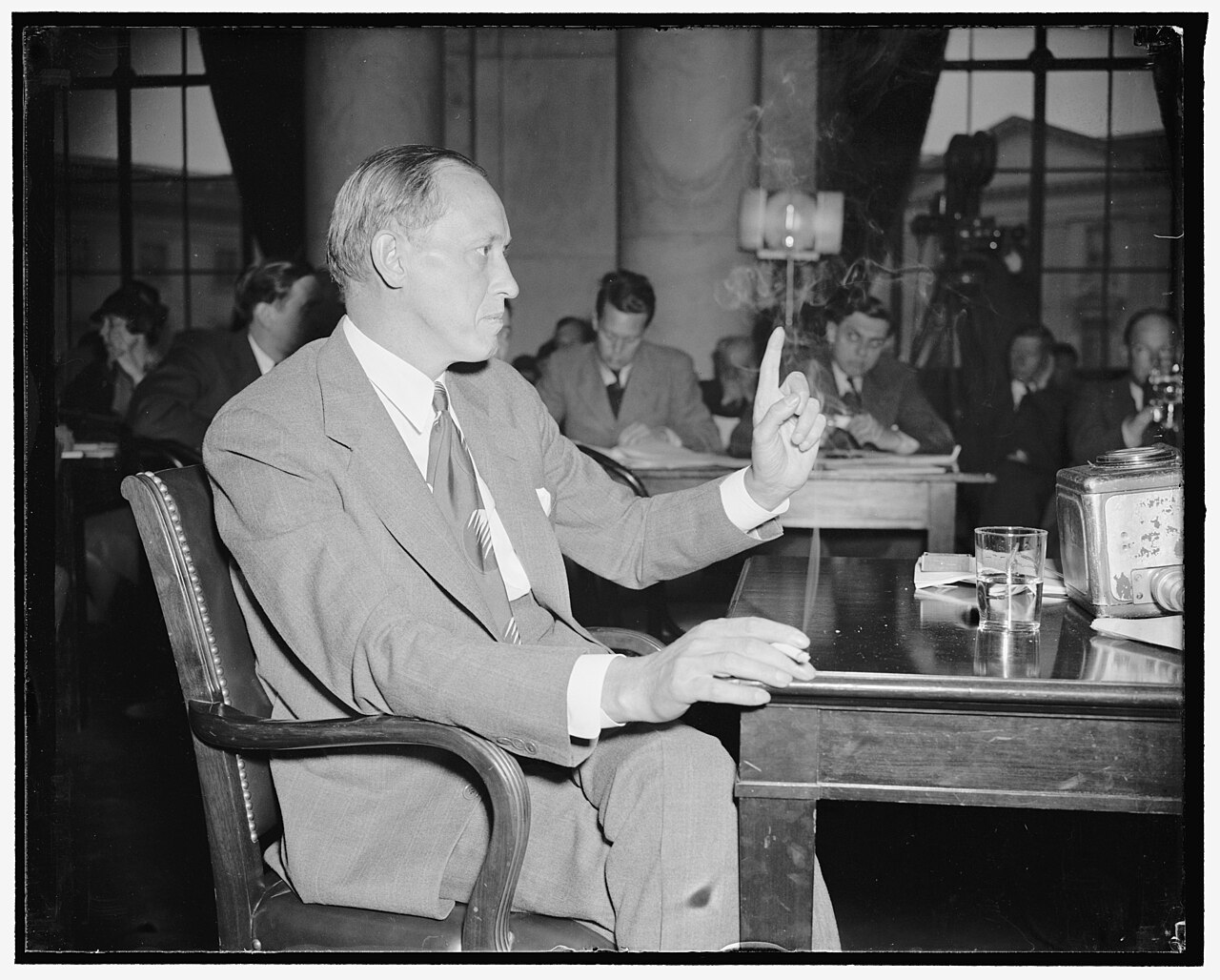
Black-and-white press photograph of a man in a light suit and tie seated at a wooden desk with a glass of water, raising one index finger while speaking. Behind him, seated men take notes at tables, and a press camera stands at right near a window.Photograph

Primary source

WPA Head Urges Expansion of Federal Works Program

Harris & Ewing · 8 April 1938

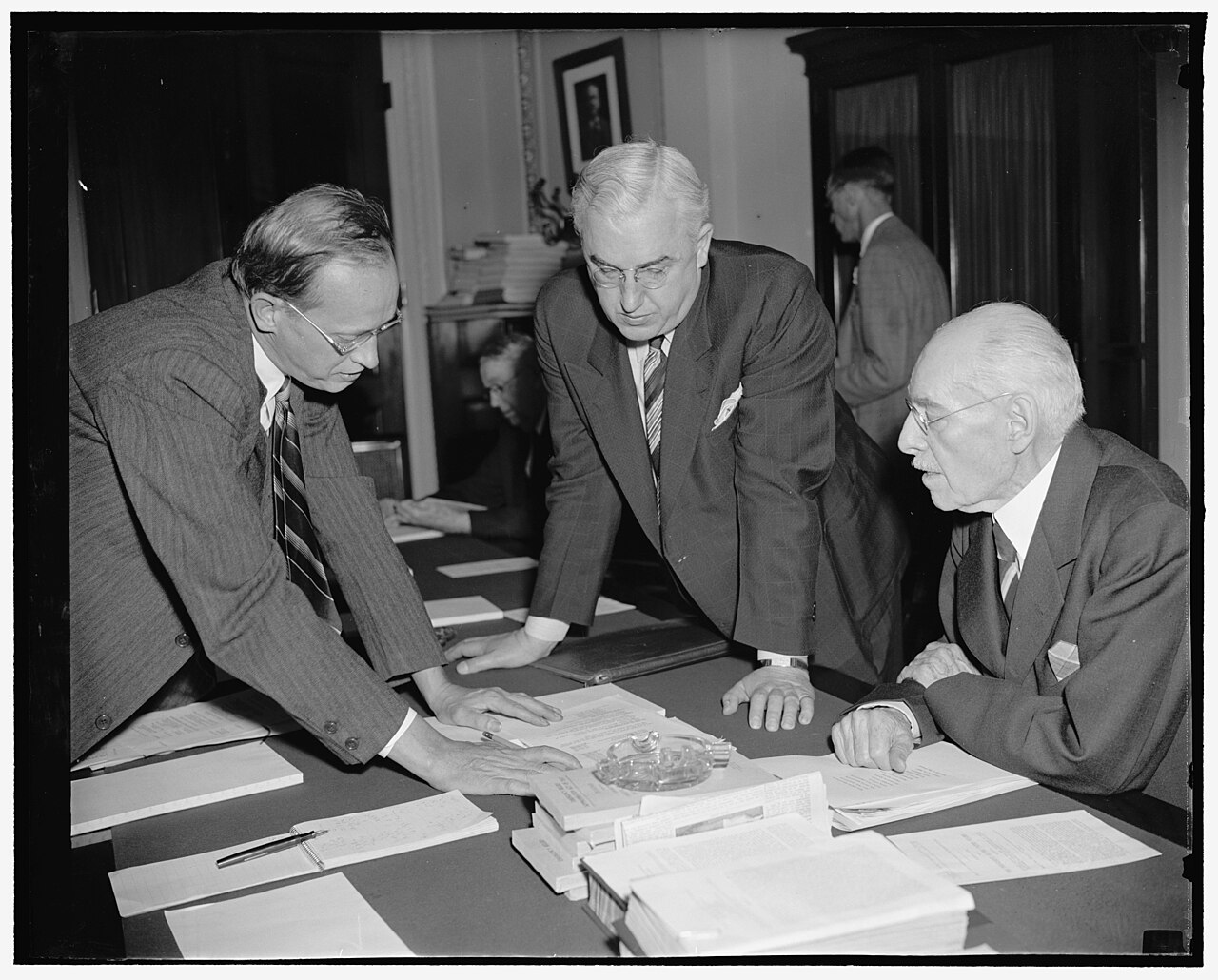
Black and white photo of three men in suits at a table covered with papers. A man on the left leans over the table pointing at documents, a man in the center leans forward looking down at the papers, and an older man with glasses on the right sits watching. An ashtray and pen rest on the table, and another man stands in the background.Photograph

Primary source

WPA Administrator Hopkins Indicates Plan to Increase Relief Load

Harris & Ewing · 20 April 1938

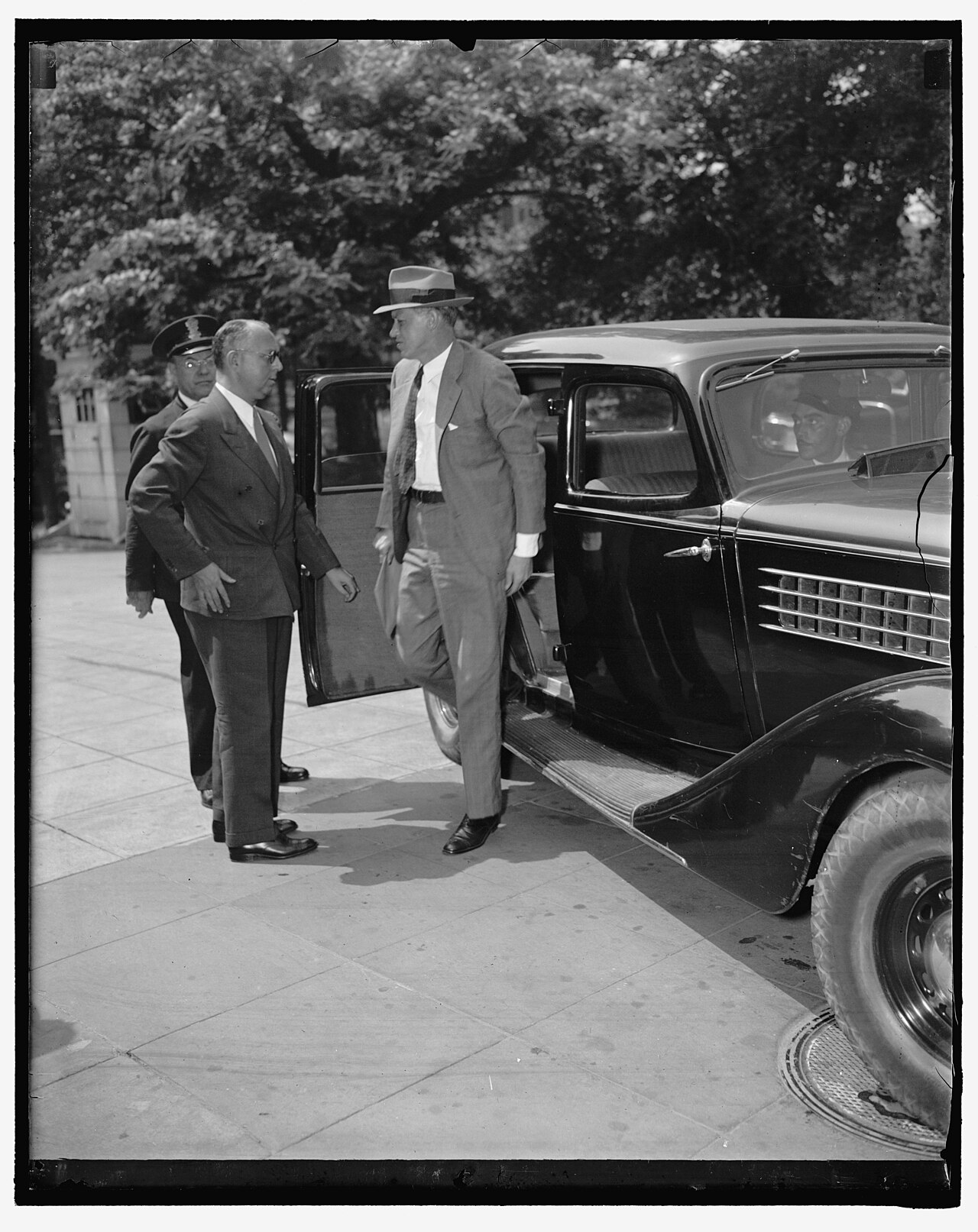
Black-and-white photograph of a man in a light fedora and suit stepping out of an open rear door of a dark sedan on a paved sidewalk, with a second man in a suit standing beside him and a uniformed chauffeur or officer in a cap behind them, trees in the background.Photograph

Primary source

Harry Hopkins Arrives at the White House for Housing Conference

Harris & Ewing · 14 July 1937

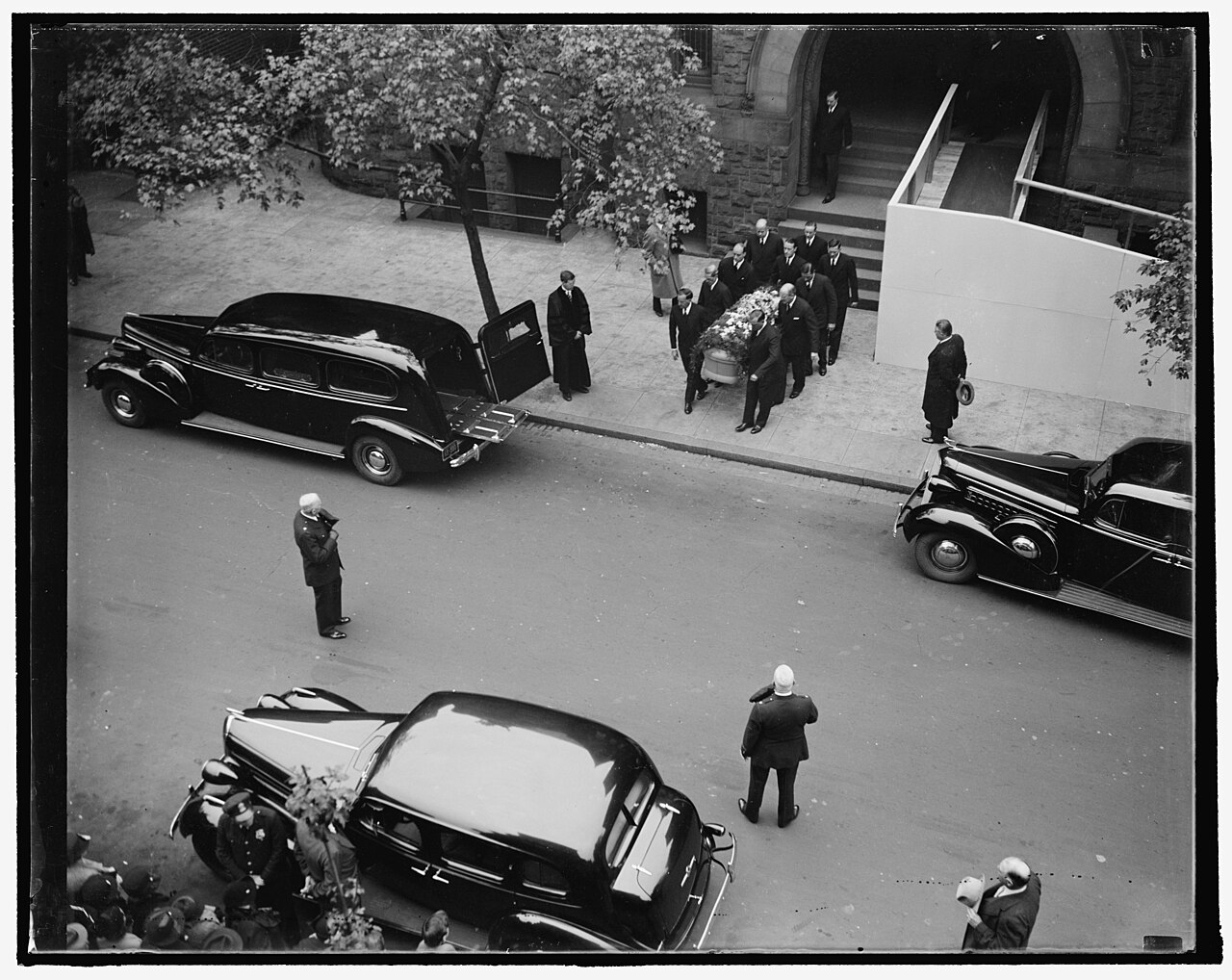
Black-and-white photo from above of a funeral outside a stone church. Mourners in dark coats carry a flower-covered casket down the church steps toward a black hearse with its rear door open. A second black car is parked on the right, a third at lower left, and a crowd stands at the bottom left edge. Uniformed police and a man in a light hat stand in the street.Photograph

Primary source

Funeral of Mrs. Harry Hopkins

Harris & Ewing · 9 October 1937

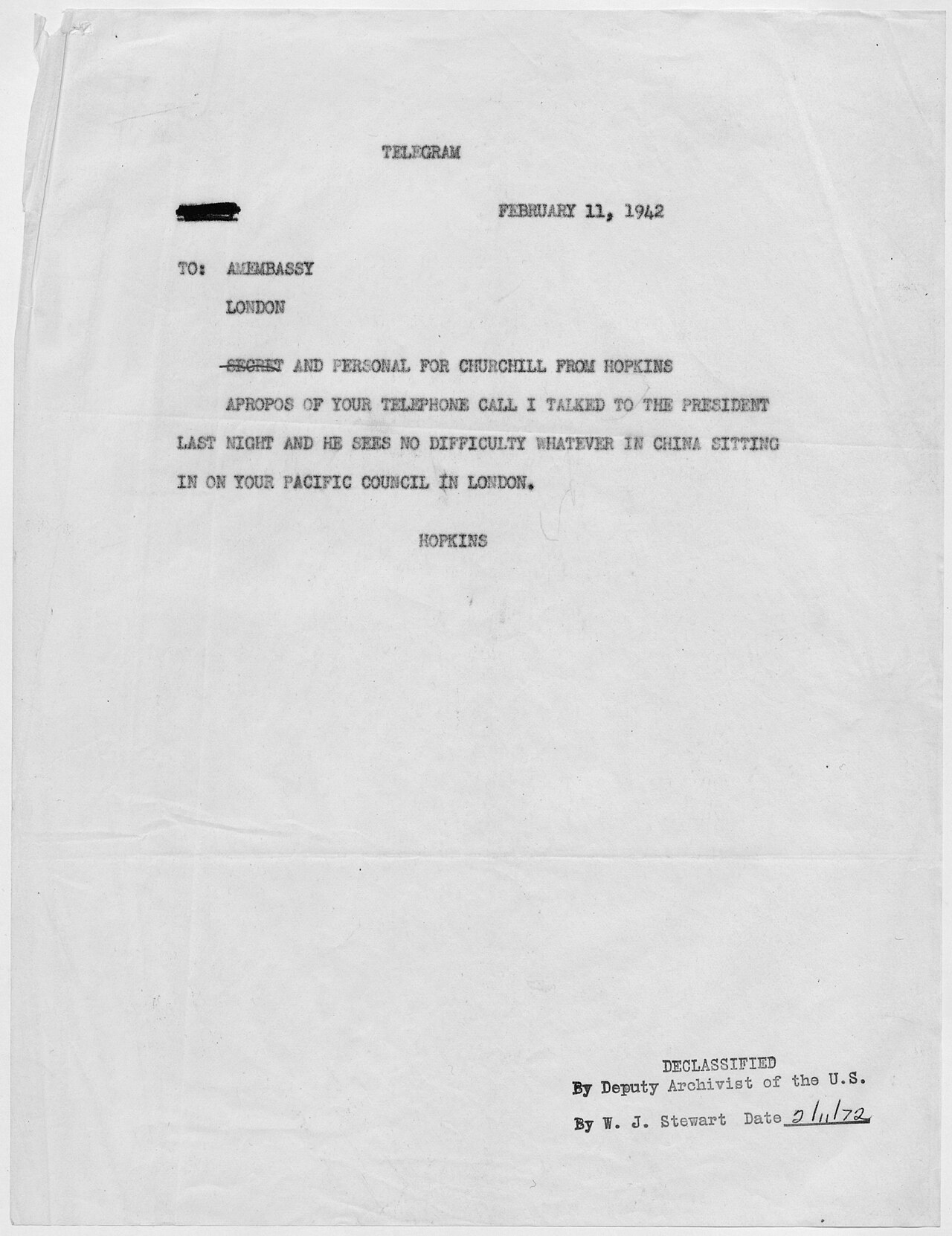
Scanned typed telegram dated February 11, 1942, addressed to Ambassy London, marked secret and personal for Churchill from Hopkins, stating the President sees no difficulty with China sitting in on the Pacific Council in London. Signed Hopkins. Stamped declassified by a Deputy Archivist, dated 2/11/72. Top left has a redacted section.Letter

Primary source

Letter to Winston Churchill, 11 February 1942

Harry Hopkins · 11 February 1942

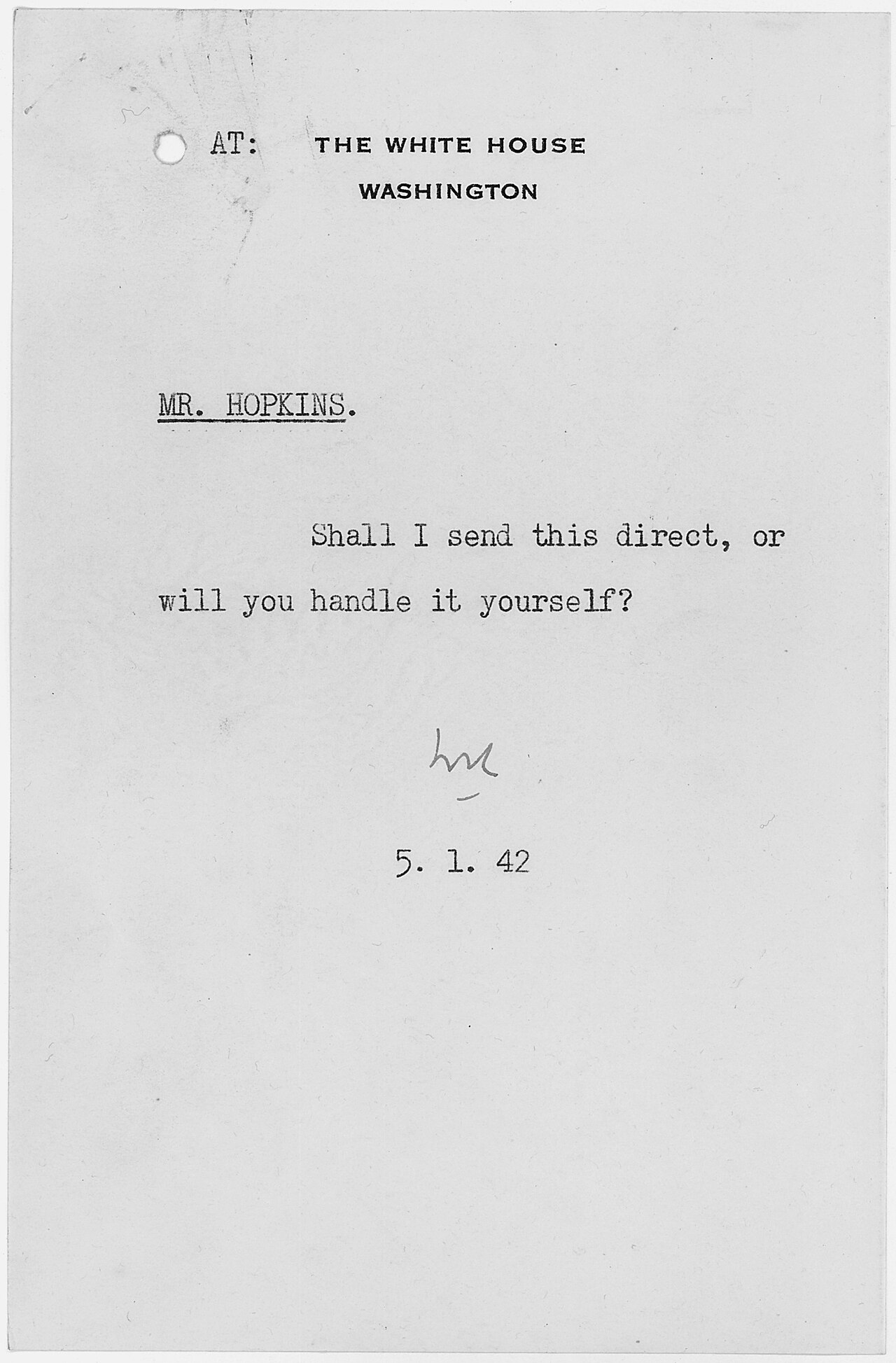
Typed memo on white paper headed 'AT: THE WHITE HOUSE WASHINGTON'. Reads 'MR. HOPKINS.' then 'Shall I send this direct, or will you handle it yourself?' Handwritten initials below and dated 5. 1. 42.Letter

Primary source

Letter from Franklin D. Roosevelt to Harry Hopkins, 1 May 1942

Franklin Delano Roosevelt · 1 May 1942

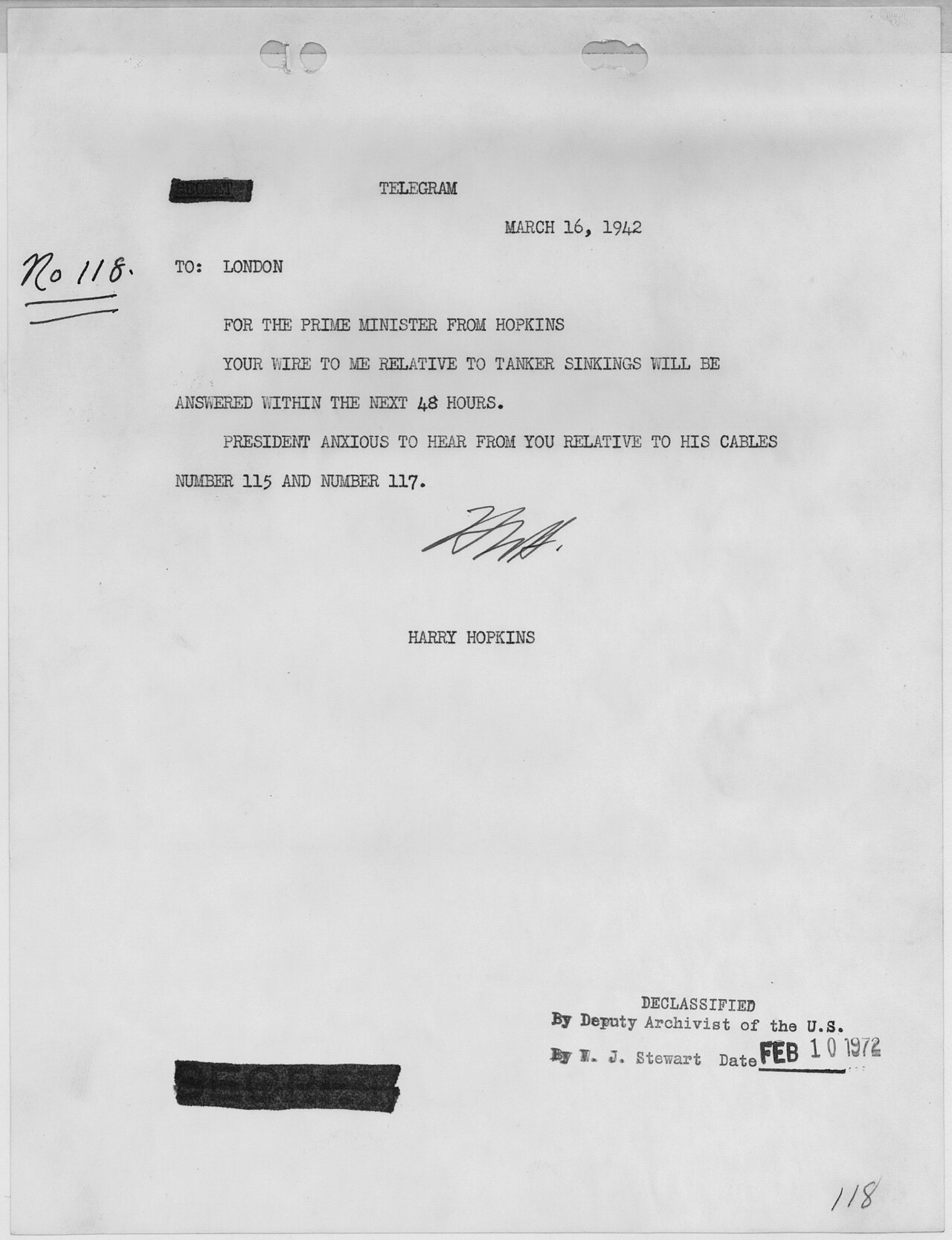
Scanned typed telegram dated March 16, 1942, addressed to London, for the Prime Minister from Hopkins, about tanker sinkings and the President's cables 115 and 117, signed by Harry Hopkins. Handwritten number 118 at left; declassified stamp dated Feb 10, 1972 at bottom right.Letter

Primary source

Letter to Winston Churchill, 16 March 1942

Harry Hopkins · 16 March 1942

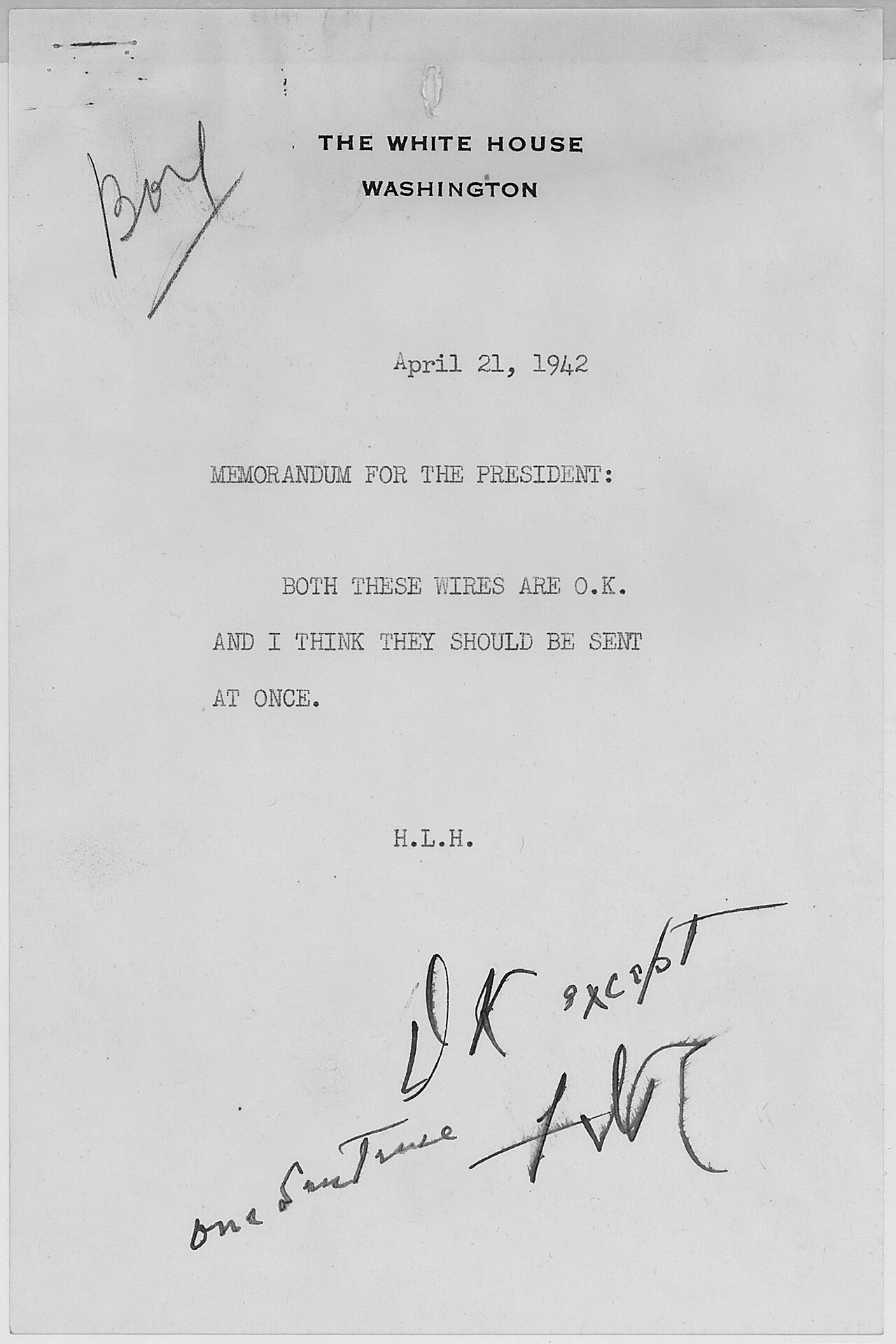
Typed White House memorandum dated April 21, 1942, addressed to the President, reading 'Both these wires are O.K. and I think they should be sent at once,' initialed H.L.H. Handwritten notes 'OK except' and a signature appear at the bottom, with a pencilled initial at top left.Letter

Primary source

Letter to Franklin D. Roosevelt, 21 April 1942

Harry Hopkins · 21 April 1942

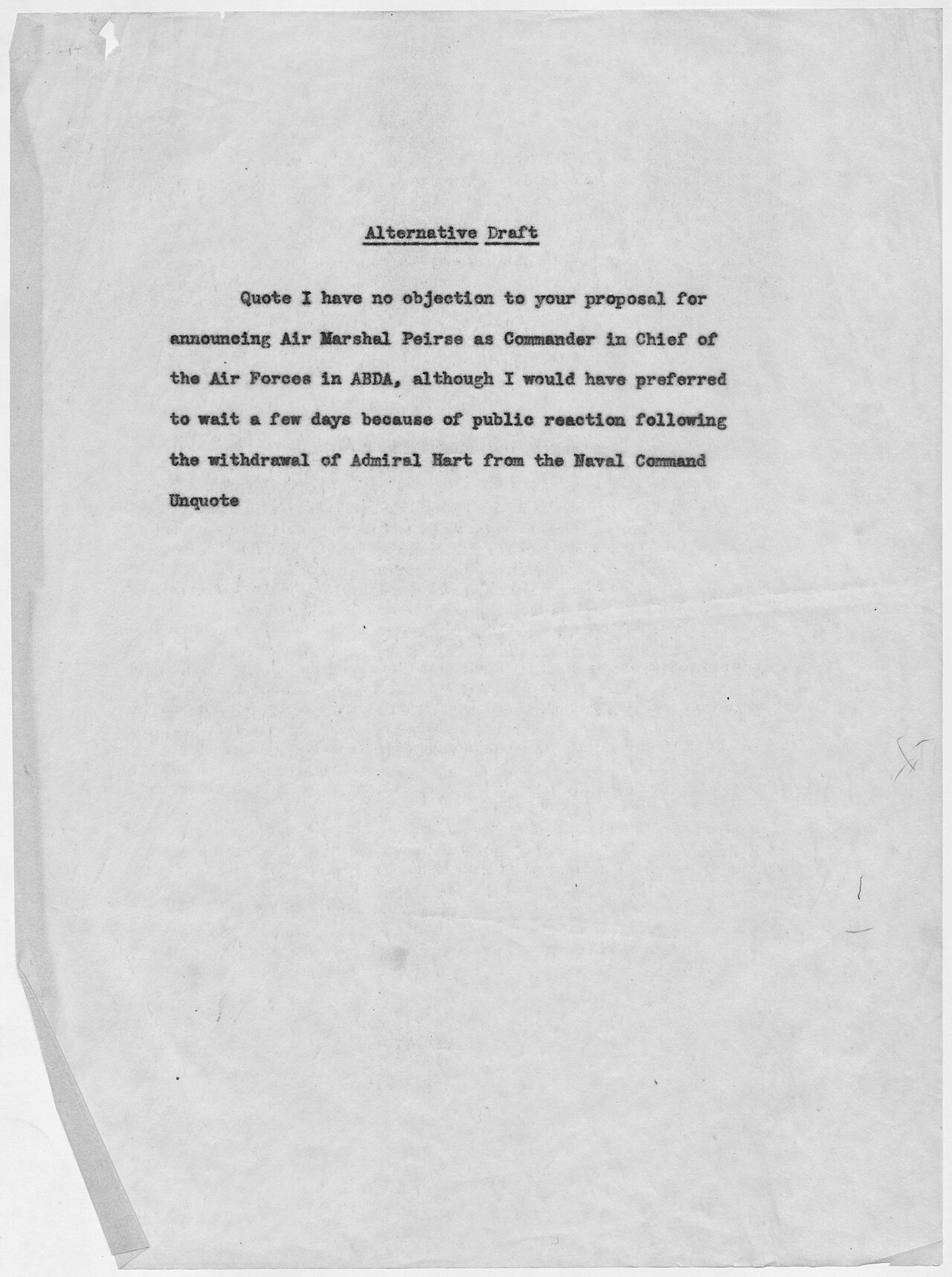
Typed page titled 'Alternative Draft' underlined at top, with a single paragraph in typewriter text beginning 'Quote I have no objection to your proposal for announcing Air Marshal Peirse as Commander in Chief of the Air Forces in ABDA' and ending 'the withdrawal of Admiral Hart from the Naval Command Unquote'. Grey scanned paper with a torn edge at left.Letter

Primary source

Alternative Draft Letter to Winston Churchill, 1942

Harry Hopkins · 1942

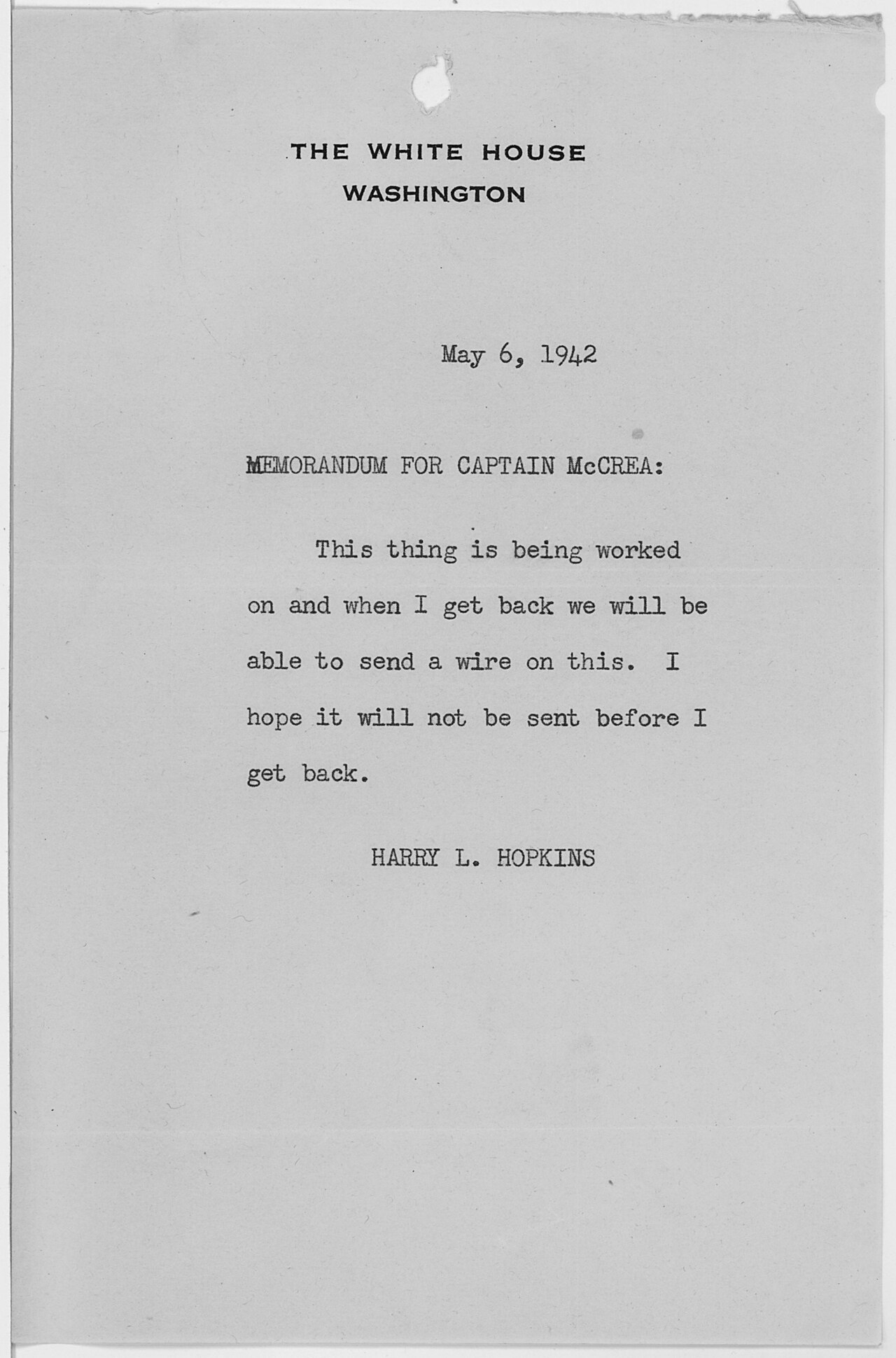
Scan of a typed White House memorandum dated May 6, 1942, addressed to Captain McCrea, saying the matter is being worked on and a wire may be sent after the writer returns. Signed Harry L. Hopkins.Letter

Primary source

Harry Hopkins to Capt. McCrea, 6 May 1942

Harry Hopkins · 6 May 1942

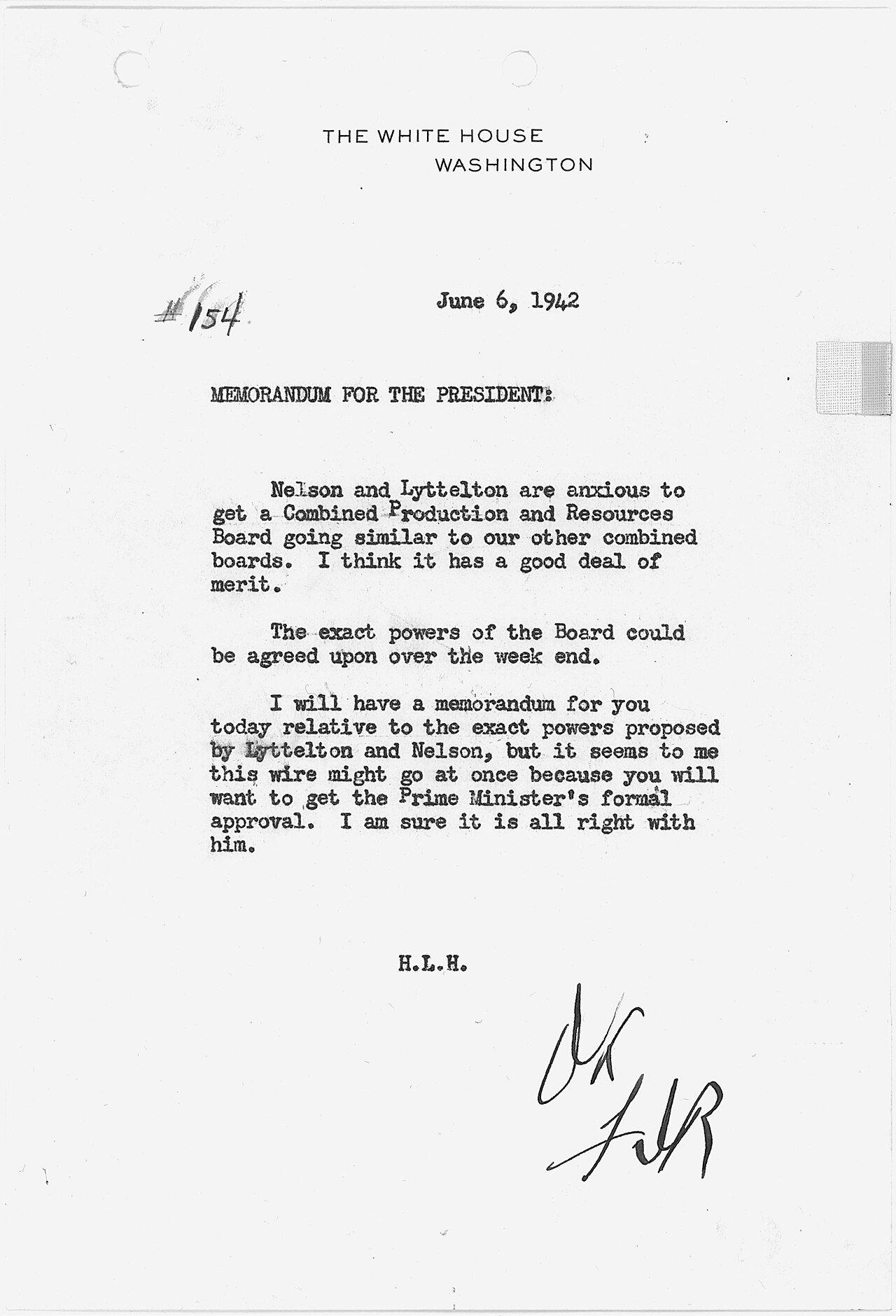
Typed White House memorandum dated June 6, 1942, addressed 'Memorandum for the President,' about a proposed Combined Production and Resources Board. Initialed H.L.H. with a handwritten signature and a handwritten note '#154' at top left.Letter

Primary source

Harry Hopkins to Franklin D. Roosevelt, 6 June 1942

Harry Hopkins · 6 June 1942

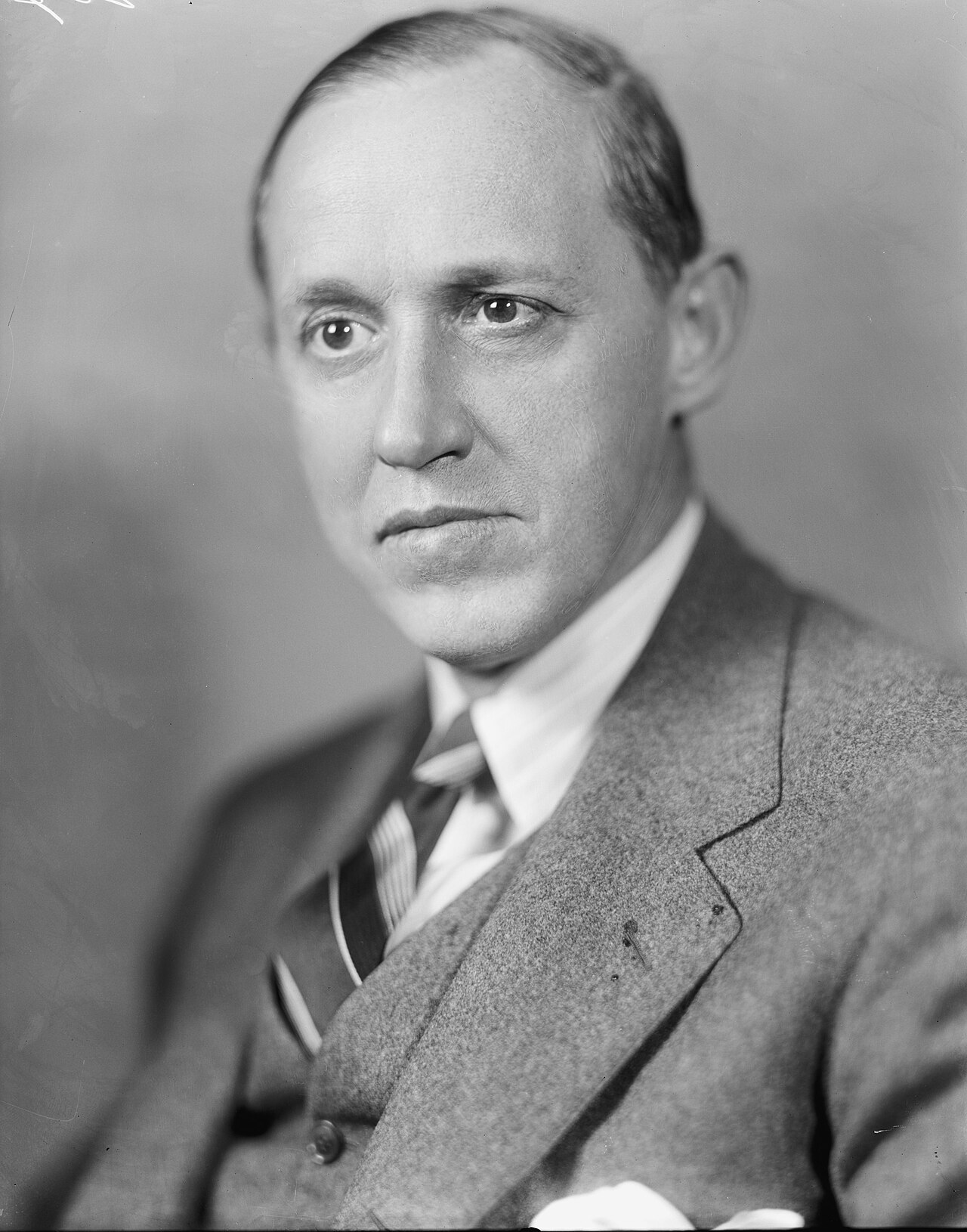
Black and white studio portrait of a man with short, slicked-back hair, wearing a suit jacket, shirt, and striped tie, with a white pocket square visible. He looks toward the camera with a serious expression against a plain grey backdrop.Photograph

Primary source

Cropped Portrait of Harry Hopkins

Harris & Ewing · Unknown

Black and white studio portrait of a man with short combed-back hair, looking to the side with a serious expression, wearing a suit jacket, white collar, and striped tie. Visible film edge border and handwritten marks on the negative.Photograph

Primary source

Harry Hopkins Portrait, Harris & Ewing Glass Negative

Harris & Ewing · 1905 (date doubtful)

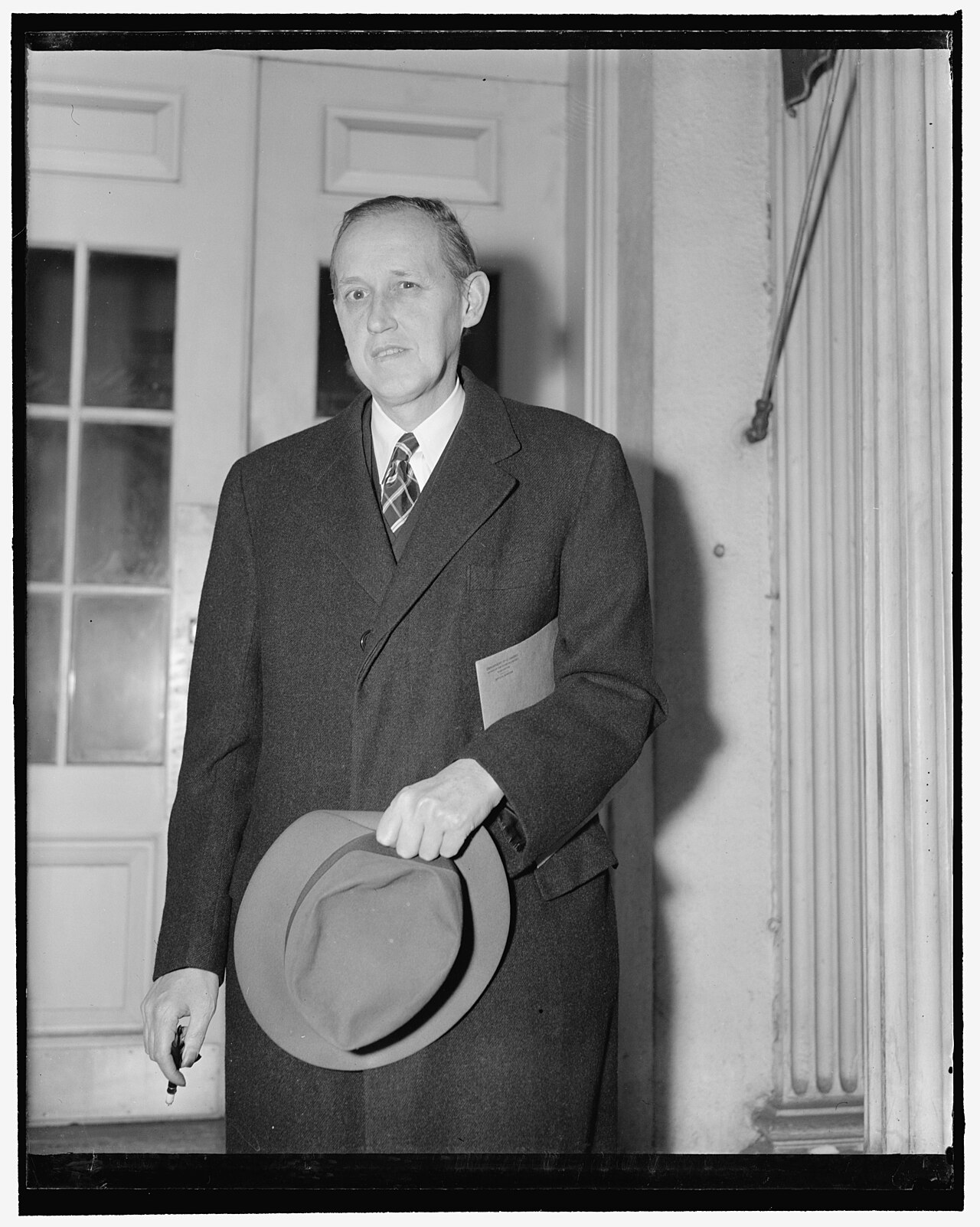
Black-and-white photograph of a man in a long overcoat and plaid tie, holding a hat in one hand and a cane or stick in the other, standing in a doorway beside a fluted column.Photograph

Primary source

Harry Hopkins Portrait, Harris & Ewing, 1940

Harris & Ewing · 1940

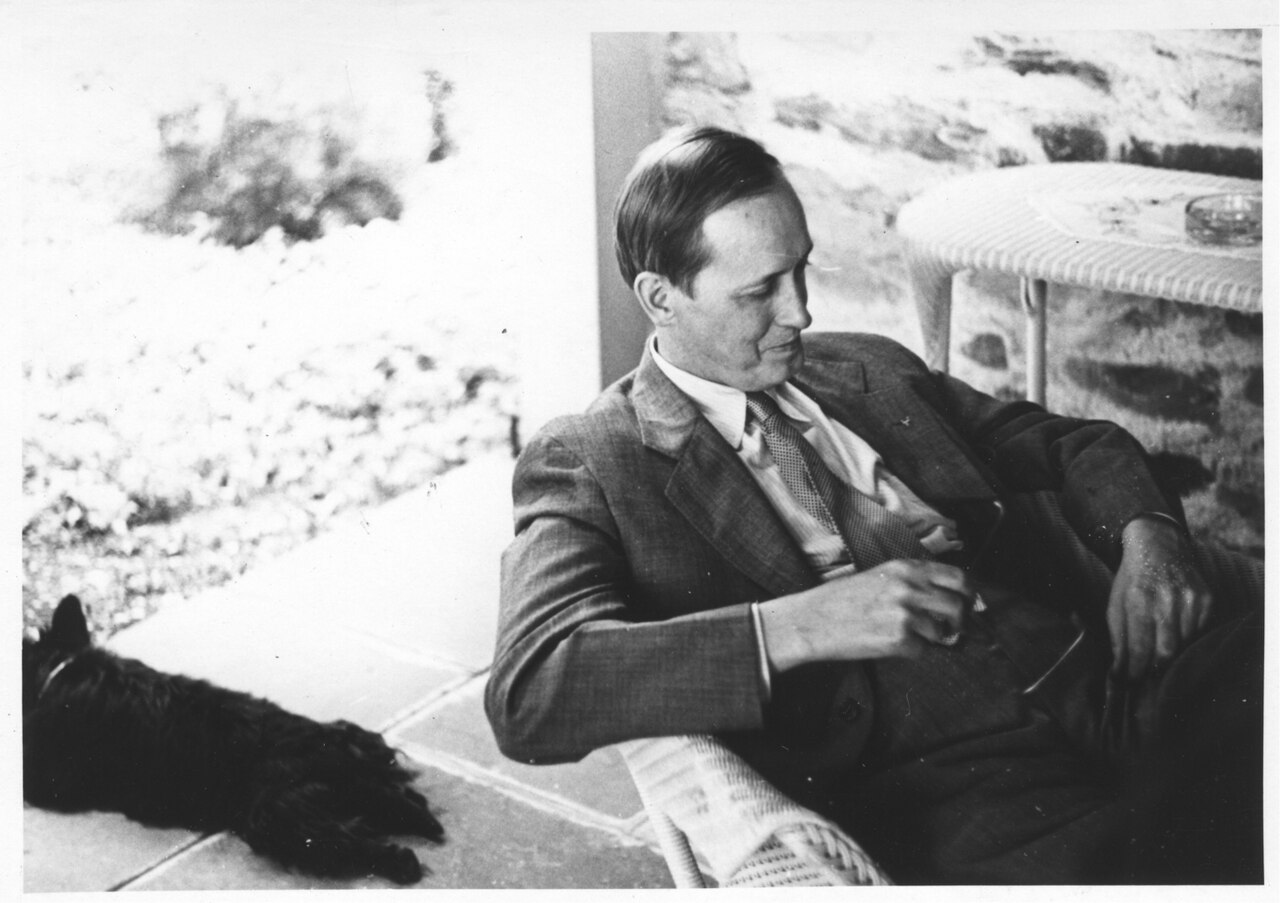
Black-and-white photograph of a man in a tweed suit and tie reclining in a wicker chair on a stone porch, holding a cigarette. A dark dog lies on the tiled floor at left. A wicker table with an ashtray is behind him, and a stone wall and shrubs are visible.Photograph

Primary source

Harry Hopkins and Fala on the Porch at Top Cottage

Margaret Suckley · 1942

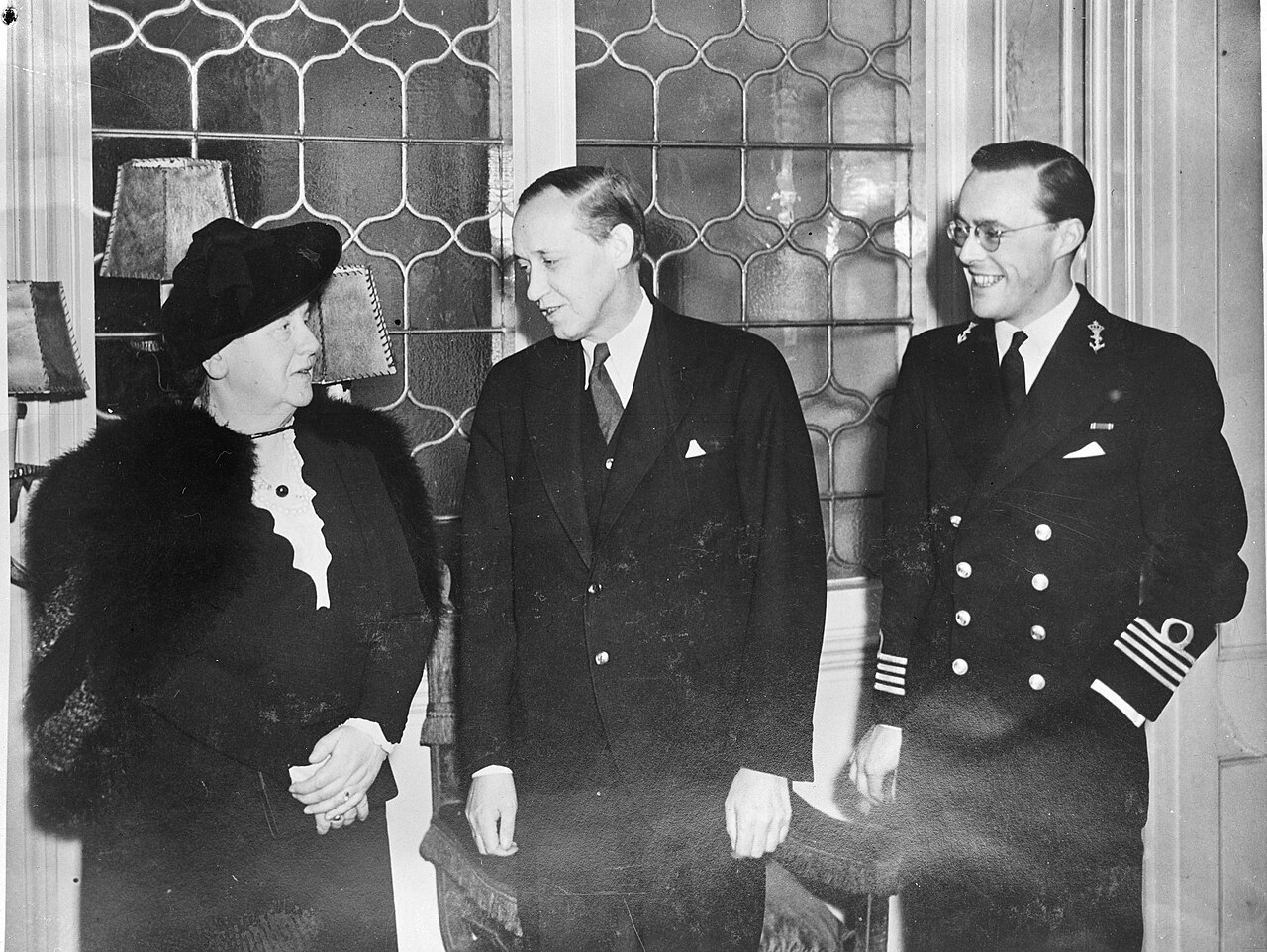
Black and white photograph of three people standing indoors before tall leaded-glass windows. On the left, an older woman in a dark hat and fur-trimmed dark coat, with hands clasped. In the center, a man in a dark suit and tie. On the right, a smiling man in a dark naval-style uniform with double-breasted buttons, sleeve stripes, and eyeglasses.Photograph

Primary source

Queen Wilhelmina and Harry Hopkins in Conversation

Pix Photos London · 4 February 1941

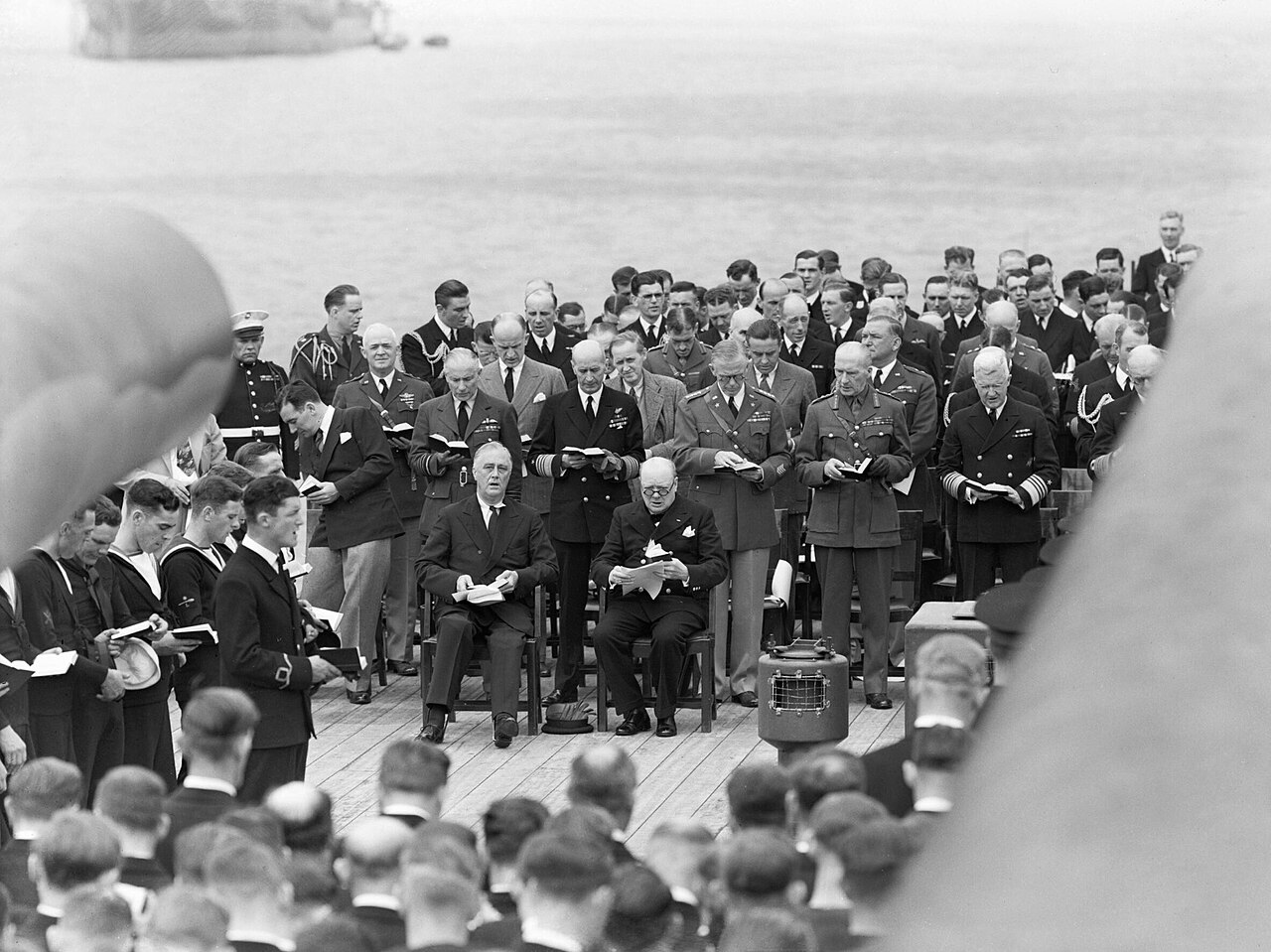
Black and white photo of a church service on a ship deck. Two seated men in front, a bespectacled man in a dark suit and a man in a dark suit with a white flower, face a crowd of sailors. Behind them, officers and men stand holding books, with the sea visible in the background.Photograph

Primary source

Roosevelt and Churchill on HMS Prince of Wales

L C Priest · 10 August 1941

Document

Primary source

Winston Churchill to Harry Hopkins, September 10, 1941

Winston Churchill · 10 September 1941

Letter

Primary source

Milo Perkins to Harry Hopkins, October 13, 1941

Milo Perkins · 13 October 1941

Document

Primary source

Winston Churchill to Harry Hopkins, June 17, 1940

Winston Churchill · 17 June 1940

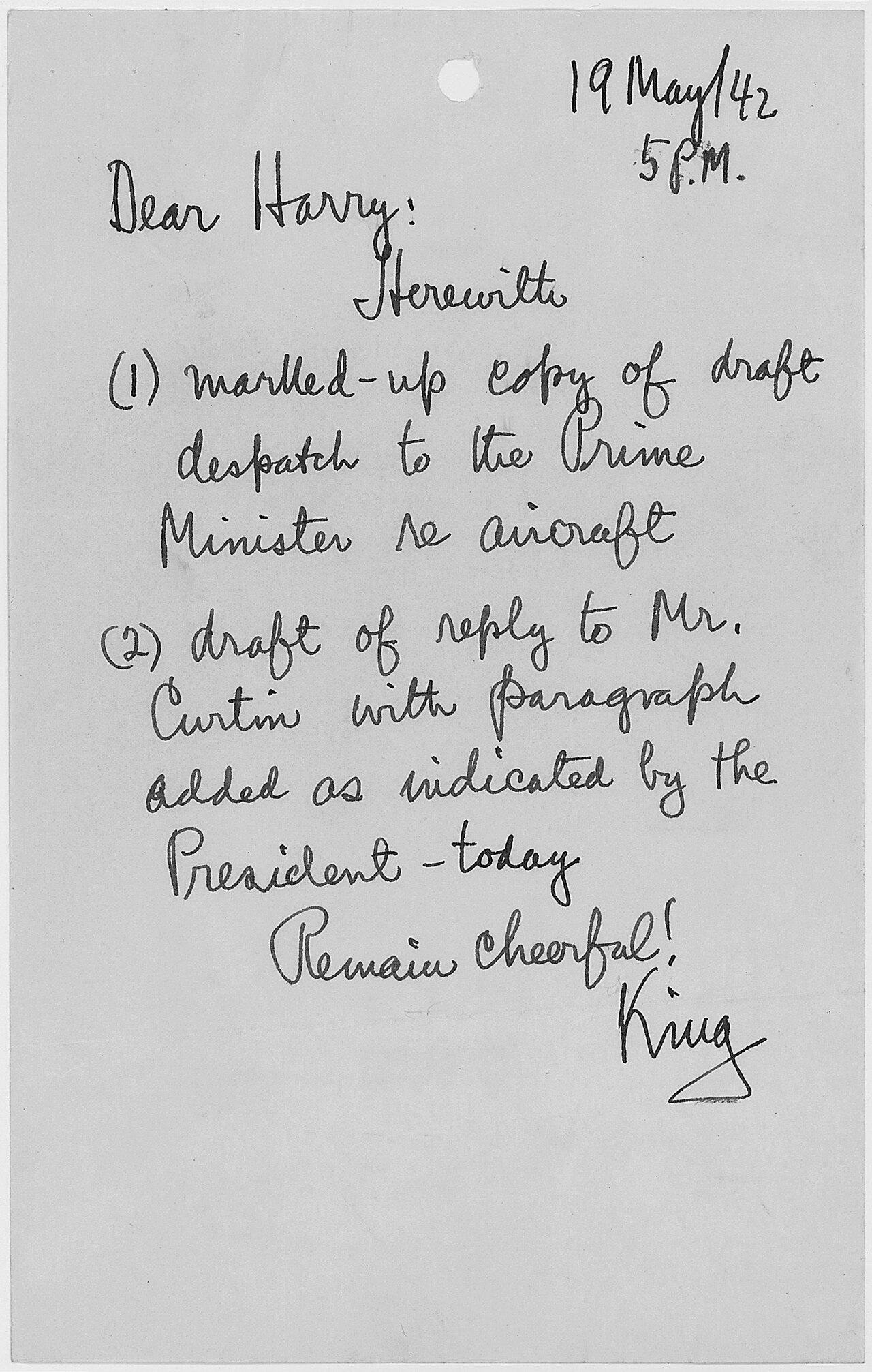
Handwritten letter in ink on paper, dated 19 May 1942, 5 P.M., addressed 'Dear Harry', listing enclosures: a marked-up copy of a draft despatch to the Prime Minister re aircraft, and a draft reply to Mr. Curtin with a paragraph added. Signed 'King' with the closing 'Remain cheerful!'Letter

Primary source

E. J. King to Harry Hopkins, 18 May 1942

E. J. King · 18 May 1942

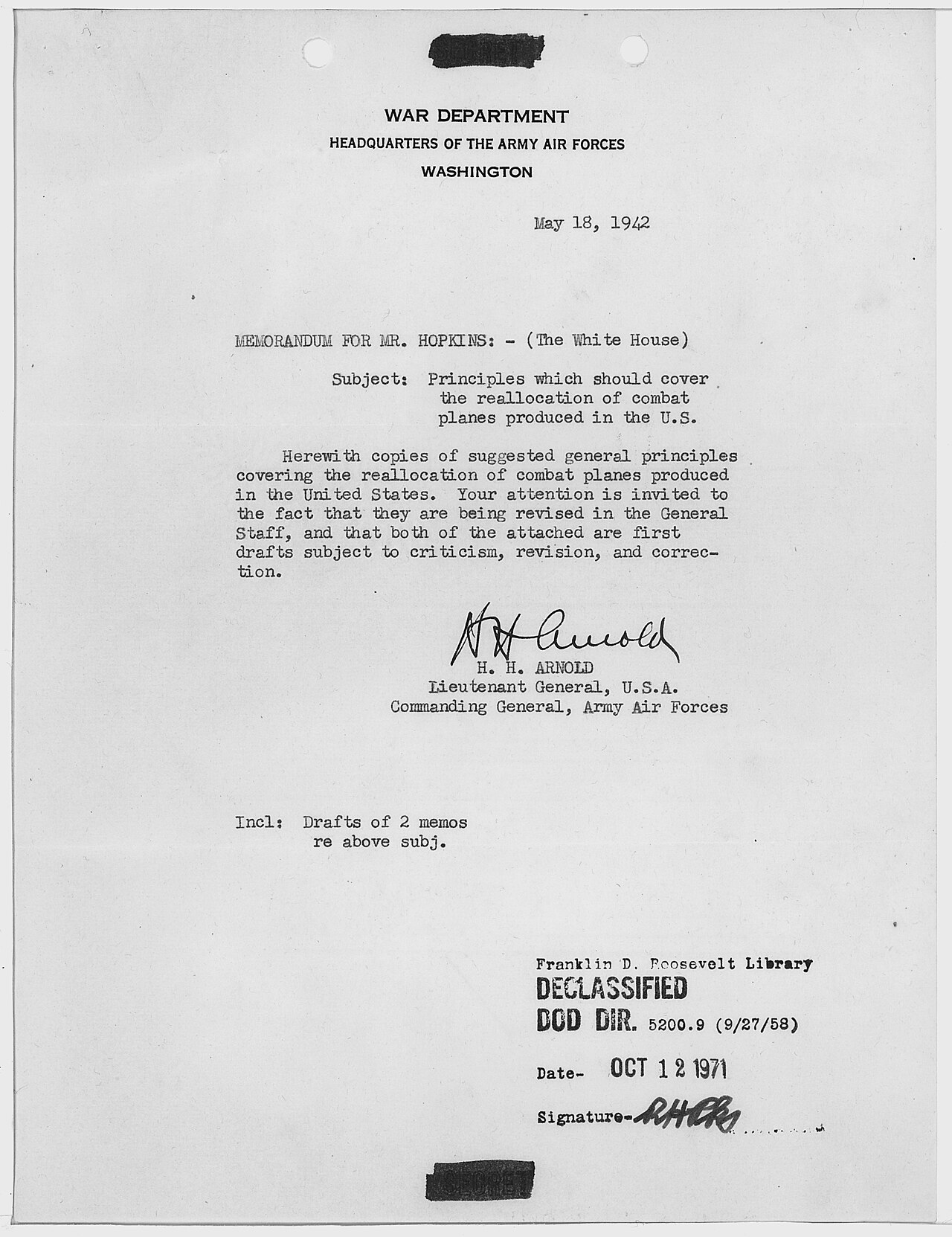
Scanned typed memorandum on War Department, Headquarters of the Army Air Forces letterhead, Washington, dated May 18, 1942, addressed to Mr. Hopkins at The White House, with subject about principles for reallocating combat planes produced in the U.S. Signed H. H. Arnold, Lieutenant General, Commanding General, Army Air Forces. Includes a Franklin D. Roosevelt Library declassified stamp and a black redaction bar.Letter

Primary source

H. H. Arnold to Harry Hopkins, 18 May 1942

Henry H. Arnold · 18 May 1942

Book

Secondary source

A Concise History of the U.S. Air Force, World War II

1997

Book

Secondary source

British War Economy, Chapter IX (Lend-Lease)

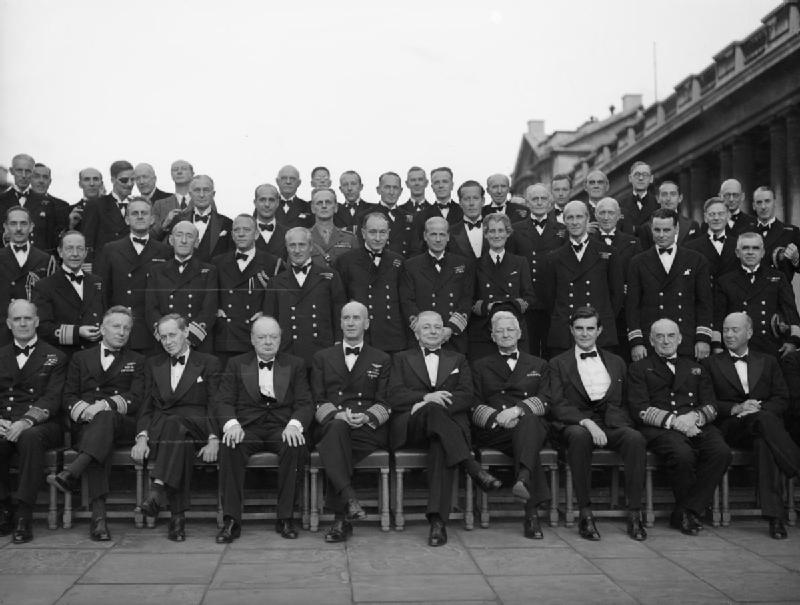
Large group portrait of about forty men in dark naval uniforms and formal dress, arranged in rows on a stone terrace before a classical building with columns. Seated front row includes a man in a dark suit with white shirt in the center; several officers wear peaked caps or braided sleeves. Overcast sky.Photograph

Primary source

Churchill and US Naval Chiefs at Greenwich Naval College, 1942

Smith, J H (Lt), Royal Navy official photographer · 25 July 1942

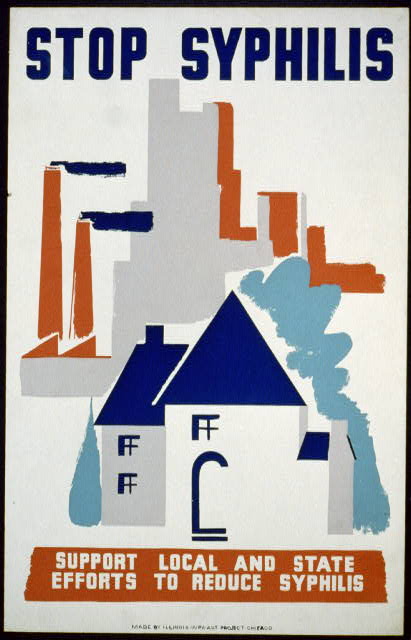
Poster reading 'STOP SYPHILIS' in dark blue letters at top. Orange and grey geometric buildings and smokestacks, a blue-roofed house with a blue cloud-like shape, and a bottom orange banner reading 'SUPPORT LOCAL AND STATE EFFORTS TO REDUCE SYPHILIS'. Small print credits Illinois WPA Art Project, Chicago.Artifact

Primary source

WPA Syphilis Awareness Poster, Chicago

Illinois WPA Art Project · 27 March 1940

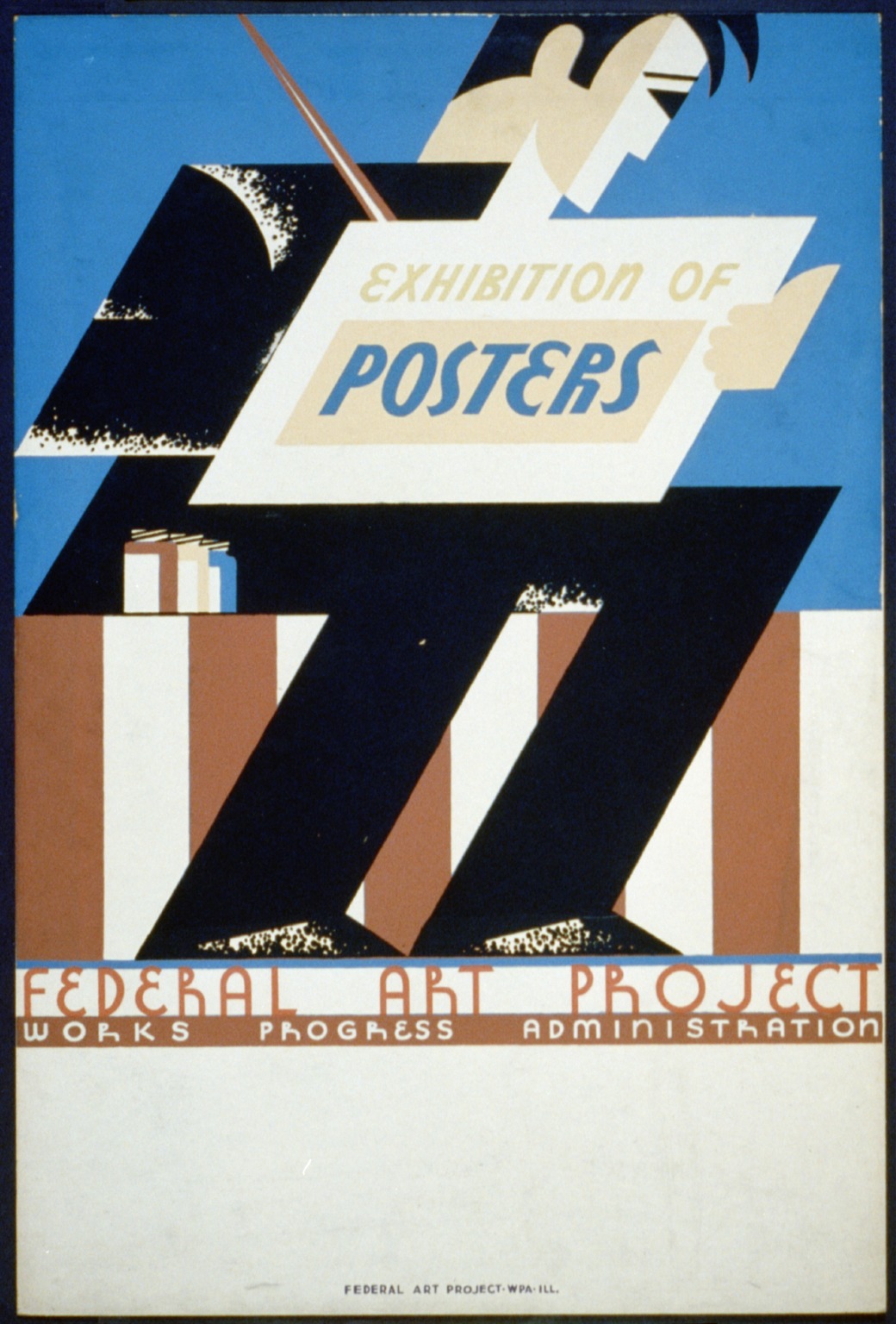
Stylized Federal Art Project poster with a blue sky, a large dark figure holding a white sign reading 'Exhibition of Posters', a tan hand giving a thumbs up, brown and white striped background, and text 'Federal Art Project Works Progress Administration' below.Artifact

Primary source

Federal Art Project WPA Exhibition Poster

Work Projects Administration Poster Collection · between 1936 and 1941

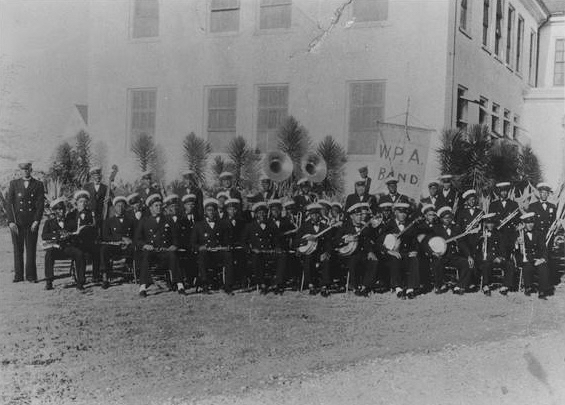
Black-and-white photograph of a large uniformed marching band of about thirty musicians, seated and standing in rows outdoors in front of a light-colored building. Several play instruments including tubas, banjos, drums, and clarinets. A banner reading W.P.A. Band hangs at right, and palm plants stand behind them.Photograph

Primary source

WPA Band, New Orleans

1935

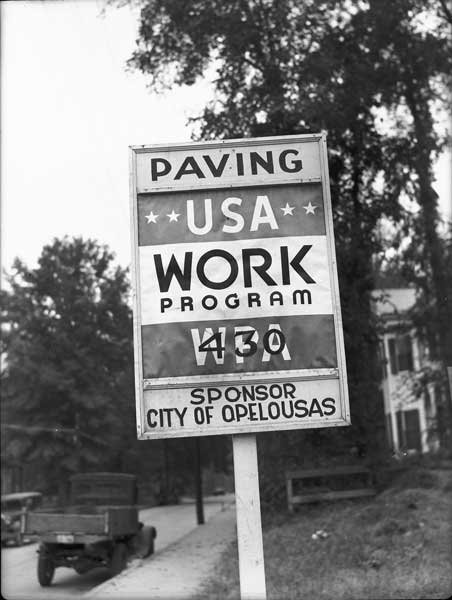
Black-and-white photograph of a roadside sign on a white post reading 'PAVING USA WORK PROGRAM 430 WPA SPONSOR CITY OF OPELOUSAS'. Trees, a house, a parked truck, and a sidewalk are visible behind it.Photograph

Primary source

WPA Paving Project Sign, Opelousas, Louisiana

12 November 1938

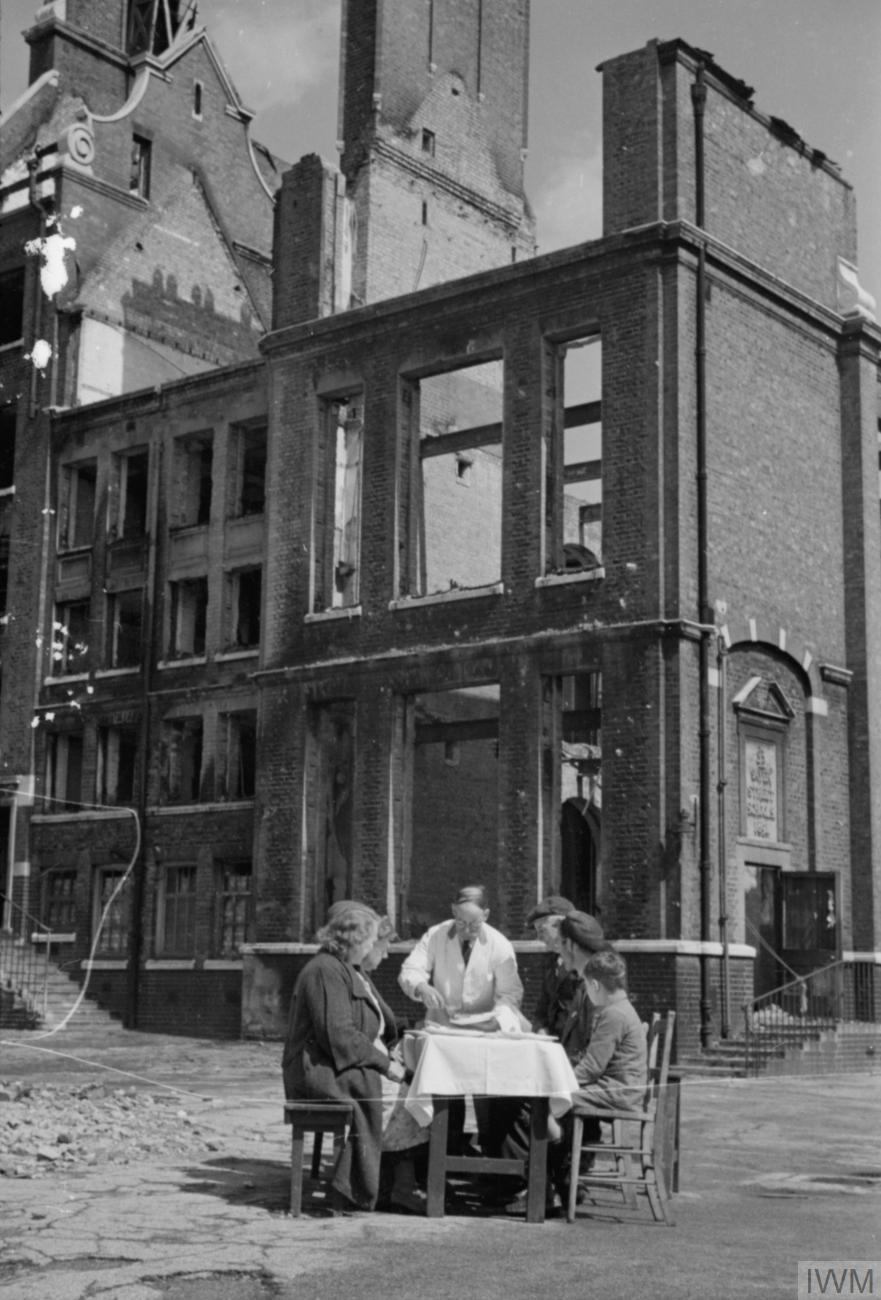
Black and white photograph of a bombed brick building with empty window frames, a white-coated waiter serving food at a table with a white cloth on a cracked street, and four seated people, including a woman and a boy.Photograph

Primary source

Aid From America: Lend-Lease Food, London

Ministry of Information Photo Division photographer · late August or early September 1941

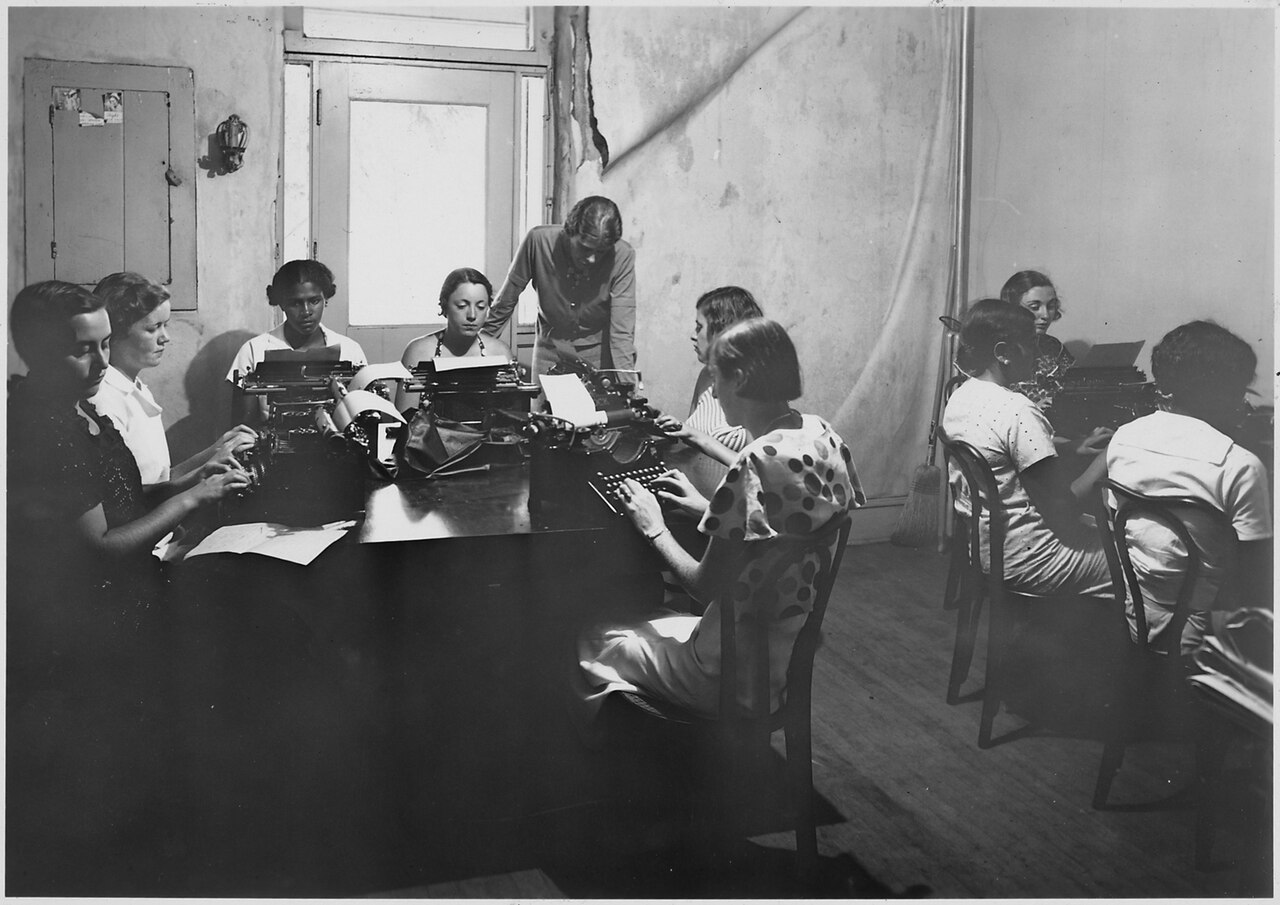
Black-and-white photograph of women seated at typewriters at a long table in a plain room with peeling walls and a window. A standing instructor in a long-sleeved shirt leans over the table. Several more women work at typewriters along the right side of the room.Photograph

Primary source

FERA Women's Camp, Arcola, Pennsylvania

circa July 1934

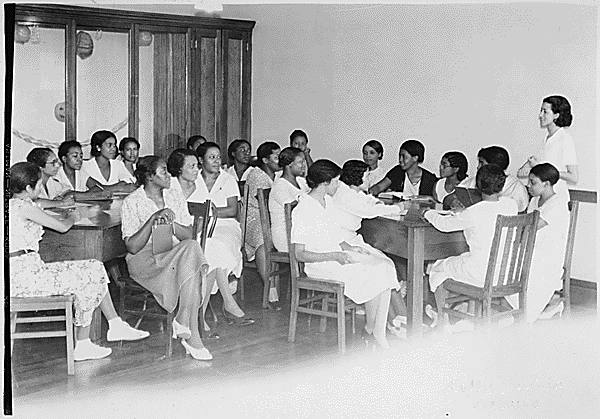
Black-and-white photo of a group of Black women seated around wooden tables in a bare room, listening to a standing white woman at the right edge. Some wear light dresses, several hold papers or cups, and a cabinet stands behind them.Photograph

Primary source

FERA Camp for Unemployed Black Women, Atlanta, Georgia

Franklin D. Roosevelt (as listed in the Commons record) · July 1934

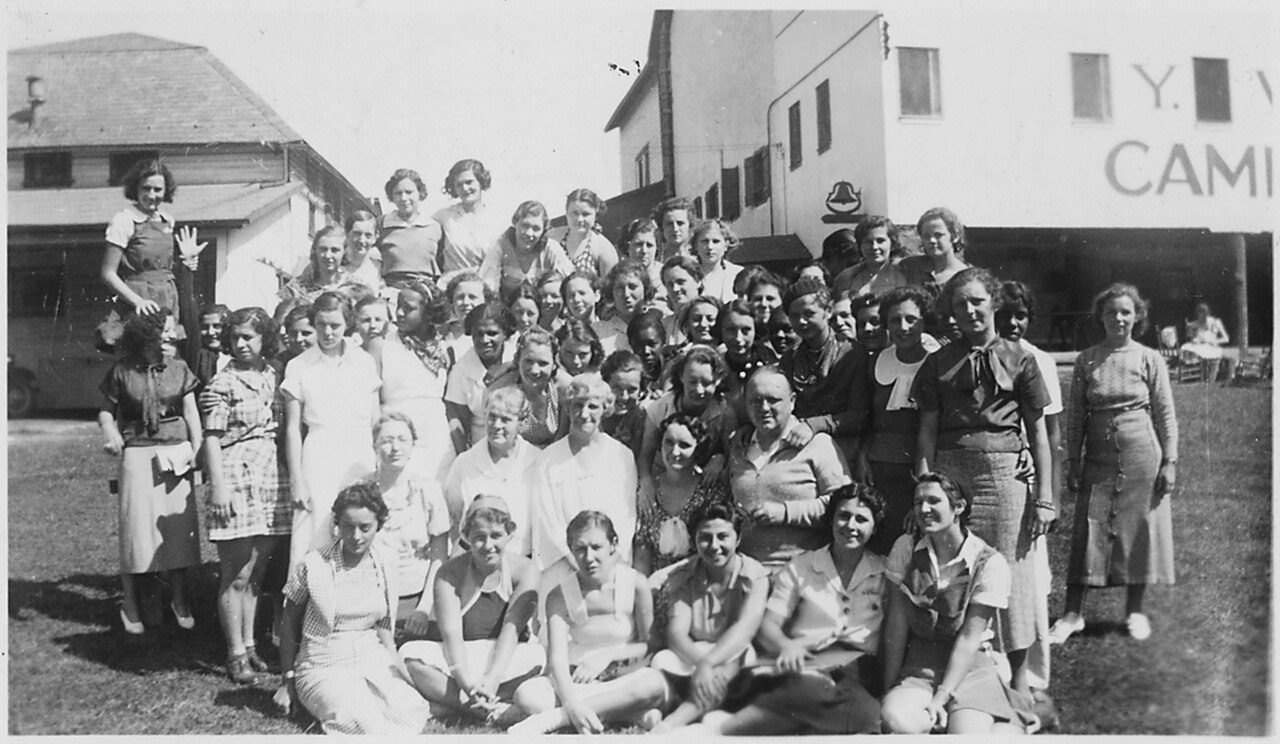
Black-and-white group photograph of about fifty young women posing outdoors on grass in front of a white building with partial sign reading 'Y. W' and 'CAMP'. Some stand in back rows, others sit in front; many wear dresses and skirts. A house and trees appear at left.Photograph

Primary source

FERA Women's Camp Reunion Day, Arcola, Pennsylvania

circa July 1934

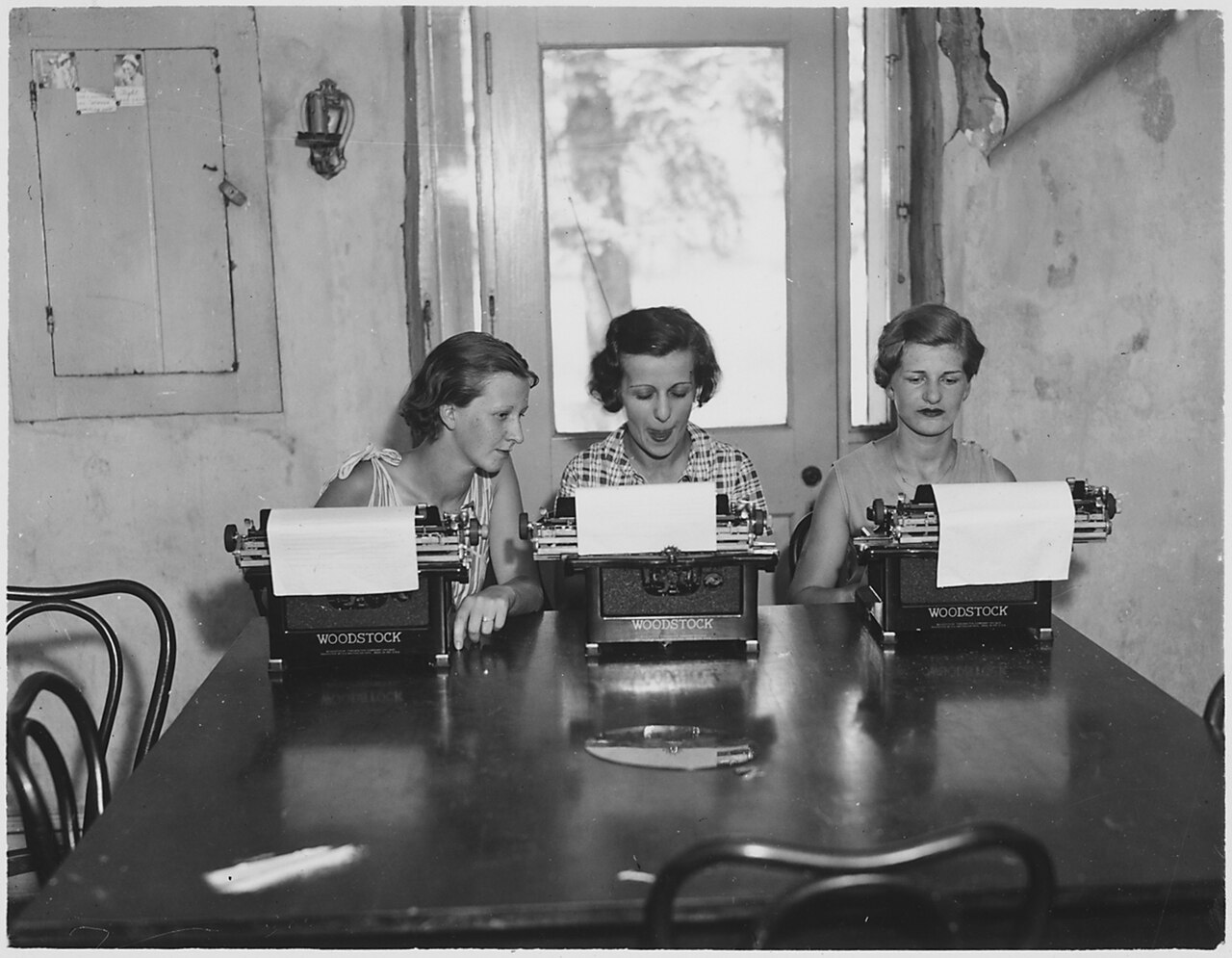
Black-and-white photograph of three young women seated at a wooden table in a plain room, each typing on a Woodstock typewriter with paper loaded. The woman on the left looks toward the center, the center woman leans forward looking at her keys, and the woman on the right looks down at her typewriter. A window and door are behind them.Photograph

Primary source

FERA camps for unemployed women, Arcola, Pennsylvania: Second Camp, 1934

circa July 1934

Document

Primary source

Order Establishing the National Defense Research Committee

Council of National Defense · 27 June 1940

Book

Secondary source

Dunes and Dreams, White Sands history, Chapter 3

1995

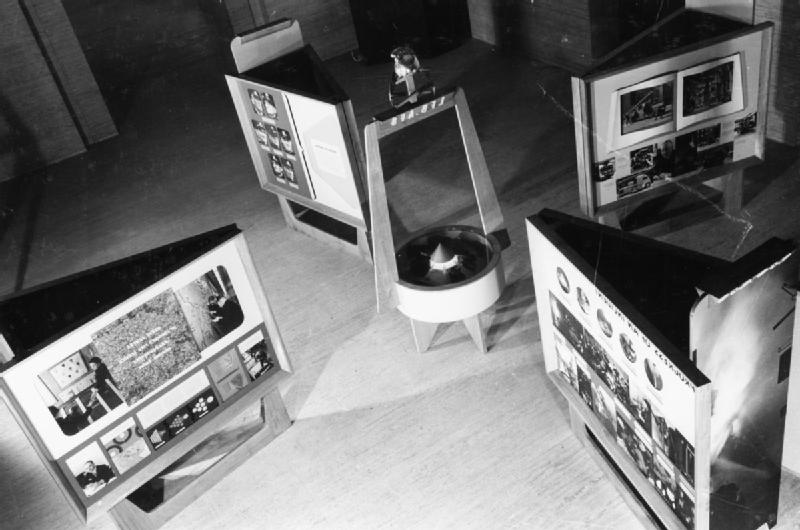
Black and white photograph of a Ministry of Information exhibition display with several angled panels mounted with photographs and text, including a central panel with a circular model and a figure standing atop it, shown on a wooden floor.Photograph

Primary source

Ministry of Information exhibition photo, New York, 1941

Ministry of Information Photo Division, photographer Ray Peter A · 1941

Want the full shelf? Chat with Harry Hopkins in the app and open the Sources panel — every quote links back to the original.

Use Harry Hopkins in class

1 collection

A ready-made collection from the Humy team that features Harry Hopkins. Preview it, then try it free.

Trusted by educators worldwide

Conversations
375,000+
Real exchanges between students and historical figures
Messages exchanged
4,142,000+
Across every figure, classroom and language
Historical figures
100,000+
Each informed by a curated biography and selected sources
Languages supported
50+
From English and Spanish to Arabic and Korean

Paying customers

Used by 98 schools and universities

Partner school logo
Tecnológico de Monterrey logo
Hyper Island logo
Partner school logo
Chambersburg Area School District logo
Broward County Public Schools logo
Nebo School District logo
National Louis University logo
South Florida PBS logo
Punahou School logo
University of Wisconsin–River Falls logo
Partner school logo
Partner school logo
Archbishop Mitty High School logo
Kingsburg High School logo
Norwalk Public Schools logo
Partner school logo
Connections logo
Partner school logo
Moore Public Schools logo
Partner school logo
Partner school logo
Partner school logo
Partner school logo
Robbinsville Public Schools logo
Partner school logo
Partner school logo
Partner school logo
Tecnológico de Monterrey logo
Hyper Island logo
Partner school logo
Chambersburg Area School District logo
Broward County Public Schools logo
Nebo School District logo
National Louis University logo
South Florida PBS logo
Punahou School logo
University of Wisconsin–River Falls logo
Partner school logo
Partner school logo
Archbishop Mitty High School logo
Kingsburg High School logo
Norwalk Public Schools logo
Partner school logo
Connections logo
Partner school logo
Moore Public Schools logo
Partner school logo
Partner school logo
Partner school logo
Partner school logo
Robbinsville Public Schools logo
Partner school logo
Partner school logo

What educators are saying

“We enjoyed the program last year and used it frequently.”
“My students say it’s a welcome change of pace. I’m not a fan of the “sage on the stage” model, so I try to incorporate research-oriented and self-paced activities. With Humy, students have to take charge of their learning. They’ve become more adept at critical thinking, forming better questions, and improving their reading comprehension. The interview feature has been my go-to tool. I create assignments where students must ask historical figures a set number of questions, then summarize the responses to ensure they’re truly absorbing the material. This approach lets them actively explore the past rather than passively consuming information.”
“Humy has helped me bring historical figures, sometimes long past, to life. When my students interact with these figures in real-time, it eliminates some of the perceived “ancient” characteristics of my curriculum. This has shifted my students’ thinking away from viewing history as abstract or irrelevant. Real-time interactions make historical figures relatable, even allowing students to ask off-topic questions that help put historical lives in a more relevant context for 13-year-olds. The feature I use the most is the interview feature. After teaching a topic, most recently Gandhi and Joan of Arc, I have the students ask pointed, focused questions. We practice good conversation techniques beforehand, teaching them to listen (or read) carefully and formulate thoughtful follow-up questions rather than just interrogating. It helps students practice effective conversation skills.”

FAQ

Frequently asked questions

Who is Harry Hopkins?
One of the key architects of the New Deal program in the United States. On Humy.ai you can chat with an AI version of Harry Hopkins that draws on a short biography and 75 historical sources during the conversation — by text or voice, in 42 languages.
Is Harry Hopkins AI free?
Harry Hopkins is part of Humy's full library of more than 100,000 figures, which comes with a paid plan. A free account (no credit card) includes 20 messages a month with the free library's figures, so you can try how the conversations work first.
What sources does the Harry Hopkins AI use?
It draws on a short biography and 75 historical sources (photographs, letters and documents), including “Lend-Lease Act”, “Harry Hopkins at WPA, November 1935” and “Atlantic Charter Conference, HMS Prince of Wales”. Each source has its own page on Humy.ai.
How historically accurate is the AI version of Harry Hopkins?
Each figure uses a short biography and a small set of selected historical sources as context (retrieval-augmented generation), so answers stay closer to known material than the model's general knowledge alone. It isn't a citation-grade research tool — like any LLM, the AI can get details wrong or extrapolate. Treat it as a strong starting point for inquiry and cross-reference important claims.
Can I talk to Harry Hopkins by voice?
Yes. In addition to text chat, you can call Harry Hopkins and hear their voice respond in real time — useful for auditory learners, interview practice and Socratic dialogue.
Is Humy.ai safe and compliant for schools?
Yes. Humy.ai is used by more than 100 schools, universities and organisations. The platform is FERPA- and GDPR-aligned, supports SSO, and offers an IT-approval pack tailored for school procurement teams.

Ready when you are

Start chatting with Harry Hopkins now.

20 messages free · No credit card · Available in 50+ languages.