


Primary sourceDocument2 July 1964
Civil Rights Act of 1964, page 8
US federal government · 2 July 1964
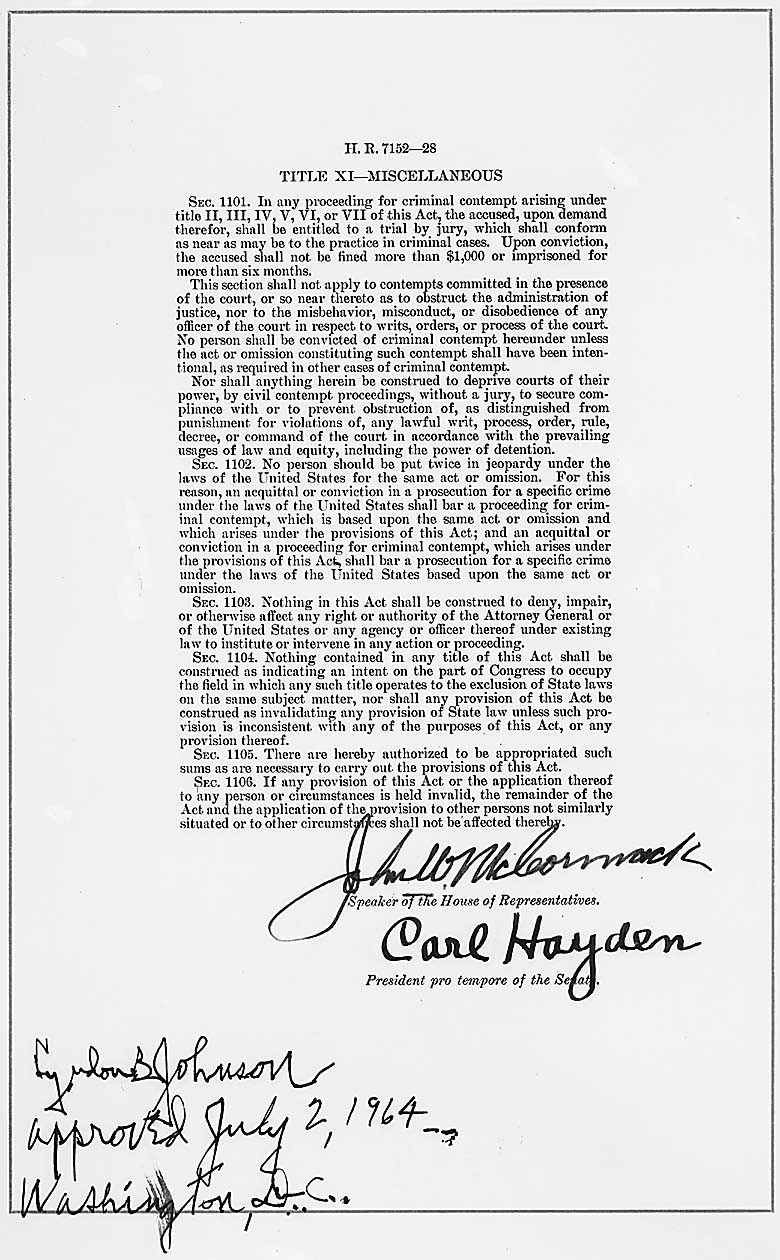
A page of the enrolled Civil Rights Act of 1964, bearing the signatures of the Speaker of the House, the President pro tempore of the Senate, and President Lyndon B. Johnson, who approved it on July 2, 1964.
Johnson's signature on this page approved the Civil Rights Act, the law that is the central achievement of his civil rights record.
About this source
What it is
This is a scanned page from the enrolled law known as the Civil Rights Act of 1964. The page is headed 'H. R. 7152-28, Title XI, Miscellaneous' and contains printed sections 1101 to 1106. Section 1101 concerns trial by jury in certain criminal contempt proceedings arising under the Act. Below the text are handwritten signatures of the Speaker of the House and the President pro tempore of the Senate, and Johnson's signature with the words 'approved July 2, 1964, Washington, D.C.' The record was prepared by the US federal government.
Why it matters
The Civil Rights Act of 1964 outlawed discrimination based on race, color, religion, sex or national origin in many public places and in employment. Johnson signed it into law, and his signature on this page is the moment the bill became law. Only one page is shown, so the archive reveals the legal form of the act rather than its full text. Students can see how Congress and the president shared responsibility for a major law.
Look closer
- Whose signatures appear on this page, and in what order?
- Why might a law include a section about how contempt of court is tried?
- What does this single page leave out about the people the law affected?
This document is part of the curated material that grounds the AI version of Lyndon B. Johnson on Humy.ai — when students ask about related events, the AI can quote it and cite it.
More Lyndon B. Johnson sources
Meet the AI Lyndon B. Johnson →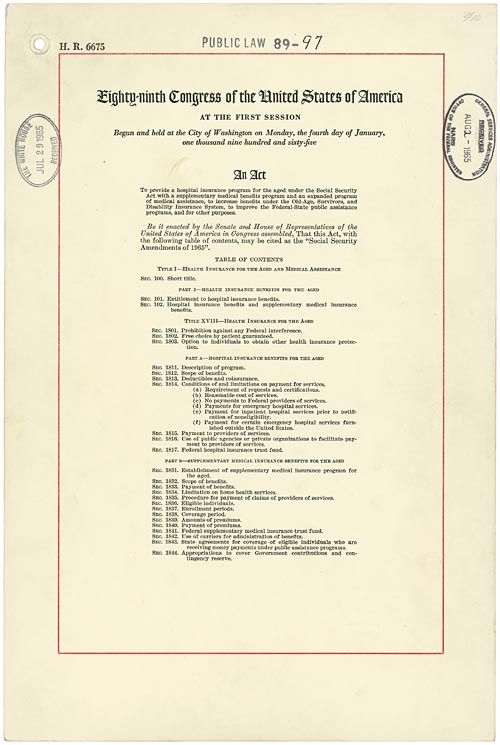 Document
Primary source
Social Security Amendments of 1965 (Medicare and Medicaid Act)
United States Congress · 30 July 1965
Primary source
Great Society Speech at the University of Michigan
Lyndon B. Johnson · 22 May 1964
Primary source
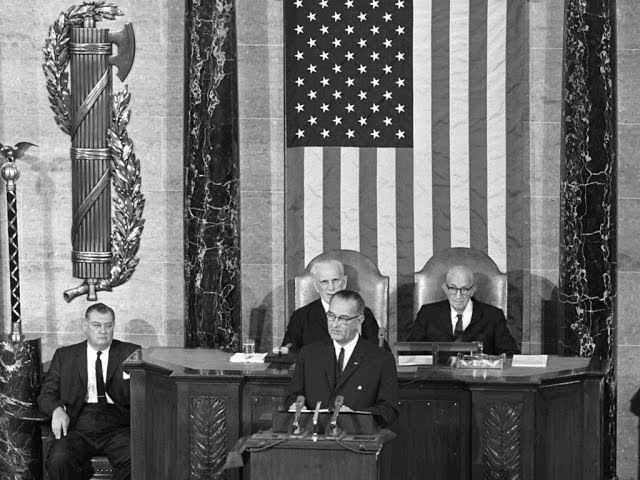
The American Promise Speech to Congress
Lyndon B. Johnson · 15 March 1965
 Speech
Primary source
1964 State of the Union Address
Lyndon B. Johnson · 8 January 1964
Primary source
Renunciation Speech
Lyndon B. Johnson · 31 March 1968
Ready when you are
Start chatting with Lyndon B. Johnson now.
20 messages free · No credit card · Available in 50+ languages.