


Primary sourceDocument1964
Engrossing copy of H.R. 7152, Civil Rights Act of 1964 (excerpt)
U.S. House of Representatives, Office of the Clerk of the House · 1964
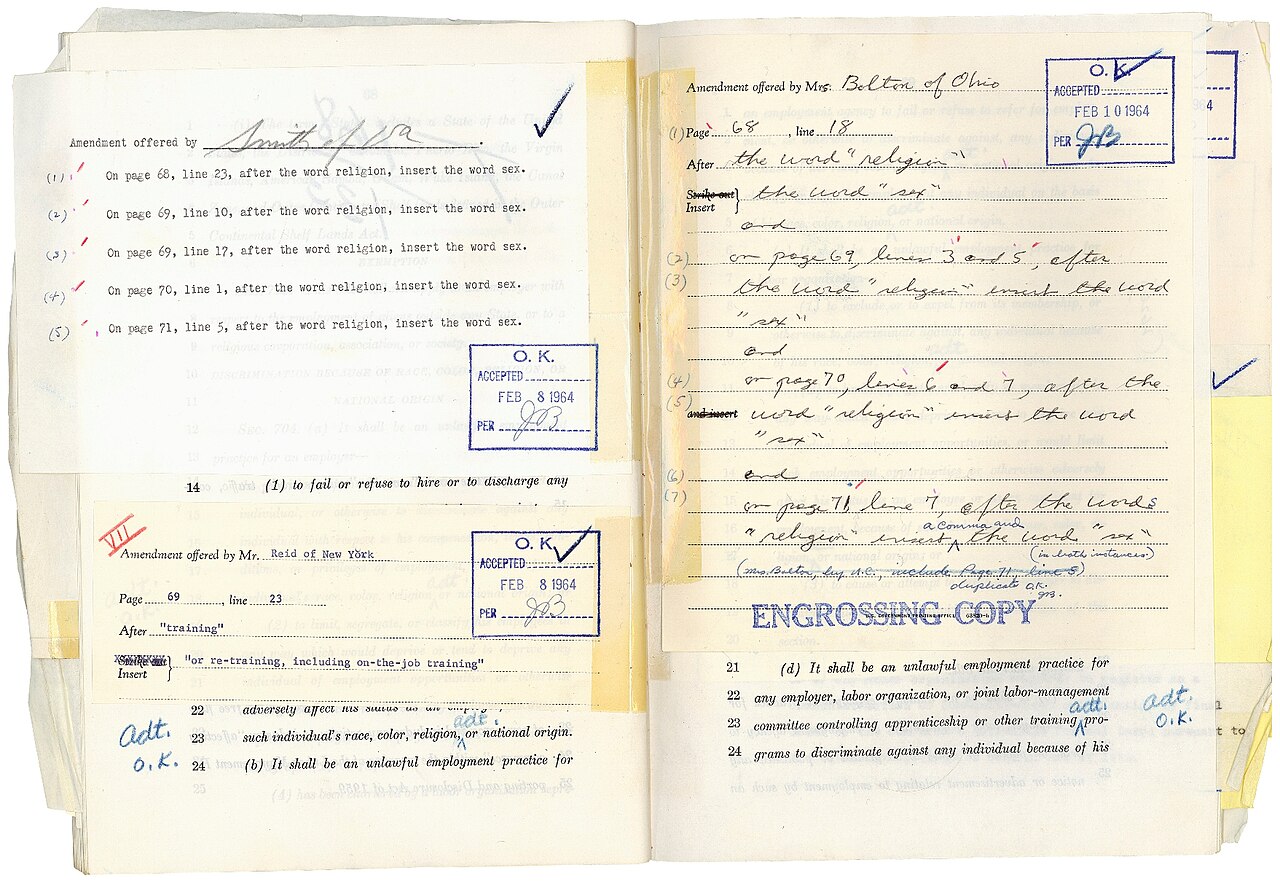
An excerpt from the official House engrossed text of the Civil Rights Act of 1964, the bill Johnson signed into law. The pages show amendments, including one that added the word sex to the list of protected categories.
Shows the House text of the law Johnson signed, including amendments that changed its protected categories, which places him at the end of its legislative path.
About this source
What it is
This is an excerpt from the engrossing copy of H.R. 7152, the Civil Rights Act of 1964, the House text of the bill that Johnson signed into law. The pages show amendments typed and handwritten into the bill, with stamps marked ACCEPTED FEB 8 1964 and the words ENGROSSING COPY printed across a page. One amendment, offered by Representative Howard Smith of Virginia, inserts the word sex after religion in several places, adding gender to the categories the bill prohibits discrimination on. The document is held by the U.S. House of Representatives record.
Why it matters
The law prohibits discrimination based on race, color, religion, sex, or national origin, and this record shows how that wording was built. Other amendments in the excerpt, proposed by Representatives Reid and Belton, change the text about training and the list of categories. The pages reveal the legislative process behind a law that Johnson signed, and they show that members of the House, not only the president, shaped its final words.
Look closer
- Which words are added or changed by the amendments, and on which lines of the bill do they appear?
- Who proposed each amendment, and what might have motivated them?
- What do the stamps and handwritten changes show about how the text was checked, and what does this excerpt leave out of the full act?
This document is part of the curated material that grounds the AI version of Lyndon B. Johnson on Humy.ai — when students ask about related events, the AI can quote it and cite it.
More Lyndon B. Johnson sources
Meet the AI Lyndon B. Johnson → Document
Primary source
Social Security Amendments of 1965 (Medicare and Medicaid Act)
United States Congress · 30 July 1965
Primary source
Great Society Speech at the University of Michigan
Lyndon B. Johnson · 22 May 1964
Primary source
The American Promise Speech to Congress
Lyndon B. Johnson · 15 March 1965
 Speech
Primary source
1964 State of the Union Address
Lyndon B. Johnson · 8 January 1964
Primary source
Renunciation Speech
Lyndon B. Johnson · 31 March 1968
Ready when you are
Start chatting with Lyndon B. Johnson now.
20 messages free · No credit card · Available in 50+ languages.