


Primary sourceLetter449
Leo's Tome
Leo I · 449
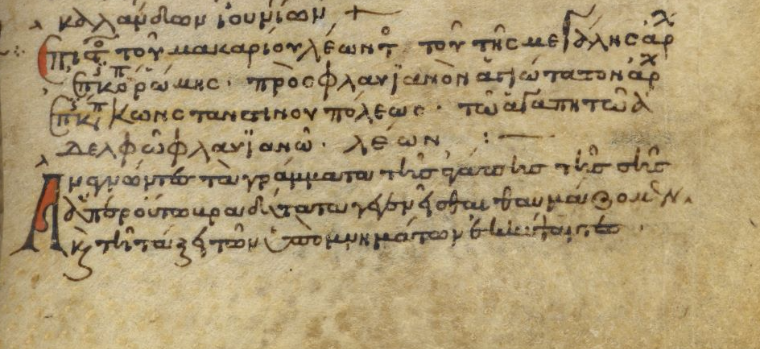
Pope Leo I's doctrinal letter to Flavian of Constantinople, defining Christ as one person in two natures, acclaimed at the Council of Chalcedon.
This is Leo's own doctrinal letter, central to his role in defining Christian teaching about Christ.
About this source
What it is
This is a letter, known as Leo's Tome or the Tomus ad Flavianum, written by Pope Leo I to Archbishop Flavian of Constantinople in 449. It responds to a dispute over the teaching of the presbyter Eutyches, who had been excommunicated by Flavian. The letter sets out the Church's teaching on the nature of Christ.
Why it matters
The Tome argues that Christ has two natures, fully human and fully divine, united in one person. It was read and approved at the Council of Chalcedon in 451, where bishops reportedly declared that Peter had spoken through Leo. It shows Leo's role as a theological authority, and the deep disputes that divided the early Christian Church, since some eastern churches rejected the letter's teaching.
Look closer
- Why might Leo have felt it necessary to explain Christian doctrine in such careful, technical language?
- What does the strong reaction at Chalcedon tell us about the importance of this letter?
- Why did some churches reject a document that others treated as authoritative?
This letter is part of the curated material that grounds the AI version of Pope Leo I on Humy.ai — when students ask about related events, the AI can quote it and cite it.
More Pope Leo I sources
Meet the AI Pope Leo I →Primary source
Sermon 82 on the Feast of Saints Peter and Paul
Leo I · c. 441
Primary source
Letter 14 to Anastasius of Thessalonica
Leo I · c. 446
Primary source
Letter to the Bishops of the Province of Vienne on Hilary of Arles
Leo I · 445
 Painting
Primary source
The Meeting of Leo the Great and Attila
Raphael · 1513-1514
Primary source
Letter 9 to Dioscorus of Alexandria
Pope Leo I · 445
Ready when you are
Start chatting with Pope Leo I now.
20 messages free · No credit card · Available in 50+ languages.