


Primary sourceBook1849
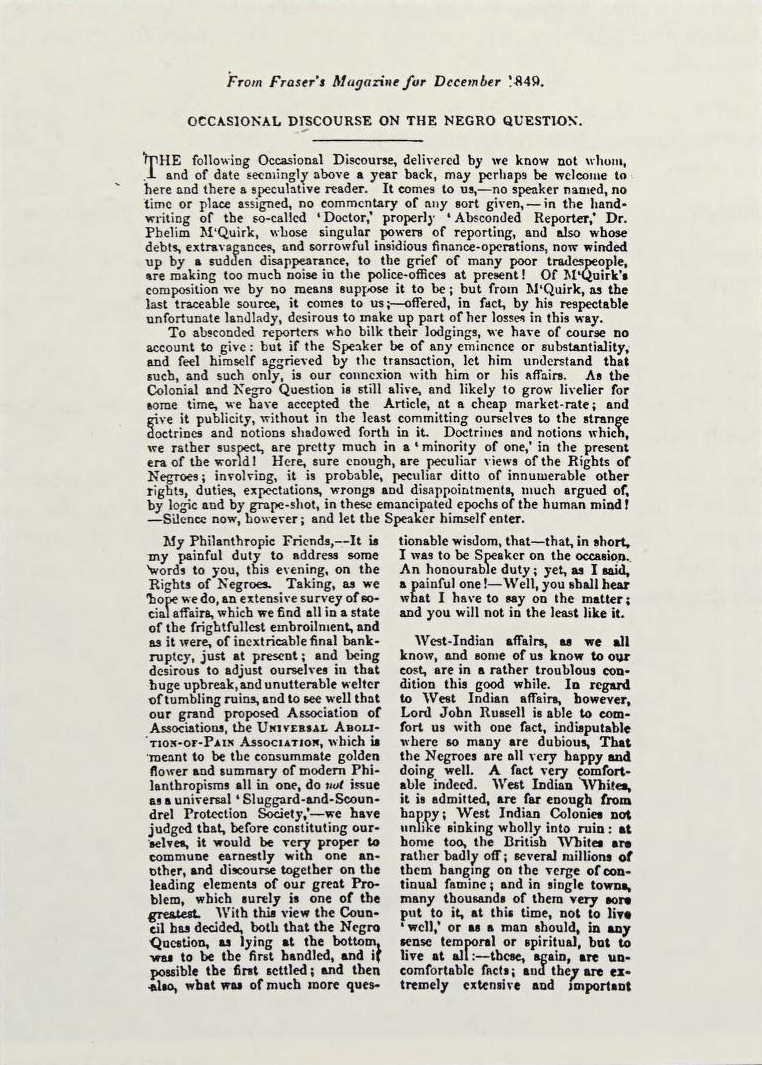
Occasional Discourse on the Negro Question
Thomas Carlyle · 1849
An 1849 essay by Thomas Carlyle that defends slavery through a fictitious speaker. It provoked John Stuart Mill's reply, "The Negro Question".
This essay is the pro-slavery text that prompted Mill's reply, the point where the two former friends broke with each other.
About this source
What it is
This is an essay by the Scottish writer Thomas Carlyle. It was first published anonymously in Fraser's Magazine in London in December 1849. Carlyle presented it as a speech delivered by an unknown speaker and written down by a fictitious reporter, Phelin M'Quirk. In 1853 it was revised and reprinted as a pamphlet under a title that used a racist term for Black people.
The speaker challenges the movement to end slavery. He says conditions on slave ships are not as bad as widely reported, that many countries still allow the trade, and that stopping it would be impossible. The text includes derogatory remarks about the appearance and intelligence of Black people.
Why it matters
The essay sparked a public debate between Carlyle and his former friend John Stuart Mill. Mill replied in the next issue of Fraser's Magazine, arguing that supposedly self-defeating actions by the poor are explained by class oppression. The essay also introduced the phrase 'the dismal science' for economics. Carlyle's closest friends criticised him, and many readers felt his reputation was permanently damaged.
Look closer
- Why does Carlyle hide his own voice behind a fictitious speaker and reporter?
- Which people does the essay describe, and whose experiences does it leave out?
- How does Mill's reply change the argument, and what does each writer assume about human nature?
This book is part of the curated material that grounds the AI version of John Stuart Mill on Humy.ai — when students ask about related events, the AI can quote it and cite it.
More John Stuart Mill sources
Meet the AI John Stuart Mill → Book
Primary source
On Liberty
John Stuart Mill · 1859
 Book
Primary source
Utilitarianism
John Stuart Mill · 1861
 Book
Primary source
The Subjection of Women
John Stuart Mill · 1869
 Book
Primary source
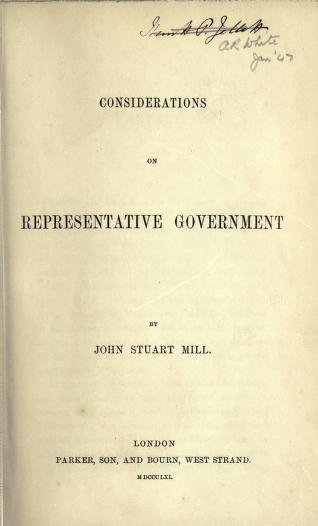
Considerations on Representative Government
John Stuart Mill · 1861
Primary source
Autobiography
John Stuart Mill · 1873 (written; published posthumously)
Ready when you are
Start chatting with John Stuart Mill now.
20 messages free · No credit card · Available in 50+ languages.