


Primary sourceDocument1706
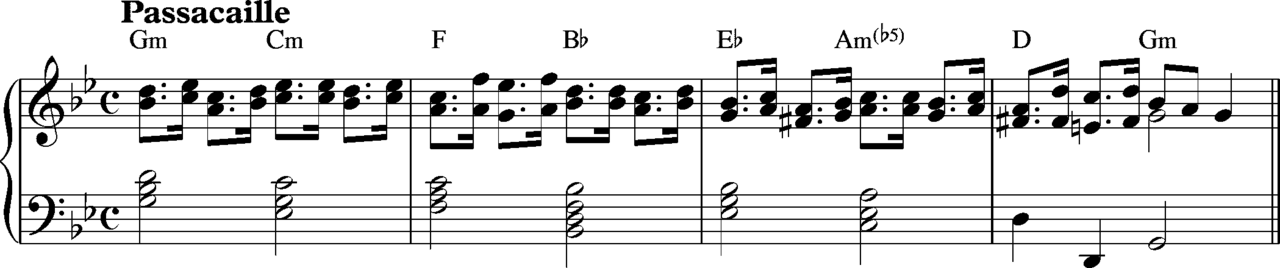
Passacaille from Suite in G minor (opening bars)
George Frideric Handel · 1706
The opening four bars of Handel's Passacaille from a harpsichord suite in G minor, dated 1706. It is a short score excerpt showing his writing for keyboard.
Shows Handel's keyboard writing from his early career, a side of his output separate from his operas and choral works.
About this source
What it is
This is a score of the opening four bars of the Passacaille from a Handel suite in G minor. The date given is 1706, although the file records only the year. The excerpt is in 3/4 time, with a title and chord symbols such as Gm, Cm, F and Bb above a two-staff treble and bass system. Because it is a score, it shows what the player reads, not how the music sounds in performance.
Why it matters
A passacaille is a repeated bass pattern used as the basis for variations. Handel's keyboard suites show the music he wrote for harpsichord players, a different world from his large operas and choral works. Seeing a short excerpt helps students connect Handel to the instrumental music that trained and entertained keyboard players of his time.
Look closer
- What patterns repeat in the bass staff, and how could they be the basis for later variations?
- Why might a composer show the chords above the notes?
- What does a four-bar excerpt leave out about the whole suite?
This document is part of the curated material that grounds the AI version of George Frideric Handel on Humy.ai — when students ask about related events, the AI can quote it and cite it.
More George Frideric Handel sources
Browse all 97 → Document
Secondary source
Messiah
George Frideric Handel · 1741
 Painting
Primary source
George Frideric Handel
Balthasar Denner · c. 1726-1728
 Painting
Primary source
Portrait of George Frideric Handel
Thomas Hudson · 1756
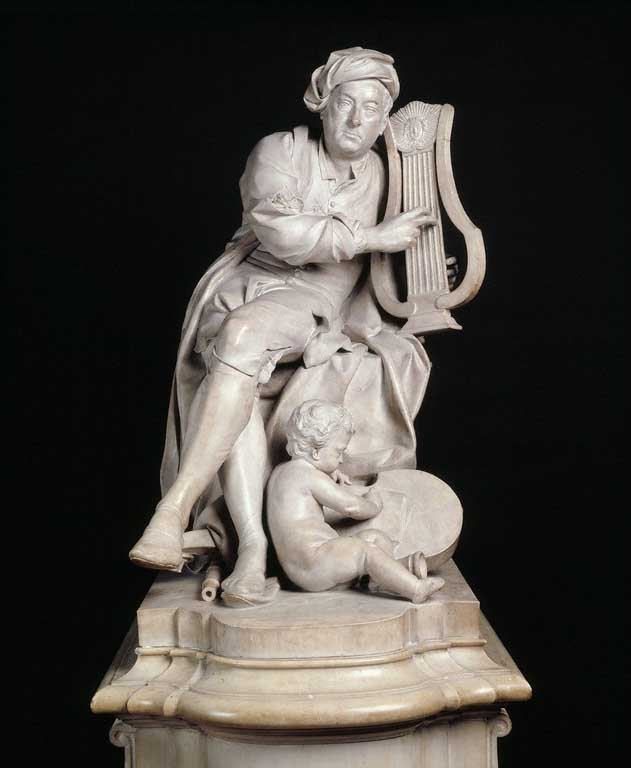 Sculpture
Primary source
Statue of George Frideric Handel
Louis-François Roubiliac · 1738
Free account
Read every George Frideric Handel source
Sign up free →
Ready when you are
Start chatting with George Frideric Handel now.
20 messages free · No credit card · Available in 50+ languages.