


Secondary sourcePainting1500
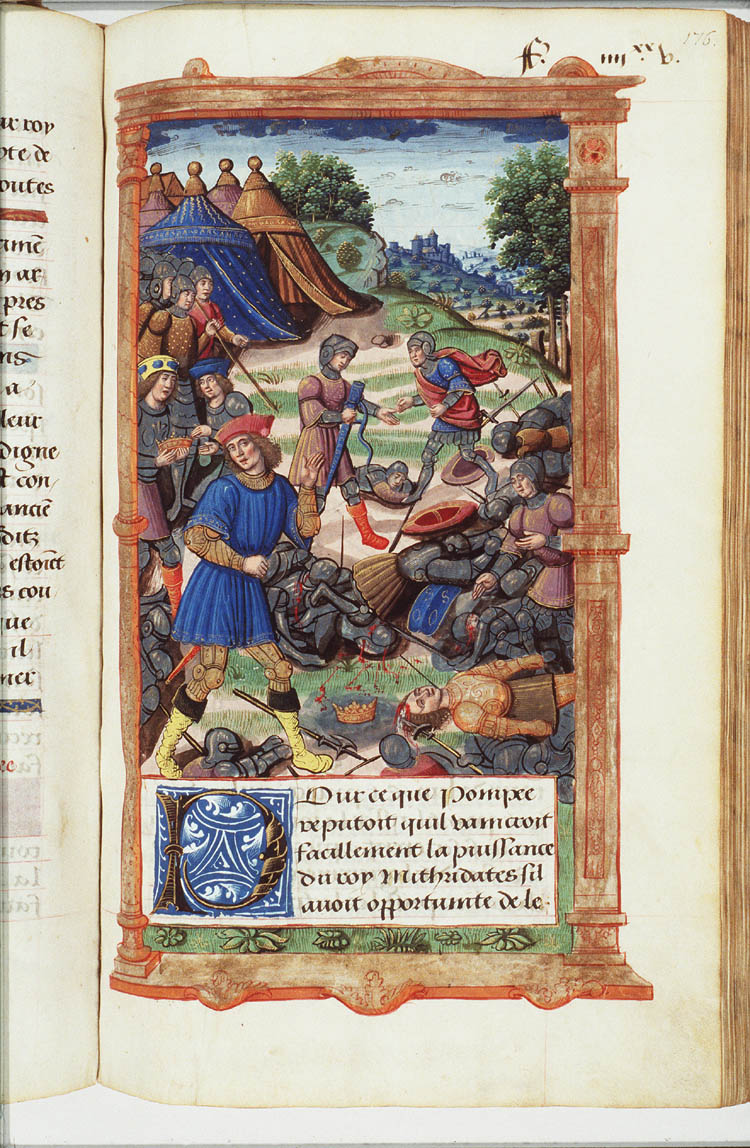
Pompey at Amisus finds gifts and Mithridates' body
1500
A manuscript miniature of Pompey's campaign against Mithridates, showing the aftermath of battle at Amisus, including the corpse of Mithridates. It is a later illustration.
Shows Pompey's campaign against Mithridates, including the dead royal family and Mithridates' corpse at Amisus.
About this source
What it is
This is a page from an illuminated manuscript with a painted miniature, held by the KB, National Library of the Netherlands, and dated 1500. The image shows a mounted and armed scene with soldiers in armor, tents and a castle on a hill. Scattered, bloodied bodies lie on the ground. French text appears below.
Why it matters
The accompanying text describes Pompey at Amisus finding gifts from Pharnaces, son of Mithridates, and the dead bodies of the royal family. It says Pompey turned away in disgust from the decomposing corpse of Mithridates. The scene links Pompey to the long war against Mithridates, king of Pontus.
Look closer
- How does the artist show violence, and what does the scene soften or leave out?
- Why might a French-language manuscript from around 1500 retell a Roman story?
- Which details come from the text and which from the artist's imagination?
This painting is part of the curated material that grounds the AI version of Pompey on Humy.ai — when students ask about related events, the AI can quote it and cite it.
More Pompey sources
Browse all 82 →
Ready when you are
Start chatting with Pompey now.
20 messages free · No credit card · Available in 50+ languages.