


Primary sourcePhotographca. 1900s
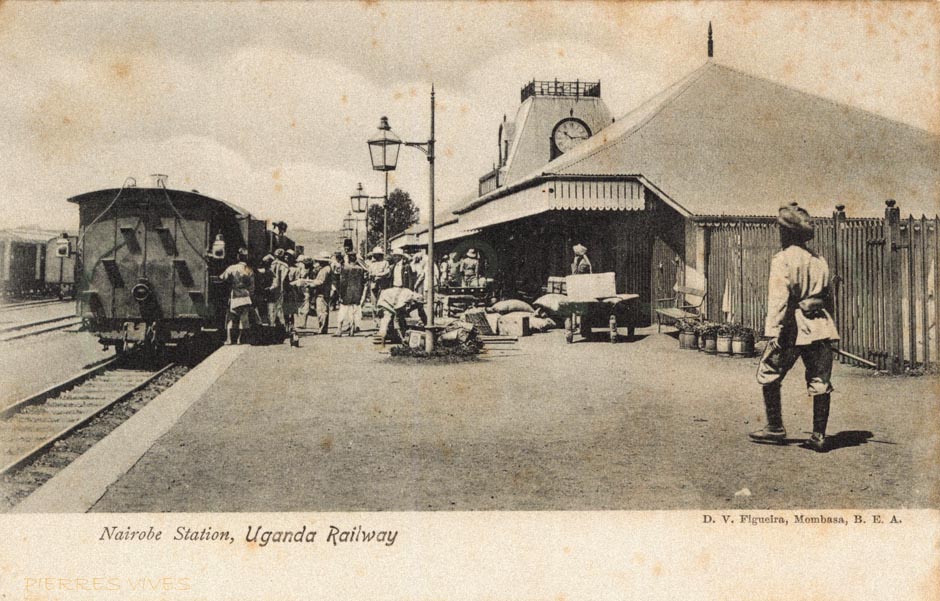
Postcard of Nairobi Station, Uganda Railway
D. V. Figueira · ca. 1900s
An early 1900s postcard photograph of Nairobi Station on the Uganda Railway, the colonial infrastructure built through the land Koitalel and the Nandi resisted.
Shows the colonial railway infrastructure built through the territory that Koitalel and the Nandi people resisted.
About this source
What it is
This is a sepia postcard photograph from around the 1900s, produced by D. V. Figueira of Mombasa, British East Africa. It shows Nairobi Station on the Uganda Railway, with a train, platform, and a clock tower station building. A uniformed guard, described as a Sikh soldier or guard, appears in the image.
Why it matters
The Uganda Railway was a major colonial project cutting through East Africa, including Nandi territory. Its construction and operation were part of the expansion that Koitalel arap Samoei and the Nandi people resisted for years. This postcard shows the railway as a finished, functioning symbol of colonial power, staffed partly by workers brought from British India.
Look closer
- Who appears in this photograph, and who does not?
- What does the presence of a guard suggest about how the railway was protected?
- Why might a postcard like this have been produced and sold?
This photograph is part of the curated material that grounds the AI version of Koitalel arap Samoei on Humy.ai — when students ask about related events, the AI can quote it and cite it.
More Koitalel arap Samoei sources
Browse all 10 →Secondary source
The Nandi: Their Language and Folk-lore
Alfred Claud Hollis · 1909
Primary source
The East Africa Protectorate
Sir Charles Eliot · 1905
 Book
Primary source
My African Journey
Winston Churchill · 1909
 Artifact
Primary source
Africa General Service Medal
George de Saulles · 1902
Free account
Read every Koitalel arap Samoei source
Sign up free →
Ready when you are
Start chatting with Koitalel arap Samoei now.
20 messages free · No credit card · Available in 50+ languages.