


Primary sourceDocument1967
Public Broadcasting Act of 1967
1967
The 1967 law establishing the Corporation for Public Broadcasting, signed by President Johnson as part of his Great Society programs.
Johnson signed this act, creating the Corporation for Public Broadcasting as part of his Great Society's cultural programs.
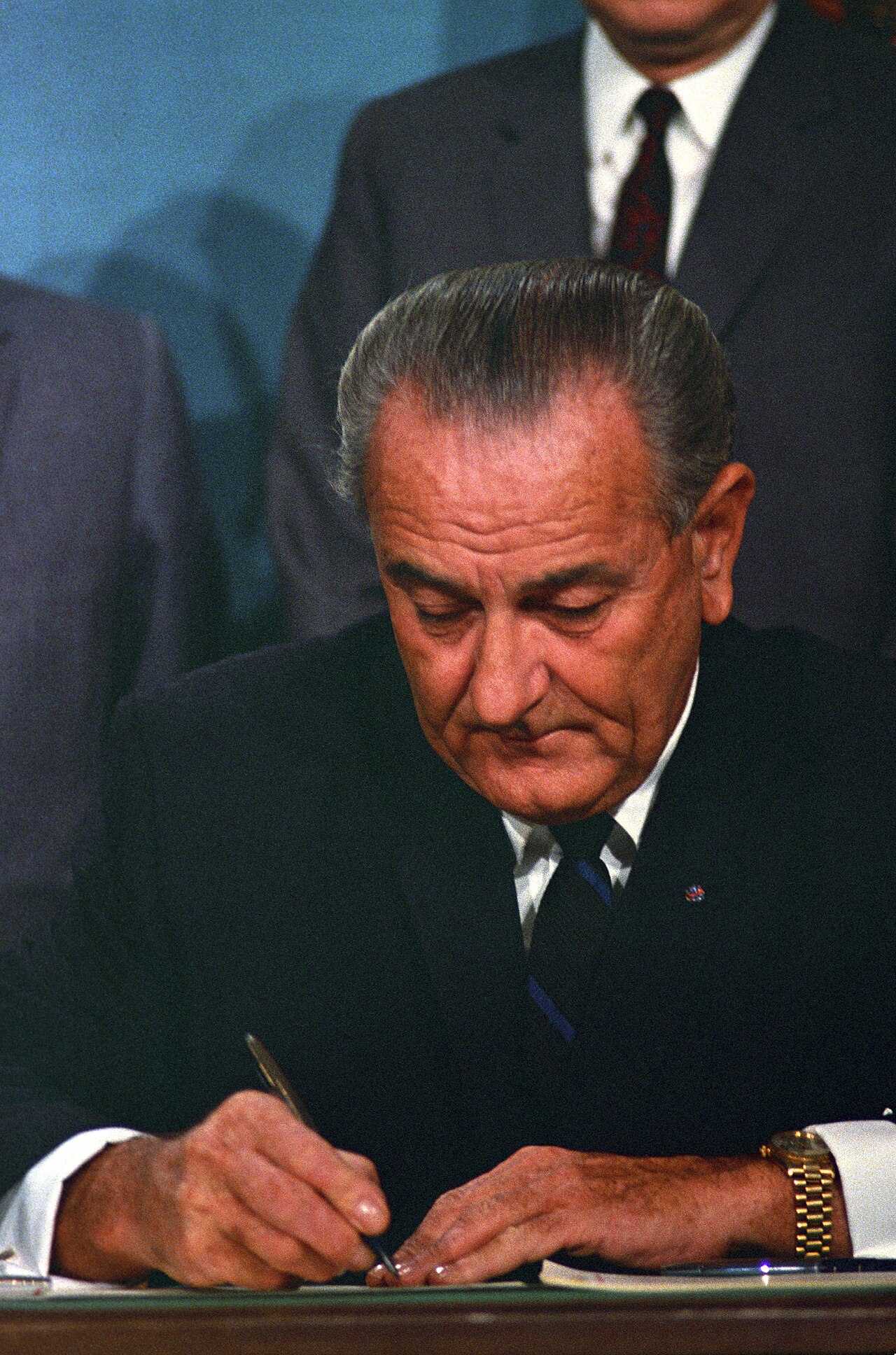
About this source
What it is
A federal statute that created the Corporation for Public Broadcasting (CPB), a nonprofit funded by taxpayers to support noncommercial radio and television. It was supported by figures including Fred Rogers and NPR founder Robert Conley, and President Lyndon B. Johnson signed it into law in 1967.
Why it matters
The Act shows how the federal government, under Johnson, extended its reach into culture and media, aiming to diversify programming beyond commercial broadcasting. It is part of the cultural strand of the Great Society, alongside Johnson's efforts in education, health, and civil rights.
Look closer
- Why might Congress have wanted public broadcasting to stay separate from commercial and political interests?
- What does the photograph of the signing tell you about how this moment was recorded for history?
- Who besides Johnson helped push this law forward, and why might they have cared about it?
This document is part of the curated material that grounds the AI version of Lyndon B. Johnson on Humy.ai — when students ask about related events, the AI can quote it and cite it.
More Lyndon B. Johnson sources
Meet the AI Lyndon B. Johnson → Document
Primary source
Social Security Amendments of 1965 (Medicare and Medicaid Act)
United States Congress · 30 July 1965
Primary source
Great Society Speech at the University of Michigan
Lyndon B. Johnson · 22 May 1964
Primary source
The American Promise Speech to Congress
Lyndon B. Johnson · 15 March 1965
 Speech
Primary source
1964 State of the Union Address
Lyndon B. Johnson · 8 January 1964
Primary source
Renunciation Speech
Lyndon B. Johnson · 31 March 1968
Ready when you are
Start chatting with Lyndon B. Johnson now.
20 messages free · No credit card · Available in 50+ languages.