


Secondary sourceArtifact1905
Punnett Square Diagram
Reginald Crundall Punnett · 1905
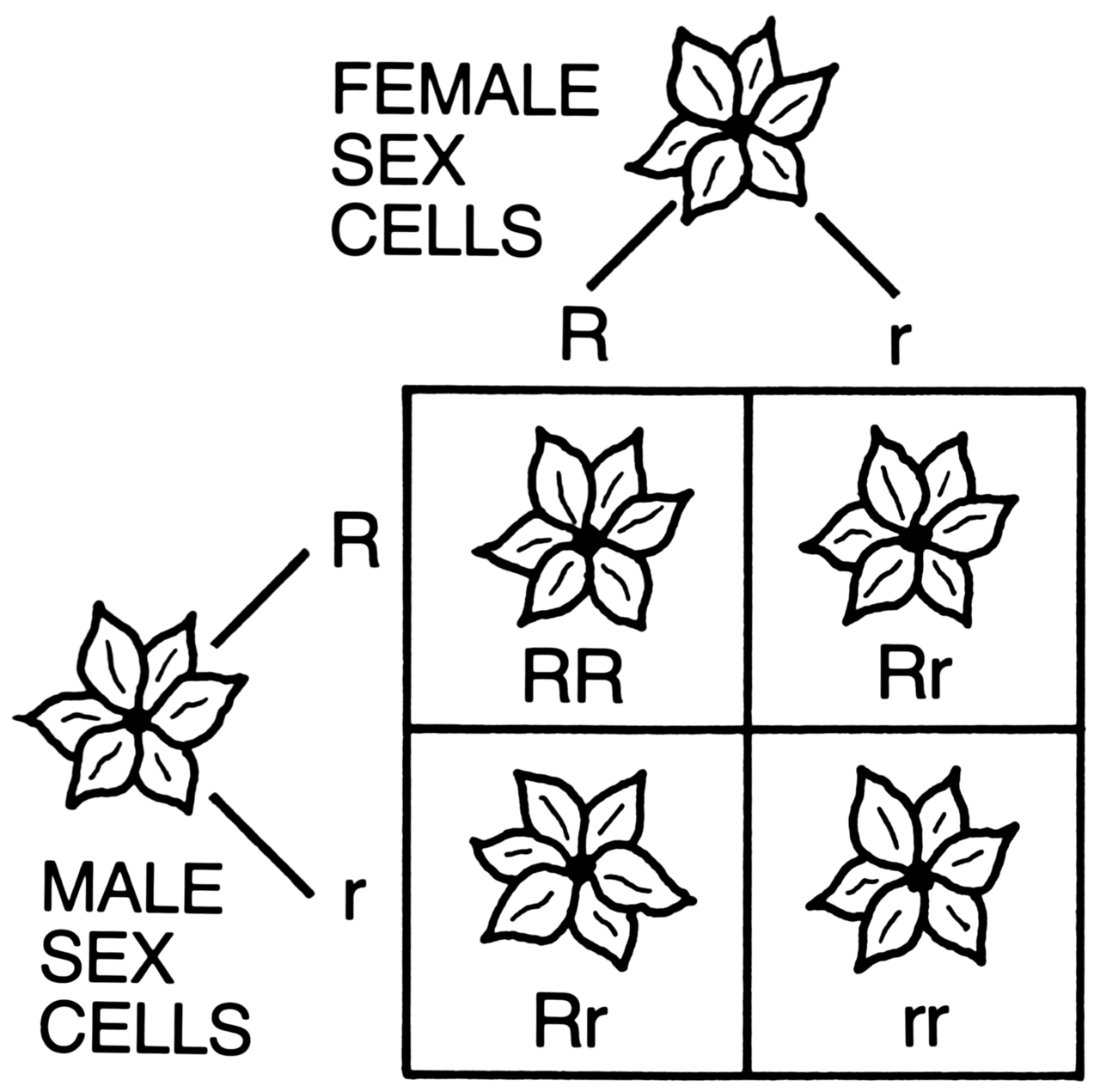
A diagram devised by Punnett in 1905 to predict the possible genetic outcomes of a breeding cross, still taught in schools today.
Punnett devised this diagram in 1905; it remains the main reason he is remembered today.
About this source
What it is
The Punnett square is a simple grid diagram used to work out the possible genotypes of offspring from a breeding cross. It was devised by Reginald C. Punnett in 1905 and is named after him.
This example shows a cross involving flowers, with the parent sex cells carrying the alleles R and r arranged along the top and side, and the four possible combinations (RR, Rr, Rr, rr) filled into the boxes.
Why it matters
The diagram turns Gregor Mendel's ideas about inheritance into a clear visual tool that scientists and students still use to predict the chance of a trait appearing in offspring. It became one of the most widely used teaching tools in biology, and is the main reason Punnett's name is remembered today.
Look closer
- Why might a simple grid be easier to understand than written probabilities?
- What does the diagram leave out about how traits actually work in real organisms?
- Why do you think this tool spread so quickly into classrooms everywhere?
This artifact is part of the curated material that grounds the AI version of Reginald Punnett on Humy.ai — when students ask about related events, the AI can quote it and cite it.
More Reginald Punnett sources
Browse all 9 →Primary source
Further Experiments on Inheritance in Sweet Peas and Stocks: Preliminary Account
William Bateson, Edith Rebecca Saunders, Reginald Crundall Punnett · 1906
Primary source
Scientific Papers of William Bateson
William Bateson · 1928
Primary source
Mimicry in Butterflies
Reginald Crundall Punnett · 1915
 Book
Primary source
Mendelism
Reginald Crundall Punnett · 1922
Free account
Read every Reginald Punnett source
Sign up free →
Ready when you are
Start chatting with Reginald Punnett now.
20 messages free · No credit card · Available in 50+ languages.