


Primary sourceArtifact1 September 1772
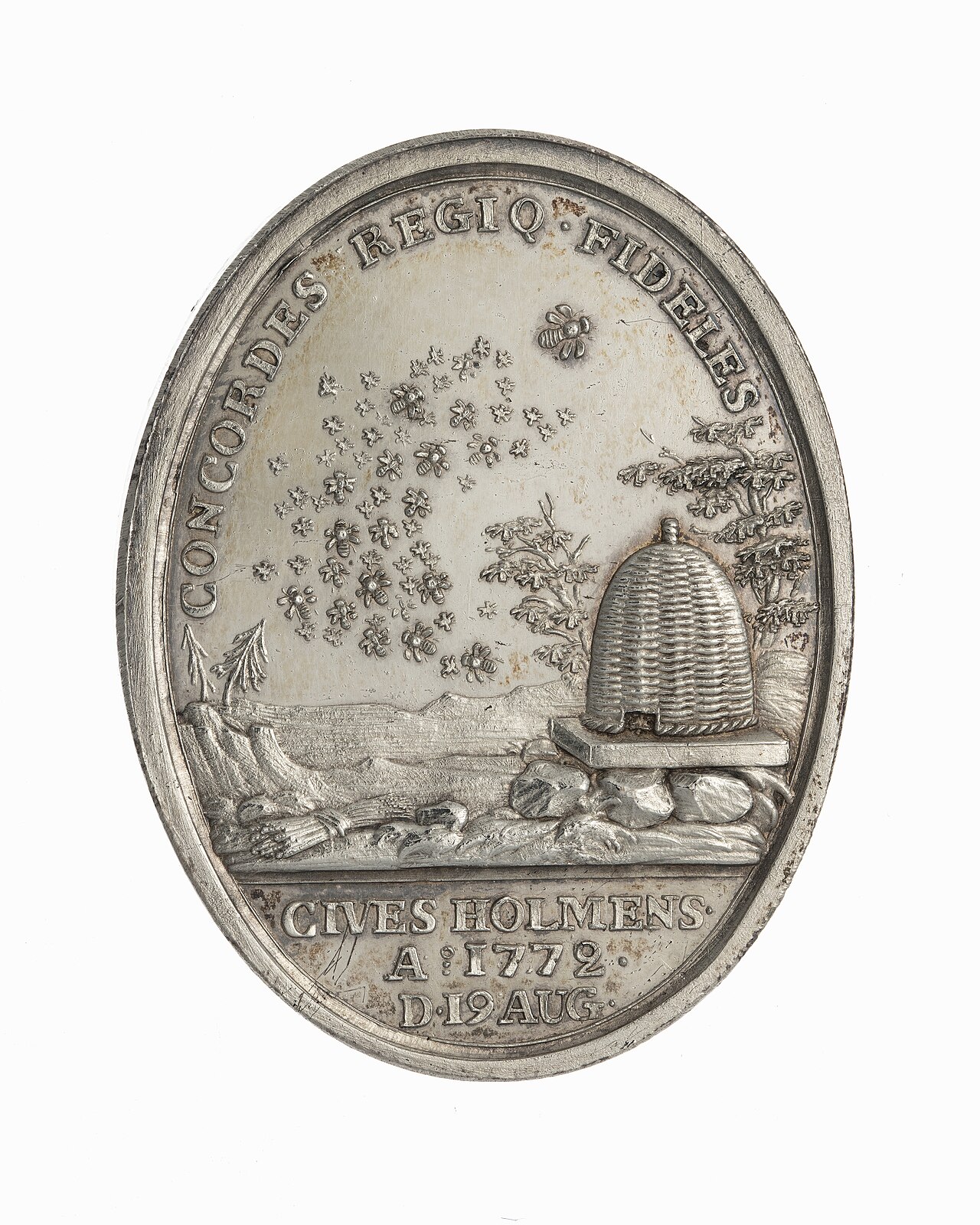
Reverse of Gustav III's 1772 Revolution Medal
Gustav III · 1 September 1772
The back of a silver medal commissioned by Gustav III to celebrate his 1772 coup, showing bees leaving a hive and a Latin motto of loyalty.
Gustav III personally commissioned this medal to commemorate and justify his own 1772 coup.
About this source
What it is
This is the reverse side of a silver medal ordered by Gustav III to mark his coup of 19 August 1772, which ended Sweden's parliamentary rule and restored royal power. It shows a swarm of bees flying from a beehive set on stones among trees, with a sheaf of grain on the ground. Around the edge runs a Latin inscription meaning that the citizens of Stockholm were united and loyal to the king in 1772. The medal is kept in the collection of the Royal Armoury (Livrustkammaren) in Stockholm.
Why it matters
Medals like this were official propaganda, made to shape how people remembered an event. The beehive imagery suggests order, obedience and a ruler guiding his people, exactly the message Gustav III wanted to send after seizing extra power for himself.
Look closer
- Why might a king choose bees and a beehive to represent his rule?
- What does the Latin motto claim about the people of Stockholm, and who decided that claim was worth stamping into silver?
- What does a coin or medal like this leave out about how the coup actually happened?
This artifact is part of the curated material that grounds the AI version of Gustav III on Humy.ai — when students ask about related events, the AI can quote it and cite it.
More Gustav III sources
Browse all 92 →Primary source
Swedish Constitution of 1772
Gustav III of Sweden · 21 August 1772
 Painting
Primary source
Riksdagen 1789
Louis Jean Desprez · 1789
 Painting
Primary source
Coronation of Gustav III
Carl Gustaf Pilo · 1792
 Painting
Primary source
King Gustav III of Sweden and his Brothers
Alexander Roslin · 1771
Free account
Read every Gustav III source
Sign up free →
Ready when you are
Start chatting with Gustav III now.
20 messages free · No credit card · Available in 50+ languages.