


Secondary sourceArtifactc. 1600
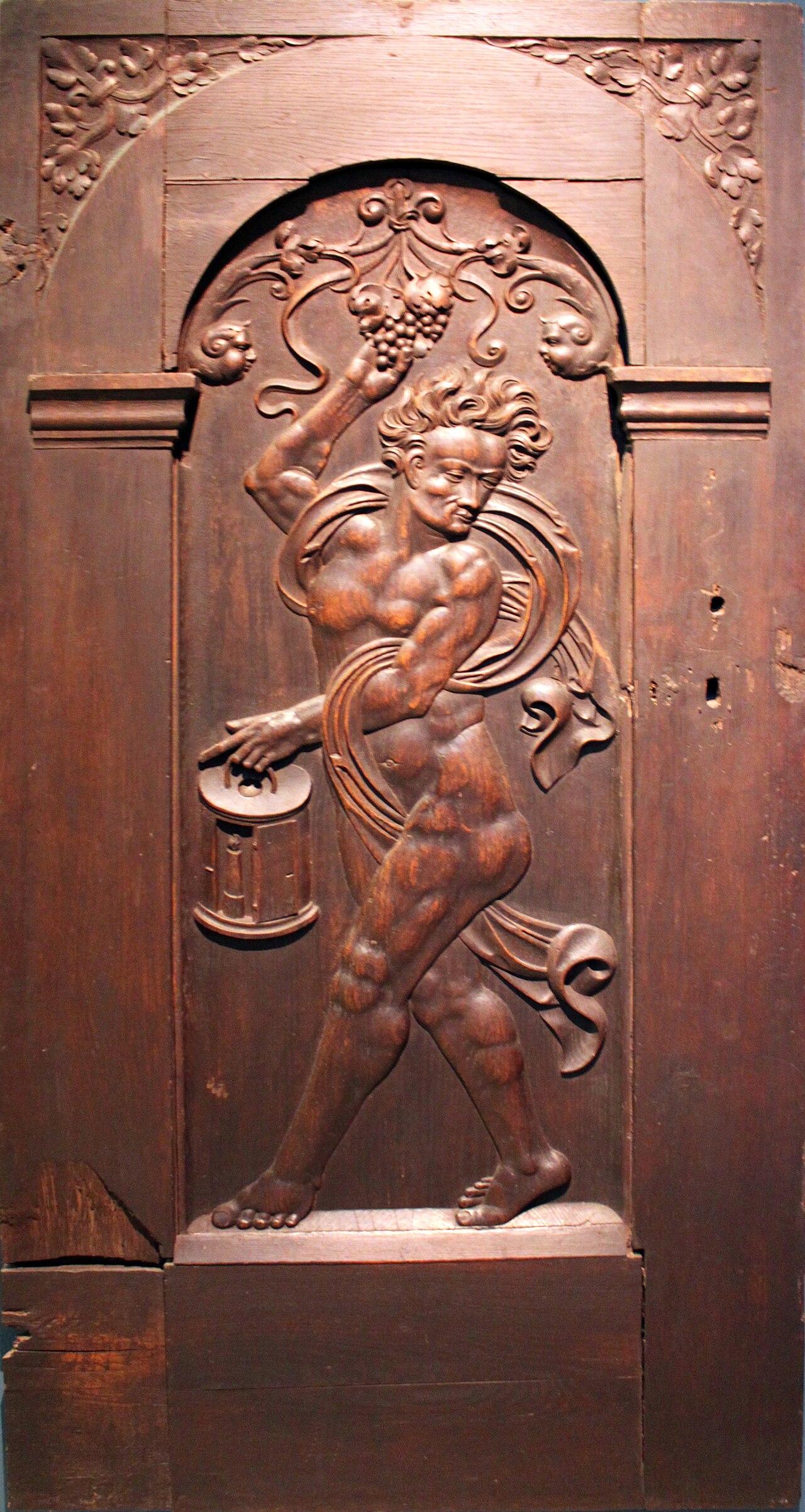
Room Door with Diogenes
c. 1600
A carved German Renaissance wooden door showing Diogenes with his lantern, used as a moral emblem in a domestic setting.
Depicts Diogenes with his lantern, used as a moral symbol in German Renaissance decorative art.
About this source
What it is
This carved wooden door, made around 1600, is decorated with vine and leaf carvings and a large relief figure holding a lantern and grapes. It is held by the Germanisches Nationalmuseum in Nuremberg, which identifies the figure as Diogenes searching unsuccessfully for an honest man.
Why it matters
The museum notes this is a rare example of large-scale Mannerist sculpture in Germany. Its use of Diogenes as a decorative, moralizing figure for a household door shows how the ancient philosopher's search for honesty became a popular emblem in everyday European life, not just in texts and paintings.
Look closer
- Why might someone choose to decorate a door with a philosopher known for criticizing dishonesty?
- What do the grapes and vines add to the meaning of the carving?
- How does displaying Diogenes in a home differ from showing him in a painting meant for display in a gallery?
This artifact is part of the curated material that grounds the AI version of Diogenes of Sinope on Humy.ai — when students ask about related events, the AI can quote it and cite it.
More Diogenes of Sinope sources
Browse all 96 → Letter
Secondary source
Letters of Diogenes, Letter 1 to the Sinopeans
Eilhard Lubin
 Artifact
Secondary source
Diogenes Mosaic
Unknown author
 Book
Secondary source
Discourses of Epictetus
Arrian · c. 108 AD
 Book
Secondary source
Anabasis of Alexander
Arrian · c. 150 AD
Free account
Read every Diogenes of Sinope source
Sign up free →
Ready when you are
Start chatting with Diogenes of Sinope now.
20 messages free · No credit card · Available in 50+ languages.