


Primary sourceDocument1903
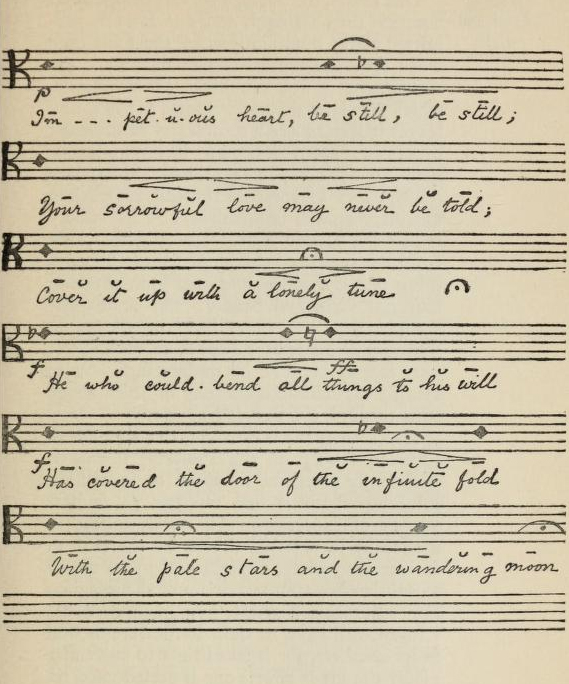
Score from Ideas of Good and Evil
William Butler Yeats · 1903
A handwritten musical score with sung lyrics from Yeats's 1903 book Ideas of Good and Evil, showing his own music notation.
Shows Yeats as a composer as well as a poet, with his own musical notation printed in one of his books.
About this source
What it is
This is an image of a handwritten musical score printed in Yeats's 1903 book Ideas of Good and Evil. The page has six staves of notation under a bass clef, with sung lyrics beneath each line. The lyrics speak of an impatient heart, a sorrowful love that may never be told, and the pale stars and wandering moon. Dynamic marks and slurs appear throughout. The facts identify Yeats as the maker of the notation.
Why it matters
Yeats was known mainly as a poet and playwright, but this page shows that he also wrote music for his verses. Many poets of the time shared their work in books with musical settings, and this score links his poetry to song. The page reveals how closely he thought about sound and the spoken or sung word.
Look closer
- How do the words and the notes work together on this page?
- Why might a writer include a musical score in a book of ideas?
- What would this song sound like, and what would a reader lose without the music?
This document is part of the curated material that grounds the AI version of W. B. Yeats on Humy.ai — when students ask about related events, the AI can quote it and cite it.
More W. B. Yeats sources
Browse all 96 →Primary source
The Second Coming
William Butler Yeats · 1919
Primary source
Easter, 1916
William Butler Yeats · 1916 (published 1921)
Primary source
The Lake Isle of Innisfree
William Butler Yeats · 1888
Primary source
Sailing to Byzantium
William Butler Yeats · 1928
Free account
Read every W. B. Yeats source
Sign up free →
Ready when you are
Start chatting with W. B. Yeats now.
20 messages free · No credit card · Available in 50+ languages.