


Primary sourceArtifactbetween 355 and 395
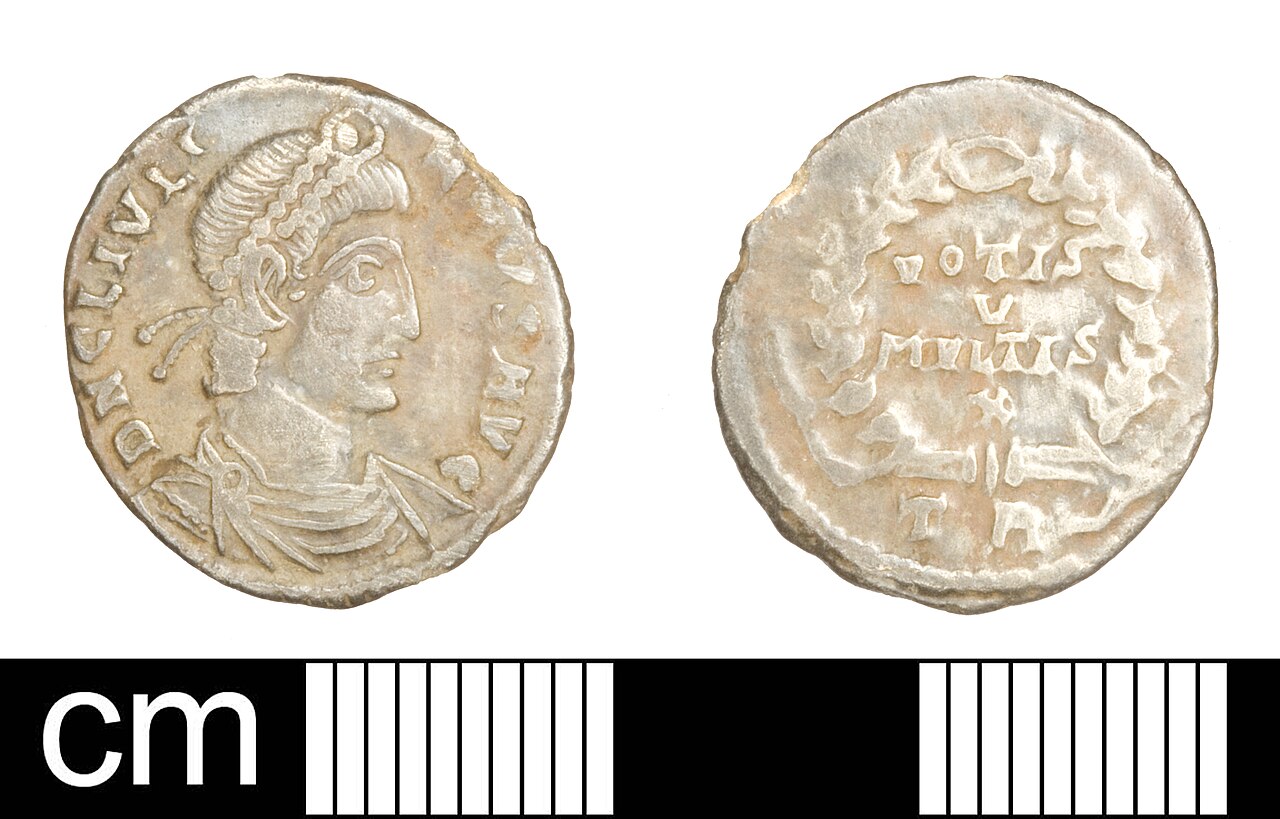
Siliqua of Julian Augustus, Somerset Hoard
Somerset County Council and Laura Burnett · between 355 and 395
A silver siliqua coin bearing the name of Julian Augustus, photographed from a late Roman hoard found in Somerset. The hoard was buried around the end of the 4th century.
Shows a coin bearing Julian's name, found in a late Roman hoard, which reflects how his coinage circulated after his reign.
About this source
What it is
This is a photograph of a silver Roman siliqua from a hoard found in Somerset. The image shows two sides of the coin: a laureate, diademed bust of a man facing right on one side, and on the other a wreath enclosing the text VOTIS V MVLTIS, with a star and mintmark letters below. The museum record describes the hoard as a find of 1 miliarensis and 60 siliquae, dated to AD 395 or earlier. The photograph was uploaded to Wikimedia Commons by Somerset County Council and Laura Burnett in 2014. The hoard record says the find was acquired by the Museum of Somerset, and the coins are part of a larger group of silver pieces.
Why it matters
Hoards like this one show the money that people buried and sometimes never recovered. The record states that most coins came from the Trier mint and that the latest coins are dated AD 388 to 395. Julian's name on a coin in such a hoard shows that earlier emperors' coins were still in circulation long after their reigns, which helps historians study how money moved across the empire.
Look closer
- What does the wreath and the text VOTIS V MVLTIS on the reverse suggest about how the coin was meant to be read?
- Why might a coin from the 350s and 360s still be in a hoard buried around the 390s?
- What does a photograph of one coin leave out about the rest of the hoard and how it was found?
This artifact is part of the curated material that grounds the AI version of Julian on Humy.ai — when students ask about related events, the AI can quote it and cite it.
More Julian sources
Browse all 89 →
Ready when you are
Start chatting with Julian now.
20 messages free · No credit card · Available in 50+ languages.