


Secondary sourceSculpture1808
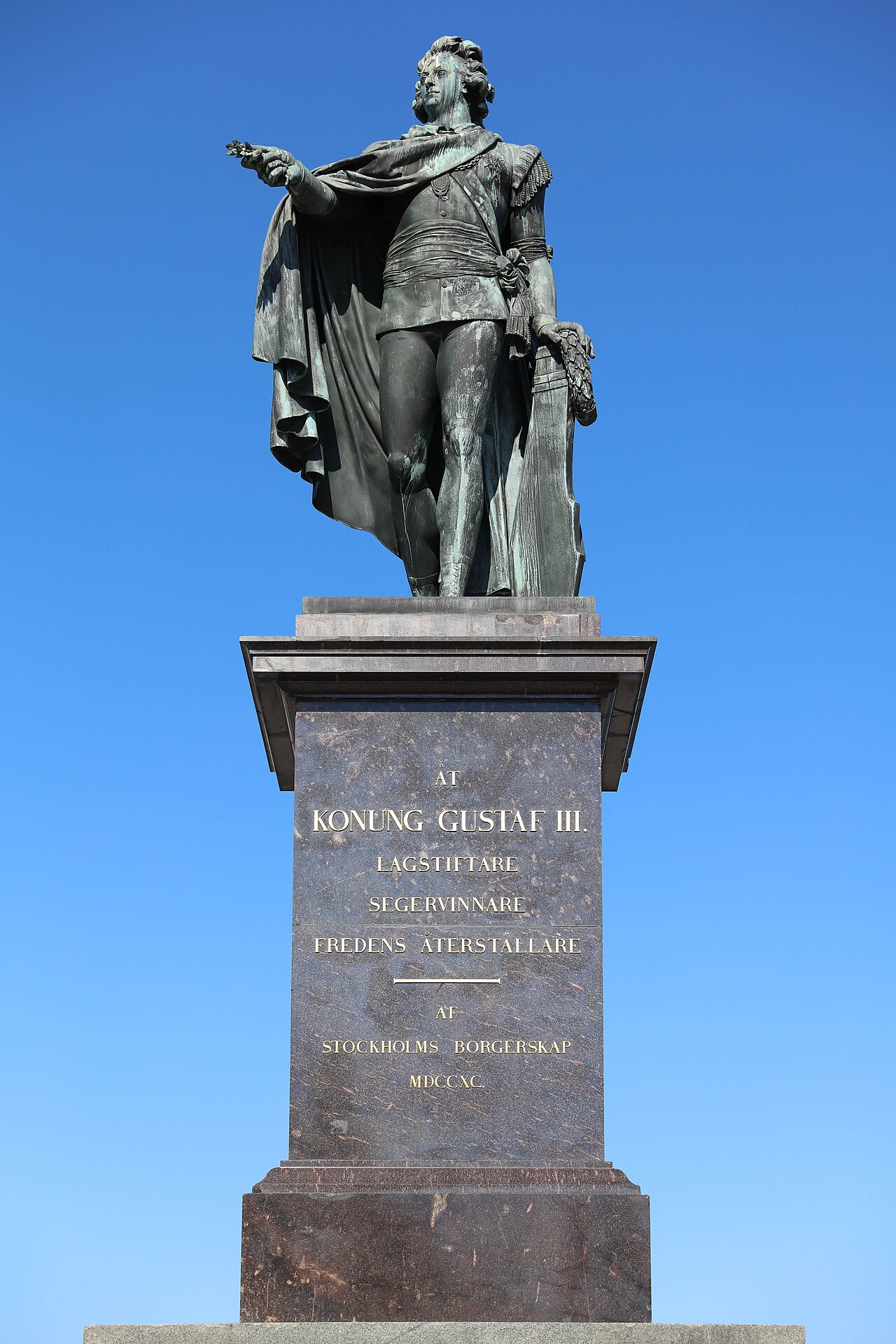
Statue of Gustav III on Skeppsbron
Johan Tobias Sergel · 1808
A bronze statue of King Gustav III in Stockholm, designed by Johan Tobias Sergel and unveiled in 1808. It is the main public monument to the king.
A later public monument that shows how Gustav III was honoured in Stockholm after his death, rather than a work from his own lifetime.
About this source
What it is
This bronze statue of King Gustav III stands on Skeppsbron in Stockholm. Its designer was Johan Tobias Sergel, the king's own court sculptor, and it was unveiled in 1808, after the king's death in 1792. It shows the king in robes and a cloak, holding a laurel branch in one hand and extending the other arm forward, on a dark granite pedestal inscribed with Swedish text.
Why it matters
The statue is the main public monument to Gustav III. Its creation shows how Swedes chose to remember him after his reign: as a ruler worth honouring in the capital. Because a sculptor who worked for the king designed it, the image reflects the artistic circle around the court. Monuments like this tell us as much about the people who built them as about the person shown.
Look closer
- What do the king's pose and the laurel branch suggest about how he wanted to be seen?
- Who commissioned a monument like this, and why was it set up years after his death?
- What does the statue leave out, such as the conflicts of his reign or the people who opposed him?
This sculpture is part of the curated material that grounds the AI version of Gustav III on Humy.ai — when students ask about related events, the AI can quote it and cite it.
More Gustav III sources
Browse all 92 →Primary source
Swedish Constitution of 1772
Gustav III of Sweden · 21 August 1772
 Painting
Primary source
Riksdagen 1789
Louis Jean Desprez · 1789
 Painting
Primary source
Coronation of Gustav III
Carl Gustaf Pilo · 1792
 Painting
Primary source
King Gustav III of Sweden and his Brothers
Alexander Roslin · 1771
Free account
Read every Gustav III source
Sign up free →
Ready when you are
Start chatting with Gustav III now.
20 messages free · No credit card · Available in 50+ languages.