


Secondary sourcePainting
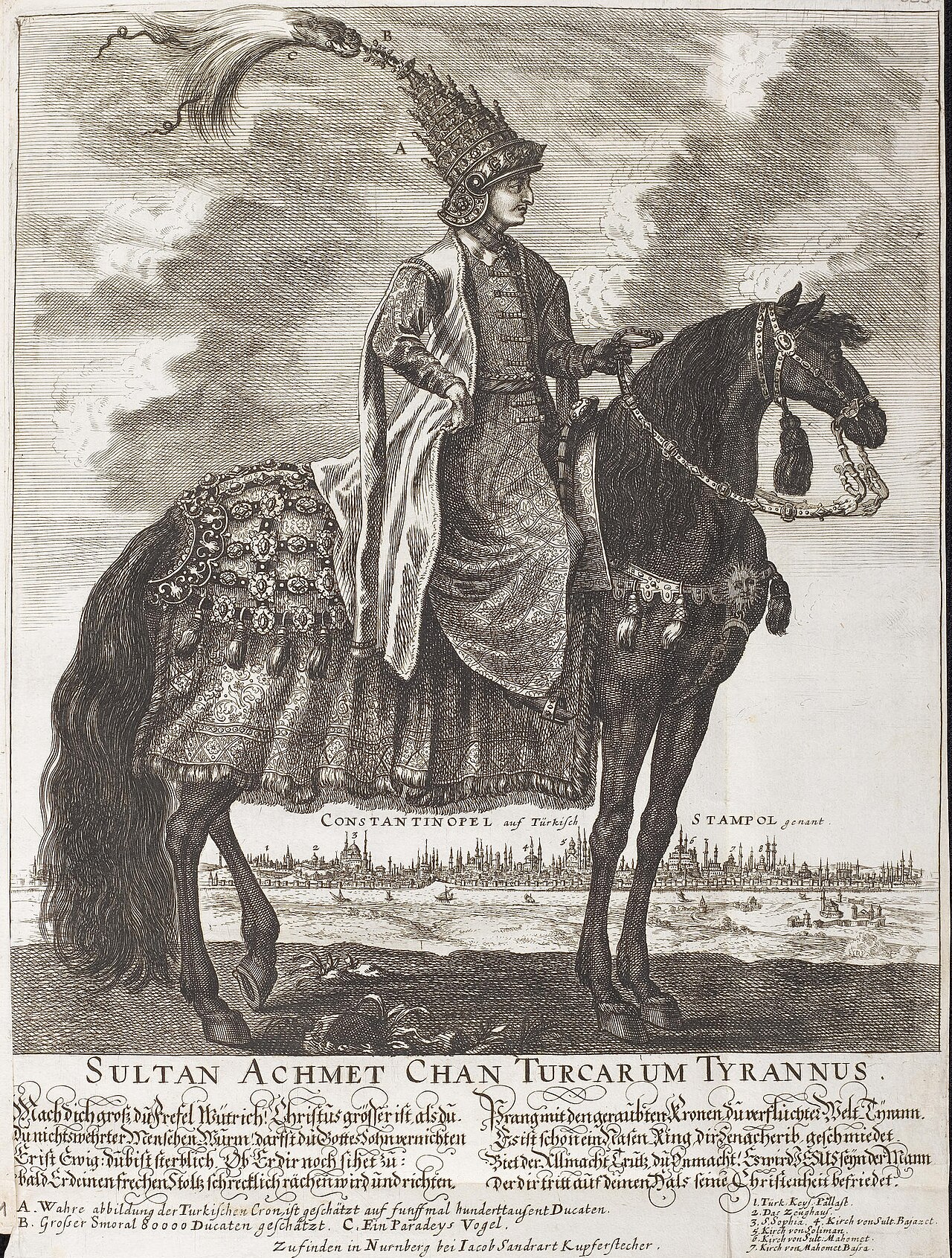
Sultan Achmet Chan Turcarum Tyrannus
Jakob von Sandrart
A German engraving by Jakob von Sandrart depicting Mehmed IV on horseback before a skyline of Constantinople, from a princely album of collected prints.
This engraving depicts Mehmed IV and shows how German courts collected and portrayed his image.
About this source
What it is
This is a black-and-white engraving by the German artist Jakob von Sandrart, showing a turbaned horseman labelled as the Ottoman sultan, with a view of Constantinople's mosques and minarets behind him. A German verse by Sigmund von Birken is printed below. It comes from a print album (Klebeband) belonging to the Fürstlich Waldecksche Hofbibliothek in Arolsen.
Why it matters
The print shows how a German princely court collected and displayed images of the Ottoman sultan, even though the title calls him a 'tyrant.' It reveals European attitudes toward the Ottoman Empire and its ruler, Mehmed IV, during his reign, mixing fascination with hostility.
Look closer
- Why might the title describe the sultan as a 'tyrant'?
- What does the cityscape in the background tell us about how Europeans imagined Constantinople?
- Who would have collected and looked at images like this, and why?
This painting is part of the curated material that grounds the AI version of Mehmed IV on Humy.ai — when students ask about related events, the AI can quote it and cite it.
More Mehmed IV sources
Browse all 65 →
Ready when you are
Start chatting with Mehmed IV now.
20 messages free · No credit card · Available in 50+ languages.