


Secondary sourcePaintingc. 1480-90
The Baptism of Christ in the Jordan
Martin Schongauer · c. 1480-90
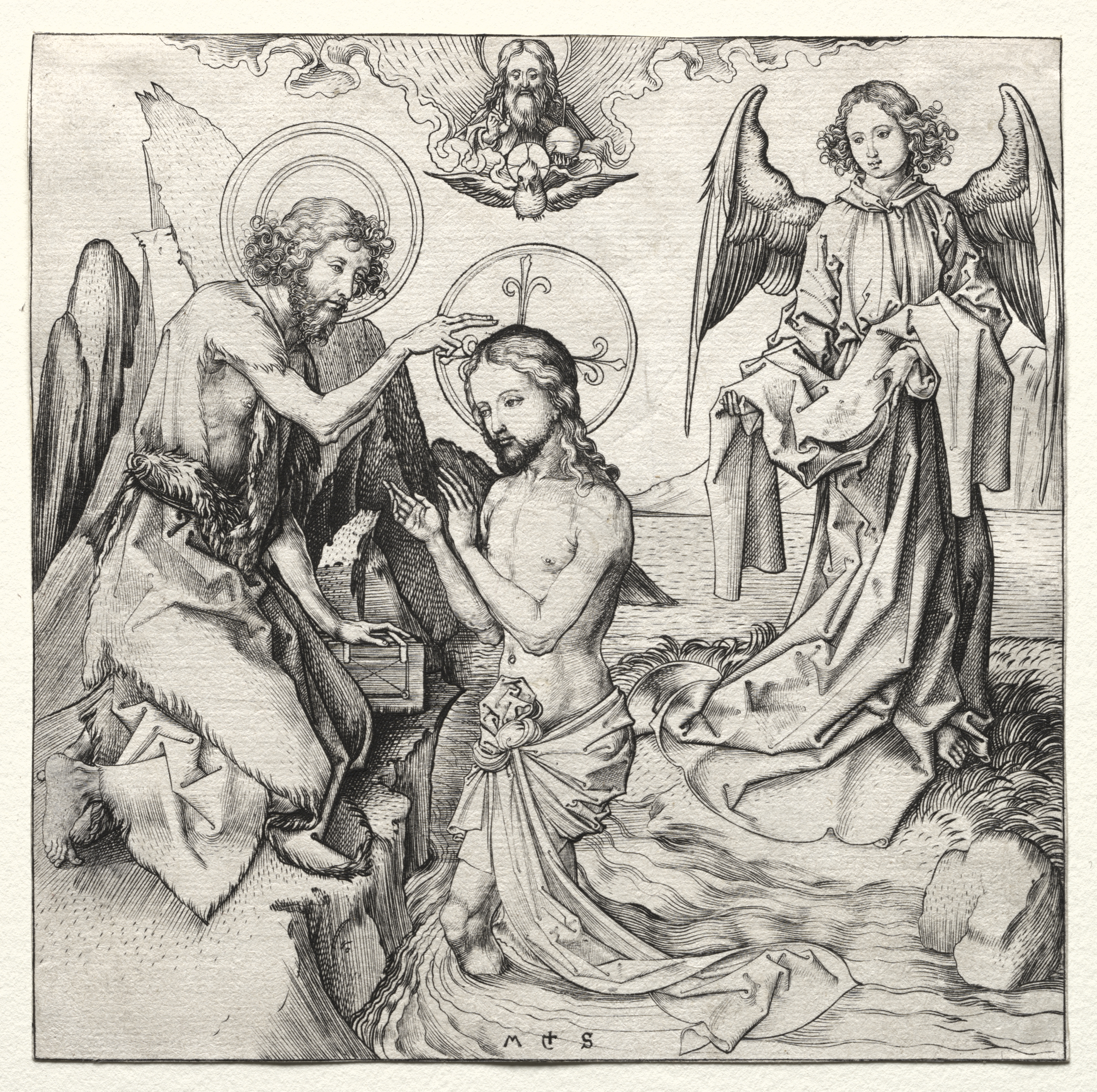
A late 15th-century German engraving by Martin Schongauer showing John the Baptist blessing Christ in the Jordan River.
Depicts John the Baptist blessing Christ during the baptism, a central scene from his life in the Gospels.
About this source
What it is
This engraving was made around 1480–90 by the German artist Martin Schongauer. It is held by The Cleveland Museum of Art.
The print shows Christ wading in the Jordan River to be blessed by John the Baptist, whose hand rests on a book of scripture, symbolizing the fulfillment of prophecy. A winged angel stands nearby, and the Spirit of God descends above as a dove.
Why it matters
Schongauer was a highly skilled printmaker, and his engraved lines were admired for their ability to imitate different textures, such as fur, hair, and feathers. This image of John the Baptist baptizing Christ shows how printmaking spread religious imagery widely in Northern Europe before the age of photography, letting many people see the same biblical scene.
Look closer
- What details in the engraving show the artist's skill at representing different textures?
- Why does John the Baptist's hand rest on a book, and what might that symbolize?
- How might this printed image have reached a wider audience than a painting?
This painting is part of the curated material that grounds the AI version of John the Baptist on Humy.ai — when students ask about related events, the AI can quote it and cite it.
More John the Baptist sources
Browse all 86 → Book
Secondary source
Gospel of Luke
Luke the Evangelist · c. AD 85
Secondary source
Josephus on Jesus
Josephus · c. 93-94 CE
 Painting
Secondary source
The Baptism of Christ
Piero della Francesca · c. 1440-1460
 Painting
Primary source
The Baptism of Christ
Andrea del Verrocchio and Leonardo da Vinci · c. 1470-1475
Free account
Read every John the Baptist source
Sign up free →
Ready when you are
Start chatting with John the Baptist now.
20 messages free · No credit card · Available in 50+ languages.