


Primary sourcePainting1830
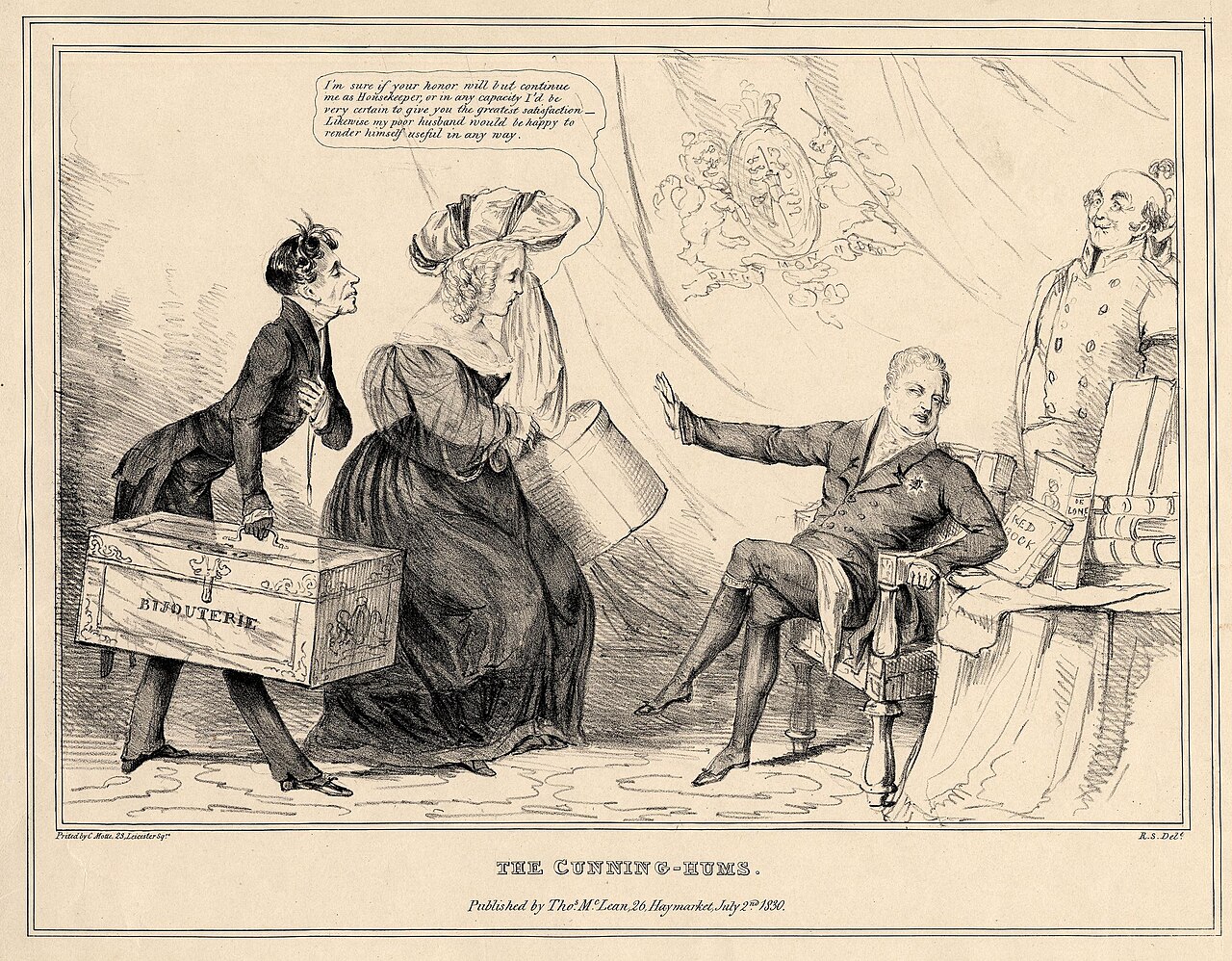
The Cunning-hums
Robert Seymour · 1830
A satirical 1830 print by Robert Seymour mocking William IV's court and his dismissal of Lord and Lady Conyngham.
This satirical print shows William IV at the start of his reign dismissing his predecessor's court favourites.
About this source
What it is
This 1830 satirical print was drawn by Robert Seymour, published by Thomas McLean, and printed by Charles Motte. It shows William IV seated, gesturing dismissively, as Lord and Lady Conyngham approach him with exaggerated flattery, begging to keep their court positions.
Why it matters
The Conynghams had been powerful favourites under William's predecessor, George IV. This cartoon captures the moment of change at the start of William's reign, when old court favourites lost influence. It shows how caricaturists used humour to comment on real political and court shake-ups for a wide public audience.
Look closer
- What does the exaggerated begging pose of the Conynghams suggest about how the artist wanted viewers to judge them?
- Why would a satirist choose humour rather than a straightforward report to describe a change of court favourites?
- What does this image suggest about public attitudes toward royal courtiers in 1830?
This painting is part of the curated material that grounds the AI version of William IV on Humy.ai — when students ask about related events, the AI can quote it and cite it.
More William IV sources
Browse all 97 →Primary source
Substance of the Speech of the Duke of Clarence on the Slave Trade
William IV · 5 July 1799
 Letter
Primary source
The Reform Act, 1832: Correspondence of Earl Grey with King William IV
William IV and Charles Grey, 2nd Earl Grey · 1830–1832 (published 1867)
 Painting
Primary source
Prince William, later Duke of Clarence
Thomas Gainsborough · 1782
 Painting
Primary source
William IV
Martin Archer Shee · 1833


Free account
Read every William IV source
Sign up free →
Ready when you are
Start chatting with William IV now.
20 messages free · No credit card · Available in 50+ languages.