


Primary sourceBook1837
The French Revolution: A History
Thomas Carlyle · 1837
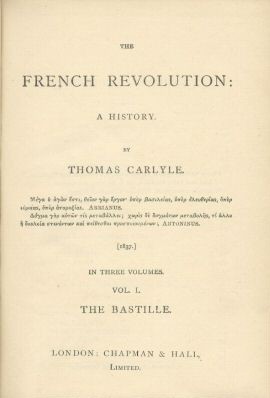
Thomas Carlyle's 1837 three-volume history of the French Revolution. John Stuart Mill encouraged it and supplied books for its research.
Mill proposed the project, supplied the research materials and lost the first manuscript while it was in his care, so the book links him directly to its creation.
About this source
What it is
This is a three-volume history by the Scottish essayist and historian Thomas Carlyle, first published in 1837. It covers the French Revolution from 1789 to the height of the Reign of Terror in 1793-94 and ends in 1795. The first volume, titled The Bastille, was published by Chapman & Hall in London. The style is unusual: Carlyle often writes in the present tense and in the first person plural, as if the reader were standing in the streets of Paris.
Mill had signed a contract for a history of the Revolution but could not finish it, so he proposed that Carlyle write it instead. He sent Carlyle a library of books and materials. Carlyle sent Mill his only complete manuscript of the first volume, and it was destroyed while in Mill's care. Mill later blamed a careless maid who used it as a firelighter.
Why it matters
Critics both praised and attacked the book's style, but it quickly made Carlyle a major intellectual figure. It influenced Charles Dickens, who carried it with him and drew on it for A Tale of Two Cities. Mill praised it highly, calling it 'not so much a history as an epic poem'. The episode shows how closely the two men worked together before their later quarrel.
Look closer
- How does Carlyle's dramatic style change the way the reader experiences events such as the execution of Robespierre?
- What does the book leave out, and which voices from the Revolution are missing?
- Why might Mill have praised a work that most professional historians would question?
This book is part of the curated material that grounds the AI version of John Stuart Mill on Humy.ai — when students ask about related events, the AI can quote it and cite it.
More John Stuart Mill sources
Meet the AI John Stuart Mill → Book
Primary source
On Liberty
John Stuart Mill · 1859
 Book
Primary source
Utilitarianism
John Stuart Mill · 1861
 Book
Primary source
The Subjection of Women
John Stuart Mill · 1869
 Book
Primary source
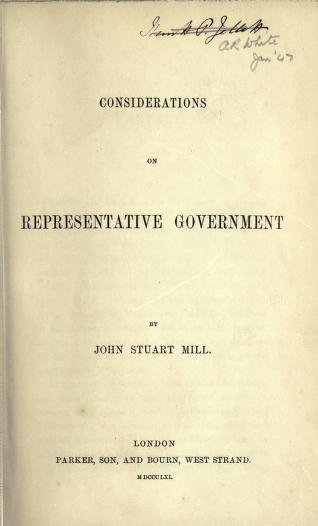
Considerations on Representative Government
John Stuart Mill · 1861
Primary source
Autobiography
John Stuart Mill · 1873 (written; published posthumously)
Ready when you are
Start chatting with John Stuart Mill now.
20 messages free · No credit card · Available in 50+ languages.