


Primary sourcePaintingAugust 1828
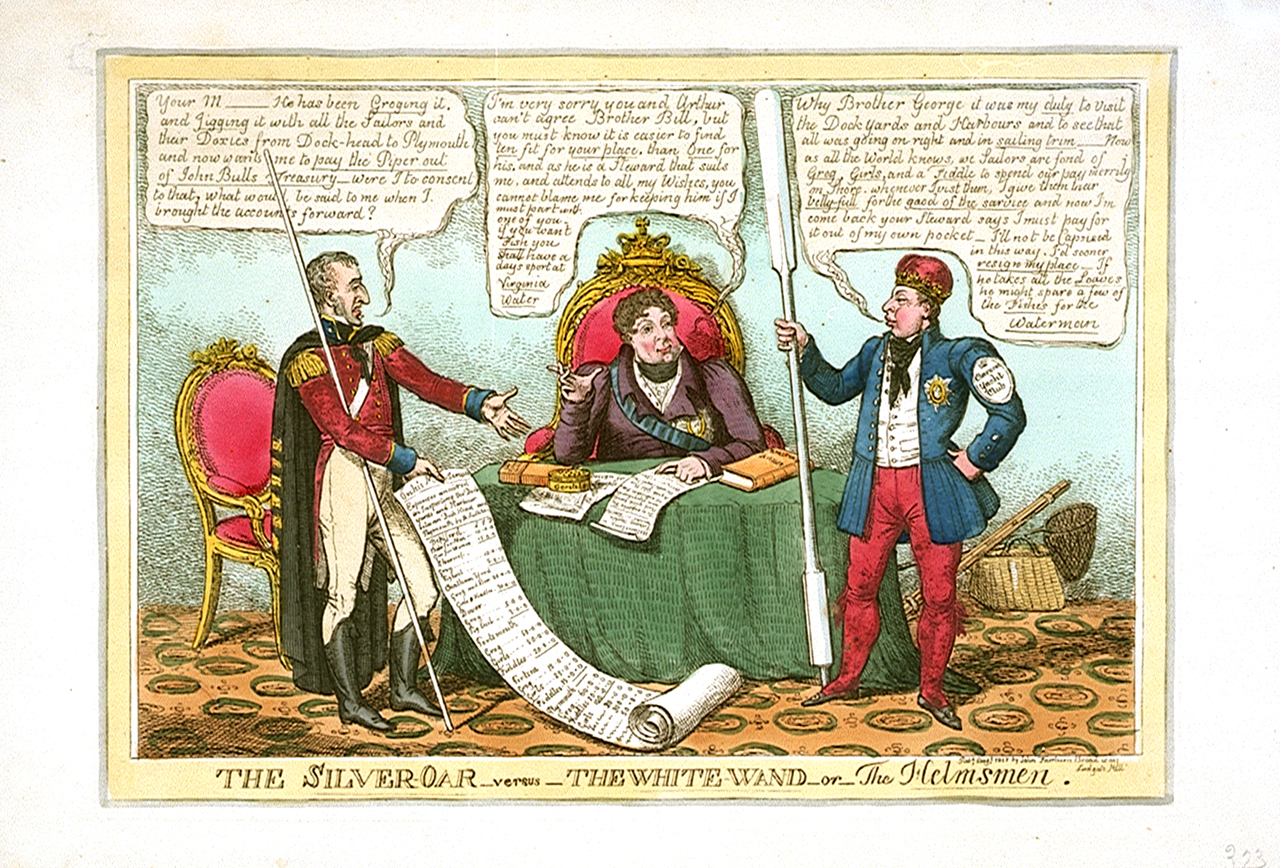
The Silver Oar versus The White Wand
John Fairburn · August 1828
A hand-coloured 1828 caricature by John Fairburn showing the dismissal of Prince William, Duke of Clarence, as Lord High Admiral, with George IV and the Duke of Wellington.
This caricature shows William, as Duke of Clarence, being dismissed as Lord High Admiral, a post that connects his naval career to his later reign.
About this source
What it is
This is a hand-coloured caricature print titled The Silver Oar versus The White Wand or The Helmsmen, made by John Fairburn in August 1828. It shows the Duke of Wellington, then Prime Minister, presenting a long list of expenses. King George IV sits on a gilded throne, and Prince William, Duke of Clarence, stands dressed as a Thames waterman and carries a silver oar. The speech bubbles present the arguments in a simple, popular way. The description notes that the print comes from a museum record and that the figures are identified there.
Why it matters
The caricature shows the dismissal of William as Lord High Admiral. The post had been given to him by his brother, the king, for honorary reasons, but William took an active interest in the navy and went on a tour of dockyards and a week at sea without authorization. The cost of these trips was part of the reason he was called to account. Two years later he succeeded his brother as the sailor king, William IV.
Look closer
- Who is shown holding a list, and what is the artist suggesting about that person's role in the dispute?
- What do the speech bubbles and costumes tell us about how the artist wanted viewers to judge each man?
- What does this satirical print leave out, such as the views of the prince himself or the reasons the navy may have had for his inspections?
This painting is part of the curated material that grounds the AI version of William IV on Humy.ai — when students ask about related events, the AI can quote it and cite it.
More William IV sources
Browse all 97 →Primary source
Substance of the Speech of the Duke of Clarence on the Slave Trade
William IV · 5 July 1799
 Letter
Primary source
The Reform Act, 1832: Correspondence of Earl Grey with King William IV
William IV and Charles Grey, 2nd Earl Grey · 1830–1832 (published 1867)
 Painting
Primary source
Prince William, later Duke of Clarence
Thomas Gainsborough · 1782
 Painting
Primary source
William IV
Martin Archer Shee · 1833
Free account
Read every William IV source
Sign up free →
Ready when you are
Start chatting with William IV now.
20 messages free · No credit card · Available in 50+ languages.