


Secondary sourcePhotograph2016-10-09
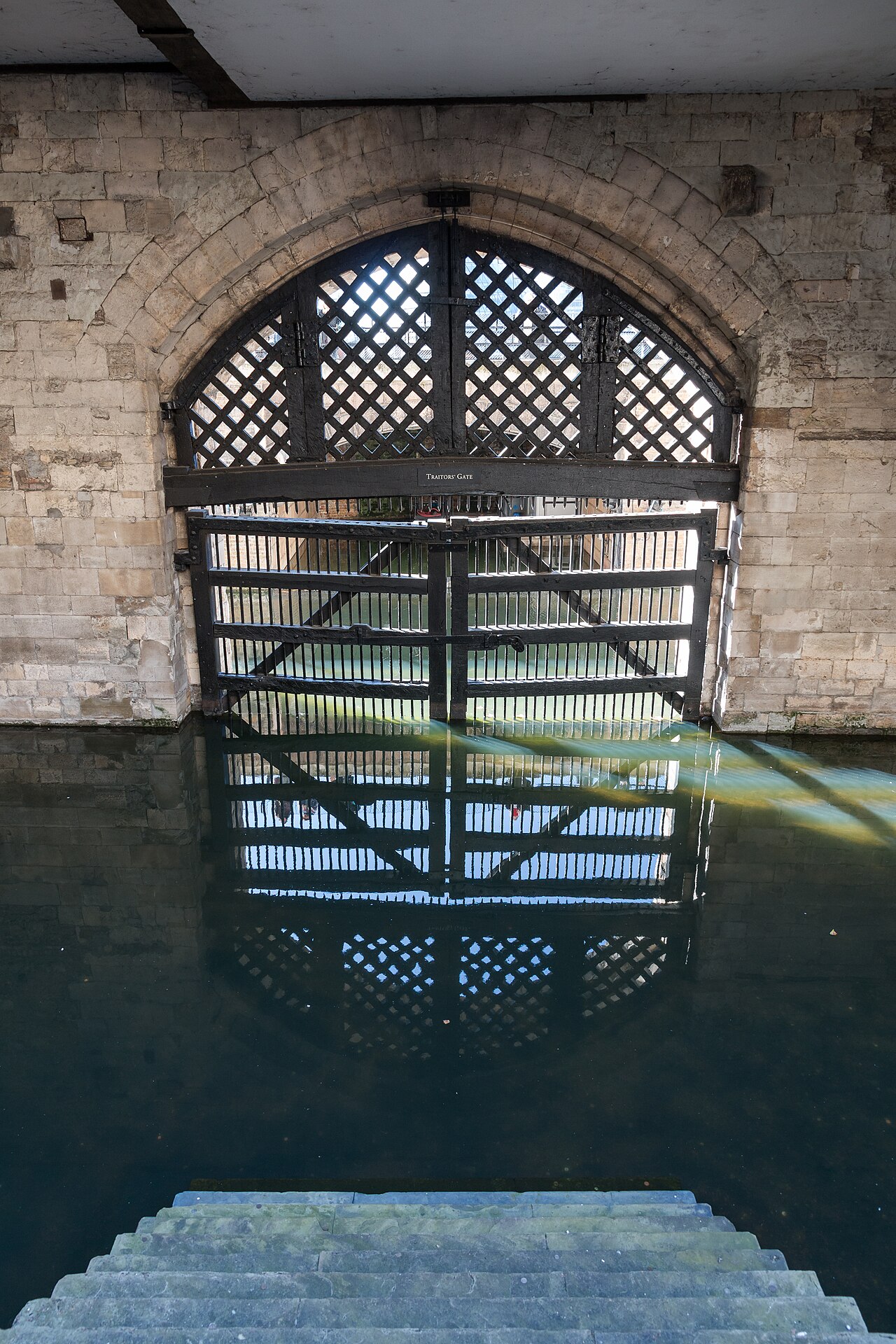
Traitors' Gate, Tower of London, 2016
Dietmar Rabich · 2016-10-09
A 2016 photograph of Traitors' Gate, the water entrance to the Tower of London. It shows a place linked to the princes' confinement, seen as it looks today.
It shows a gate of the Tower linked to the princes' confinement, but as it looks in 2016, long after Edward V.
About this source
What it is
This is a photograph by Dietmar Rabich, taken on 9 October 2016 at 11:00. It shows Traitors' Gate at the Tower of London from the water. The image shows an arched stone water entrance with a wooden portcullis-style lattice grille and a barred wooden gate, reflected in dark water, with stone steps in the foreground. It is shared on Wikimedia Commons.
Why it matters
Traitors' Gate is a place the archive links to the confinement of the princes in the Tower, including Edward V in 1483. The photograph was taken in 2016, so it shows the gate as it is now, not as it was in the fifteenth century. It helps students see the physical entrance the princes would have known in a modern form.
Look closer
- What features of the gate suggest it was built for defence?
- How does the water in the picture change how we imagine arriving at the Tower?
- What can a recent photograph not tell us about the gate's use in 1483?
This photograph is part of the curated material that grounds the AI version of Edward V on Humy.ai — when students ask about related events, the AI can quote it and cite it.
More Edward V sources
Browse all 78 → Painting
Primary source
Rivers and Caxton Presenting a Book to Edward IV
Lorenzo Lippi · 1477
Secondary source
Titulus Regius
1483
 Document
Primary source
Signature of Edward V of England
Edward V of England · 1483
 Book
Secondary source
Mémoires of Philippe de Commynes
Philippe de Commynes · c. 1489–1498
Free account
Read every Edward V source
Sign up free →
Ready when you are
Start chatting with Edward V now.
20 messages free · No credit card · Available in 50+ languages.