


Secondary sourceDocument4 October 2009
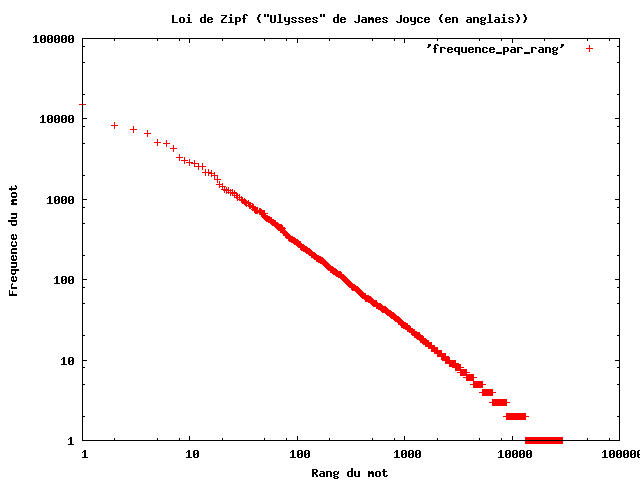
Zipf law word-frequency graph for Ulysses
Xofc · 4 October 2009
A 2009 log-log graph showing how often each word appears in Joyce's Ulysses, ranked from most to least frequent. It is a modern statistical study of the novel's text.
Analyses the word patterns of Joyce's novel Ulysses, so it studies his work rather than being a document he made.
About this source
What it is
This is a graph made on 4 October 2009 by a Wikimedia Commons user known as Xofc. It is a log-log scatter plot titled 'Loi de Zipf' ('Zipf's law') for the English text of Ulysses. Red markers form a roughly straight line descending from about 15,000 occurrences at the first rank to one occurrence at about rank 20,000. Both axes use a logarithmic scale, and the labels are in French.
Why it matters
The graph is named after Zipf's law, a pattern in how often words appear in a text. It is a modern analysis of Joyce's novel, not a document from his time. It shows one way researchers have counted and compared the words in a famous book, which is a different way of reading than a novel is usually read.
Look closer
- What does the steep drop at the left of the graph suggest about how often the most common words appear?
- Why might someone measure a novel by counting words rather than by reading its story?
- What might this kind of graph miss about the meaning of Joyce's language?
This document is part of the curated material that grounds the AI version of James Joyce on Humy.ai — when students ask about related events, the AI can quote it and cite it.
More James Joyce sources
Browse all 90 → Book
Primary source
Ulysses
James Joyce · 1914-1922
 Book
Primary source
A Portrait of the Artist as a Young Man
James Joyce · 1907-1916
 Book
Primary source
Dubliners
James Joyce · 1904-1907, published 1914
 Book
Primary source
The Dead
James Joyce · 1907, published 1914
Free account
Read every James Joyce source
Sign up free →
Ready when you are
Start chatting with James Joyce now.
20 messages free · No credit card · Available in 50+ languages.