





Dr. Michael Calvert
Assistant Superintendent, South Allegheny School District, Pennsylvania
Been using Humy in his district since 2024
“We enjoyed the program last year and used it frequently.”
Collection · 20 AI figures
20 AI figures for this unit, including Dwight D. Eisenhower, Harry S. Truman and Yuri Gagarin. Share one link and students choose who to talk to.
Featuring Dwight D. Eisenhower, Harry S. Truman, Yuri Gagarin and 17 more
Free teacher account · 20 AI messages a month · No credit card
Collection
Preview
The Cold War Era

Five-star general during World War II and 34th President of the United States.

33rd President of the United States.

First human in space.

Iconic rock and roll musician.

Revolutionary leader and President of North Vietnam.

35th President of the United States.

Musician, singer, and songwriter, known for co-founding the Beatles.

37th President of the United States.

40th President of the United States, actor, and governor of California.

Soviet dictator and revolutionary leader.

Soviet statesman and politician, leader of the Soviet Union during the height of the Cold War.

Former leader of the Soviet Union and proponent of political reforms.

Infamous British spy and double agent for the Soviet Union.

Convicted American CIA officer who spied for the Soviet Union and Russia.

Famous Soviet spy who worked in Japan during World War II.

Prominent American intelligence official and the first civilian Director of Central Intelligence.

Soviet naval officer who prevented a nuclear war during the Cuban Missile Crisis by refusing to authorize the use of nuclear torpedoes.

Svetlana Alliluyeva was the youngest child and only daughter of Soviet leader Joseph Stalin. She defected to the United States in 1967.

East German politician and statesman who briefly served as the General Secretary of the Socialist Unity Party and the head of state of East Germany.

Nobel Prize-winning labor activist and politician.
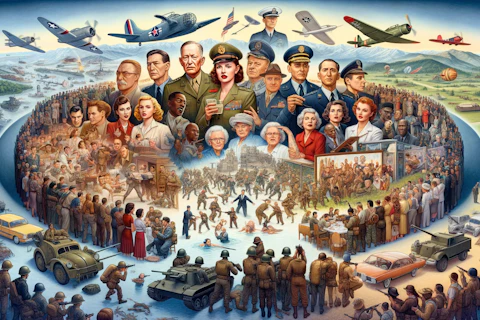
Step behind the Iron Curtain and into the geopolitical chess game of the Cold War with this engaging assignment. Students will conduct conversations with key figures from the Cold War era, immersing them in the strategic, controversial, and sometimes perilous moments that defined this period of history. Through these dialogues, participants will gain a deeper understanding of the international tensions and cultural shifts that characterized the decades-long standoff between superpowers.
AI Interactions: Participants have the opportunity to "interview" these historical figures, examining their beliefs, decisions, and the impact of their actions on the course of the Cold War.
Analytical Essays: Students will compose essays that analyze the complex dynamics of the Cold War, reflecting on how leadership decisions shaped international relations and domestic policies.
Group Discussions: Debates and seminars will enable students to explore and challenge different perspectives on the Cold War, discussing the multifaceted nature of global power struggles and cultural changes.
Build a comprehensive understanding of the Cold War era, delving into the intricacies of its political confrontations, nuclear brinkmanship, espionage, and propaganda campaigns.
Develop critical thinking by evaluating the roles of individuals within the context of the larger East-West conflict and analyzing the factors that led to the Cold War's resolution.
Enhance communication and interpretative skills, learning to articulate a coherent perspective on complex historical events and their significance in shaping the modern world.
In your classroom
Preview the collection, then choose Activate to add it to your collections. Add or remove figures any time.
Students join with their first and last name. No email, no password.
Each student chooses who to question and starts a conversation.
After sign-up, find it under Collections → Community library.
Paying customers
























Dr. Michael Calvert
Assistant Superintendent, South Allegheny School District, Pennsylvania
Been using Humy in his district since 2024
“We enjoyed the program last year and used it frequently.”

Jacob Chisom
World and American History, Monticello High School, Arkansas
Been using Humy in his classroom since 2024
“My students say it’s a welcome change of pace. I’m not a fan of the “sage on the stage” model, so I try to incorporate research-oriented and self-paced activities. With Humy, students have to take charge of their learning. They’ve become more adept at critical thinking, forming better questions, and improving their reading comprehension. The interview feature has been my go-to tool. I create assignments where students must ask historical figures a set number of questions, then summarize the responses to ensure they’re truly absorbing the material. This approach lets them actively explore the past rather than passively consuming information.”
Roger Campbell
7th-grade World History, Lancaster County, Pennsylvania
Been using Humy in his classroom since 2024
“Humy has helped me bring historical figures, sometimes long past, to life. When my students interact with these figures in real-time, it eliminates some of the perceived “ancient” characteristics of my curriculum. This has shifted my students’ thinking away from viewing history as abstract or irrelevant. Real-time interactions make historical figures relatable, even allowing students to ask off-topic questions that help put historical lives in a more relevant context for 13-year-olds. The feature I use the most is the interview feature. After teaching a topic, most recently Gandhi and Joan of Arc, I have the students ask pointed, focused questions. We practice good conversation techniques beforehand, teaching them to listen (or read) carefully and formulate thoughtful follow-up questions rather than just interrogating. It helps students practice effective conversation skills.”
Dr. Michael Calvert
Assistant Superintendent, South Allegheny School District, Pennsylvania
Been using Humy in his district since 2024
“We enjoyed the program last year and used it frequently.”
Jacob Chisom
World and American History, Monticello High School, Arkansas
Been using Humy in his classroom since 2024
“My students say it’s a welcome change of pace. I’m not a fan of the “sage on the stage” model, so I try to incorporate research-oriented and self-paced activities. With Humy, students have to take charge of their learning. They’ve become more adept at critical thinking, forming better questions, and improving their reading comprehension. The interview feature has been my go-to tool. I create assignments where students must ask historical figures a set number of questions, then summarize the responses to ensure they’re truly absorbing the material. This approach lets them actively explore the past rather than passively consuming information.”
Roger Campbell
7th-grade World History, Lancaster County, Pennsylvania
Been using Humy in his classroom since 2024
“Humy has helped me bring historical figures, sometimes long past, to life. When my students interact with these figures in real-time, it eliminates some of the perceived “ancient” characteristics of my curriculum. This has shifted my students’ thinking away from viewing history as abstract or irrelevant. Real-time interactions make historical figures relatable, even allowing students to ask off-topic questions that help put historical lives in a more relevant context for 13-year-olds. The feature I use the most is the interview feature. After teaching a topic, most recently Gandhi and Joan of Arc, I have the students ask pointed, focused questions. We practice good conversation techniques beforehand, teaching them to listen (or read) carefully and formulate thoughtful follow-up questions rather than just interrogating. It helps students practice effective conversation skills.”
FAQ
Ready when you are
Free teacher account · 20 AI messages a month · No credit card.