


Primary sourceSculpturec. 900
3D Mandala, Tō-ji Lecture Hall
Kūkai · c. 900
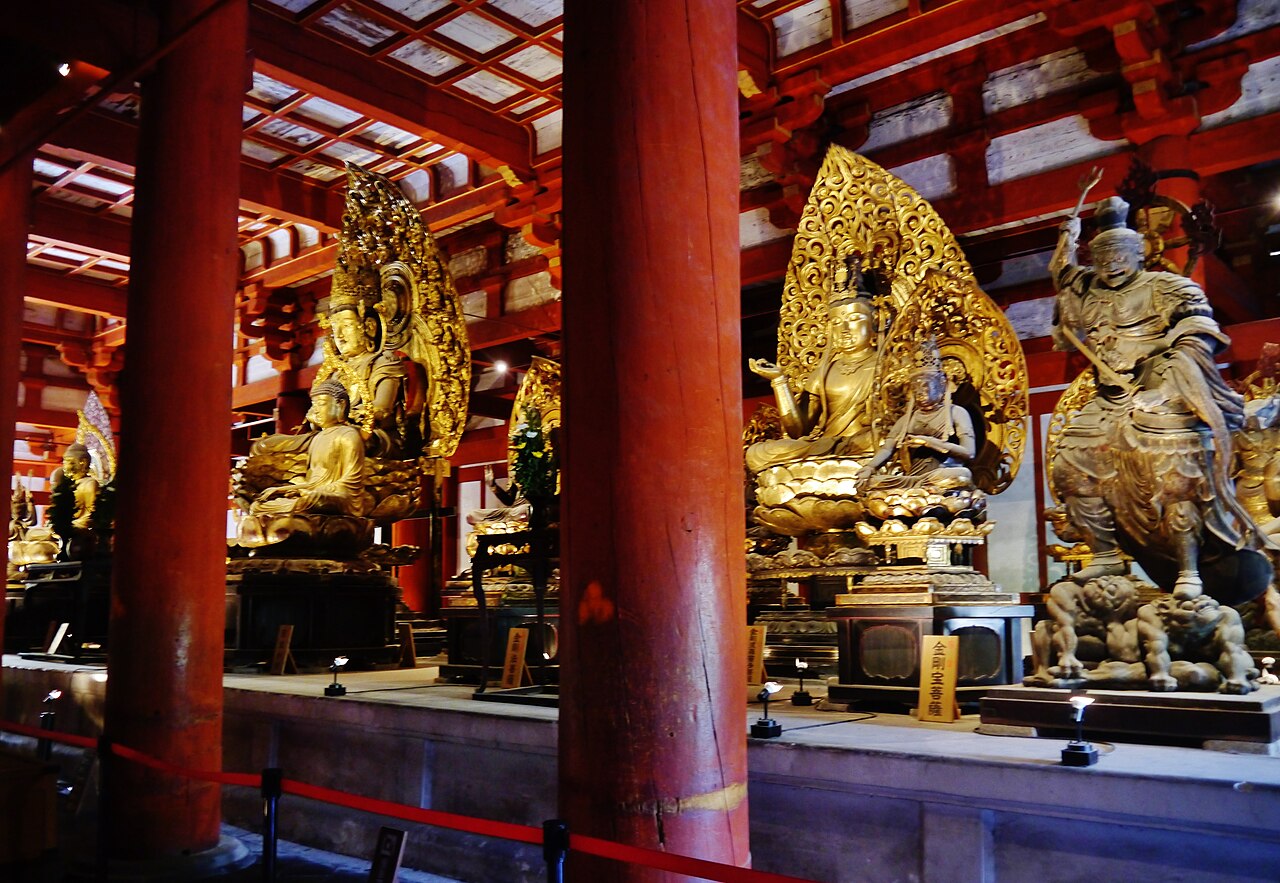
A group of 21 statues arranged by Kūkai's plan into a three-dimensional mandala of Buddhist deities.
Kūkai planned this three-dimensional mandala of statues as part of his design for Tō-ji's Lecture Hall.
About this source
What it is
This set of 21 statues stands in the Lecture Hall of Tō-ji Temple, planned under Kūkai around 900. The figures include seated and standing deities, gilded and arranged on a raised platform.
Why it matters
Kūkai designed this arrangement to turn the abstract idea of a mandala, a diagram used in esoteric Buddhist meditation, into a physical, three-dimensional space that worshippers could walk around. It shows how he translated Chinese esoteric teachings into a uniquely Japanese religious experience.
Look closer
- Why might arranging statues in space teach something that a flat painted mandala cannot?
- What do the different poses and expressions of the statues suggest about the different deities they represent?
- What can this arrangement tell us, and what can it not tell us, about how people actually used this hall?
This sculpture is part of the curated material that grounds the AI version of Kūkai on Humy.ai — when students ask about related events, the AI can quote it and cite it.
More Kūkai sources
Browse all 97 →


Ready when you are
Start chatting with Kūkai now.
20 messages free · No credit card · Available in 50+ languages.