


Secondary sourcePainting
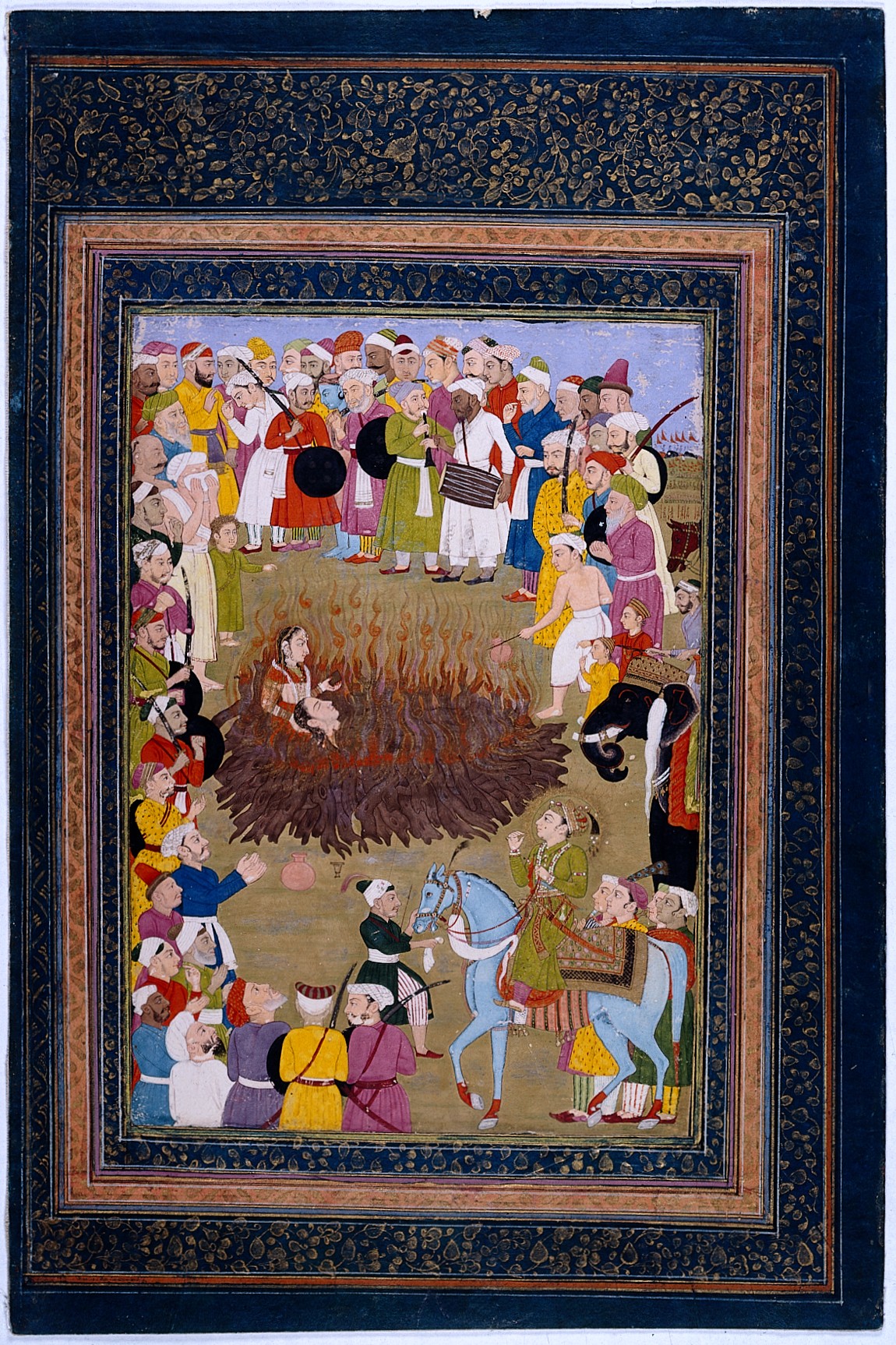
A Hindu Princess Committing Suttee
Mohammad Rizā Naw'ī
A Mughal miniature illustrating a scene from Nau'i's poem Suz u Gudaz, showing Akbar trying to dissuade a widow from committing sati.
The painting shows Akbar personally intervening to try to stop a widow's suttee, illustrating his social reforms.
About this source
What it is
This is a Mughal miniature painting illustrating a scene from the Persian poem Suz u Gudaz ("Burning and Melting") by Muhammad Rizā Nau'ī, who died in 1610. It shows a widow on a funeral pyre surrounded by a crowd, with a horseman identified as Prince Dāniyāl, Akbar's third son, in the foreground.
Why it matters
The painting is a visual record of Akbar's attempts to restrict sati, the practice of a widow burning herself on her husband's funeral pyre. It connects Akbar, his son Dāniyāl (who gave the poet the story), and the poet Nau'ī, showing how art, literature and imperial policy intertwined at the Mughal court.
Look closer
- Why might the artist choose to show the crowd and musicians rather than focus only on the widow?
- What does the presence of elephants and richly dressed men tell you about who is watching this event?
- What does this image suggest about how rulers tried to influence social customs?
This painting is part of the curated material that grounds the AI version of Akbar the Great on Humy.ai — when students ask about related events, the AI can quote it and cite it.
More Akbar the Great sources
Meet the AI Akbar the Great →
Ready when you are
Start chatting with Akbar the Great now.
20 messages free · No credit card · Available in 50+ languages.