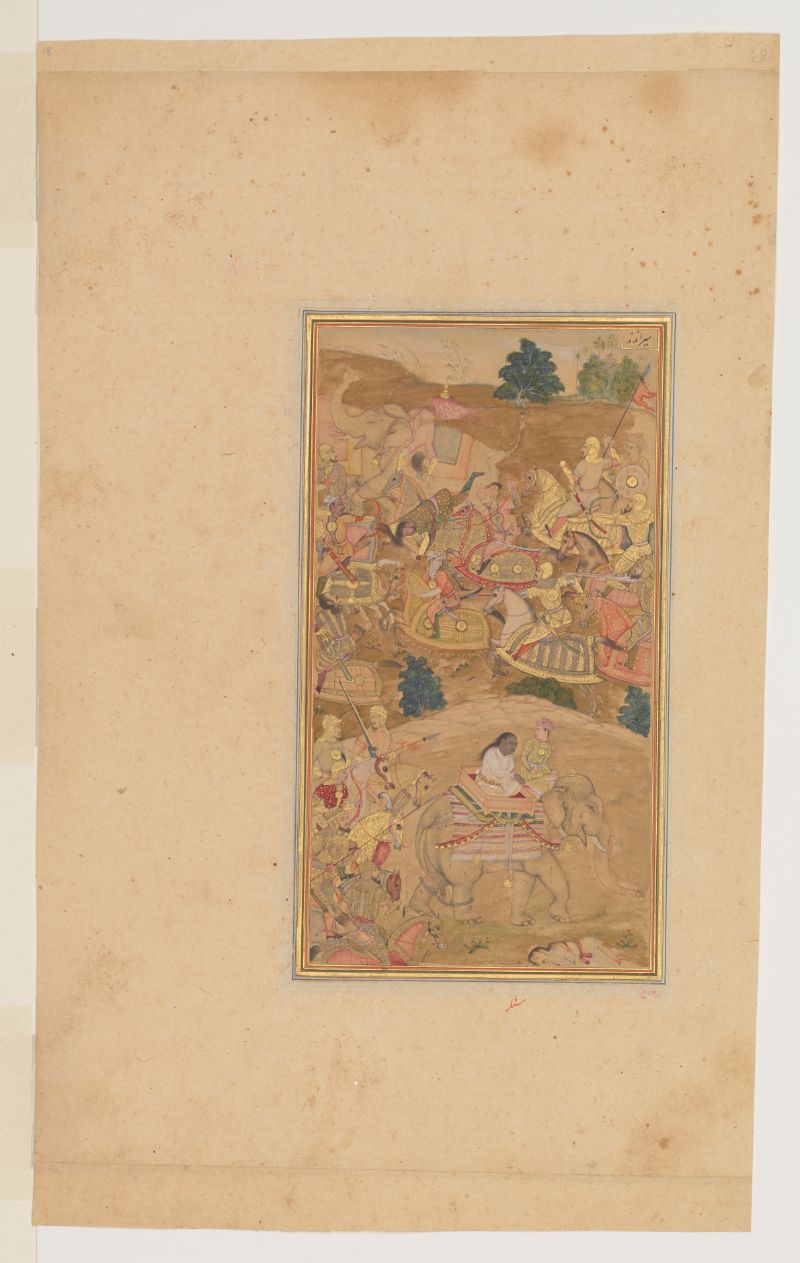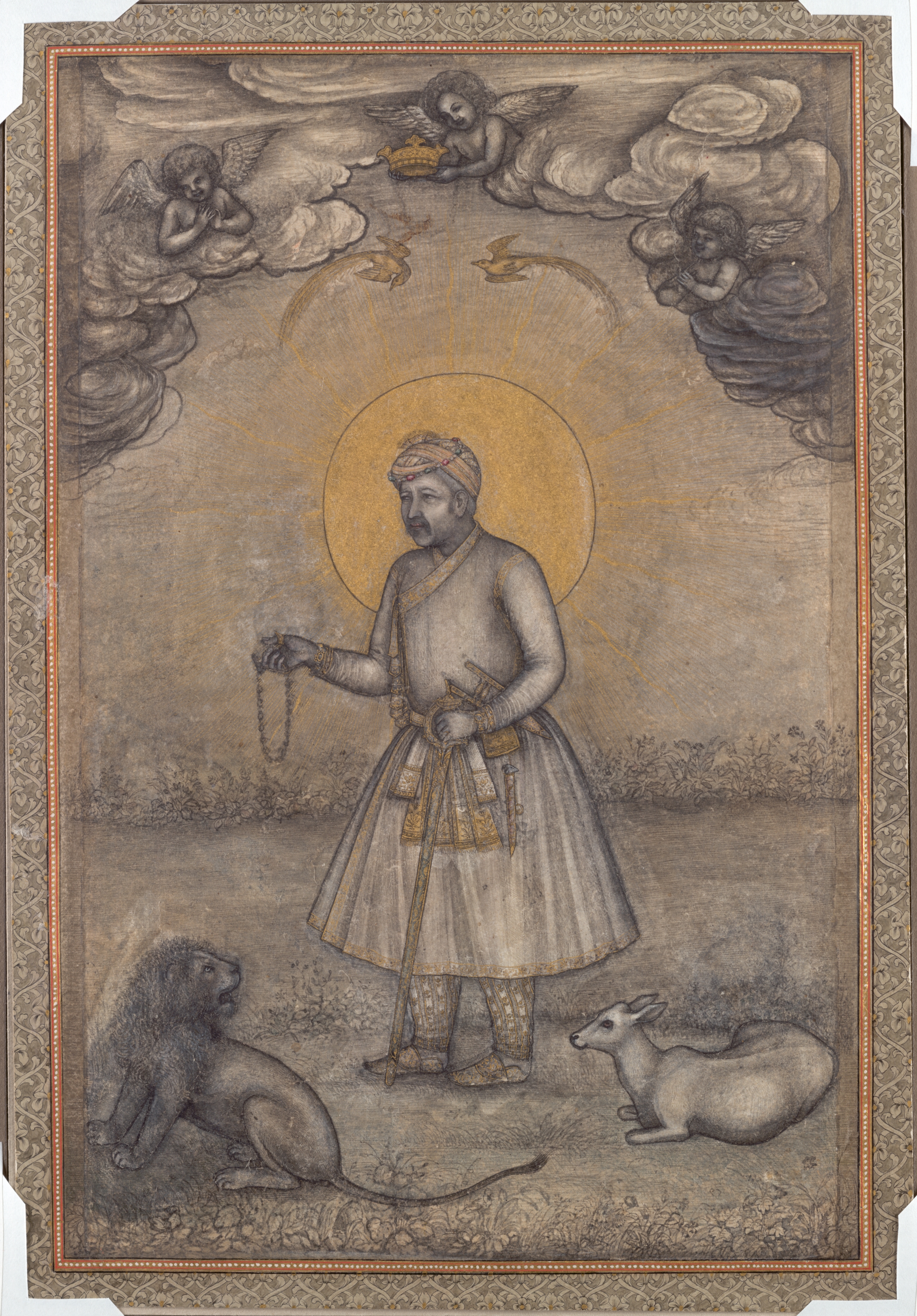

Portrait of Akbar the Great

AI Historical Figure

Akbar the Great

Mughal emperor of India known for religious tolerance and administrative reforms.

Chat with Akbar the Great via text or voice — in 42 languages, drawing on a curated biography and 80 historical sources. Available 24/7.

Start chatting with Akbar the Great20 messages free · No credit card
Lived
1542–1605
From
India
Known for
Rulers & royaltyPolitics & government
Akbar the Great

Akbar the Great

Online · responds in seconds

Hello — I'm Akbar the Great. Mughal emperor of India known for religious tolerance and administrative reforms. What would you like to ask me?

20 messages free · No credit card · Powered by Humy.ai

Live preview · Switch between 42 languages above · Send a message to continue in the app

Multilingual

Talk to Akbar the Great in 42 languages

Ask Akbar the Great questions in any language below, and the rest of Humy's app speaks it too. Pick yours to open the chat in that language.

Also in German (Austria), German (Switzerland), English (UK), English (Australia), English (Canada).

The sources behind this AI

80 sources · 33 paintings · 26 books · 17 artifacts · 4 documents

Akbar the Great doesn’t improvise from thin air. The AI is grounded in 80 curated historical sources students can inspect. Open any of them to see what informs the conversation.

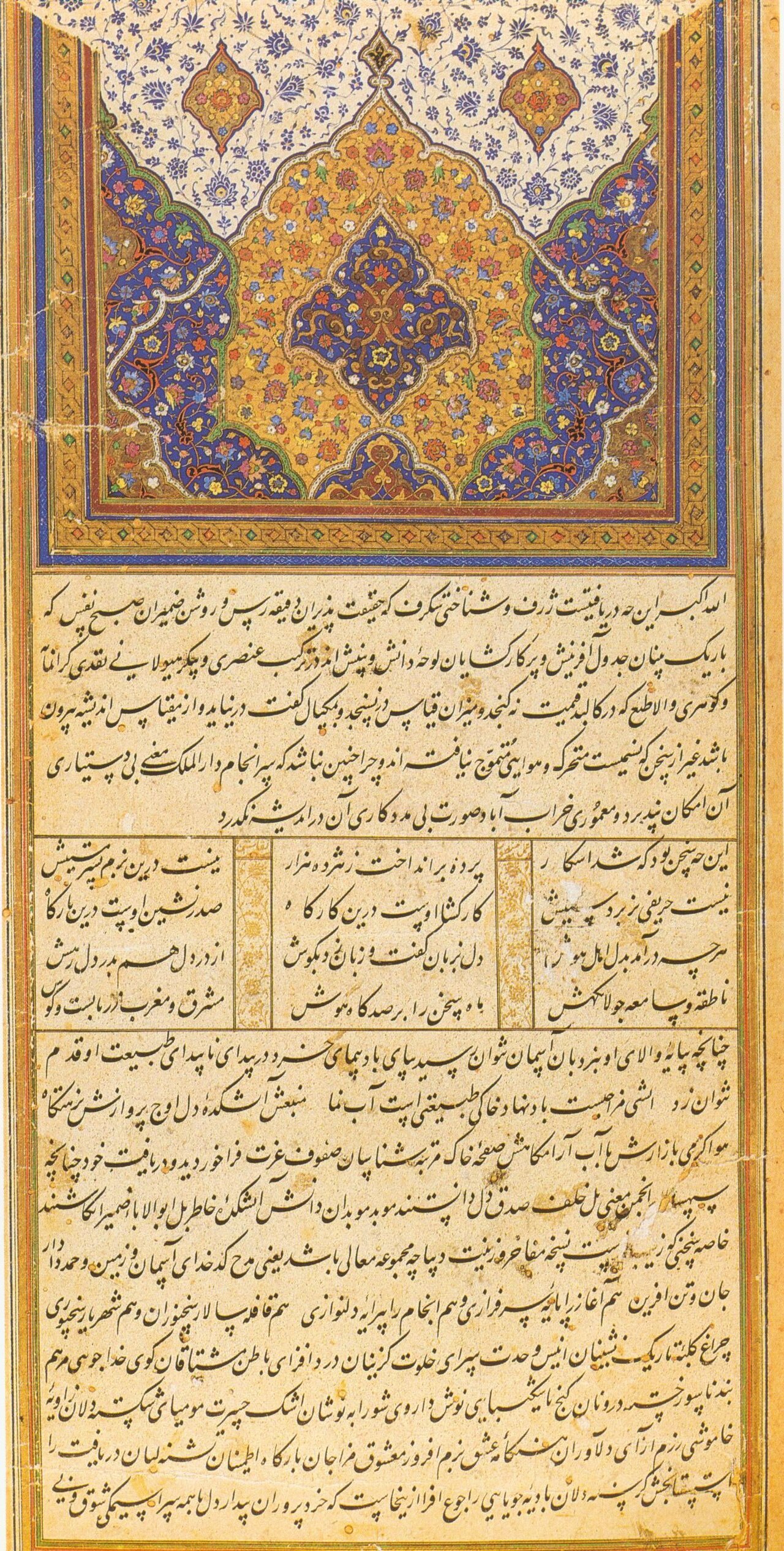
Illuminated opening page of a manuscript in Persian script. At top is an ornate gold and blue illuminated frontispiece with floral arabesques, a central cartouche and arched panels. Below are three columns of black calligraphy on cream paper, framed by gold and red borders.Book

Primary source

Akbarnama

Abu'l-Fazl ibn Mubarak · c. 1590

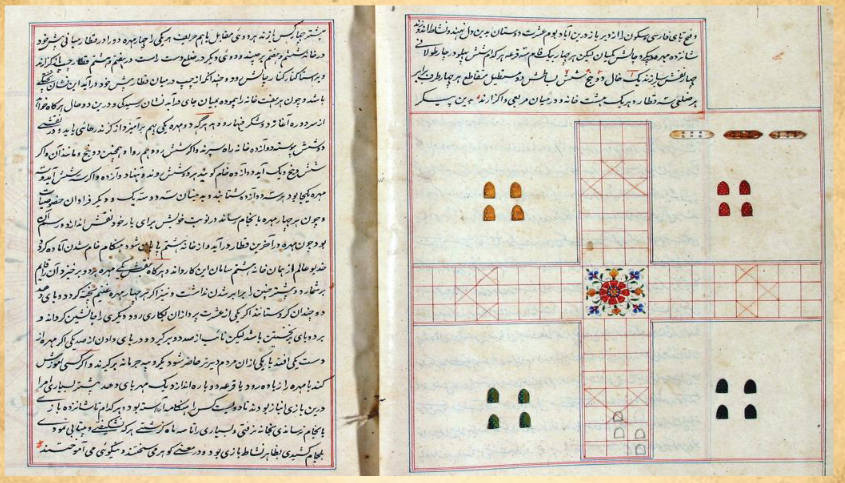
Two-page manuscript spread with dense Persian script in black ink on the left and right pages. The right page has a ruled grid board with red and blue lines, a central multicolored rosette, and sets of colored pawn shapes in four corners, illustrating a Chaupar game.Book

Primary source

Ain-i-Akbari

Abu'l-Fazl ibn Mubarak · 1589-1596

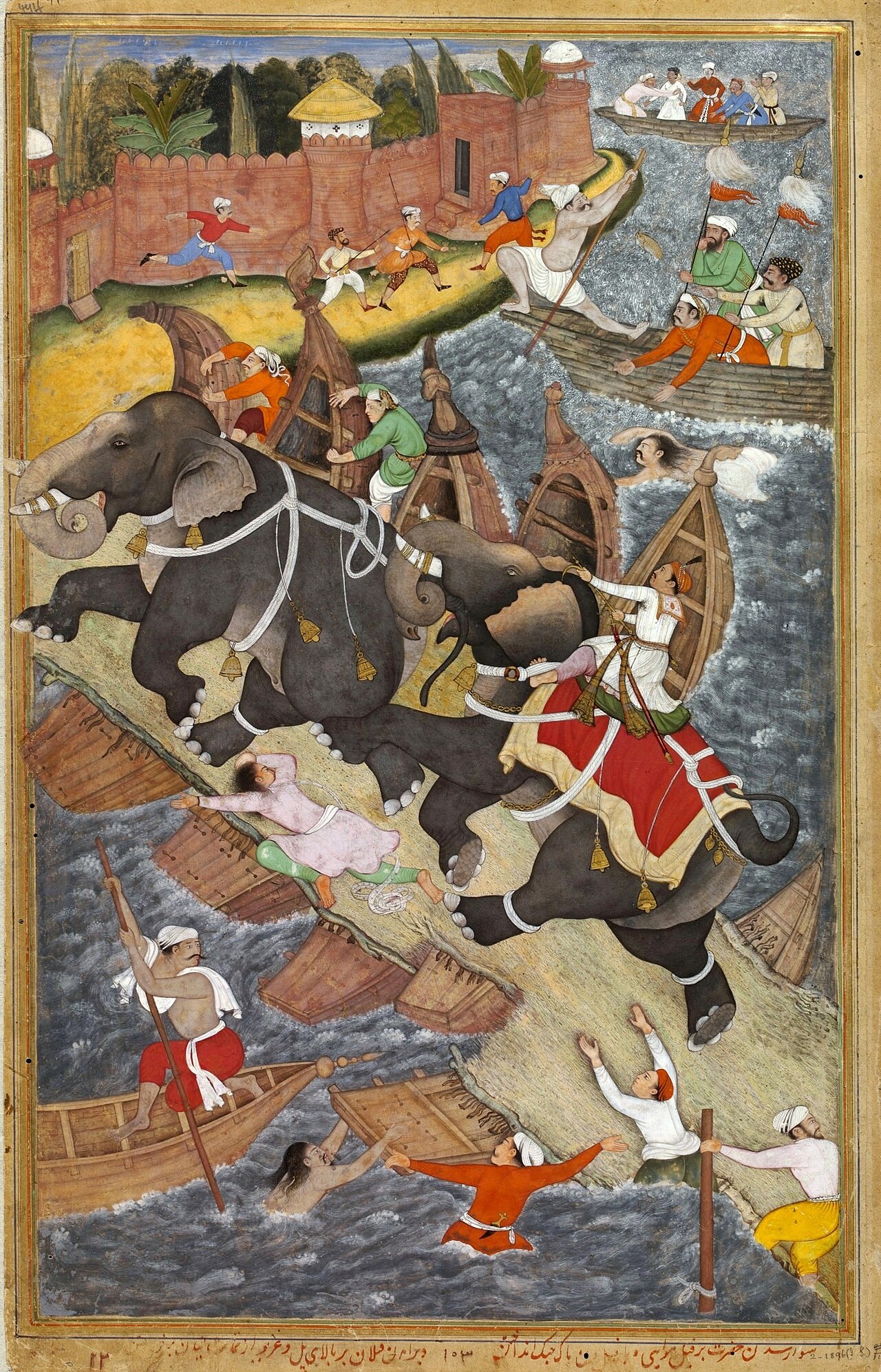
Painted Mughal miniature showing Akbar's elephant Hawai in a riverside scene: elephants and men on a sandy bank, boatmen in wooden boats struggling in choppy water, figures at a red fort wall above, and Persian inscriptions at the bottom.Artifact

Primary source

Victoria and Albert Akbarnama

c. 1590-1595

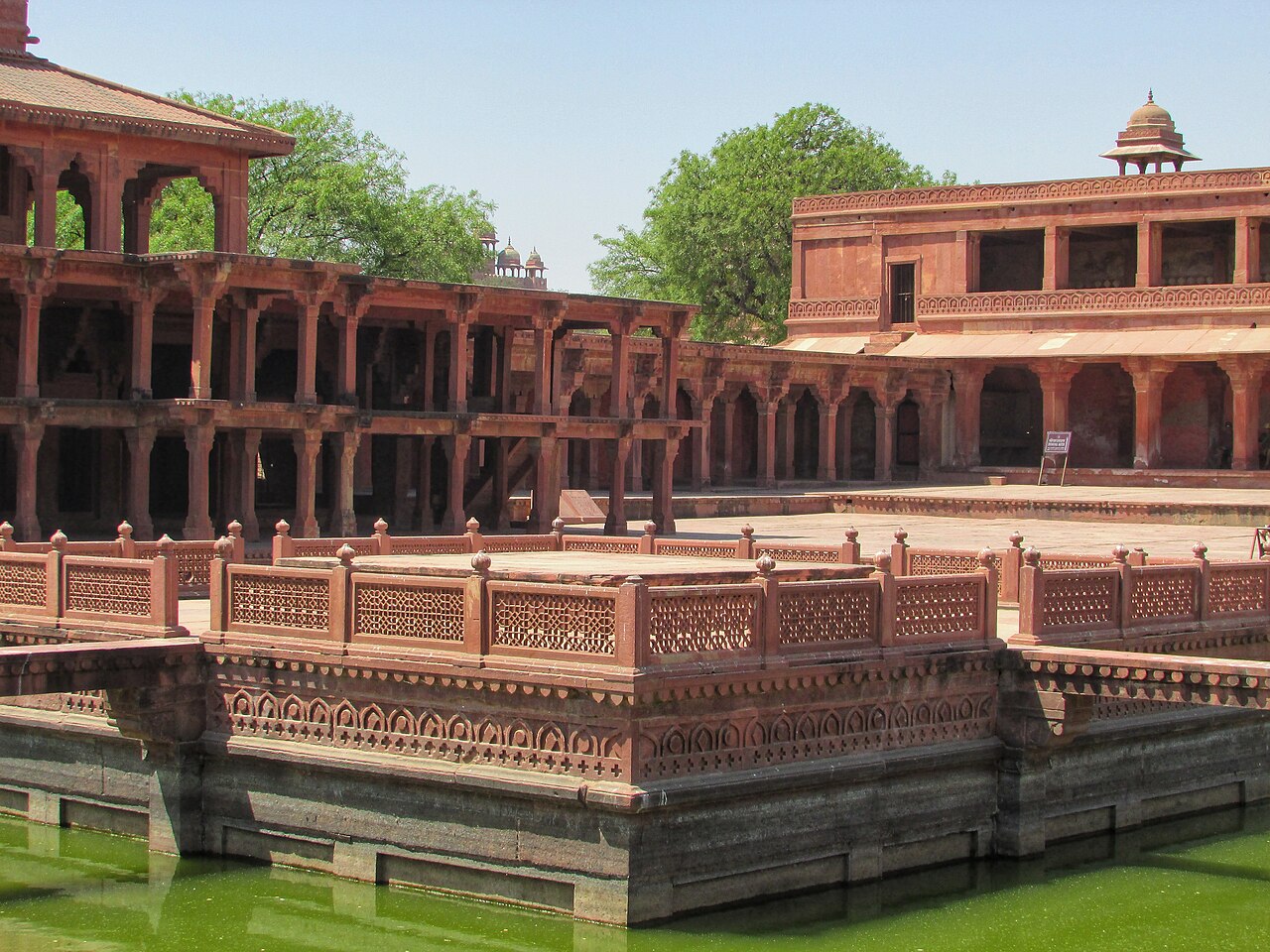
Red sandstone palace courtyard at Fatehpur Sikri with multi-storey colonnaded pavilions, carved jali screen railings, and a green-tinted water pool in the foreground under a clear sky with trees.Artifact

Primary source

Fatehpur Sikri

founded 1571

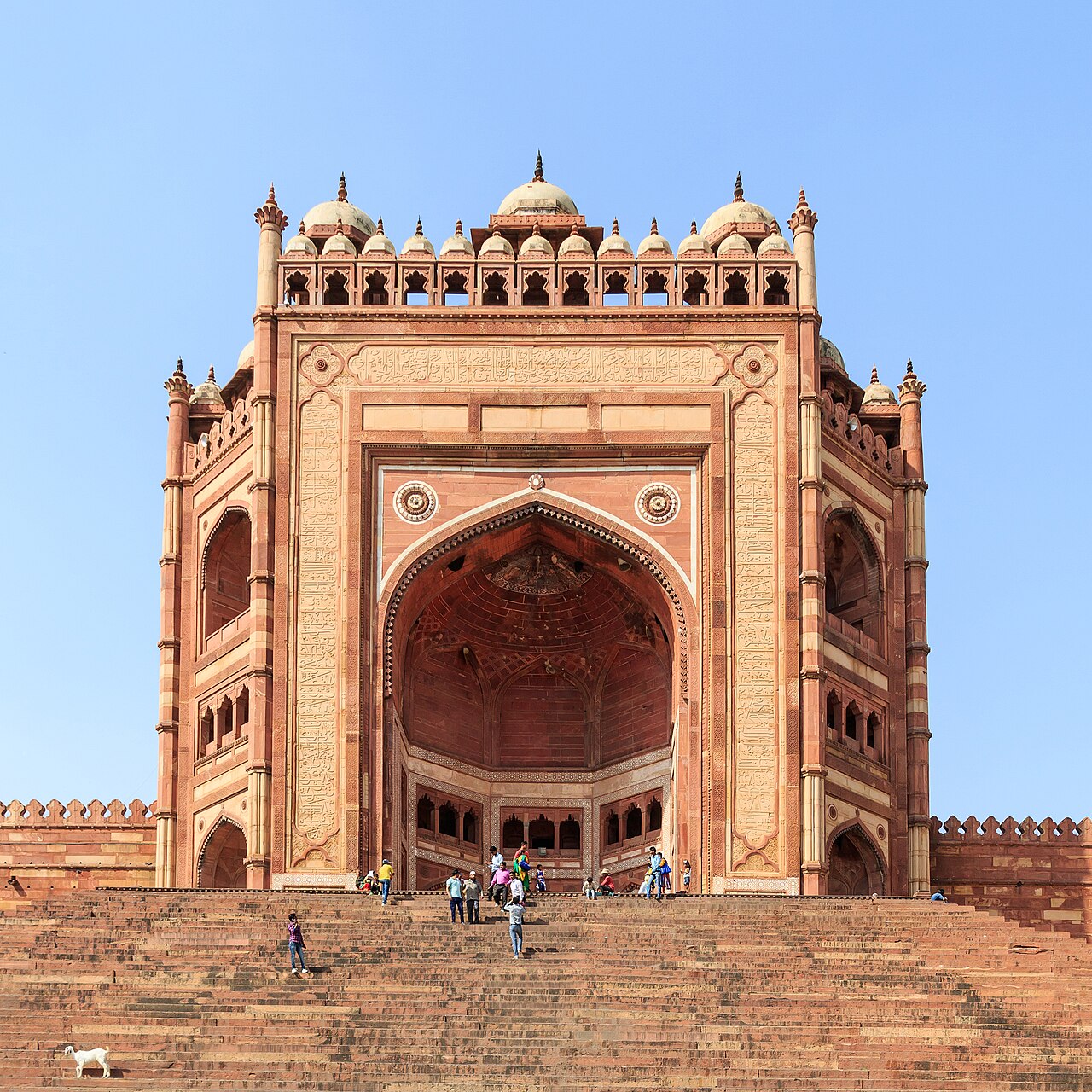
Front view of the Buland Darwaza, a tall red sandstone gateway with white domed pavilions on its roof, a large central arched portal, and a wide flight of steps leading up to it. Several people stand on the steps and a small white goat is at lower left.Artifact

Primary source

Buland Darwaza

begun 1573

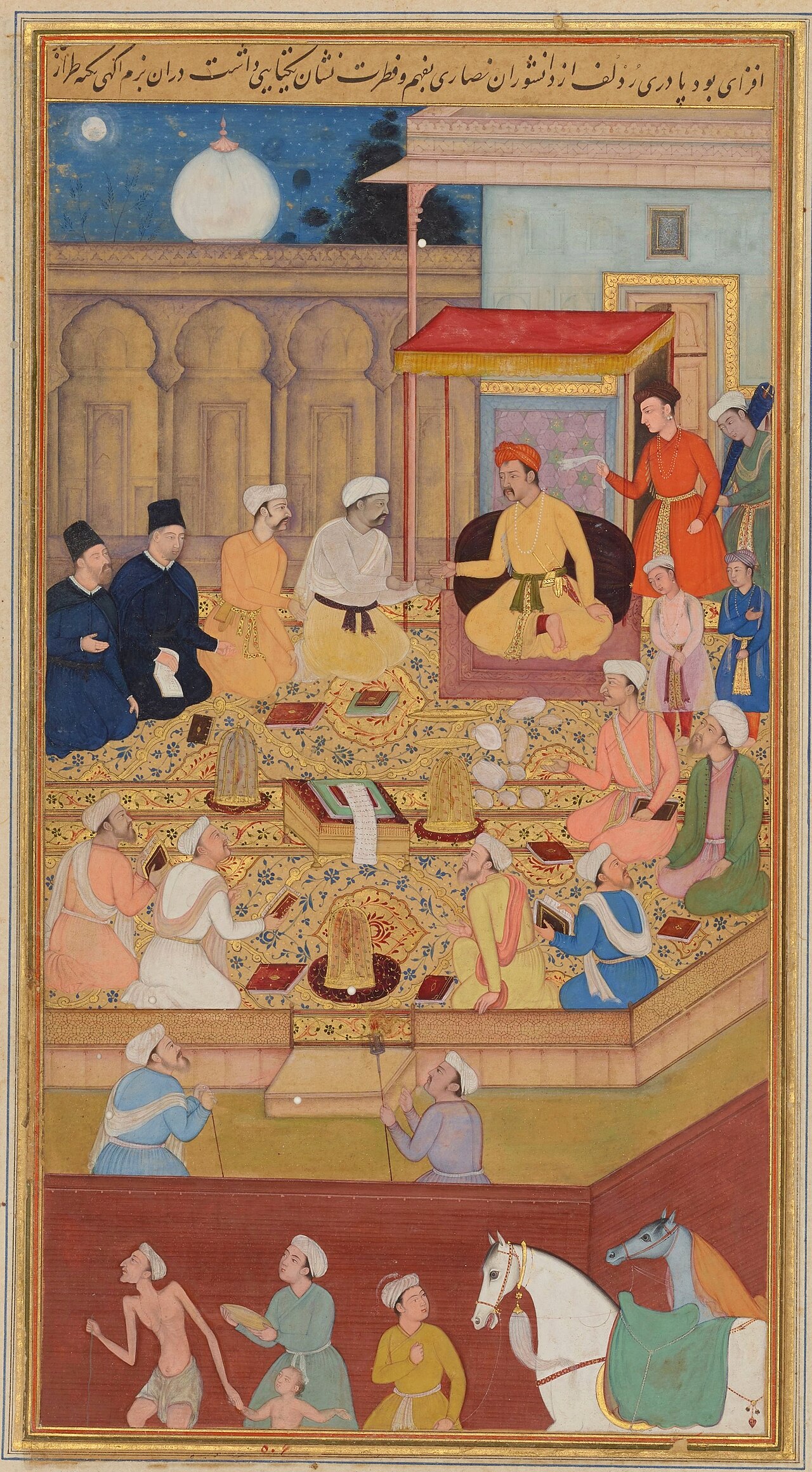
Mughal miniature painting of a seated ruler in yellow robes under a red canopy, surrounded by courtiers, scholars with books, and a night sky with a domed building above. Below, figures include a horseman and beggars.Painting

Primary source

Akbar Holds a Religious Assembly in the Ibadat Khana

Nar Singh · c. 1605

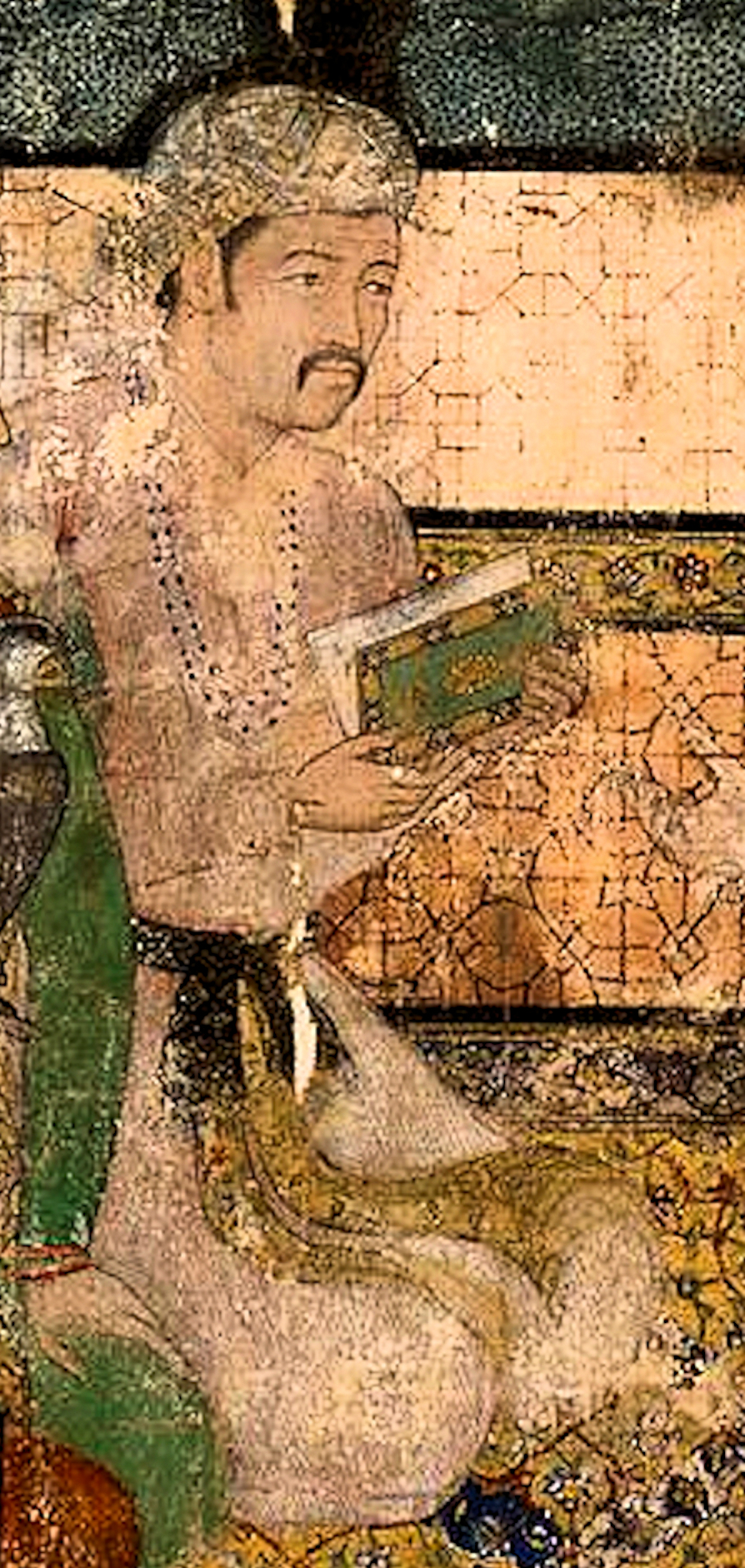
Detail of a miniature painting showing a seated man in a rounded turban and light robe, with a mustache, holding a book with a green cover. A falcon perches on his left arm, and a patterned tiled background with gold-trimmed carpet surrounds him.Painting

Primary source

Portrait of Akbar

1605

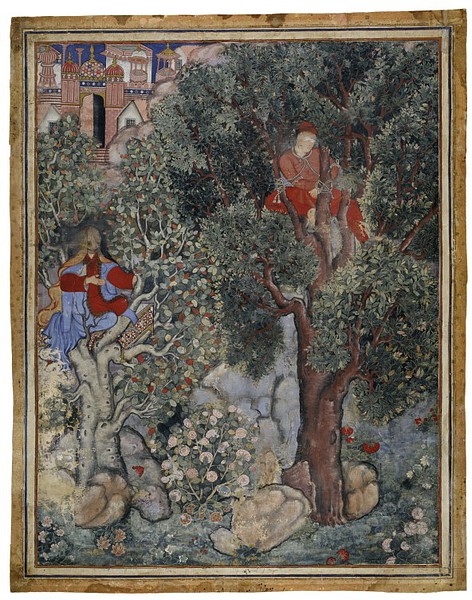
Painted miniature from a Persian-style illustrated manuscript showing two figures in a garden: a bearded figure in blue and red seated on a rocky outcrop among shrubs, and a figure in red robes perched in a large tree. Pale pink flowering bushes and a walled city with domed buildings appear in the background.Book

Primary source

Akbar's Hamzanama

c. 1557-1577

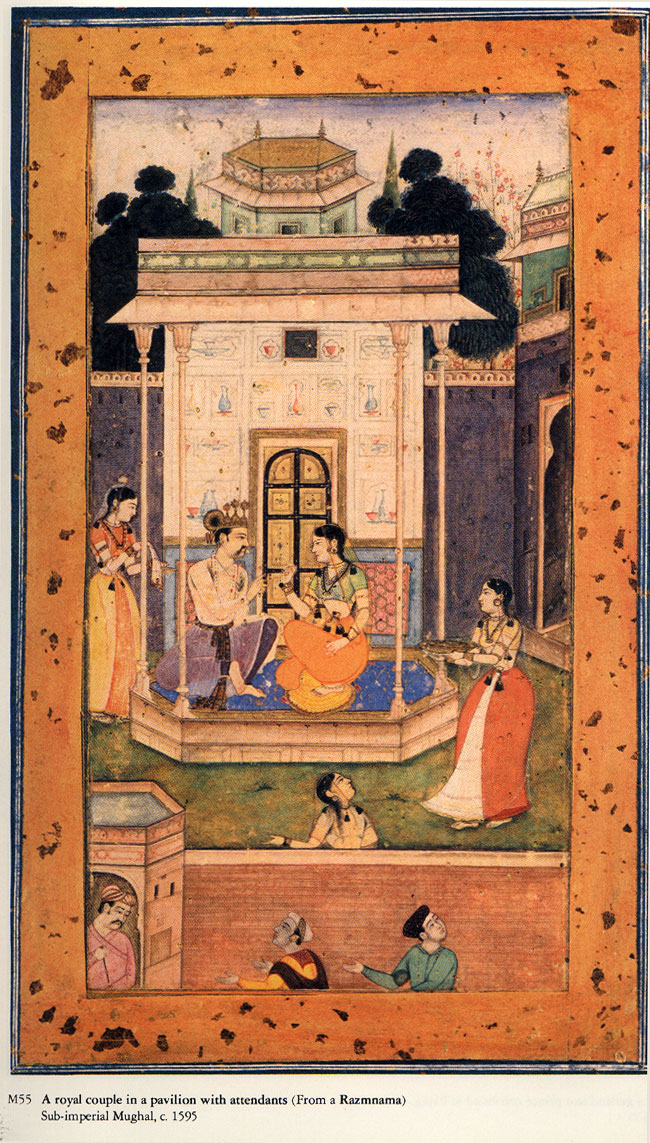
A painted miniature folio showing a royal couple seated in an open pavilion with a patterned wall and a central door. Attendants stand nearby, one holding a tray, and figures peer from a lower courtyard and a doorway.Book

Primary source

Razmnama

c. 1584-1586

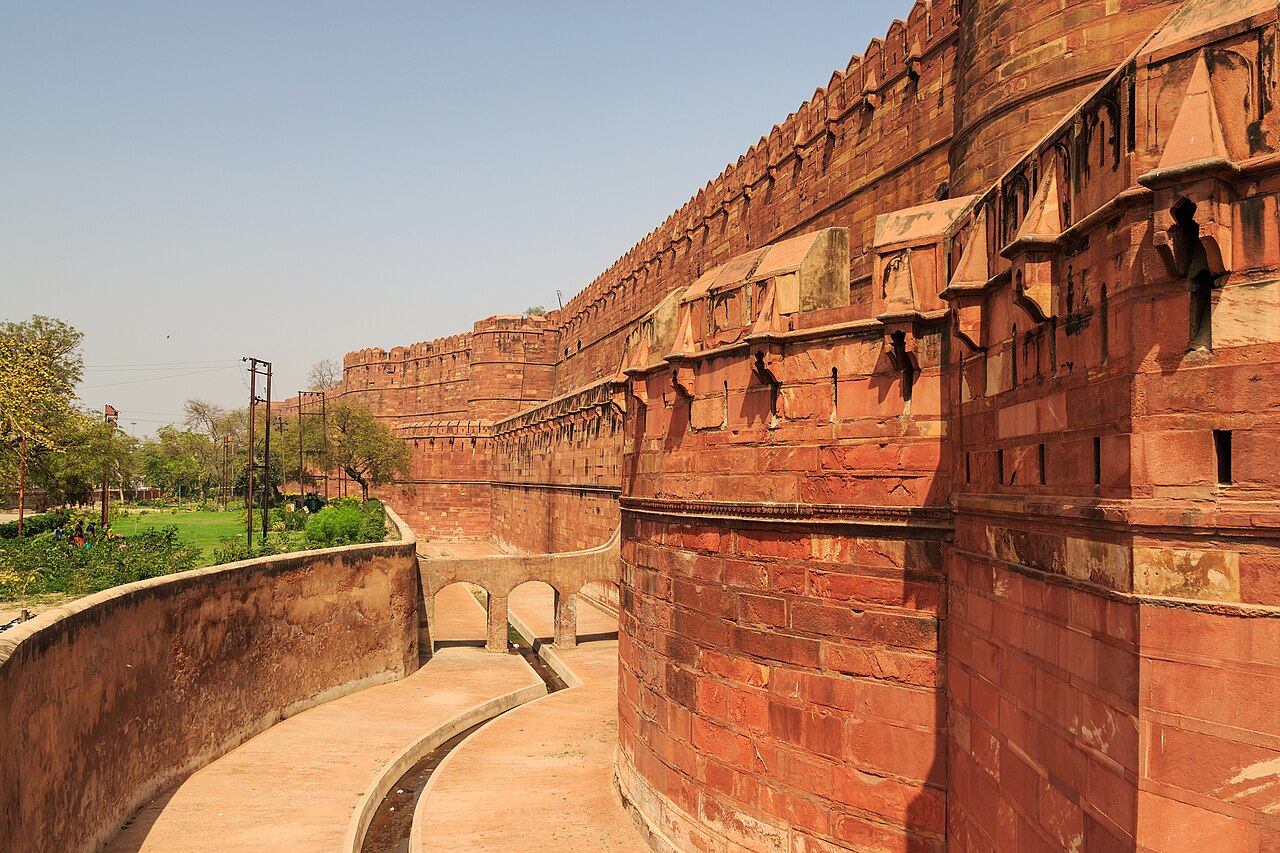
Red sandstone curtain walls of Agra Fort with crenellated parapets, carved stone brackets and projecting balconies, a curving moat path, a small arched bridge, and green trees under a clear sky.Artifact

Primary source

Agra Fort

1565-1573

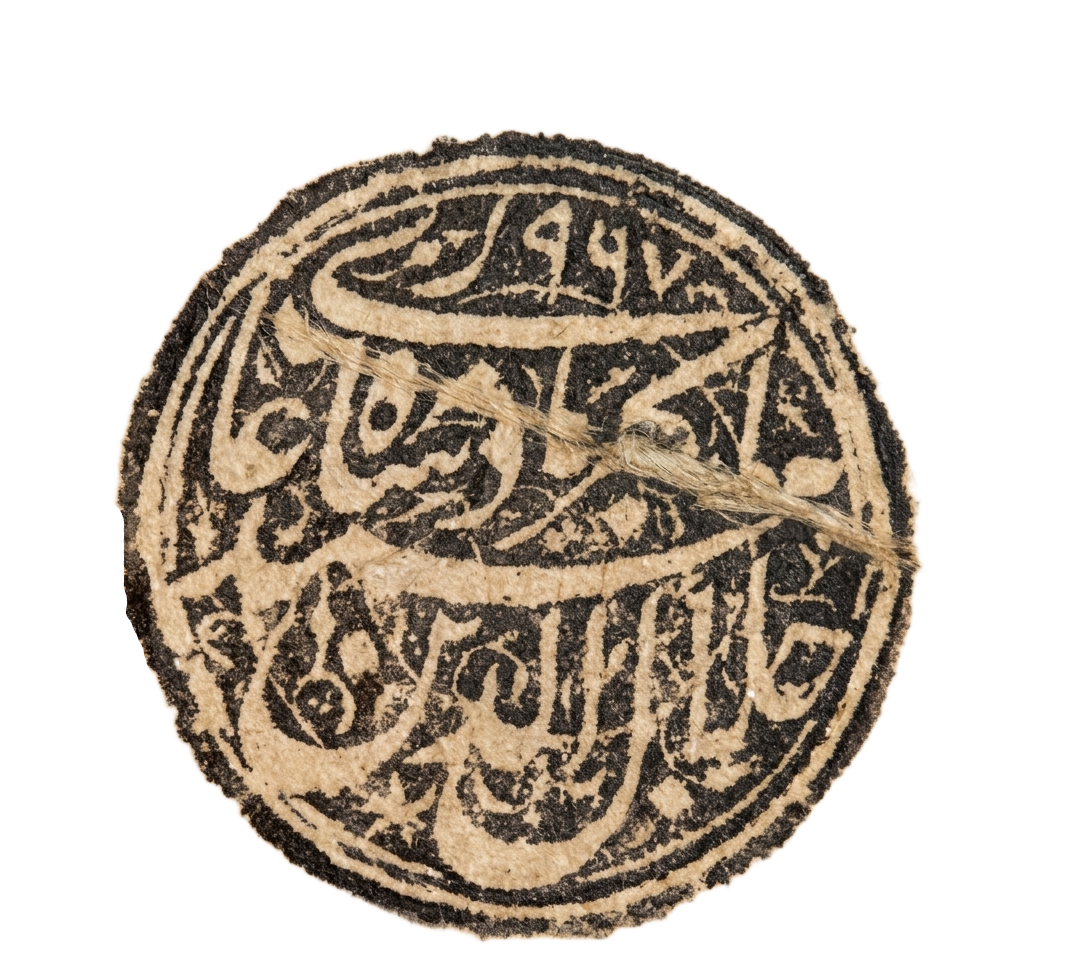
Round paper seal with black background and cream Arabic-style calligraphy in ornate script, with a few dark numerals at the top. A thread runs diagonally across the seal. The background is white.Artifact

Primary source

Seal of Akbar

Akbar · 967 AH (1559-60 CE)

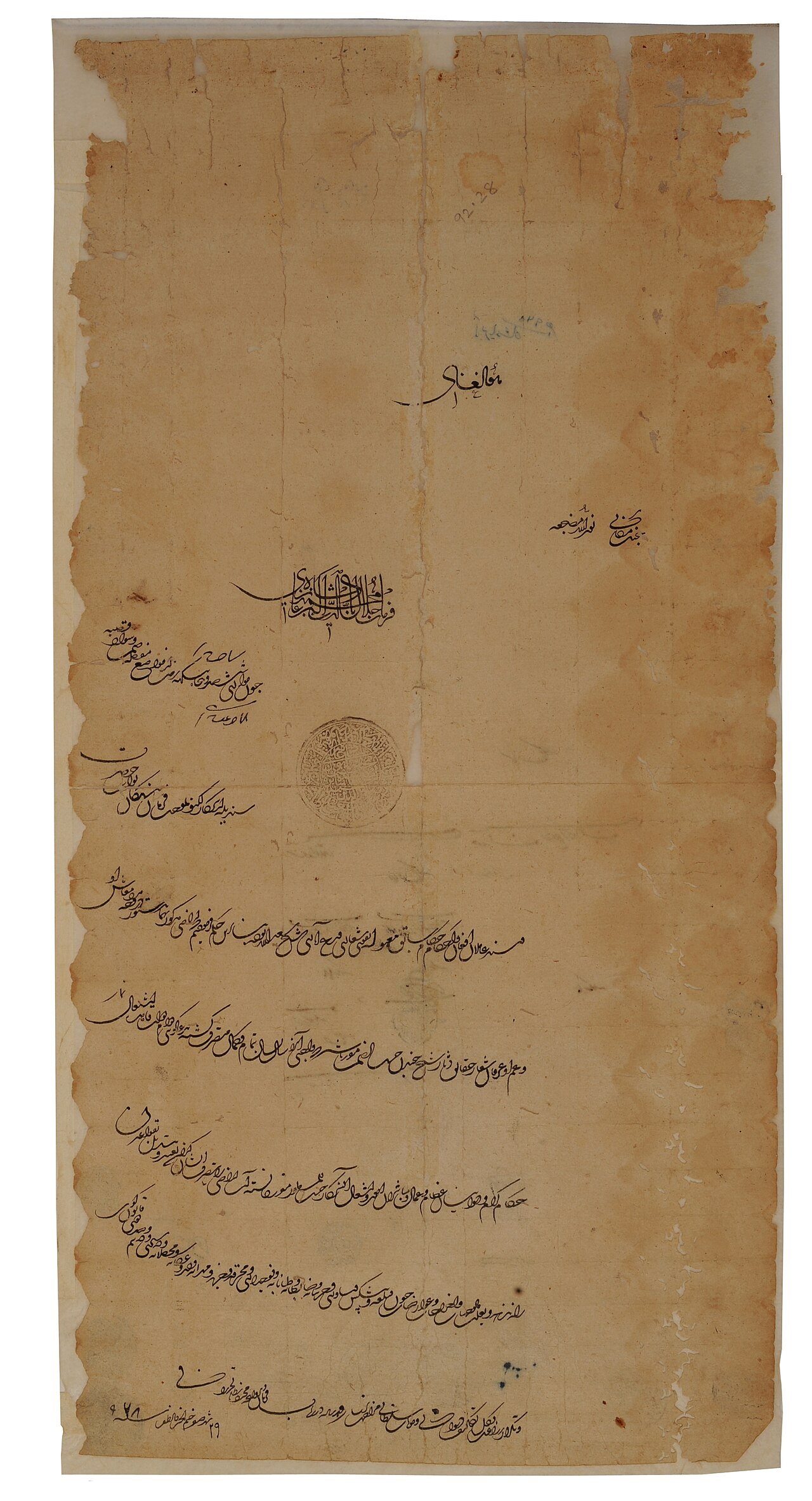
Photograph of a large, aged paper document with torn and browned edges, covered in Persian calligraphy in black ink in several lines, with a circular seal impression near the center and a small signature mark at the lower left.Document

Primary source

Farman of Jalal-ud-Din Mohammad Akbar

1560 C.E.

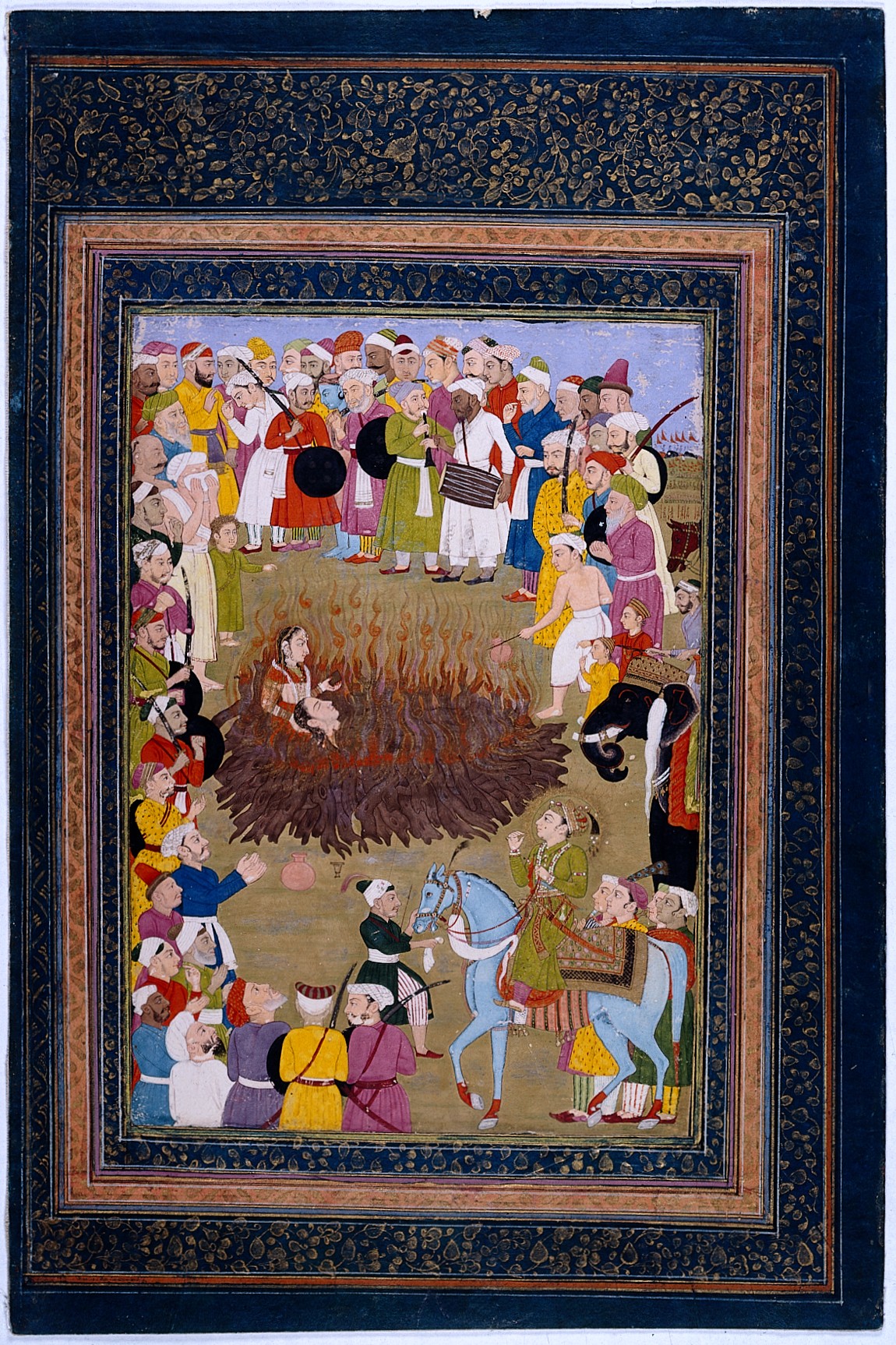
Mughal miniature painting within a dark blue gold-flecked border. A crowd of richly dressed men in turbans watches a fire in the center where a woman in red and gold lies on a pyre amid flames. A drummer and musicians stand at top; a man on a pale horse with an attendant is at lower right, and a man in white robes stands near the fire. Elephants appear at right.Painting

Secondary source

A Hindu Princess Committing Suttee

Mohammad Rizā Naw'ī

Scan of a black book cover with a white library label at top left reading UC-NRLF above a barcode and the number $B 49 736. The rest of the cover is dark, with faint worn texture.Book

Primary source

Humayunnama

Gulbadan Begum · c. 1600 (surviving manuscript)

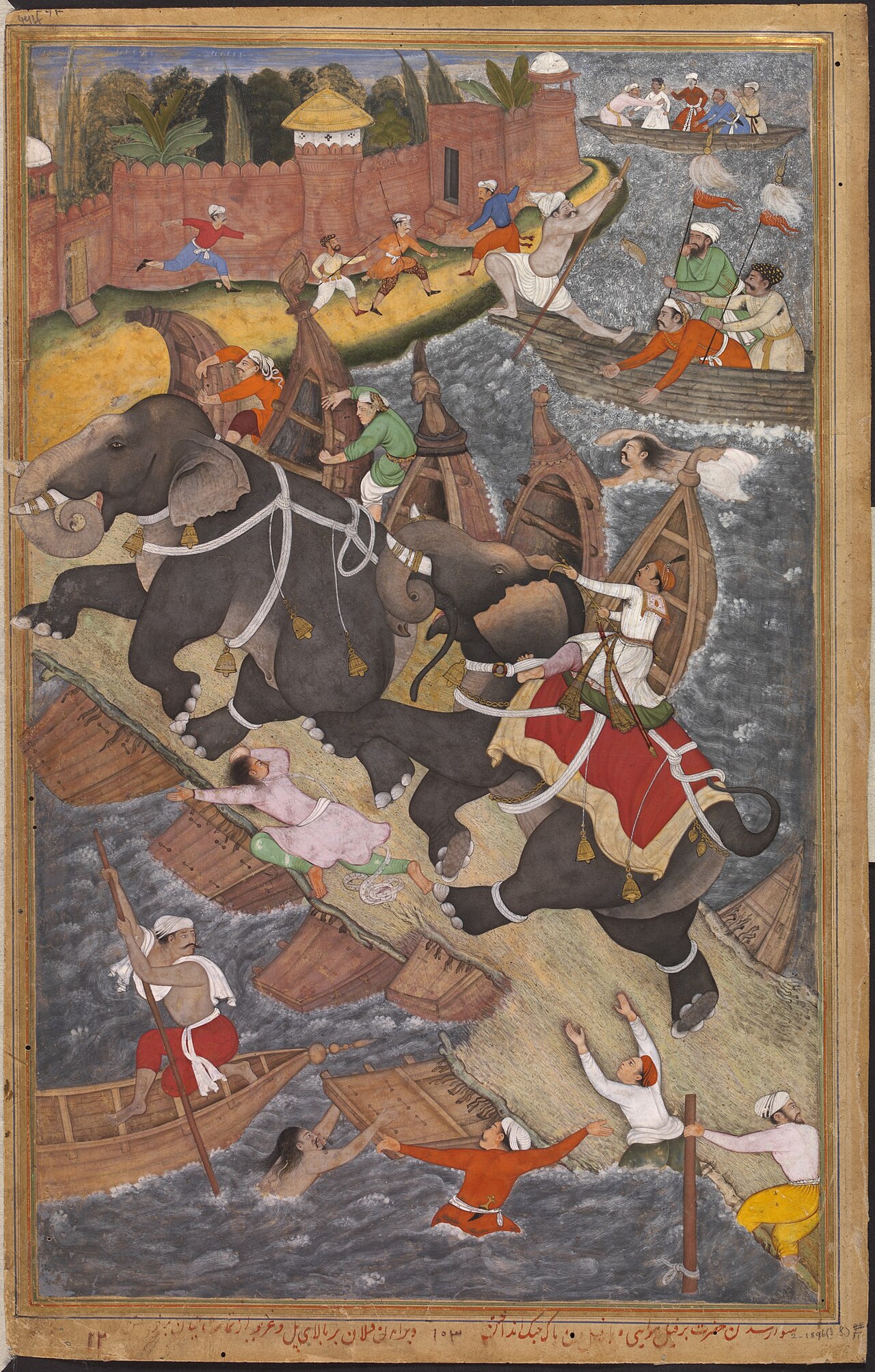
Mughal painting of a chaotic river scene: a rider in red and white on a large grey elephant leads a charge down a muddy bank, while other elephants, boats, and men in water and on a fort wall below red battlements react to the commotion.Painting

Secondary source

Akbar's Adventures with the Elephant Hawa'i

Basawan · c. 1590

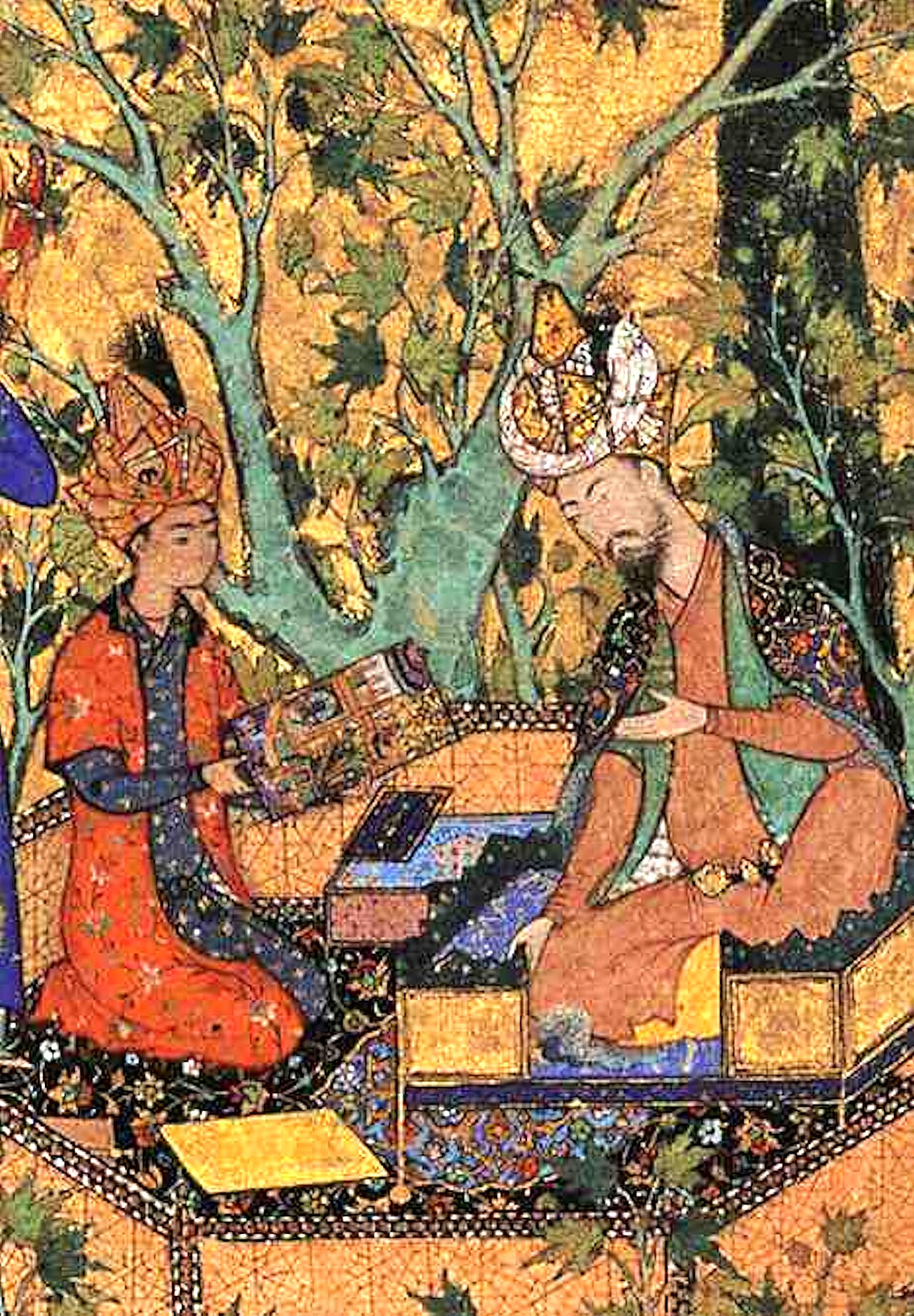
Miniature painting in bright gold, orange, green and blue. Two seated figures under trees: a young man in a red robe and tall jeweled headdress on the left holds an open book, and a bearded older man in a red robe and white turban on the right gestures toward a small writing desk. Gold ground with floral patterns.Painting

Primary source

Akbar and Humayun Portrait in Kabul

'Abd al-Samad · c. 1550-1556

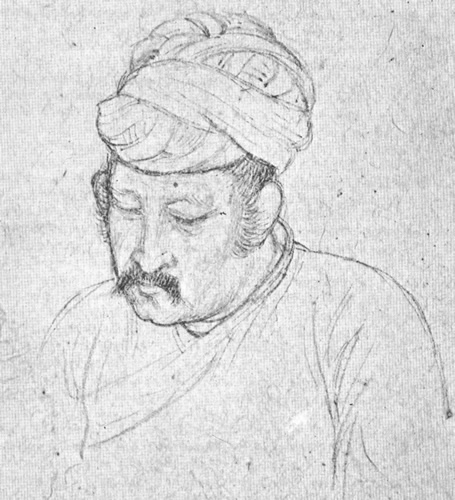
Pencil drawing on a pale, textured paper of a man wearing a wrapped turban, with a head bowed and eyes lowered. He has a thick mustache and wears a loose garment with folds at the shoulders.Painting

Primary source

Study of Akbar's Head

Govardhan · c. 1600

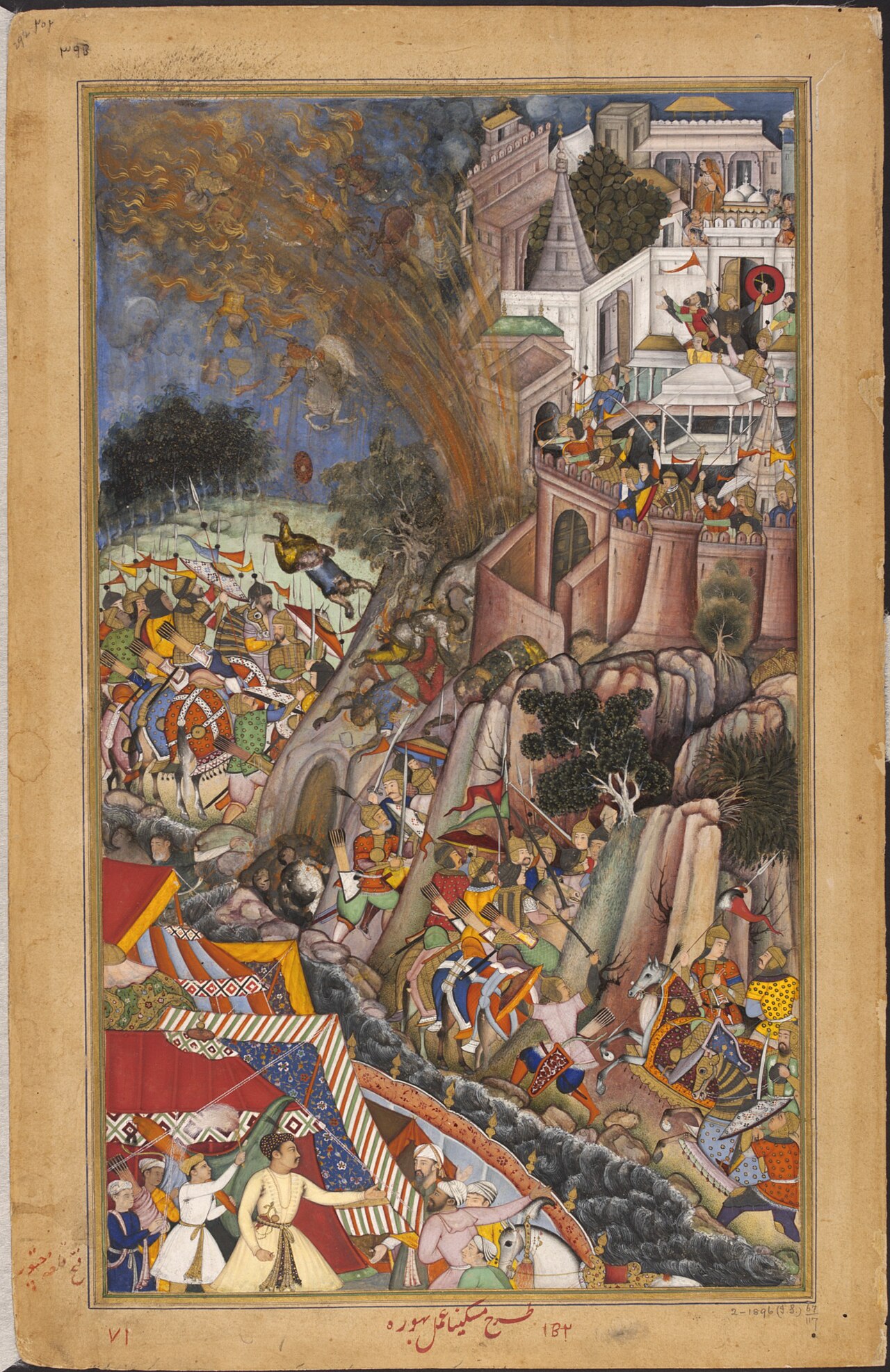
Miniature painting of a siege: on the right, a fortress with white and red walls and towers has defenders on its battlements. A fiery explosion with orange sparks and smoke rises from a mine below the walls, hurling figures into the air. On the left and lower center, armored soldiers with shields, banners, and bows advance over rocky ground. In the lower left, a figure in a cream robe stands under a striped tent with attendants nearby.Painting

Secondary source

A Mine Explodes During the Siege of Chittor

Miskina · c. 1590

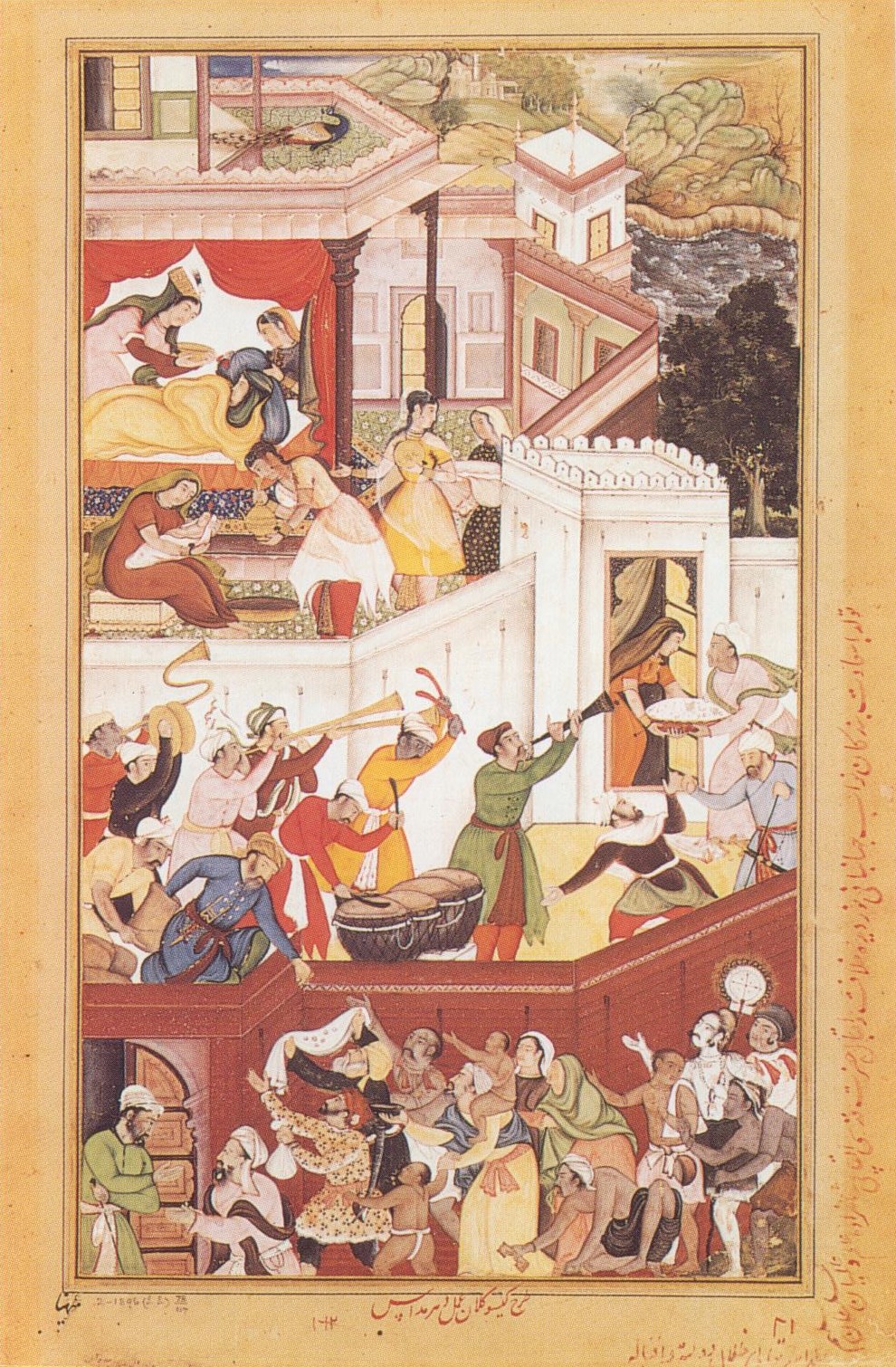
Mughal miniature painting in an ornate border with Persian script. Upper left, a woman lies on a bed attended by women while a peacock is shown in a garden court. Center, musicians blow long trumpets and beat large drums on a balcony. Lower section, a crowd of people in a courtyard celebrates, some lifting a figure.Painting

Primary source

Akbar Celebrates the Birth of His Second Son

Kesu Kalan · 1592

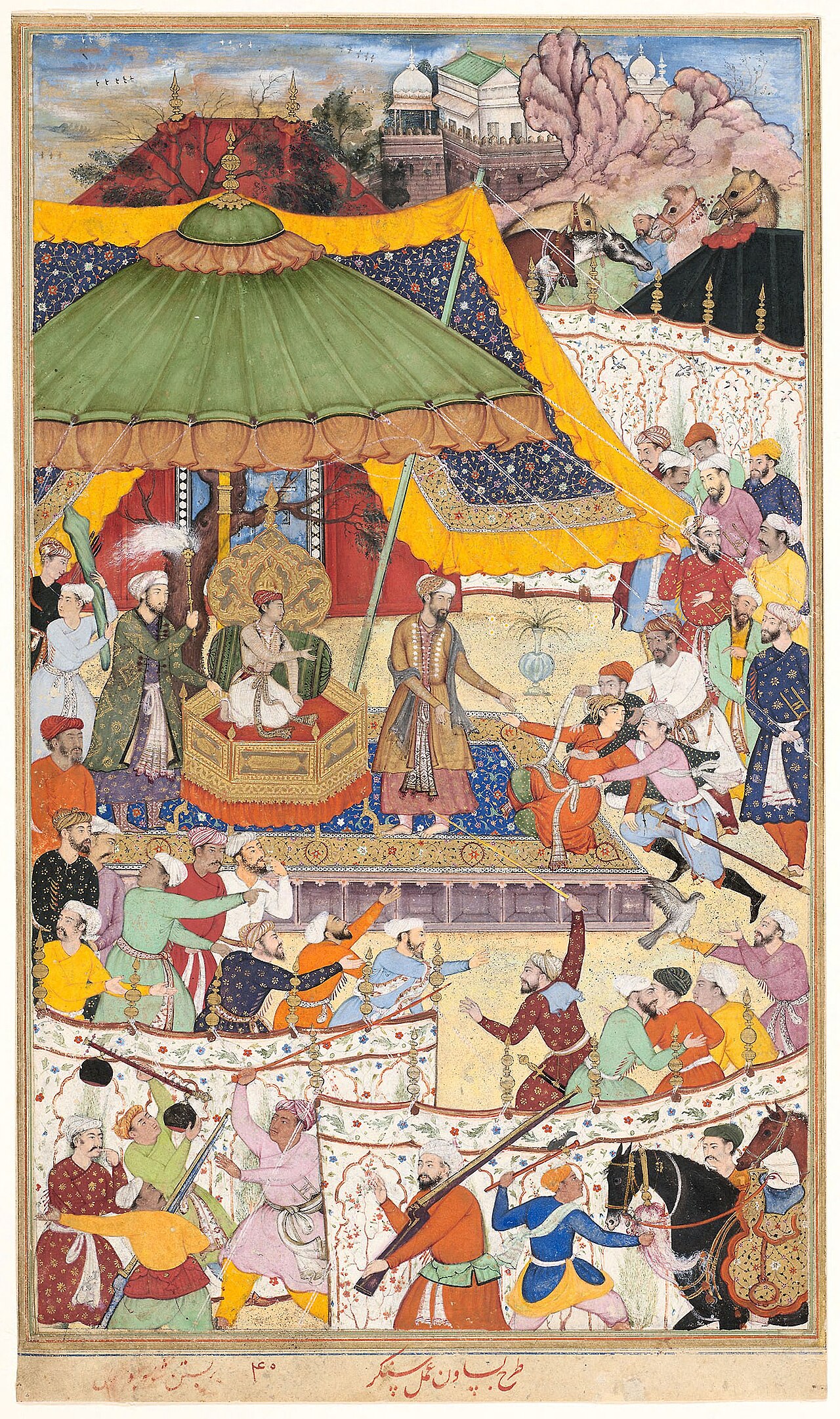
Mughal miniature painting of a royal court scene: a young ruler seated on a gold throne under a green canopy, with a standing figure in brown robes gesturing, and crowds of courtiers and armed men. In the lower area, soldiers struggle with a figure on the ground and a rider on a black horse appears at right. Persian caption at bottom.Painting

Primary source

The Young Emperor Akbar Arrests the Insolent Shah Abu'l-Maali

Basawan · 1590

Panoramic view of the courtyard of the Jama Masjid mosque at Fatehpur Sikri, with red sandstone arcades, domed pavilions, a large white marble tomb in the center, and visitors walking across the open courtyard under a hazy sky.Artifact

Primary source

Jama Masjid, Fatehpur Sikri

1570

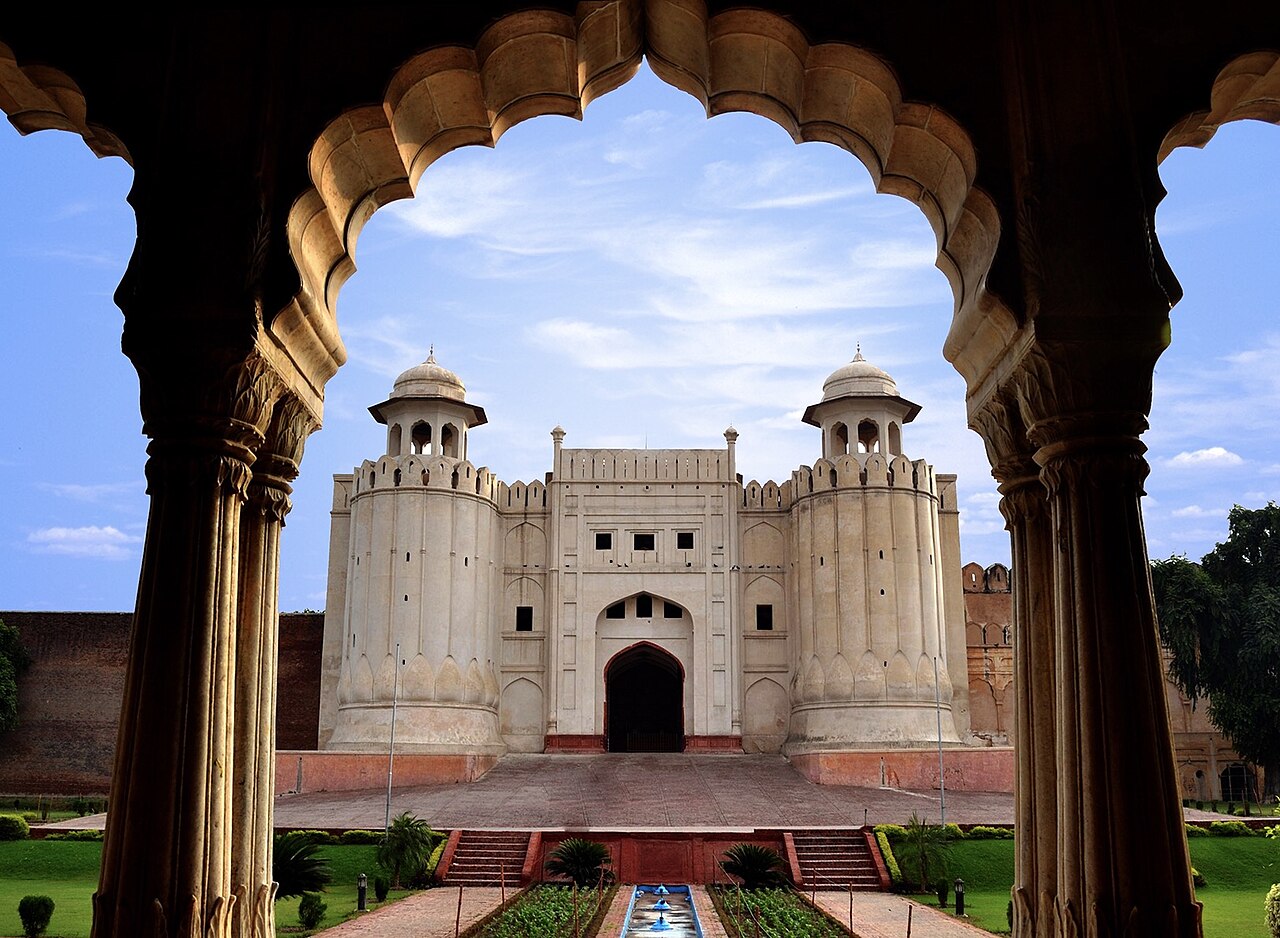
View through the carved sandstone arches of a pavilion toward the white marble-faced Alamgiri Gate of the Lahore Fort, with twin domed octagonal towers, a central recessed archway, lawns, and a water channel in the foreground under a blue sky.Artifact

Primary source

Lahore Fort

1566

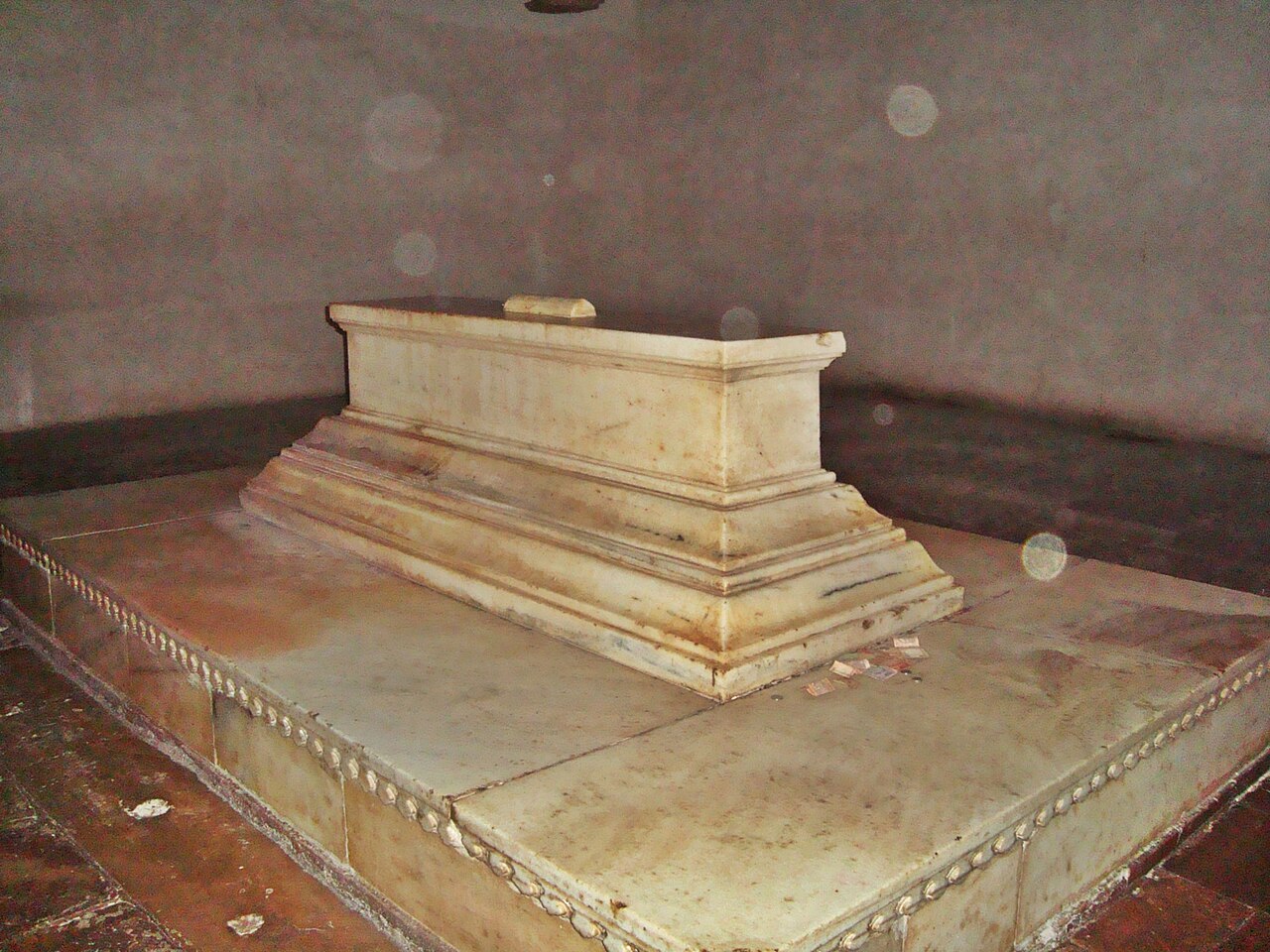
A white marble cenotaph-style tomb sits on a raised marble platform inside a dim chamber. The tomb has a stepped plinth base and a flat top with a small raised block. The platform edges have a decorative bead border.Artifact

Secondary source

Grave of Akbar

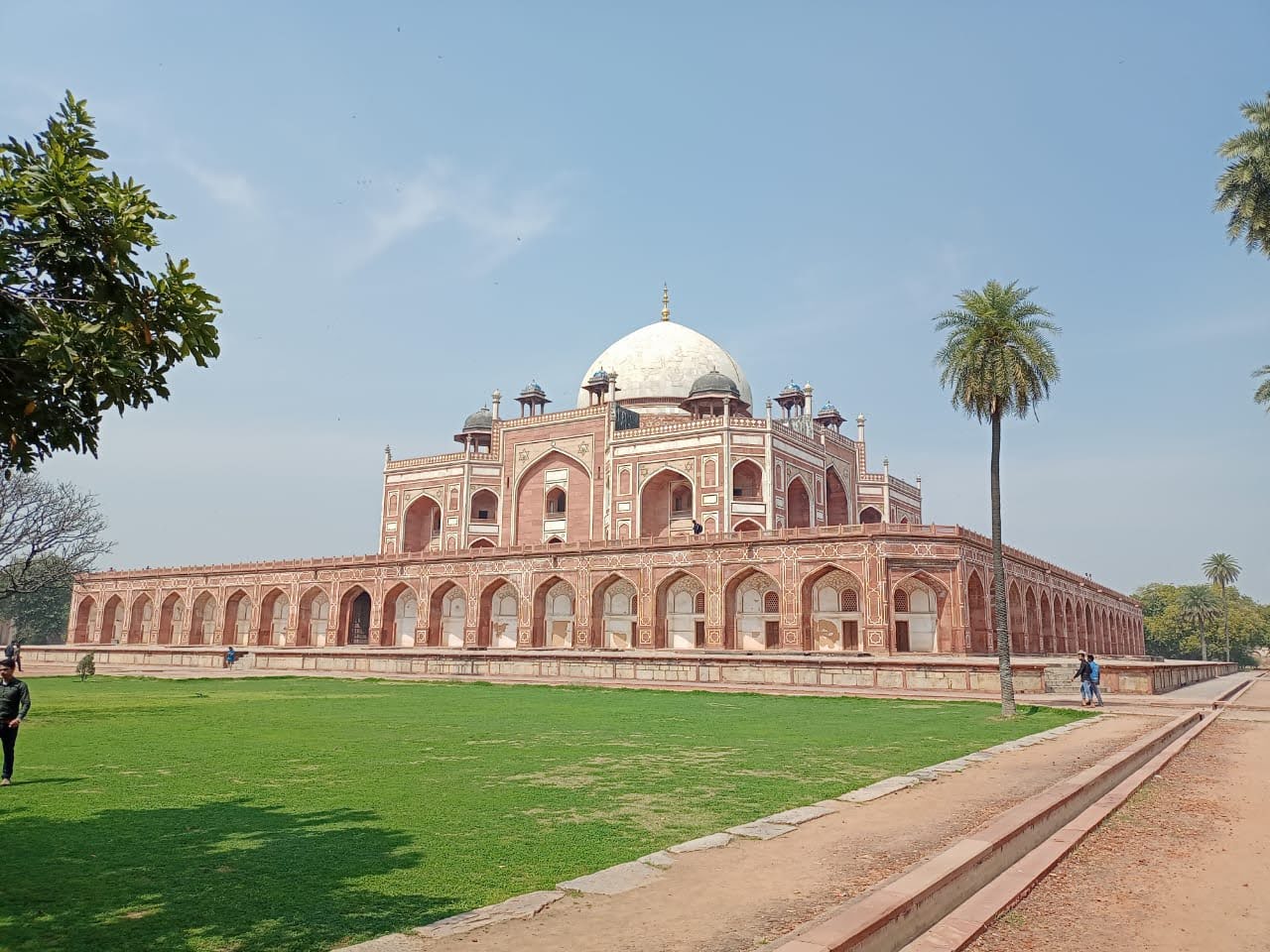
Photograph of Humayun's Tomb, a red sandstone and white marble Mughal mausoleum with a large white central dome, arched galleries along its base, set on a green lawn with palm trees under a pale blue sky.Artifact

Secondary source

Humayun's Tomb

Mirak Mirza Ghiyas · 1560

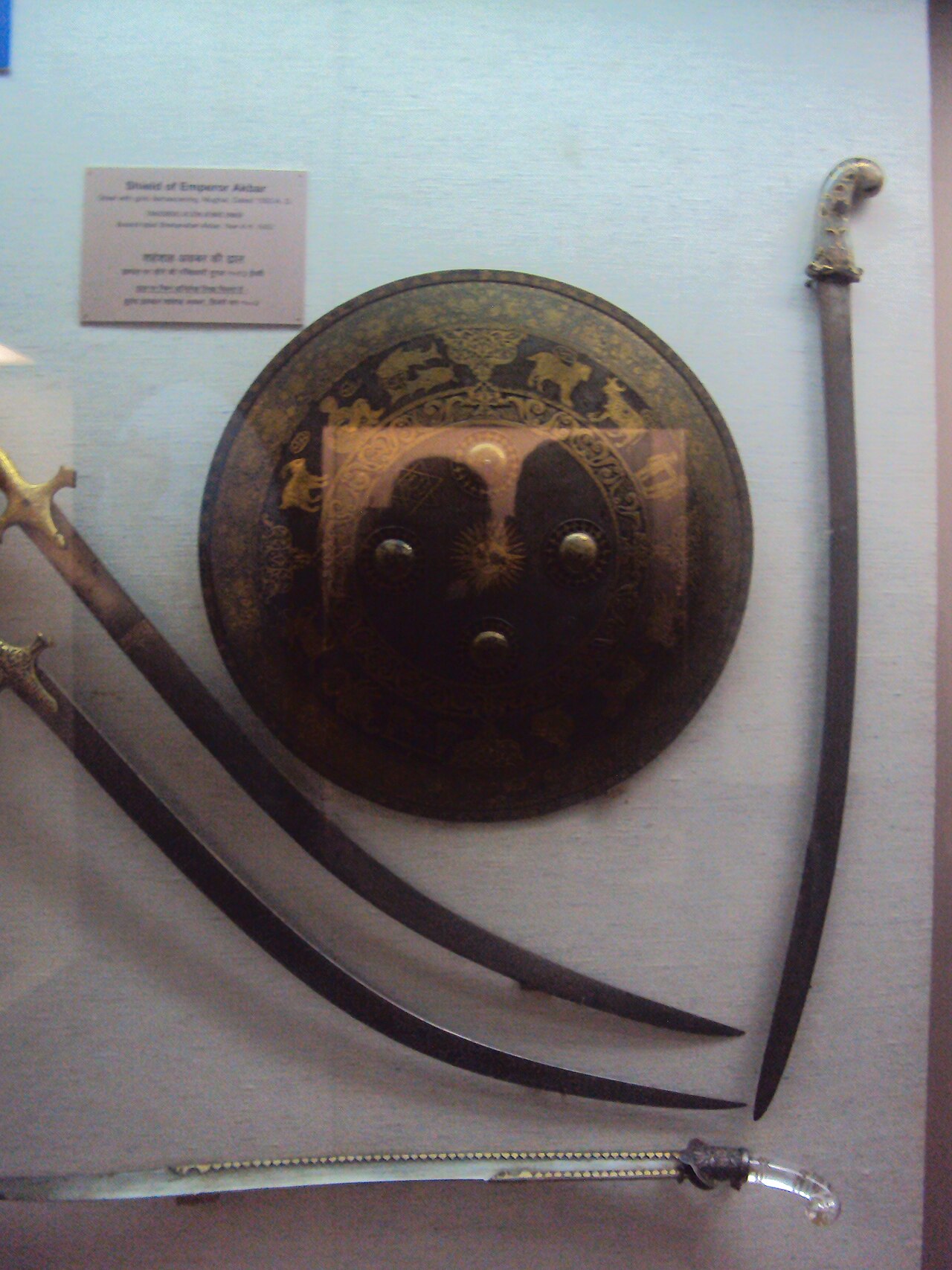
A round steel shield with gold damascened decoration, displayed in a glass case. Gold figures of animals and riders and floral scrollwork cover its surface, with three brass-domed bosses. Beside it are curved swords with ornate hilts and a label reading Shield of Emperor Akbar.Artifact

Primary source

Shield of Emperor Akbar

1593 AD

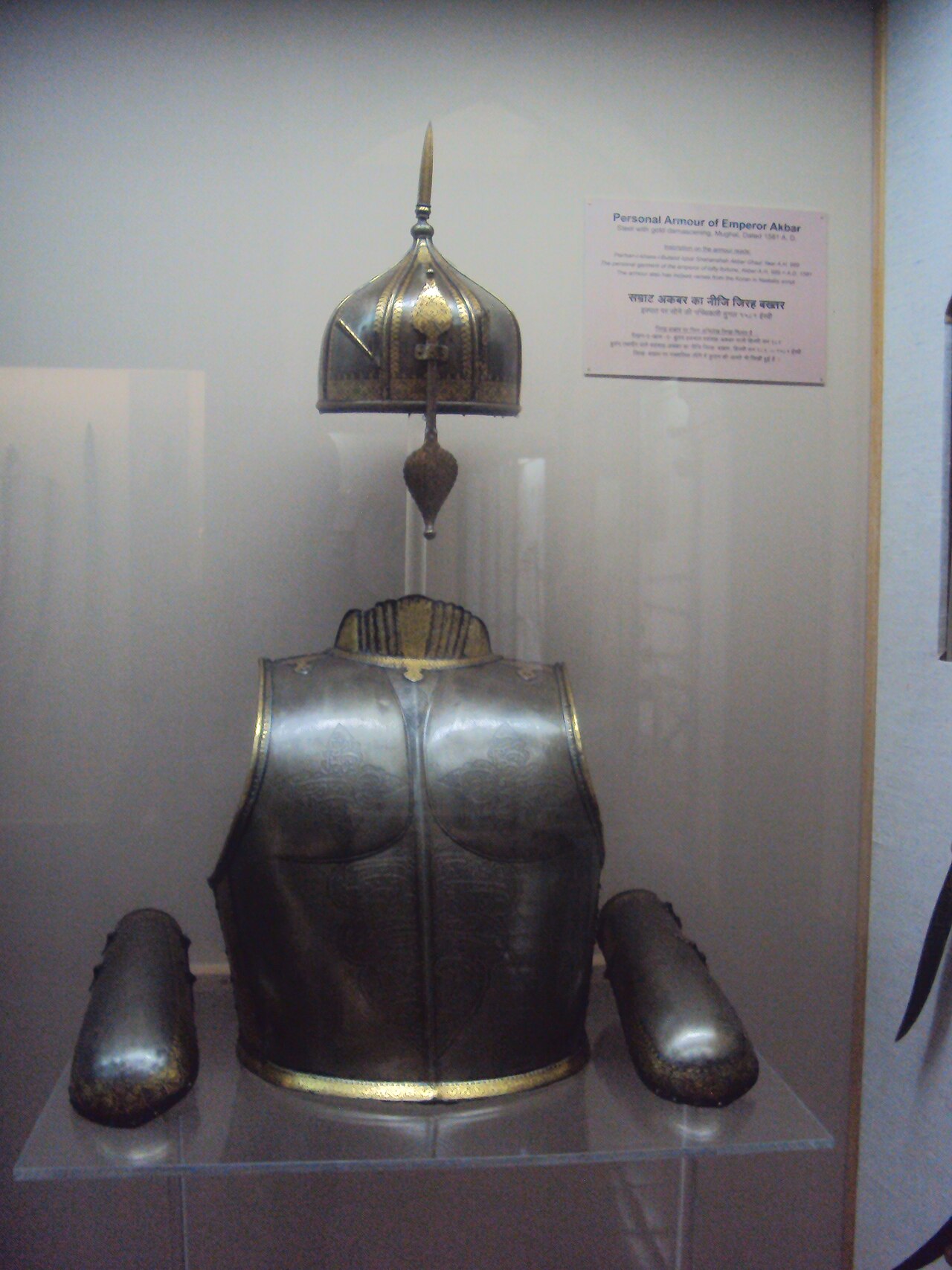
Steel helmet with a tall spike and gold-inlaid bands, and a steel body armour cuirass with gold trim and engraved decoration, plus two arm guards, displayed in a glass case in a museum. A placard above reads Personal Armour of Emperor Akbar.Artifact

Secondary source

Personal Armour of Emperor Akbar

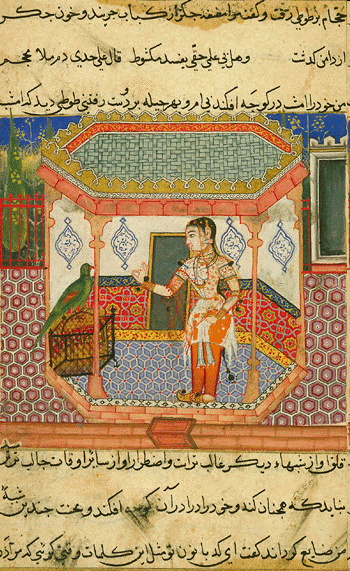
Page from a Mughal manuscript of the Tutinama. A woman stands in an arched pavilion with a tiled floor, holding a cup, while a green parrot perches in a cage at left. Persian calligraphy in black ink surrounds the painted scene on cream paper.Book

Primary source

Tutinama

Nakhshabi · 1550s

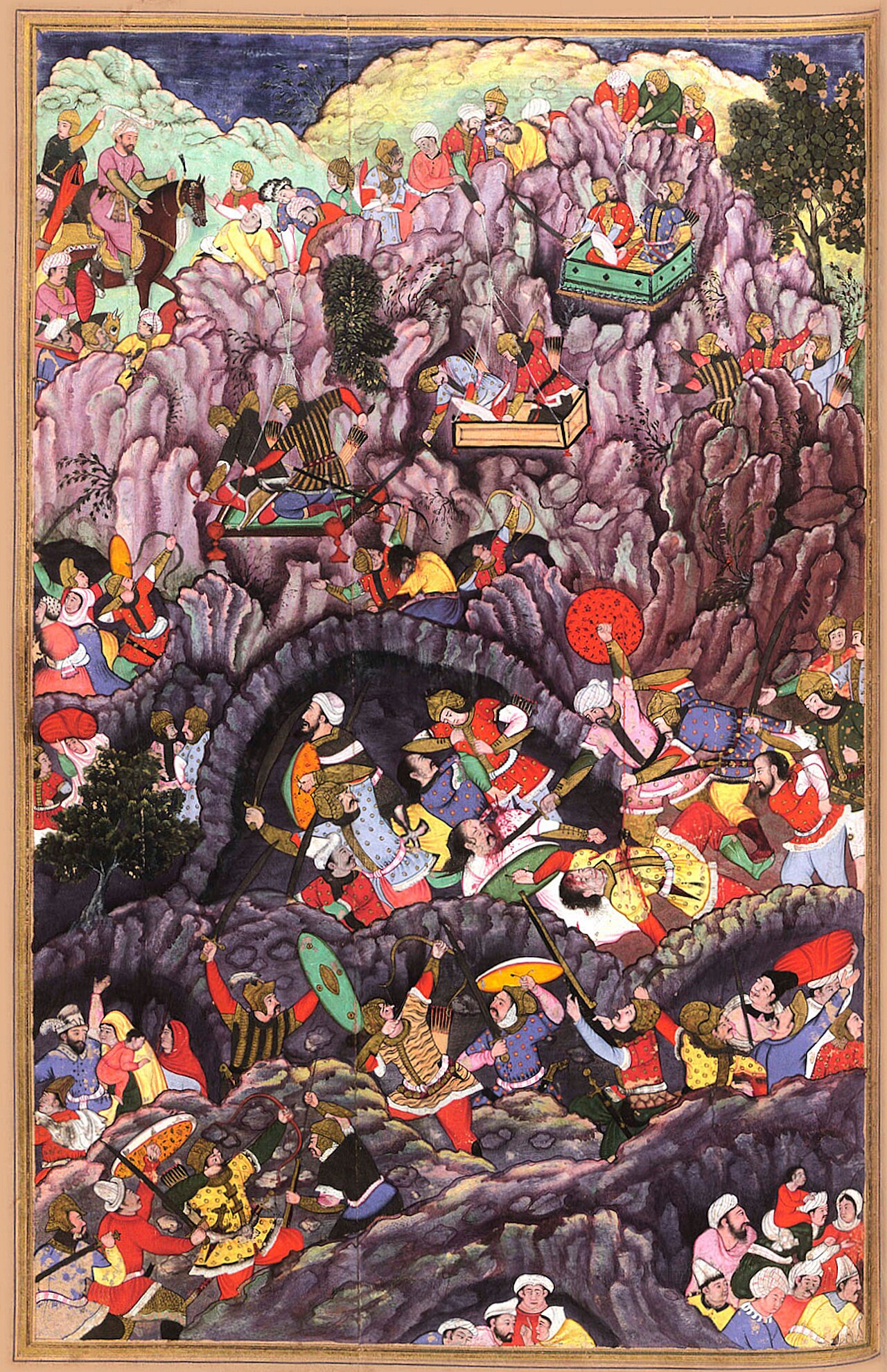
Painted manuscript folio: a rocky mountain battle. Soldiers in boxes hang from cliffs on ropes while archers and swordsmen fight below. A large red disc sits at center-right, and figures in colorful robes and turbans crowd the rocks.Book

Primary source

Chronicle of the Descendants of Timur

1578

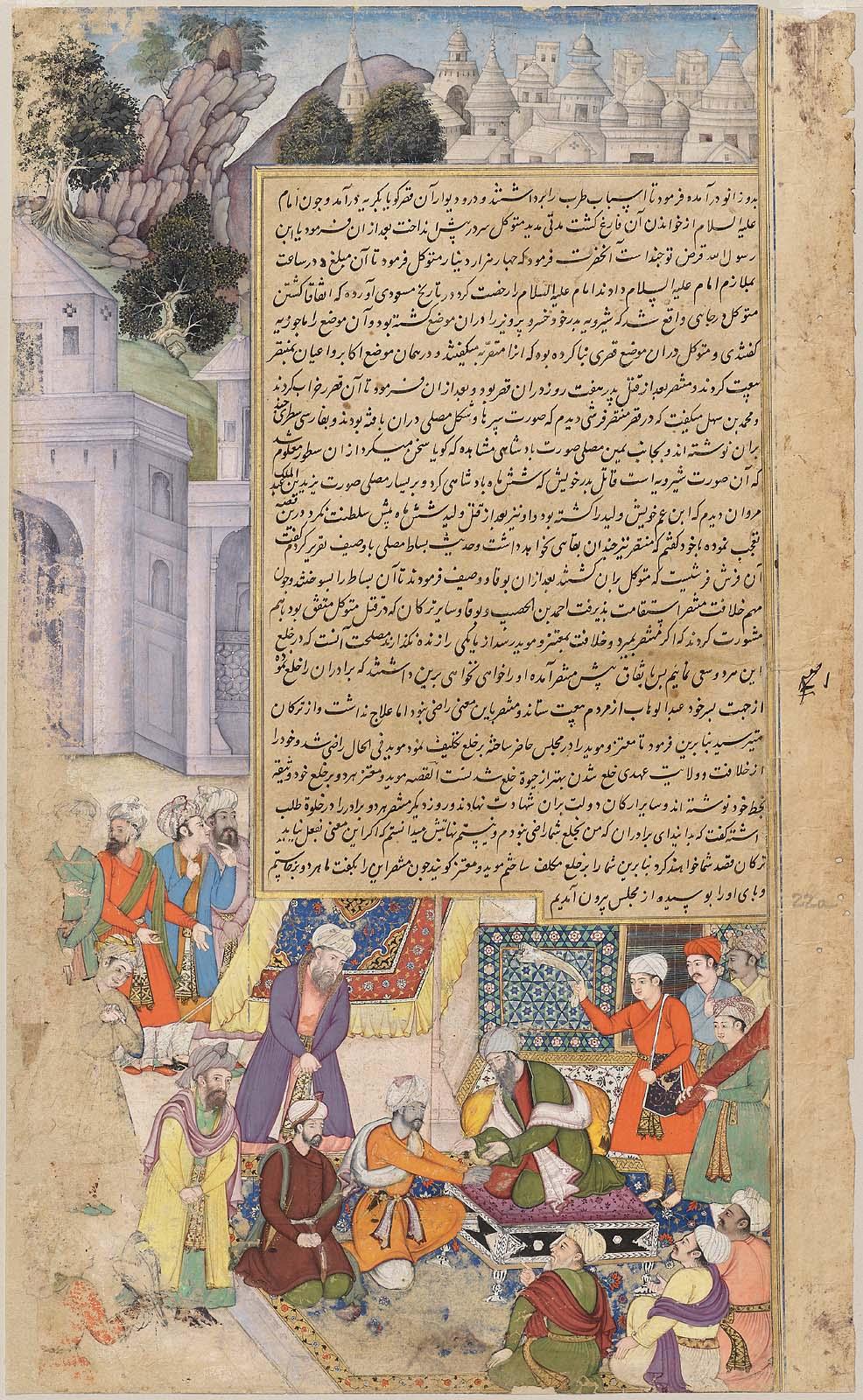
Illuminated manuscript page with a block of Persian nastaliq calligraphy in a central text panel, surrounded by painted scenes: a city skyline and rocky hillside at top left, a building and trees at left, and a crowd of turbaned men in a courtyard with a seated figure receiving a visitor at bottom.Book

Primary source

Tarikh-i Alfi

1580s-1593/1594

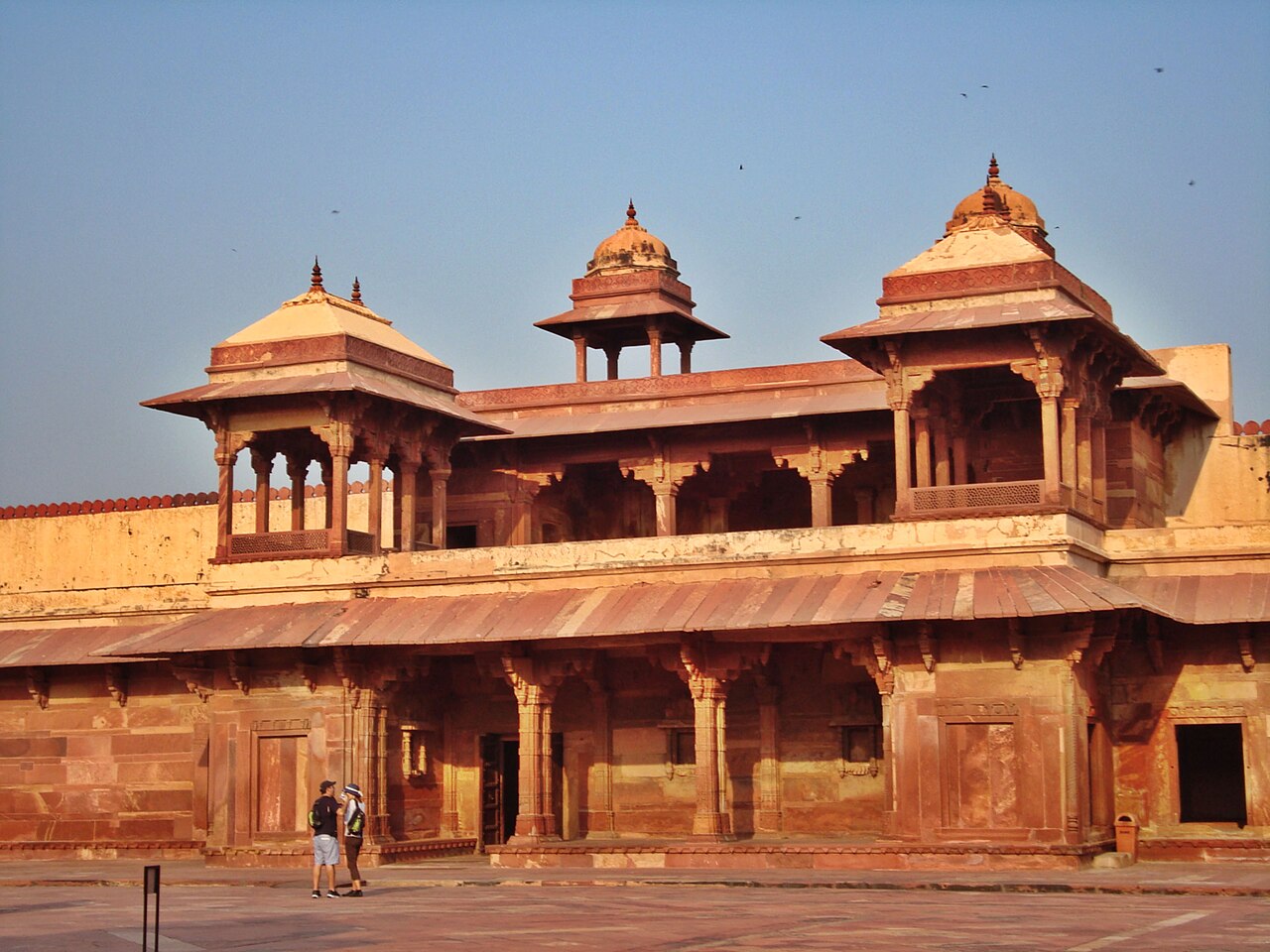
Sandstone palace with multiple tiered levels, domed kiosks with pointed finials on the roof, carved pillars and arcaded galleries, under a clear blue sky. Two people stand on the paved courtyard in the foreground.Artifact

Primary source

Jodha Bai Mahal

1569

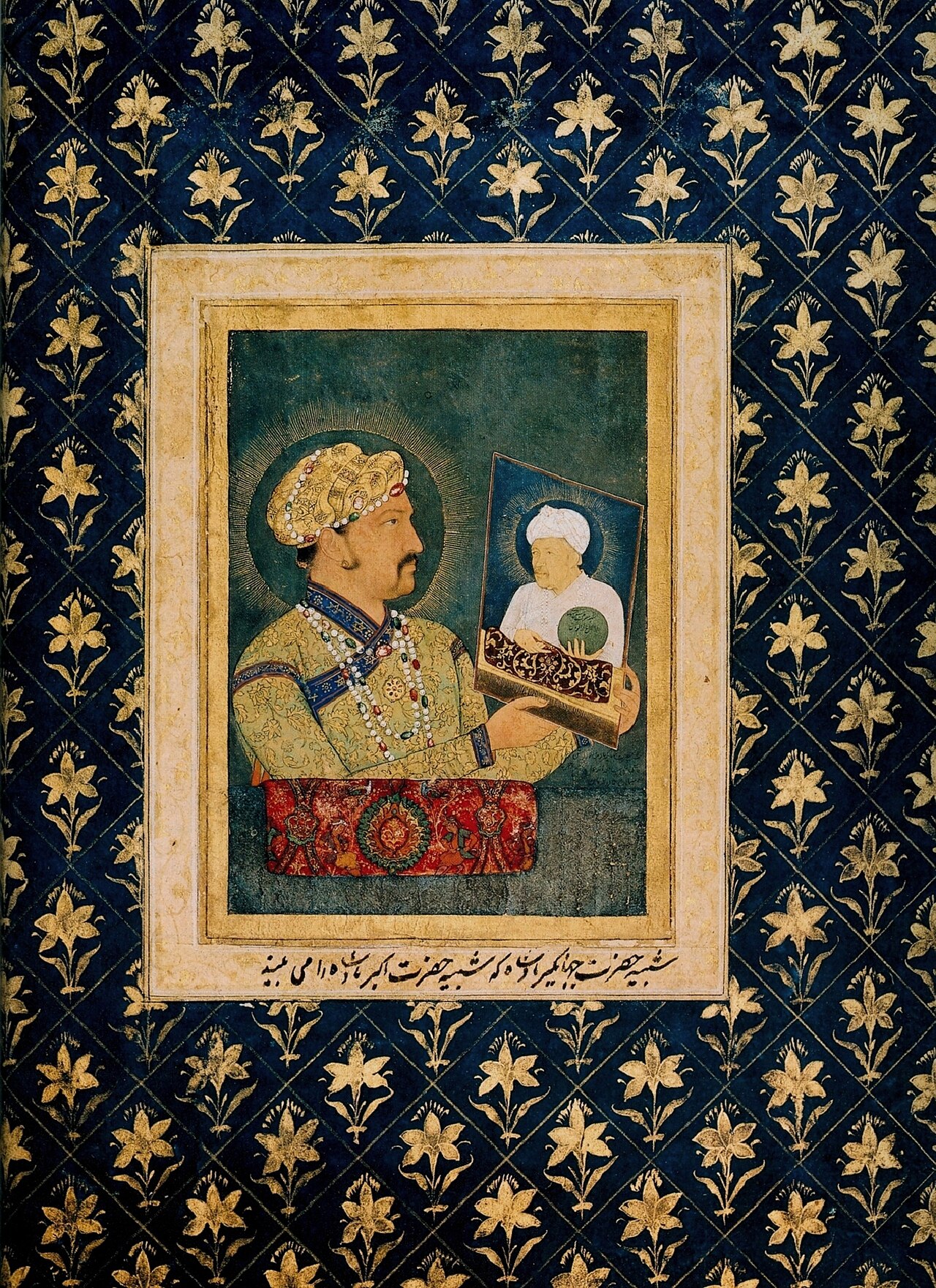
Painting of a mughal emperor in a gold-embroidered robe and jeweled turban, with a halo, holding a framed portrait of an older bearded man in a white turban, also with a halo. Ornate gold floral patterned border surrounds the image, with Persian inscription below.Painting

Secondary source

Jahangir with a Portrait of Akbar

Abu al-Hasan · c. 1610–1614

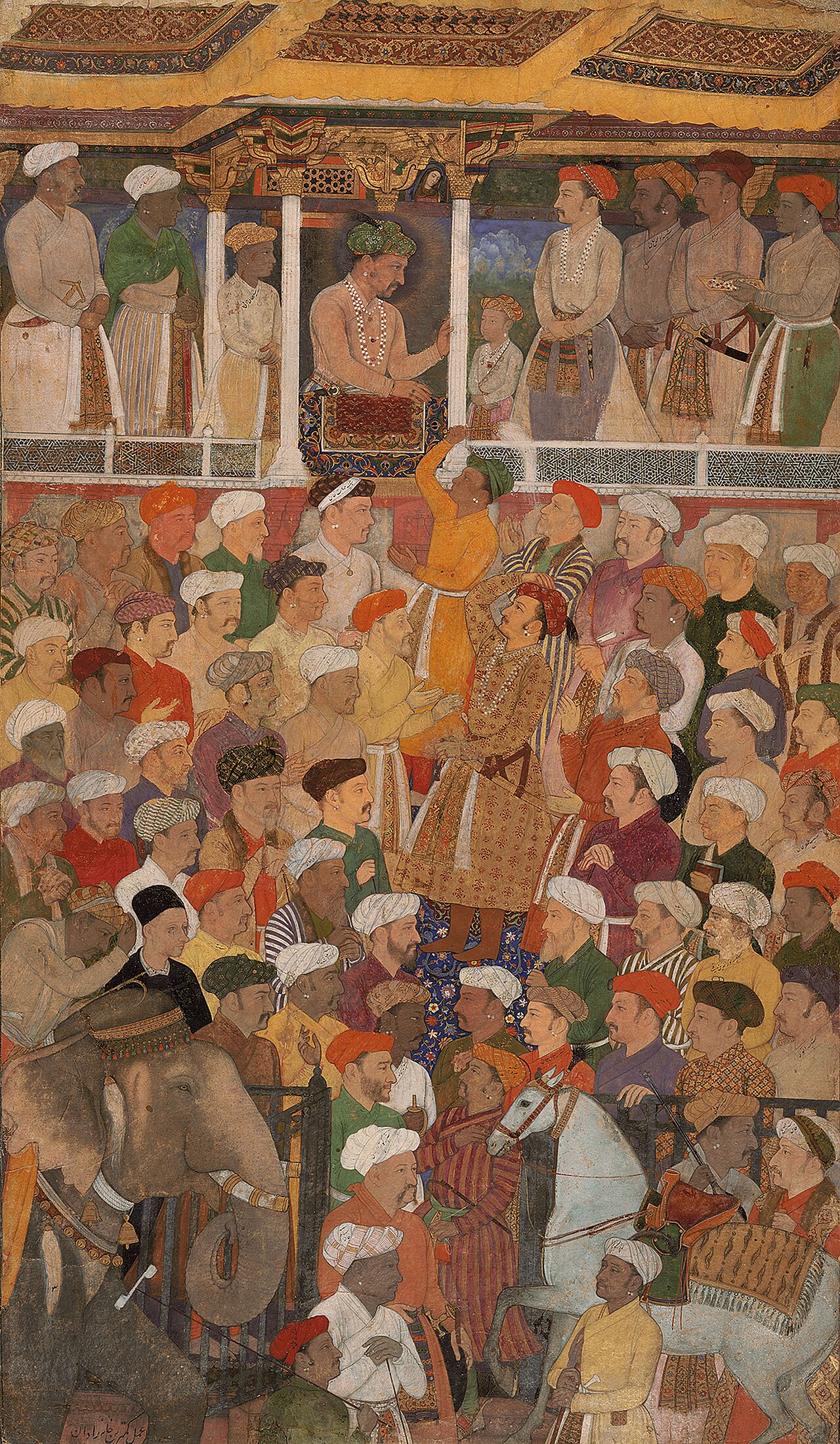
Painted miniature of a royal court scene: a ruler on a raised balcony with columns receives a figure in a gold robe while crowds of courtiers in turbans fill the ground and an elephant stands at left. Courtiers line the upper gallery.Book

Primary source

Tuzk-e-Jahangiri

Jahangir · begun 1609

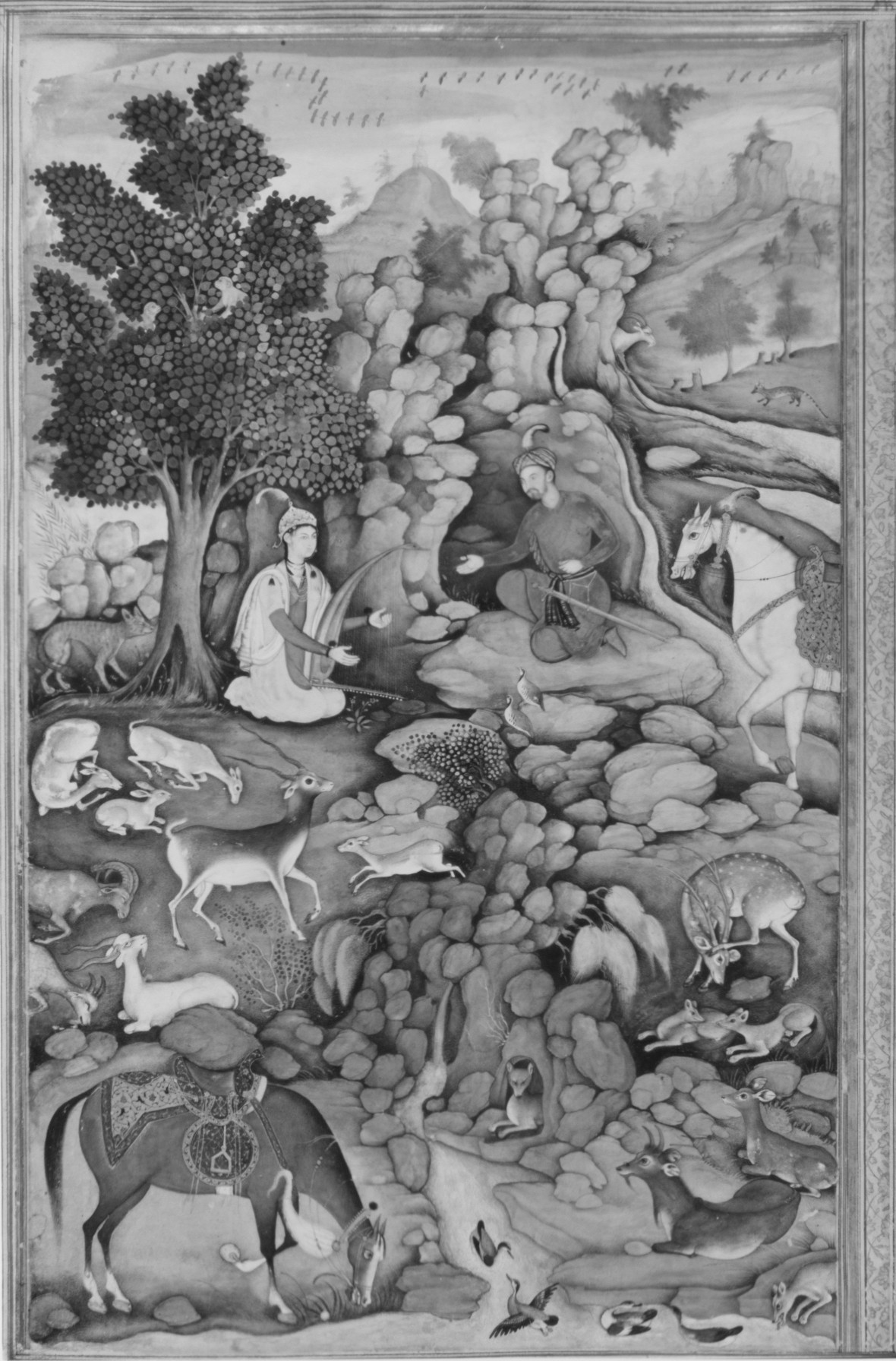
Black-and-white reproduction of a Mughal miniature painting. A seated woman playing a harp-like instrument sits beside a rocky hillside under a large tree, while a man on a rock listens. Many deer, antelope, and other animals gather around in a rocky landscape, and a horse with an ornate saddle stands at lower left.Painting

Primary source

Bahram Gur Sees a Herd of Deer Mesmerized by Dilaram's Music

Miskina · 1597–98

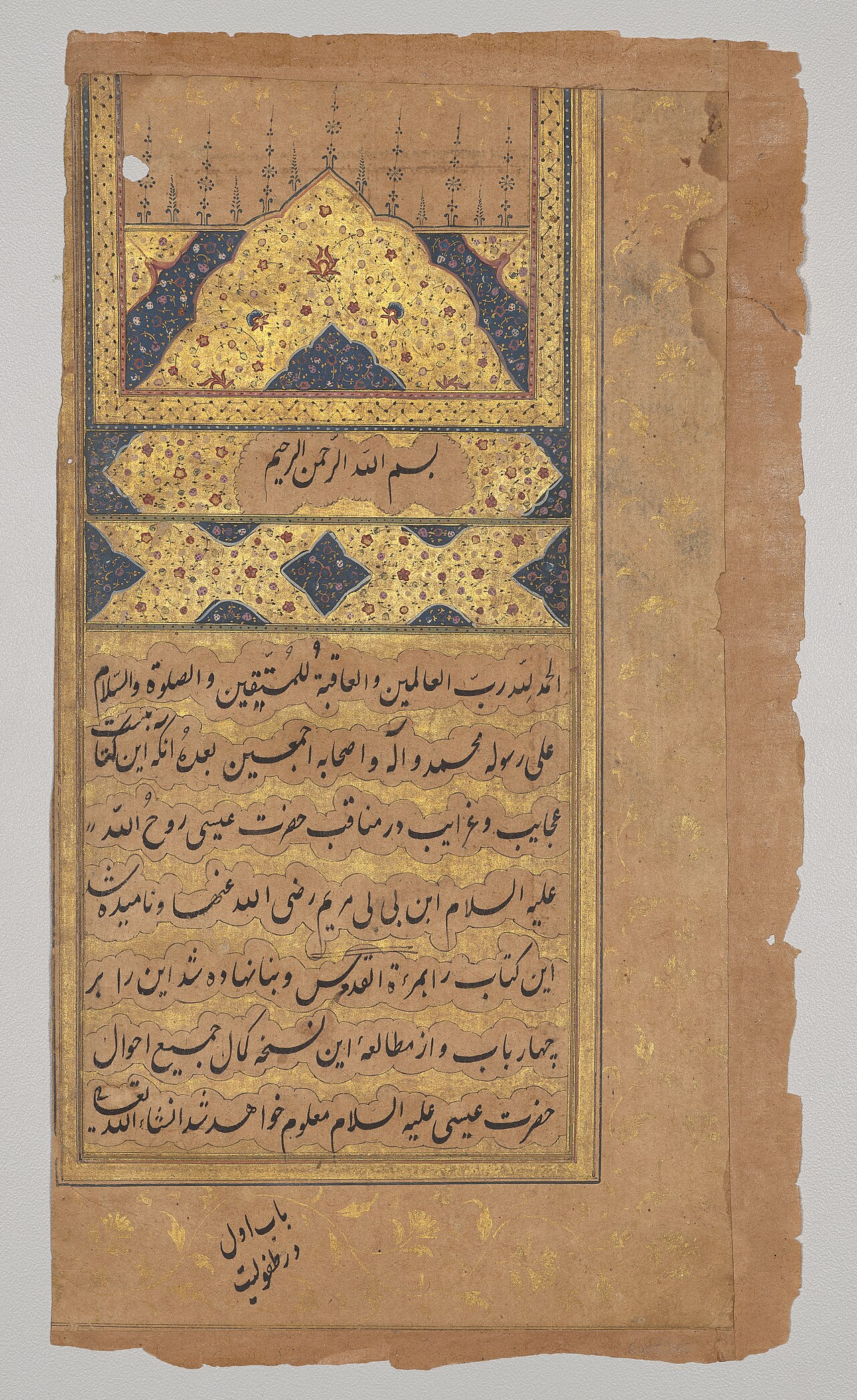
Illuminated manuscript page with a gold-and-blue arched frame at top, a central cartouche with Arabic calligraphy, and several lines of Arabic script in cloud-shaped panels on a tan paper with gold floral borders. A Persian-script label appears at bottom left.Book

Primary source

Mir'at al-quds

Jerome Xavier · presented 1602

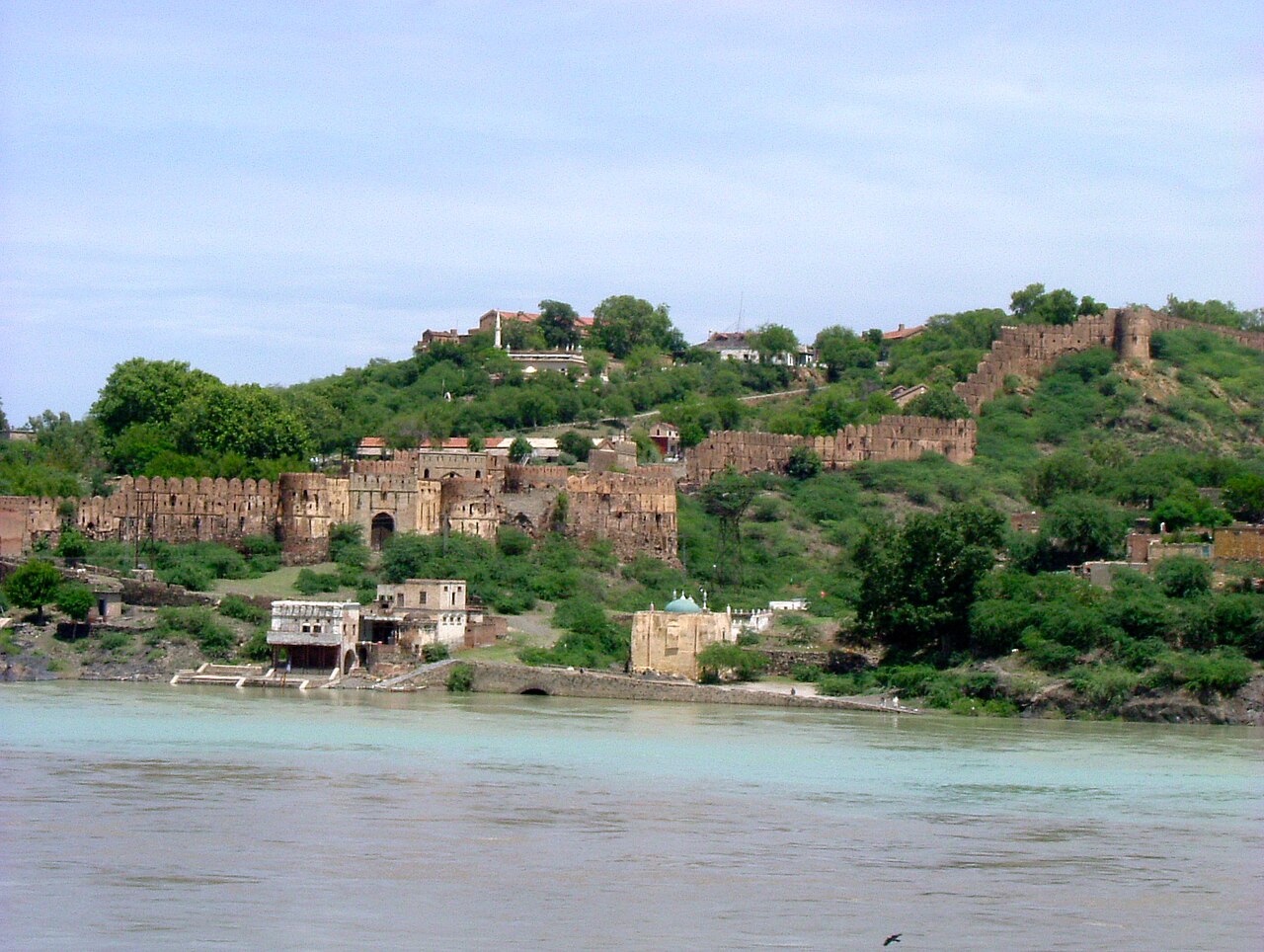
A large fort with thick brown stone walls and towers sits on a green hillside above a river. Several old buildings with domes and an archway gate are at the riverbank. Light blue-green water is in the foreground.Artifact

Primary source

Attock Fort

1581–1583

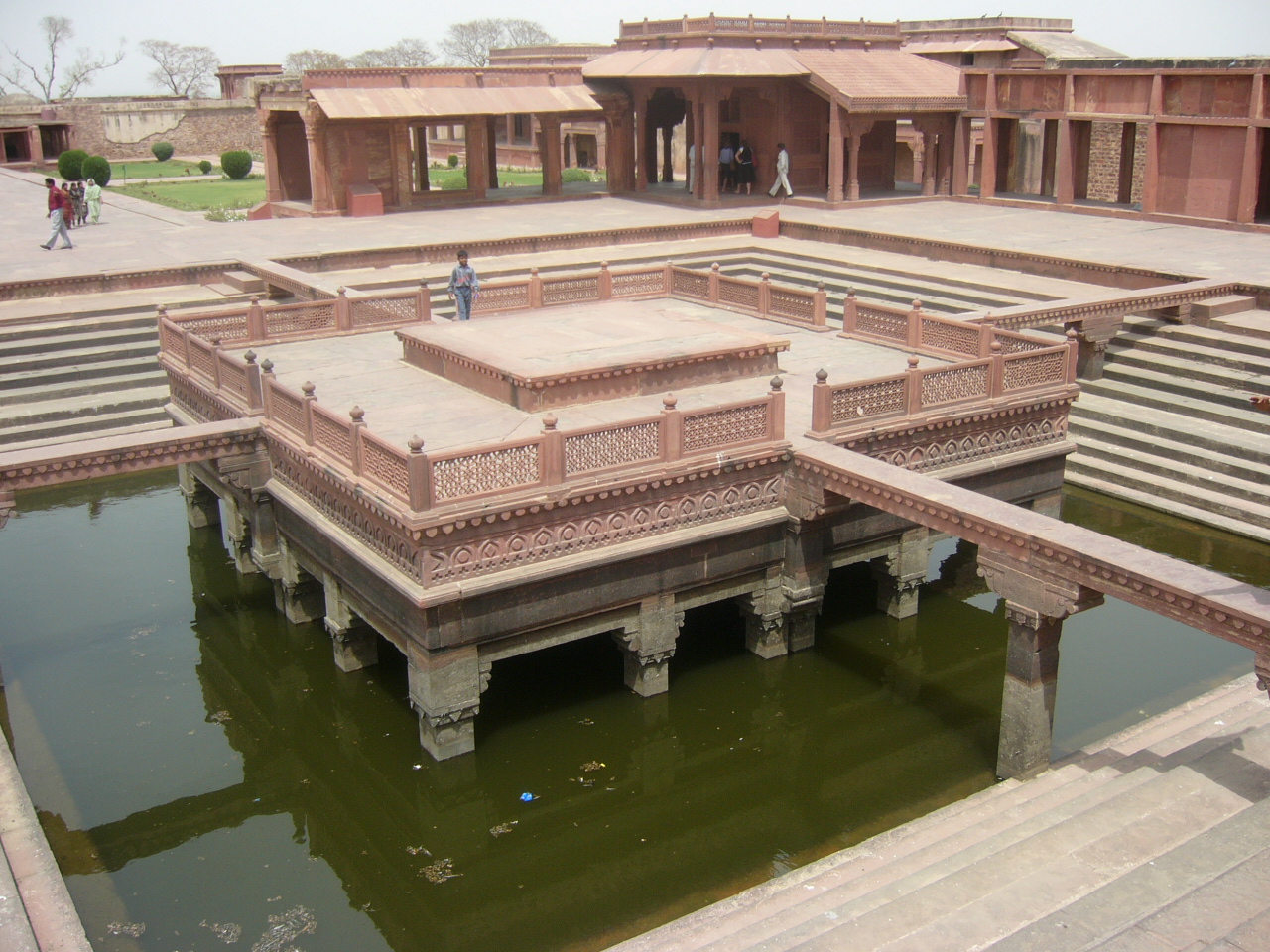
Red sandstone pavilion with carved balustrades and bracketed corner supports, standing on pillars in the middle of a green-water tank, approached by stone stairs and walkways. Pavilions and colonnaded buildings stand behind on the courtyard.Artifact

Primary source

Anup Talao

completed 1576

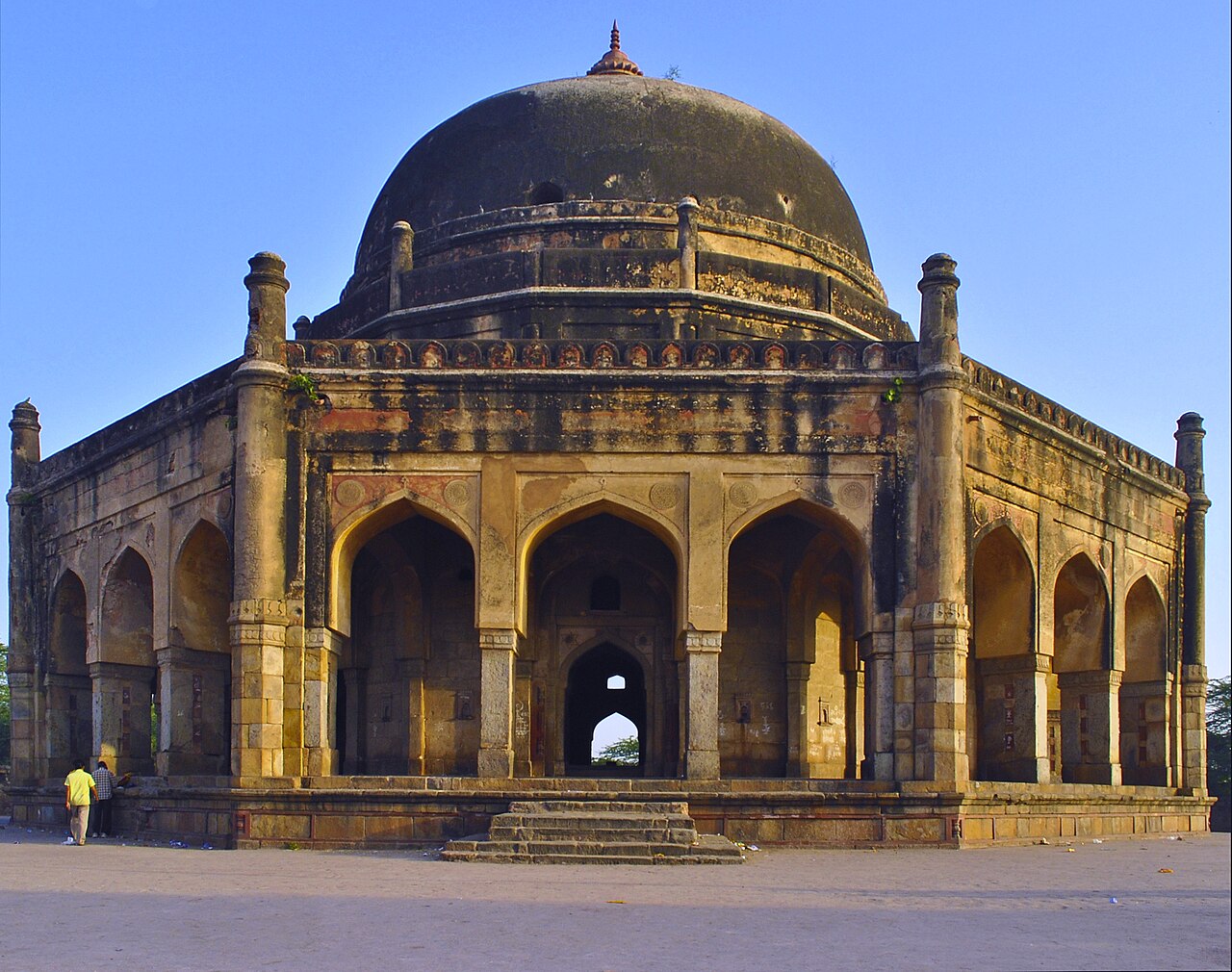
Photo of a domed, sandstone octagonal tomb with pointed arched openings on a raised plinth, reached by a flight of steps at the front. Two people stand at the left edge under a clear blue sky.Artifact

Primary source

Tomb of Adham Khan

1562

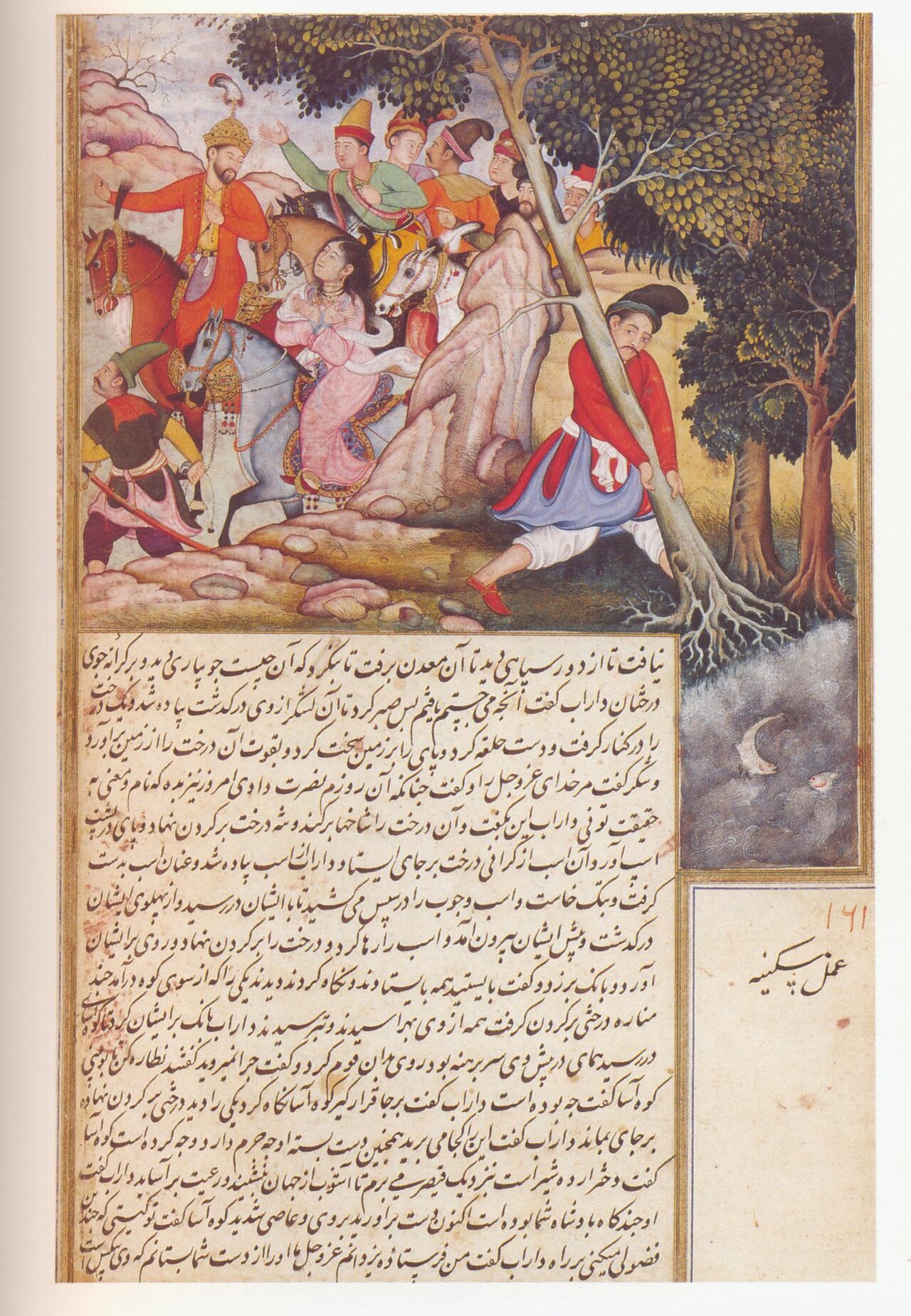
Illuminated Persian manuscript page with a painting above and columns of Persian script below. The painting shows a red-robed man pulling up a tree by its roots while a group of riders in colorful clothing watch; a woman in pink rides a horse nearby. A small crescent moon appears in the lower right corner, beside a Persian label.Painting

Primary source

Darabnama

c. 1580

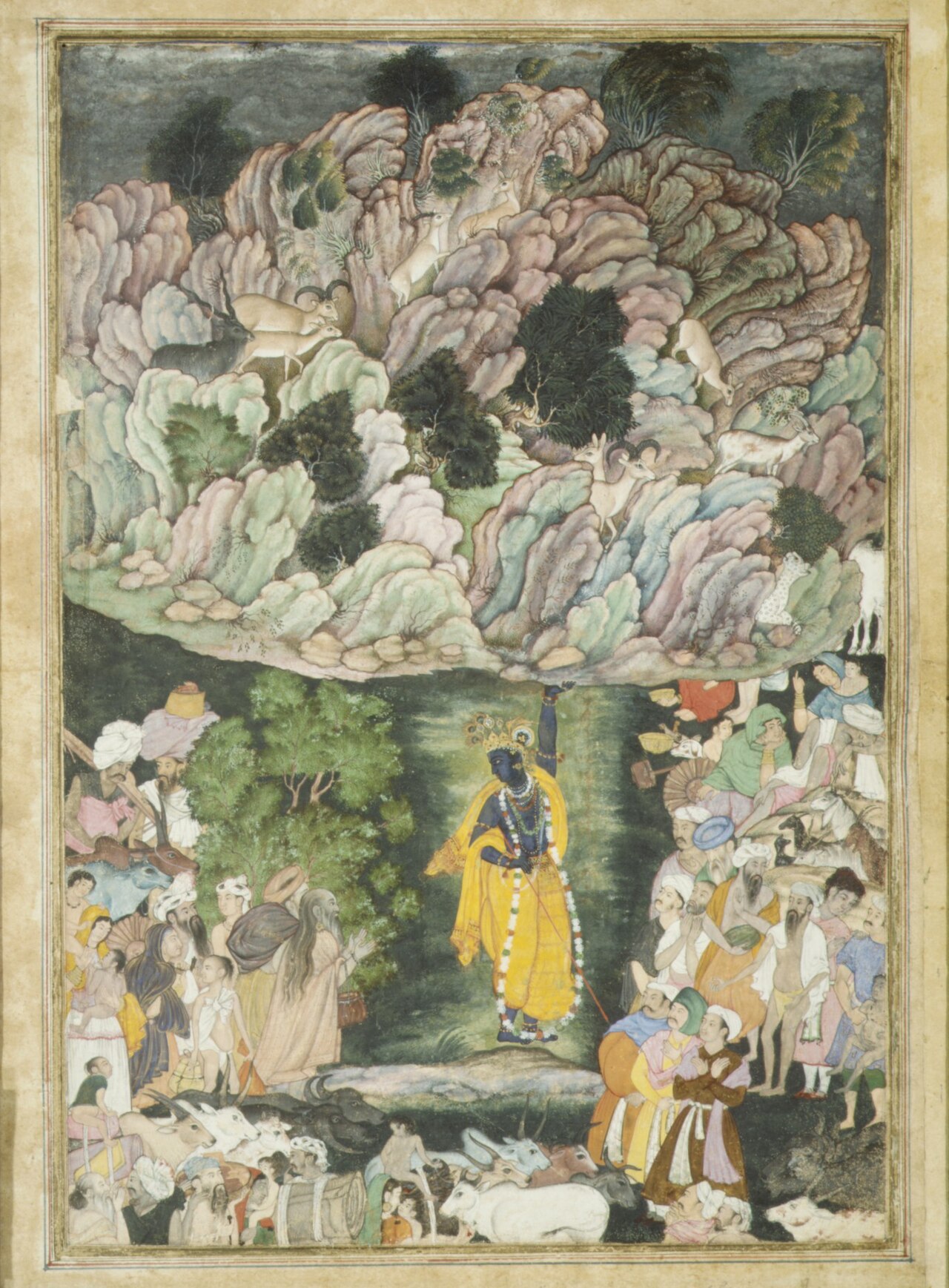
Mughal-style painting of Krishna, blue-skinned and in a yellow garment with a flower garland, raising a rocky mountain on one hand above a crowd of villagers, cattle and herders. Deer and goats graze on the rocks above, and trees fill the green landscape.Painting

Primary source

Krishna Holds Up Mount Govardhan to Shelter the Villagers of Braj

c. 1590

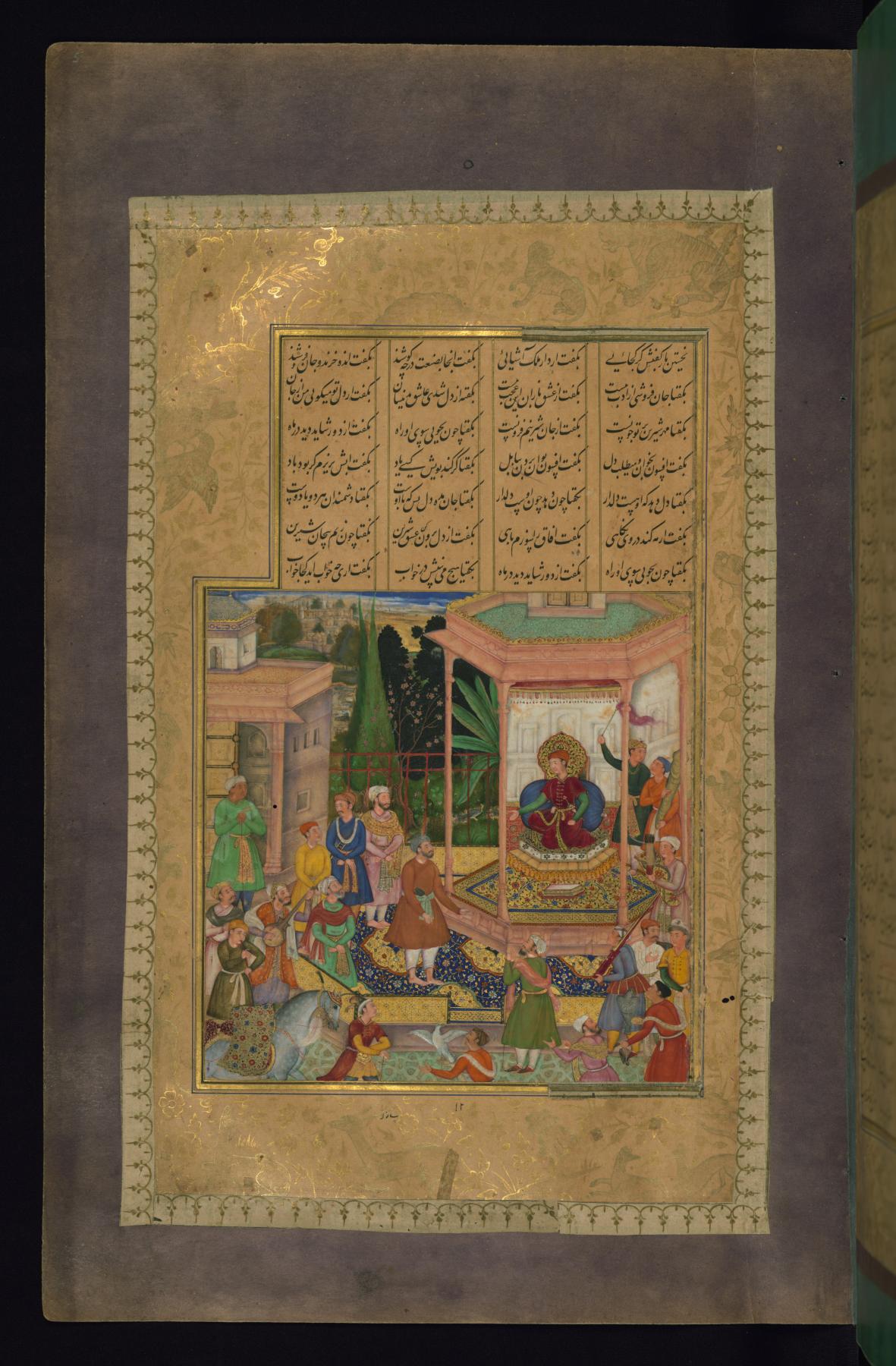
Full page of a manuscript painting: an illuminated folio with Persian calligraphy in four columns of text above, and a miniature below showing a seated ruler under a pavilion, attended by courtiers and servants, with a green-clad figure bowing at left and a man in a brown robe standing before the throne on a carpet. A gold-decorated border frames the page.Book

Primary source

Khamsa of Nizami

Abd al-Rahim 'Anbarin-Qalam · c. 1593-1595

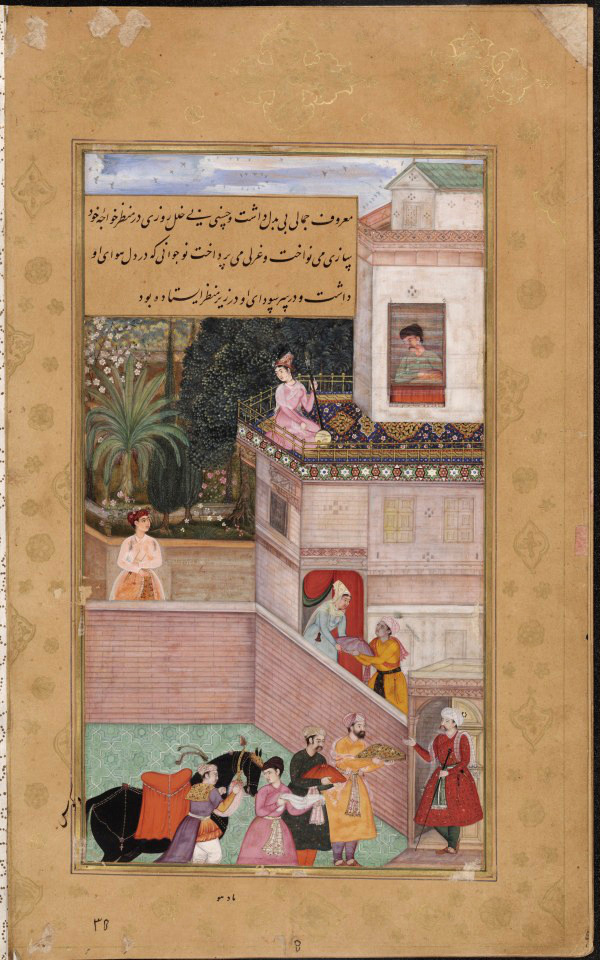
A folio from a manuscript: a painted Mughal miniature with Persian calligraphy in a cartouche at top. A figure sits on a terrace of a tall building, a woman looks from a window, and attendants carry trays down a stair. Gold-patterned border surrounds the page.Book

Primary source

Baharistan

Jami · 1595

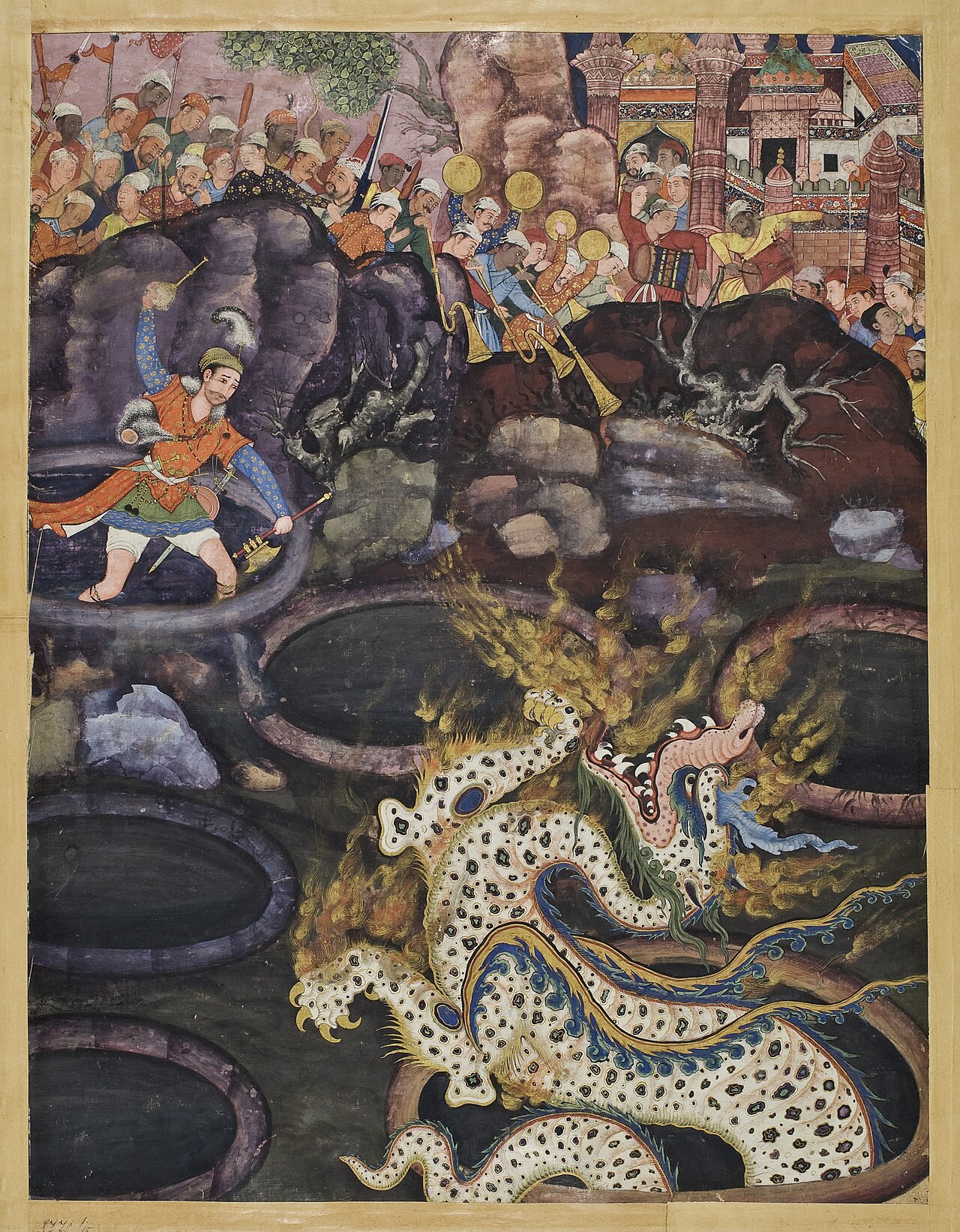
Mughal miniature painting of a figure in orange and green robes with a sword and mace fighting a white, spotted, fiery dragon in a rocky landscape, while crowds and trumpeters watch from a walled city and hillside above.Painting

Primary source

Umar Defeats a Dragon

Daswanth · c. 1577

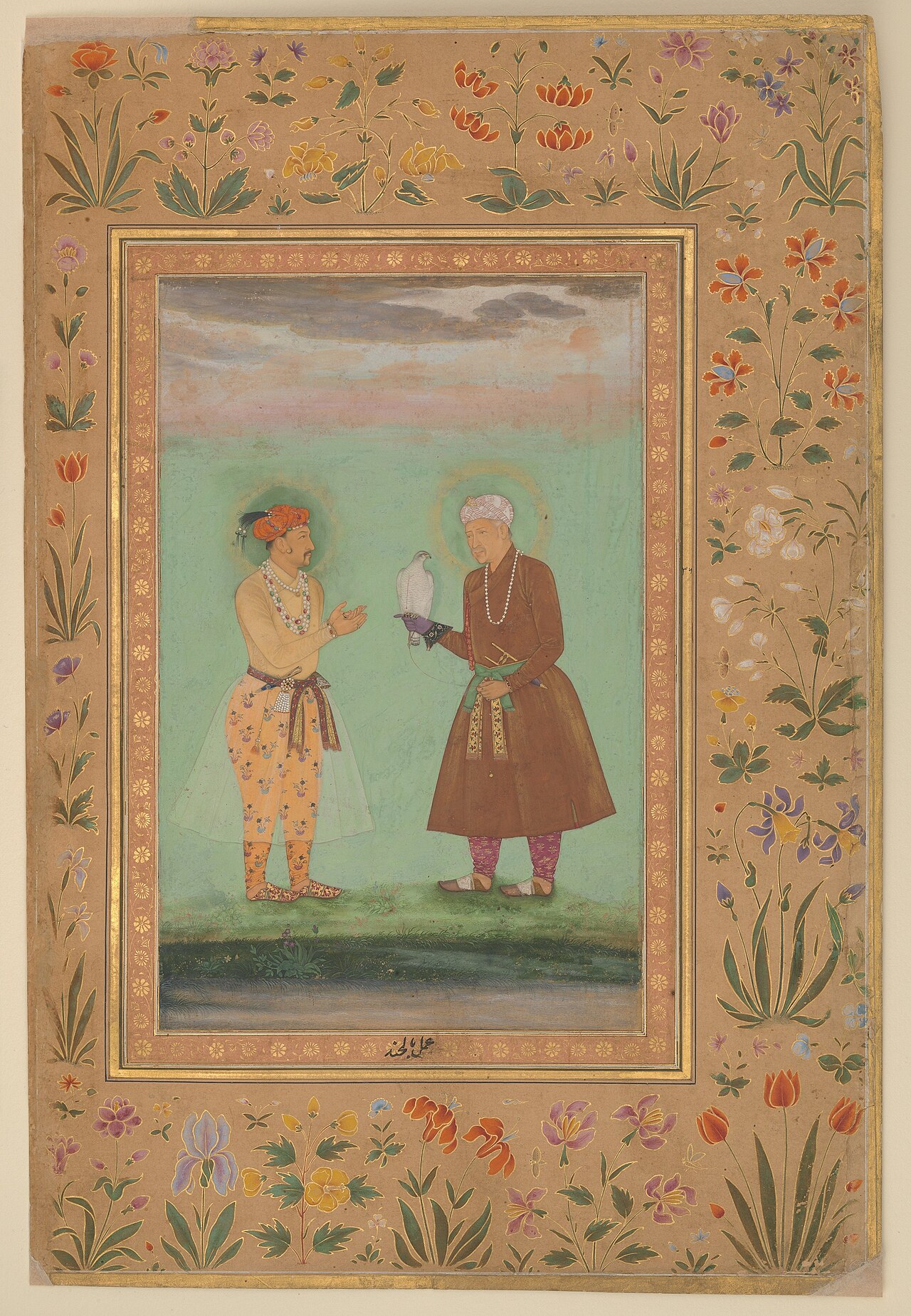
Mughal miniature painting in a gold-ruled frame with floral border. Two haloed men stand on grass before a green background and pink-gray sky. The man on the left wears an orange turban and jewels and gestures with open hands. The man on the right wears a brown robe and white turban and holds a white falcon on his gloved hand. Calligraphy appears below the painting.Painting

Secondary source

Jahangir and his Father, Akbar

Balchand · verso: c. 1630; recto: c. 1540-50

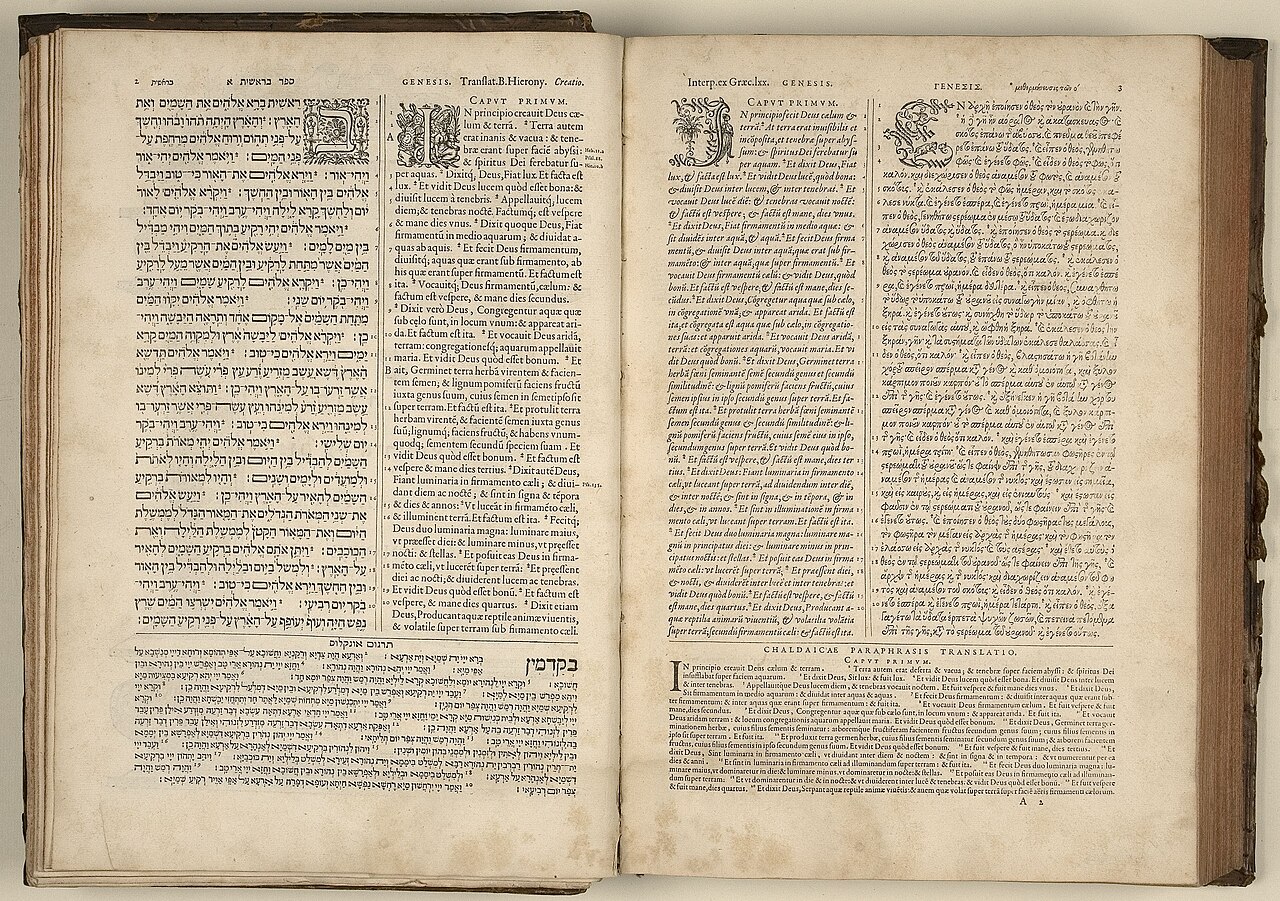
Open book spread of a multilingual polyglot Bible showing the Book of Genesis in parallel columns: Hebrew text with vowel points, Latin Vulgate and Greek columns, and Chaldaic paraphrase at the bottom. Aged brown pages and leather binding edge are visible.Book

Primary source

Plantin Polyglot

Benito Arias Montano · 1568-1573

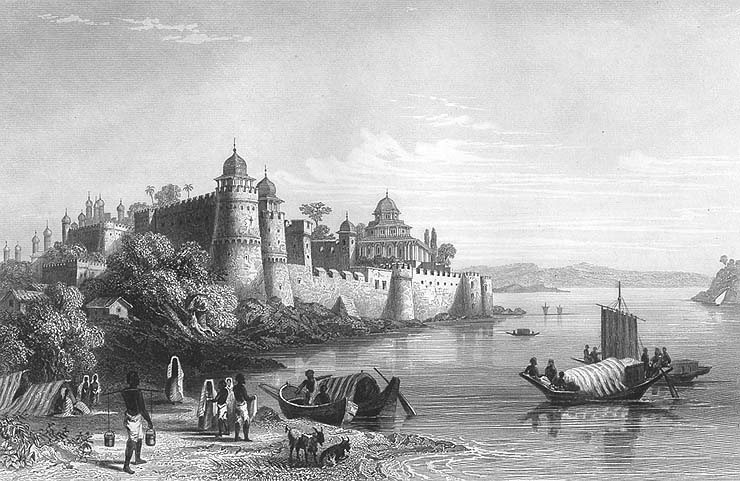
Black and white engraving of a large walled fort with round towers and domed pavilions along a riverbank. Small boats with passengers sit on the water, and figures in the foreground carry water pots near a tent and animals.Artifact

Primary source

Allahabad Fort

Akbar · 1583

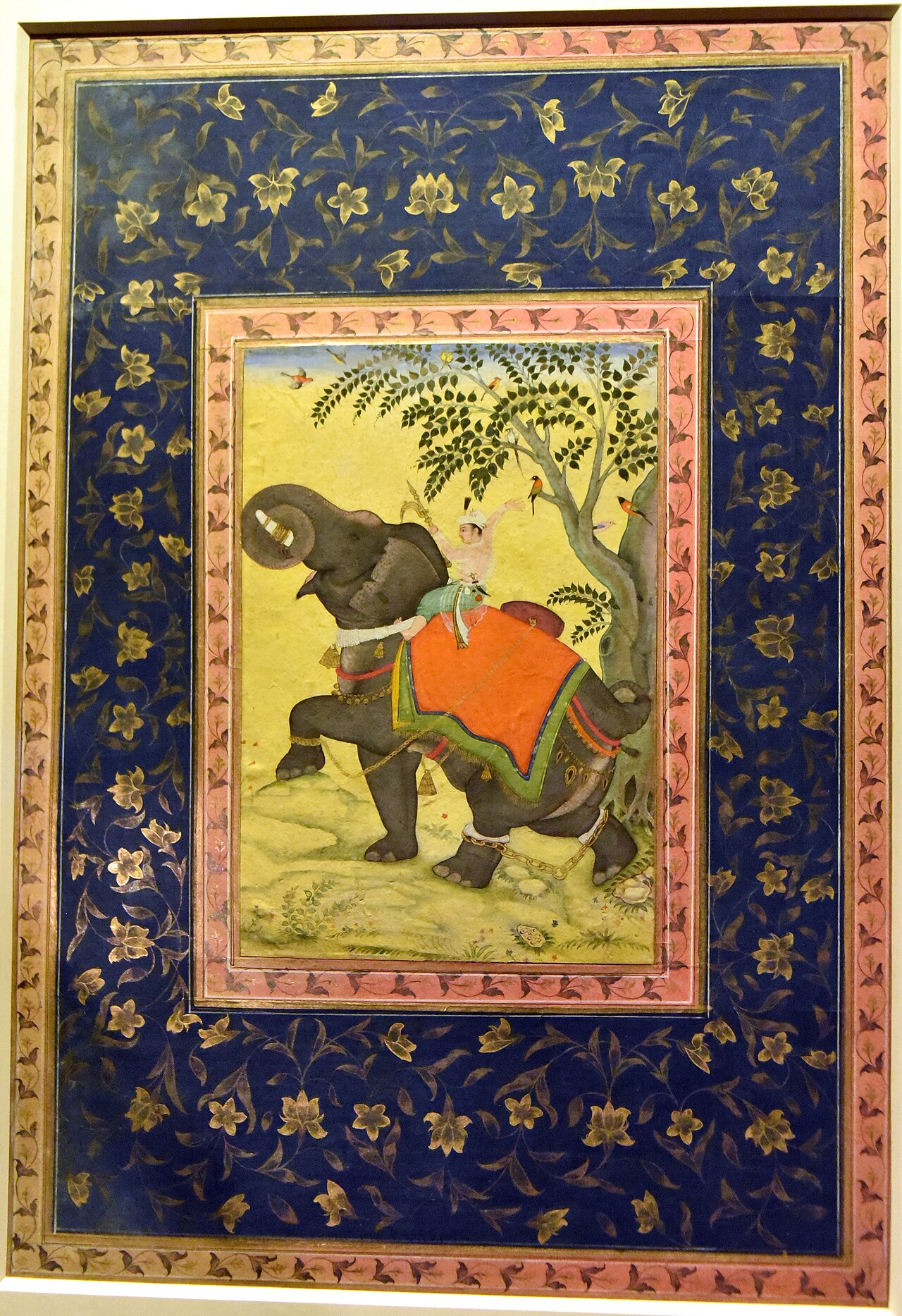
Framed Mughal-style miniature painting on a yellow background showing an elephant with a raised trunk and gold-chained legs, carrying a red and green saddle cloth. A small rider sits on its neck beside a leafy tree with birds. The painting sits within a blue border decorated with gold floral patterns and a pink inner mat.Painting

Secondary source

Sultan Akbar the Great Training an Elephant

1609

Book

Primary source

Ayeen Akbery, or the Institutes of the Emperor Akber

Abu'l Fazl ibn Mubarak · 1800 (translation; original Persian text written during Akbar's reign)

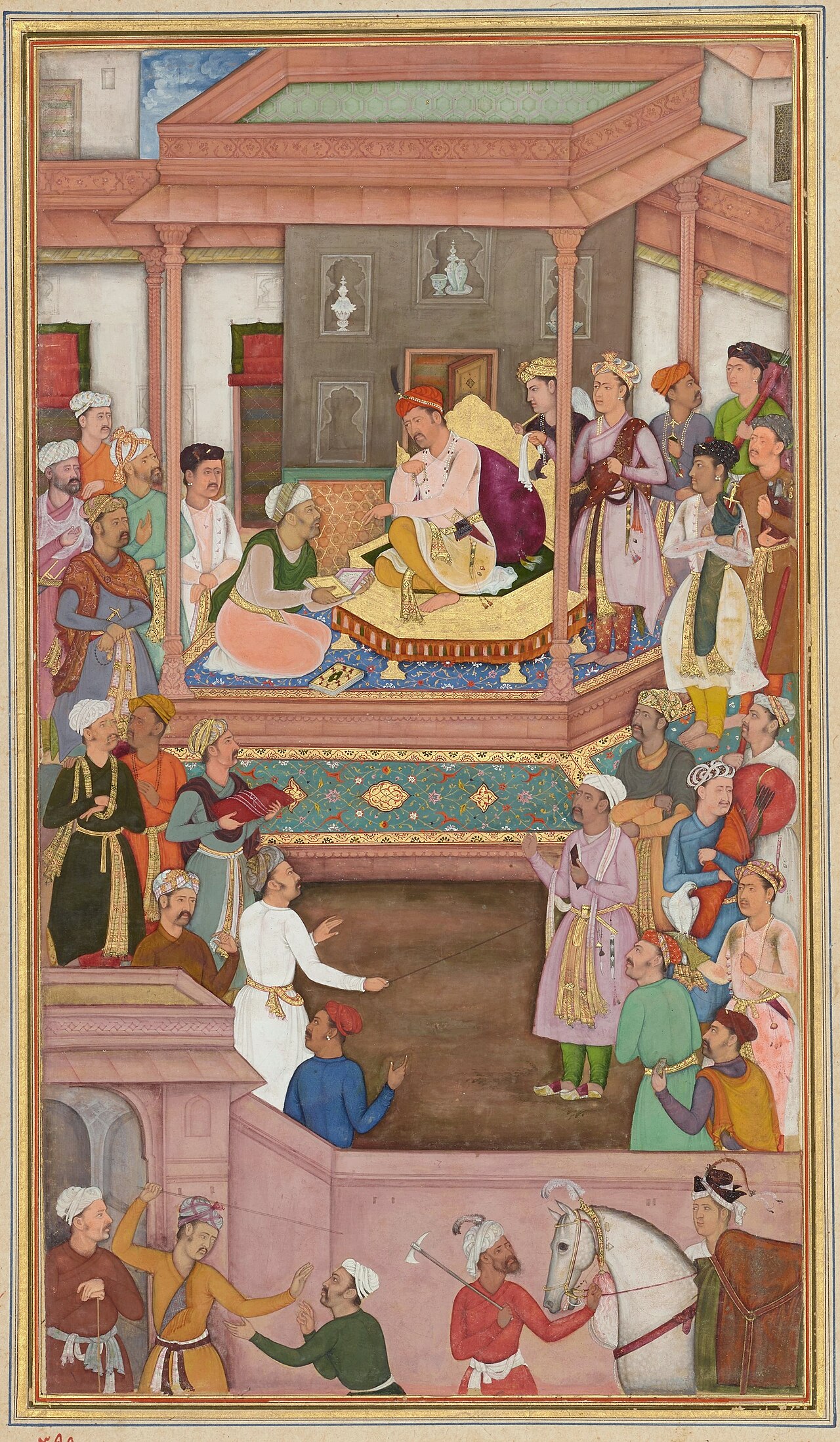
Mughal miniature painting of a royal court. A ruler in a red turban sits on a gold cushioned throne under a pavilion. A seated scholar in green holds an open book toward him. Courtiers in ornate robes stand and sit around, and a lower courtyard shows more attendants, a white horse, and a man in red holding an axe.Painting

Primary source

Abu'l-Fazl Presents the Akbarnama to Akbar

Govardhan · c. 1603-1605

The Commentary of Father Monserrate on his Journey to the Court of AkbarBook

Primary source

The Commentary of Father Monserrate on his Journey to the Court of Akbar

Antonio Monserrate · written during Akbar's reign; translated 1922

Akbar the Great Mogul, 1542-1605Book

Secondary source

Akbar the Great Mogul, 1542-1605

Vincent Arthur Smith · 1917

Akbar, Emperor of India: A Picture of Life and CustomsBook

Secondary source

Akbar, Emperor of India: A Picture of Life and Customs

Richard von Garbe · 1909

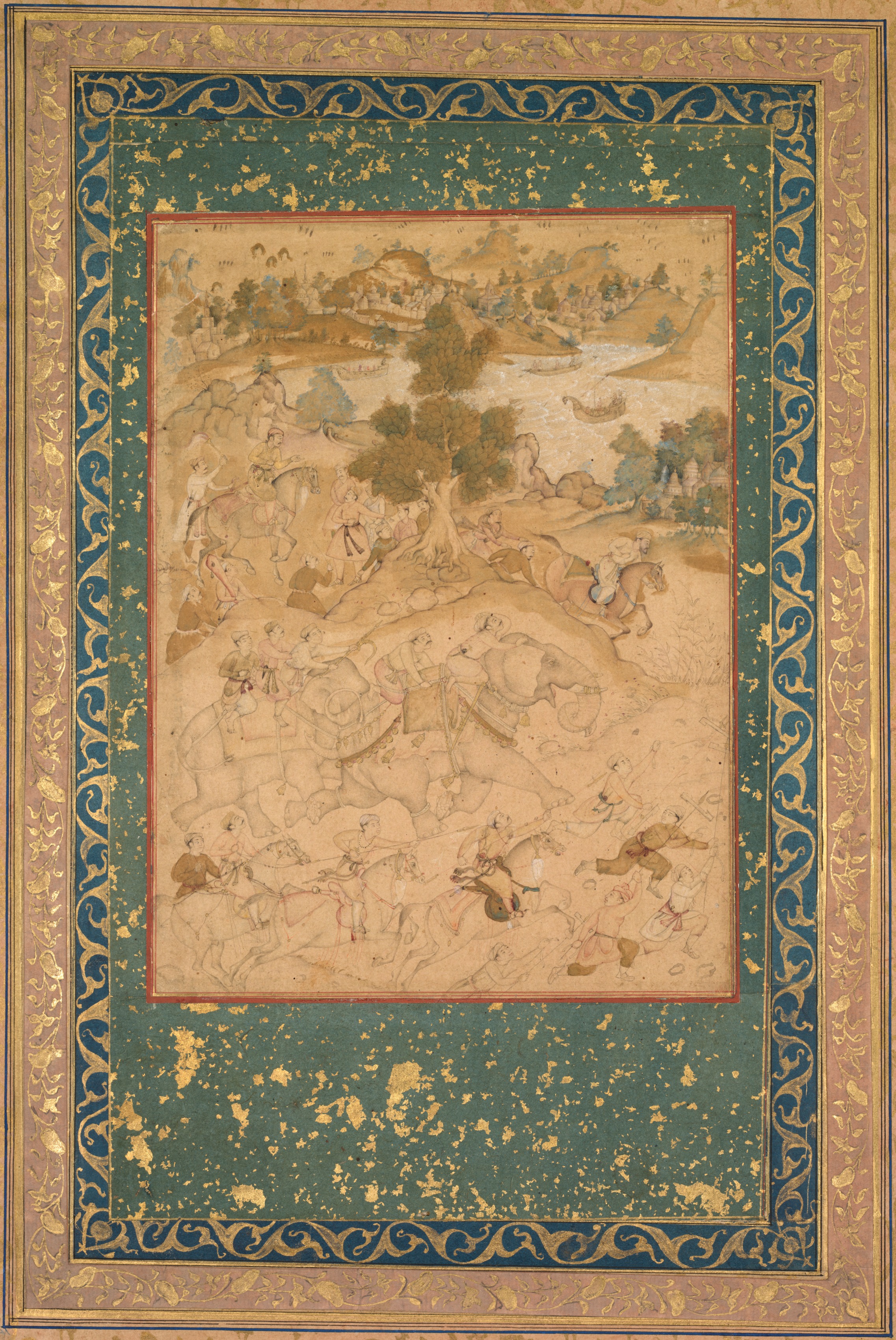
Mughal miniature painting in a gold-decorated, blue and green border. Scene of men on horseback and on foot chasing and capturing wild elephants in a hilly landscape, with a large tree at center, a river with boats, and a town in the background.Painting

Primary source

Akbar Supervising the Capture of Wild Elephants at Malwa

Farukh Chela · c. 1602-3, borders added c. 1700s

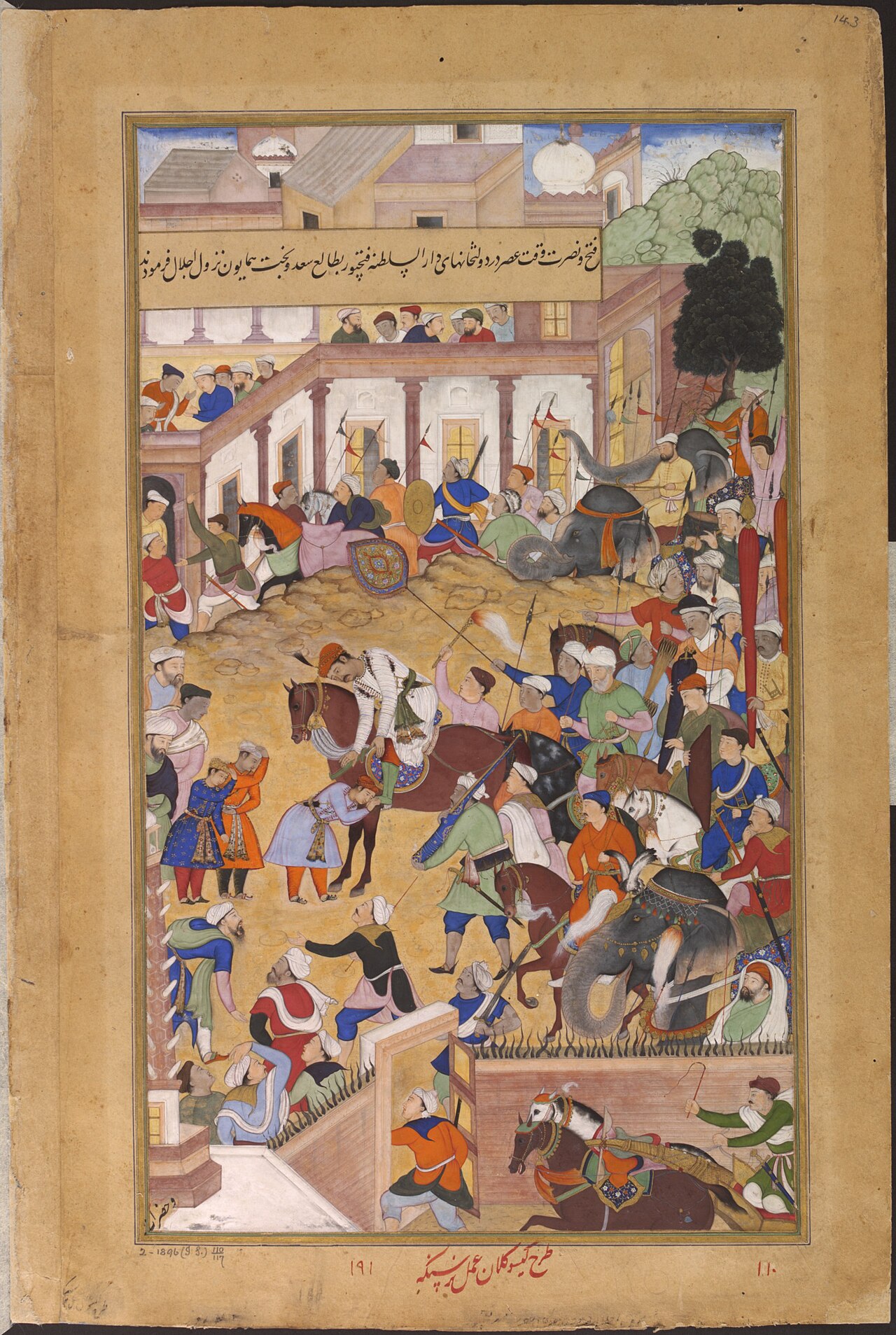
Mughal miniature painting with a Persian inscription band across the top. A courtyard with a crowd of men in turbans and robes, several war elephants, and horsemen. In the center, a figure on a horse is being attended by people; in the lower right a man on a horse with a whip. Figures watch from a balcony and rooftops. Ochre ground, many colors.Painting

Primary source

Akbar Receiving His Sons at Fatehpur, 1573

Kesev the Elder and Nar Singh · c. 1590

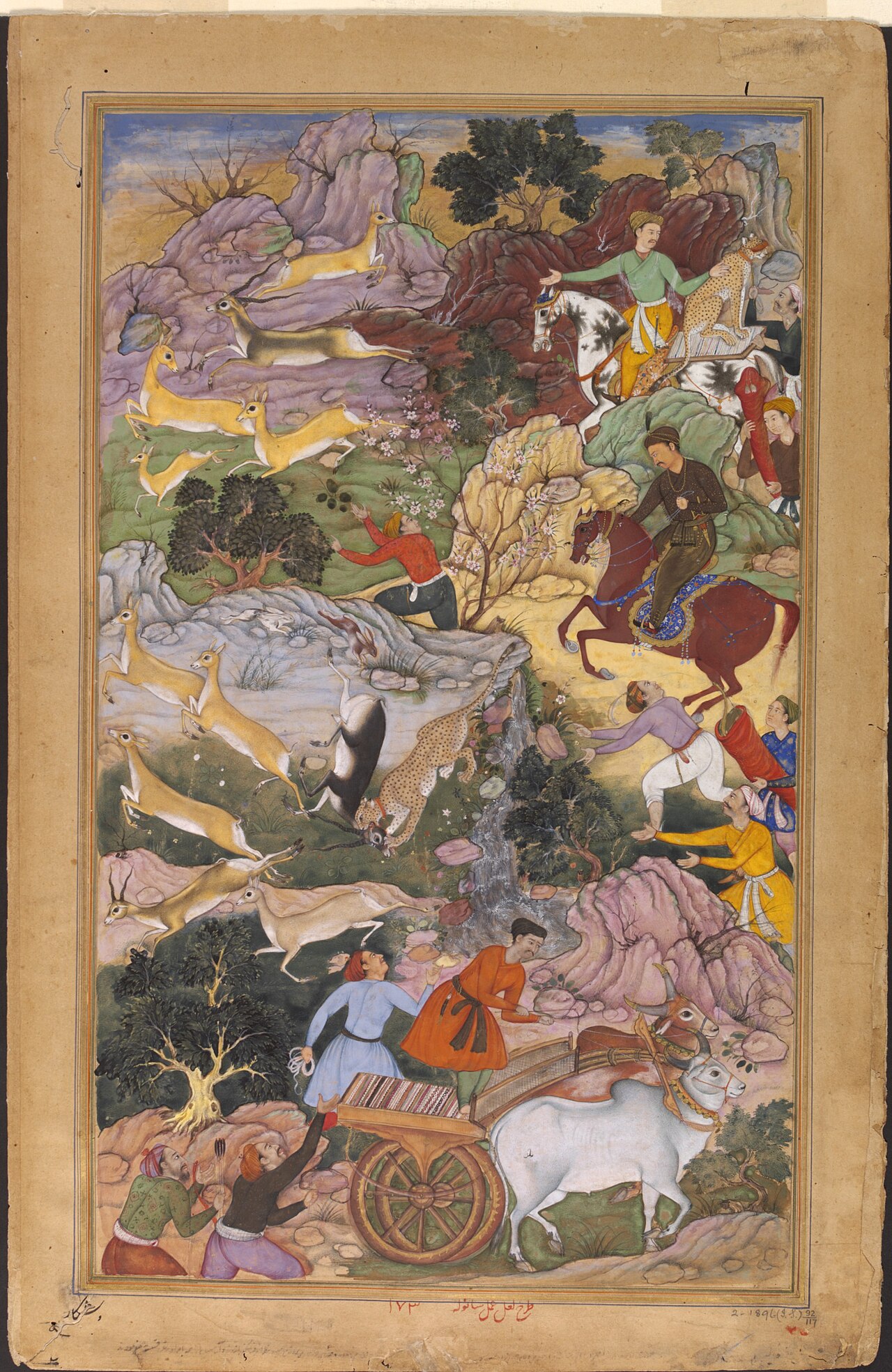
Mughal miniature painting of a hunt in a rocky landscape. Riders on horseback, one on a grey horse with a cheetah behind him, another on a dark red horse, chase herds of antelope and blackbuck. Cheetahs attack antelope, and men on foot run and crouch below. Two white oxen pull a cart at lower right, and a tree stands at lower left. Persian script appears in the margins.Painting

Primary source

Akbar Hunting Black Buck

Unknown · c. 1590

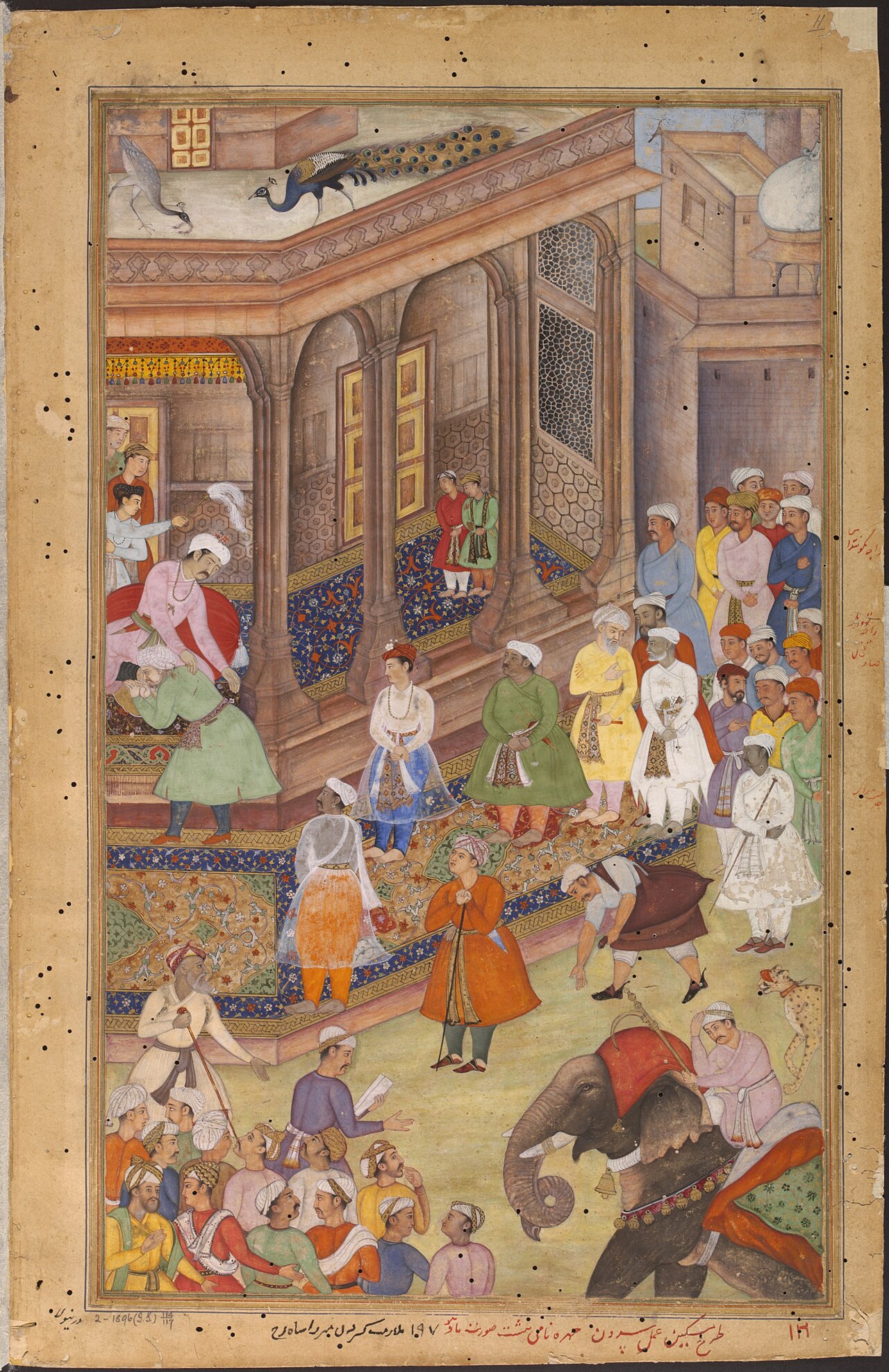
Mughal miniature painting of a courtly scene: an elevated arcaded palace terrace where a central figure in orange robes stands, flanked by nobles in turbans and robes; a crowd fills the foreground, a peacock perches on the roof, and an elephant with a red saddle stands at the lower right.Painting

Primary source

Akbar Greeting Rajput Rulers at Court, 1577

Miskina, Sarwan, and Madhav · c. 1590

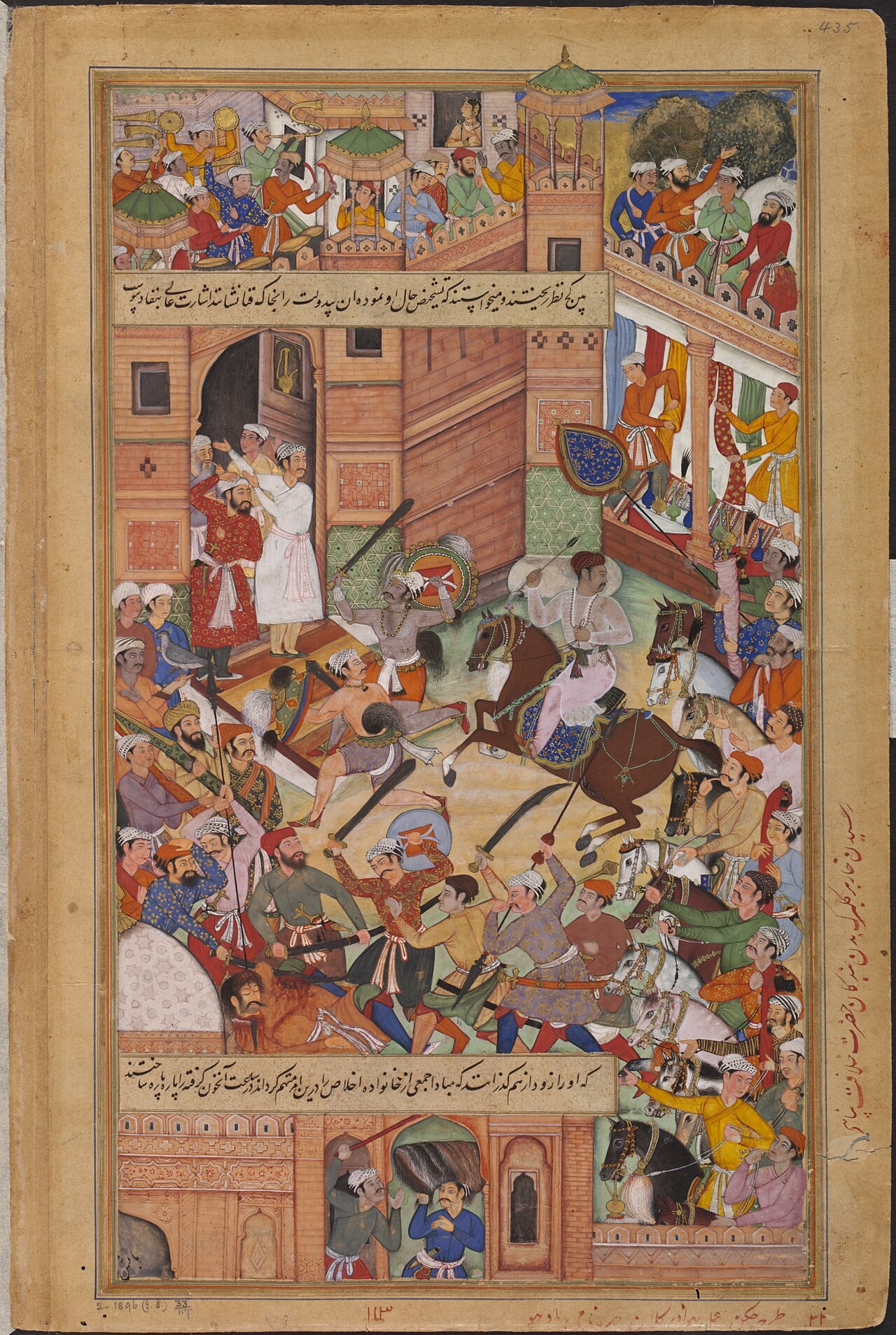
Mughal painting of a courtyard scene. Akbar, in white on horseback at center right, holds an arrow while armed retainers fight and pursue attackers in a crowded courtyard. Ornate palace buildings and onlookers on balconies surround the scene, with Persian inscriptions in bands above and below.Painting

Primary source

An Attempt to Assassinate Akbar at Delhi, 1564

Jagan, Bhawani the Elder, and Madhav · c. 1590

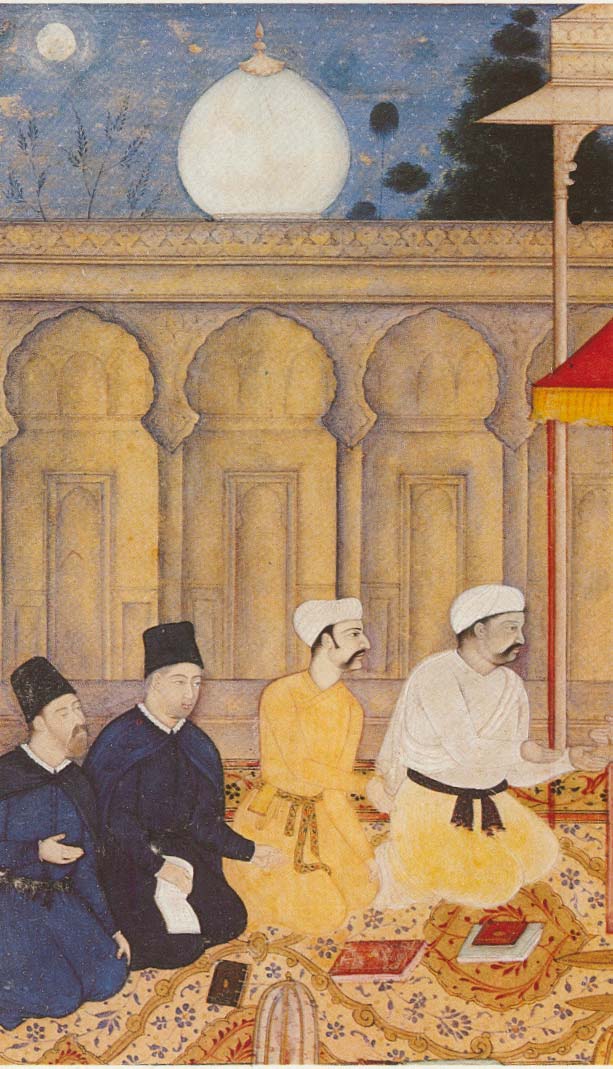
Detail of a Mughal miniature painting: three men in dark blue and yellow robes and black caps sit on a patterned carpet before an arcaded wall, while a man in white and yellow sits under a red canopy; a white dome and night sky appear behind.Painting

Primary source

Jesuits in the Ibadat Khana

Unknown · c. 1605

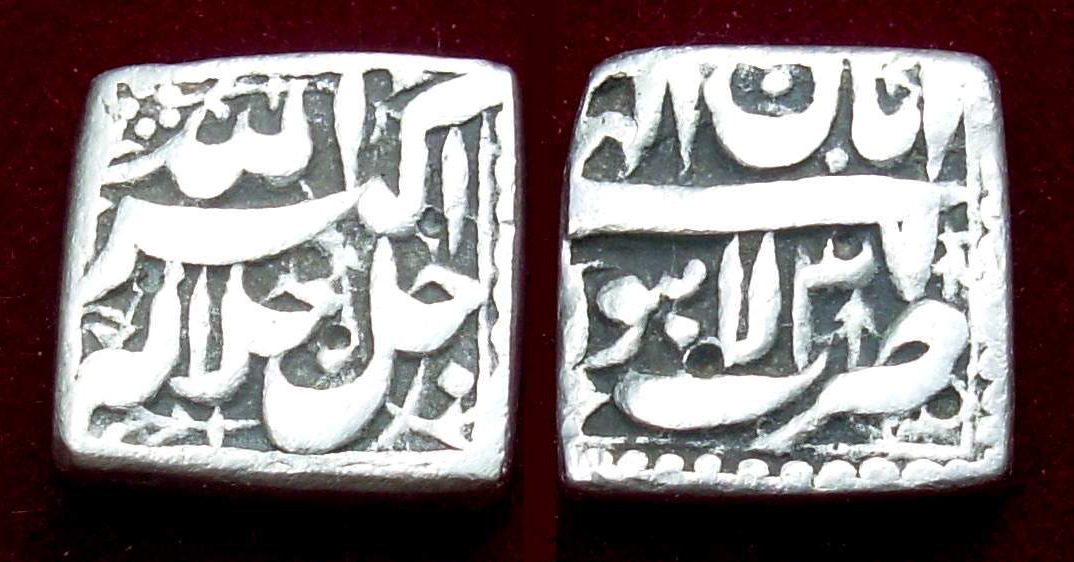
Two sides of a square silver coin with raised Persian-style Arabic script on a dark red background. The left side has calligraphy including a large word in the center; the right side has a horizontal band of script and a row of dots along the bottom edge.Artifact

Primary source

Silver Rupee of Akbar, Lahore Mint

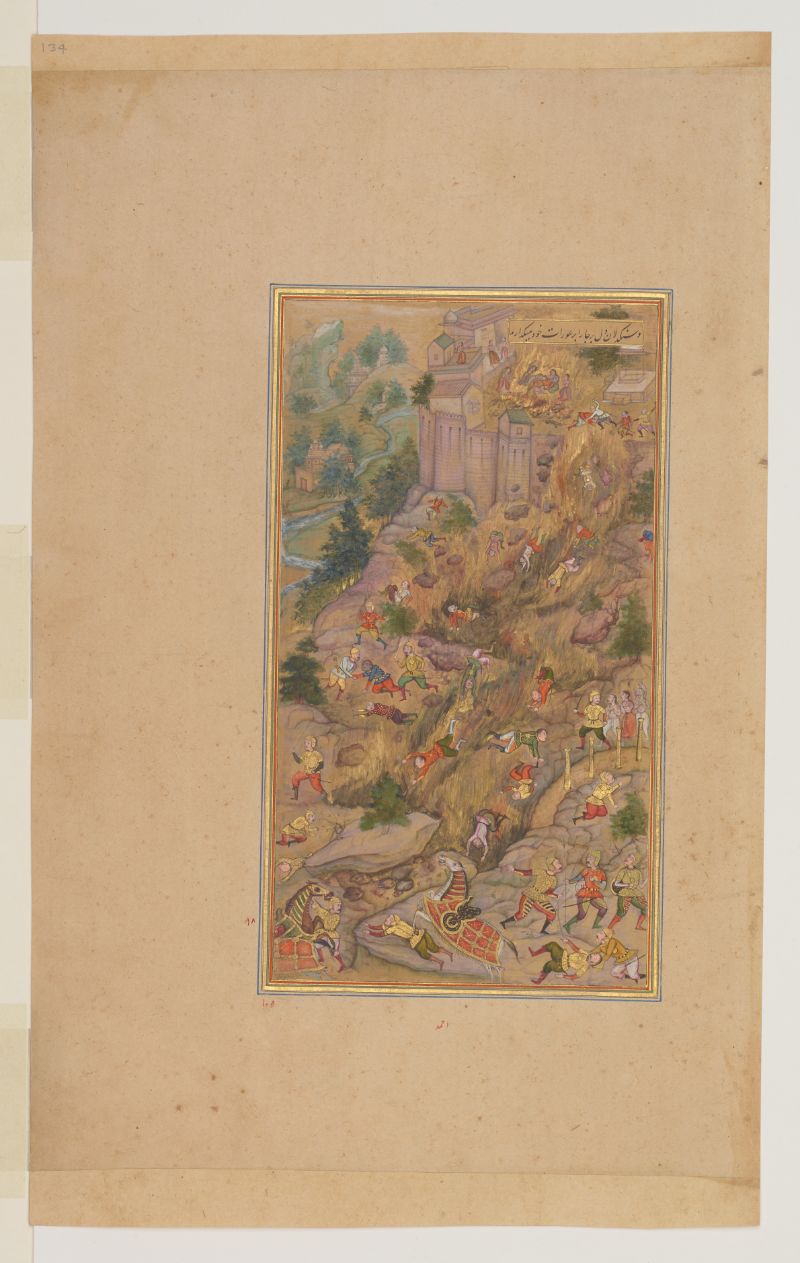
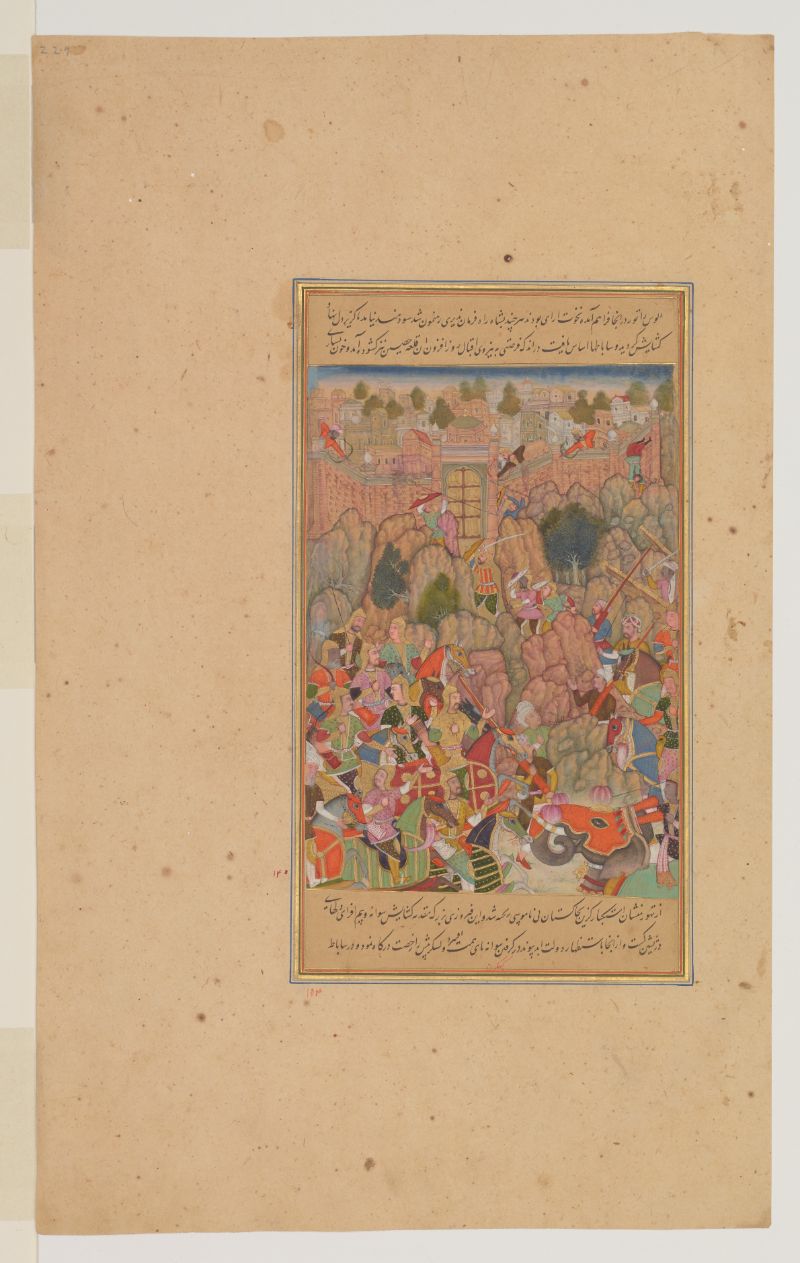
Painted Mughal manuscript folio on a tan paper page. A framed miniature shows a hilltop fort with pink walls and towers at upper left, its ramparts and slopes burning. Below, many small armored soldiers in red, yellow and green clash on rocky ground and dry grass, with a red-caparisoned horse and rider at lower left. Persian calligraphy appears in a cartouche at top right.Painting

Primary source

Akbar's Armies at Chitor Fort

Muhammad Husayn Kashmiri and Zarin Qalam · c. 1603-1605

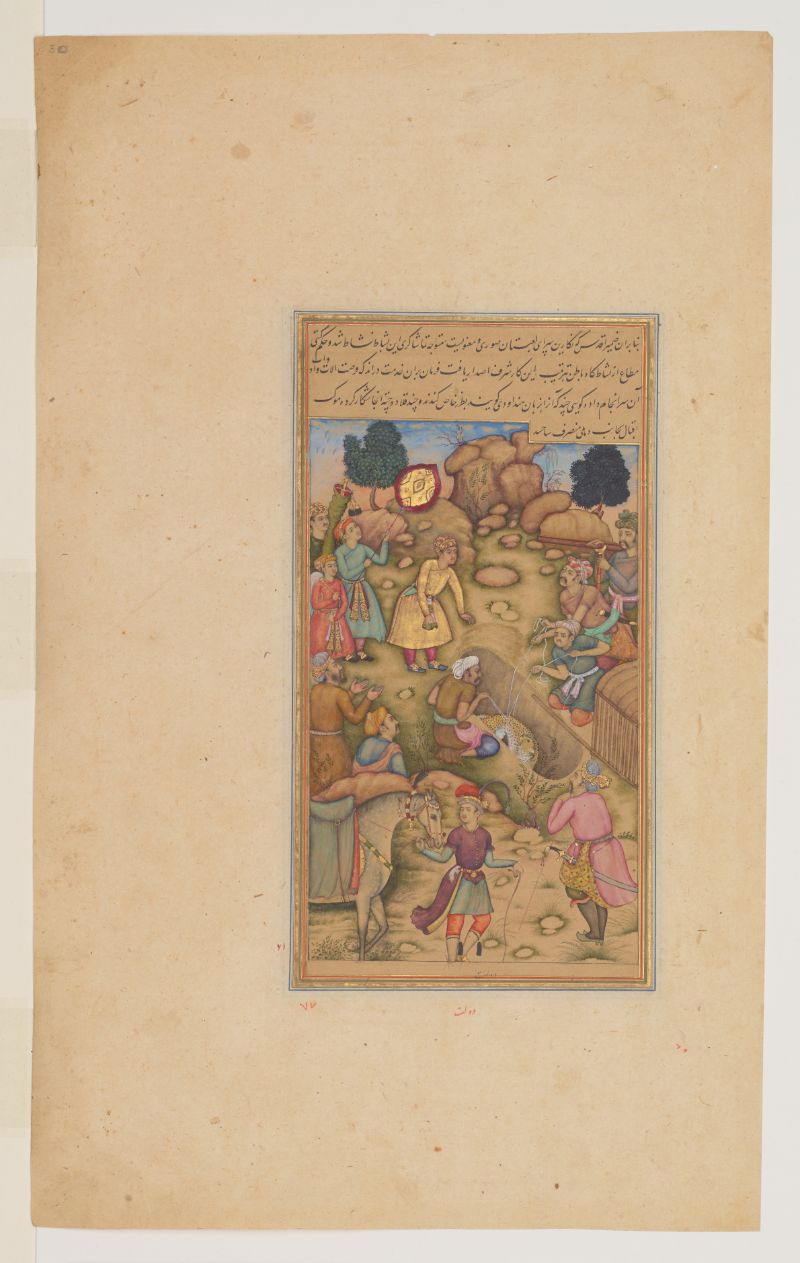
Miniature painting on paper with Persian calligraphy at top. A rocky landscape with trees shows courtiers and attendants, a man in a yellow robe, and a leopard or cheetah being handled near a mound, with a horseman on a white horse at lower left.Painting

Primary source

Akbar Captures a Wild Cheetah

Daulat · c. 1603-1605

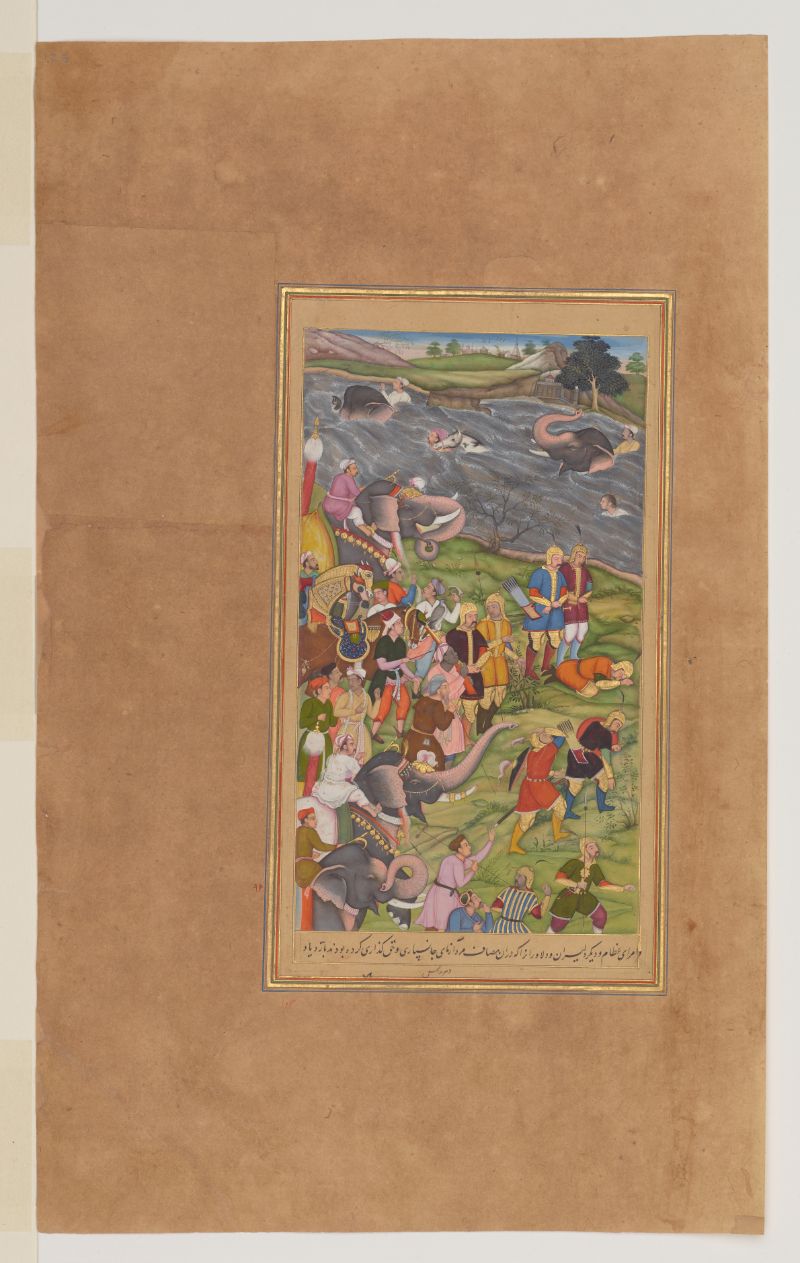
Miniature painting on paper mounted on brown card: soldiers and elephants crossing a swollen river with men swimming, while on the bank archers, horsemen and elephants gather among figures in colorful robes. Persian calligraphy runs along the bottom edge.Painting

Primary source

Akbar's Army at the Ganges

Dharm Das · c. 1603-1605

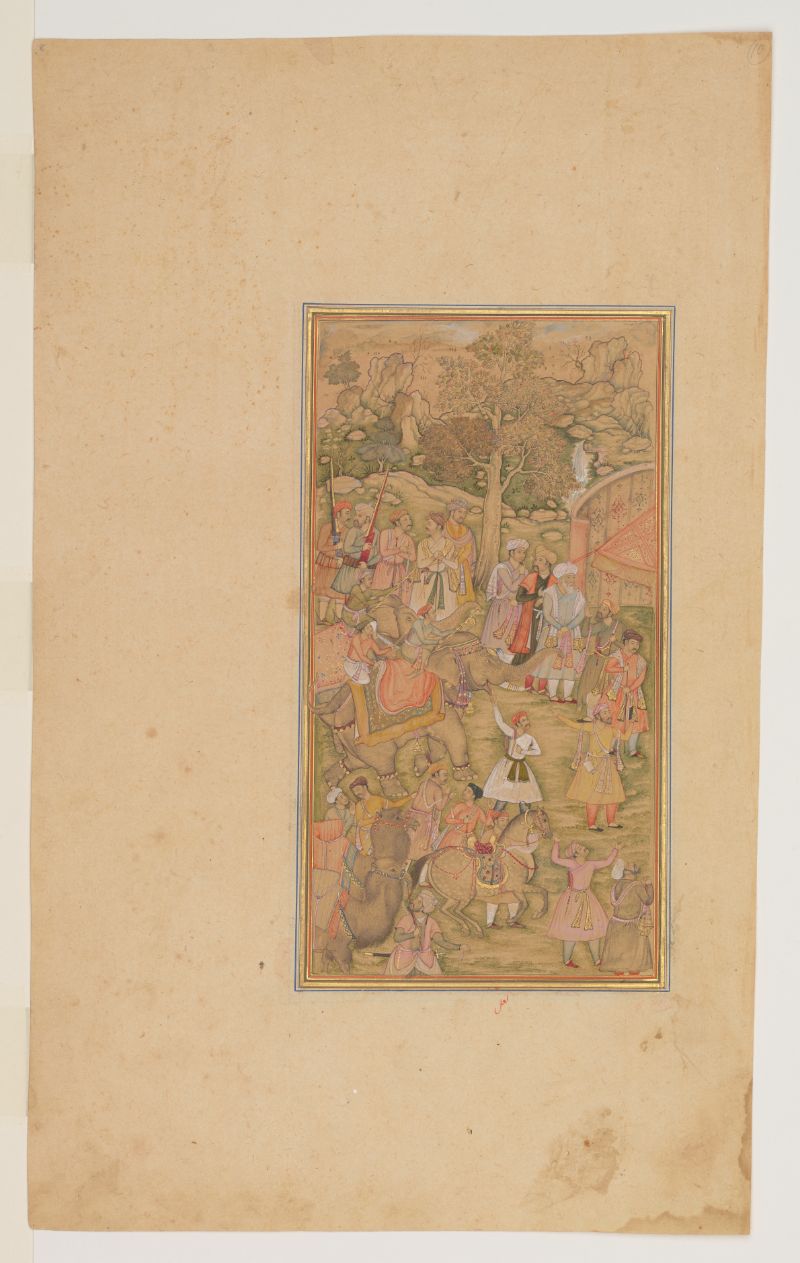
Mughal miniature painting on paper mounted on a larger sheet. A rectangular painted scene shows a garden with a large tree and rocky hills. A seated royal figure on an elephant with a red canopy is at left, with mounted riders, attendants with spears, and a turbaned figure dancing in the center. A red-draped tent or pavilion stands at right.Painting

Primary source

Nobles Arrive for Akbar's Coronation Feast

La`l · c. 1603-1605

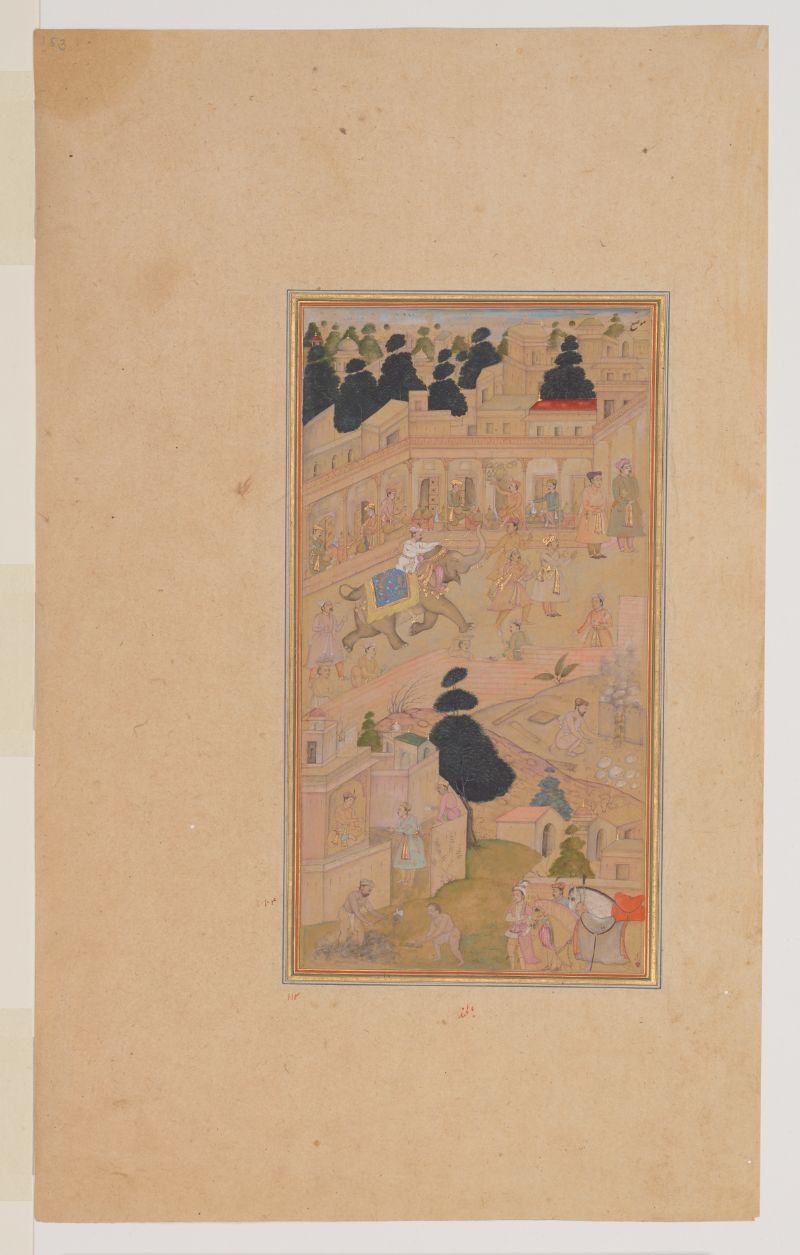
Painted folio on a tan mount showing a walled courtyard with arcaded buildings and trees. An elephant with a blue-and-gold howdah and a rider is in the center. Robed figures stand and walk in the courtyard, and workers in the lower left and right appear to be building or carrying materials.Painting

Primary source

Construction at Fatehpur Sikri

Balchand · c. 1603-1605

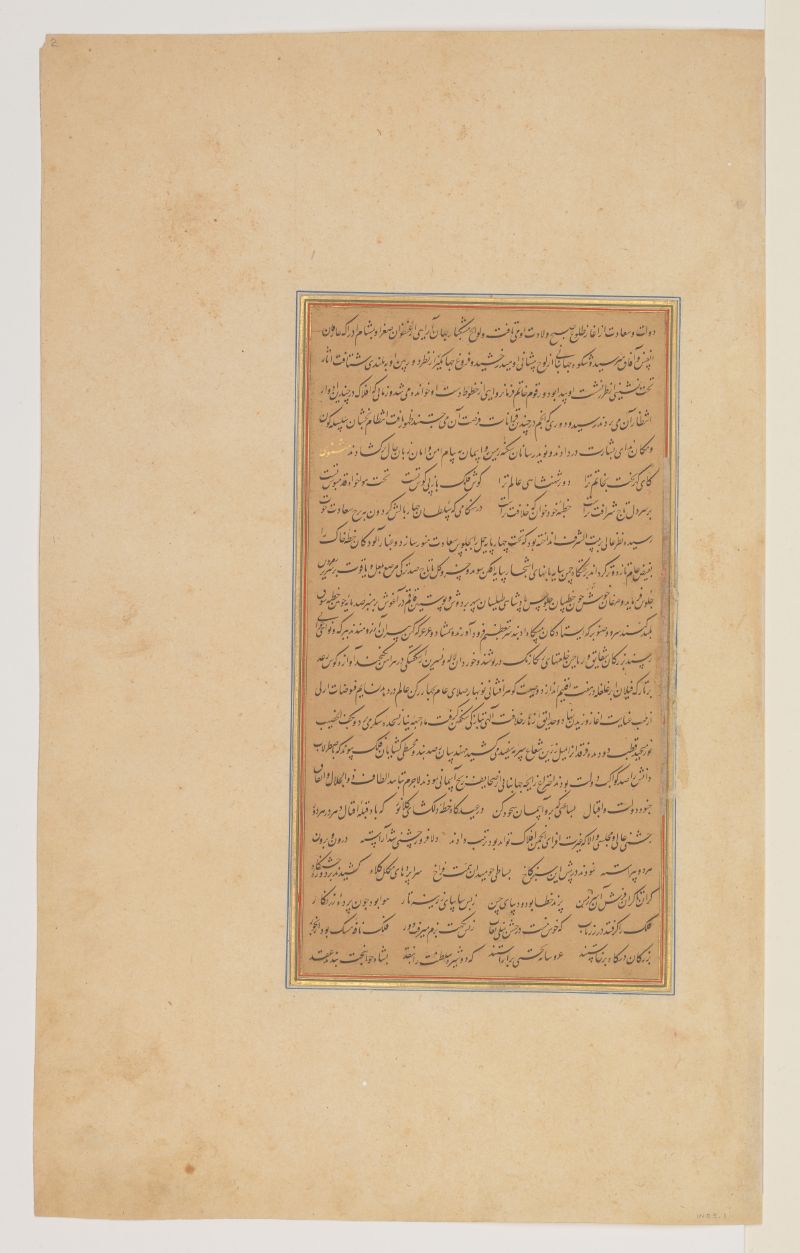
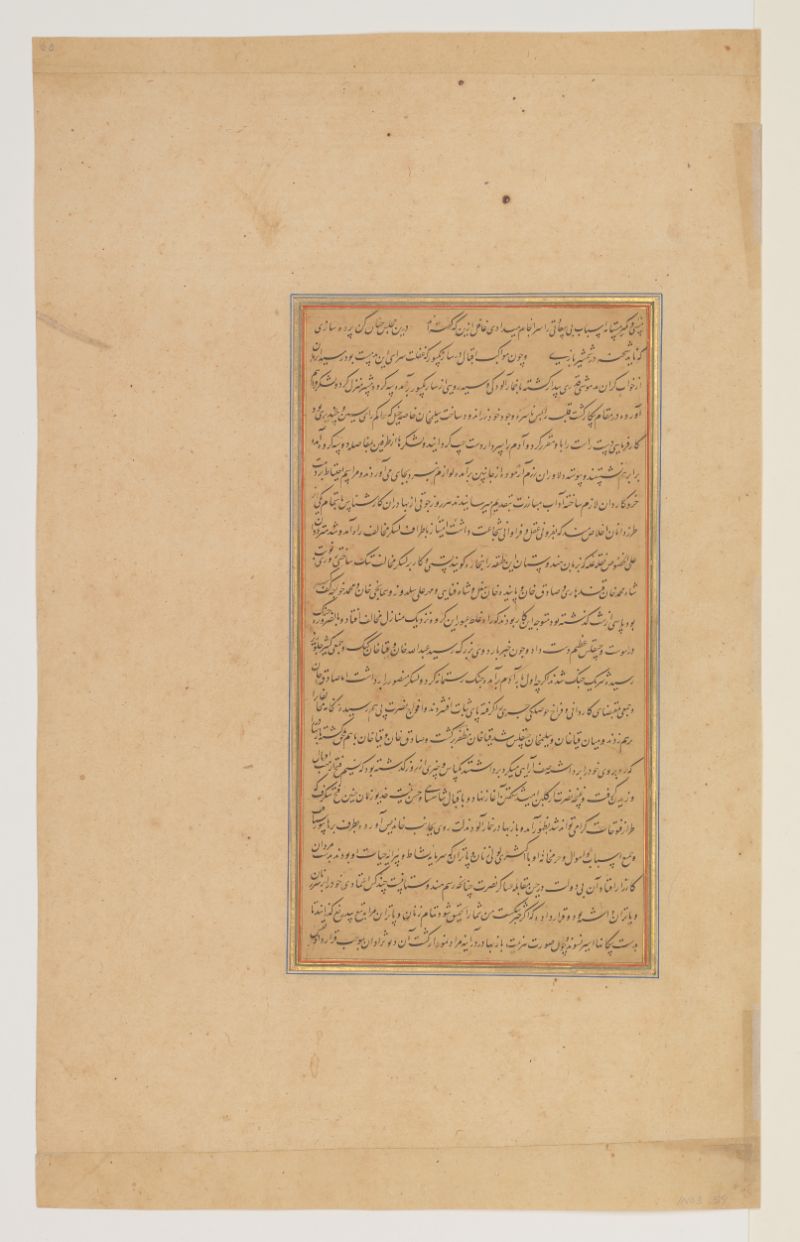
A folio of an Akbarnama manuscript on a tan paper page with a single block of Persian nastaliq script in black ink, framed by red, gold and blue ruled borders. The page has no painting visible.Document

Primary source

The Coronation of Akbar in February 1556

Madhu (attributed) · c. 1603-1605

Painted Mughal manuscript folio on paper: a miniature shows a crowded battle scene with armored horsemen and foot soldiers in red, green and gold before a walled fort with towers and a central gate, rocky hills in the foreground. Persian calligraphy text fills panels above and below the painting.Painting

Primary source

Akbar's Army Besieging Dunara Fort in 1576

Khem Karan · c. 1603-1605

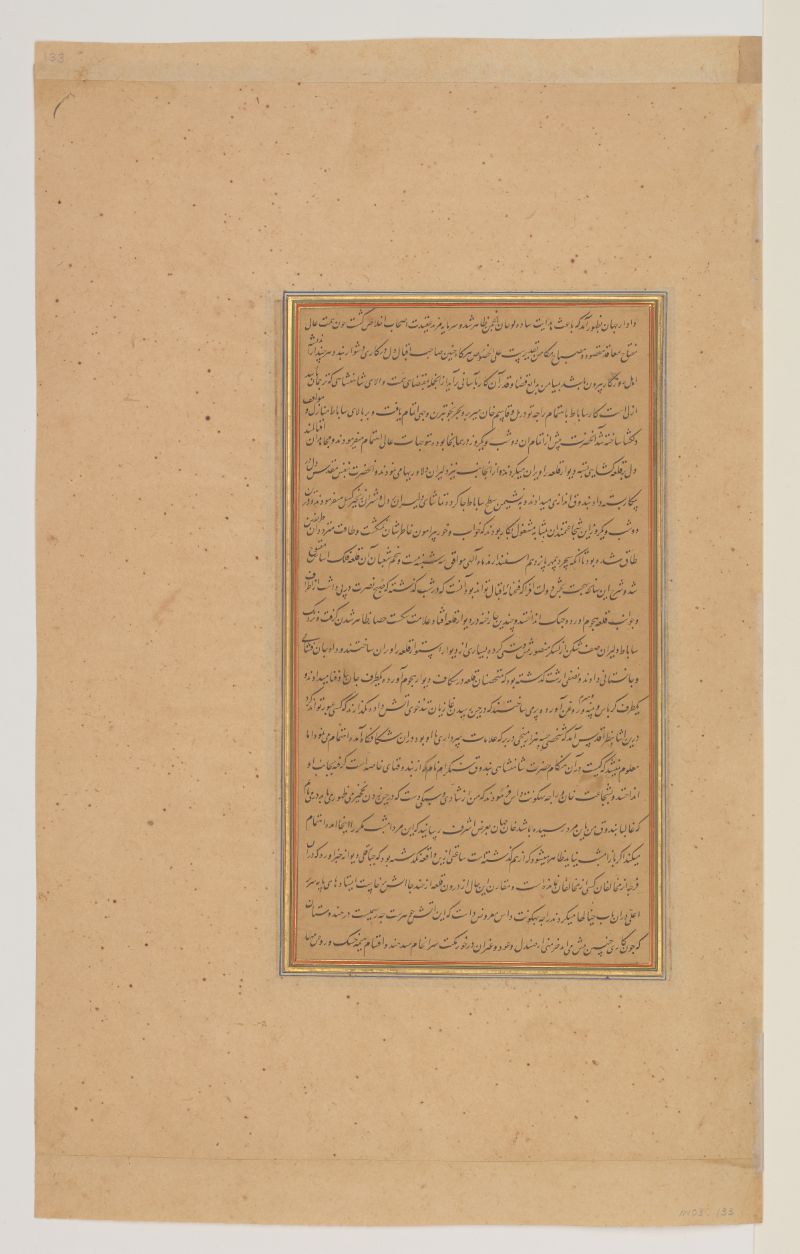
Scan of a manuscript folio on a light tan paper sheet, showing a rectangular text block of Persian script in black ink within gold and blue ruled borders, with no illustration visible. The page has an edge of faded marks and a small page number in the top left corner.Document

Primary source

Akbar's Forces Take Sarangpur Fort in Malwa

La'l · c. 1603-1605

Akbar and the Rise of the Mughal EmpireBook

Secondary source

Akbar and the Rise of the Mughal Empire

G. B. Malleson · 1894

Book

Secondary source

Kaiser Akbar: Ein Versuch über die Geschichte Indiens

F. A. Noer; edited by Gustav von Buchwald · 1885

Manuscript folio of Persian calligraphy in black ink on a buff paper page, framed by gold and red ruled borders on a tan mount. Text is written in columns, with a page number visible in the upper left corner. No painting is visible.Document

Primary source

Akbar's Conquest of Chitor Fort in 1568

Ahmad · c. 1603-1605

Mughal miniature painting on a cream paper folio showing a battle scene. A seated figure rides on a decorated elephant in the foreground, surrounded by armored horsemen, soldiers with spears, and a red-canopied tent in the background. Gold-bordered text panel at top.Painting

Primary source

Hemu Is Captured by Akbar's Forces in 1556

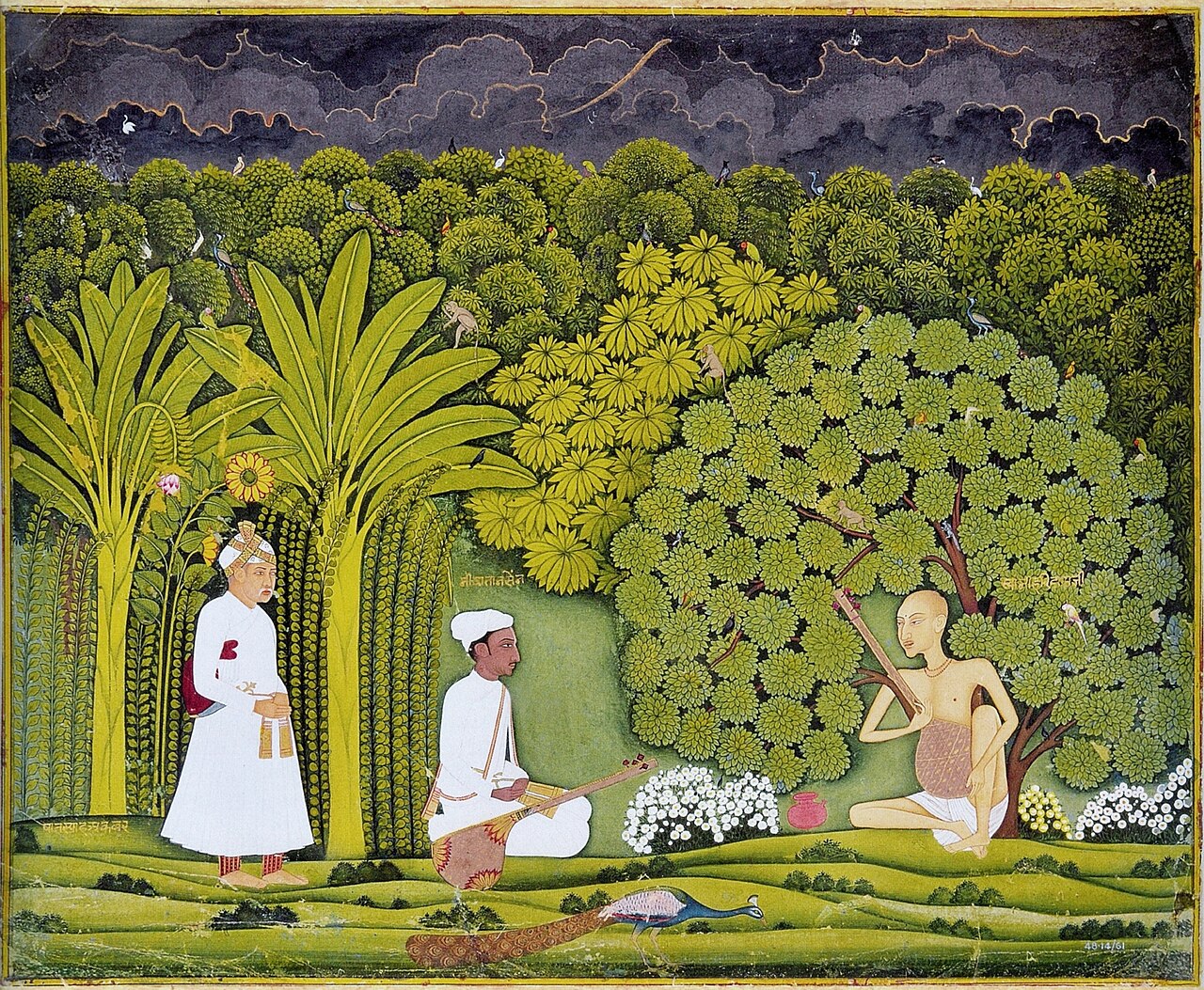
Shankar · c. 1603-1605

Painting of a green landscape with a dark stormy sky. A standing man in white robes and a turban stands at left, a seated man in white and white turban sits center, and a bald, bare-chested seated figure plays a long-necked instrument at right under a tree. A peacock is in the foreground.Painting

Secondary source

Akbar and Tansen Visit Swami Haridas in Vrindavan

Unknown painter, Jaipur-Kishangarh style · c. 1750

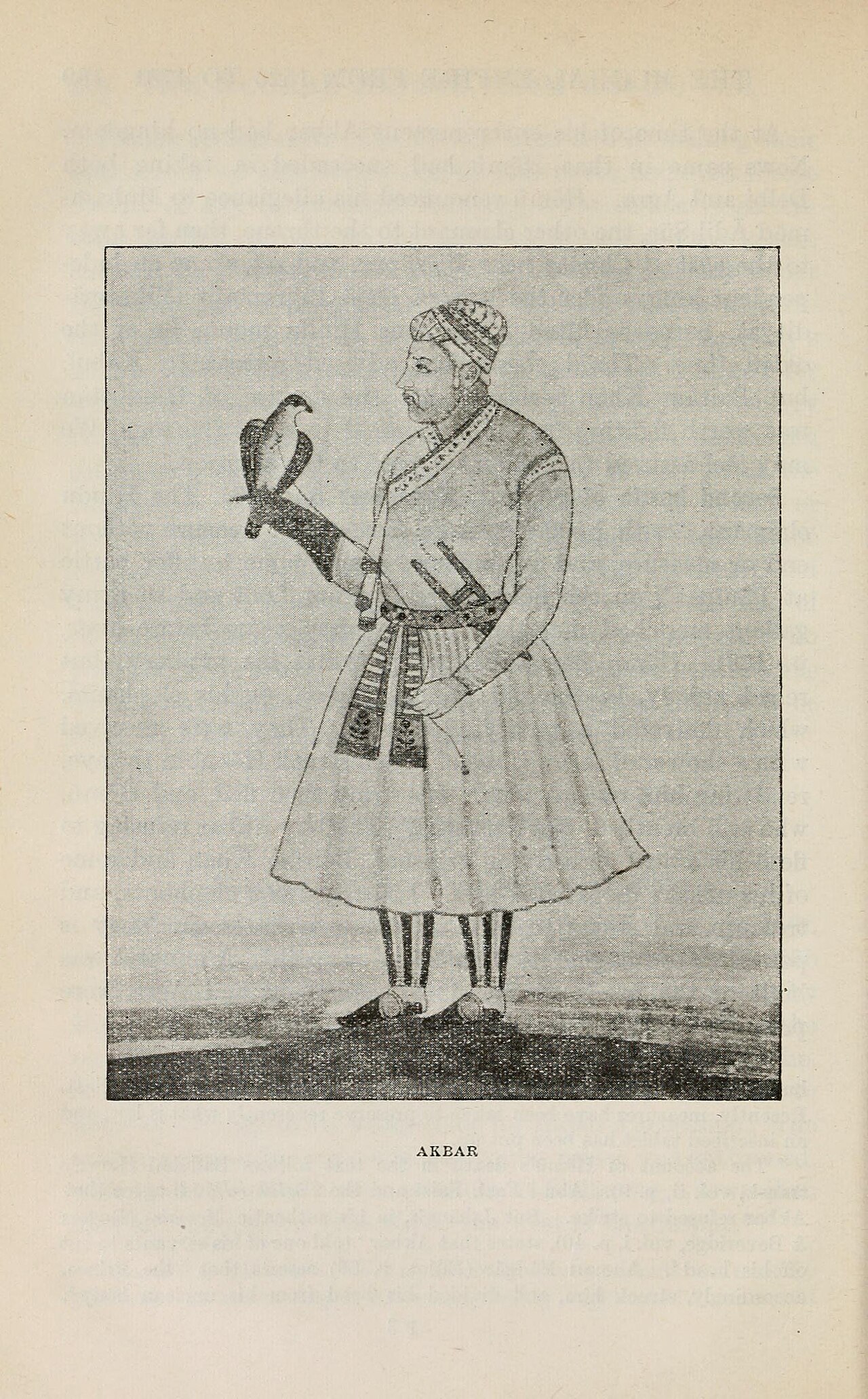
Black-and-white halftone plate from a book showing a standing figure in a turban and long coat with a belt, holding a hooded falcon on a gloved left hand, facing left, with a caption reading AKBAR below.Book

Secondary source

Akbar, by Vincent Arthur Smith

Vincent Arthur Smith · published early 20th century

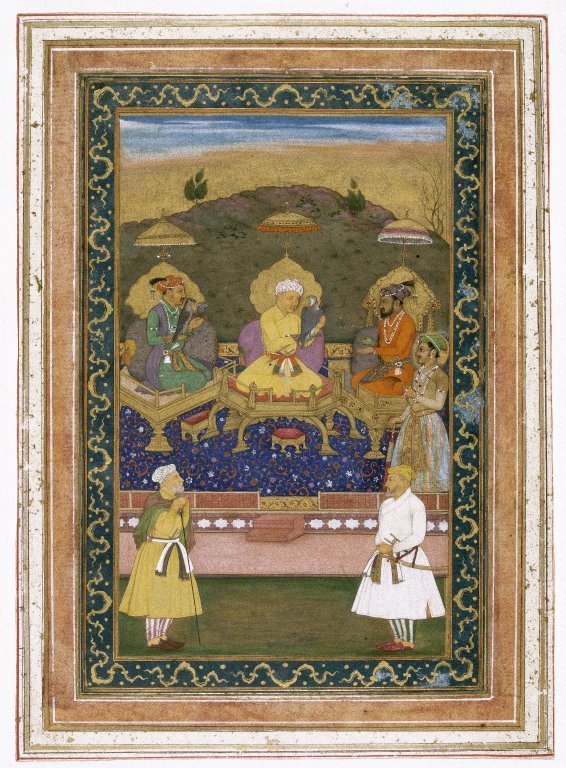
Mughal miniature painting in a gold and blue floral border with an outer cream mat. Three seated rulers sit under gold haloes and parasols on a raised golden platform against a hillside and sky. Attendants stand nearby, and two men in yellow and white robes stand in the foreground on a green ground.Painting

Secondary source

Emperors Akbar, Jahangir, Shah Jahan with Ministers and Dara Shikoh

Chitarman · c. 1630-1640

Painting of a standing man in a pale robe, gold sash, and patterned turban, with a golden halo, holding a string of beads. A seated lion is at lower left and a reclining deer at right. Two angels and birds appear in clouds above, within a decorative border.Painting

Secondary source

Portrait of the Aged Akbar

Govardhan · c. 1640-1650

Book

Tertiary source

Akbar entry, Encyclopedia Americana (1920)

1920

Book

Tertiary source

Akbar entry, Encyclopaedia Britannica, Ninth Edition

19th century

Book

Secondary source

Rulers of India: Akbar

G. B. Malleson · 1890

India at the Death of Akbar: An Economic StudyBook

Secondary source

India at the Death of Akbar: An Economic Study

W. H. Moreland · 1920

Book

Tertiary source

Akbar entry, The New International Encyclopedia (1902)

1902

Book

Secondary source

The Slave Girl of Agra, Book 2 Chapter 8

1909

Want the full shelf? Chat with Akbar the Great in the app and open the Sources panel — every quote links back to the original.

Use Akbar the Great in class

1 collection

A ready-made collection from the Humy team that features Akbar the Great. Preview it, then try it free.

Trusted by educators worldwide

Conversations
375,000+
Real exchanges between students and historical figures
Messages exchanged
4,142,000+
Across every figure, classroom and language
Historical figures
100,000+
Each informed by a curated biography and selected sources
Languages supported
50+
From English and Spanish to Arabic and Korean

Paying customers

Used by 98 schools and universities

Partner school logo
Tecnológico de Monterrey logo
Hyper Island logo
Partner school logo
Chambersburg Area School District logo
Broward County Public Schools logo
Nebo School District logo
National Louis University logo
South Florida PBS logo
Punahou School logo
University of Wisconsin–River Falls logo
Partner school logo
Partner school logo
Archbishop Mitty High School logo
Kingsburg High School logo
Norwalk Public Schools logo
Partner school logo
Connections logo
Partner school logo
Moore Public Schools logo
Partner school logo
Partner school logo
Partner school logo
Partner school logo
Robbinsville Public Schools logo
Partner school logo
Partner school logo
Partner school logo
Tecnológico de Monterrey logo
Hyper Island logo
Partner school logo
Chambersburg Area School District logo
Broward County Public Schools logo
Nebo School District logo
National Louis University logo
South Florida PBS logo
Punahou School logo
University of Wisconsin–River Falls logo
Partner school logo
Partner school logo
Archbishop Mitty High School logo
Kingsburg High School logo
Norwalk Public Schools logo
Partner school logo
Connections logo
Partner school logo
Moore Public Schools logo
Partner school logo
Partner school logo
Partner school logo
Partner school logo
Robbinsville Public Schools logo
Partner school logo
Partner school logo

What educators are saying

“We enjoyed the program last year and used it frequently.”
“My students say it’s a welcome change of pace. I’m not a fan of the “sage on the stage” model, so I try to incorporate research-oriented and self-paced activities. With Humy, students have to take charge of their learning. They’ve become more adept at critical thinking, forming better questions, and improving their reading comprehension. The interview feature has been my go-to tool. I create assignments where students must ask historical figures a set number of questions, then summarize the responses to ensure they’re truly absorbing the material. This approach lets them actively explore the past rather than passively consuming information.”
“Humy has helped me bring historical figures, sometimes long past, to life. When my students interact with these figures in real-time, it eliminates some of the perceived “ancient” characteristics of my curriculum. This has shifted my students’ thinking away from viewing history as abstract or irrelevant. Real-time interactions make historical figures relatable, even allowing students to ask off-topic questions that help put historical lives in a more relevant context for 13-year-olds. The feature I use the most is the interview feature. After teaching a topic, most recently Gandhi and Joan of Arc, I have the students ask pointed, focused questions. We practice good conversation techniques beforehand, teaching them to listen (or read) carefully and formulate thoughtful follow-up questions rather than just interrogating. It helps students practice effective conversation skills.”

FAQ

Frequently asked questions

Who is Akbar the Great?
Mughal emperor of India known for religious tolerance and administrative reforms. On Humy.ai you can chat with an AI version of Akbar the Great that draws on a short biography and 80 historical sources during the conversation — by text or voice, in 42 languages.
Is Akbar the Great AI free?
Akbar the Great is part of Humy's full library of more than 100,000 figures, which comes with a paid plan. A free account (no credit card) includes 20 AI messages a month with the free library's figures, so you can try how the conversations work first. The free plan's 20 AI messages a month are shared by you and your students: enough to try Humy yourself; a whole class needs Plus.
What sources does the Akbar the Great AI use?
It draws on a short biography and 80 historical sources (paintings, books and artifacts), including “Akbarnama”, “Ain-i-Akbari” and “Victoria and Albert Akbarnama”. Each source has its own page on Humy.ai.
How historically accurate is the AI version of Akbar the Great?
Each figure uses a short biography and a small set of selected historical sources as context (retrieval-augmented generation), so answers stay closer to known material than the model's general knowledge alone. It isn't a citation-grade research tool — like any LLM, the AI can get details wrong or extrapolate. Treat it as a strong starting point for inquiry and cross-reference important claims.
Can I talk to Akbar the Great by voice?
Yes. In addition to text chat, you can call Akbar the Great and hear their voice respond in real time — useful for auditory learners, interview practice and Socratic dialogue.
Is Humy.ai safe and compliant for schools?
Yes. Humy.ai is used by more than 100 schools, universities and organisations. The platform is FERPA- and GDPR-aligned, supports SSO, and offers an IT-approval pack tailored for school procurement teams.

Cross-reference Akbar the Great

Like any LLM, the AI version of Akbar the Great can get details wrong. Open one of these sources in a new tab to verify what you’ve read.

Ready when you are

Start chatting with Akbar the Great now.

20 messages free · No credit card · Available in 50+ languages.