
Portrait of Chandragupta Maurya

AI Historical Figure

Chandragupta Maurya

Founder of the Maurya Empire in ancient India.

Chat with Chandragupta Maurya via text or voice — in 42 languages, drawing on a curated biography and 56 historical sources. Available 24/7.

Start chatting with Chandragupta Maurya20 messages free · No credit card
Lived
c. 340–298 BCE
From
India
Known for
Rulers & royaltyPolitics & government
Chandragupta Maurya

Chandragupta Maurya

Online · responds in seconds

Hello — I'm Chandragupta Maurya. Founder of the Maurya Empire in ancient India. What would you like to ask me?

20 messages free · No credit card · Powered by Humy.ai

Live preview · Switch between 42 languages above · Send a message to continue in the app

Multilingual

Talk to Chandragupta Maurya in 42 languages

Ask Chandragupta Maurya questions in any language below, and the rest of Humy's app speaks it too. Pick yours to open the chat in that language.

Also in German (Austria), German (Switzerland), English (UK), English (Australia), English (Canada).

The sources behind this AI

56 sources · 15 artifacts · 11 photographs · 9 documents · 9 sculptures · 8 books · 4 paintings

Chandragupta Maurya doesn’t improvise from thin air. The AI is grounded in 56 curated historical sources students can inspect. Open any of them to see what informs the conversation.

Book

Secondary source

Arthashastra

Chanakya (traditional attribution) · c. 1st–3rd century CE (traditionally attributed to Chanakya, c. 300 BCE)

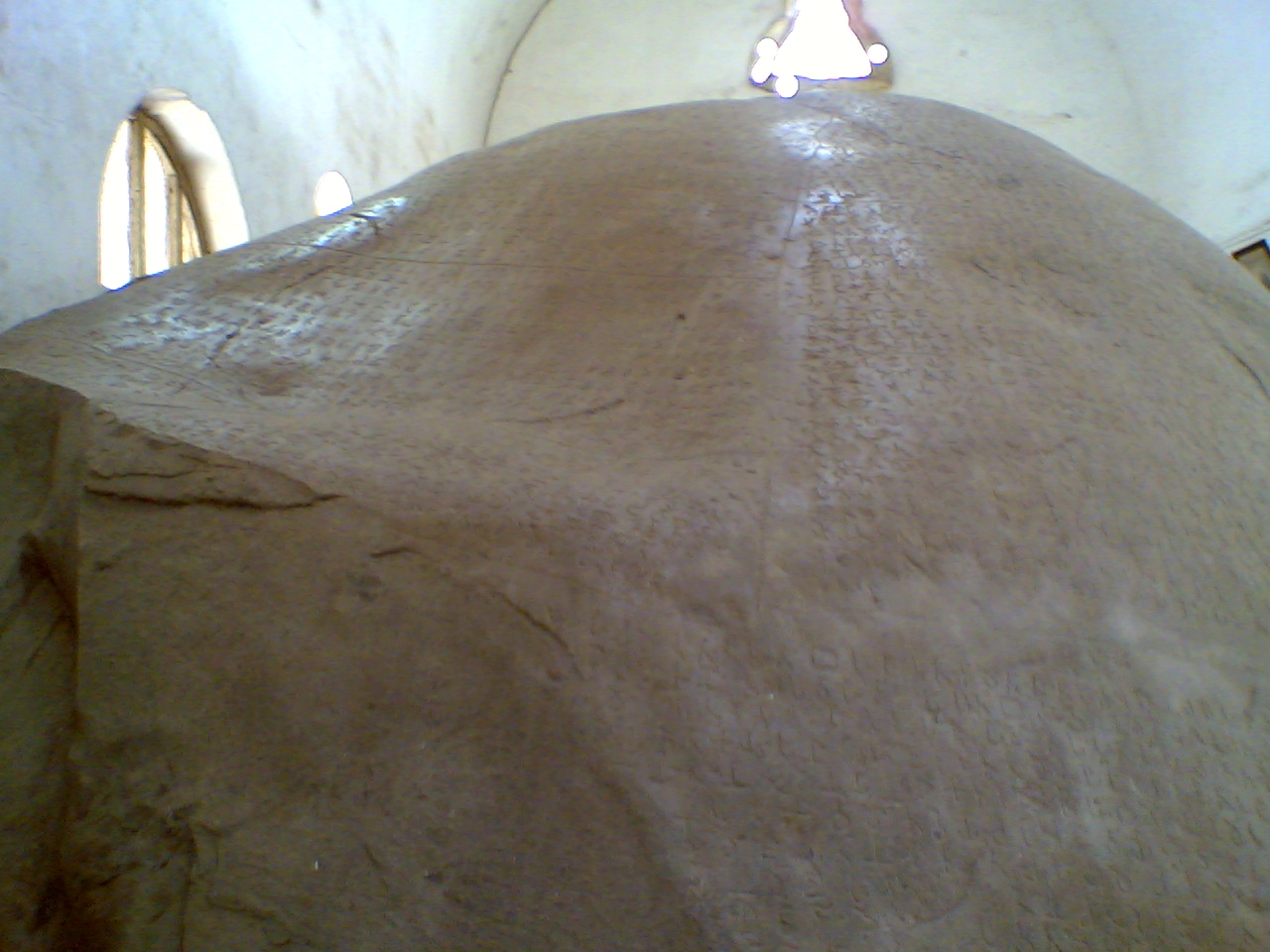
Photo of a large, smooth, rounded granite boulder with a pitted, weathered surface, taken indoors under a pale arched ceiling. A small arched window is visible at the left edge. Faint marks and textured areas are visible on the rock, but the text is not clearly legible.Document

Secondary source

Junagadh Rock Inscription of Rudradaman

Rudradaman I (commissioner) · shortly after 150 CE

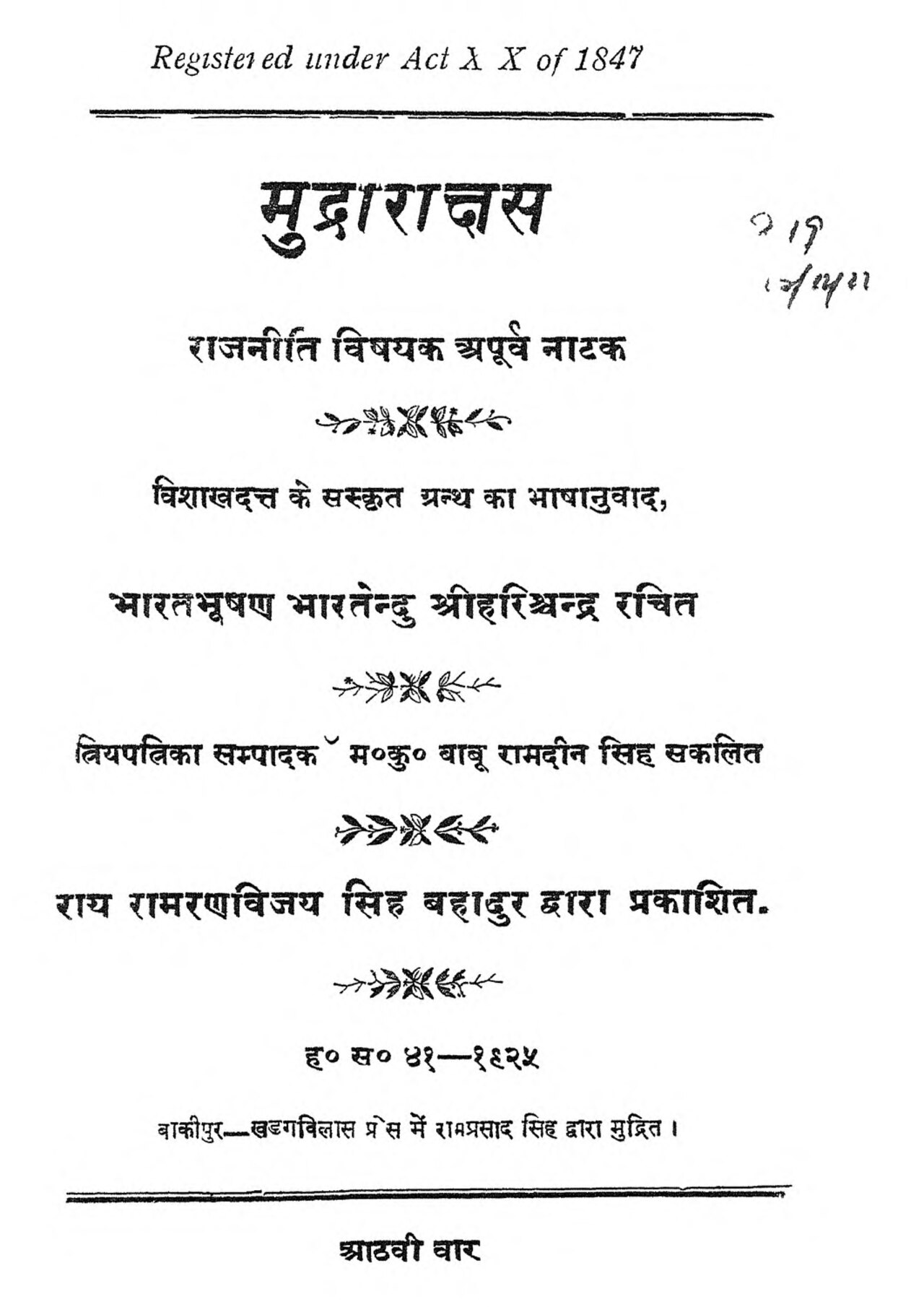
Title page of the Hindi book Mudrarakshas, a political drama by Bharatendu Harishchandra, translated from Vishakhadatta's Sanskrit play. Printed text in Devanagari with ornamental dividers, a publisher line, and a registration note at top reading Registered under Act X of 1847.Book

Secondary source

Mudrarakshasa

Vishakhadatta · between the 4th and 8th century CE

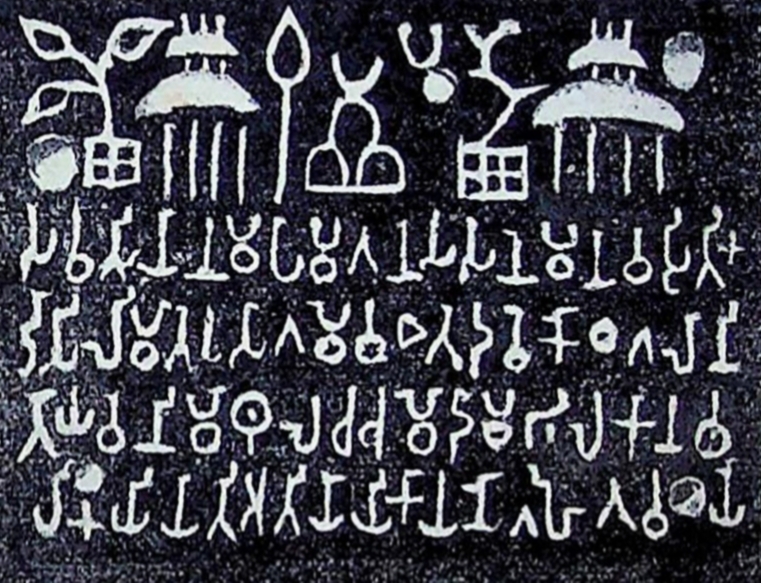
Photograph of an inscribed dark plate with light-colored carved symbols: at top, a sprouting plant, two domed structures with columns, a standing figure, and a gridded box. Below are four rows of unfamiliar angular script characters.Document

Primary source

Sohgaura Copper Plate Inscription

3rd century BCE

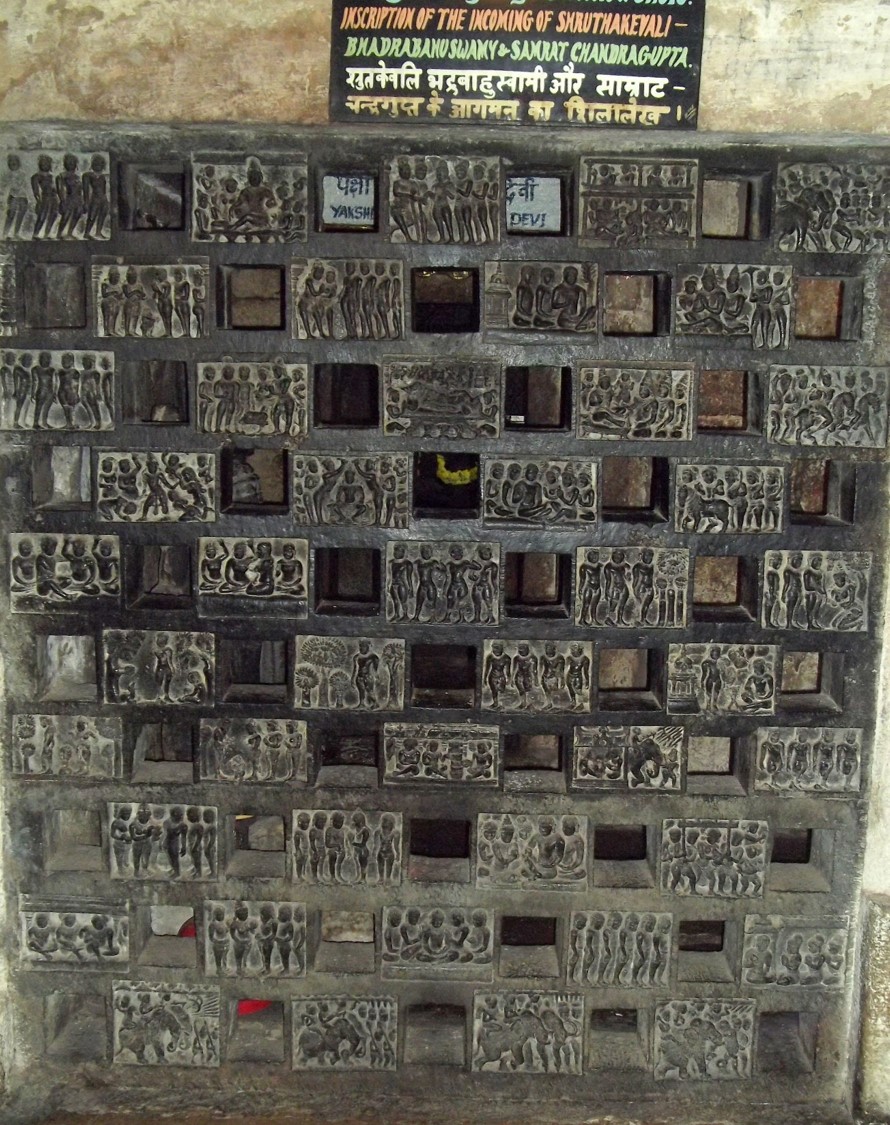
A dark stone wall covered with rows of small carved relief panels showing human figures in various scenes, set into square recesses. A black sign above in English, Hindi and Kannada reads 'Inscription of the incoming of Shrutkevali Bhadrabahu Swami and Samrat Chandragupta'.Document

Secondary source

Shravanabelagola Inscription of Bhadrabahu and Chandragupta

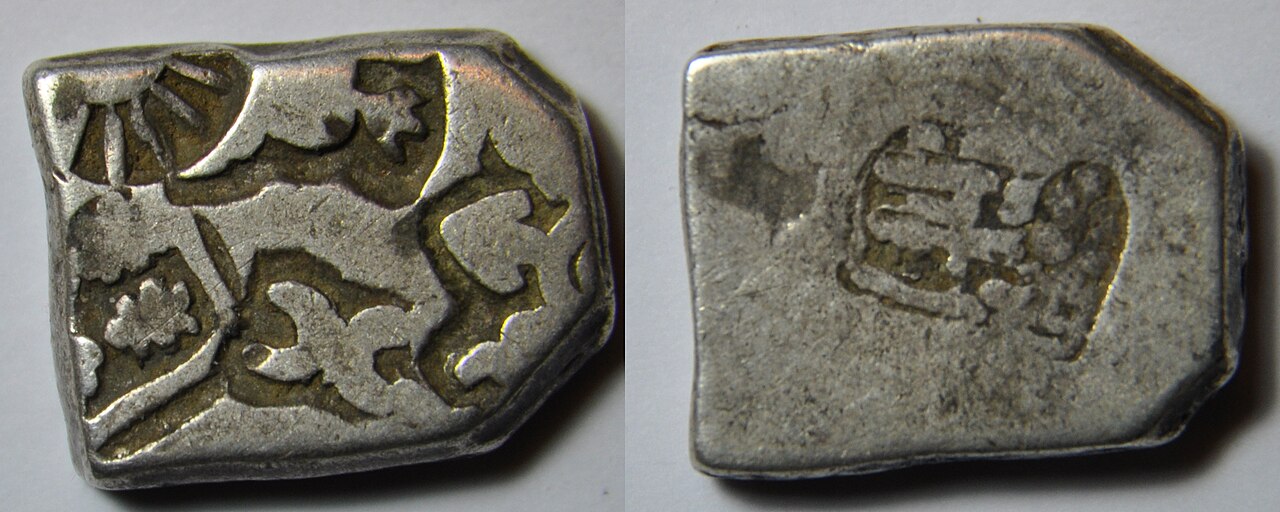
Two views of a small irregular silver punch-marked coin. The obverse shows a sun with rays at upper left, a lion-like or animal figure, a crescent-shaped mark, and other punched symbols in a worn, irregular outline. The reverse is plain silver with a single punched symbol of a stylized emblem at center.Artifact

Primary source

Mauryan Punch-Marked Silver Karshapana Coin

c. 4th–2nd century BCE

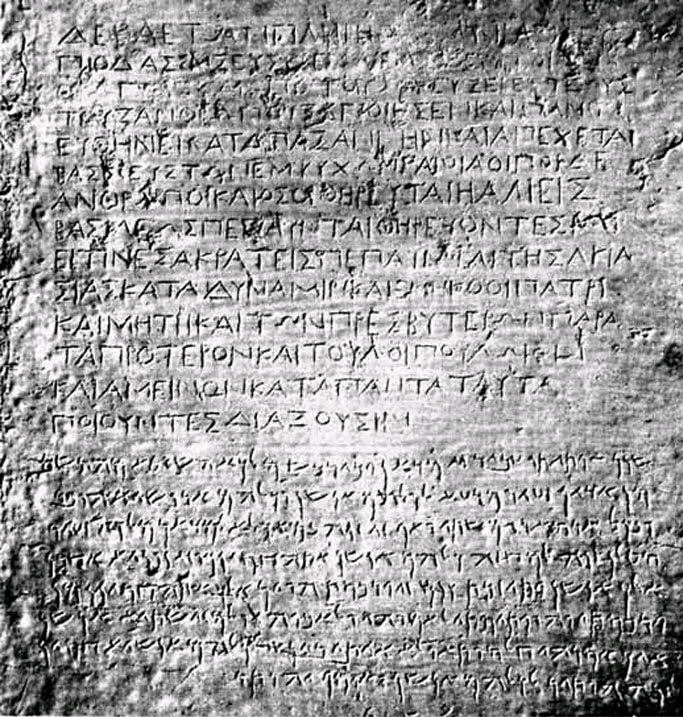
Black-and-white photograph of a rough stone surface carved with Greek inscription. The upper block of text has large letters in several lines; below, a denser block of smaller lettering fills the lower part of the stone.Document

Primary source

Kandahar Bilingual Rock Inscription

Ashoka · c. 260 BCE

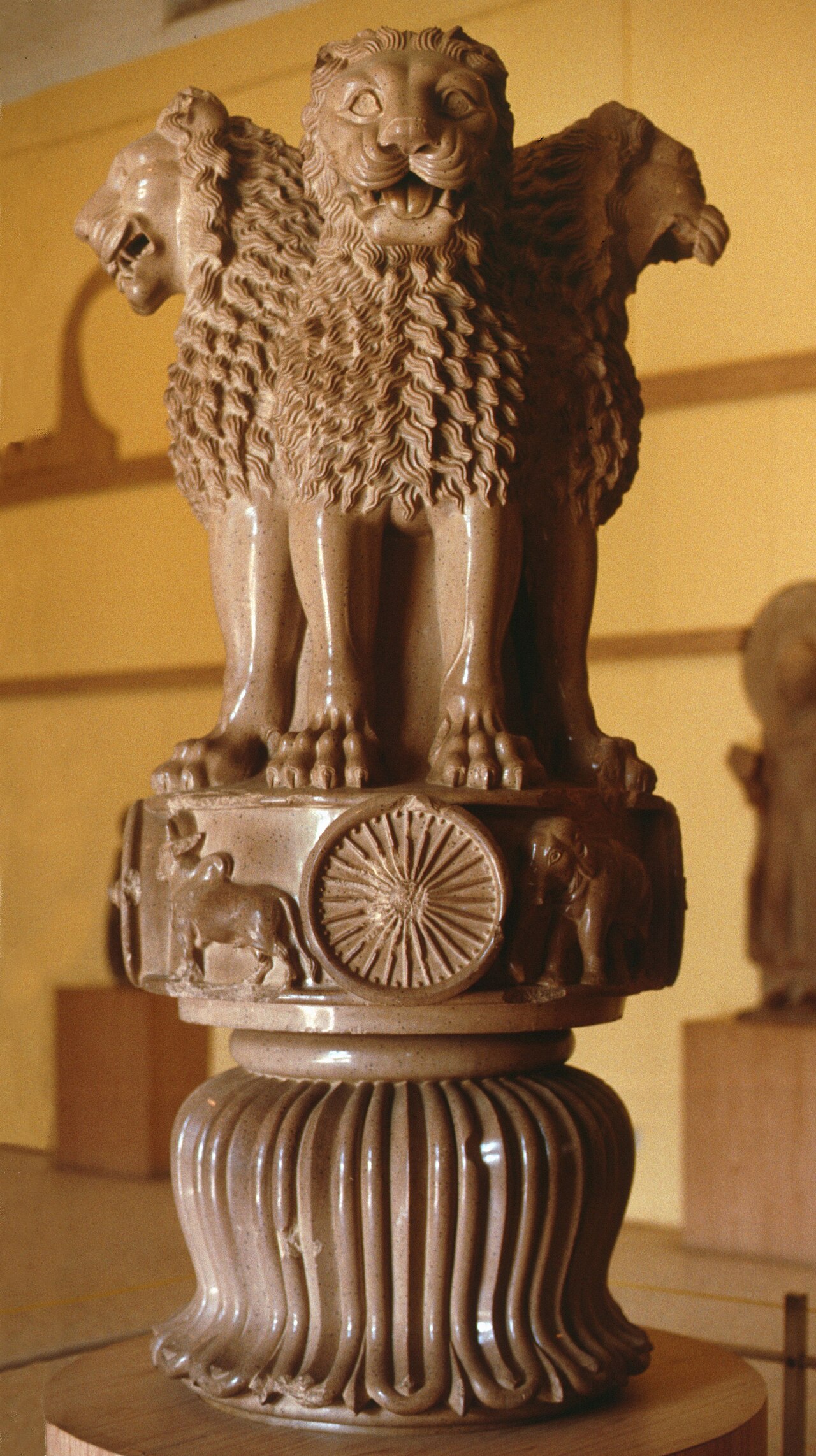
Photo of the Lion Capital of Asoka: four lions stand back to back atop a carved abacus with a wheel, elephant, horse and bull reliefs, over a bell-shaped base with fluted petals, in a museum with yellow walls.Sculpture

Secondary source

Lion Capital of Ashoka

Commissioned by Ashoka · c. 250 BCE

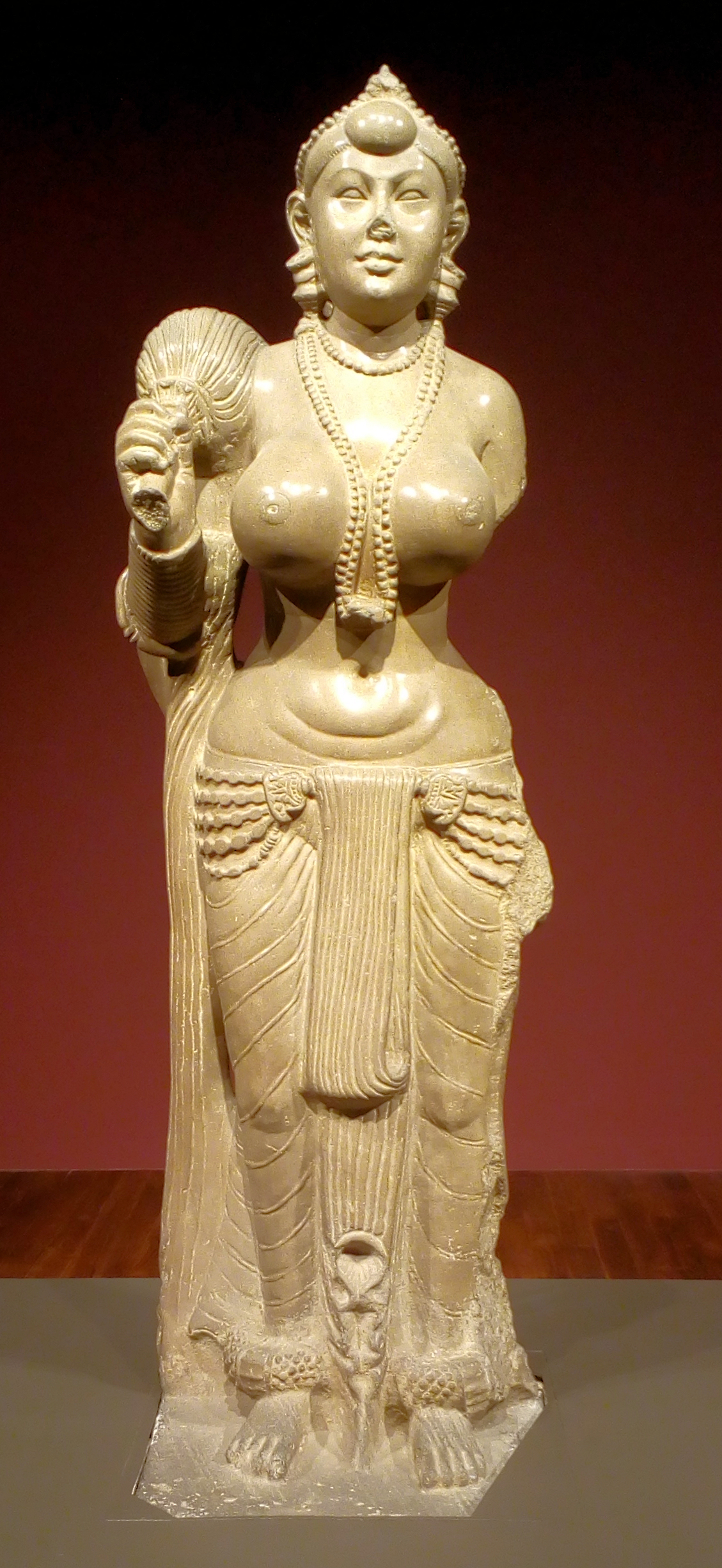
A standing polished sandstone statue of a female figure holding a fly-whisk (chauri) in her raised right hand. She wears a beaded necklace, a girdle, and a draped lower garment, and stands on a plinth against a dark red background.Sculpture

Secondary source

Didarganj Yakshi

3rd century BCE (disputed, possibly 1st-2nd century CE)

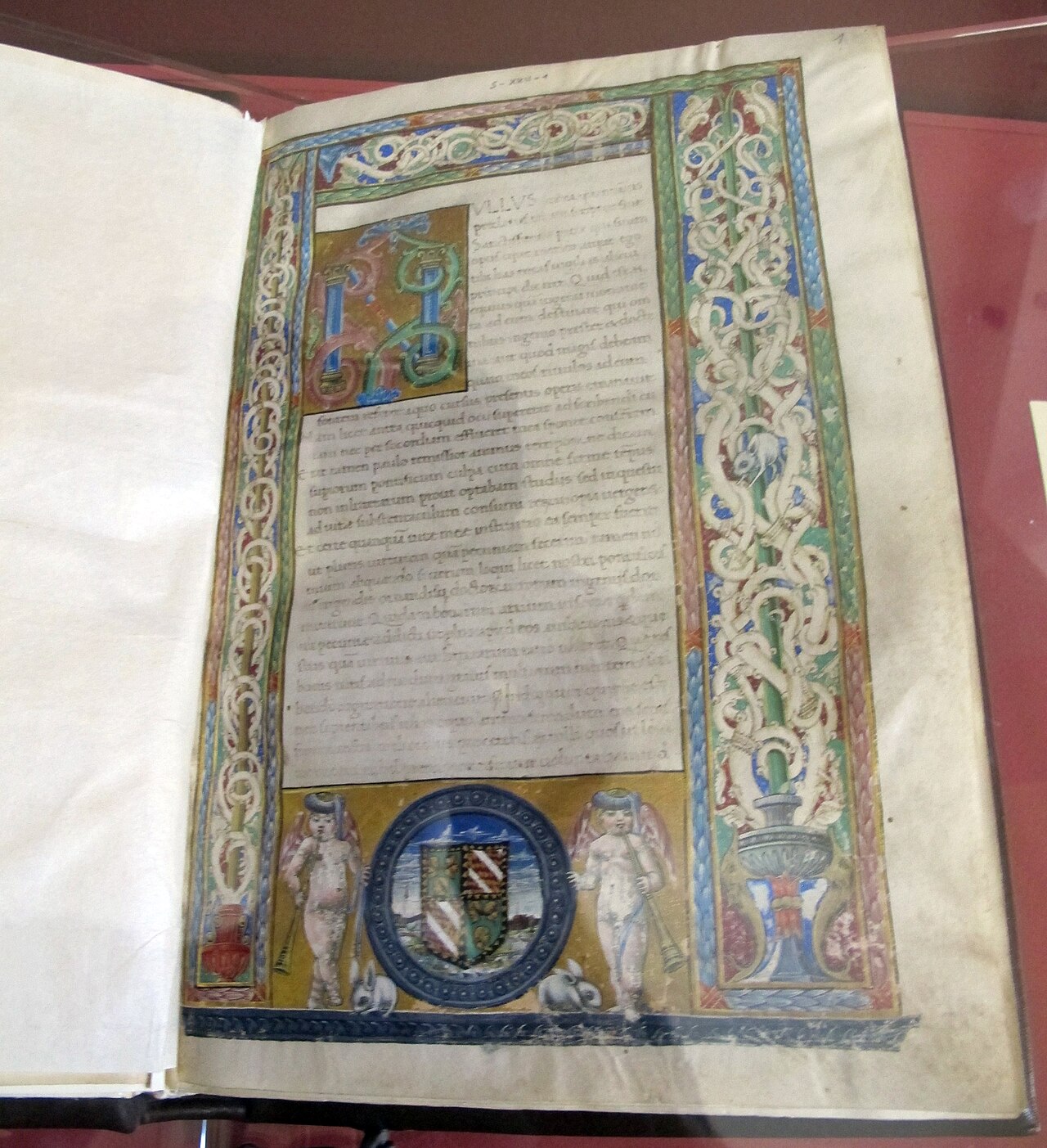
Open illuminated manuscript page on vellum in a display case, with a decorative border of foliage and interlace, a historiated initial, and a central text block in Latin script. A circular coat of arms with angels and rabbits appears at the bottom.Book

Secondary source

Bibliotheca Historica

Diodorus Siculus · 1st century BCE

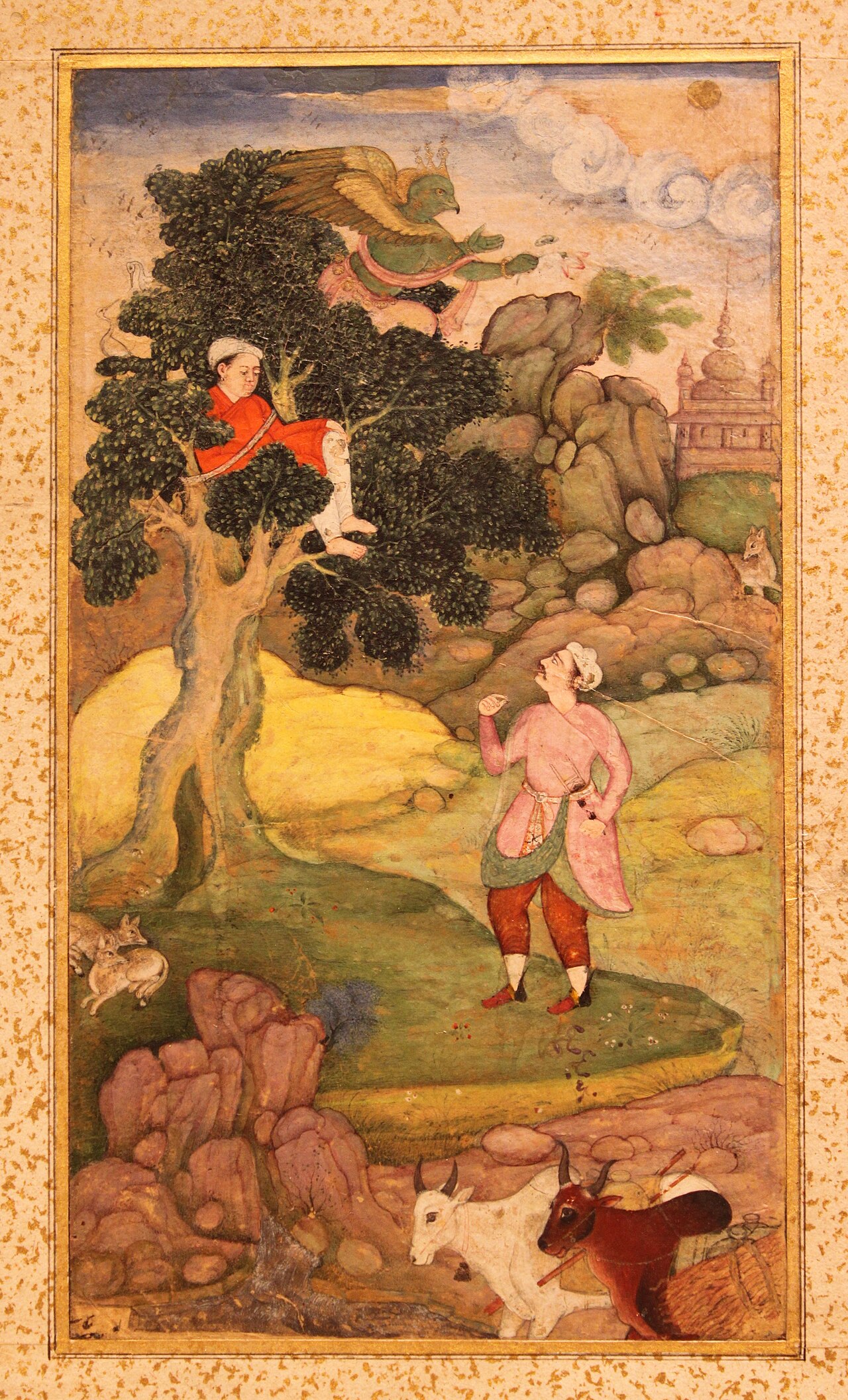
Mughal-style painting in a gold-speckled border: a man in red sits in a dense green tree while a winged green dragon-like creature with a crown hovers above. Below, a man in pink robes and a white turban stands on a grassy hill beside two oxen and rabbits, with rocky hills and a domed building on the right.Book

Secondary source

Kathasaritsagara

Somadeva · 11th century CE

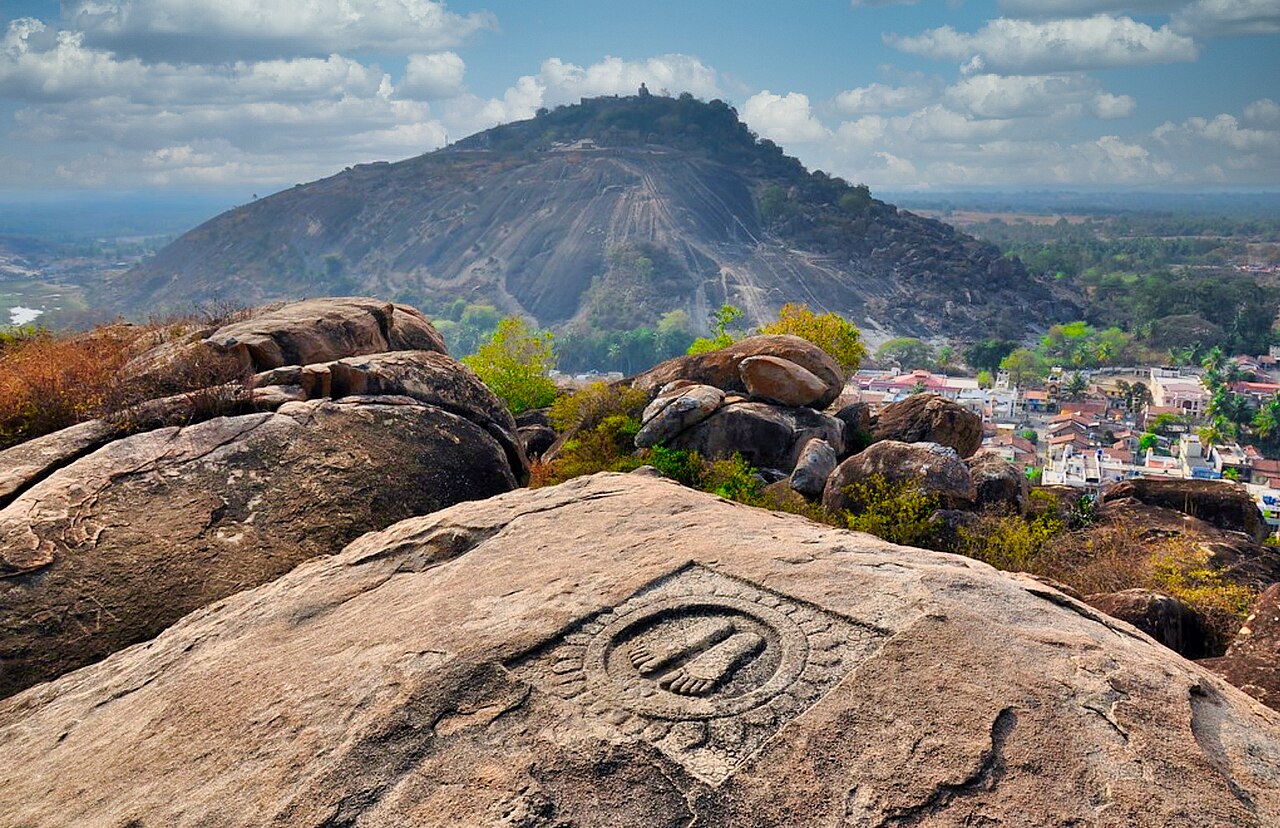
A carved stone footprint set within a circular engraved design on a large sandstone boulder, with a hilltop, rock formations, and a town visible in the background under a partly cloudy sky.Artifact

Secondary source

Footprint of Chandragupta Maurya

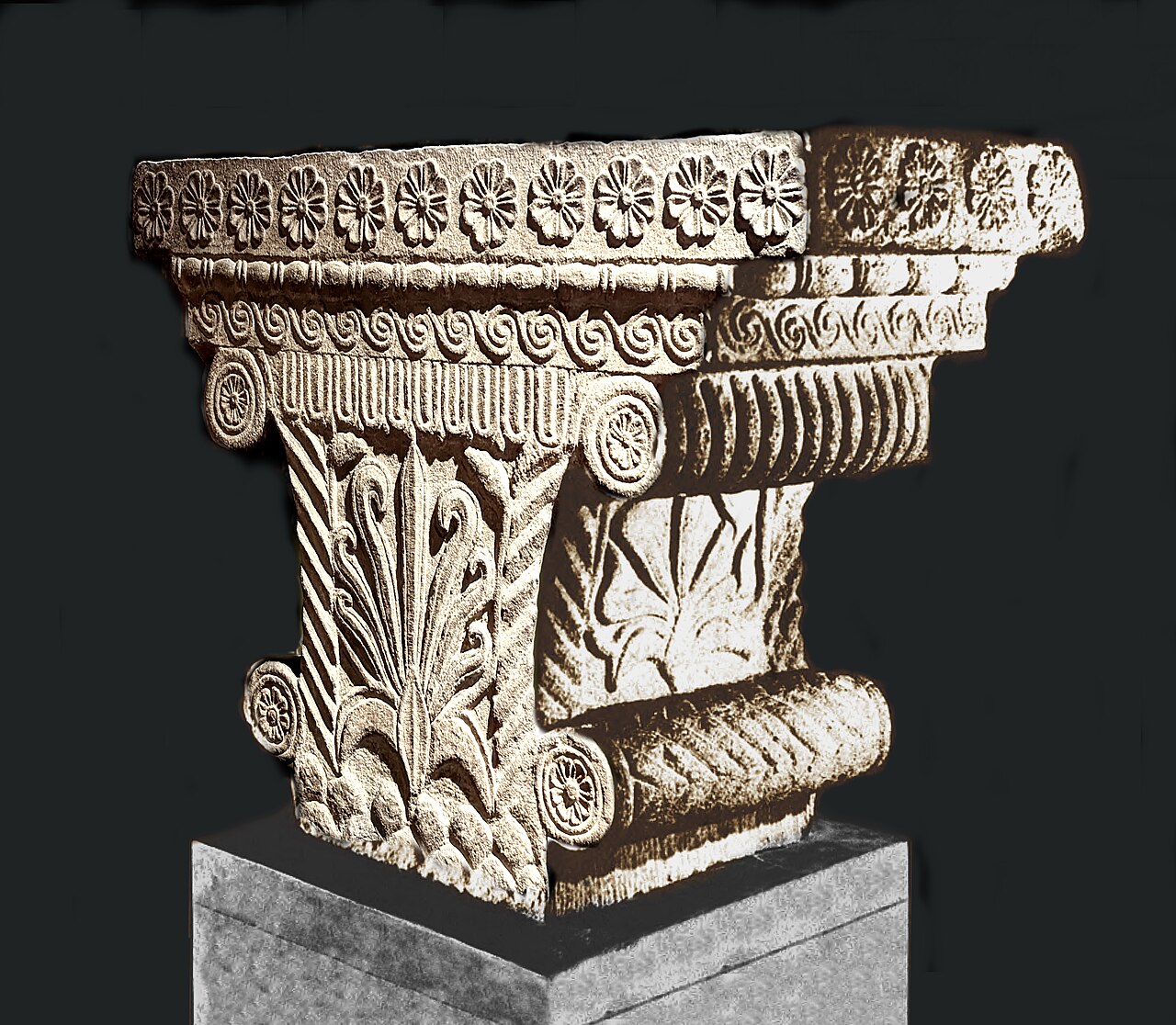
Photo of a carved stone capital on a grey stone pedestal against a dark background. The capital has a top band of rosettes, below it rows of scrolls and a row of vertical fluting, and at the sides volutes and leaf-like carvings. The image is high-contrast with a sepia tone.Sculpture

Primary source

Pataliputra capital

3rd century BCE

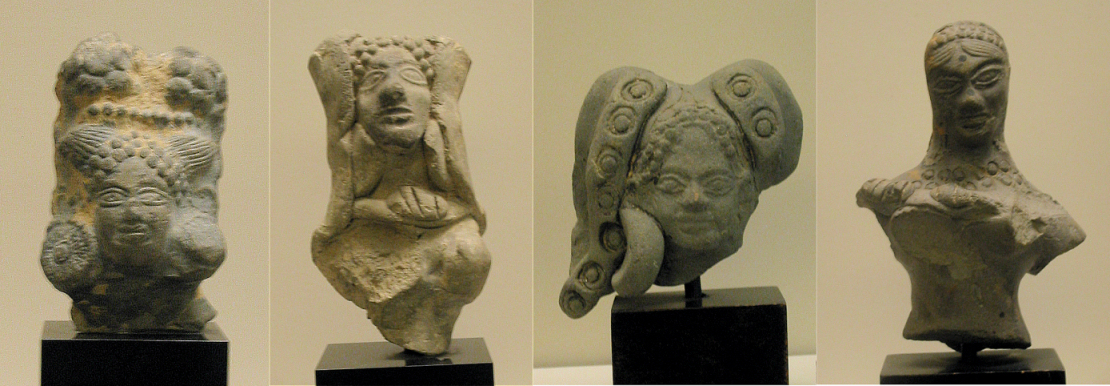
Four small grey-green terracotta statuettes on black display stands against a pale wall. From left: a figure with a dense headdress and round ornaments; a seated figure with arms raised to the head; a head with a large circular headdress and spiral motifs; a bust with a necklace and bare shoulders.Artifact

Primary source

Maurya terracotta statuettes

4th-3rd century BCE

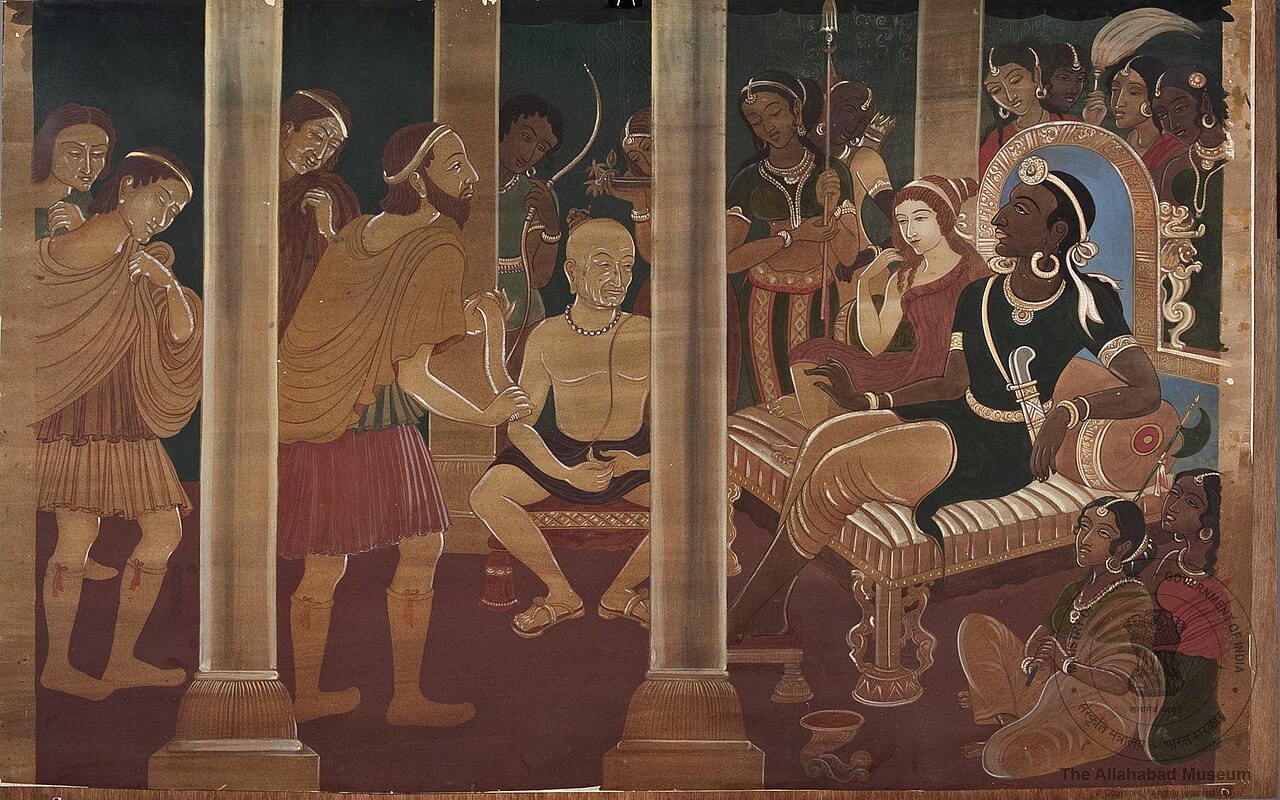
Painted scene of a royal court with tall pillars. A seated dark-skinned king on a raised couch wears jewelry and a turban, with attendants and women around him. On the left, a Greek-robed man in a draped cloak and a pleated skirt stands near a bald, bearded older man seated on a low bench. Women sit and stand in the foreground and background, and a watermark reads The Allahabad Museum.Painting

Secondary source

Megasthenes in Chandragupta's Court

Asit Kumar Haldar · 20th century

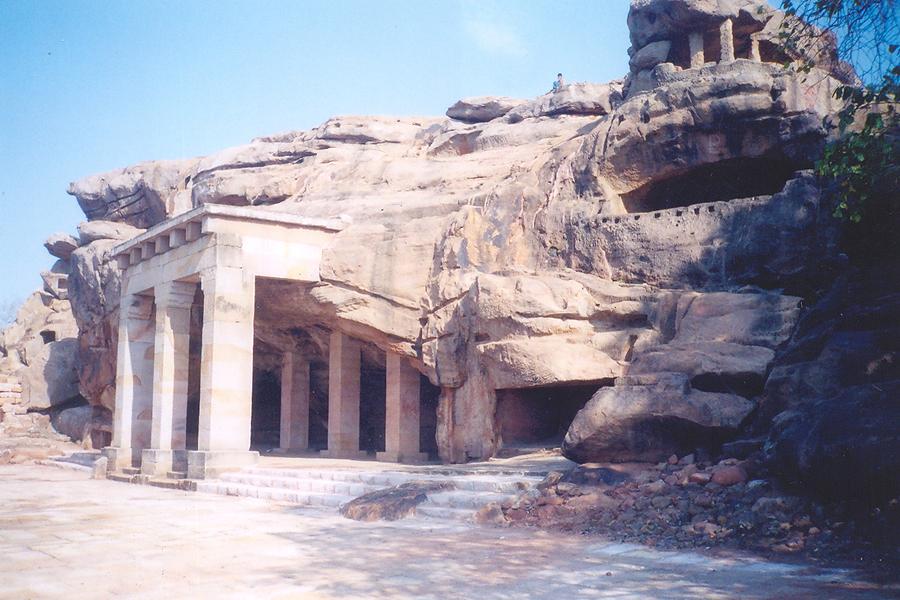
A rock-cut cave facade on a sandstone hill. A pillared veranda with square columns and a flat cornice stands at the base, with steps leading up to it. Above and to the right, more cut openings are visible in the rock. A small figure stands on the hilltop.Document

Secondary source

Hathigumpha inscription

2nd century BCE – 1st century CE

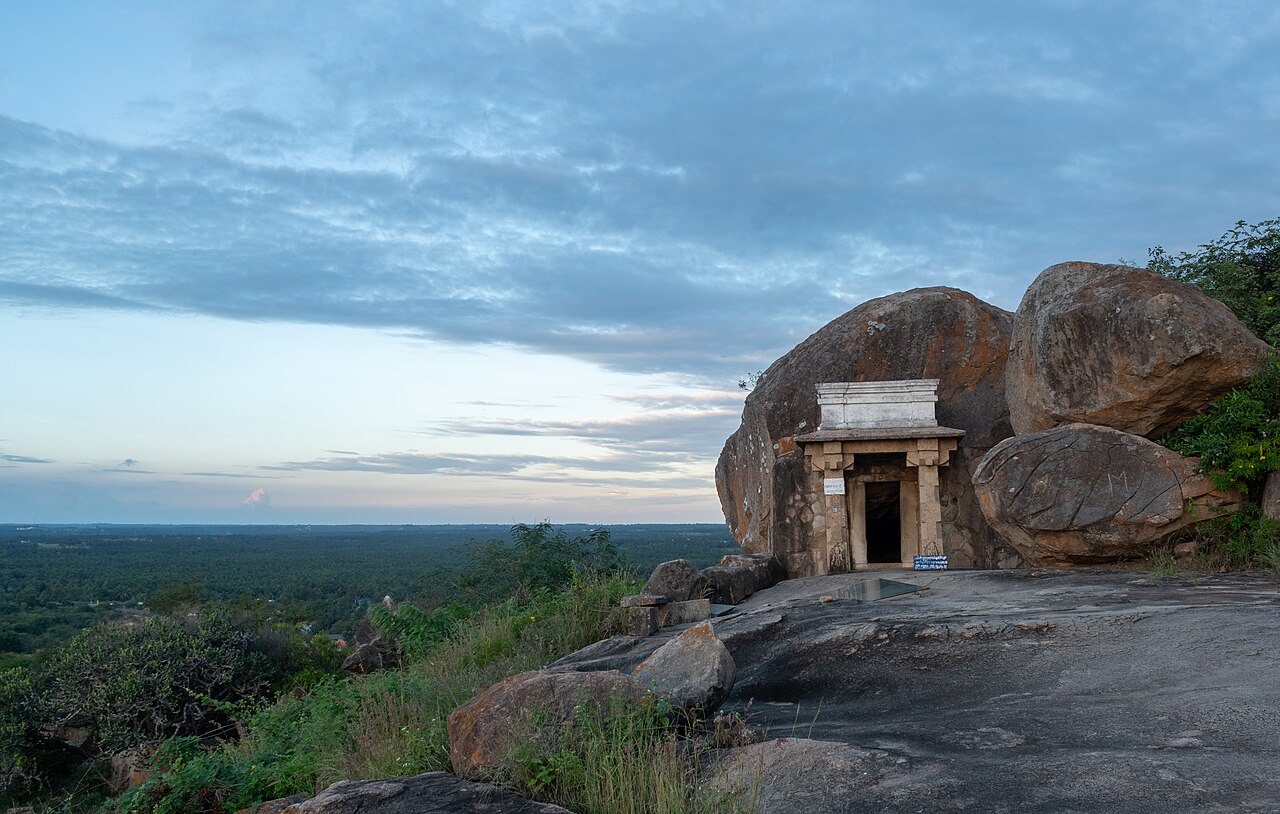
A small stone cave shrine with a carved white stone lintel and pillared doorway set into a large rounded granite boulder on a rocky hilltop. Open flat rock surface in front; hazy green plains and a cloudy dusk sky behind.Artifact

Secondary source

Bhadrabahu Cave, Chandragiri

traditional site; inscriptions 7th century CE onward

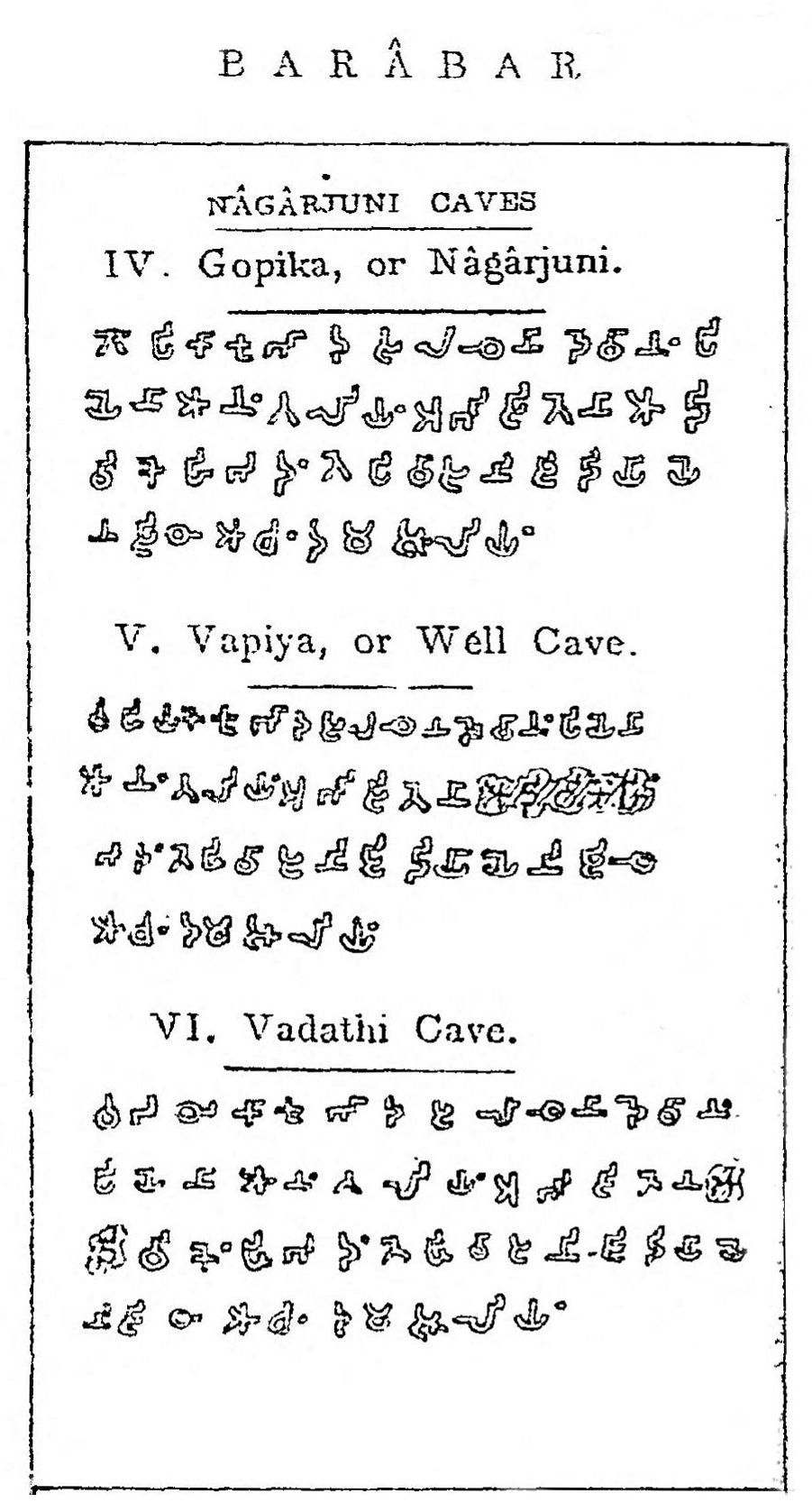
Printed page headed BARÂBAR showing the Nagarjuni Caves section with three numbered entries (IV Gopika or Nâgârjuni, V Vapiya or Well Cave, VI Vadathi Cave), each followed by lines of stylized inscription characters in a printed transcription. No building or photograph of the caves is visible.Document

Primary source

Barabar Caves

Ashoka and Dasharatha Maurya · c. 261–230 BCE

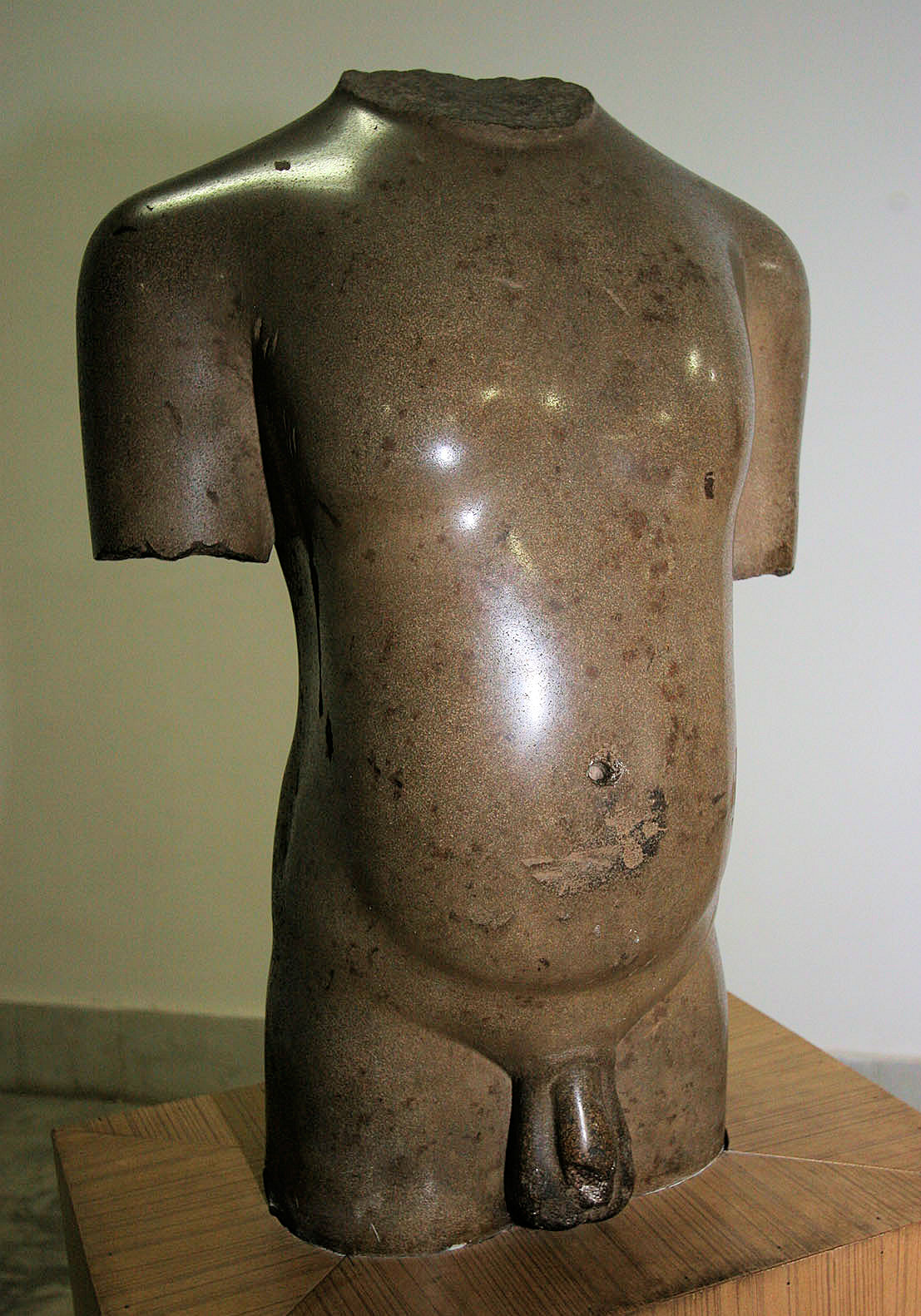
Headless, armless male torso sculpture in polished brownish stone, standing on a wooden base in front of a pale wall. The torso has a rounded belly with a navel and a visible genital area.Sculpture

Secondary source

Lohanipur Torso

c. 3rd century BCE – 2nd century CE

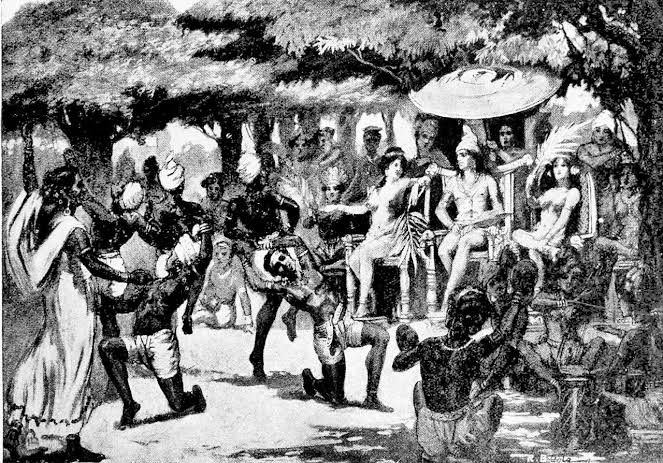
Black-and-white print of a scene under trees: a seated couple on ornate thrones with a canopy, flanked by attendants. In the foreground, men in European-style military dress and figures kneel and dance, and a woman in a long white robe stands at left.Painting

Tertiary source

Chandragupta Maurya Entertains His Bride from Babylon

Richard Bertram Ogle · early 20th century

Book

Secondary source

History of India, Volume II: Chandragupta Maurya and Bindusara

Vincent A. Smith

Book

Secondary source

Ancient India as Described by Megasthenes and Arrian, Fragment II

1877

Book

Secondary source

The Early History of India from 600 B.C.

Vincent A. Smith · 1914

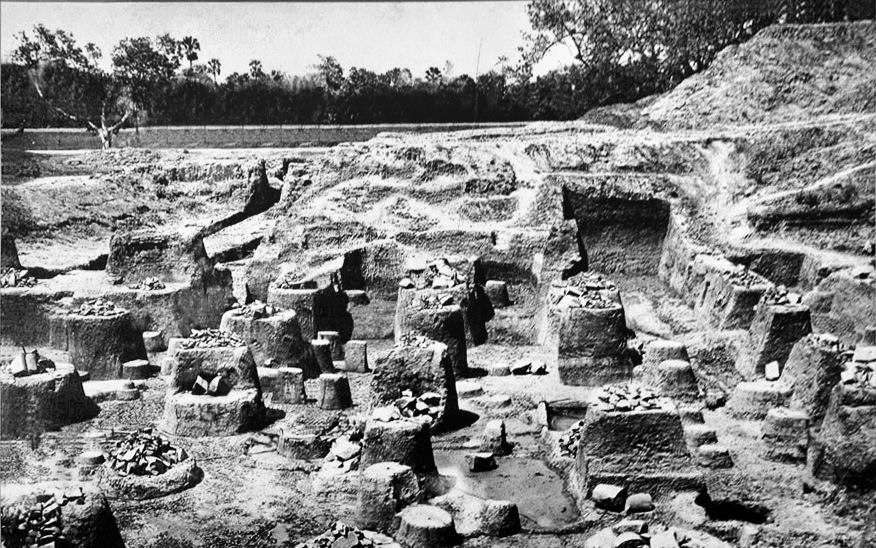
Black-and-white photograph of an archaeological excavation showing rows of square brick or stone pillar bases with stone fragments on top, set in excavated earth. Trees and a flat horizon line appear in the background.Photograph

Secondary source

Pillared Hall Ruins at Kumrahar, Pataliputra

Archaeological Survey of India Eastern Circle · 1912-1913

Document

Tertiary source

Chandragupta Maurya, Encyclopædia Britannica Entry

1911

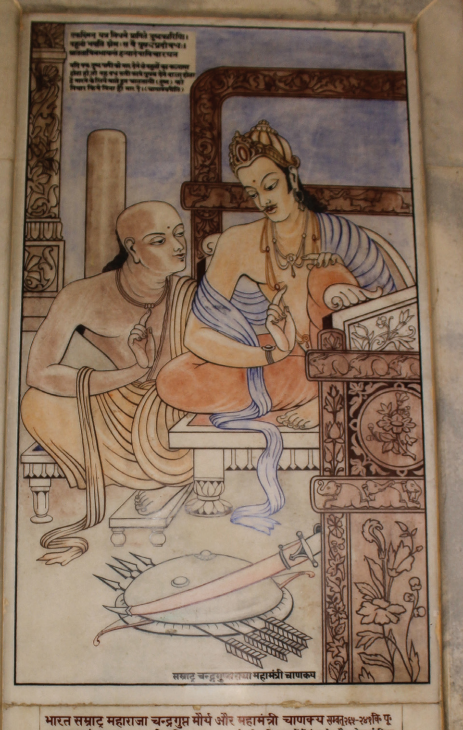
Painted panel in a marble frame showing two seated men in conversation. The bald man on the left, with a sash and wrap, gestures with one hand. The man on the right wears a crown and jewelry and holds a pen or stylus over a tablet. A sword, shield, and arrows lie in the foreground. Devanagari text appears above and below the scene.Painting

Secondary source

Painting of Chandragupta and Chanakya, New Vishwanath Temple, Varanasi

2023

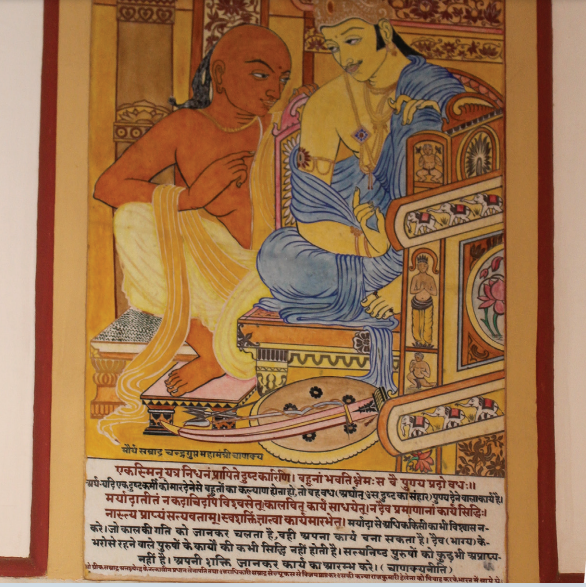
A painted panel showing two seated men in a palace-like setting. On the left, a bald man with a bare upper body and a yellow shawl draped over his arm sits on a low platform, facing right. On the right, a crowned man in blue robes and a necklace sits on an ornate throne, leaning forward. A Sanskrit inscription in red and black lines runs along the bottom of the painting, and a decorated harp-like instrument lies at the foot of the throne.Painting

Secondary source

Painting of Chandragupta and Chanakya, Srimadbhagavadgita Temple, Mathura

2023

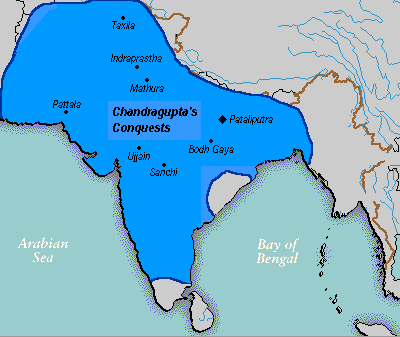
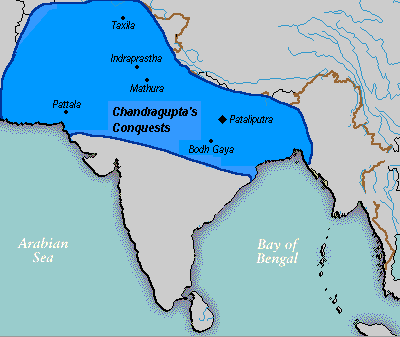
Map of the Indian subcontinent in blue showing the extent of Chandragupta's conquests, with labeled cities including Taxila, Indraprastha, Mathura, Pataliputra, Ujjain, Sanchi, Bodh Gaya, and Pattala, set against the Arabian Sea and Bay of Bengal.Document

Secondary source

Maurya Empire Map After Bindusara's Death

Jagged 85 · 2007

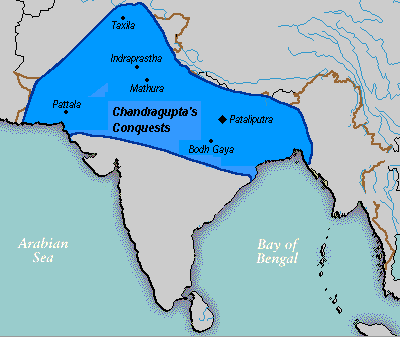
Map of the Indian subcontinent with a large blue region labeled Chandragupta's Conquests, covering the north and center. Cities marked include Taxila, Indraprastha, Mathura, Pataliputra, Bodh Gaya, and Pattala. Arabian Sea and Bay of Bengal are labeled.Artifact

Tertiary source

Chandragupta Empire Map, 320 BC

320 BC (map created in modern times)

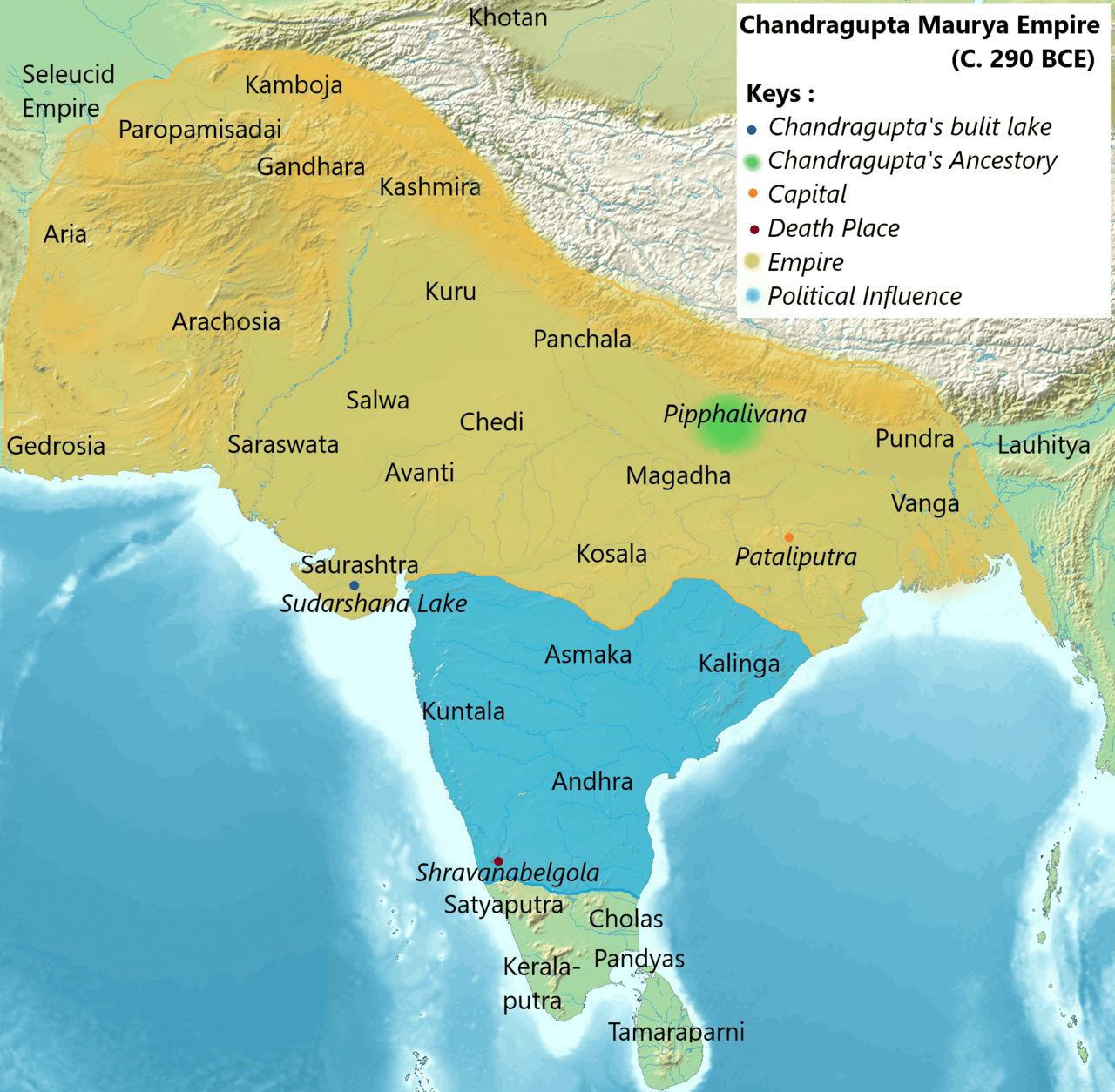
Map titled Chandragupta Maurya Empire (c. 290 BCE) showing the Indian subcontinent. Yellow area marks the empire, which spans from the northwest across the north to the east, with a blue area of political influence covering the south. Labeled regions include Gandhara, Kashmira, Magadha, Kalinga, Andhra, and Pataliputra as the capital. Map keys mark a lake, ancestry region, capital, death place, empire, and political influence.Artifact

Tertiary source

Chandragupta Maurya Empire Map, c. 290 BCE

Levakpitam · c. 290 BCE (map created 2023)

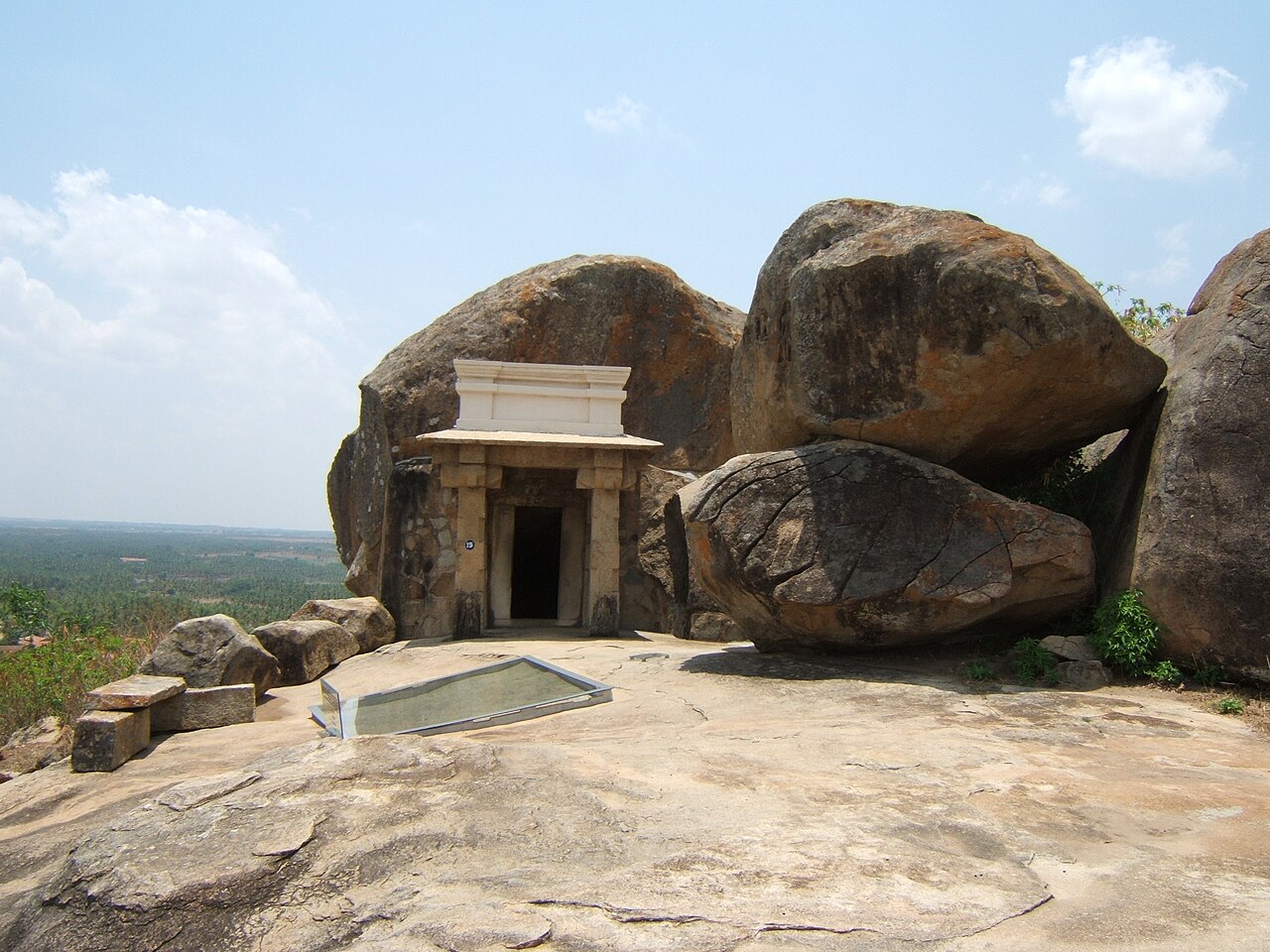
Bhadrabahu Cave on a rocky hilltop: a small stone shrine facade with a white capital and a dark doorway, set among large weathered granite boulders, with a flat rock floor and a glass-covered slab in front; hazy plains stretch to the left under a pale blue sky.Photograph

Secondary source

Bhadrabahu Cave, Shravanabelagola

Ilya Mauter · 1 May 2007

Map of the Indian subcontinent with a large blue shaded area labeled Chandragupta's Conquests, covering the north and center, with cities marked including Taxila, Indraprastha, Mathura, Pataliputra, Bodh Gaya, and Pattala. Seas labeled Arabian Sea and Bay of Bengal.Artifact

Tertiary source

Chandragupta Maurya Empire Map

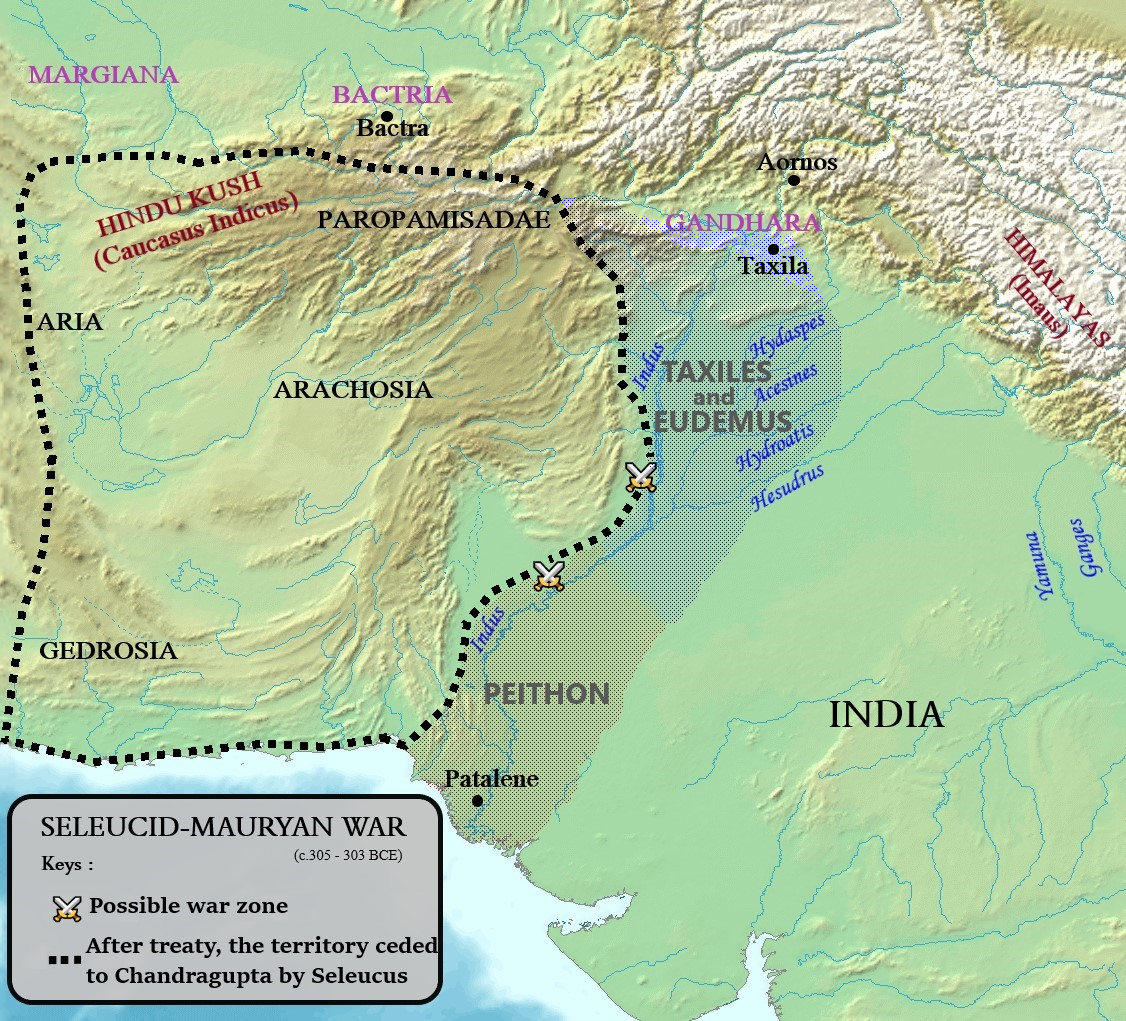
Map of the Seleucid-Mauryan War, c. 305-303 BCE, showing northern India, Bactria, Gandhara and surrounding regions. Dotted border marks territory ceded to Chandragupta after the treaty. Crossed-swords icons mark possible war zones along the Indus. Legend and labels for Taxiles and Eudemus, Peithon, Patalene, Paropamisadae, Arachosia, Aria, Gedrosia and rivers are included.Artifact

Tertiary source

Map of the Seleucid-Mauryan War, c. 305-303 BCE

Levakpitam · c. 305-303 BCE (map created 2024)

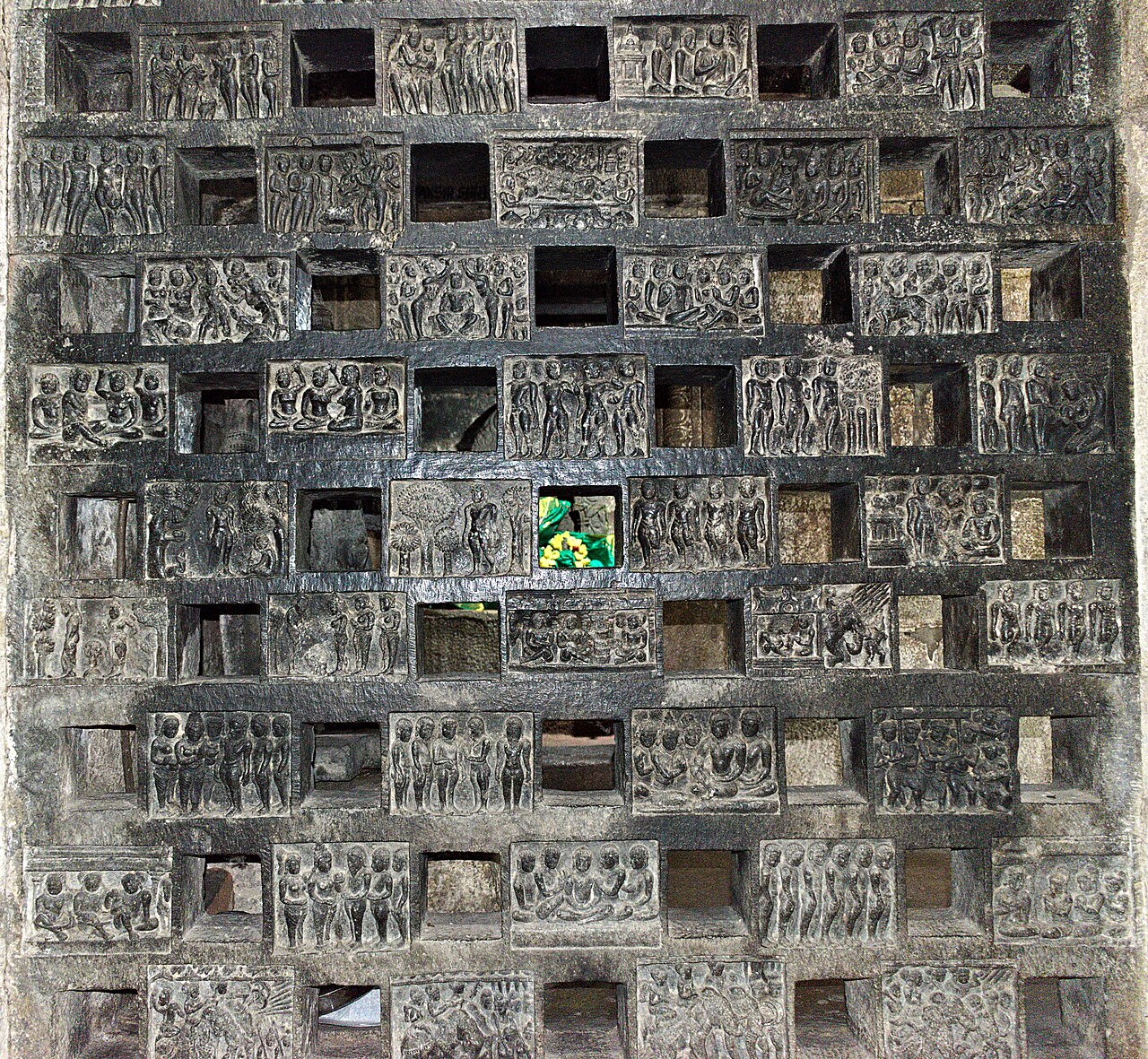
Close view of a stone wall with a grid of carved relief panels set between rectangular openings. Many panels show standing and seated human figures in rows, some with ornate framing. Several openings are dark, and a few show green and yellow flowers inside.Sculpture

Secondary source

Carved Scenes of Bhadrabahu and Chandragupta, Chandragupta Basadi

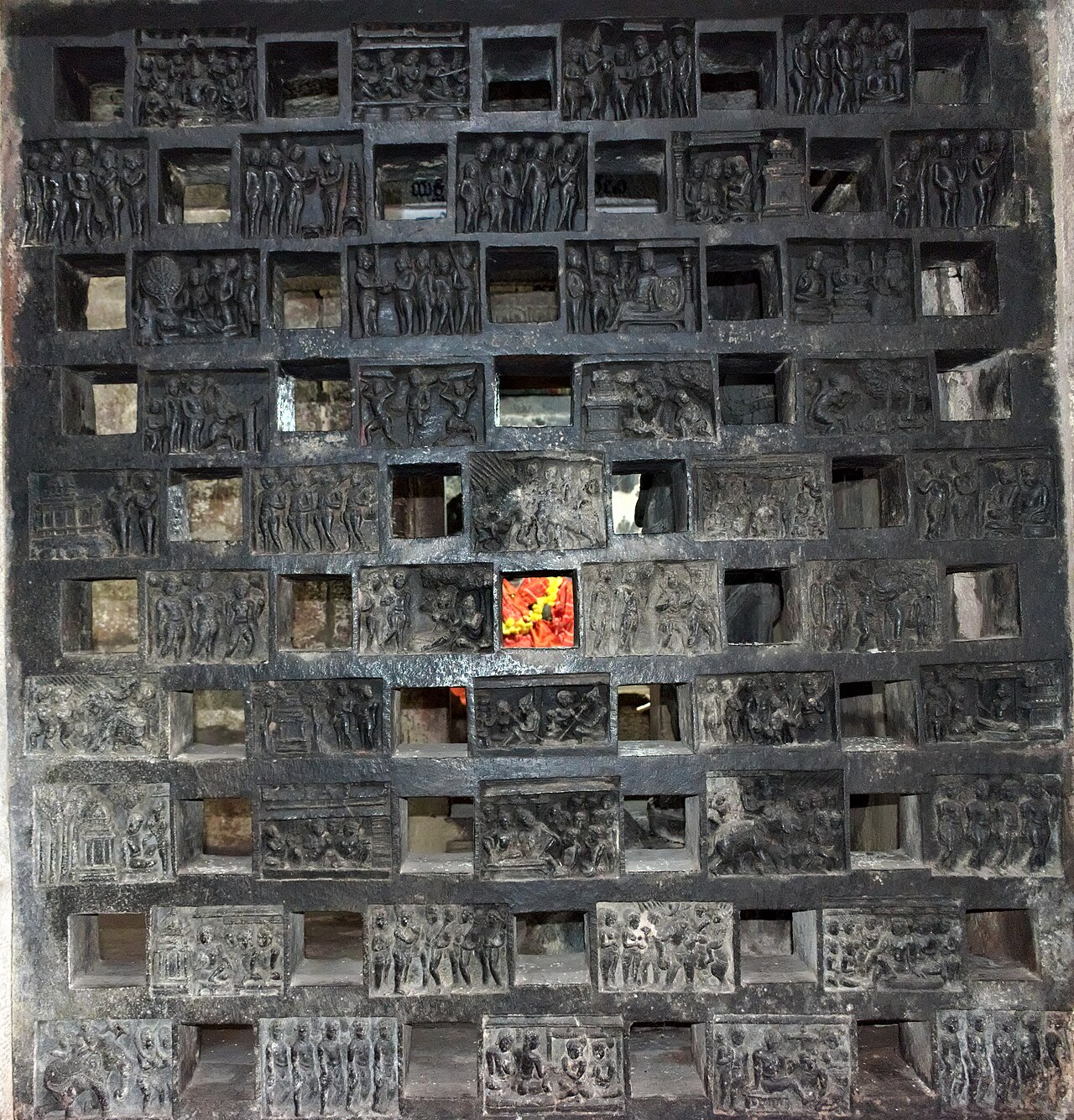
Dark stone wall covered with rows of rectangular carved panels and open niches. Many panels show standing and seated human figures in relief, some with architectural elements. A bright red-and-yellow decoration sits in one central niche.Artifact

Secondary source

Carvings of Bhadrabahu and Chandragupta, Chandragupta Basadi

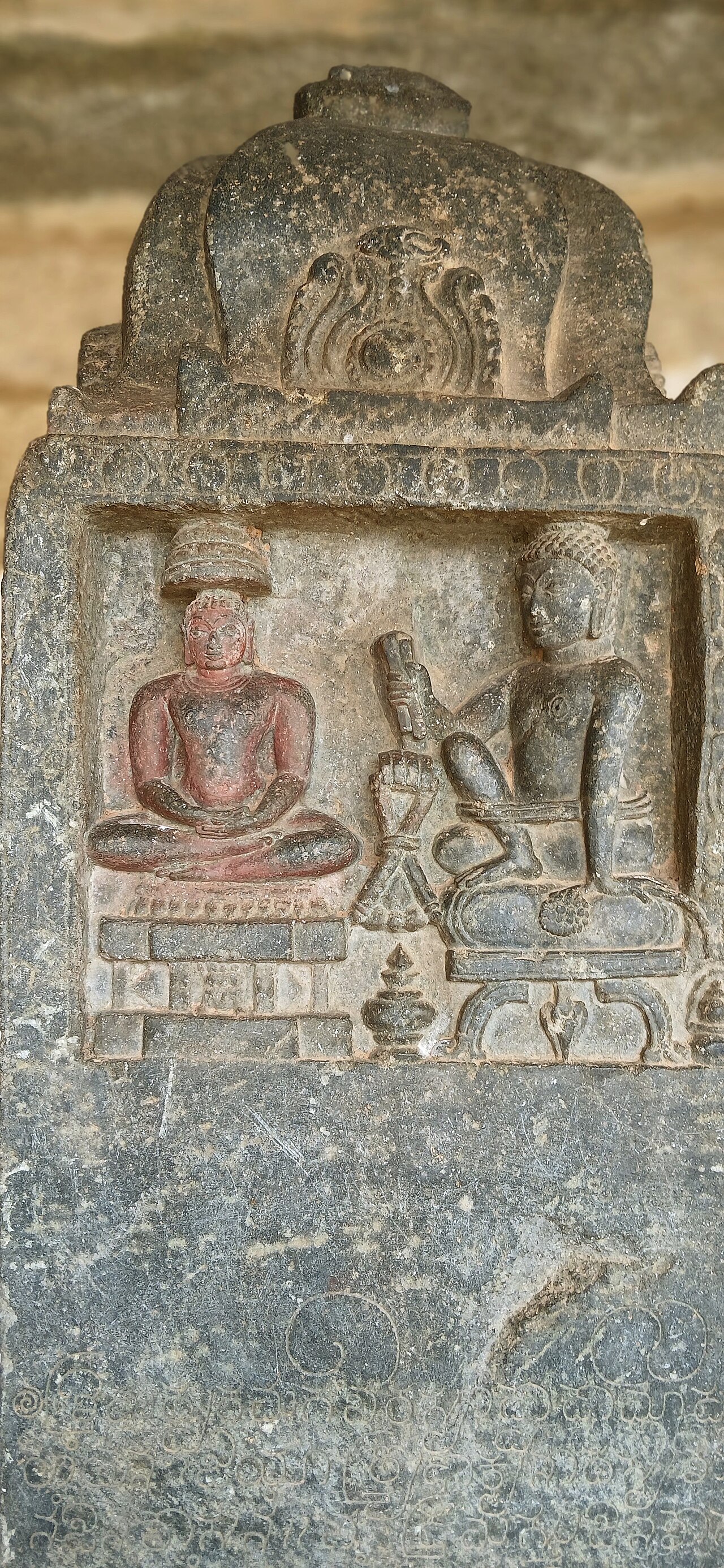
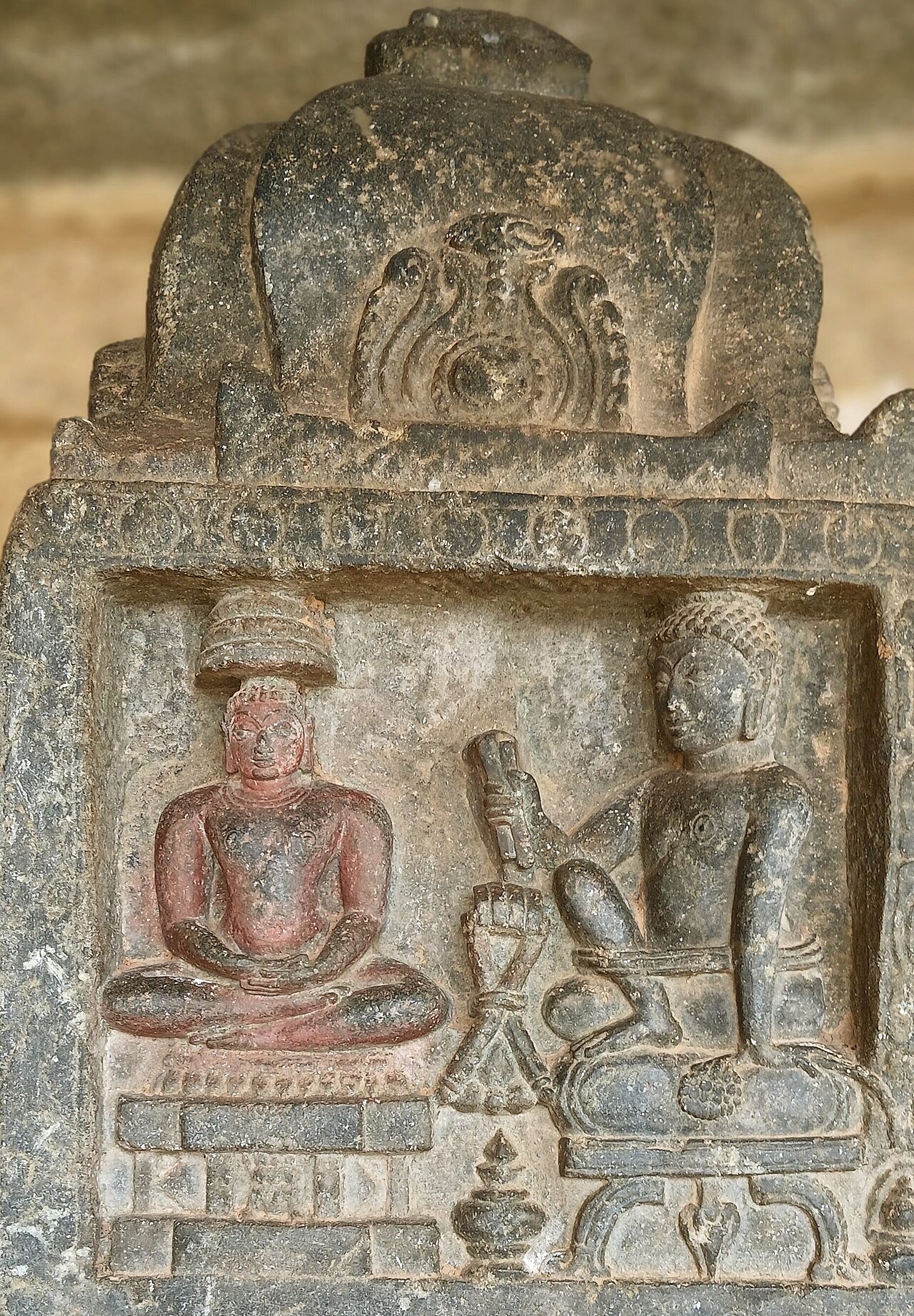
Carved stone relief panel under a stepped arch with a decorative top. Inside a niche, a red-painted seated figure in meditation pose sits on a stepped base beneath a canopy, and a grey seated figure with a raised hand sits on a lotus-like pedestal beside a small vessel. Below is an inscription in carved script.Sculpture

Secondary source

Chandragupta Maurya and Bhadrabahu at Chandragupta Basadi

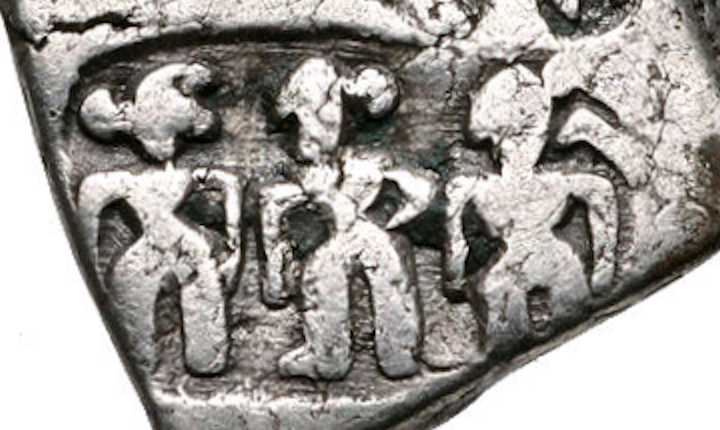
Close-up photograph of a silver punch-marked coin showing several punch-marked symbols in relief, including small figures or deity-like forms arranged in a row across the coin's surface, with the metal worn and slightly corroded.Artifact

Secondary source

Mauryan Punch-Marked Coin with Three Deities

4th-2nd century BCE

Book

Secondary source

Invasion of India by Alexander the Great, Greek Accounts

John Watson McCrindle · 1896

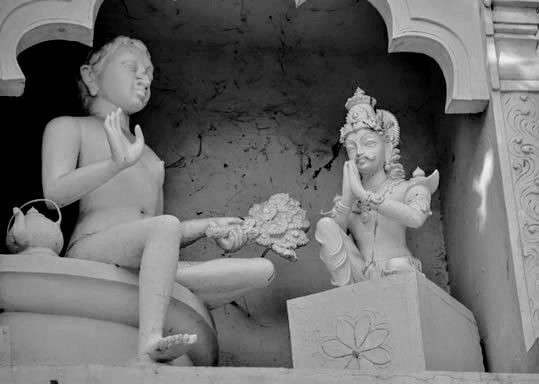
Black-and-white photo of two white stone statues in a niche. On the left, a bare-chested seated figure with one hand raised and eyes closed. On the right, a crowned figure kneels with palms pressed together, on a pedestal carved with a lotus.Sculpture

Secondary source

Statue of Chandragupta Maurya and Bhadrabahu, Shravanabelagola

2019

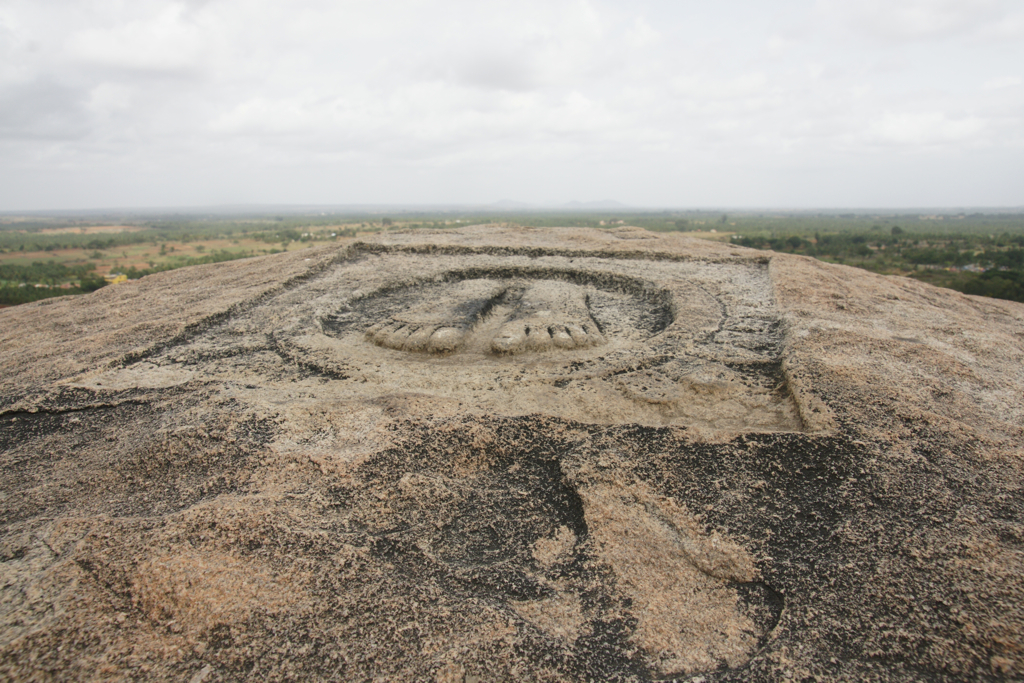
A carved stone footprint pair set into a flat granite rock summit, with a rectangular outline carved around it. Beyond the rock, a wide flat landscape of green trees and fields under a pale cloudy sky.Photograph

Secondary source

Footprints Said to Be Chandragupta Maurya's, Chandragiri

romana klee · 2009

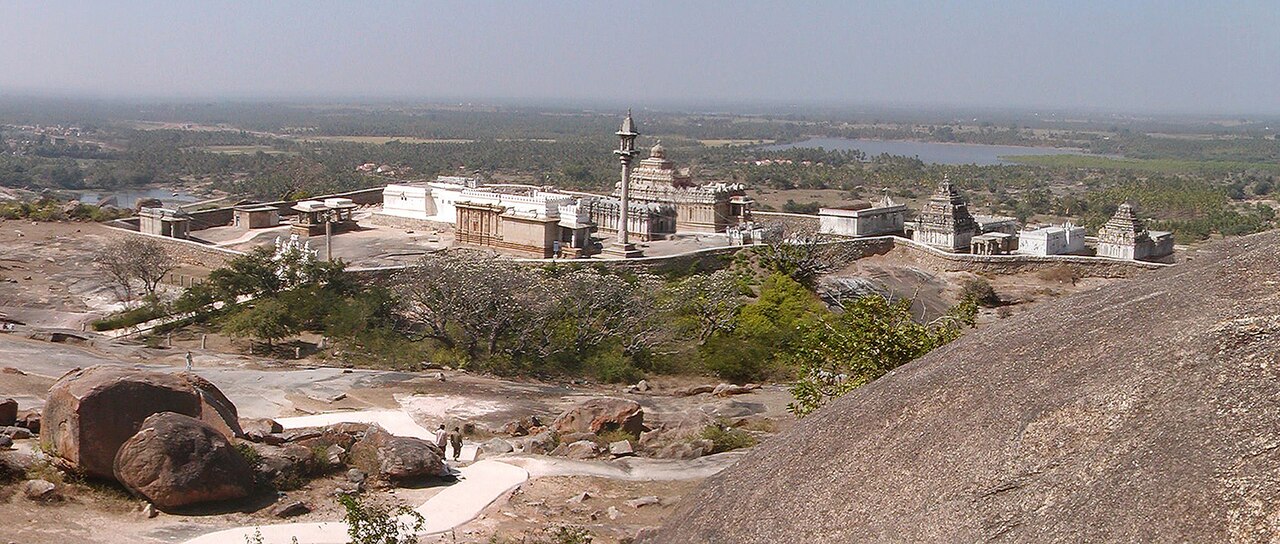
Panoramic view from a rocky hilltop of the Chandragiri temple complex at Shravanabelagola, India: white and stone temple structures with a tall pillar, surrounded by trees, boulders, and a distant lake under hazy sky.Photograph

Secondary source

Chandragiri Temple Complex, Shravanabelagola

Nikhil Varma · 2007

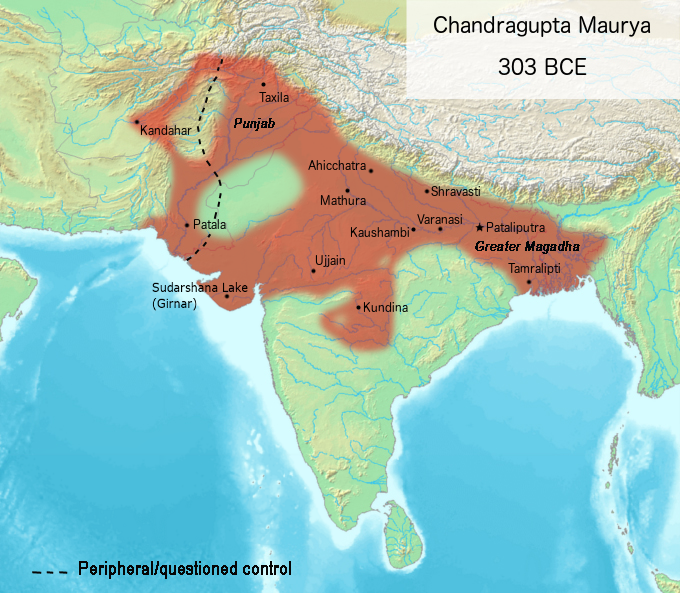
Map of the Indian subcontinent titled Chandragupta Maurya 303 BCE, with the empire shaded in red-orange and a lighter green region in the northwest. Cities labeled include Taxila, Kandahar, Pataliputra, Ujjain, Kundina and Tamralipti. A dashed line marks peripheral or questioned control, and the Bay of Bengal and Arabian Sea are shown in blue.Document

Tertiary source

Chandragupta Maurya Empire Map, 303 BCE

Avantiputra7 · 2024

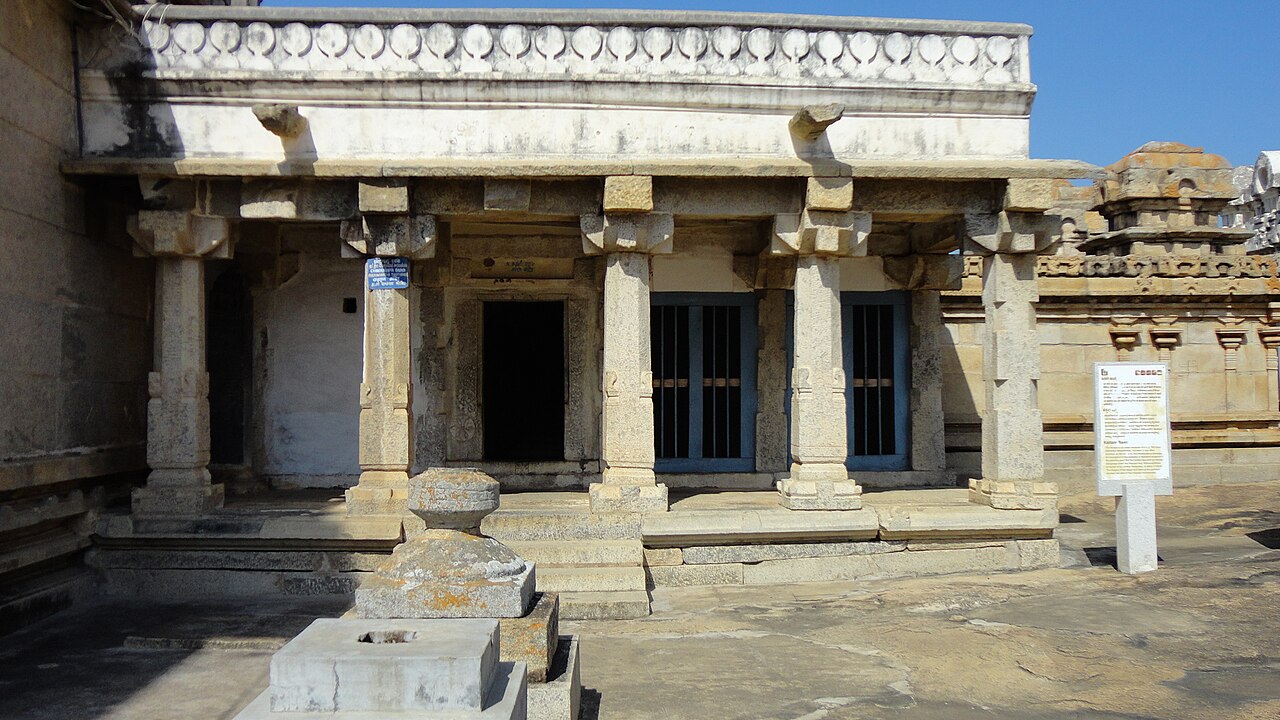
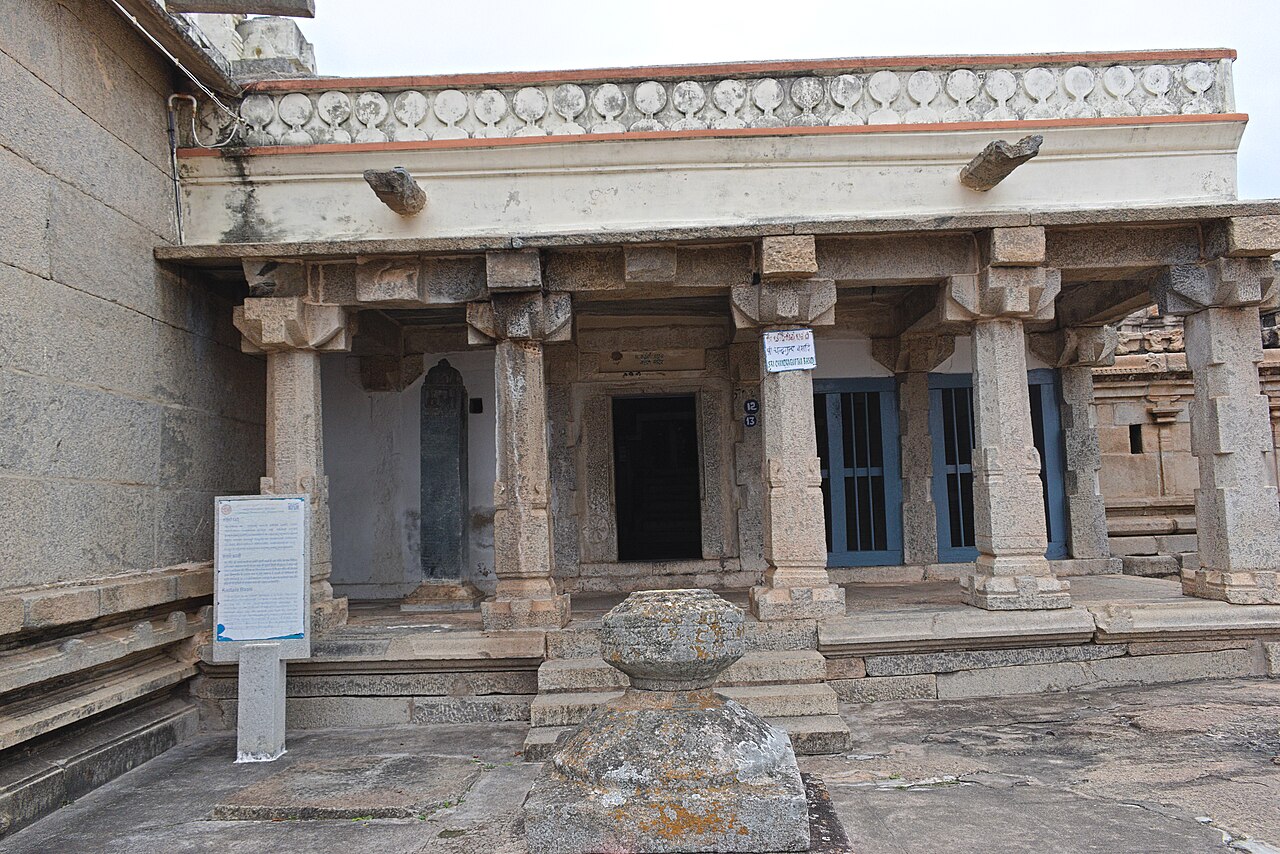
Front view of a stone temple entrance with a pillared portico, a carved cornice, and a dark doorway flanked by barred windows. A small information board stands on the right, and a stone pedestal with a basin is in the foreground.Photograph

Secondary source

Chandragupta Basadi Entrance, Shravanabelagola

HoysalaPhotos · 24 September 2012

Close-up of a carved stone panel with a shrine-like top and a niche. On the left, a red-painted seated figure with a canopy above sits in meditation. On the right, a dark stone seated figure holds a whisk-like object near a standing small figure with a bundle, with a small stone stupa-like form below.Sculpture

Secondary source

Chandragupta and Bhadrabahu Figures, Chandragupta Basadi

2024

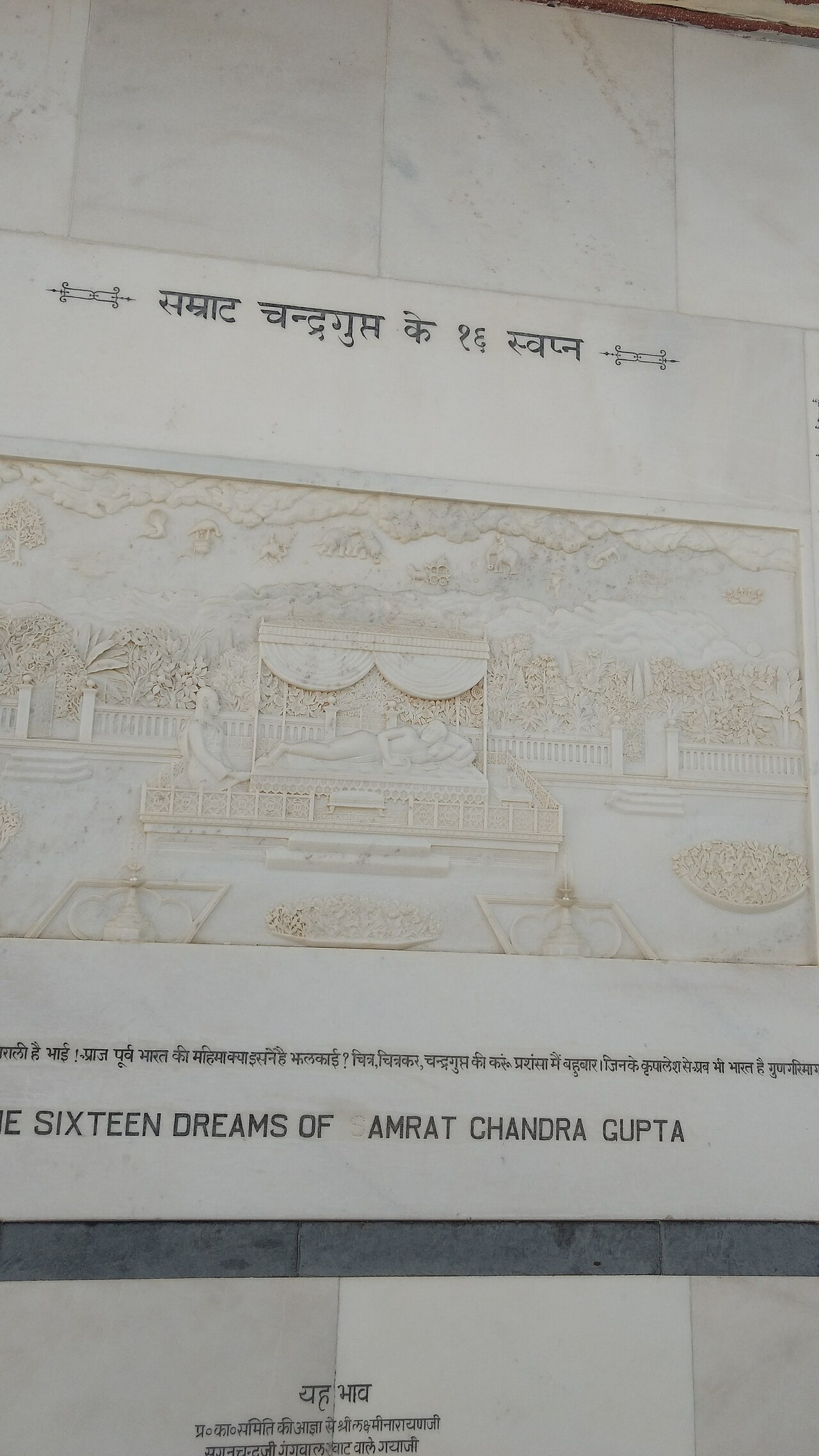
Photo of a white marble wall panel with Hindi and English inscriptions reading 'The Sixteen Dreams of Samrat Chandra Gupta'. Below is a carved relief of a reclining figure on a canopied bed, with trees, a railing, fountains, and animals in the sky.Artifact

Secondary source

Inscription Depicting Chandragupta's Dreams, Mahavirji

2016

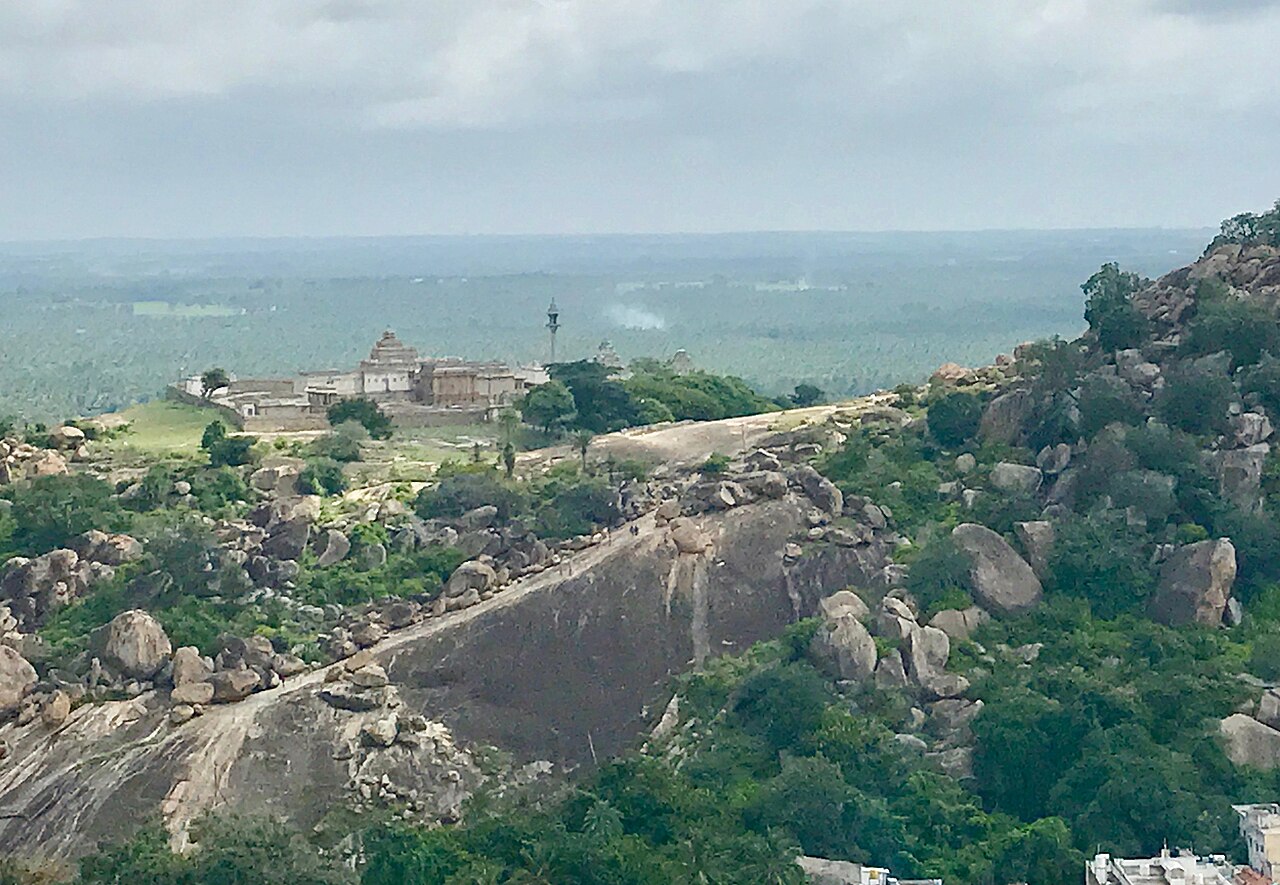
Hilltop view across a green plain under a grey sky. In the centre, a rocky hill with a path climbing its granite slope toward a walled temple complex with stone shrines and a tall pillar. Boulders and trees cover the hillside, with buildings at lower right.Photograph

Secondary source

Aerial View of Chandragiri, Shravanabelagola

Ms Sarah Welch · 2017

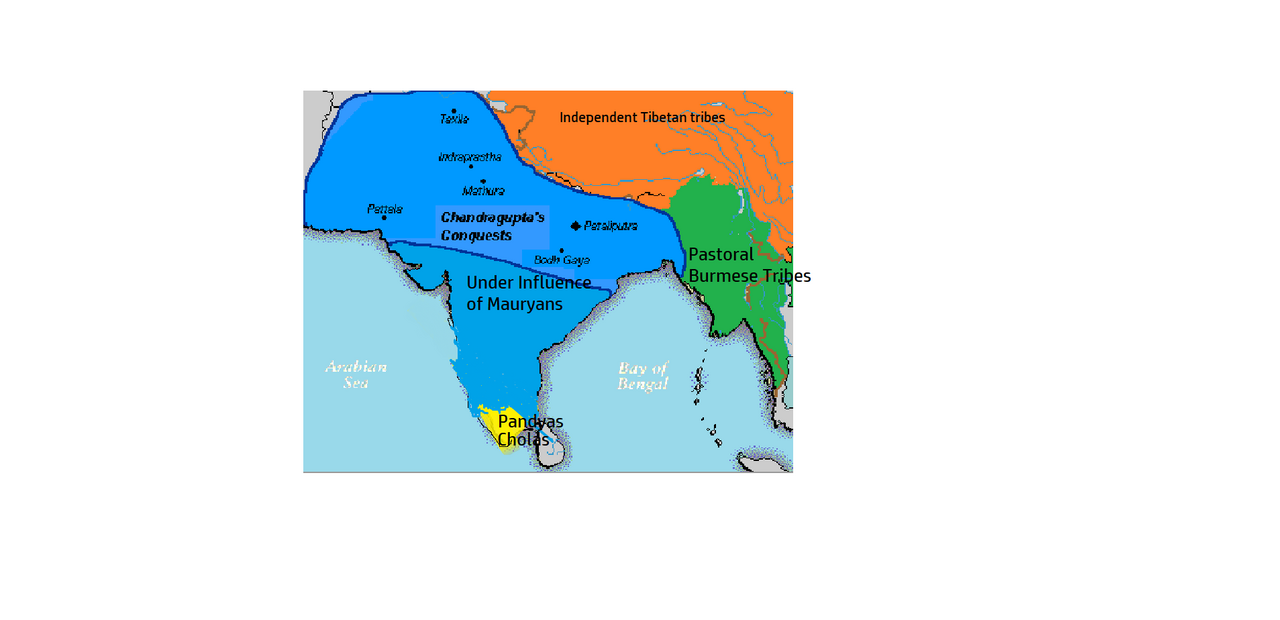
Colored map of ancient India showing the Mauryan Empire around 300 BCE. A large blue area labeled Chandragupta's Conquests and Under Influence of Mauryans covers the north and center, with cities such as Taxila, Indraprastha, Mathura, Pataliputra, and Patala marked. Orange marks independent Tibetan tribes, green marks pastoral Burmese tribes, and yellow marks the Pandyas and Cholas in the far south. Surrounding seas are labeled Arabian Sea and Bay of Bengal.Artifact

Secondary source

Mauryan Empire Map, 300 BCE

Edasf · 2024 (depicting c. 300 BCE)

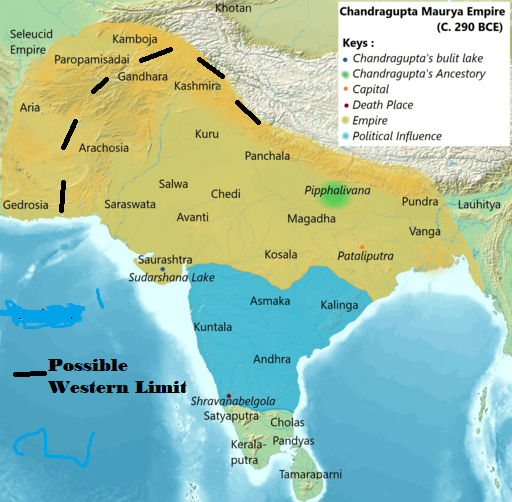
Map titled Chandragupta Maurya Empire (c. 290 BCE). Shows the Indian subcontinent with the empire shaded in yellow-orange across north and central India, a blue political influence zone covering the south-central and southern peninsula, a green marker for Chandragupta's ancestry near Pippalivana, and labels for regions, cities such as Pataliputra, and a legend. Hand-drawn blue lines mark a possible western limit along the coast and western frontier.Artifact

Secondary source

Mauryan Empire under Chandragupta Maurya, Map

Edasf · 2024 (depicting c. 290 BCE)

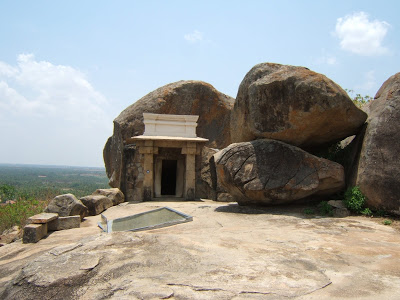
A small stone shrine with a columned entrance and a doorway sits in front of large rounded granite boulders on a rocky hilltop. A shallow rectangular stone basin lies in the foreground, with hazy green landscape and blue sky beyond.Photograph

Secondary source

Shravanabelagola Cave, Traditional Death Place of Chandragupta Maurya

Usarode2057 · 2015

Front entrance of a stone temple with a pillared porch of carved granite columns and a dark doorway. A decorated frieze with circular medallions runs along the top, and a stone pedestal stands in the foreground. An information board stands on the left.Artifact

Secondary source

Chandragupta Basadi Entrance, Shravanabelagola

Rohit14400 · 2023

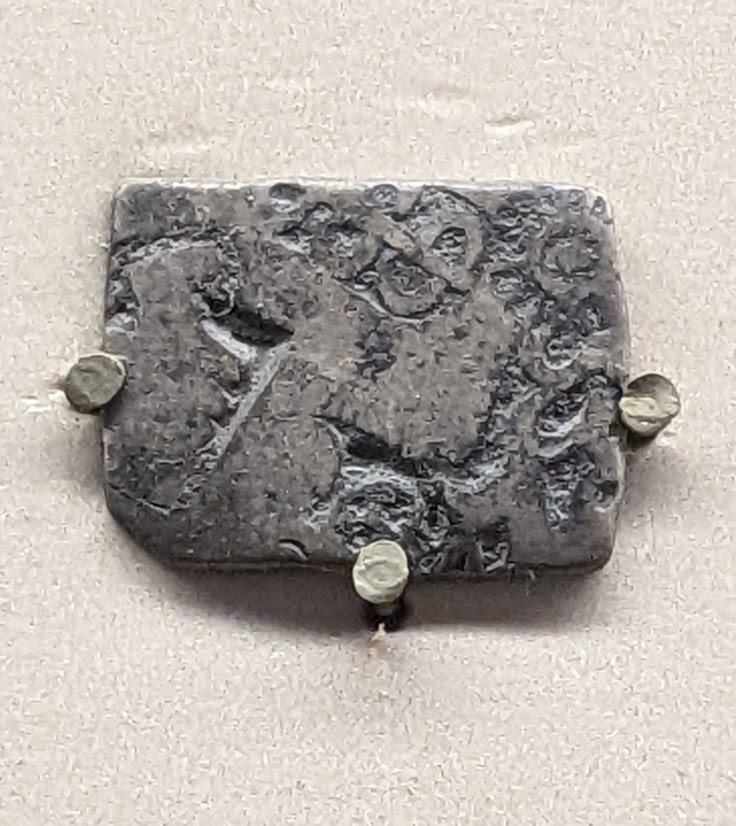
A small, irregular, roughly rectangular silver-grey punch-marked coin with worn, uneven surfaces and several indented punch marks. It is pinned to a pale beige display board by three small brass-colored pins, one at the left, one at the right, and one at the bottom.Artifact

Secondary source

Series IV Imperial Punch-Marked Coin, Nashik

Mauryan period

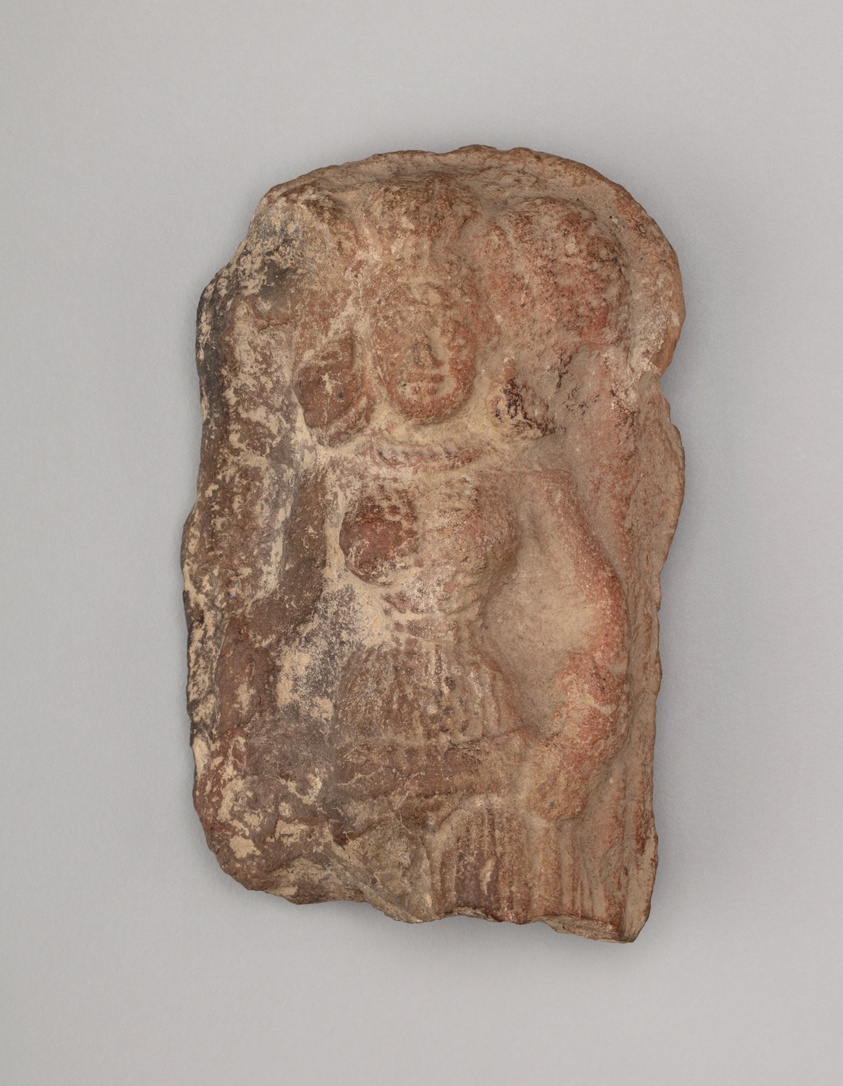
Photo of a fragmentary reddish-brown terracotta relief showing a standing female figure in high relief with an elaborate headdress, the head and upper body partly worn away, set against a plain grey background.Sculpture

Primary source

Woman with a Headdress

Mauryan period, 1st century BCE

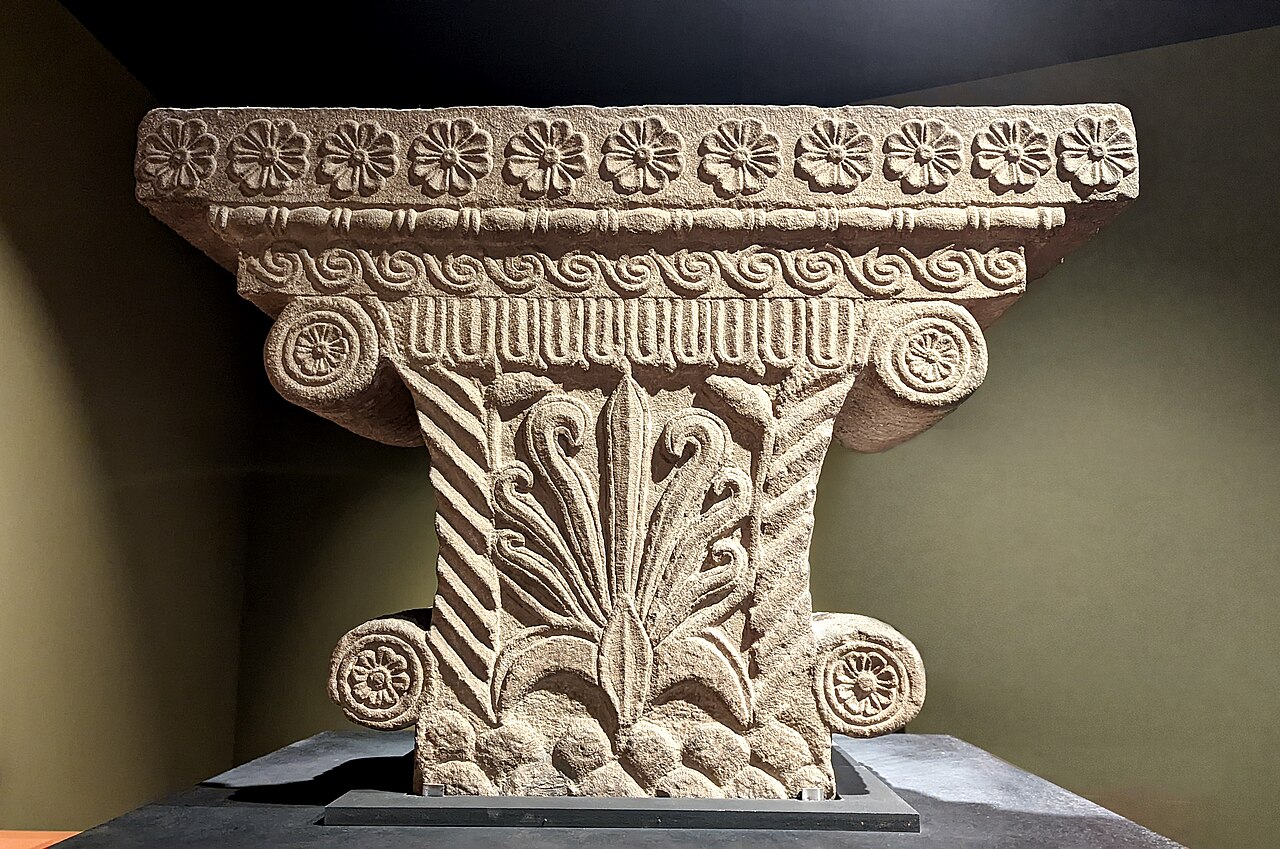
Carved sandstone pillar capital displayed in a dark gallery on a dark stone plinth. The top band has rosettes and a bead-and-reel border, below it a spiral scroll band, egg-and-dart molding, volute scrolls at the corners, a fluted section with a central acanthus-like palmette, and a lower band of bulbous forms.Photograph

Secondary source

Mauryan Pillar Capital, Bihar Museum

Pritha For Heritage · 4th-3rd century BCE

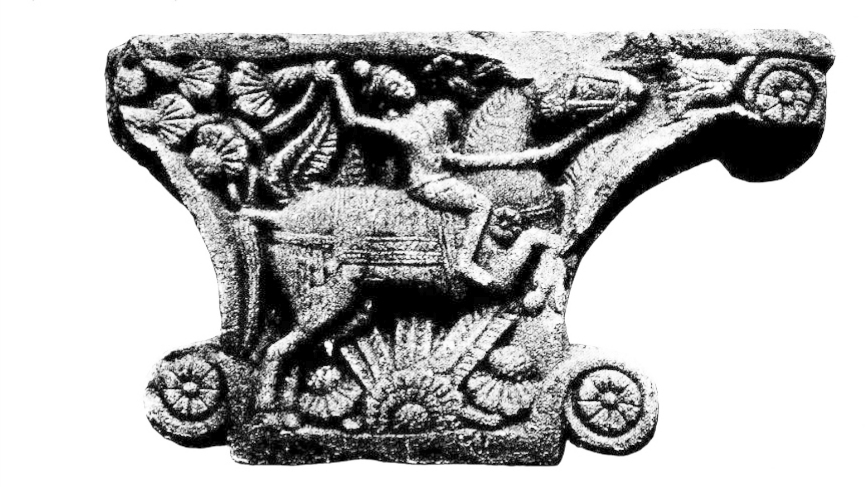
Black and white photograph of a carved stone fragment showing a horse-drawn chariot with a rider and wheels, surrounded by carved foliage and lotus-like motifs, on a dark background.Photograph

Secondary source

Sarnath Mauryan Capital, Front and Back

Vincent Arthur Smith · 1910

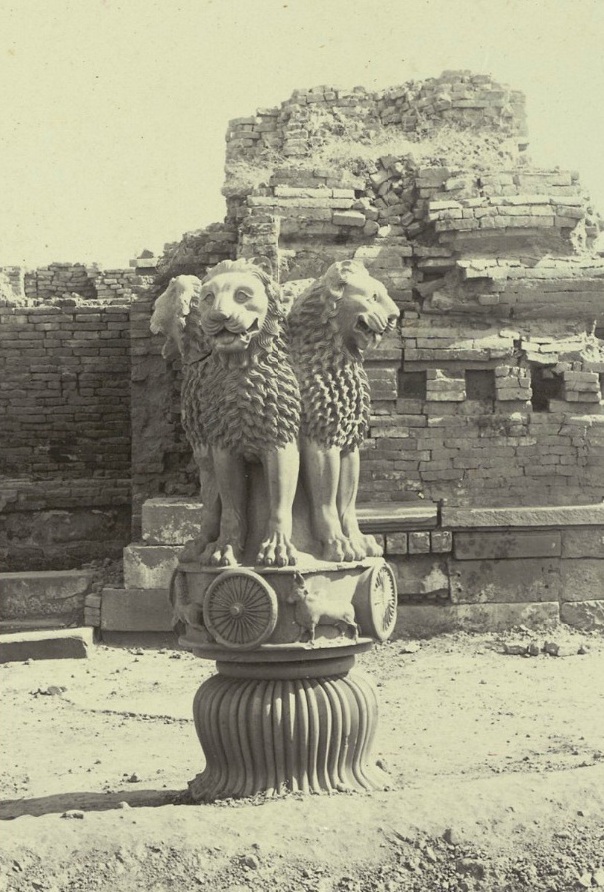
Sepia photograph of the Sarnath lion capital: four lions back to back on a circular abacus carved with a wheel and animals, set atop a fluted column in front of weathered brick ruins in a dusty open yard.Photograph

Secondary source

Lion Capital at Sarnath

Madho Prasad · c. 1905

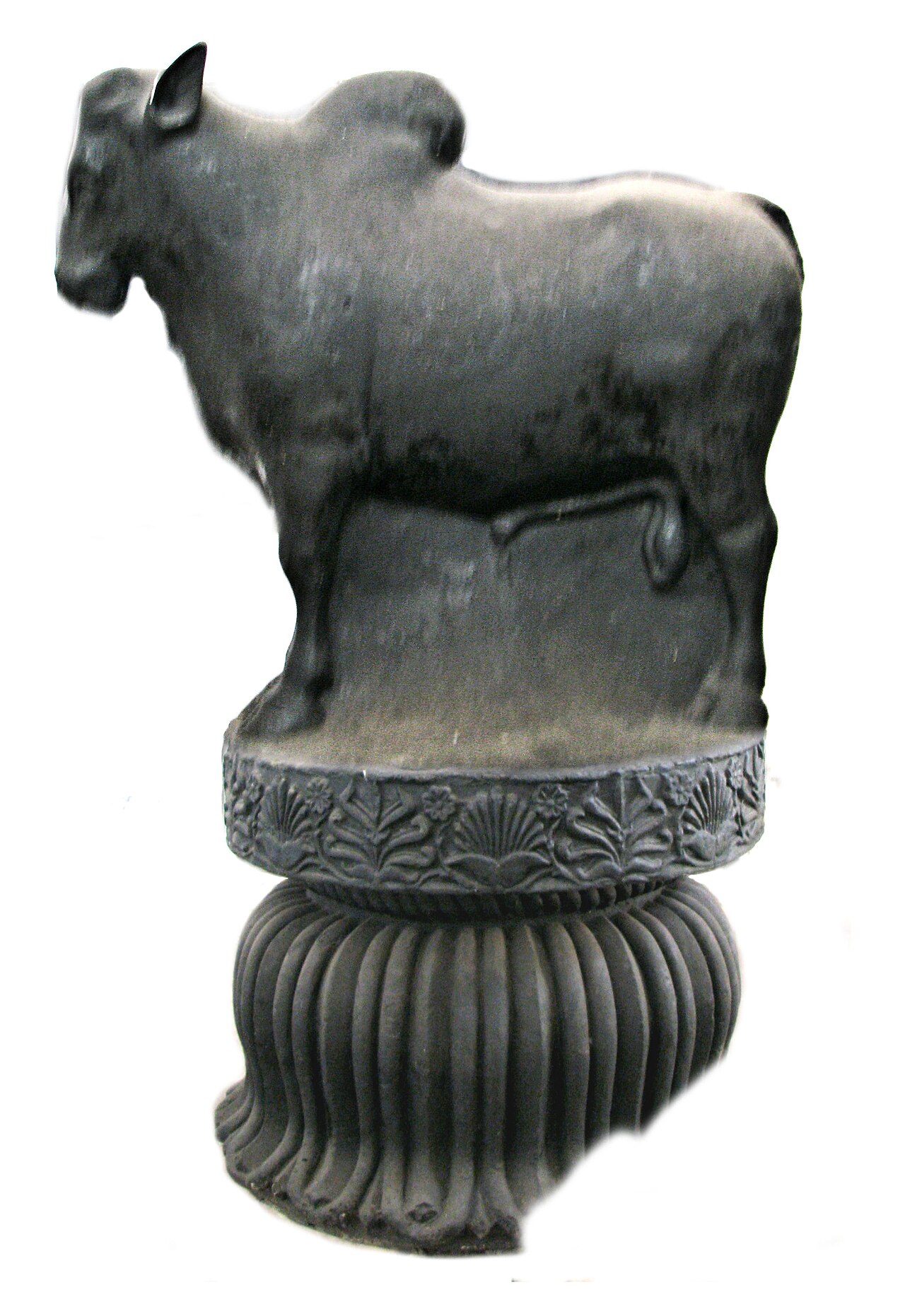
Black polished stone sculpture of a standing bull with a humped back and small ears, facing left, on a carved base. The base has a band of floral and lotus relief above a fluted lower column that flares at the bottom. Plain white background.Photograph

Secondary source

Rampurva Bull Capital

Tinucherian · 4th-3rd century BCE

Want the full shelf? Chat with Chandragupta Maurya in the app and open the Sources panel — every quote links back to the original.

Use Chandragupta Maurya in class

1 collection

A ready-made collection from the Humy team that features Chandragupta Maurya. Preview it, then try it free.

Trusted by educators worldwide

Conversations
375,000+
Real exchanges between students and historical figures
Messages exchanged
4,142,000+
Across every figure, classroom and language
Historical figures
100,000+
Each informed by a curated biography and selected sources
Languages supported
50+
From English and Spanish to Arabic and Korean

Paying customers

Used by 98 schools and universities

Partner school logo
Tecnológico de Monterrey logo
Hyper Island logo
Partner school logo
Chambersburg Area School District logo
Broward County Public Schools logo
Nebo School District logo
National Louis University logo
South Florida PBS logo
Punahou School logo
University of Wisconsin–River Falls logo
Partner school logo
Partner school logo
Archbishop Mitty High School logo
Kingsburg High School logo
Norwalk Public Schools logo
Partner school logo
Connections logo
Partner school logo
Moore Public Schools logo
Partner school logo
Partner school logo
Partner school logo
Partner school logo
Robbinsville Public Schools logo
Partner school logo
Partner school logo
Partner school logo
Tecnológico de Monterrey logo
Hyper Island logo
Partner school logo
Chambersburg Area School District logo
Broward County Public Schools logo
Nebo School District logo
National Louis University logo
South Florida PBS logo
Punahou School logo
University of Wisconsin–River Falls logo
Partner school logo
Partner school logo
Archbishop Mitty High School logo
Kingsburg High School logo
Norwalk Public Schools logo
Partner school logo
Connections logo
Partner school logo
Moore Public Schools logo
Partner school logo
Partner school logo
Partner school logo
Partner school logo
Robbinsville Public Schools logo
Partner school logo
Partner school logo

What educators are saying

“We enjoyed the program last year and used it frequently.”
“My students say it’s a welcome change of pace. I’m not a fan of the “sage on the stage” model, so I try to incorporate research-oriented and self-paced activities. With Humy, students have to take charge of their learning. They’ve become more adept at critical thinking, forming better questions, and improving their reading comprehension. The interview feature has been my go-to tool. I create assignments where students must ask historical figures a set number of questions, then summarize the responses to ensure they’re truly absorbing the material. This approach lets them actively explore the past rather than passively consuming information.”
“Humy has helped me bring historical figures, sometimes long past, to life. When my students interact with these figures in real-time, it eliminates some of the perceived “ancient” characteristics of my curriculum. This has shifted my students’ thinking away from viewing history as abstract or irrelevant. Real-time interactions make historical figures relatable, even allowing students to ask off-topic questions that help put historical lives in a more relevant context for 13-year-olds. The feature I use the most is the interview feature. After teaching a topic, most recently Gandhi and Joan of Arc, I have the students ask pointed, focused questions. We practice good conversation techniques beforehand, teaching them to listen (or read) carefully and formulate thoughtful follow-up questions rather than just interrogating. It helps students practice effective conversation skills.”

FAQ

Frequently asked questions

Who is Chandragupta Maurya?
Founder of the Maurya Empire in ancient India. On Humy.ai you can chat with an AI version of Chandragupta Maurya that draws on a short biography and 56 historical sources during the conversation — by text or voice, in 42 languages.
Is Chandragupta Maurya AI free?
Chandragupta Maurya is part of Humy's full library of more than 100,000 figures, which comes with a paid plan. A free account (no credit card) includes 20 AI messages a month with the free library's figures, so you can try how the conversations work first. The free plan's 20 AI messages a month are shared by you and your students: enough to try Humy yourself; a whole class needs Plus.
What sources does the Chandragupta Maurya AI use?
It draws on a short biography and 56 historical sources (artifacts, photographs and documents), including “Arthashastra”, “Junagadh Rock Inscription of Rudradaman” and “Mudrarakshasa”. Each source has its own page on Humy.ai.
How historically accurate is the AI version of Chandragupta Maurya?
Each figure uses a short biography and a small set of selected historical sources as context (retrieval-augmented generation), so answers stay closer to known material than the model's general knowledge alone. It isn't a citation-grade research tool — like any LLM, the AI can get details wrong or extrapolate. Treat it as a strong starting point for inquiry and cross-reference important claims.
Can I talk to Chandragupta Maurya by voice?
Yes. In addition to text chat, you can call Chandragupta Maurya and hear their voice respond in real time — useful for auditory learners, interview practice and Socratic dialogue.
Is Humy.ai safe and compliant for schools?
Yes. Humy.ai is used by more than 100 schools, universities and organisations. The platform is FERPA- and GDPR-aligned, supports SSO, and offers an IT-approval pack tailored for school procurement teams.

Cross-reference Chandragupta Maurya

Like any LLM, the AI version of Chandragupta Maurya can get details wrong. Open one of these sources in a new tab to verify what you’ve read.

Ready when you are

Start chatting with Chandragupta Maurya now.

20 messages free · No credit card · Available in 50+ languages.