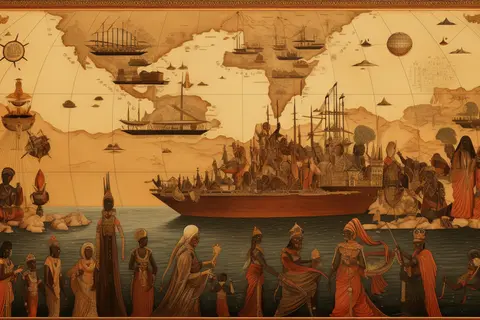

Portrait of Mansa Musa

AI Historical Figure

Mansa Musa

Mansa Musa was the tenth Mansa, which translates to "sultan" or "emperor", of the wealthy West African Mali Empire. He is known for his immense wealth and for his pilgrimage to Mecca, during which he distributed so much gold that he caused inflation in the regions he passed through.

Chat with Mansa Musa via text or voice — in 42 languages, drawing on a curated biography and 42 historical sources. Available 24/7.

Start chatting with Mansa Musa20 messages free · No credit card
Lived
c. 1280–1337
From
Mali
Known for
Rulers & royaltyPolitics & government
Mansa Musa

Mansa Musa

Online · responds in seconds

Hello — I'm Mansa Musa. Mansa Musa was the tenth Mansa, which translates to "sultan" or "emperor", of the wealthy West African Mali Empire. He is known for his immense wealth and for his pilgrimage to Mecca, during which he distributed so much gold that he caused inflation in the regions he passed through. What would you like to ask me?

20 messages free · No credit card · Powered by Humy.ai

Live preview · Switch between 42 languages above · Send a message to continue in the app

Multilingual

Talk to Mansa Musa in 42 languages

Ask Mansa Musa questions in any language below, and the rest of Humy's app speaks it too. Pick yours to open the chat in that language.

Also in German (Austria), German (Switzerland), English (UK), English (Australia), English (Canada).

The sources behind this AI

42 sources · 12 artifacts · 10 books · 9 photographs · 7 paintings · 3 documents · 1 sculpture

Mansa Musa doesn’t improvise from thin air. The AI is grounded in 42 curated historical sources students can inspect. Open any of them to see what informs the conversation.

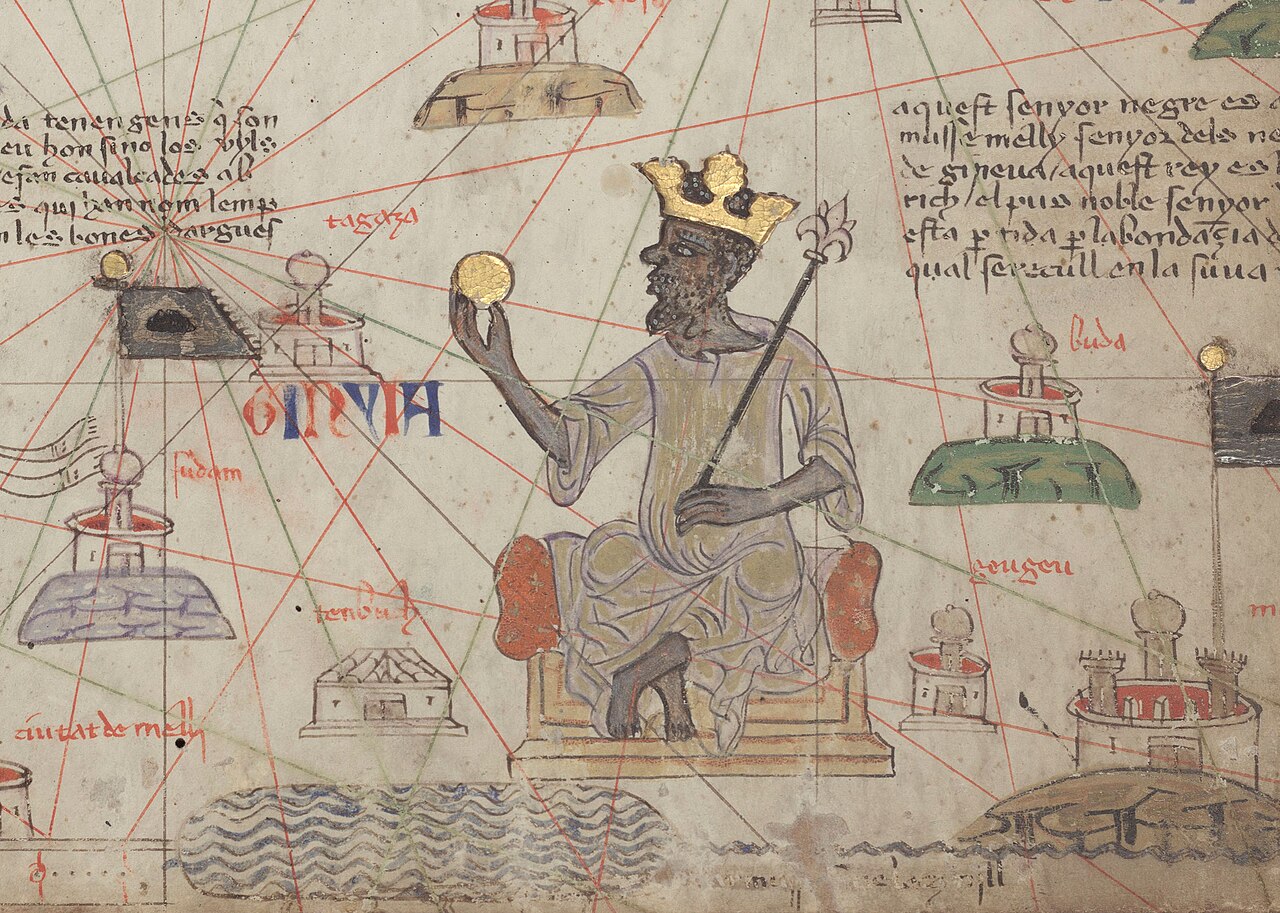
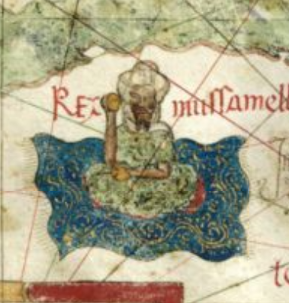
Detail of a medieval painted map showing a crowned figure seated on a throne, holding a gold coin in one hand and a scepter in the other, with towns, handwritten labels, and wavy sea nearby.Painting

Secondary source

Catalan Atlas: Mansa Musa Enthroned

Abraham Cresques (attributed) · 1375

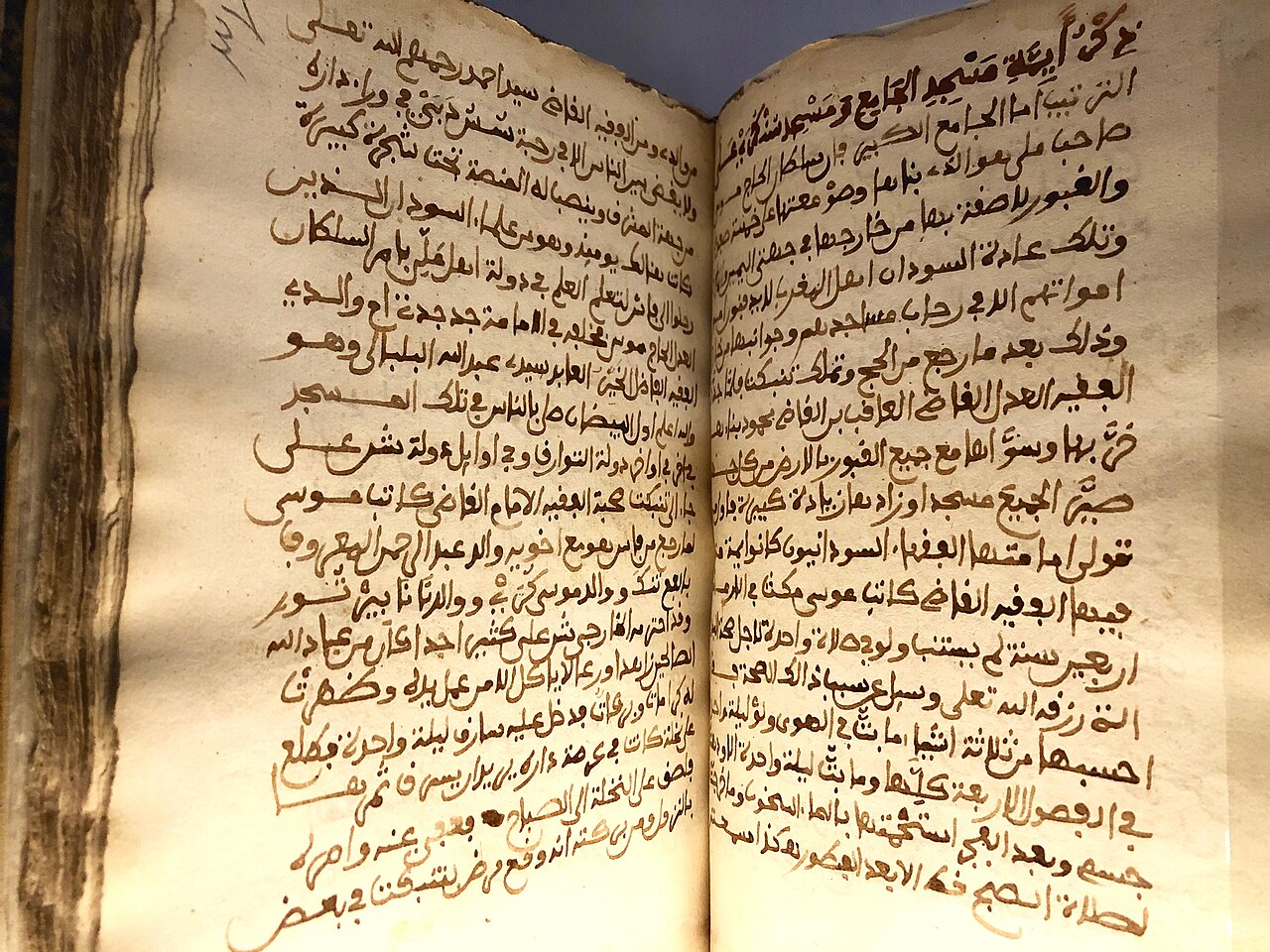
Open manuscript on a display, pages covered in brown-ink Arabic script on aged, yellowed paper. The left page is written in handwriting across most of its lines, and the right page has a decorated heading at the top followed by dense Arabic text. The leather-bound spine is visible at the left edge.Book

Secondary source

Tarikh al-Sudan

Abderrahmane Es Saâdi · c. 1655

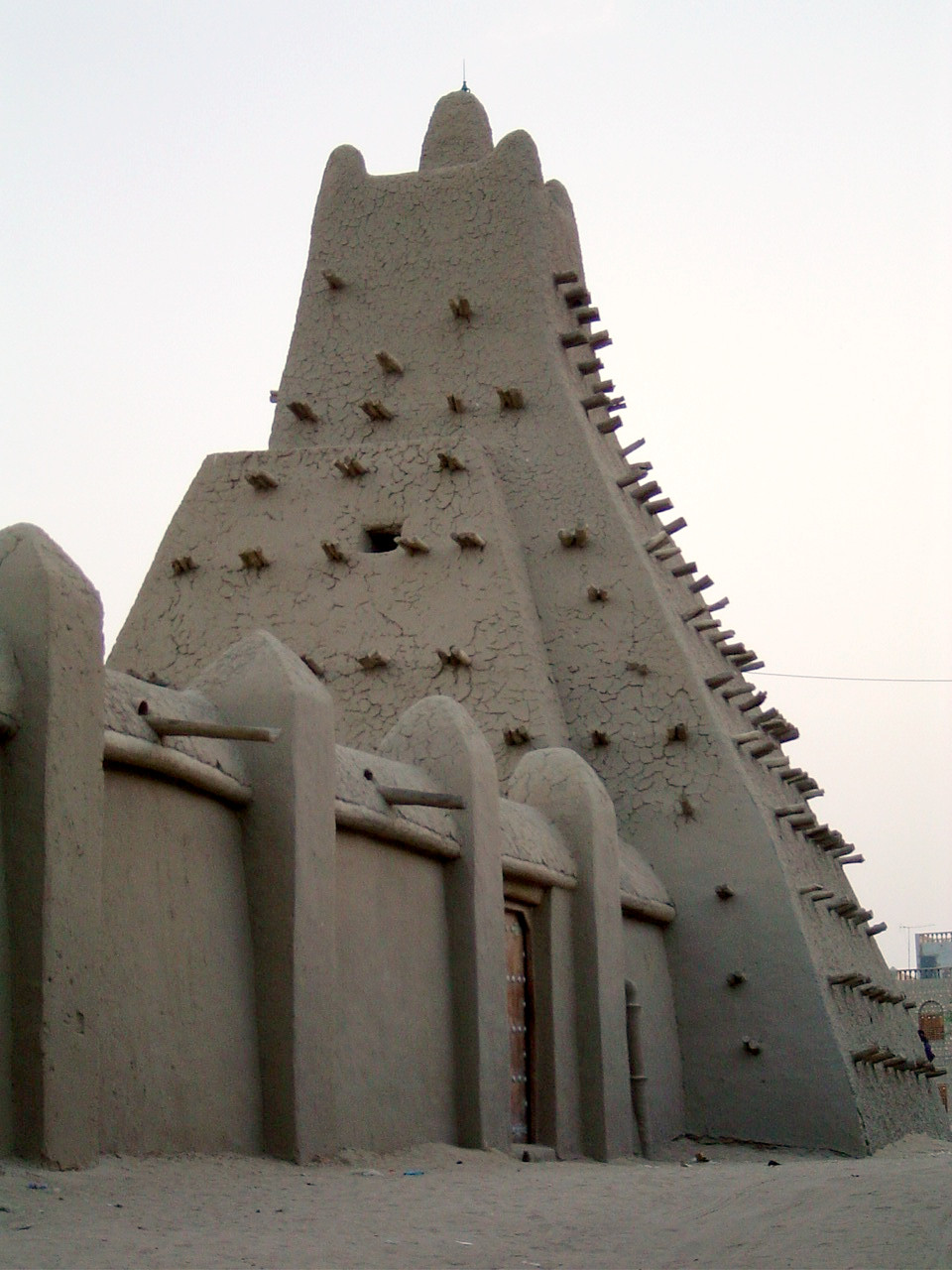
Tall mud-brick mosque with stepped towers, small wooden beam projections on its walls, and a low wall with arched buttresses and a wooden door, set on sandy ground under a pale sky.Artifact

Secondary source

Sankoré Madrasa

14th-15th century

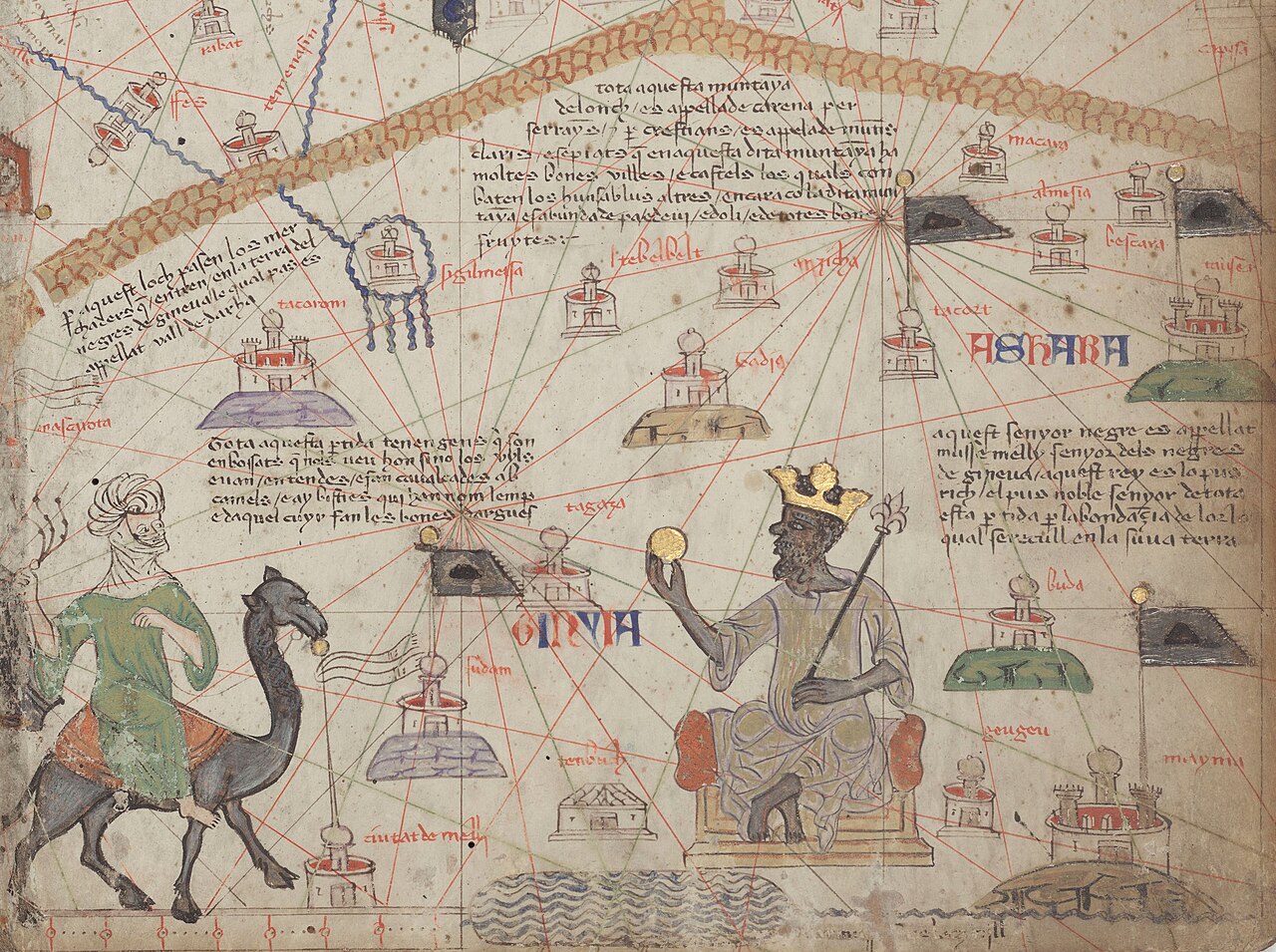
Detail of a medieval painted map showing a seated crowned figure holding a gold coin and a scepter on a throne, a camel rider in green robes and turban on the left, walled cities drawn in red and purple, red rhumb lines, and handwritten Catalan-style text in brown ink.Painting

Primary source

Catalan Atlas, Sheet 6: Western Sahara

Abraham Cresques · 1375

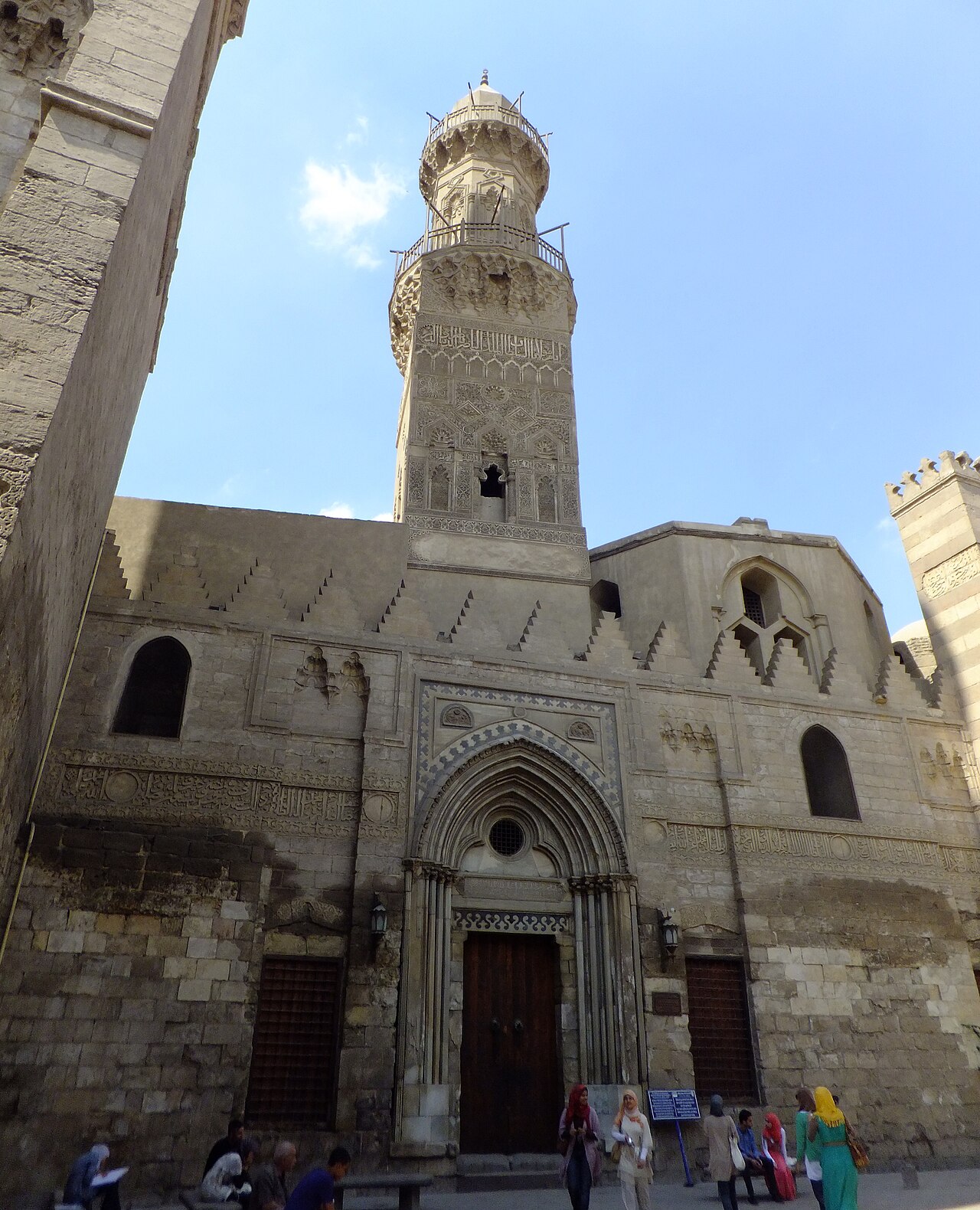
Front facade of a stone madrassa with a tall, ornately carved minaret rising above a pointed-arch wooden doorway. Visitors stand in the courtyard in front; a blue information sign stands at right.Artifact

Secondary source

Madrasa of Al-Nasir Muhammad

1303

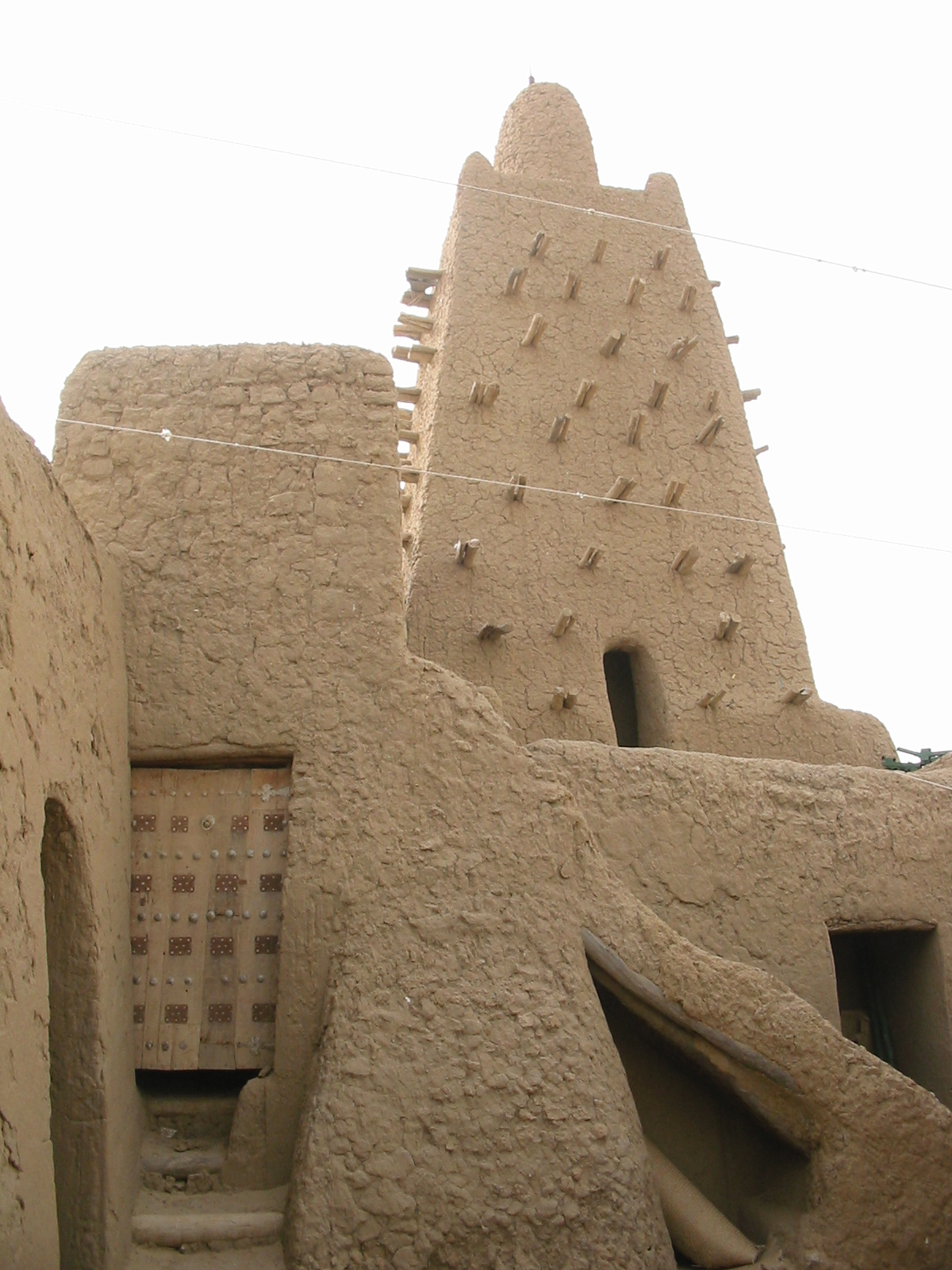
Exterior view looking up at a mud-brick mosque with a tall tapering tower topped by a rounded dome, with protruding wooden beam ends set in its walls. A large studded wooden door sits at lower left beside steps, under a pale sky with power lines crossing.Artifact

Secondary source

Djinguereber Mosque

1327 (traditional date)

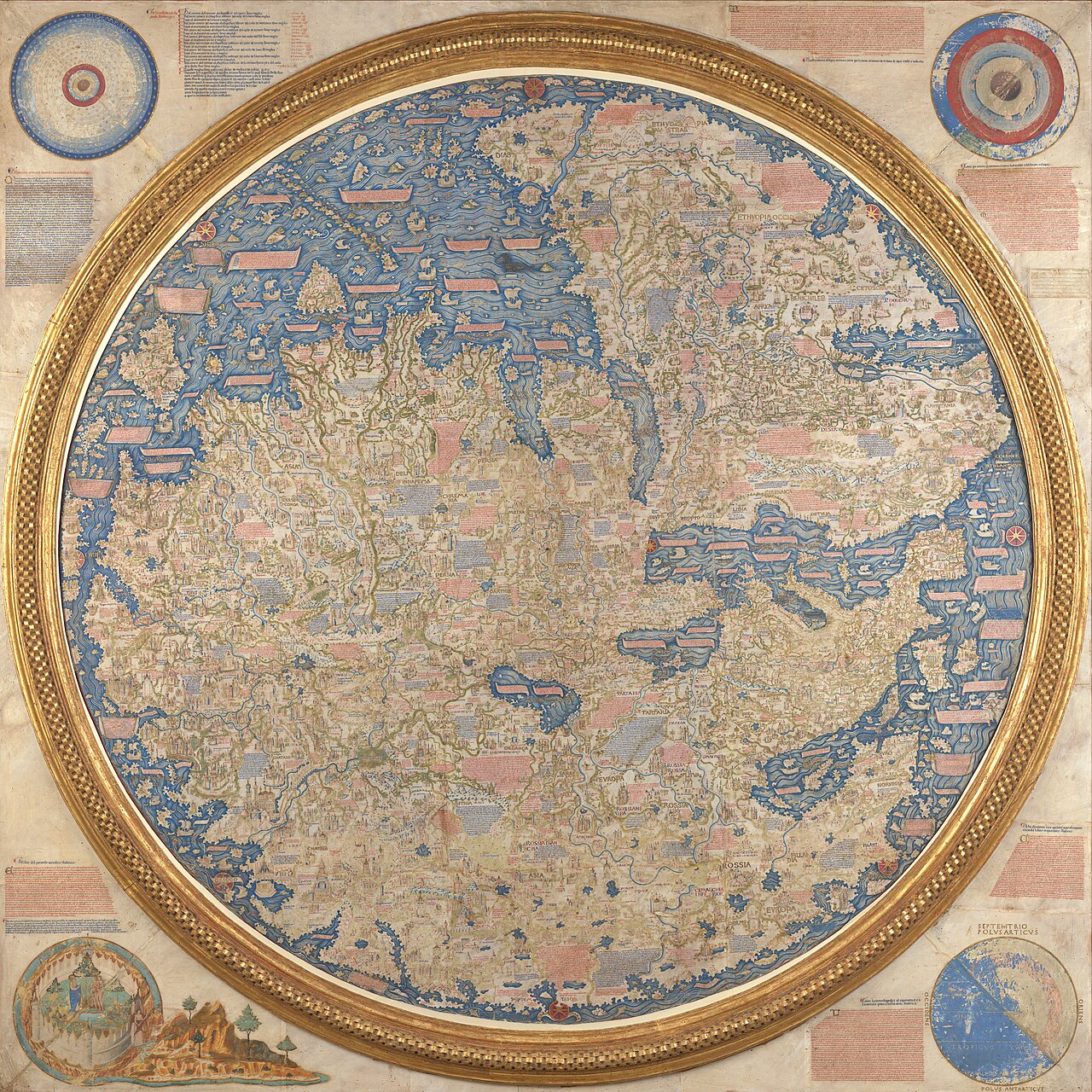
Circular world map in a gold frame, with south at top. Blue oceans with ships surround tan-colored landmasses, with rivers, cities and labels in Italian. Text panels and small circular diagrams fill the four corners.Artifact

Secondary source

Fra Mauro map

Fra Mauro · c. 1450-1459

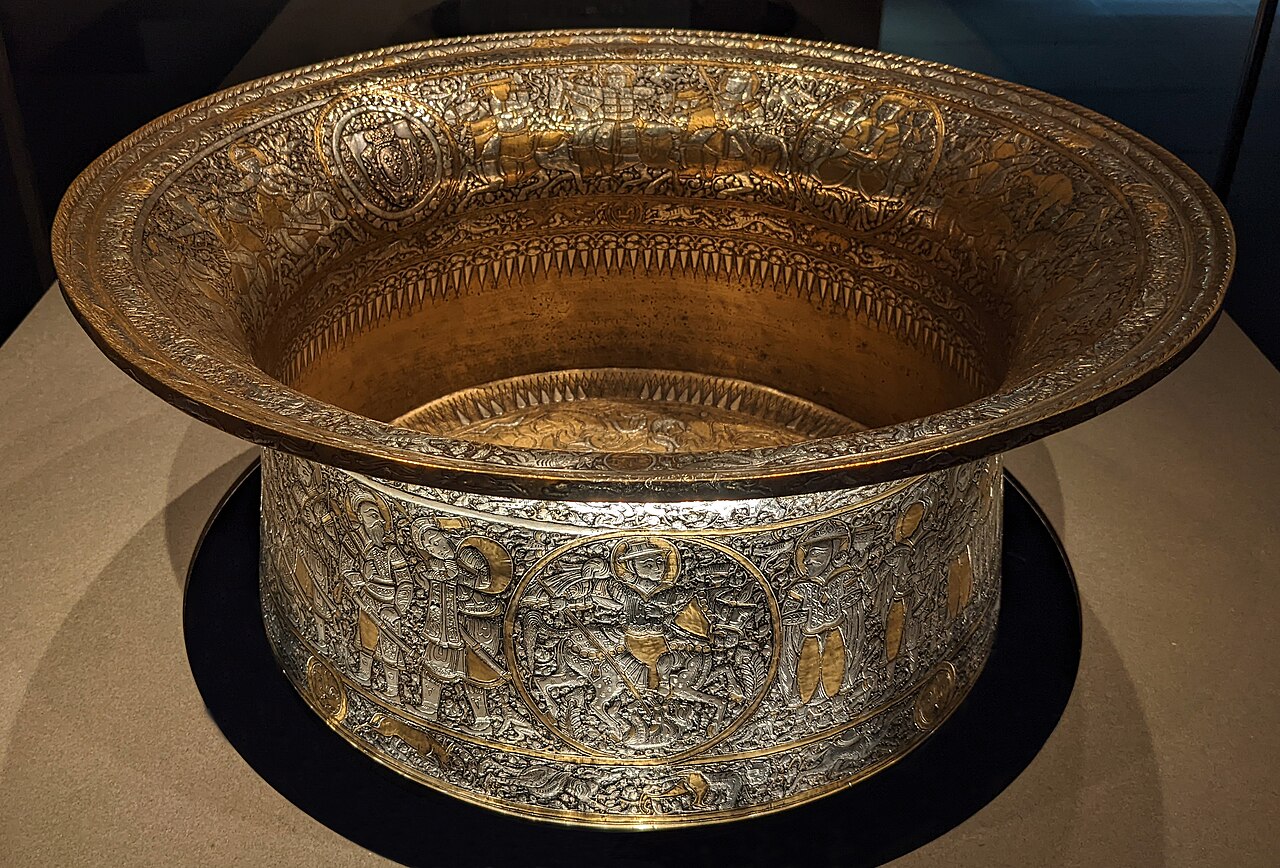
A large brass basin with flared rim, displayed on a black stand in a museum case. Its surfaces are densely engraved and inlaid with silver, showing bands of figures, animals, and decorative patterns, with circular medallions on the body.Artifact

Primary source

Baptistery of Saint Louis

Muhammad ibn al-Zayn · c. 1320

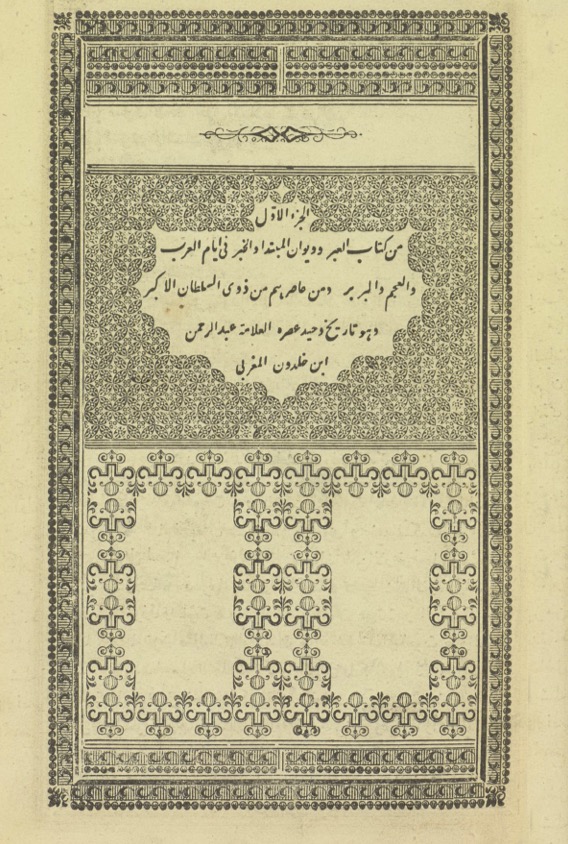
Title page of an Arabic printed book with an ornate decorative border, a central framed panel of Arabic calligraphic text, and a lower section with geometric floral ornaments in three columns. The text names Ibn Khaldun as author.Book

Secondary source

Kitab al-Ibar

Ibn Khaldun · 14th century

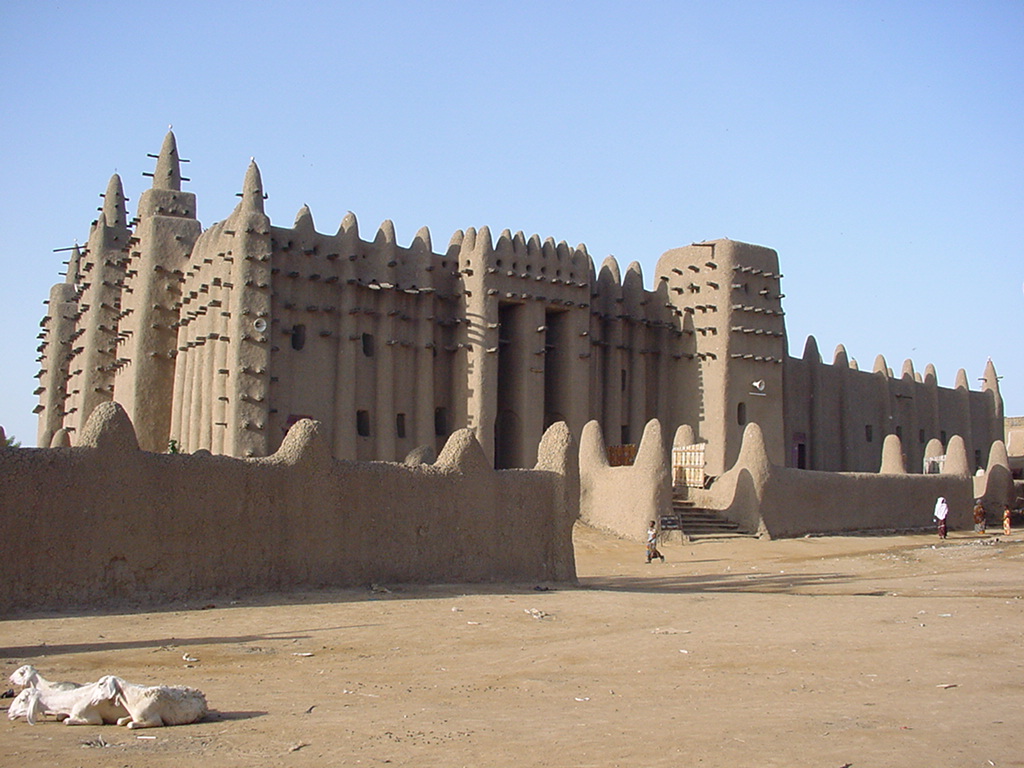
A large mud-brick mosque with tall pinnacles and rows of wooden beam stubs projecting from its walls, set behind a low mud wall. Two white goats lie on bare sandy ground in the foreground, and a few people walk nearby under a clear blue sky.Artifact

Secondary source

Great Mosque of Djenné

Ismaila Traoré · 1906-1907 (present structure)

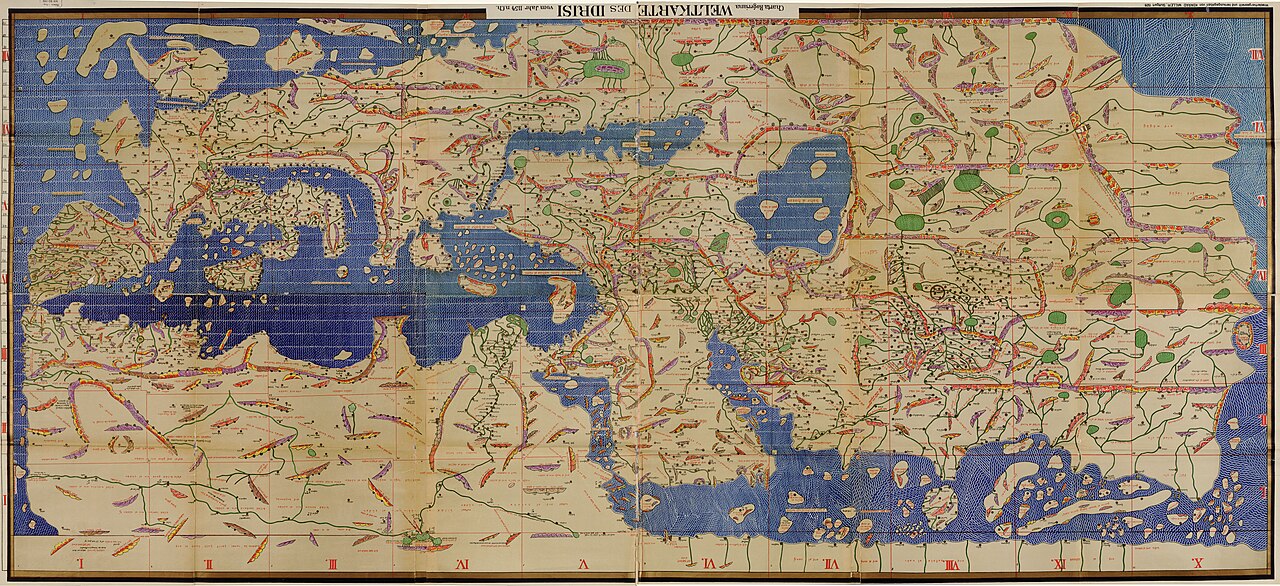
A large, wide medieval map drawn in blue, beige, green, and red with many coastlines, rivers, and place markings. The map is printed upside down, with a title label at the top edge. Blue seas surround the landmasses.Document

Secondary source

Tabula Rogeriana

Muhammad al-Idrisi · 1154

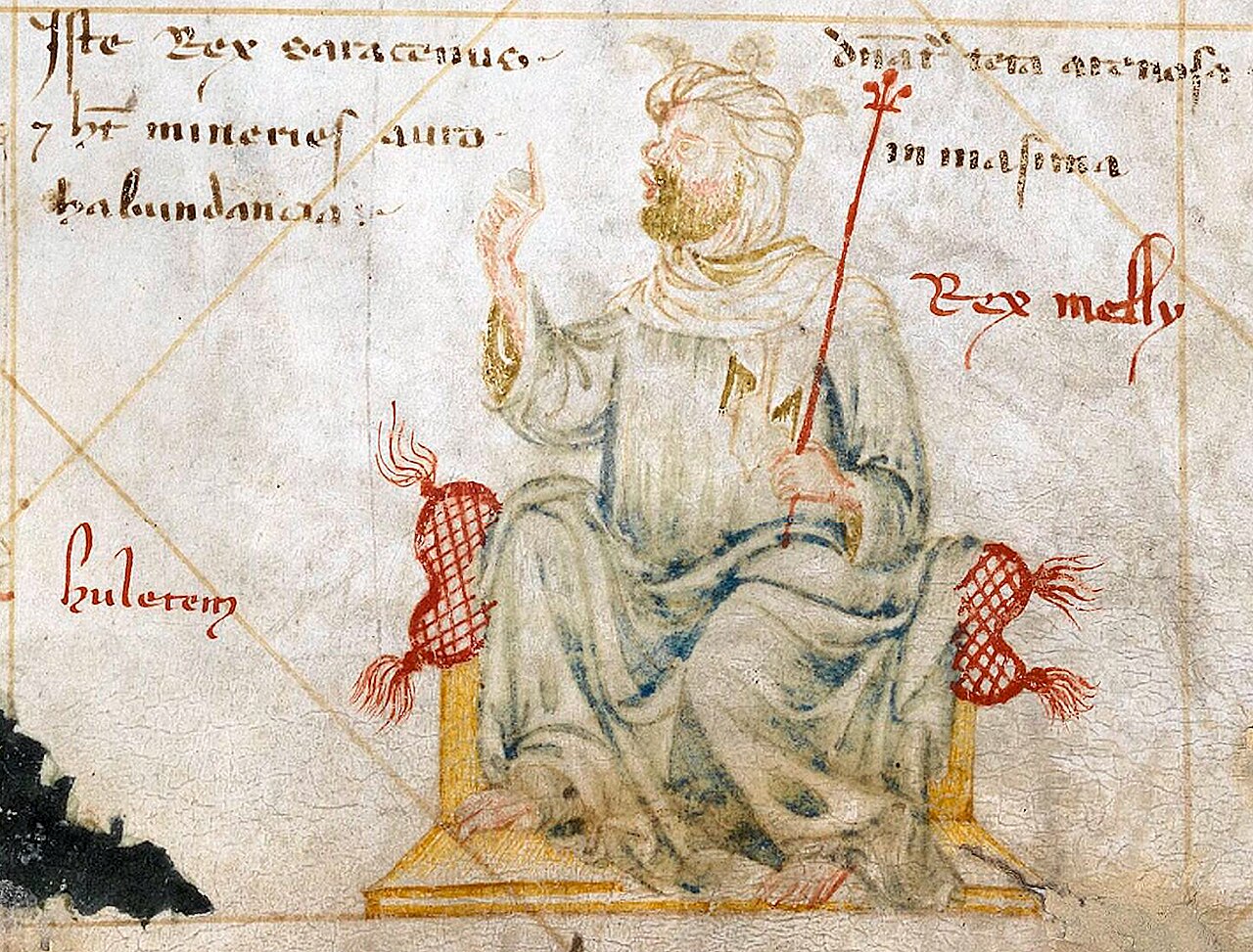
Detail of a medieval painted map showing a seated, bearded ruler in a white robe and turban, holding a red sceptre and raising one hand, with gold accents and a red-tasselled cushion. Latin inscriptions appear in brown and red ink, including 'Rex Melly'.Painting

Secondary source

Mansa Musa on the Map of Angelino Dulcert

Angelino Dulcert · 1339

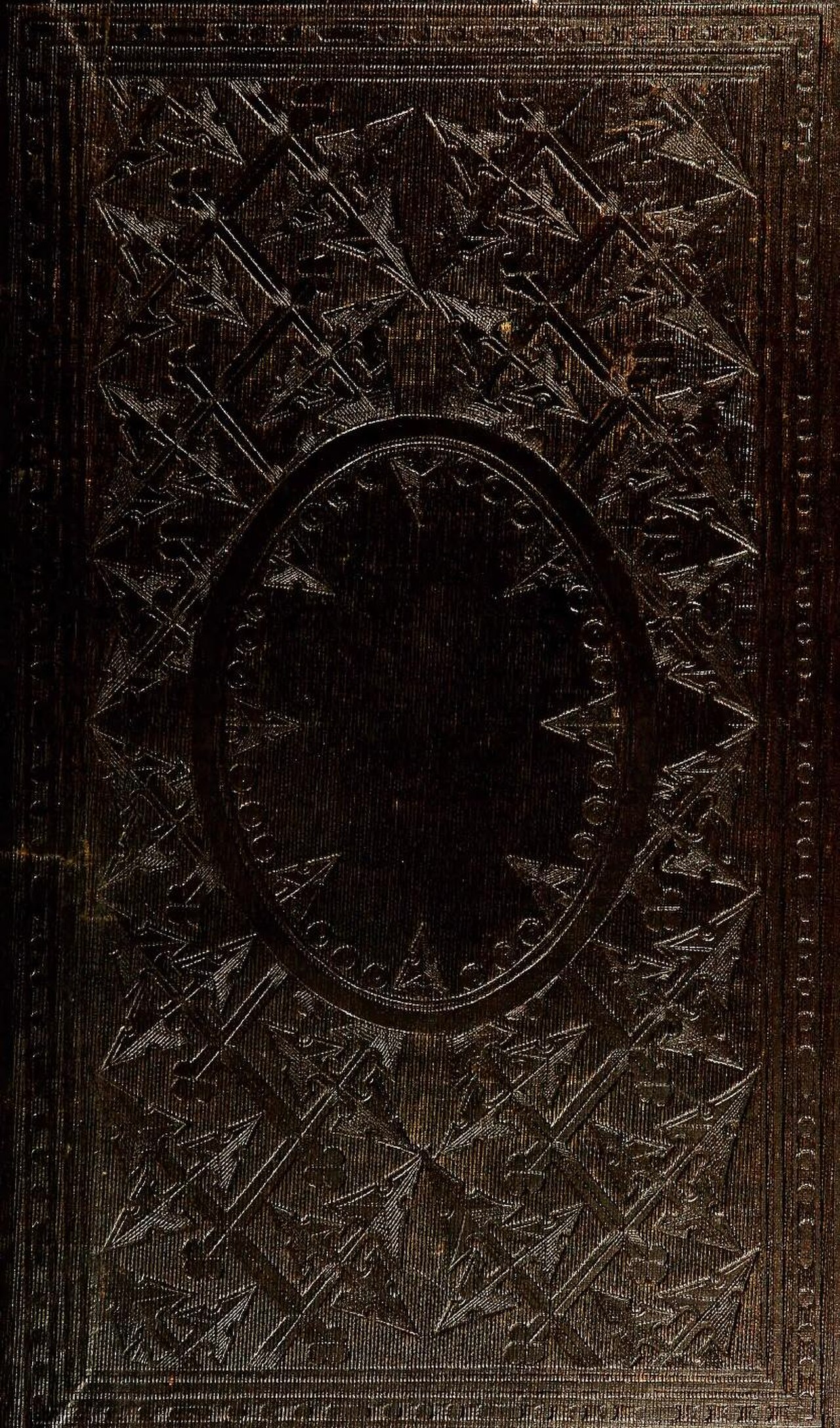
Dark brown embossed book cover with a fine ruled texture, decorated with a repeating pattern of arrows and diagonal lines in a diamond grid, framed by a border and an oval central panel with a dotted edge and no visible title.Book

Secondary source

Travels and Discoveries in North and Central Africa

Heinrich Barth · 1857

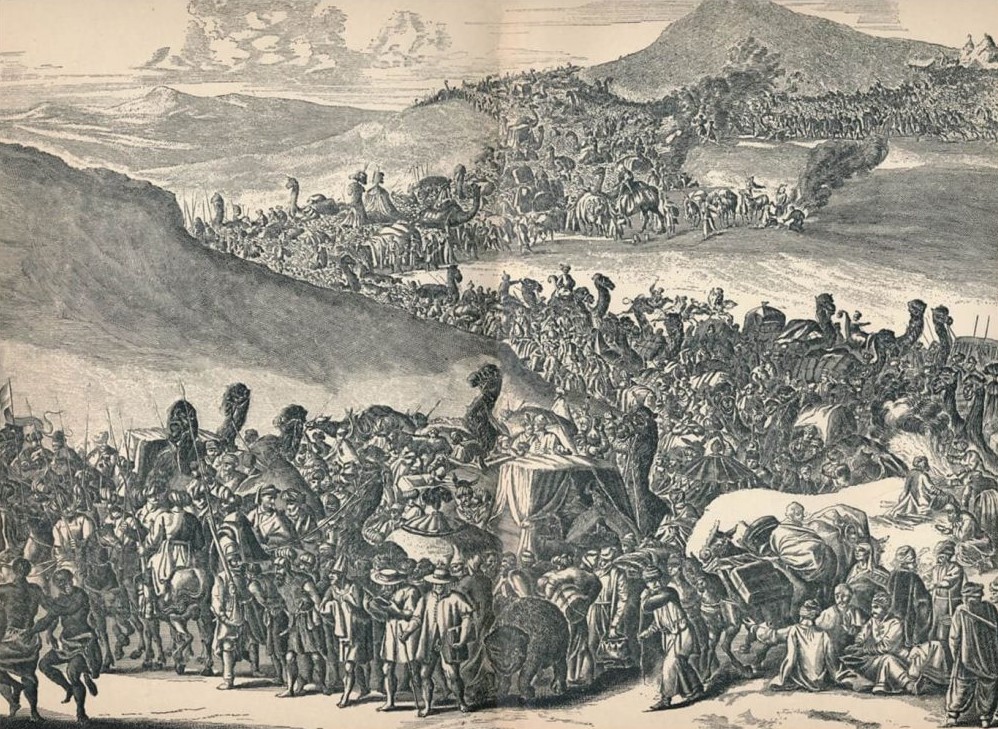
Engraved black-and-white illustration of a large crowd in a desert landscape: camels with tall loads, mounted riders, people on foot in robes and hats, and a white canopied tent in the center. Hills rise in the background.Painting

Secondary source

Mansa Musa on His Way to Mecca

Unknown · 1903 (published)

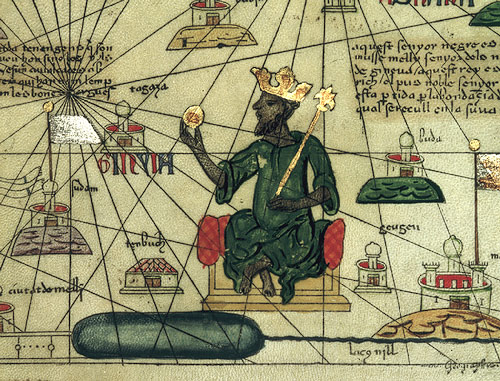
Detail of a painted map showing a seated crowned figure with a dark face, wearing a green robe, holding a gold orb in one hand and a gold scepter in the other, on a golden throne with red cushions. Surrounding areas show small towns with red-roofed towers, palm-like trees, lettering in medieval script, and a dark green blue-bordered area at the bottom.Painting

Secondary source

Mansa Musa in the Catalan Atlas

1959 (reproducing a 1375 original)

Book

Secondary source

The Negroland of the Arabs Examined and Explained

William Desborough Cooley · 1841

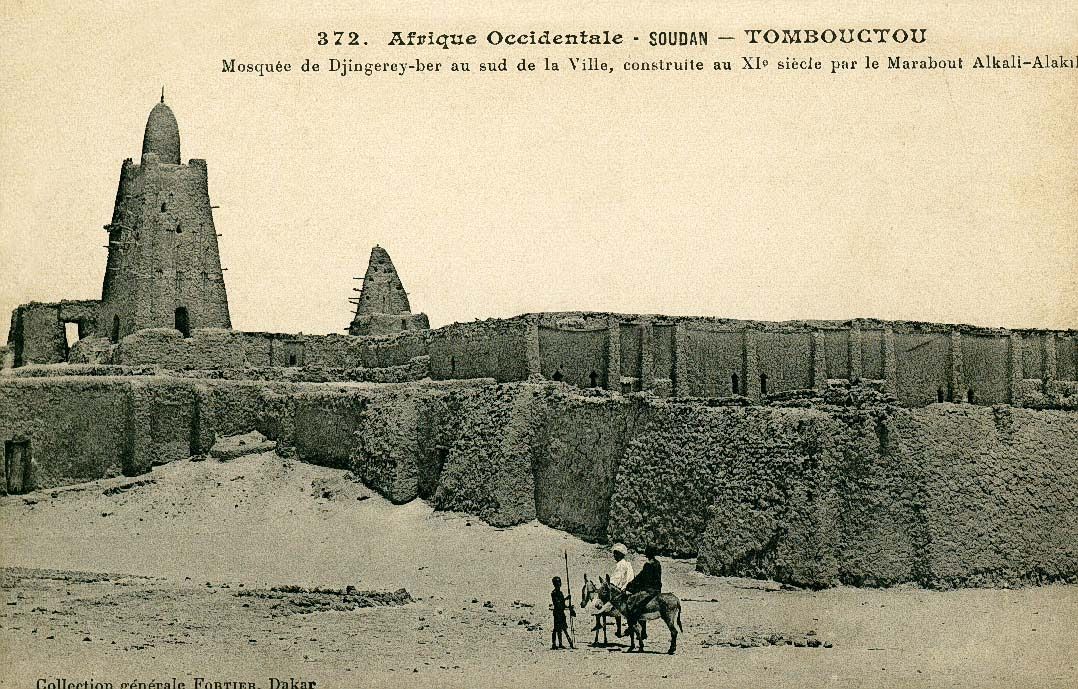
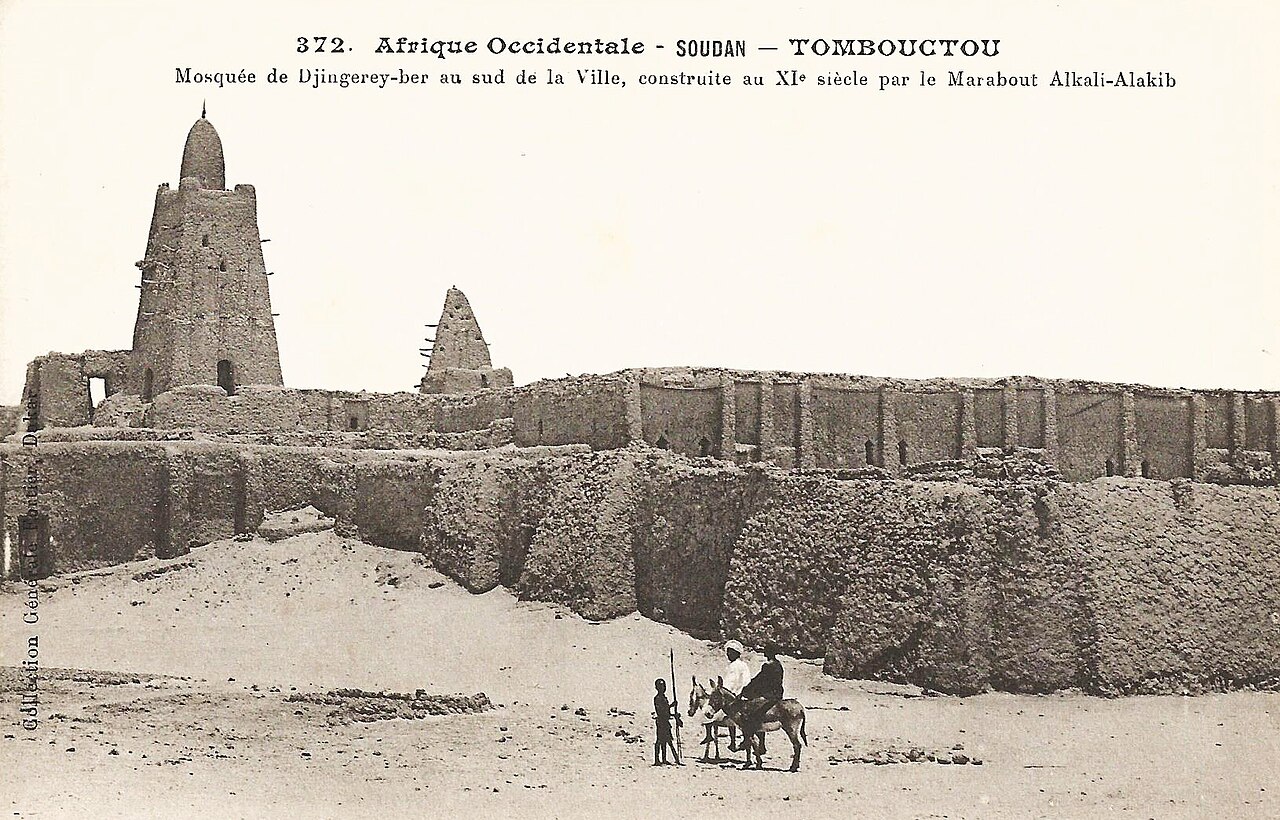
Sepia postcard of the Djinguereber Mosque in Timbuktu. Mud-brick walls and a tall tapering minaret with a domed top stand under a pale sky, with a small tower beside it. Two riders on a donkey and a standing figure with a staff appear in sandy ground in the foreground. Printed captions across the top read 372, Afrique Occidentale, Soudan, Tombouctou, and a French description; a credit line at the bottom left reads Collection générale Fortier, Dakar.Photograph

Secondary source

Djinguereber Mosque, Timbuktu (postcard by Fortier)

Edmond Fortier · c. 1905-1906

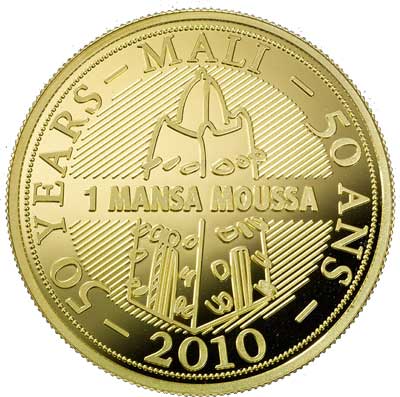
Reverse of a gold-colored commemorative coin. Text reads 'MALI', '50 YEARS', '50 ANS', '1 MANSA MOUSSA', and '2010'. Engraved line drawings of a domed building and a figure with a staff are on the coin.Artifact

Secondary source

Mansa Moussa Commemorative Coin

Africatoine · 2012

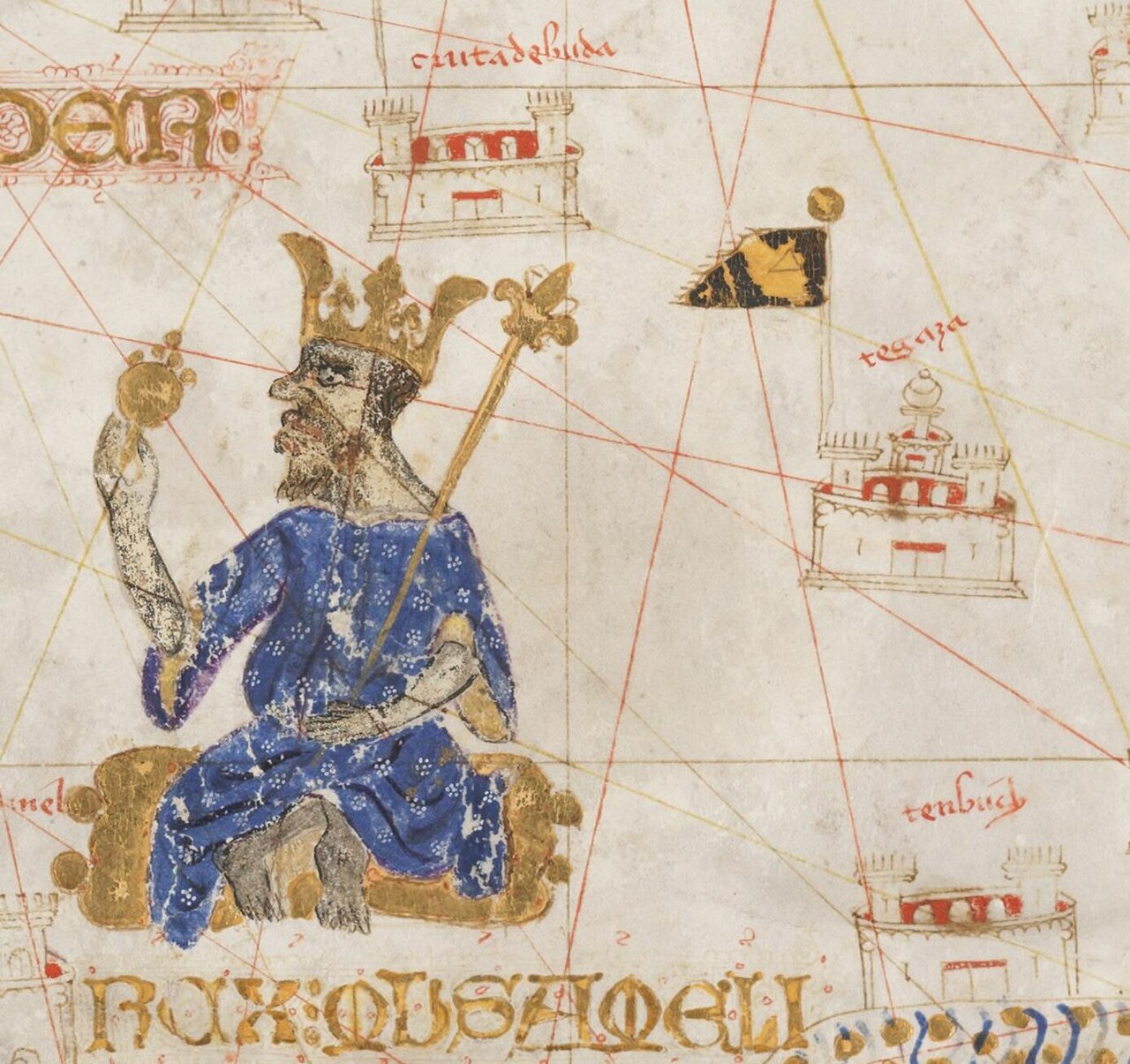
Detail of the 1413 Catalan Atlas portolan chart showing a crowned, seated figure in a blue robe holding a gold orb and scepter, labeled Rex Musa Melli, with castle-like towns and red and gold lettering nearby.Artifact

Secondary source

Mussa Melli on the 1413 Portolan Chart

Mecia de Viladestes · 1413

Sepia postcard of the Djingareyber Mosque in Timbuktu. Its tall mud-brick minaret with a domed top stands at left beside a ruined smaller tower. A long earthen wall runs across the scene. Two men on a donkey and a standing figure with a staff are in the sandy foreground. French caption reads 372 Afrique Occidentale Soudan Tombouctou.Photograph

Secondary source

Djingareyber Mosque, Timbuktu (photo by Fortier)

François-Edmond Fortier · early 20th century

Photograph of the Djinguereber Mosque in Timbuktu, a large mud-brick building with tapering towers and rounded parapets under a pale sky. Several people stand and walk in the sandy street in front of the walls.Photograph

Secondary source

Djinguereber Mosque, Timbuktu

upyernoz · 20 March 2005

Detail of a painted medieval map showing a seated, crowned king figure on a blue ornate throne-like base, with red lettering reading 'REX MUSAMEL' (Rex Musa Mell) on a pale parchment background with red lines.Artifact

Secondary source

Mansa Musa on the 1455 Bartolomeo Pareto Map

Bartolomeo Pareto · 1455

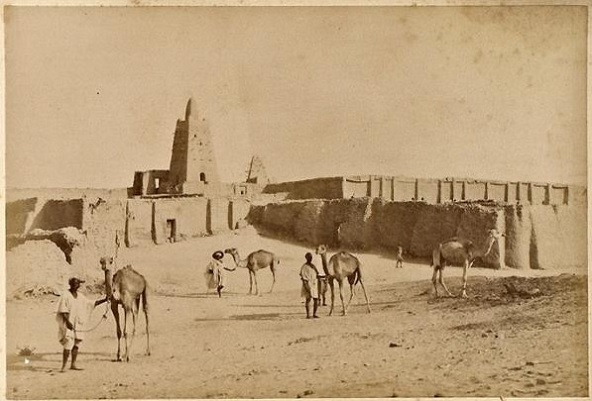
Sepia photograph of a desert town with a tall, tapering mud-brick minaret and a mosque structure behind earthen walls. Several camels and robed men stand in sandy ground in the foreground.Photograph

Secondary source

Djingareyber Mosque in 1893

Louis Archinard · 1893

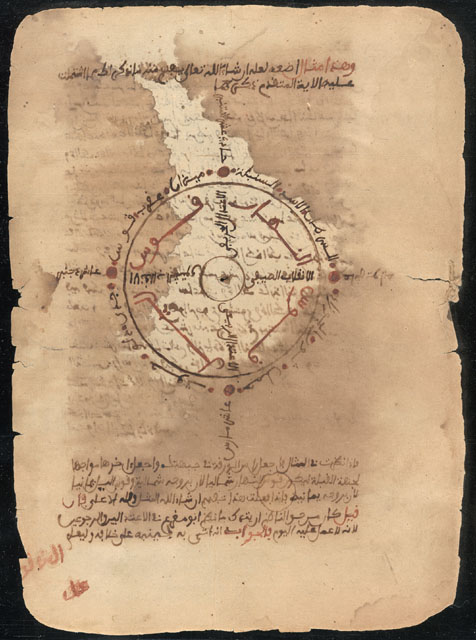
Scan of a worn, stained handwritten Arabic manuscript page on aged paper, with a red and black ink diagram of a large circle divided into sections, with text around its edges and a torn area at upper left. Text fills the top and bottom of the page.Book

Secondary source

Timbuktu Manuscripts

13th–20th century, example page from 1700

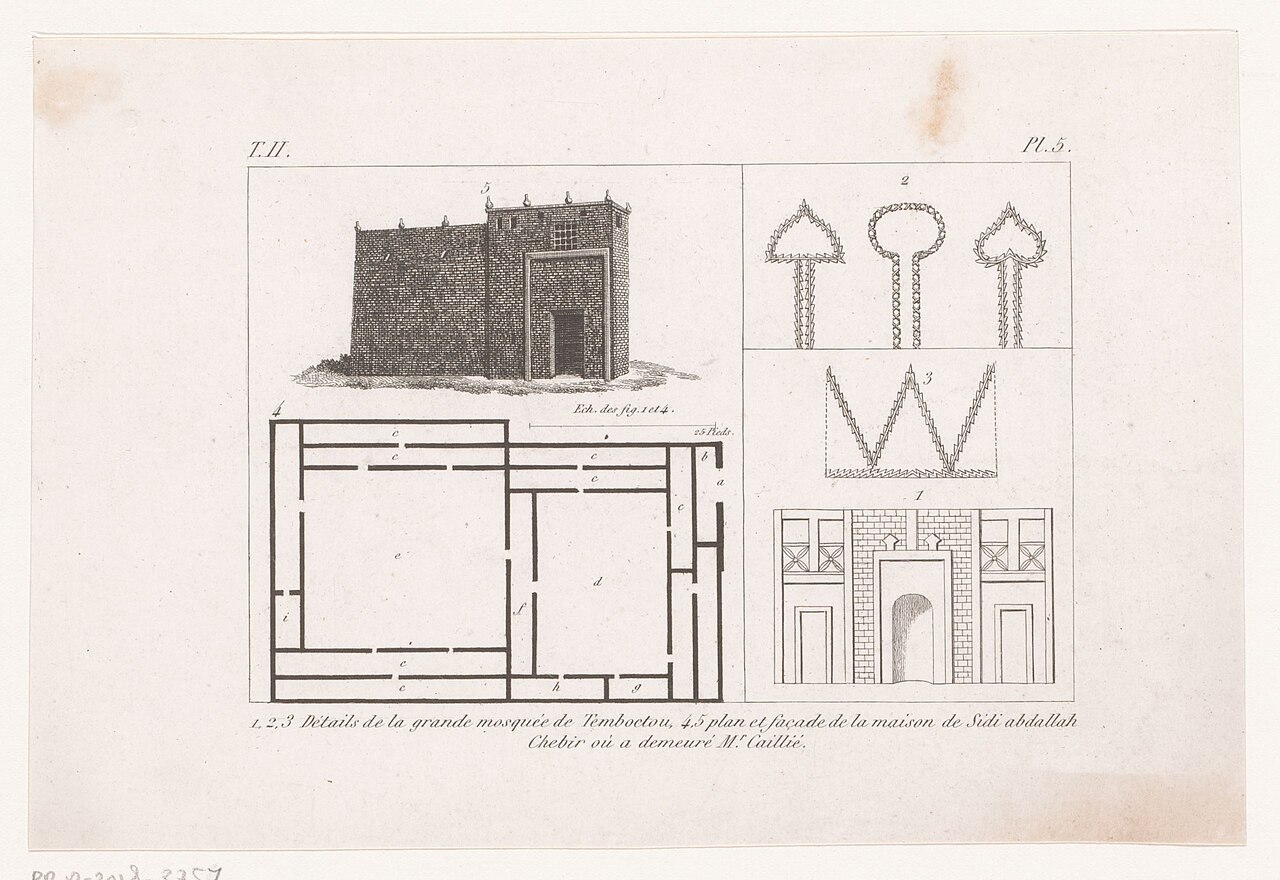
Engraved plate titled T.II, Pl.5. Upper left: a perspective drawing of a brick mosque-like building with a tall doorway and small parapet ornaments. Lower left: a floor plan. Right: three arched decorative motifs labeled 2, a W-shaped motif labeled 3, and a front elevation of a doorway flanked by windows.Painting

Secondary source

Details of the Djinguereber Mosque and the House of Sidi Abdallah Chebir

François Louis Couché · 1830

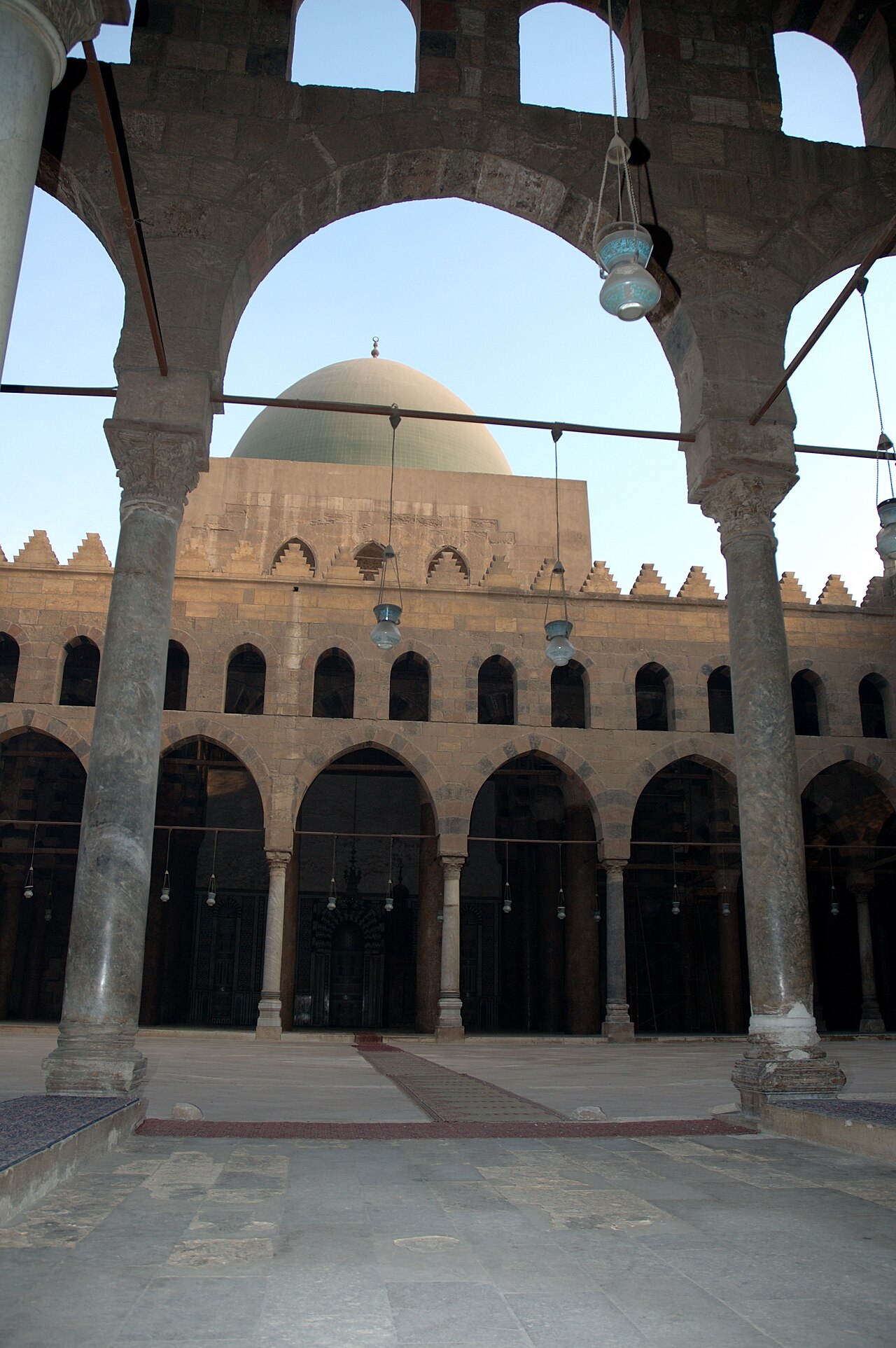
Interior courtyard of a stone mosque with tall grey marble columns and carved capitals supporting pointed arches. Through the arcade, a pale green domed roof and a crenellated stone wall are visible under a clear blue sky. Hanging glass lamps with blue decoration are suspended from the arches.Artifact

Secondary source

Al-Nasir Muhammad Mosque

1318

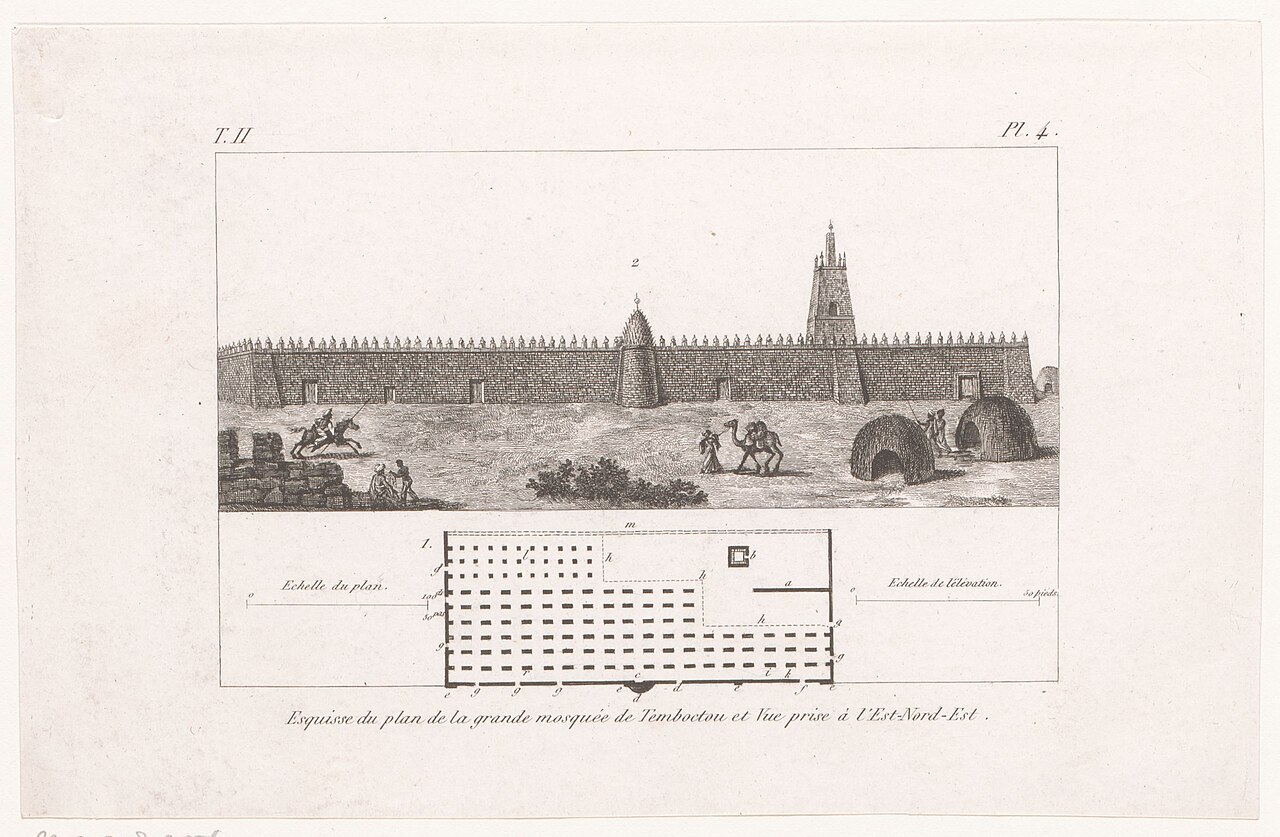
Engraved print showing a view of a walled mosque with a tall minaret and domed tower, with a horseman, a camel rider, and two figures in the foreground. Below is a ground plan of the mosque with rows of columns and labeled letters, and a scale bar on each side. French caption beneath.Painting

Secondary source

View and Plan of the Djinguereber Mosque, Timbuktu

François Louis Couché · 1830

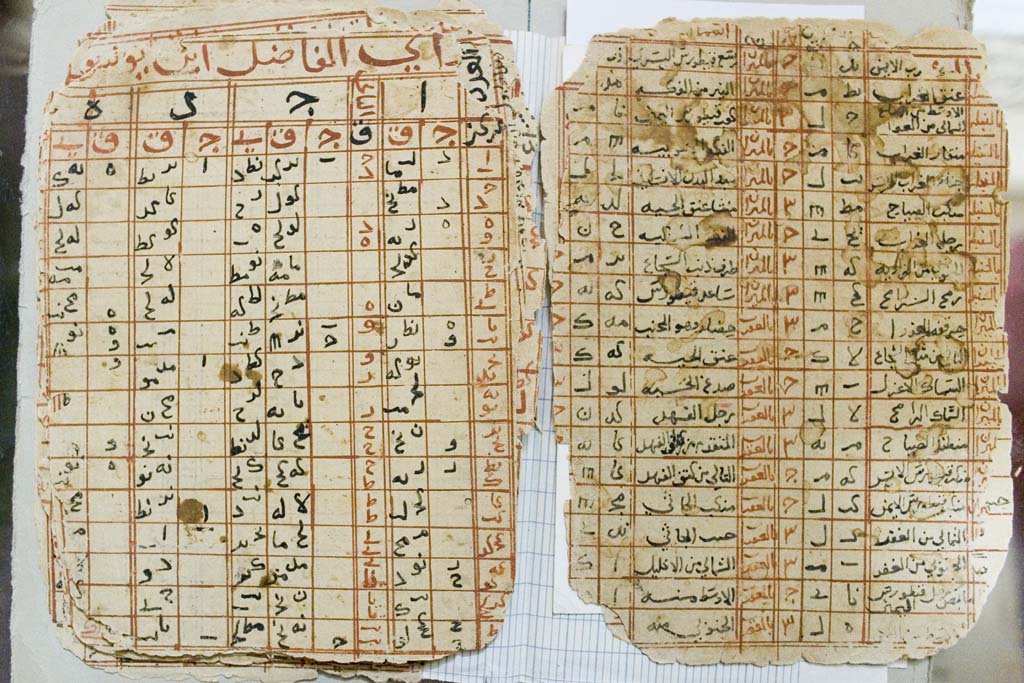
Two loose, torn pages of an aged handwritten Arabic manuscript laid side by side on a grey surface. Both pages have brown ink lines forming ruled tables with columns of Arabic script in black and red ink. The left page is more damaged with a large number of table cells; the right page has a bold tabular layout with stains and worn edges.Document

Primary source

Timbuktu Astronomy Manuscript (Ahmed Baba Institute 2163)

Ibn Yunus · November 2007 (photograph); manuscript by Ibn Yunus, c. 950-1009

Book

Primary source

The Travels of Ibn Battuta, A.D. 1325-1354 (Hakluyt Society edition)

Ibn Battuta · 1354 (English translation published 1958-2000, Hakluyt Society)

Title page of 'A Geographical Historie of Africa, Written in Arabicke and Italian' by John Leo, translated by John Pory, with an engraved printer's device of a shield and crest, printed London 1600 by Georg Bishop.Book

Secondary source

Description of Africa

Leo Africanus · 1550 (written 1526)

Book

Secondary source

A Tropical Dependency

Flora Louise Shaw, Lady Lugard · 1905

Exterior view looking up at the mud-brick Djingareiber Mosque in Timbuktu. A tall tapering tower with a rounded top rises at right, studded with protruding wooden beam ends. A large wooden door with iron studs sits at lower left, with a stepped entrance and a low arched doorway nearby. Plain sky above.Photograph

Secondary source

Courtyard of the Djingareiber Mosque, Timbuktu

KaTeznik · 7 January 2005

Book

Secondary source

Timbuctoo the Mysterious

Félix Dubois · 1897

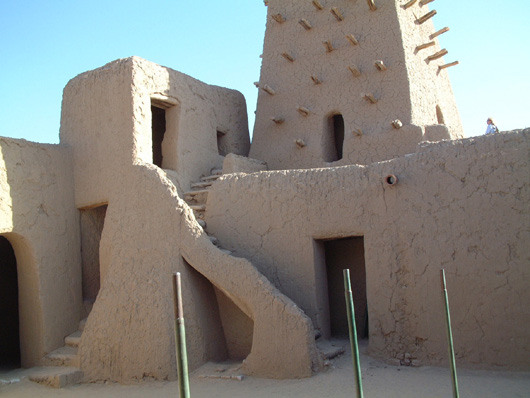
Mud-brick building with sloped walls, projecting wooden beam ends, and a narrow staircase against a wall, with a tall tower in the background under a clear blue sky. Two green poles stand in sandy ground in the foreground, and a person in light clothing is visible at the top right of the tower.Photograph

Secondary source

Main Courtyard of the Djingareyber Mosque, Timbuktu

Taguelmoust · 18 December 2006

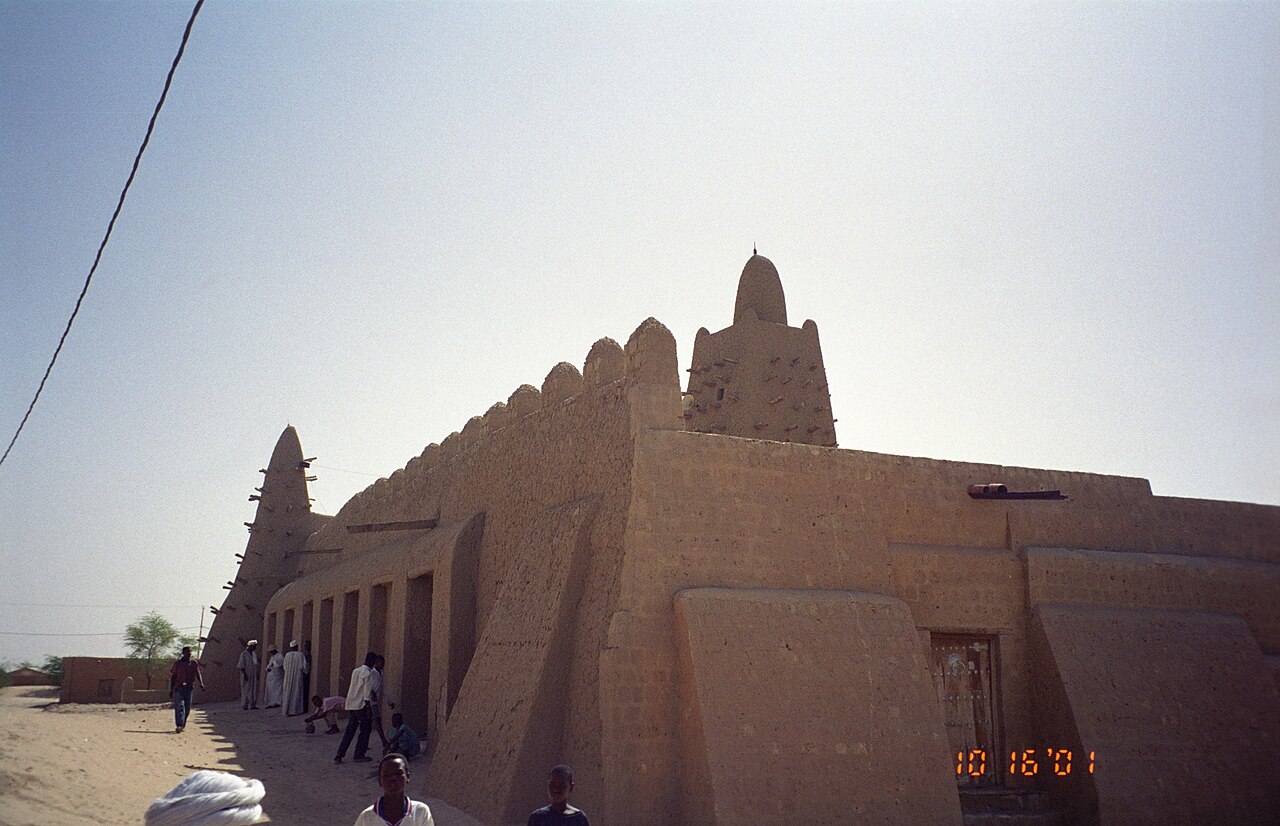
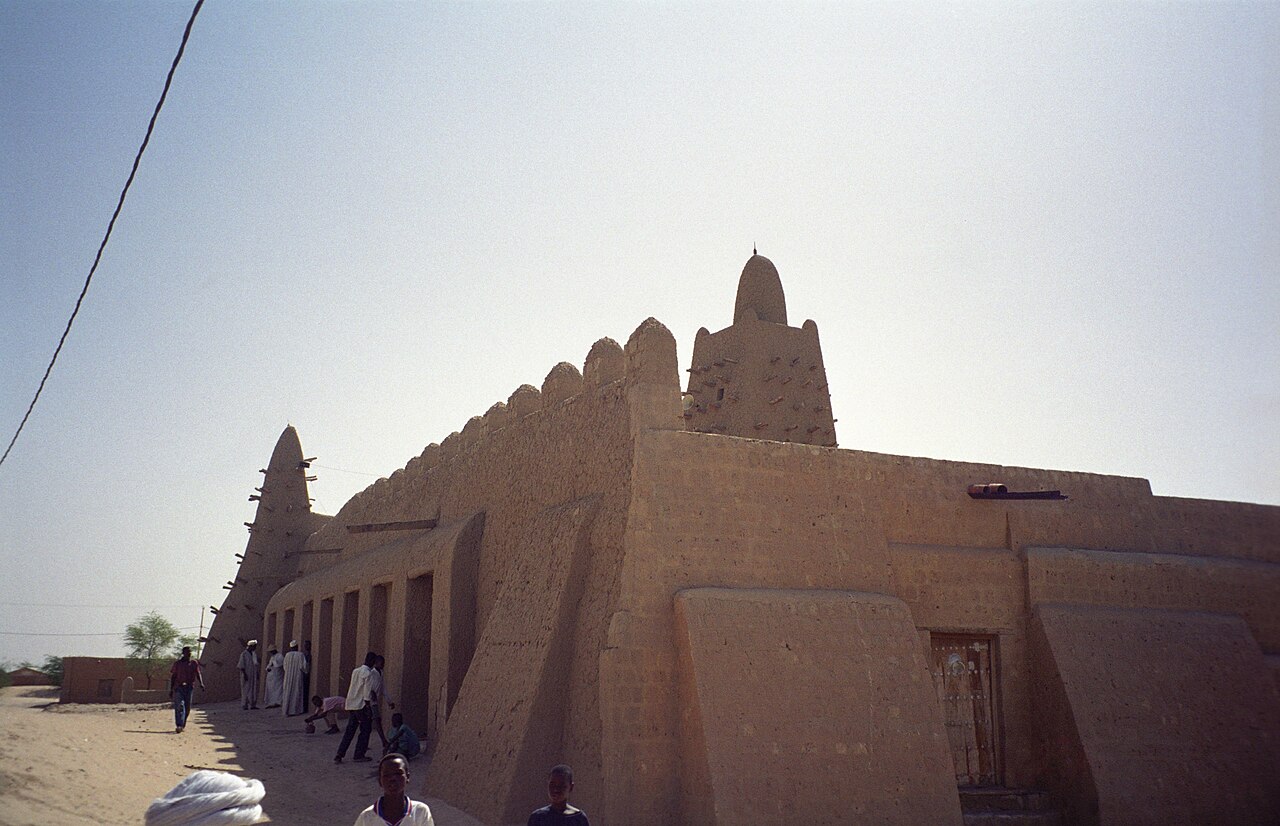
Exterior of a large mud-brick mosque with tapering minaret-like towers and rounded parapets under a pale sky. Several people stand and walk in the sandy street in front of its walls, and a bundle lies at the lower left.Photograph

Secondary source

Djinguereber Mosque, Timbuktu

upyernoz from Haverford, USA · 16 October 2001

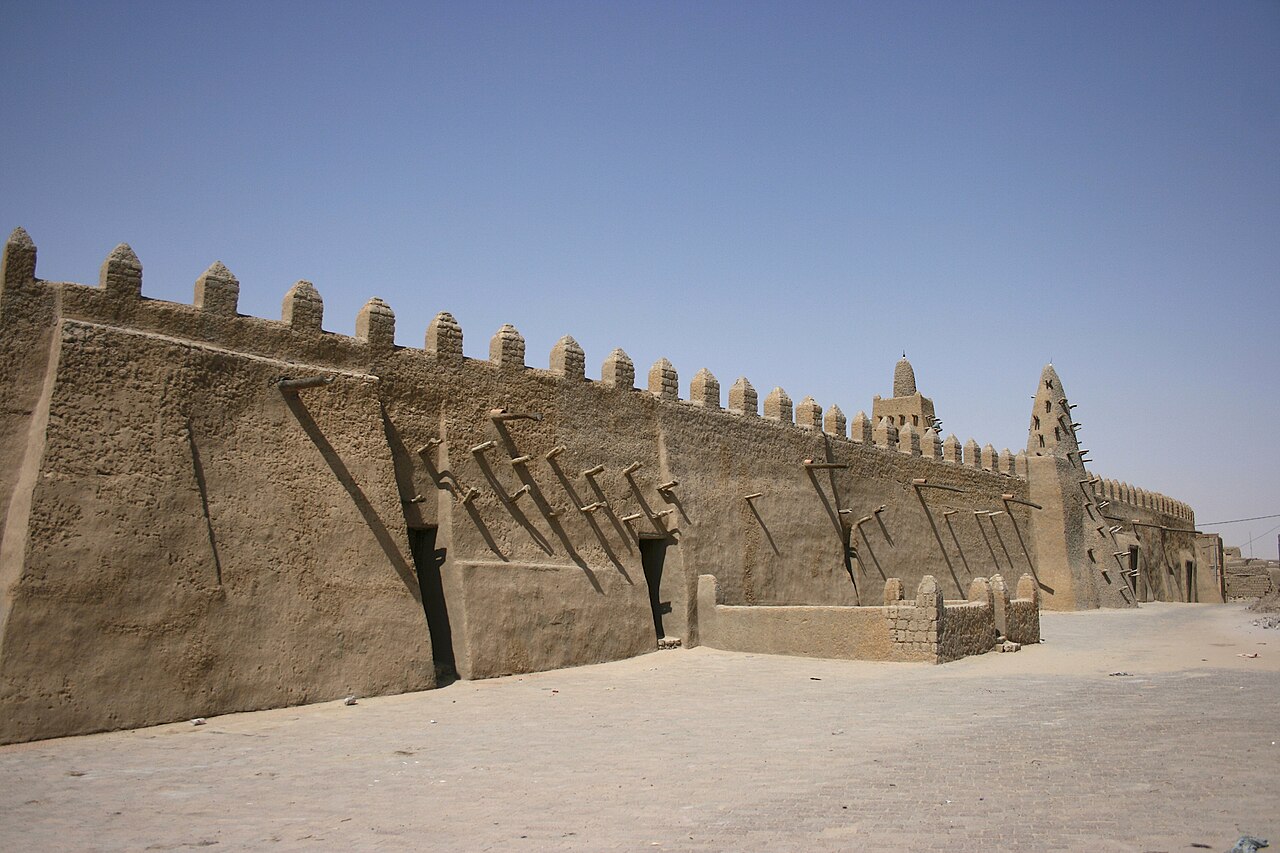
A long mud-brick mosque wall under a clear blue sky, with rows of rounded pinnacles along the top and wooden beam ends projecting from the facade. A tall tapered minaret stands at the right end, and a small sandy courtyard lies in front.Photograph

Secondary source

East Facade of the Djingareyber Mosque

Ousmane Garba Kounta · 12 November 2014

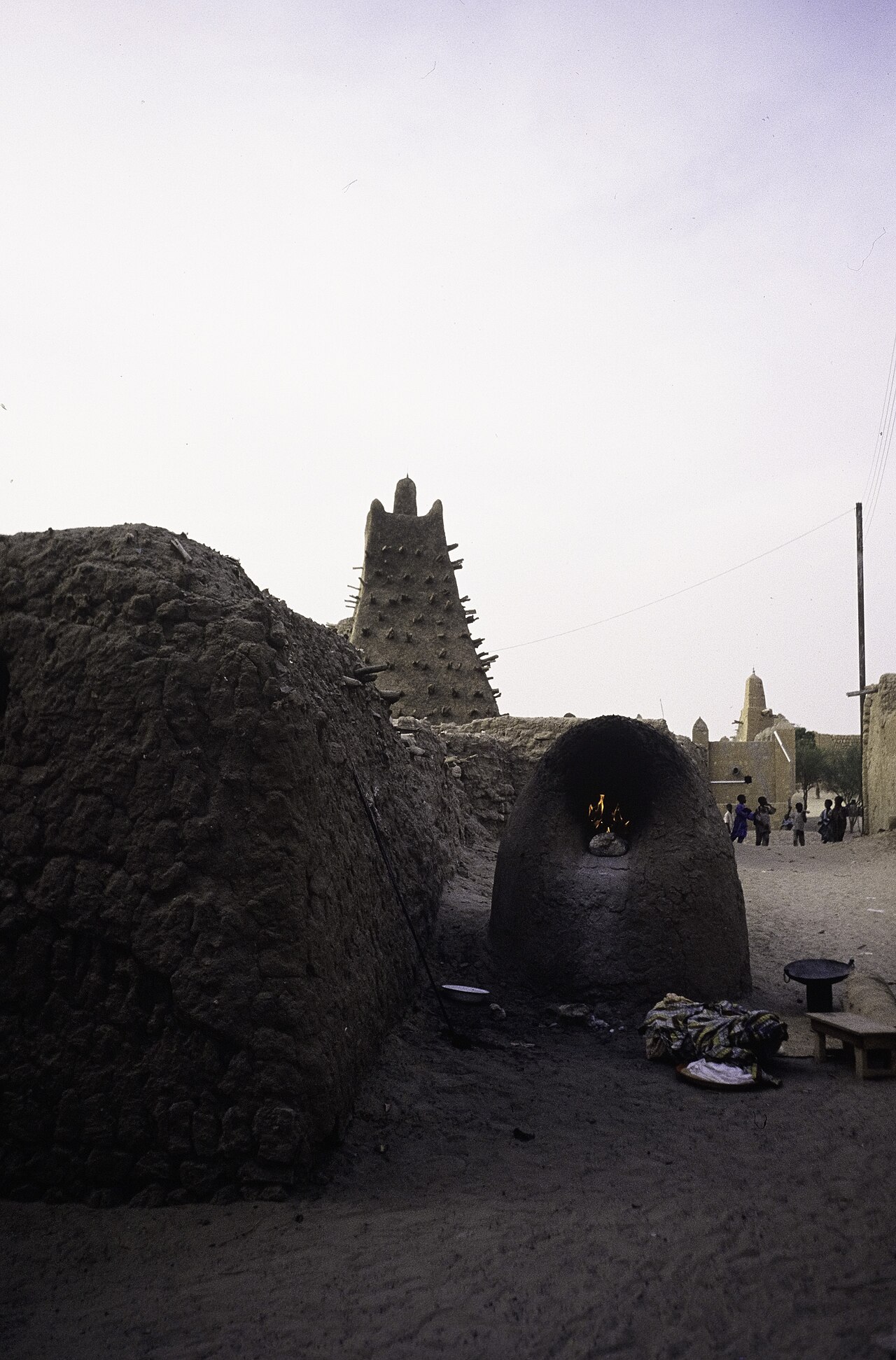
A clay bread oven with a lit fire glowing inside its arched opening, in a dusty courtyard. Behind it rises the tapering mud-brick Djinguereber minaret with wooden pegs projecting from its walls. A utility pole, wires, and a few people stand in the distance on the right. A cloth and a low wooden stool lie in the foreground.Photograph

Secondary source

Bread Oven and Djinguereber Minaret

Angeline A. van Achterberg · November-December 1993

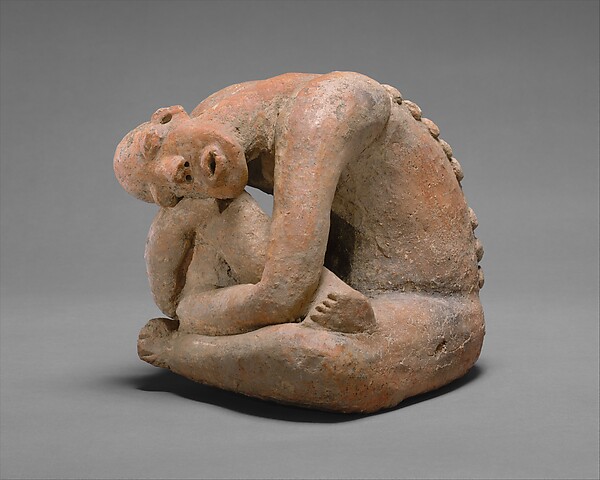
Photograph of a reddish-brown terracotta sculpture of a seated figure on a plain gray background. The figure is hunched forward with its head bowed and resting on one raised arm, with the knees drawn up and the body compact, and the surface shows fine texture and tool marks.Sculpture

Primary source

Seated Figure, Middle Niger Civilization

Middle Niger artist · 13th century

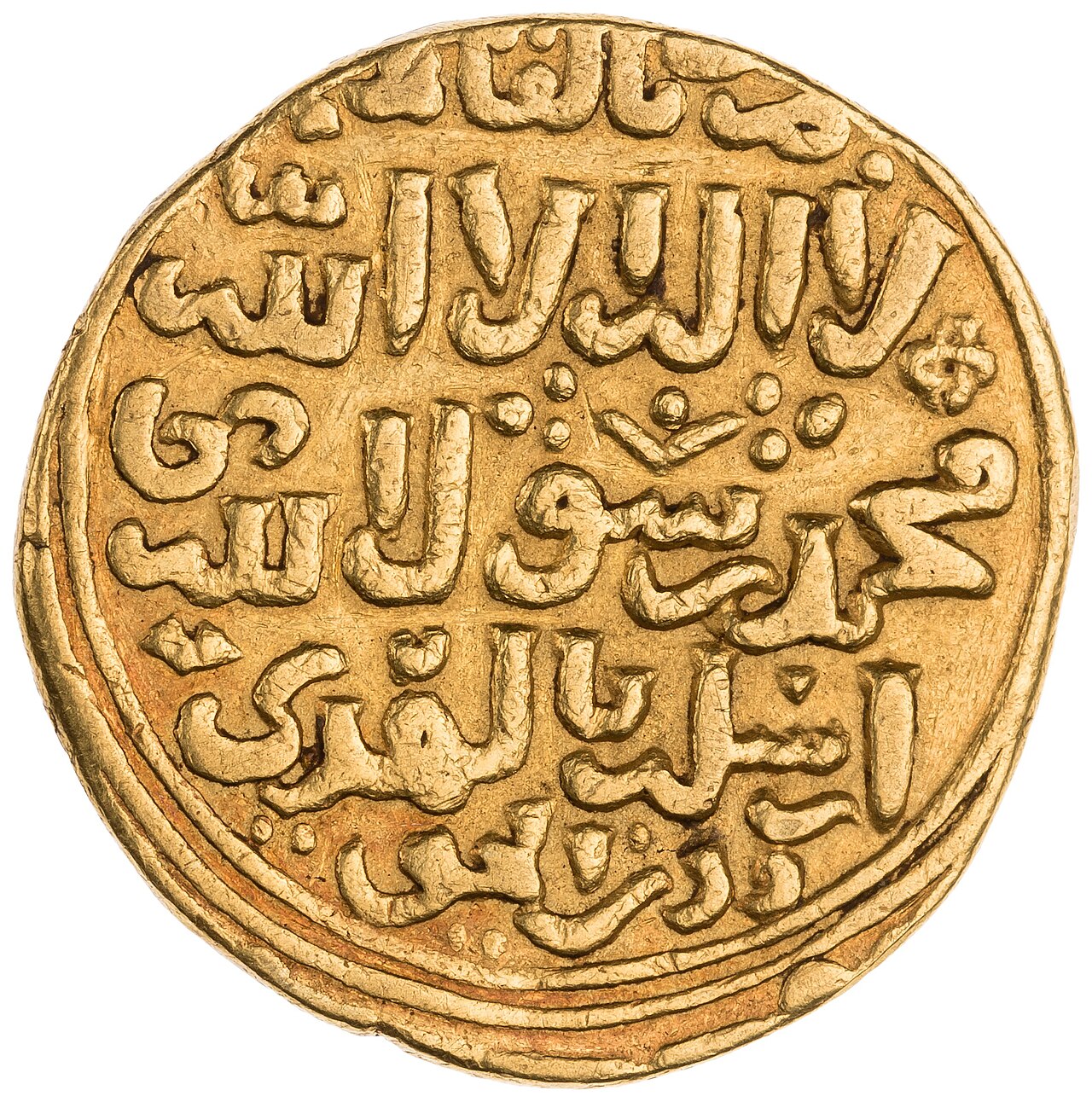
Photograph of a gold dinar coin, reverse side, showing raised Arabic calligraphic inscription arranged in lines across the field of the coin, with a circular border of further inscription and beaded dots near the center.Artifact

Primary source

Gold Dinar of Mamluk Sultan Lajin

1297-99

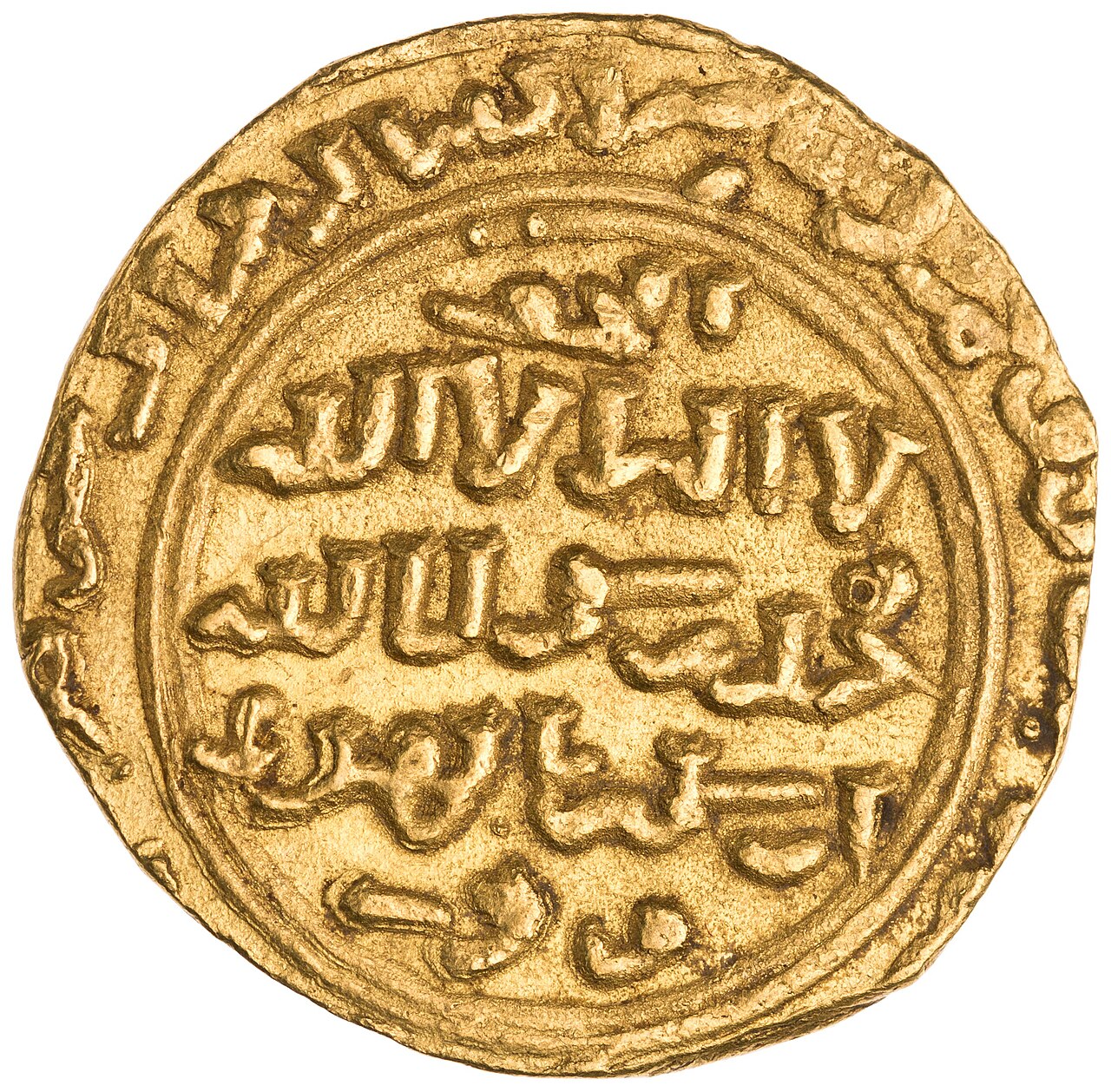
Round gold coin showing Arabic calligraphic inscriptions in raised script across a central field, framed by a border of inscribed text around the edge. The coin has a worn, uneven rim.Artifact

Primary source

Gold Dinar of Mamluk Sultan Qutuz

1260

A scanned page of an Arabic manuscript on aged, stained paper. A large circular diagram with red and black ink sits at the center, with Arabic text in lines around and below it, and a red marginal note at the lower left.Book

Secondary source

Timbuktu Manuscript of Kashf al-Ghummah

Nasir al-Din Abu al-Abbas Ahmad ibn al-Hajj al-Amin al-Tawathi al-Ghalawi · copied 1733

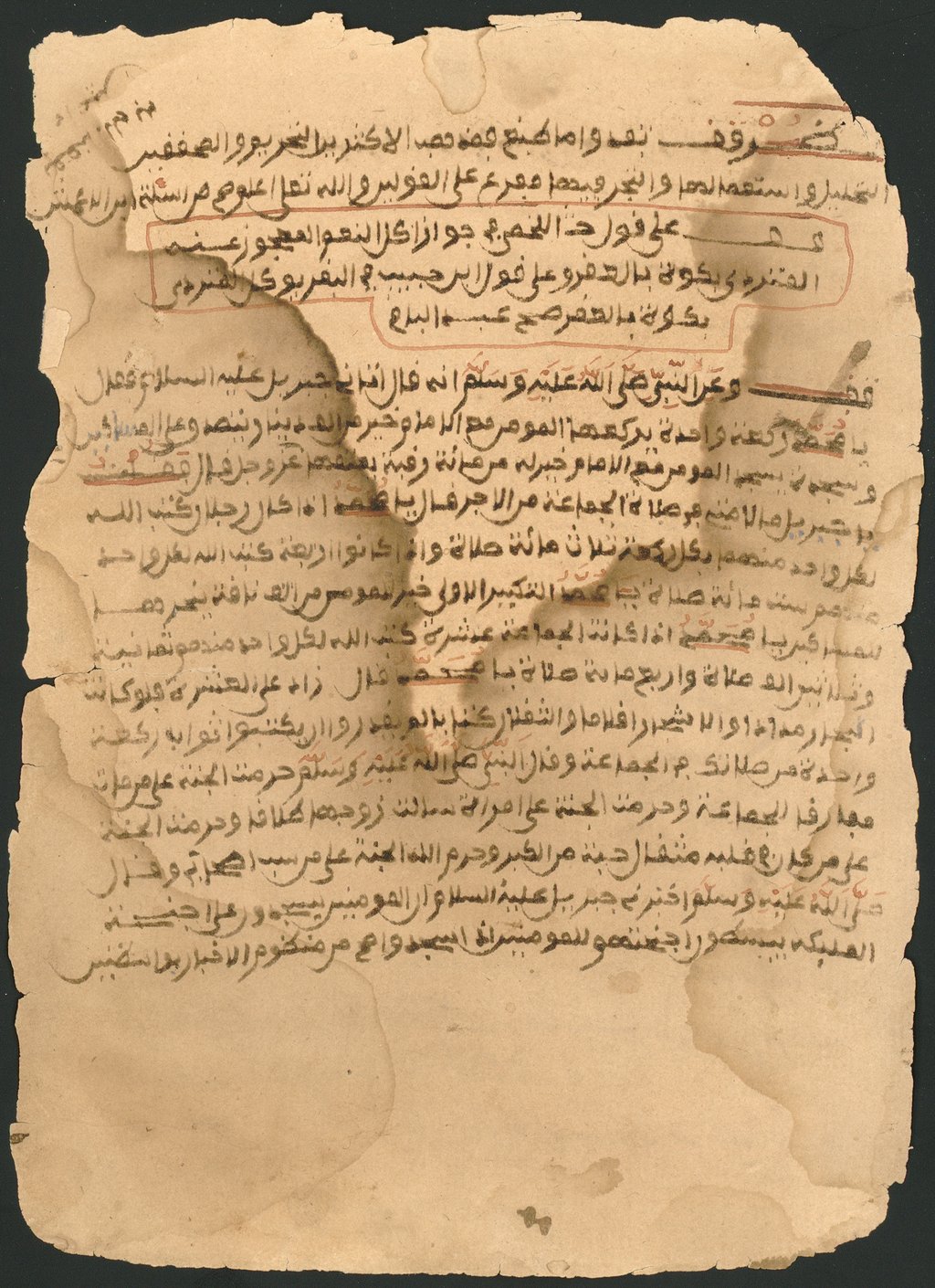
Scan of a handwritten Arabic manuscript page on aged, torn, tan paper with brown scorch marks and a dark burn area down the center. Dark brown ink script in several lines, with some red ink headings and a red-outlined box near the top.Document

Secondary source

Askiyah's Questions and al-Maghili's Answers on Politics

Al-Maghili, Muhammad ibnu Abdul Kareem · c. 1450-1504

Want the full shelf? Chat with Mansa Musa in the app and open the Sources panel — every quote links back to the original.

Use Mansa Musa in class

1 collection

A ready-made collection from the Humy team that features Mansa Musa. Preview it, then try it free.

Trusted by educators worldwide

Conversations
375,000+
Real exchanges between students and historical figures
Messages exchanged
4,142,000+
Across every figure, classroom and language
Historical figures
100,000+
Each informed by a curated biography and selected sources
Languages supported
50+
From English and Spanish to Arabic and Korean

Paying customers

Used by 98 schools and universities

Partner school logo
Tecnológico de Monterrey logo
Hyper Island logo
Partner school logo
Chambersburg Area School District logo
Broward County Public Schools logo
Nebo School District logo
National Louis University logo
South Florida PBS logo
Punahou School logo
University of Wisconsin–River Falls logo
Partner school logo
Partner school logo
Archbishop Mitty High School logo
Kingsburg High School logo
Norwalk Public Schools logo
Partner school logo
Connections logo
Partner school logo
Moore Public Schools logo
Partner school logo
Partner school logo
Partner school logo
Partner school logo
Robbinsville Public Schools logo
Partner school logo
Partner school logo
Partner school logo
Tecnológico de Monterrey logo
Hyper Island logo
Partner school logo
Chambersburg Area School District logo
Broward County Public Schools logo
Nebo School District logo
National Louis University logo
South Florida PBS logo
Punahou School logo
University of Wisconsin–River Falls logo
Partner school logo
Partner school logo
Archbishop Mitty High School logo
Kingsburg High School logo
Norwalk Public Schools logo
Partner school logo
Connections logo
Partner school logo
Moore Public Schools logo
Partner school logo
Partner school logo
Partner school logo
Partner school logo
Robbinsville Public Schools logo
Partner school logo
Partner school logo

What educators are saying

“We enjoyed the program last year and used it frequently.”
“My students say it’s a welcome change of pace. I’m not a fan of the “sage on the stage” model, so I try to incorporate research-oriented and self-paced activities. With Humy, students have to take charge of their learning. They’ve become more adept at critical thinking, forming better questions, and improving their reading comprehension. The interview feature has been my go-to tool. I create assignments where students must ask historical figures a set number of questions, then summarize the responses to ensure they’re truly absorbing the material. This approach lets them actively explore the past rather than passively consuming information.”
“Humy has helped me bring historical figures, sometimes long past, to life. When my students interact with these figures in real-time, it eliminates some of the perceived “ancient” characteristics of my curriculum. This has shifted my students’ thinking away from viewing history as abstract or irrelevant. Real-time interactions make historical figures relatable, even allowing students to ask off-topic questions that help put historical lives in a more relevant context for 13-year-olds. The feature I use the most is the interview feature. After teaching a topic, most recently Gandhi and Joan of Arc, I have the students ask pointed, focused questions. We practice good conversation techniques beforehand, teaching them to listen (or read) carefully and formulate thoughtful follow-up questions rather than just interrogating. It helps students practice effective conversation skills.”

FAQ

Frequently asked questions

Who is Mansa Musa?
Mansa Musa was the tenth Mansa, which translates to "sultan" or "emperor", of the wealthy West African Mali Empire. He is known for his immense wealth and for his pilgrimage to Mecca, during which he distributed so much gold that he caused inflation in the regions he passed through. On Humy.ai you can chat with an AI version of Mansa Musa that draws on a short biography and 42 historical sources during the conversation — by text or voice, in 42 languages.
Is Mansa Musa AI free?
Yes. Mansa Musa is in Humy's free library: a free account includes 20 messages a month with Mansa Musa and the other free figures, by text or voice. No credit card is needed.
What sources does the Mansa Musa AI use?
It draws on a short biography and 42 historical sources (artifacts, books and photographs), including “Catalan Atlas: Mansa Musa Enthroned”, “Tarikh al-Sudan” and “Sankoré Madrasa”. Each source has its own page on Humy.ai.
How historically accurate is the AI version of Mansa Musa?
Each figure uses a short biography and a small set of selected historical sources as context (retrieval-augmented generation), so answers stay closer to known material than the model's general knowledge alone. It isn't a citation-grade research tool — like any LLM, the AI can get details wrong or extrapolate. Treat it as a strong starting point for inquiry and cross-reference important claims.
Can I talk to Mansa Musa by voice?
Yes. In addition to text chat, you can call Mansa Musa and hear their voice respond in real time — useful for auditory learners, interview practice and Socratic dialogue.
Is Humy.ai safe and compliant for schools?
Yes. Humy.ai is used by more than 100 schools, universities and organisations. The platform is FERPA- and GDPR-aligned, supports SSO, and offers an IT-approval pack tailored for school procurement teams.

Ready when you are

Start chatting with Mansa Musa now.

20 messages free · No credit card · Available in 50+ languages.