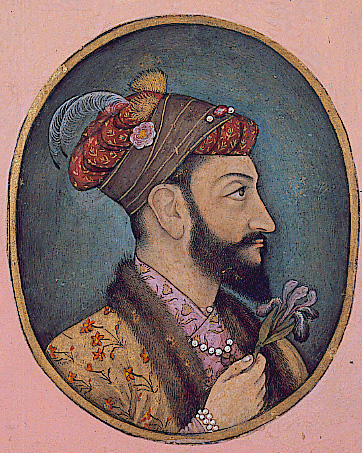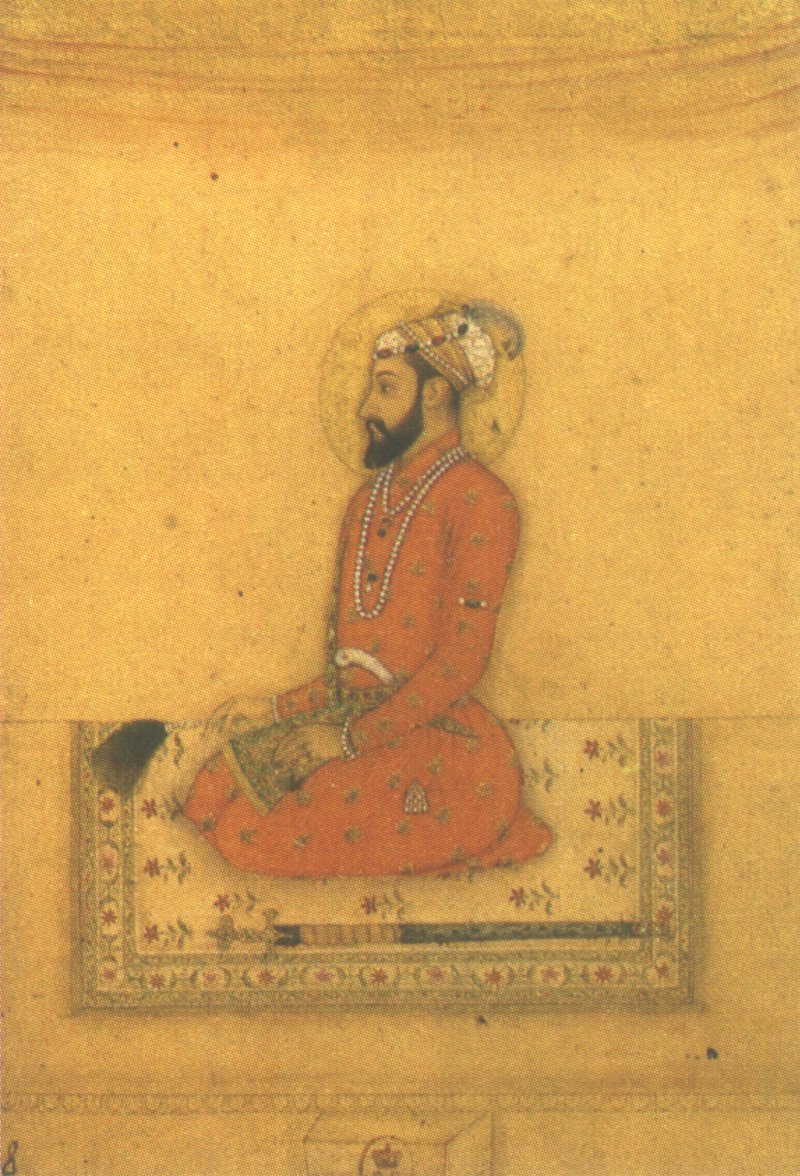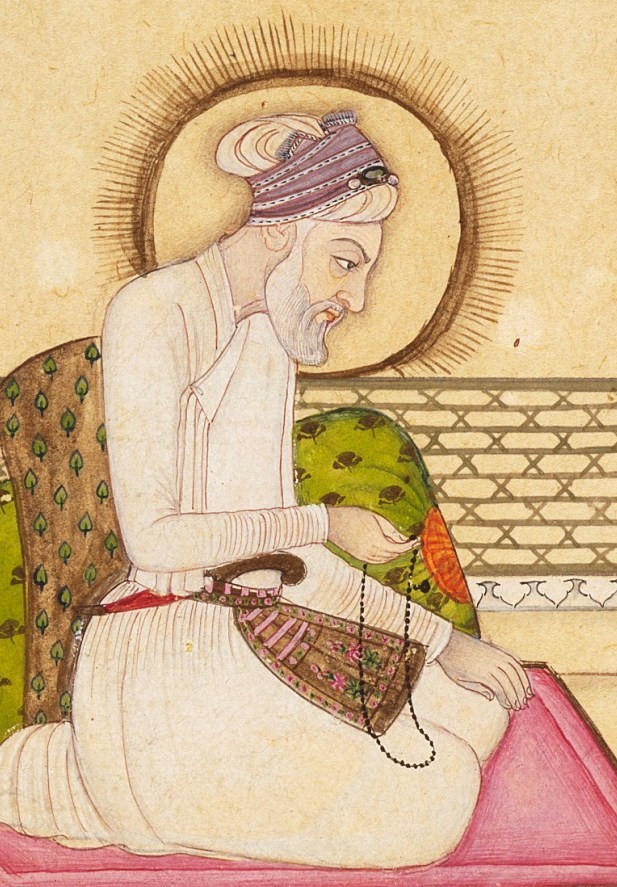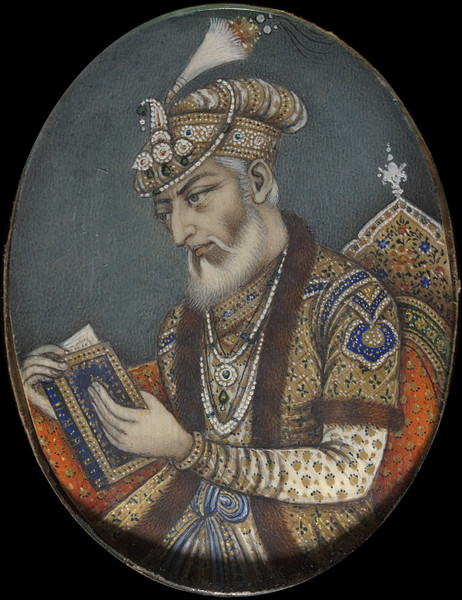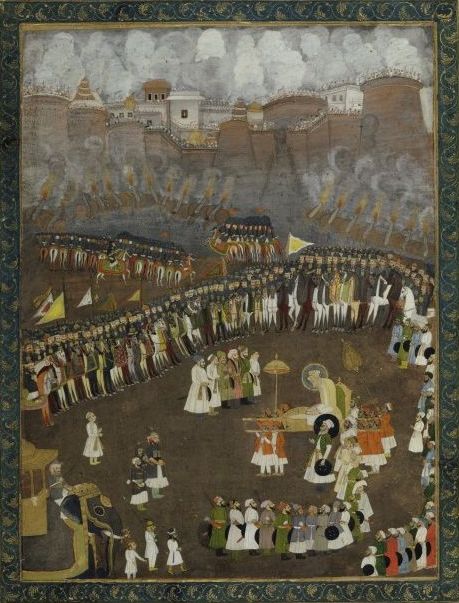

Portrait of Aurangzeb

AI Historical Figure

Aurangzeb

Mughal emperor of India known for his expansion of the empire and imposition of Islamic orthodoxy.

Chat with Aurangzeb via text or voice — in 42 languages, drawing on a curated biography and 95 historical sources. Available 24/7.

Start chatting with Aurangzeb20 messages free · No credit card
Lived
1618–1707
From
India
Known for
Rulers & royaltyPolitics & government
Aurangzeb

Aurangzeb

Online · responds in seconds

Hello — I'm Aurangzeb. Mughal emperor of India known for his expansion of the empire and imposition of Islamic orthodoxy. What would you like to ask me?

20 messages free · No credit card · Powered by Humy.ai

Live preview · Switch between 42 languages above · Send a message to continue in the app

Multilingual

Talk to Aurangzeb in 42 languages

Ask Aurangzeb questions in any language below, and the rest of Humy's app speaks it too. Pick yours to open the chat in that language.

Also in German (Austria), German (Switzerland), English (UK), English (Australia), English (Canada).

The sources behind this AI

95 sources · 43 paintings · 20 books · 14 artifacts · 9 documents · 7 letters · 1 sculpture · 1 photograph

Aurangzeb doesn’t improvise from thin air. The AI is grounded in 95 curated historical sources students can inspect. Open any of them to see what informs the conversation.

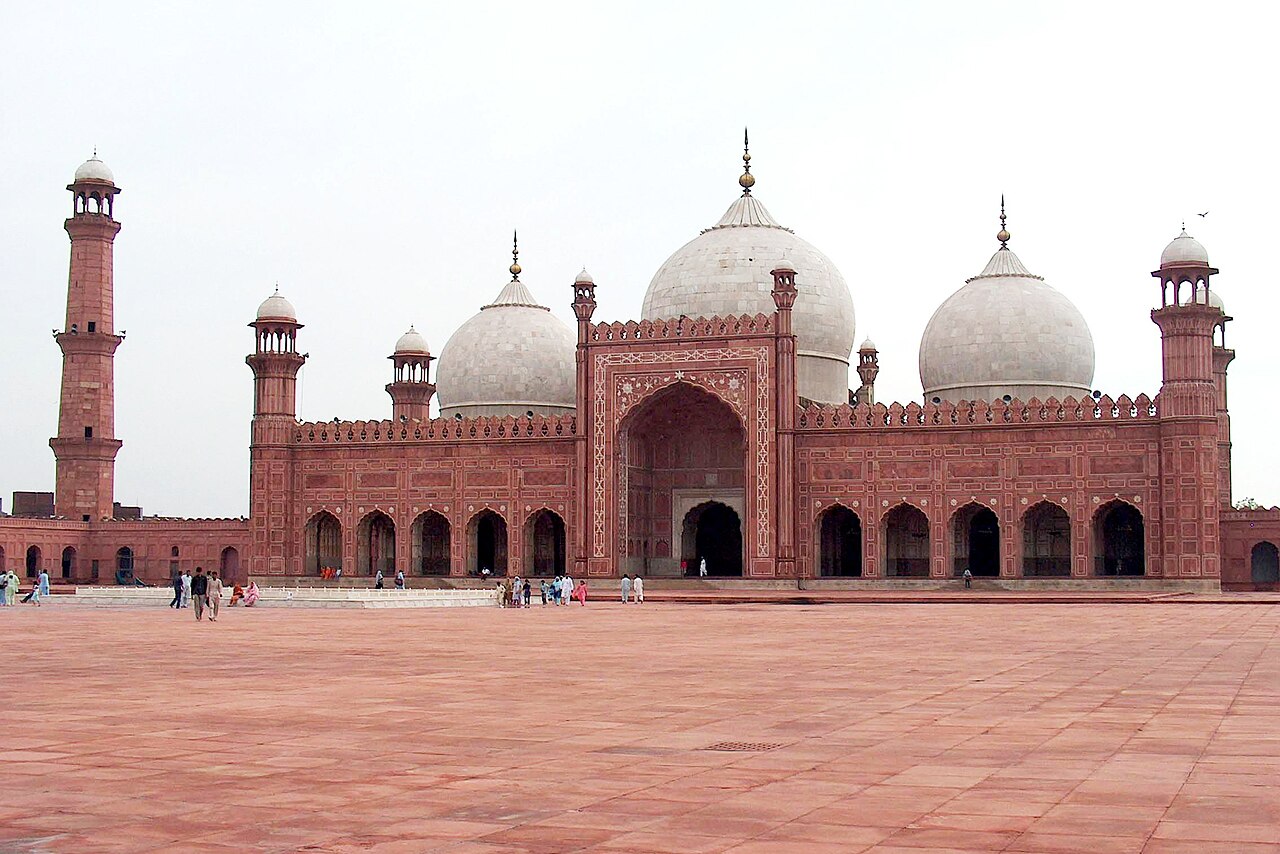
Front view of the Badshahi Mosque in Lahore: red sandstone facade with three large white marble domes, tall minarets with white domed kiosks, a central arched entrance, and a wide red paved courtyard with a few people walking.Artifact

Primary source

Badshahi Mosque

1671–1673

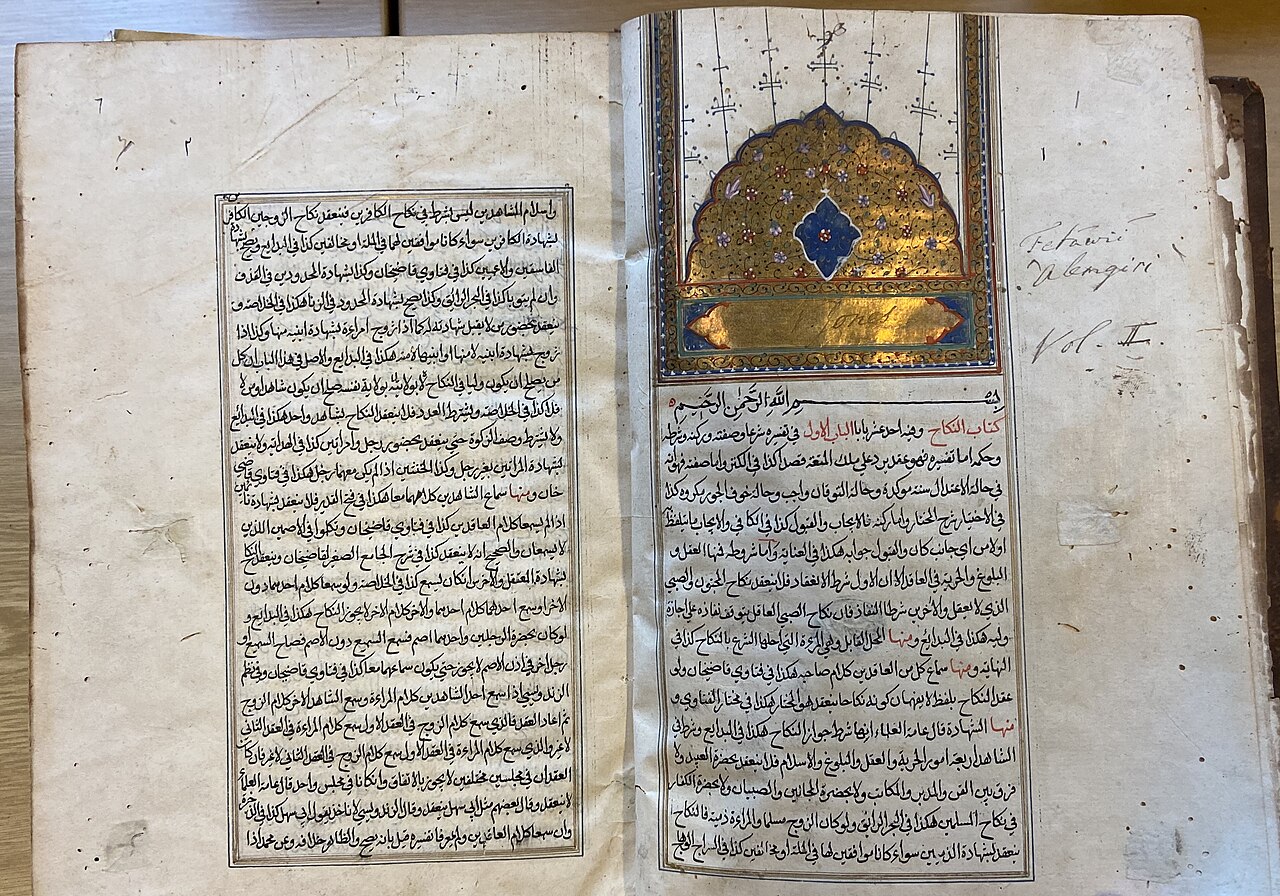
Open manuscript volume in Arabic script on aged cream paper. Left page has dense black text in a block within a ruled border. Right page has an illuminated gold and blue arched frontispiece with floral motifs, below which is a column of handwritten Arabic text with red headings. Handwritten English note in the margin reads 'Fatawa Alengiri Vol. II'.Document

Primary source

Fatawa-i Alamgiri Manuscript

17th century (this copy later recopied)

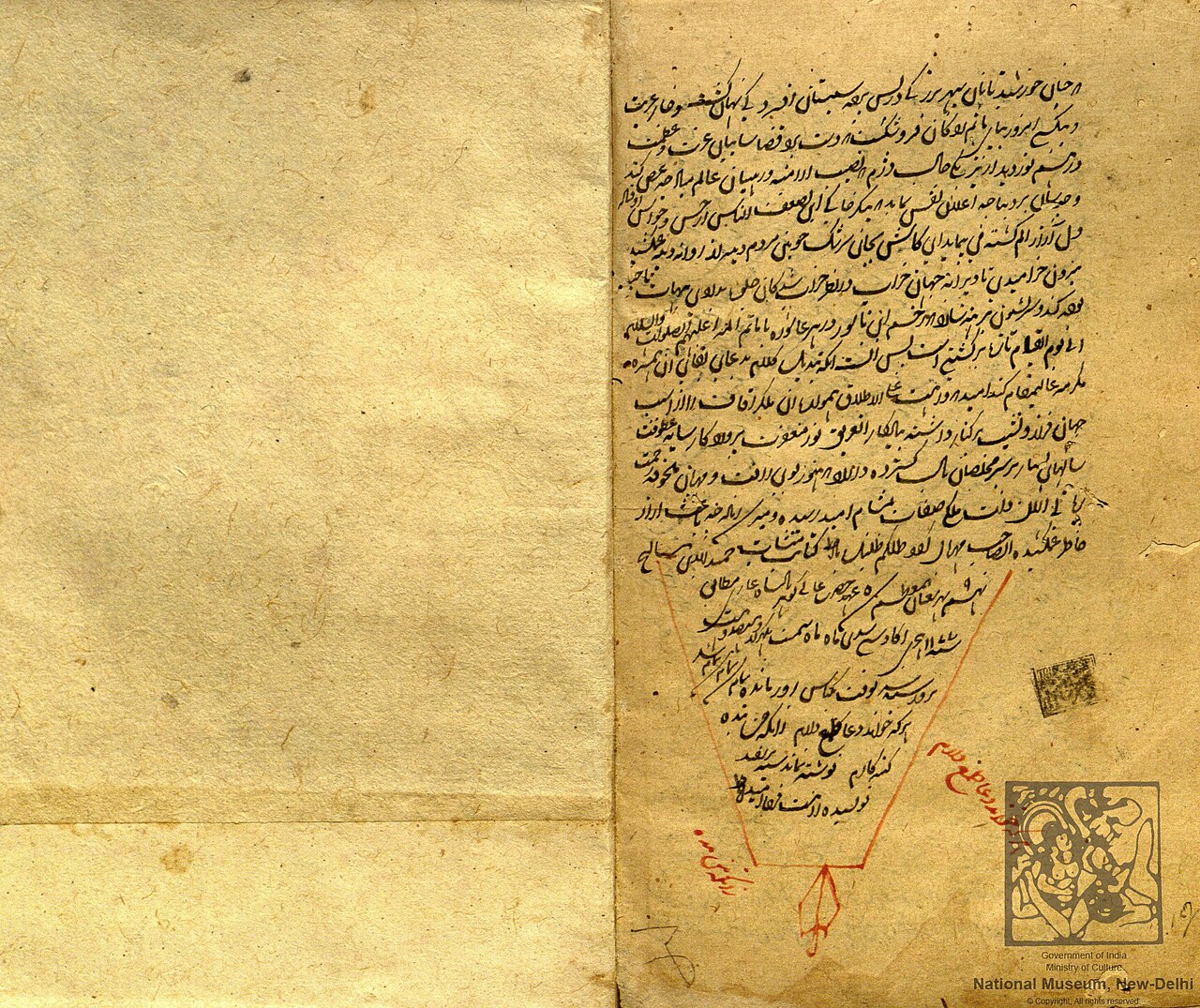
Scan of a handwritten page in Persian nastaliq script on aged cream paper, with red ink markings and a red-outlined geometric symbol at the bottom. The left half of the spread is blank. A museum stamp reads National Museum, New-Delhi.Book

Secondary source

Maasir-i-Alamgiri

Saqi Musta'id Khan · c. 1710 (this copy 1763-1764)

Letter

Primary source

Ruka'at-i-Alamgiri

Aurangzeb · 17th century

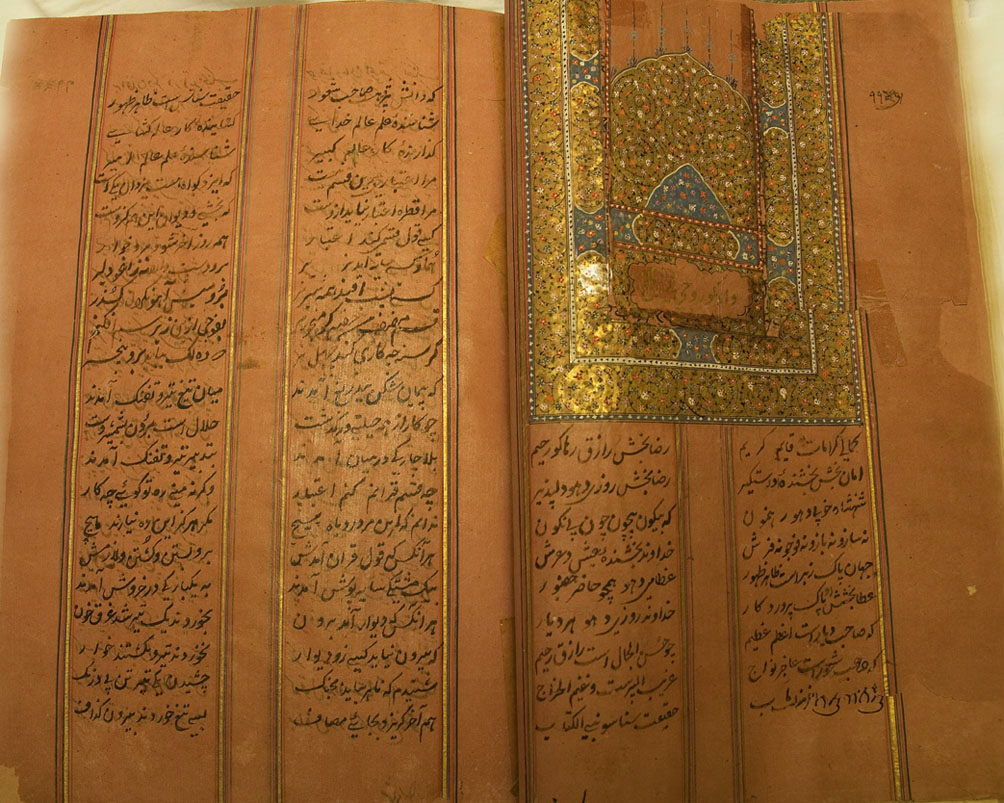
Open manuscript on reddish-brown paper with dense black Persian-style script in vertical columns. On the right page, an ornate gold and floral illuminated frame with a blue arched panel surrounds a small text box.Letter

Primary source

Zafarnamah

Guru Gobind Singh · 1705

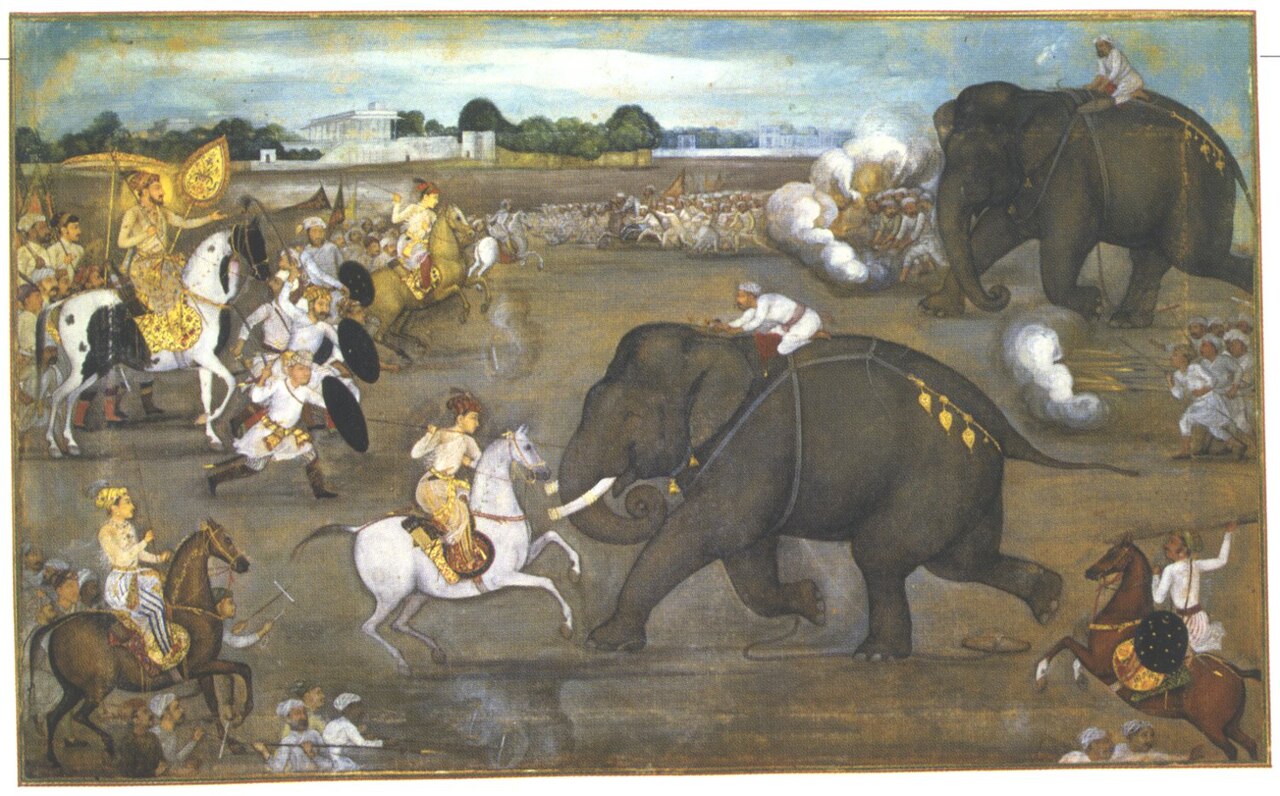
Mughal miniature painting of a royal elephant hunt on a wide plain. A large grey elephant with gold trappings and a mahout charges toward a rider on a white horse in the center. Mounted and foot soldiers, a second elephant with smoke puffs, and a walled city with domes in the background fill the scene.Painting

Primary source

Prince Aurangzeb Facing the Maddened Elephant Sudhakar

Attributed to Payag (Mughal court artist) · c. 1635

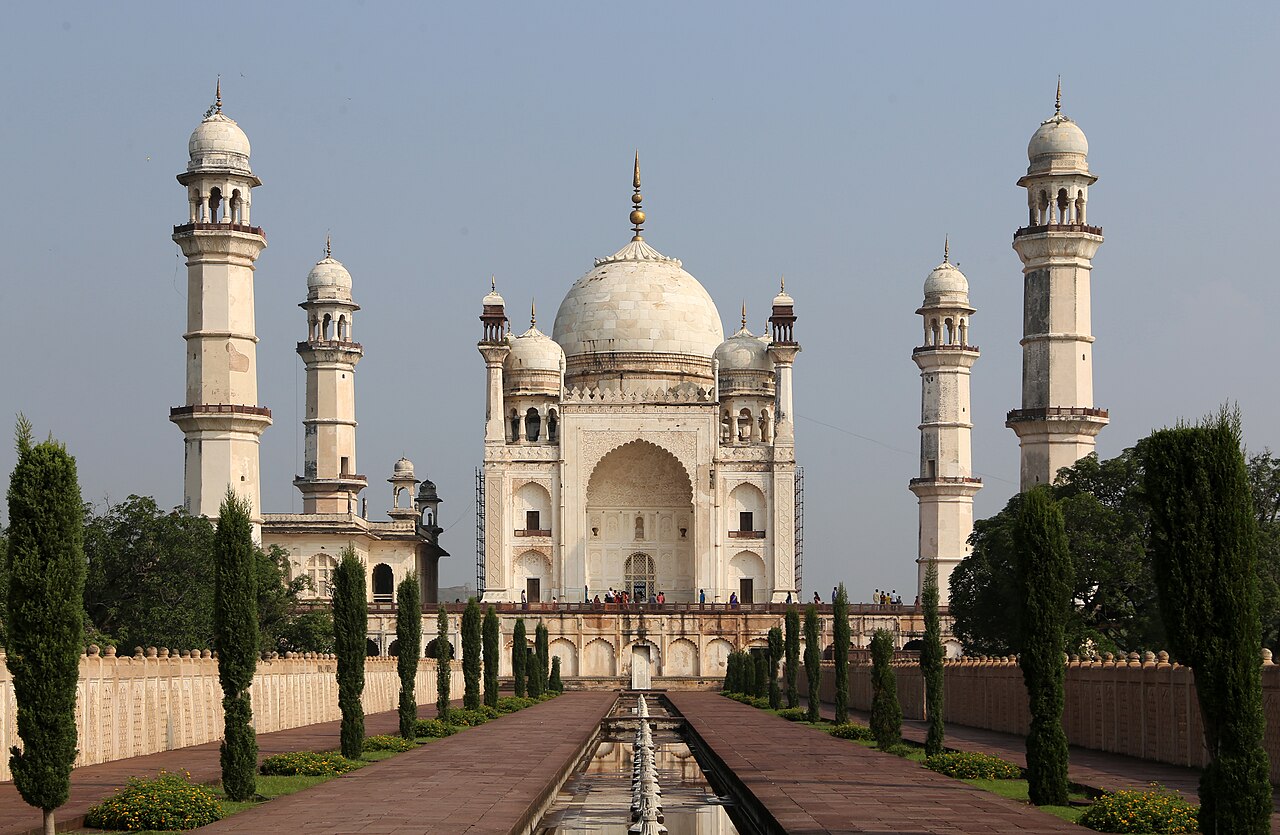
Front view of the Bibi Ka Maqbara mausoleum in Aurangabad: a white marble central dome with a golden finial, flanked by smaller domed corner pavilions and four tall slender minarets, with a long reflecting pool and cypress trees in the foreground under a pale sky.Artifact

Secondary source

Bibi Ka Maqbara

Ataullah Rashidi (architect) · 1660s, completed c. 1668-1669

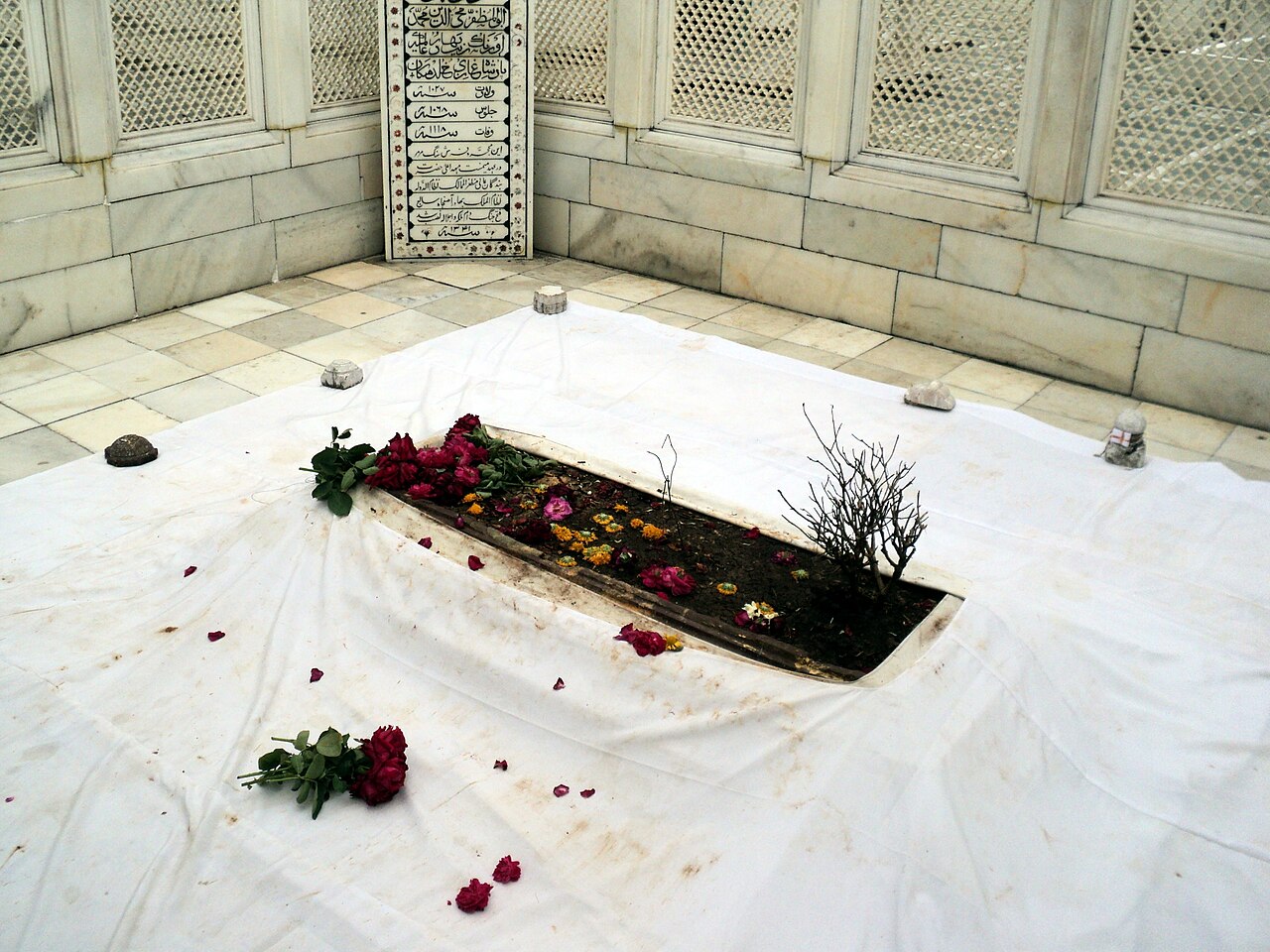
Simple open grave of white marble in a marble-walled courtyard, covered with a white cloth, with dark soil planted with marigolds, rose petals and a small bare shrub. An inscribed marble panel stands against the wall behind.Artifact

Secondary source

Grave of Aurangzeb

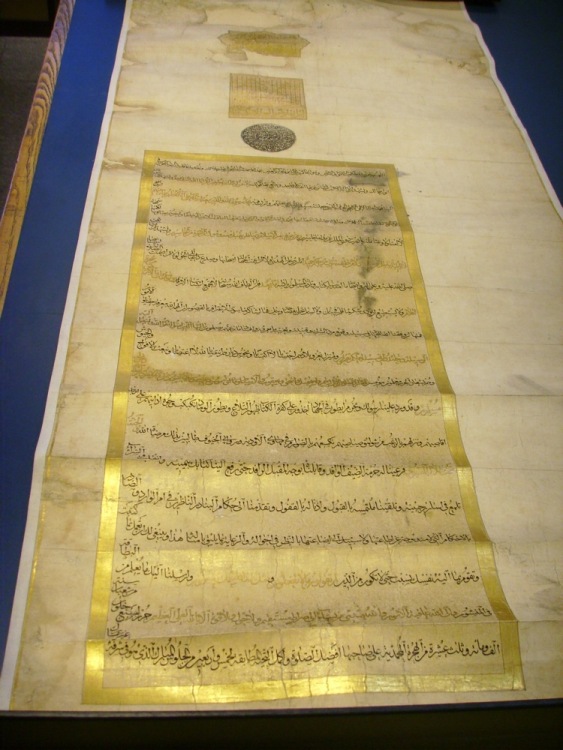
Photograph of a long, mounted parchment letter laid out on a blue surface. Gold-bordered text panels in Persian script fill the page, with a gilded seal impression and a small round seal near the top. Edges show age and staining.Letter

Primary source

Letter from Aurangzeb to William III

Aurangzeb · 7 January 1702

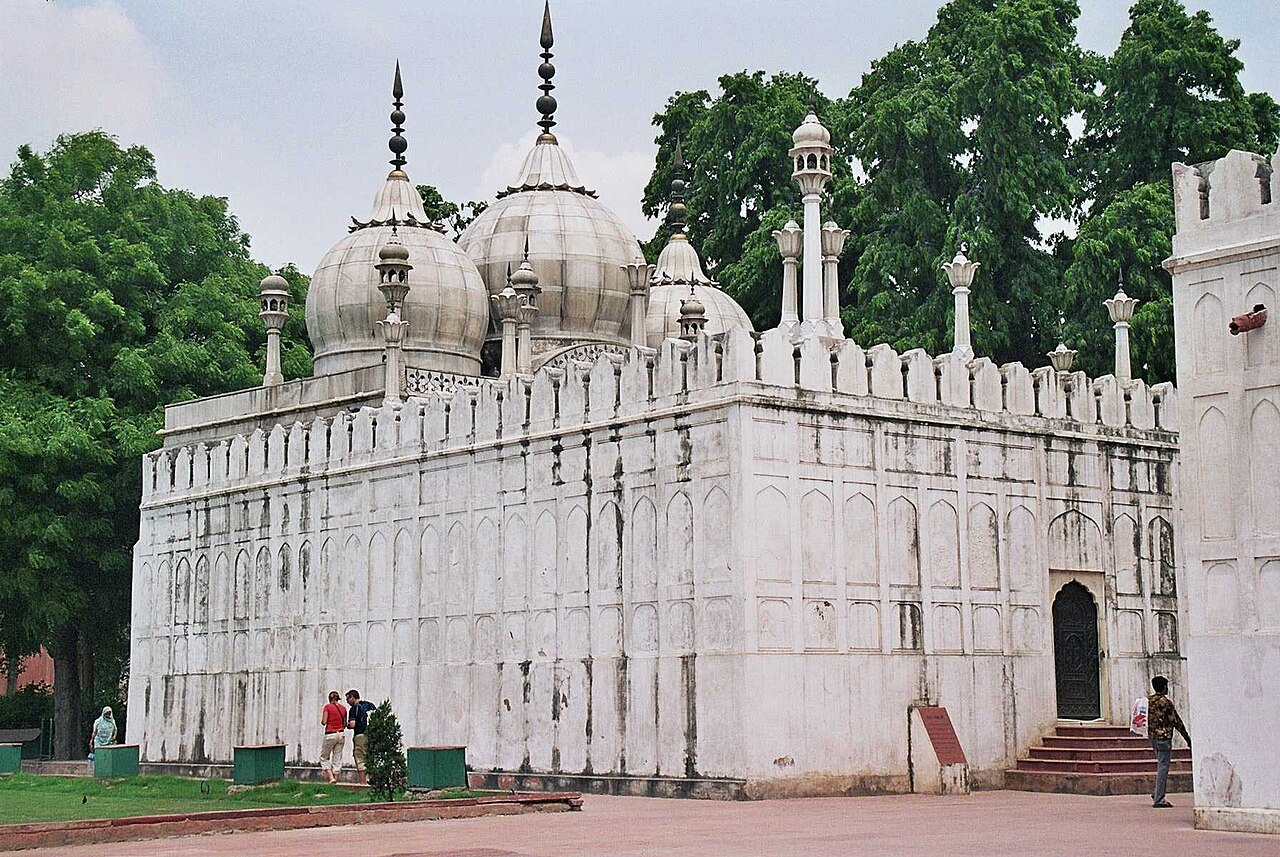
A white marble mosque with three bulbous domes on finials, a parapet with crenellated edges, and arched recessed panels on its walls. Tourists stand near a green bin at the base, and a dark wooden door sits at the top of a red stone staircase.Artifact

Secondary source

Moti Masjid, Delhi

1659-1663 (completed 1662/1663)

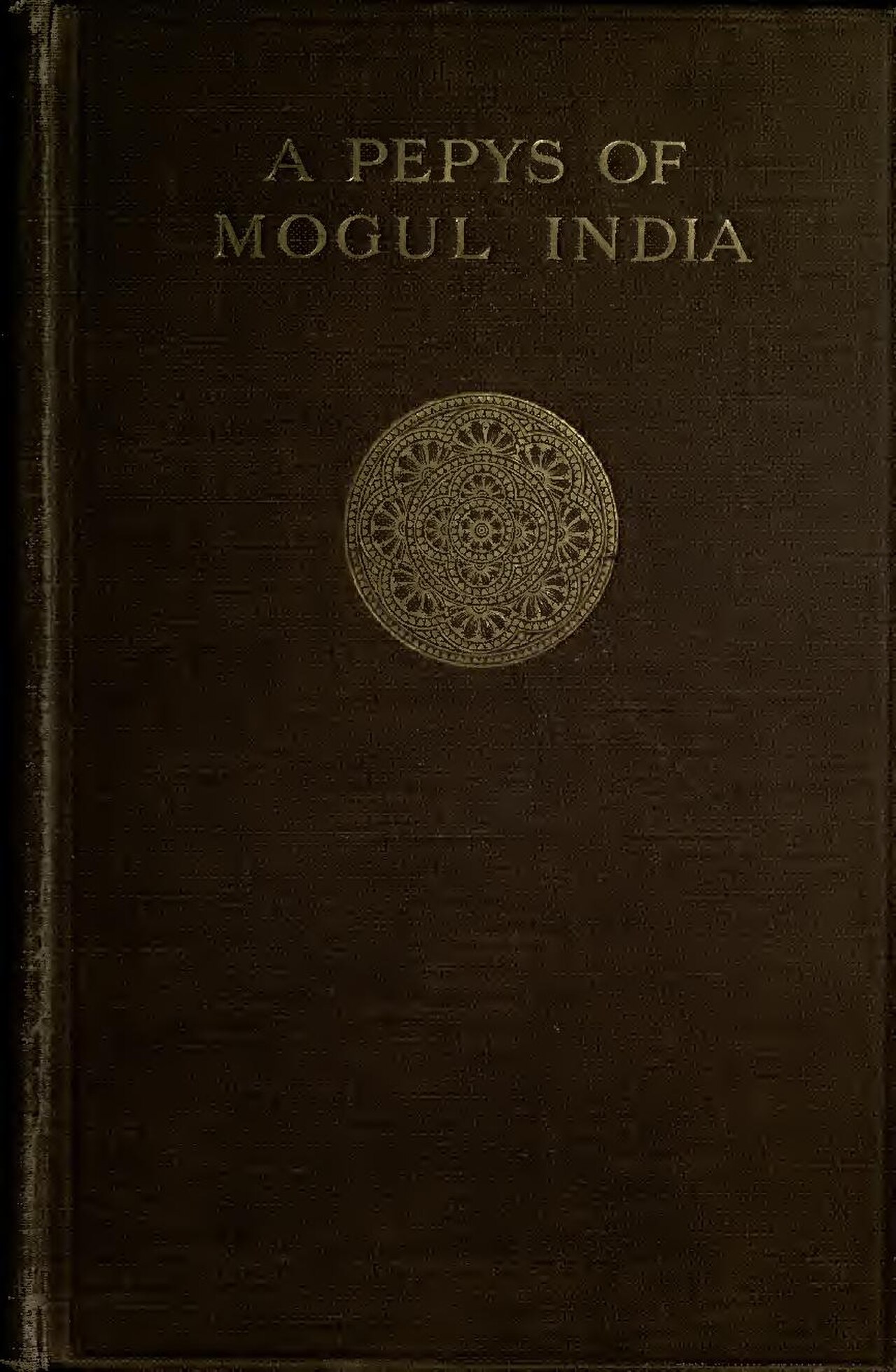
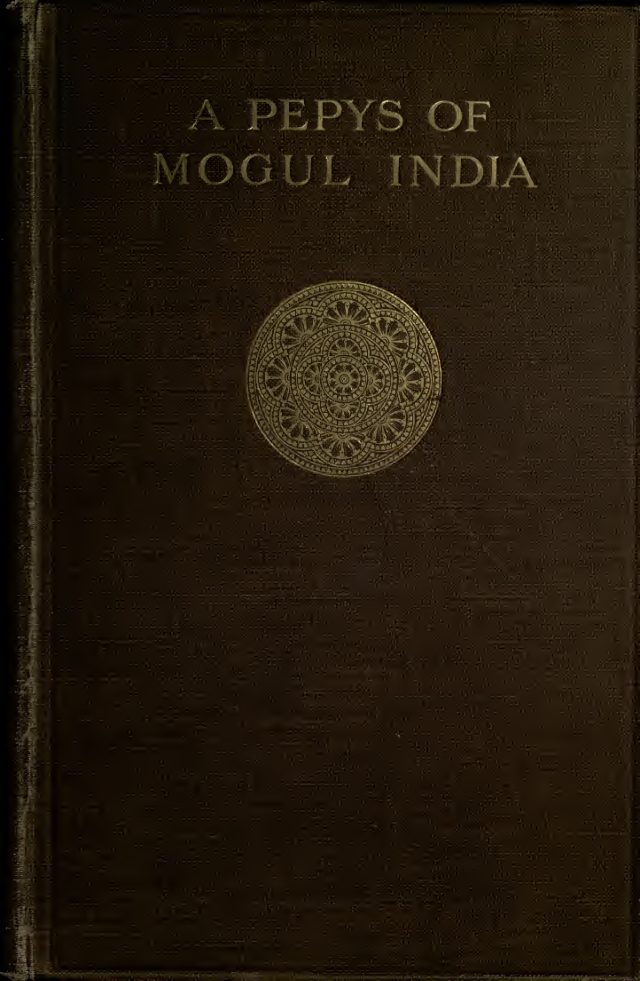
Dark brown cloth book cover with gold-colored title text reading 'A Pepys of Mogul India' and a circular ornamental medallion with a radiating floral and geometric pattern in the center.Book

Primary source

Storia do Mogor

Niccolao Manucci · c. 1699-1709 (written); published 1907 in translation

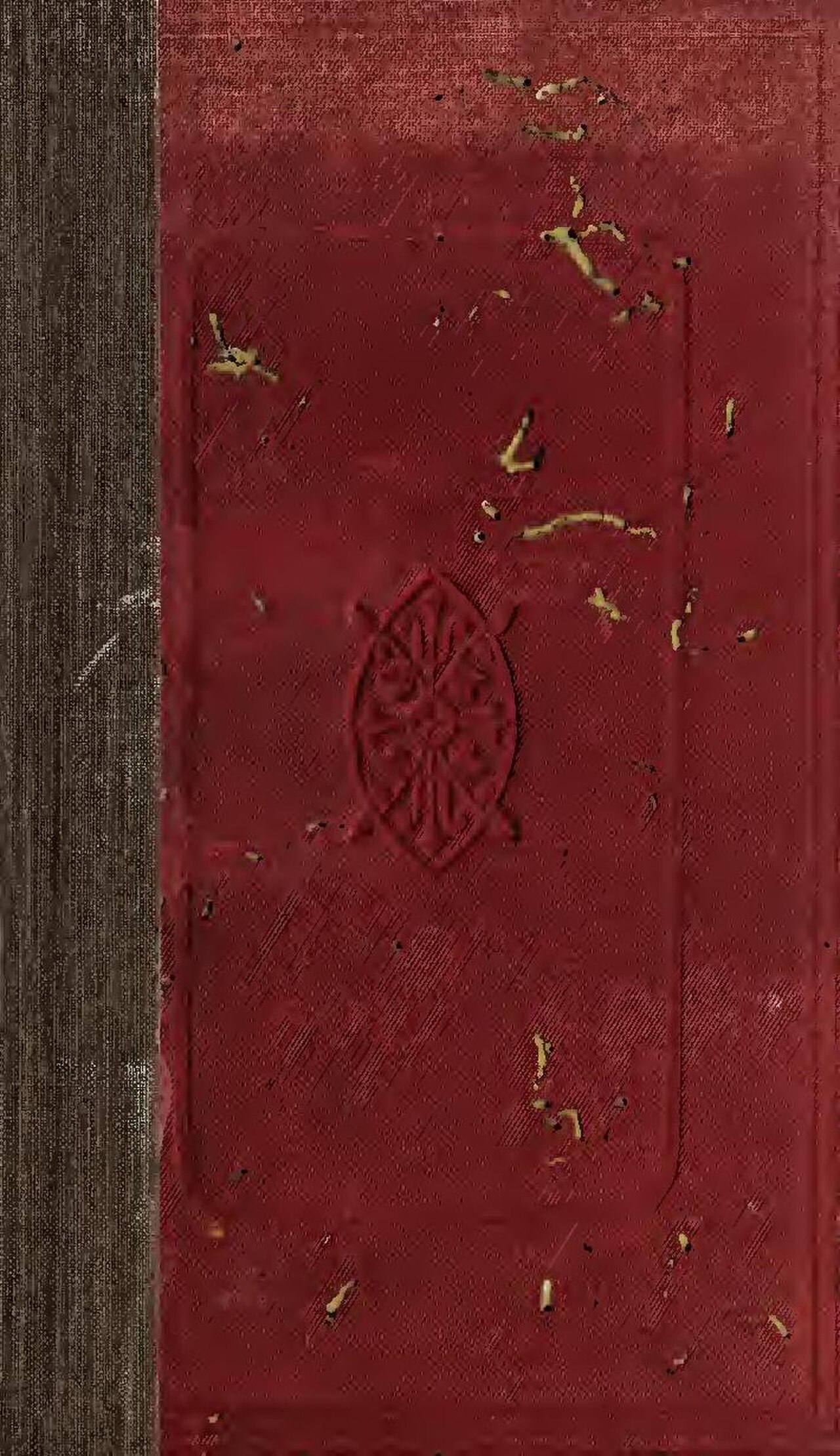
Front cover of a red cloth-bound book with a darker spine on the left. A rectangular panel is blind-stamped on the cover with a central oval ornament containing a radiating floral or star pattern. Small yellowish stains and specks mark the cover.Book

Primary source

Les six voyages de Jean-Baptiste Tavernier

Jean-Baptiste Tavernier · 1676

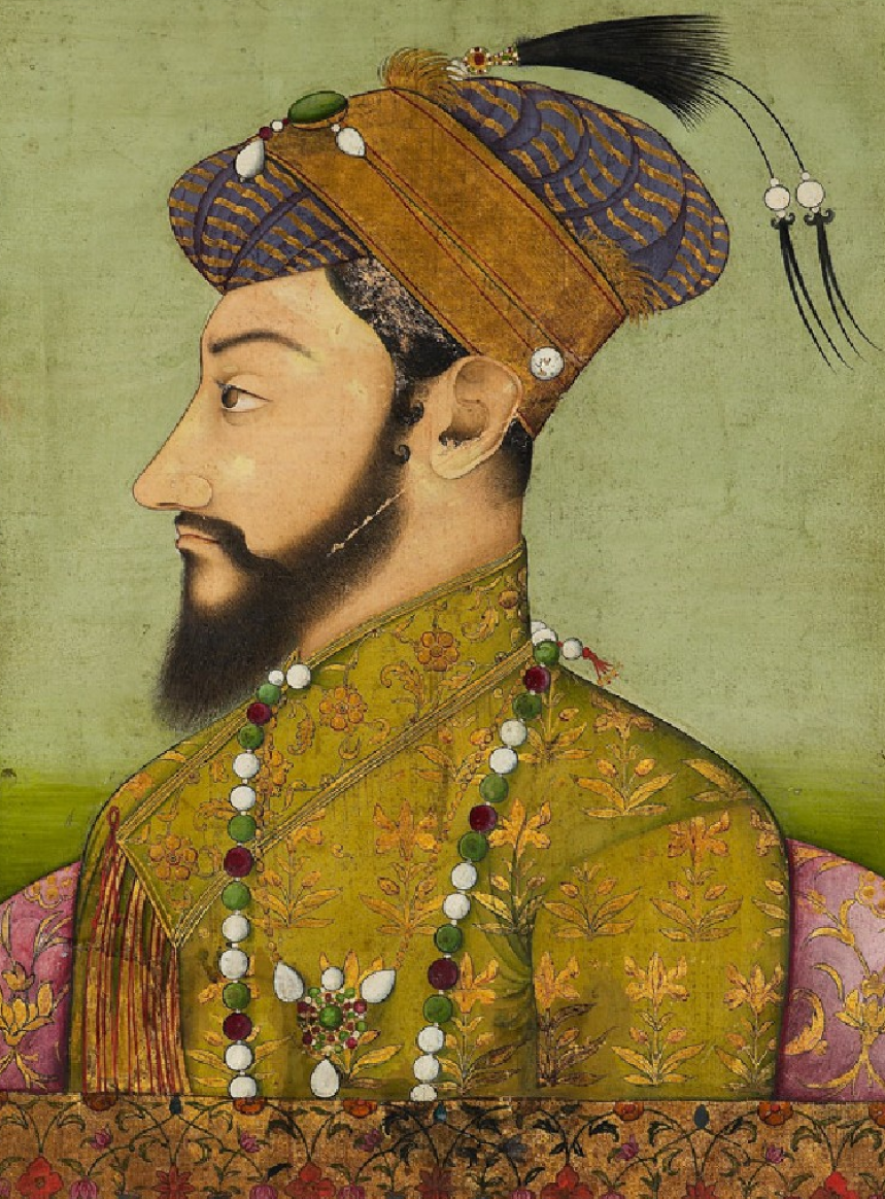
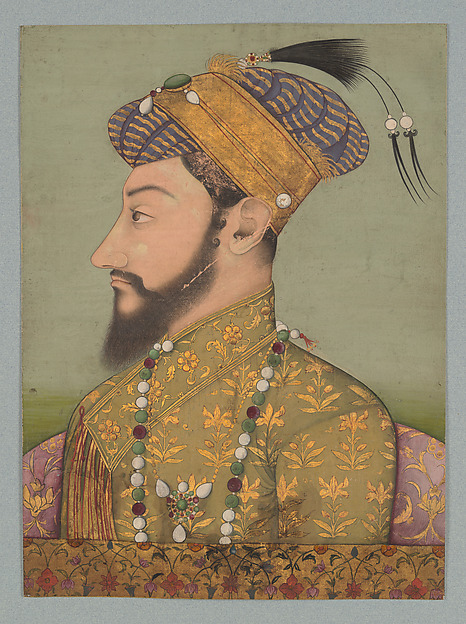
Profile portrait painting of a bearded man facing left against a pale green background. He wears a striped purple and gold turban with a jeweled clasp and a plume, a gold-patterned green robe with a pearl and emerald necklace, and pink floral sleeves.Painting

Primary source

Prince Aurangzeb

c. 1653

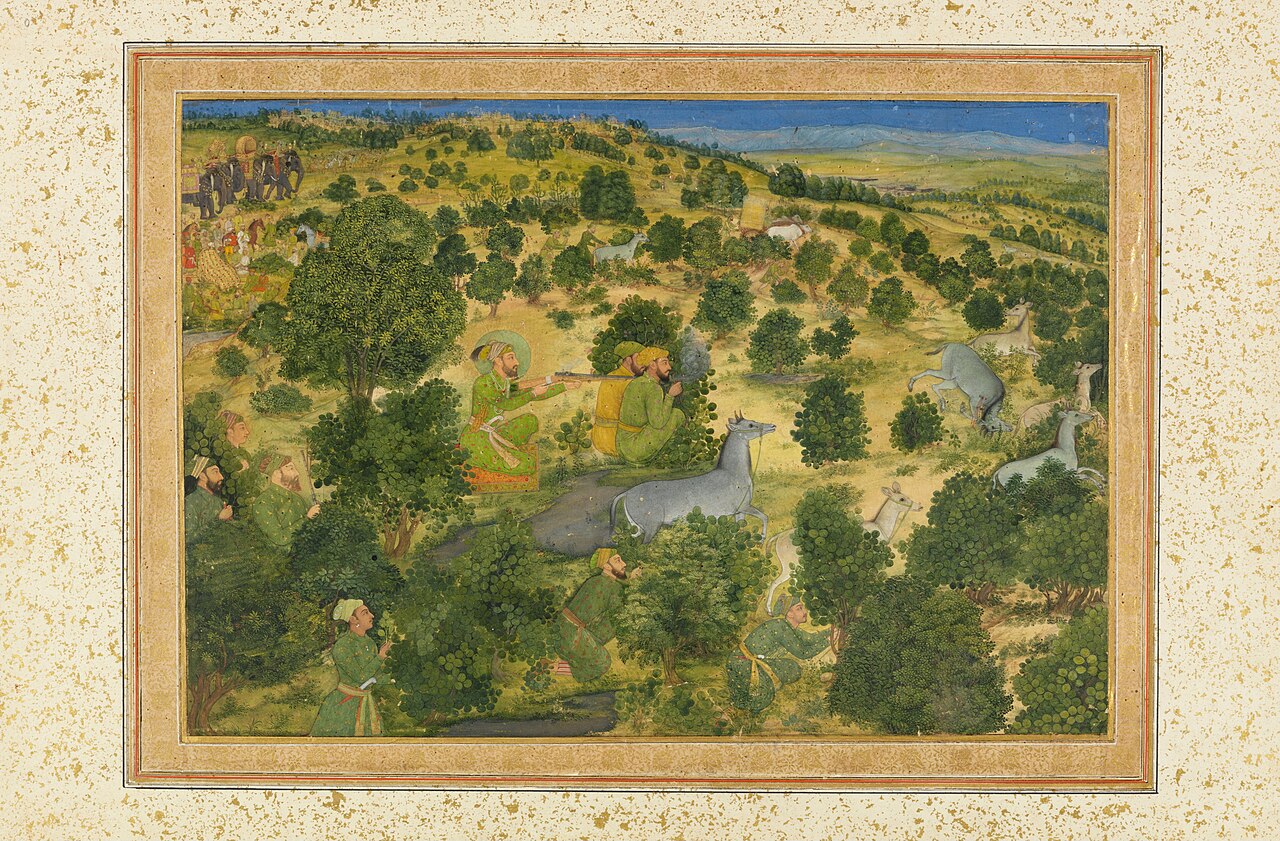
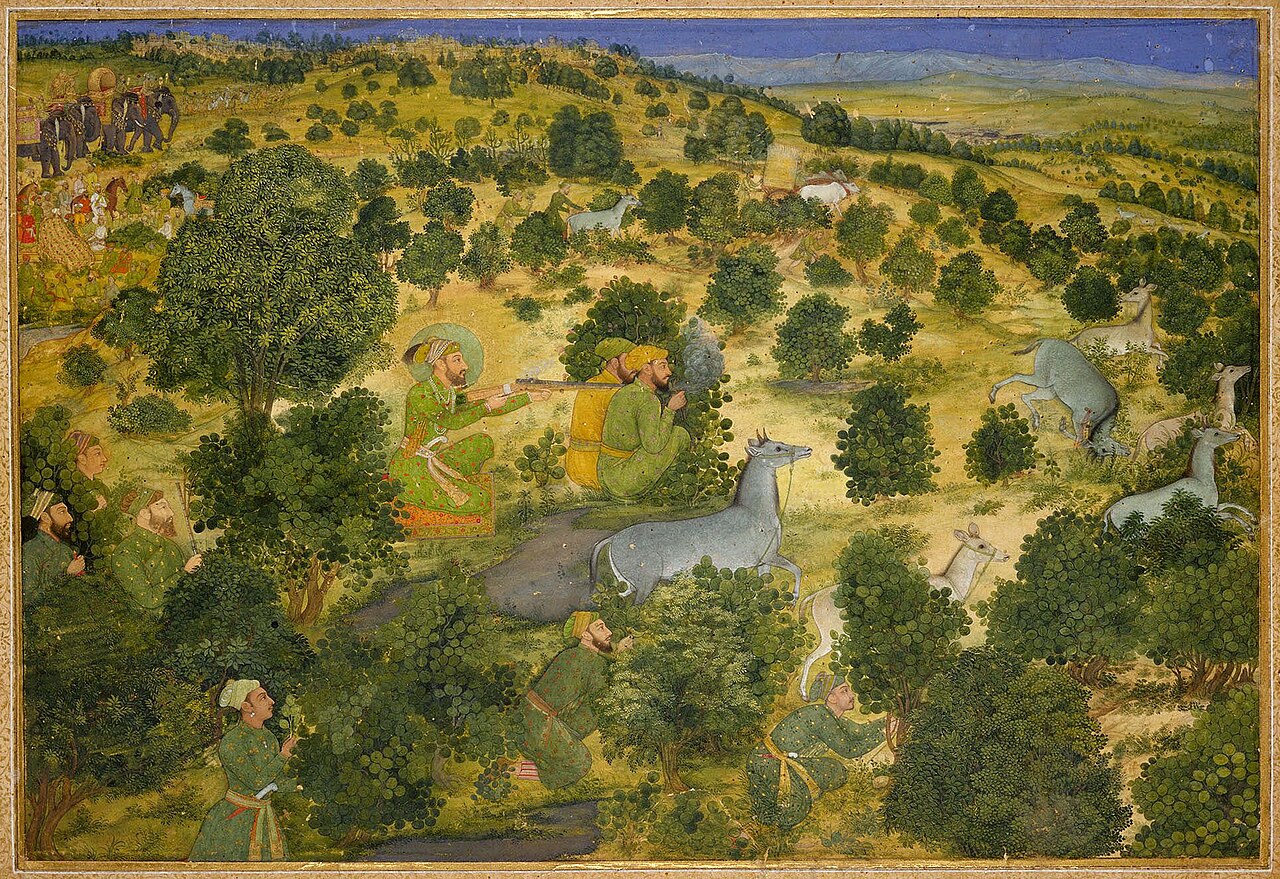
Mughal miniature painting of a hunting scene in a green, tree-filled landscape. A figure with a halo sits at center aiming a long gun, with attendants beside him. Grey nilgai antelope leap and run across the field, and elephants and riders appear at upper left. Framed by a decorative border.Painting

Primary source

Awrangzib Hunts Nilgais

c. 1660

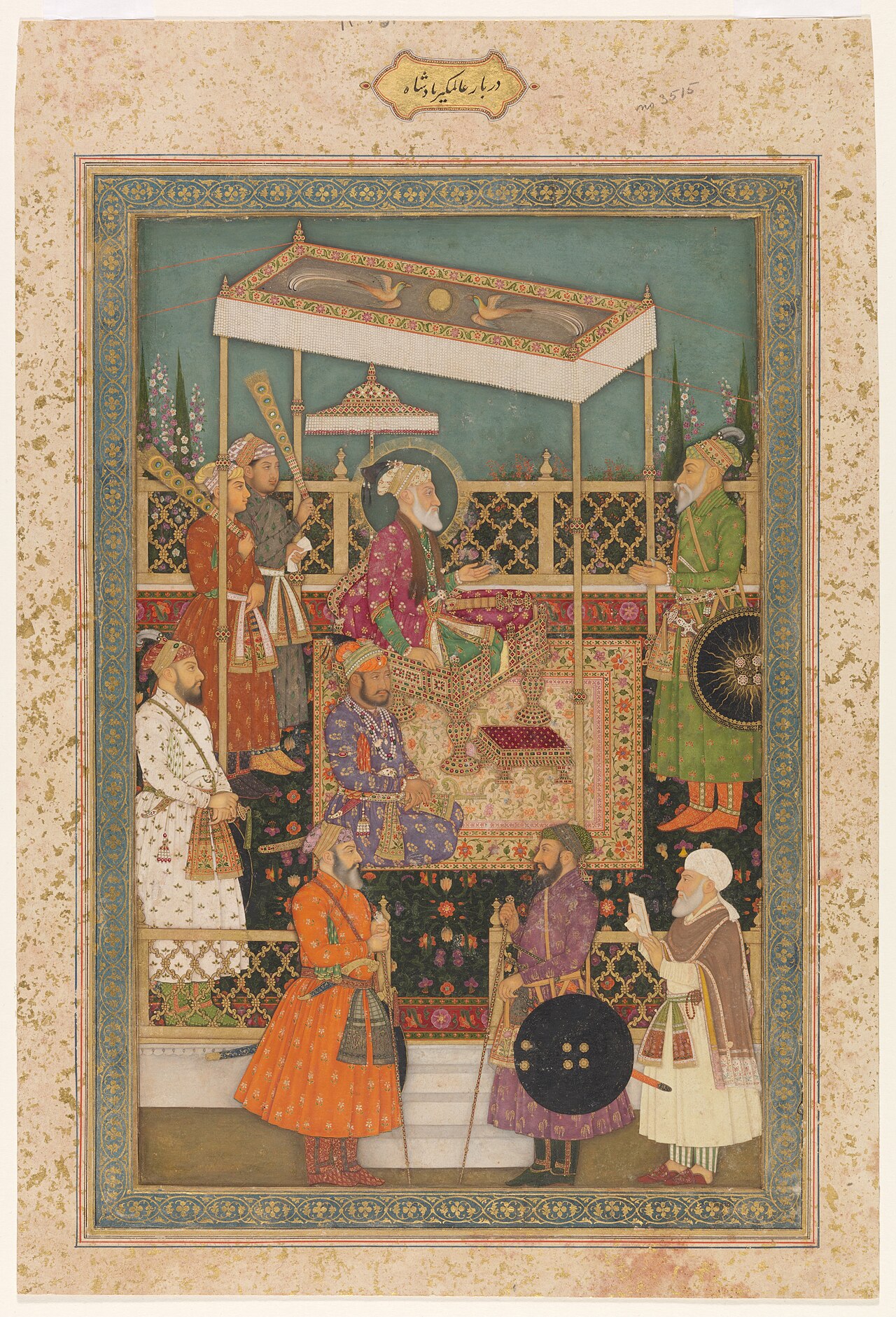
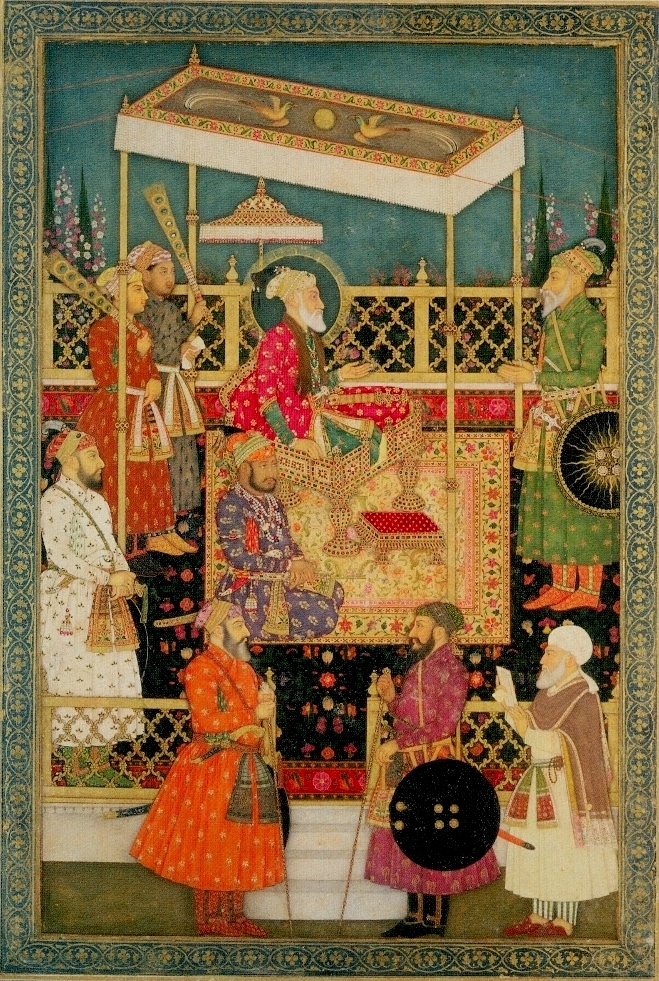
Mughal miniature painting in a gold-flecked border with an Urdu title cartouche. A seated emperor under a jeweled canopy with bird motifs receives visitors on a terrace with a lattice railing. Attendants in red, green, orange, and purple robes stand around him, some holding shields and staffs.Painting

Primary source

Emperor Awrangzib Receives Prince Mu'azzam

Bhavanidas · c. 1700-1712

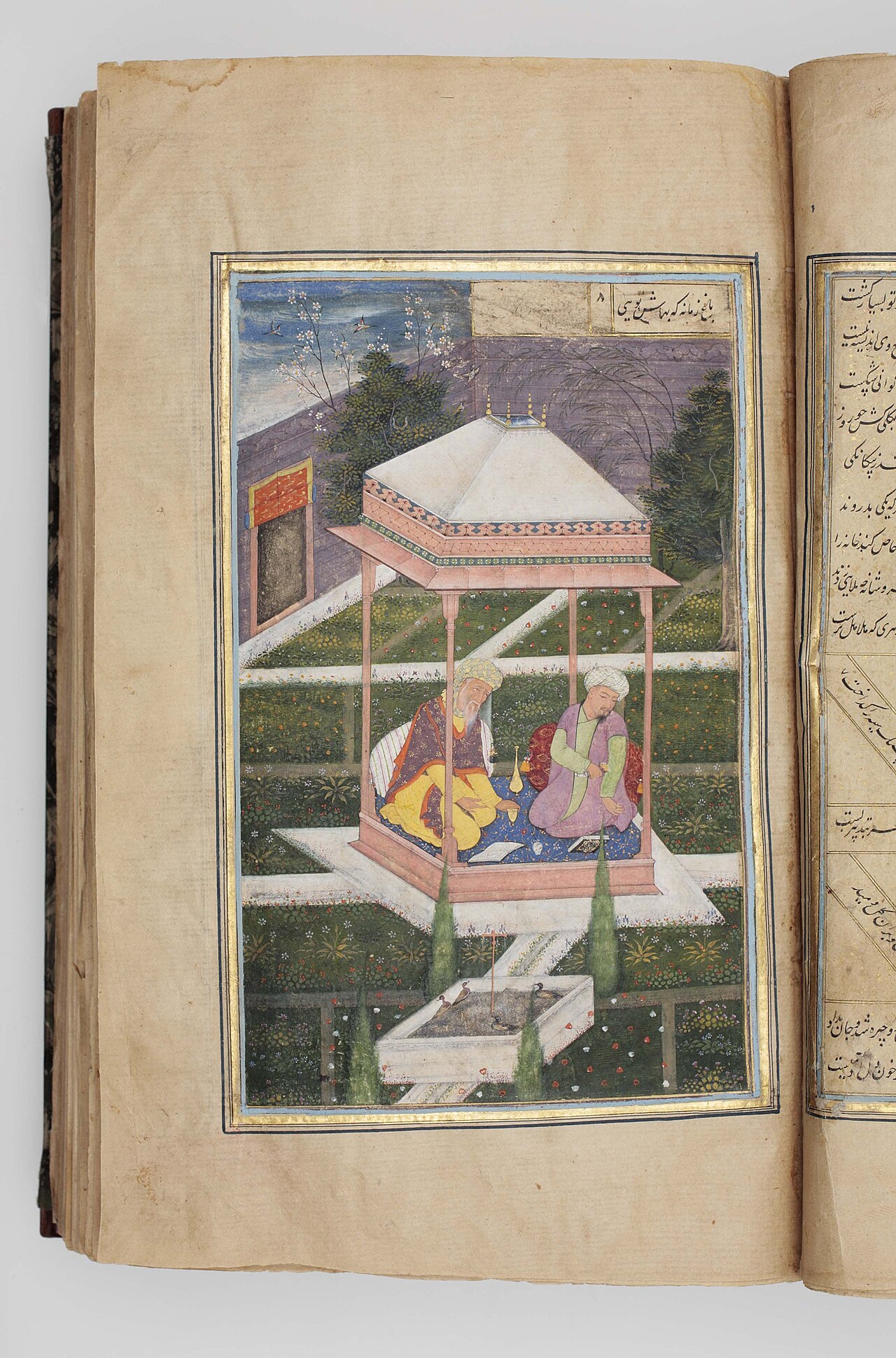
Open manuscript page showing a Persian miniature painting in a gold-ruled frame: two seated men under a pavilion with a white dome in a garden with a fountain, flowering trees, and cypresses. Persian text is on the facing page.Book

Primary source

A Khamsah of Nizami for Prince Awrangzeb

c. 1640

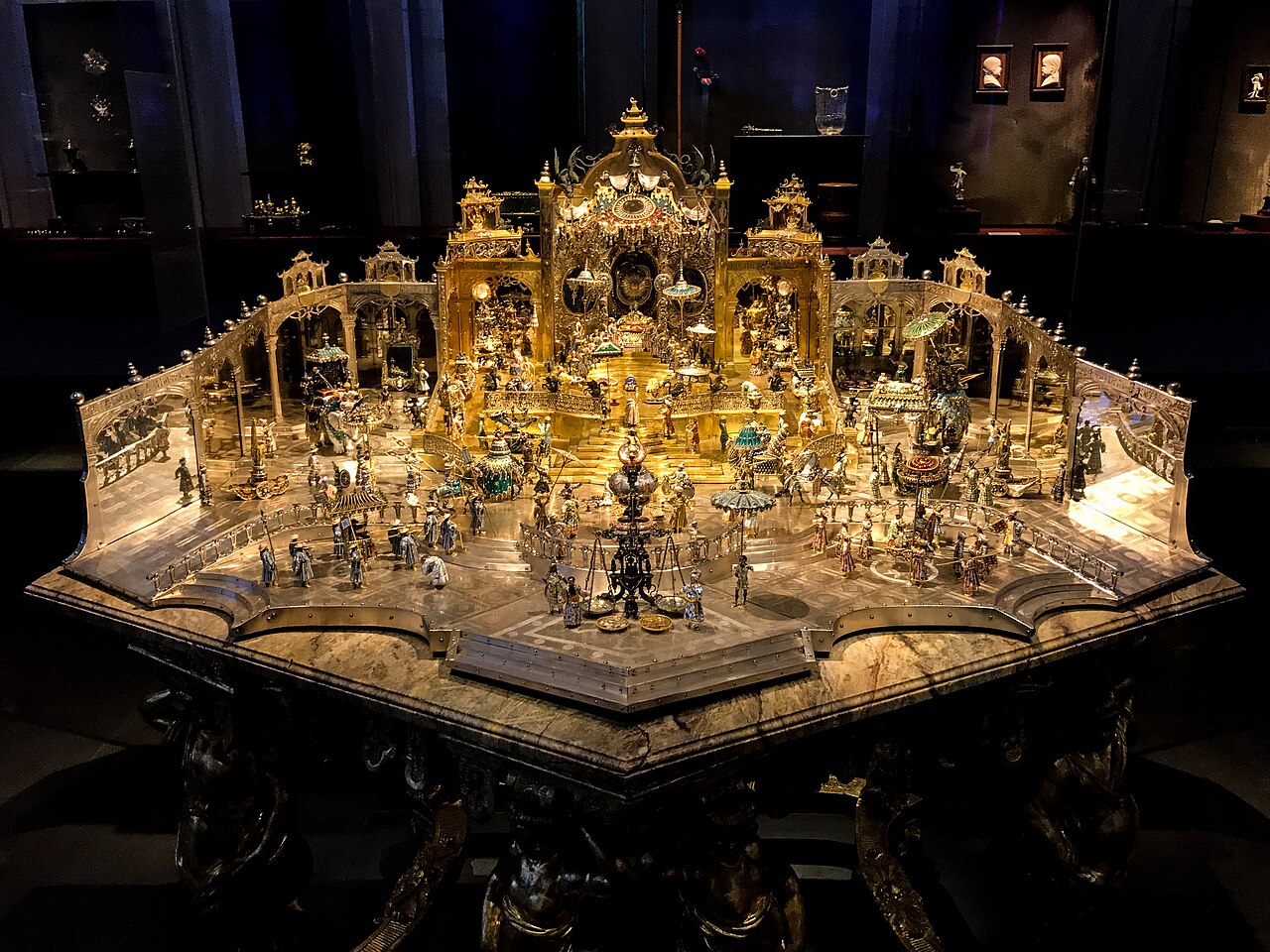
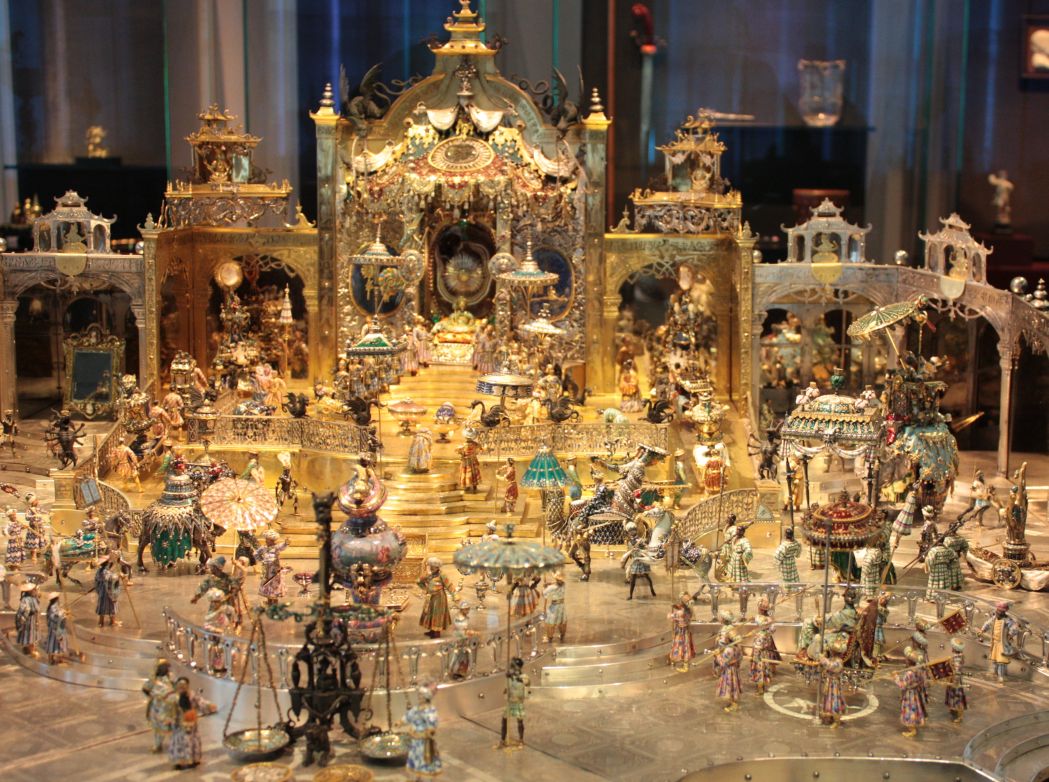
A gold and jewel-encrusted tableau of a miniature Mughal court on an octagonal marble table, with a central golden throne pavilion, arcades, many small enamelled figures, and an umbrella-shaped canopy, shown in dark museum lighting.Sculpture

Secondary source

Throne of Aurangzeb (Hofstaat zu Delhi)

Johann Melchior Dinglinger · c. 1700

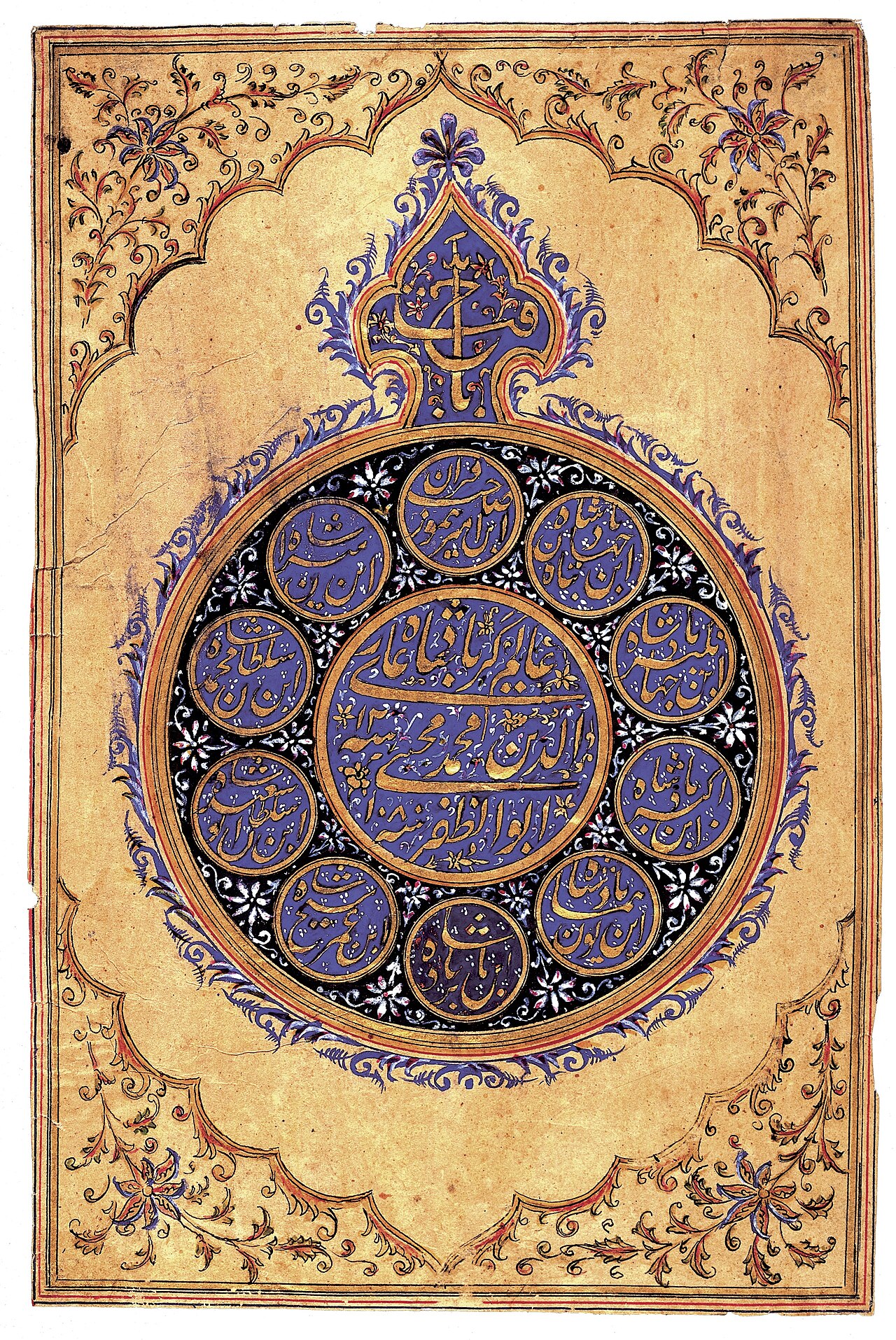
A painted illuminated page in gold, blue, and red with ornate floral borders. A large circular medallion contains a central blue disc with gold Persian-script calligraphy, surrounded by ten smaller circular medallions with gold inscriptions, topped by a pointed lobed cartouche.Document

Primary source

Seal of Aurangzeb

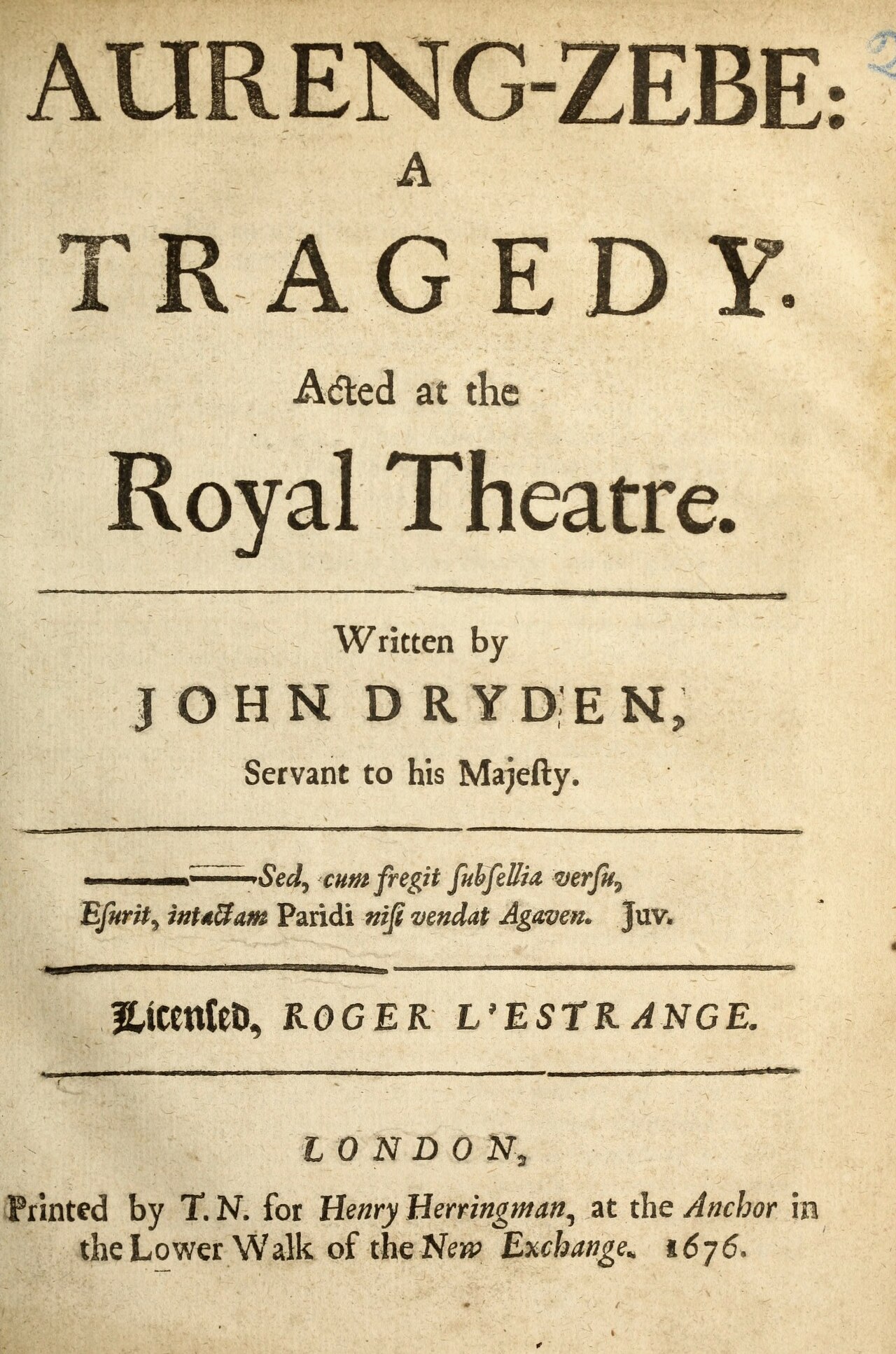
Title page of a 1676 London printed edition of the tragedy Aureng-Zebe, written by John Dryden, acted at the Royal Theatre. Text includes a Latin epigraph from Juvenal, the licence by Roger L'Estrange, and the printer and publisher details.Book

Secondary source

Aureng-zebe

John Dryden · 1675 (printed 1676)

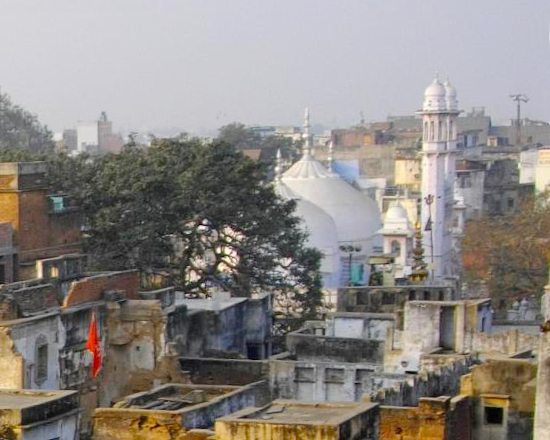
View over rooftops of old buildings in Varanasi toward the Gyanvapi Mosque, with its white domes and a tall white minaret rising above dense trees under a hazy sky. A small red flag flutters on a rooftop in the foreground.Artifact

Primary source

Gyanvapi Mosque

c. 1678 (decree 1669)

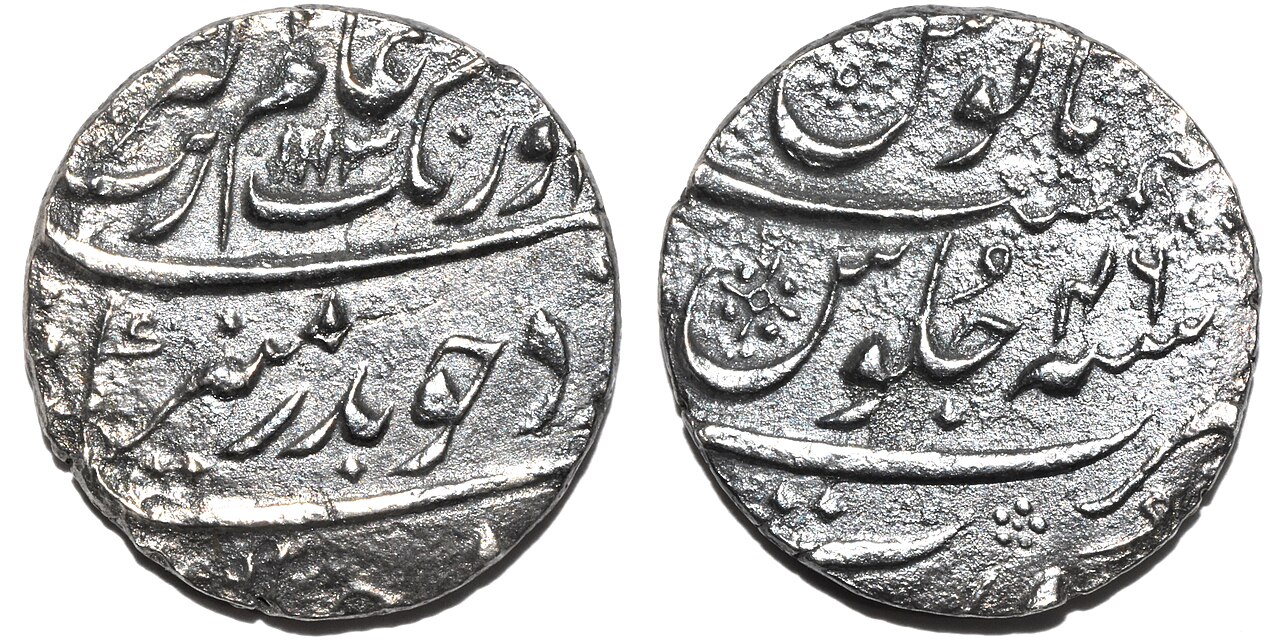
Two sides of a silver Mughal rupee coin shown side by side. Both faces have raised Persian script inscriptions and decorative borders, with a dotted rosette pattern visible on each side. The surfaces show a worn, tarnished silver finish.Artifact

Primary source

Silver Rupee of Aurangzeb (Alamgir)

Mughal imperial mints · 1658–1707 (this example 1702)

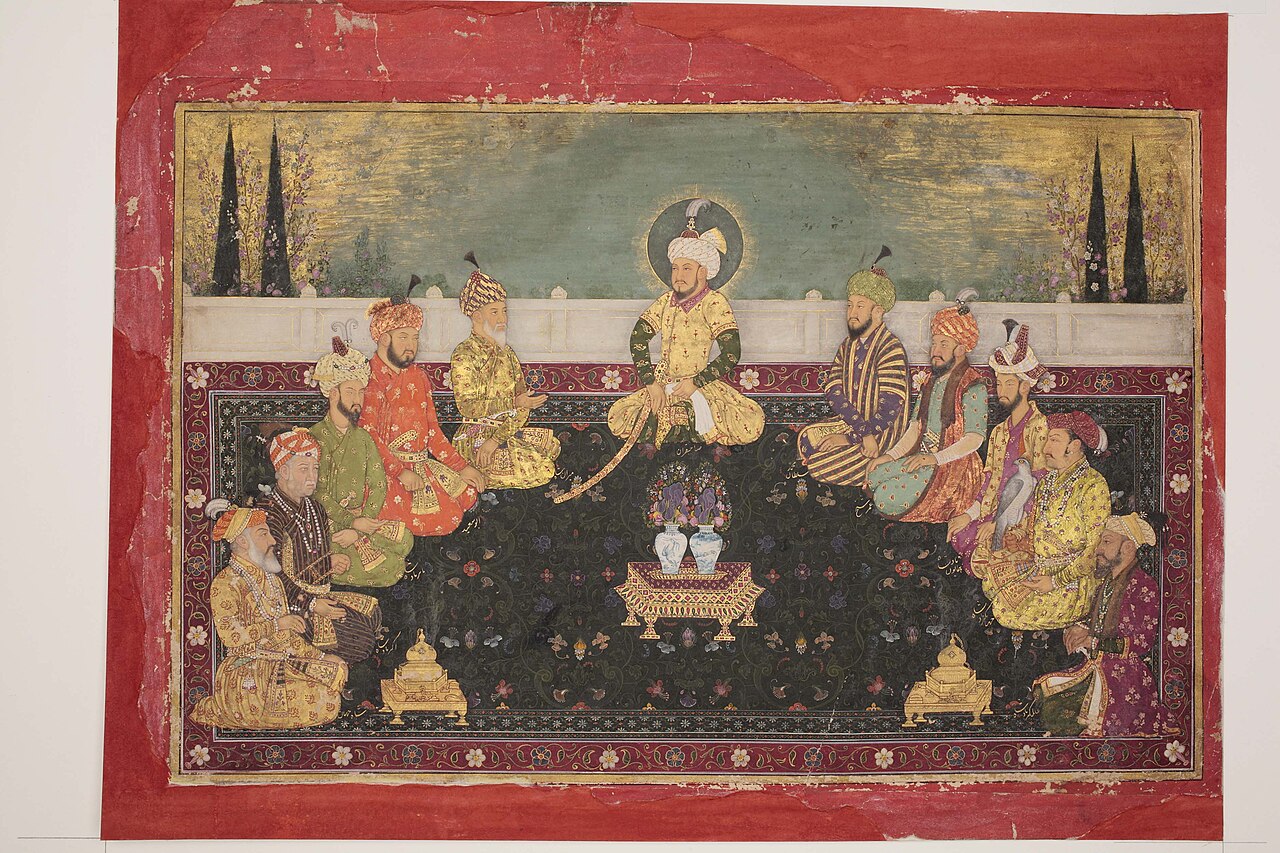
A painting of a seated ruler in a gold-and-yellow robe and white turban with a halo, flanked by rows of richly dressed men in turbans on a dark floral carpet before a white balustrade, with cypress trees and a gold-tinted sky behind. Red border surrounds the painting.Painting

Primary source

The Rulers of the Mughal Dynasty from Babur to Aurangzeb, with their Ancestor Timur

Bhavanidas · c. 1707

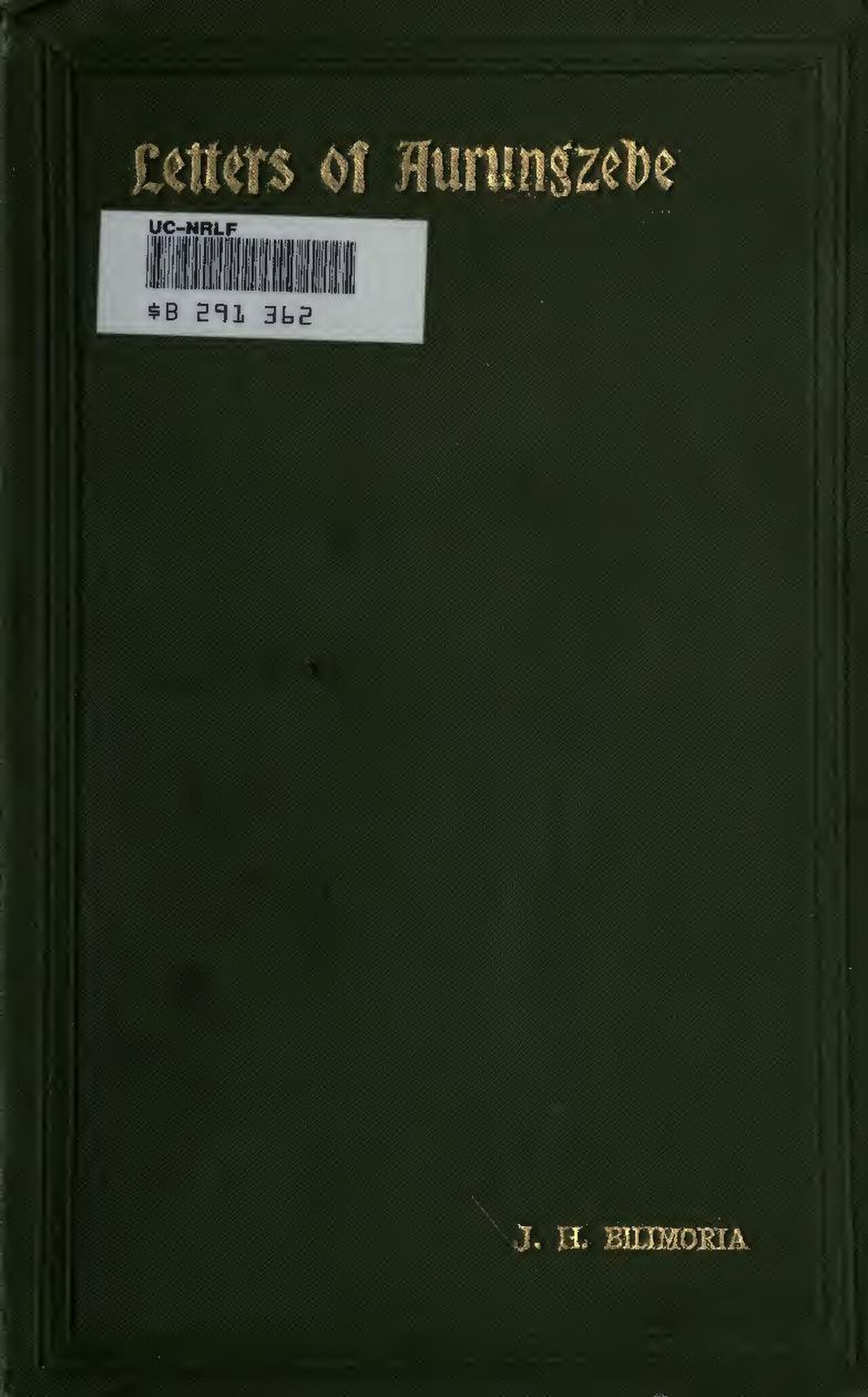
Front cover of a dark green cloth book. Gold blackletter title reads 'Letters of Aurungzebe'. A white library label with a barcode and 'UC-NRLF' and '$B 291 362' is affixed upper left. Gold text at lower right reads 'J. H. BILIMORIA'.Letter

Primary source

Adab-i-Alamgiri

Aurangzeb · 1650s (compiled later)

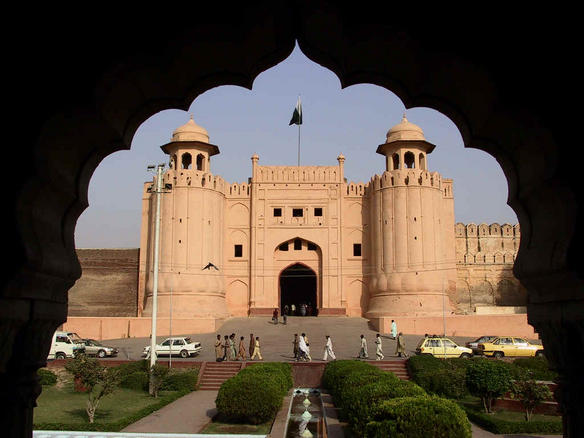
View through a carved arch of a large red sandstone gateway with two domed corner towers, a central arched entrance, and a green flag on top. People walk on steps and cars are parked in front, with trimmed hedges and a fountain below.Artifact

Primary source

Alamgiri Gate

1673-74

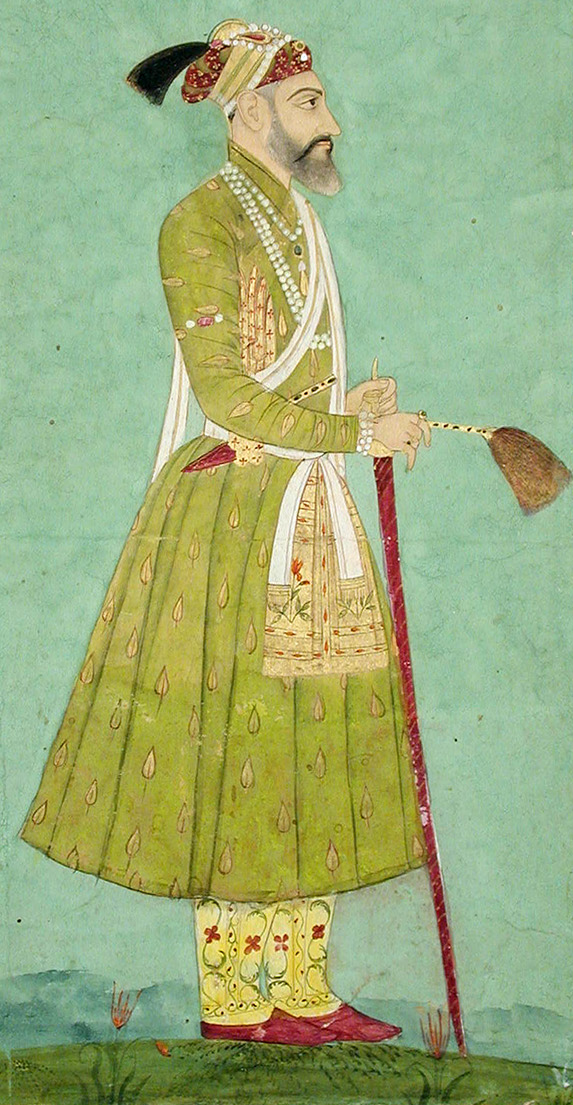
Painting of a man in profile facing right against a pale green background. He wears a red and white turban with a black plume, a green long coat with a white sash, a pearl necklace, and yellow trousers with red shoes. He holds a red staff in one hand and a flywhisk in the other, standing on a grassy strip.Painting

Primary source

Aurangzeb Holding a Flywhisk

c. 1680

Oval miniature painting of a bearded man in profile facing right, wearing a red and gold turban with a feather plume and jewel, a fur-trimmed brown robe over a lilac garment, pearl necklace, holding a pale iris flower, on a blue-grey background within a gold oval border.Painting

Primary source

Aurangzeb Bahadur Holding an Iris

c. 1650

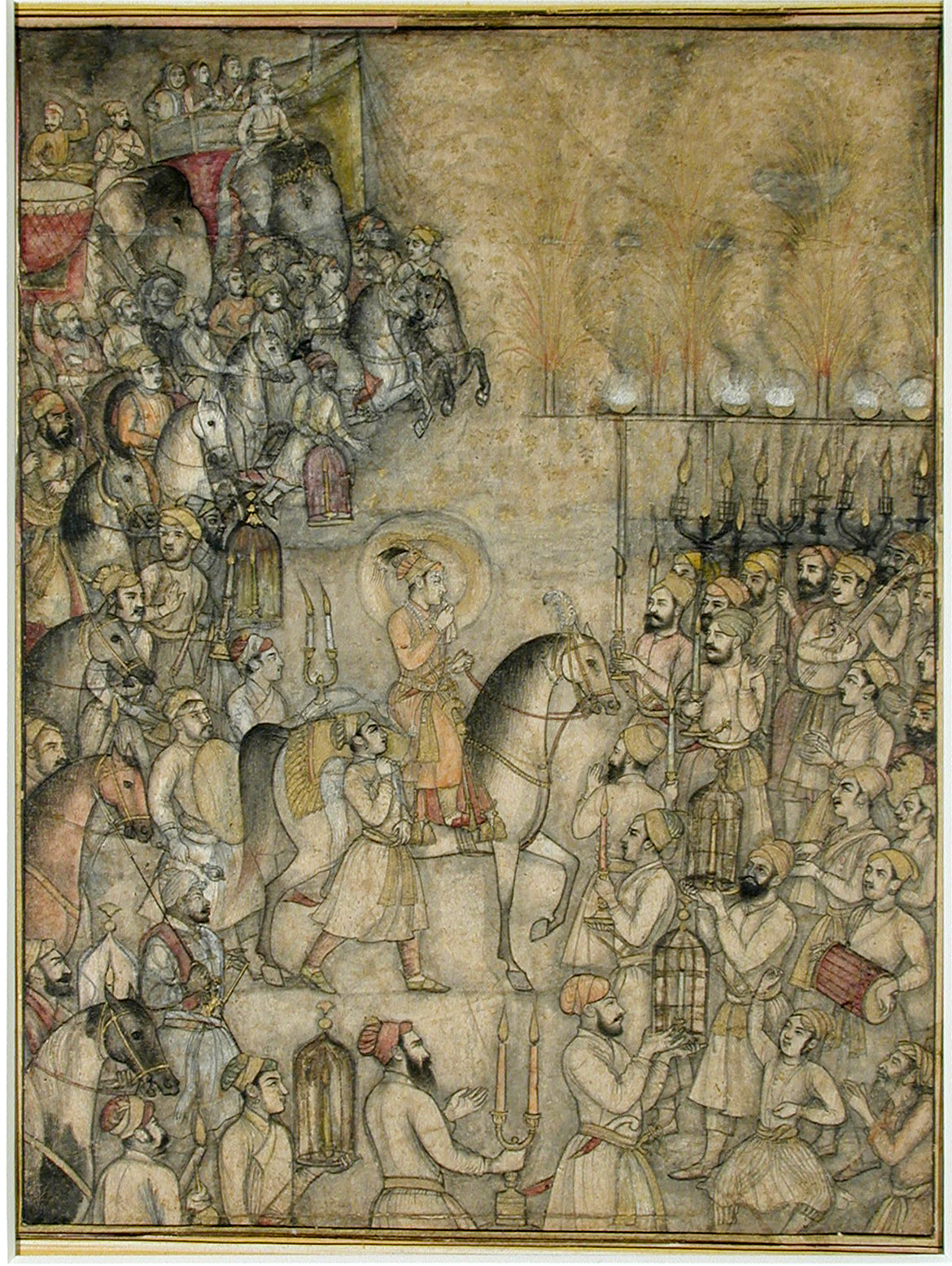
Mughal miniature painting of a celebration: a mounted ruler with a halo-like nimbus rides at center among crowds, musicians with drums and trumpets, attendants holding candelabra and birdcages, and an elephant with a canopied howdah at upper left. Fireworks and lit lamps fill the background.Painting

Primary source

Celebrations at the Time of the Marriage of Aurangzeb

Hunhar · c. 1640

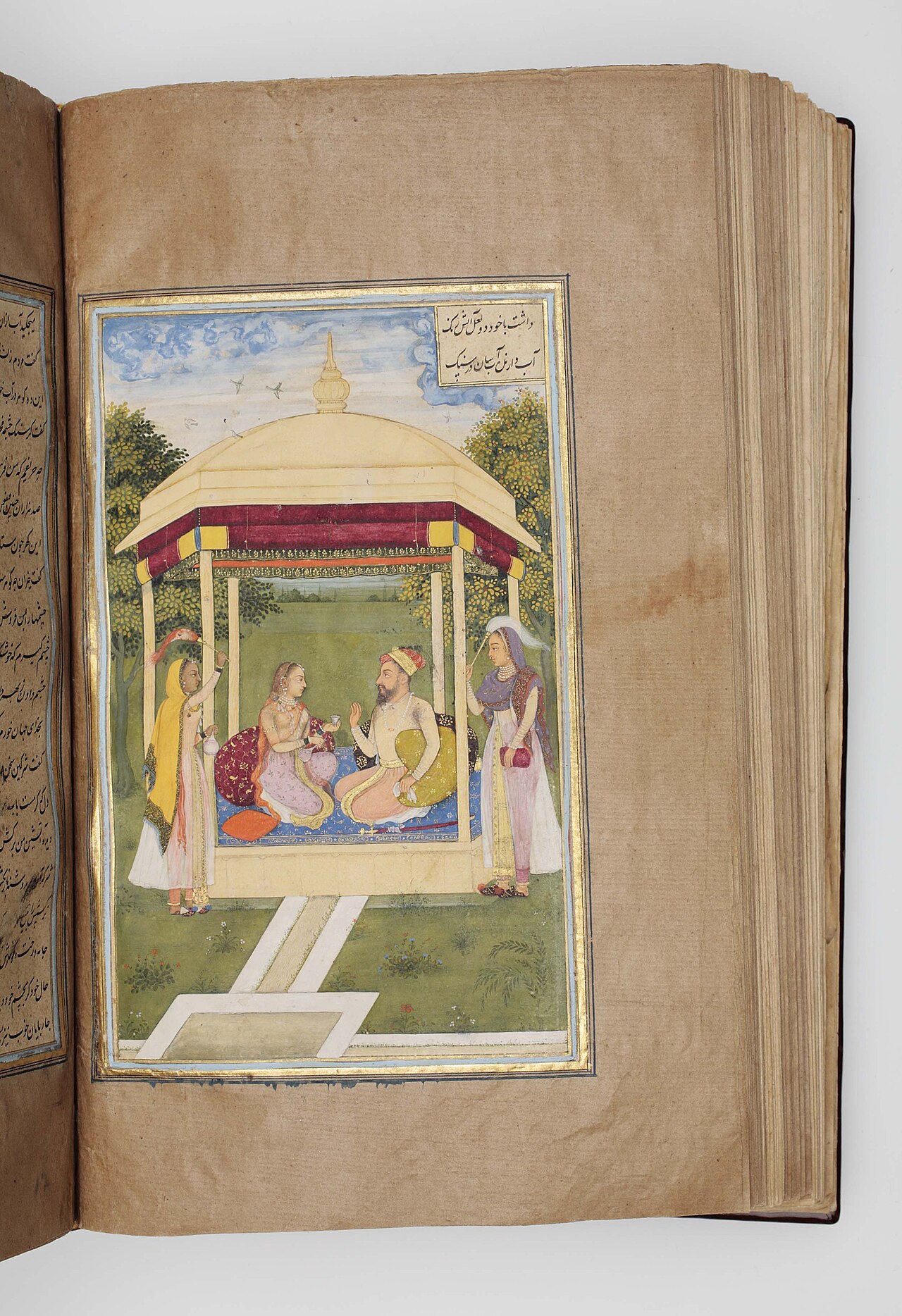
Manuscript page with a Persian-script caption in a cartouche at upper right. A framed miniature painting shows a pavilion with a cream domed roof and red valance, set in a garden. A bearded man in a turban and a seated woman converse on a blue rug; attendant women stand on either side holding fans or items. Trees and blue sky surround the pavilion.Painting

Primary source

Bahram Gur in the Sandalwood Pavilion

1640

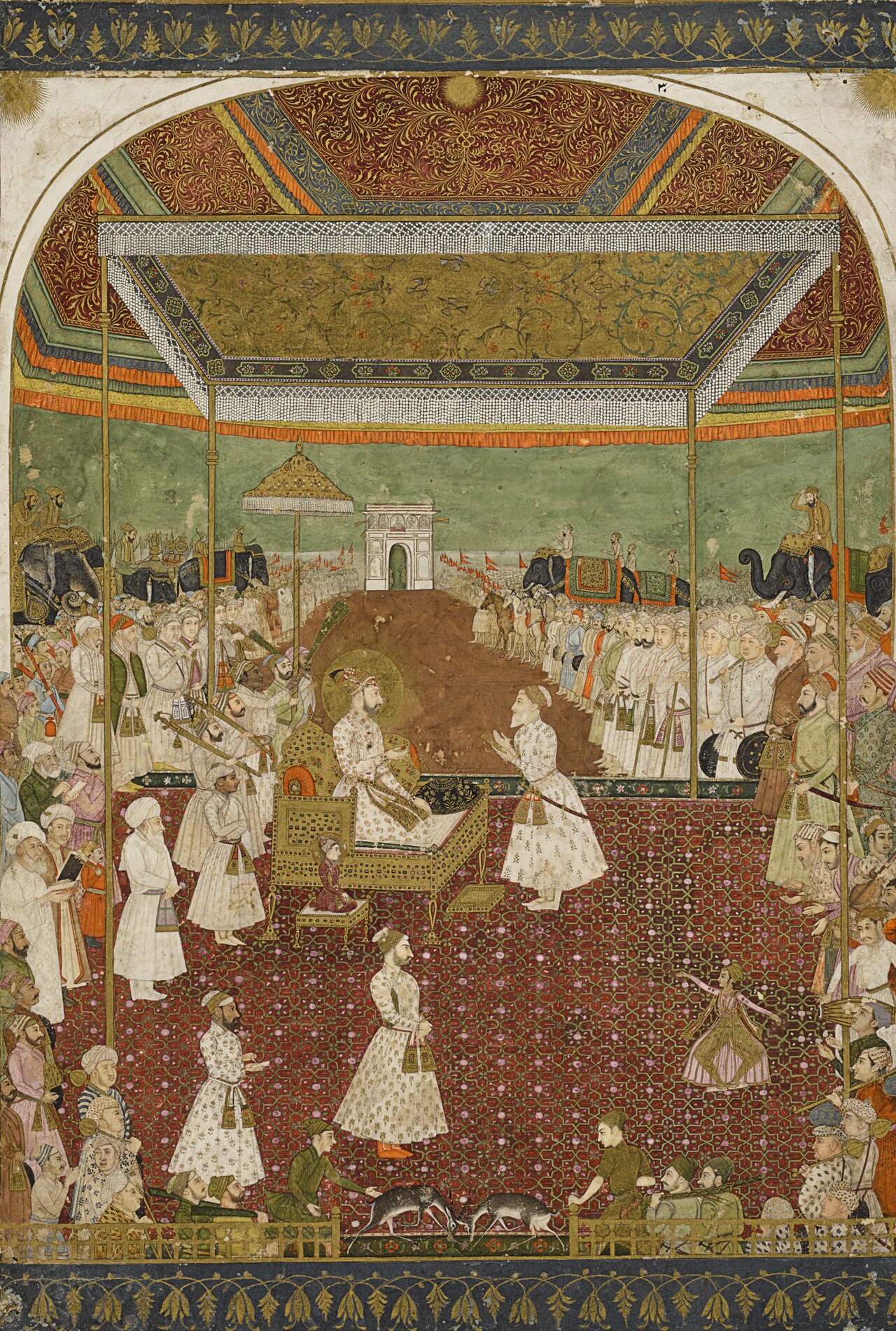
Miniature painting of a Mughal darbar court scene. A seated ruler with a halo, under a gold-patterned canopy with a lace-like fringe, receives a kneeling courtier. Crowds of attendants in white robes and turbans stand around a red patterned carpet, with elephants, horses, and a small pavilion in the background. Two animals, likely dogs, appear at the bottom.Painting

Primary source

Aurangzeb Enthroned in a Darbar Scene

Bichitr

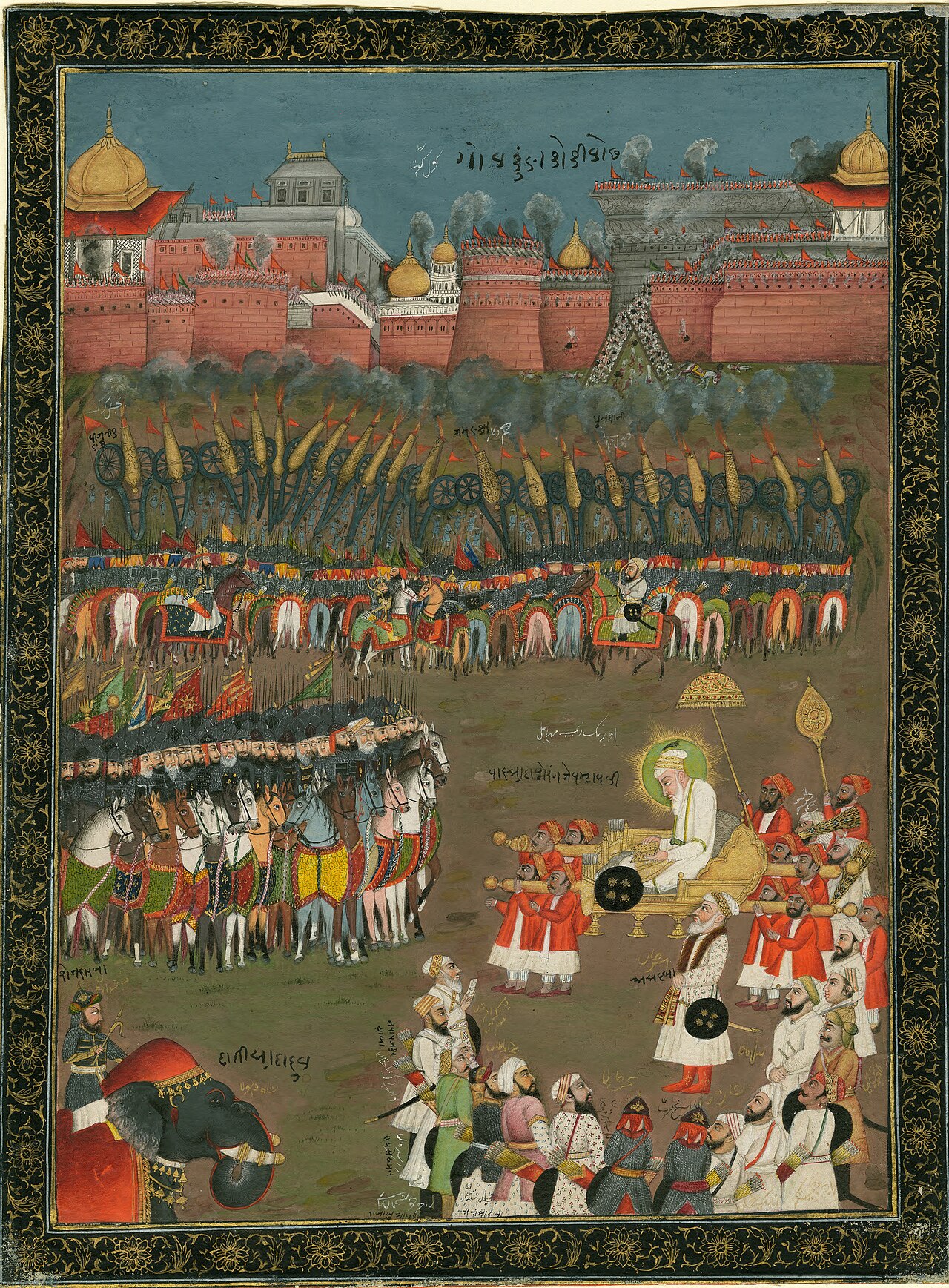
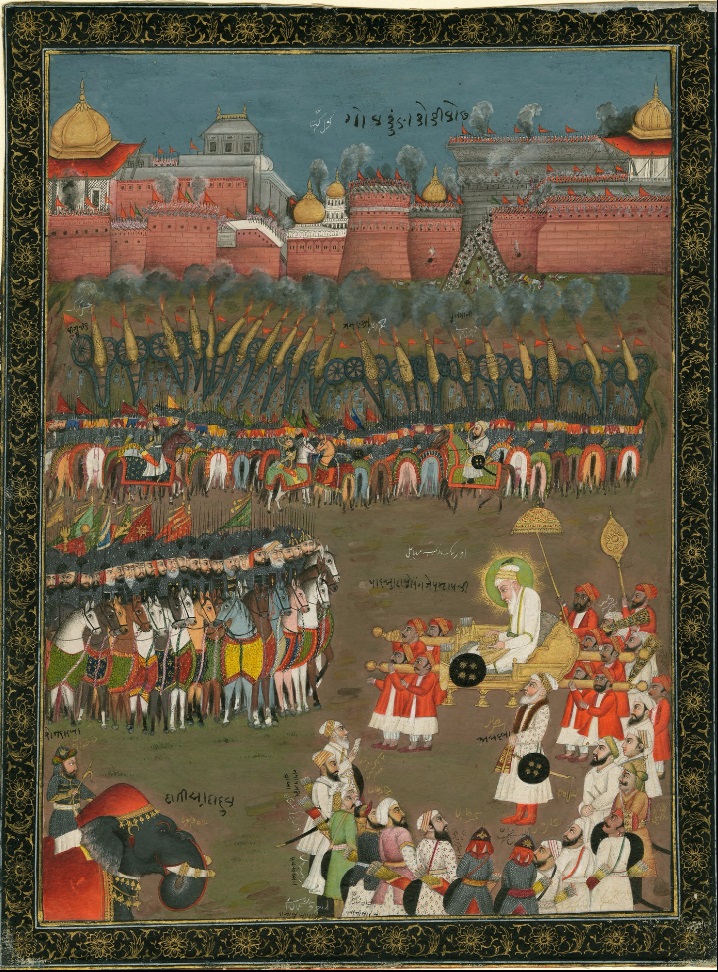
Painting of a siege scene. In the upper background a red walled fortress with gold domes and smoke rises above. Mid-ground shows lines of cannons and mounted troops with banners. An elderly man with a halo sits on a golden litter in the lower right, attended by men in red and white, while soldiers in turbans gather nearby. A dark decorative border frames the scene.Painting

Secondary source

Emperor Aurangzeb at the Siege of Golconda

depicting 1687

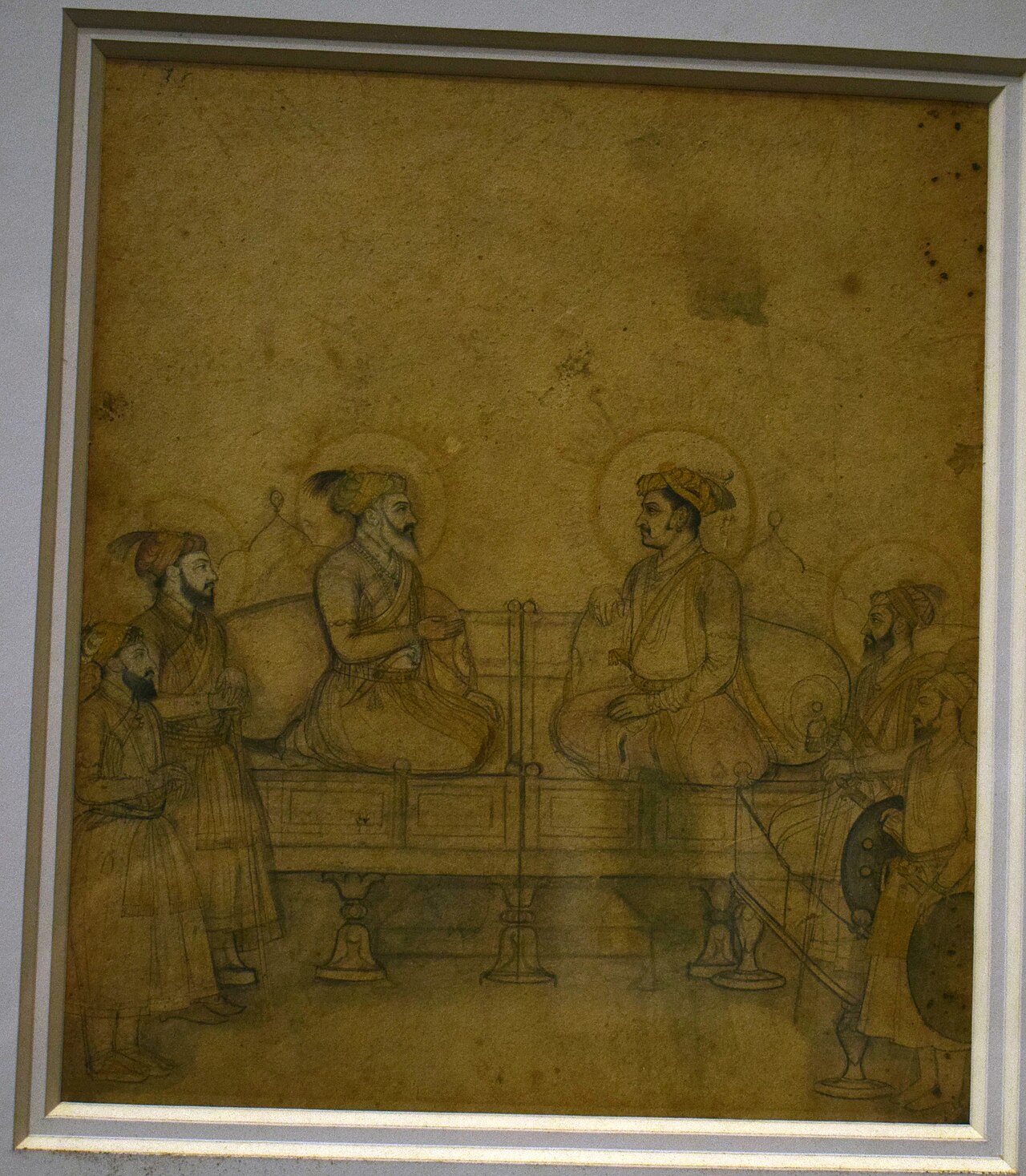
Framed sepia ink and wash drawing on aged paper of Mughal figures seated on a low platform with halos, attendants standing at left and right holding a shield, and a small figure at upper left.Painting

Secondary source

Jahangir with Shahjahan, Aurangzeb, Suja and Darashikho

c. 1700

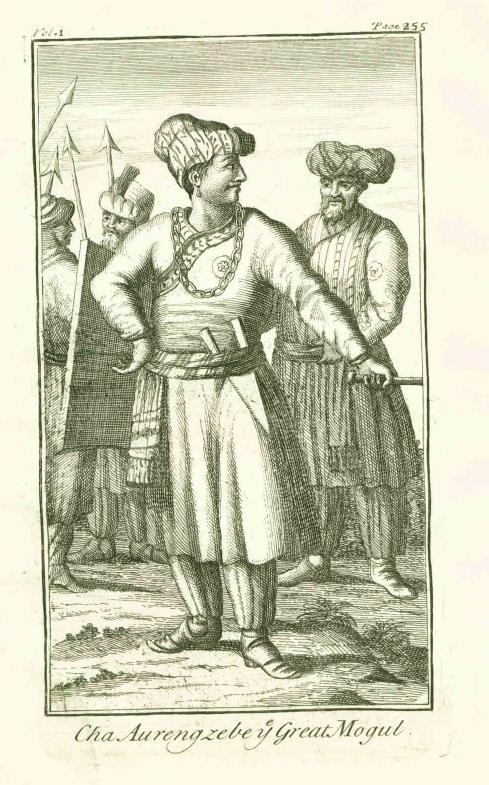
Black-and-white engraving of a standing man in a turban and long robe with a sash and a jeweled necklace, one hand on his hip, holding a short staff; two attendants stand behind him, one wearing a turban and one holding spears. Caption below reads 'Cha Aurengzebe Ye Great Mogul'.Painting

Secondary source

Cha Aurengzebe Ye Great Mogul

Unsigned

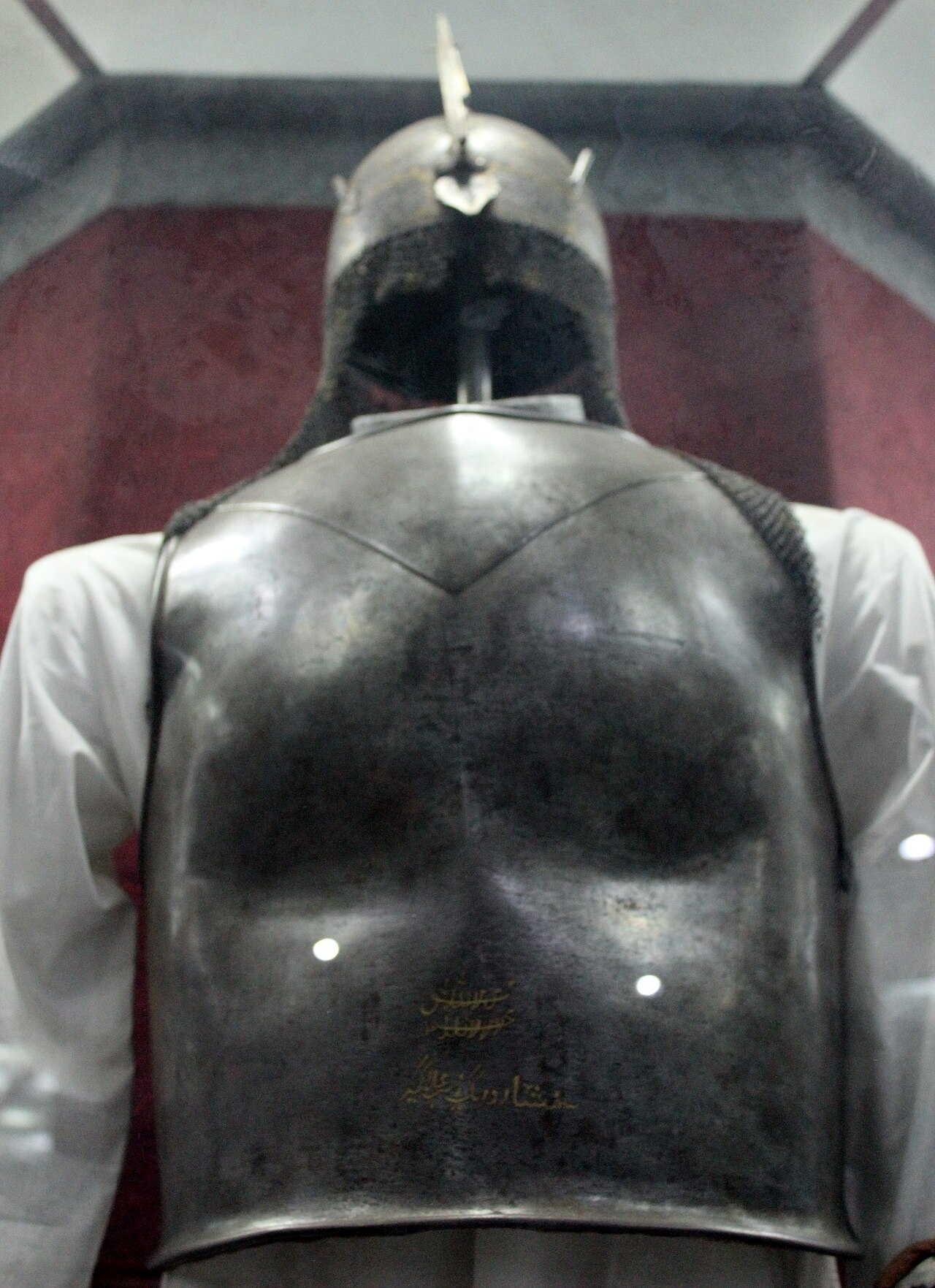
Rear view of a steel body armour with a helmet with a spike and mail aventail, displayed on a mannequin in front of a red background. Gold Persian-script inscriptions are engraved on the back plate.Artifact

Primary source

Body Armour of Aurangzeb

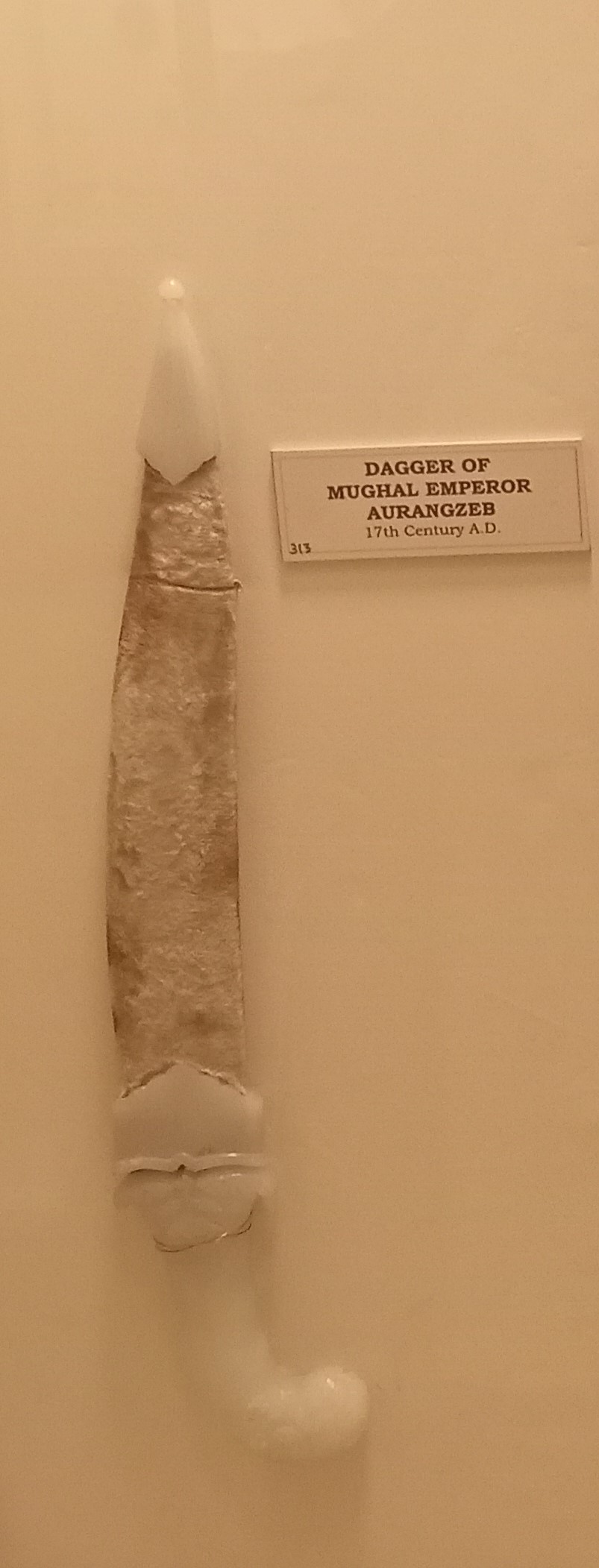
A museum display of a dagger with a pale, possibly jade hilt and a long, grayish-tan blade, mounted against a cream wall. A label beside it reads: Dagger of Mughal Emperor Aurangzeb, 17th Century A.D., with number 313.Artifact

Primary source

Dagger of Aurangzeb

17th century

Open pages of an illuminated manuscript with gold and blue decorative borders, geometric patterns, and rows of Arabic calligraphy in gold-tinted panels across both pages.Book

Secondary source

Qur'an Manuscript Attributed to Aurangzeb

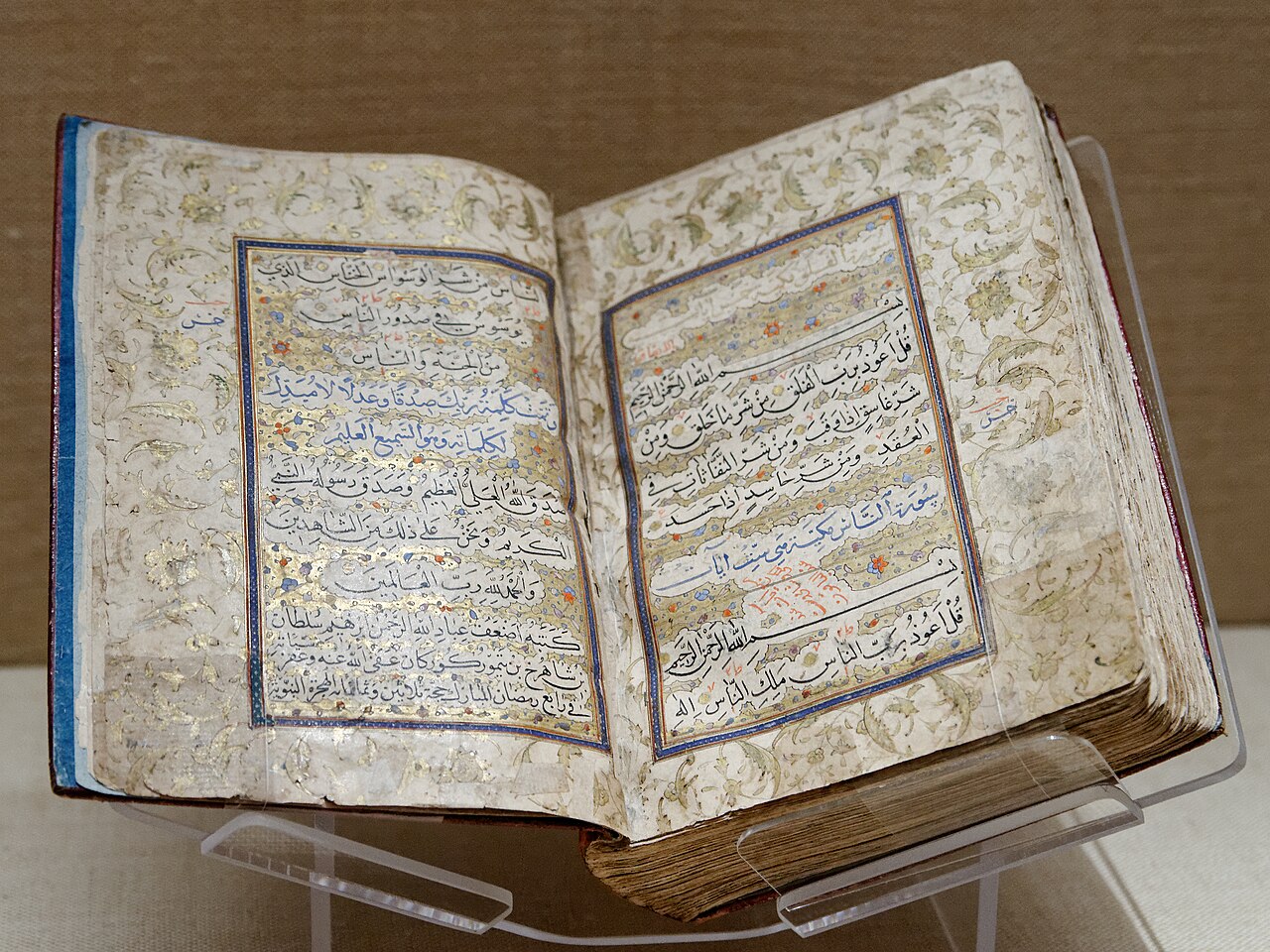
An open illuminated manuscript book resting on a clear acrylic stand, showing two pages of Arabic calligraphy in blue and black ink framed by gold and floral decorated borders on cream paper. The book's leather binding edges are visible at the lower right.Book

Primary source

Qur'an of Ibrahim Sultan

Ibrahim Sultan · June 1427

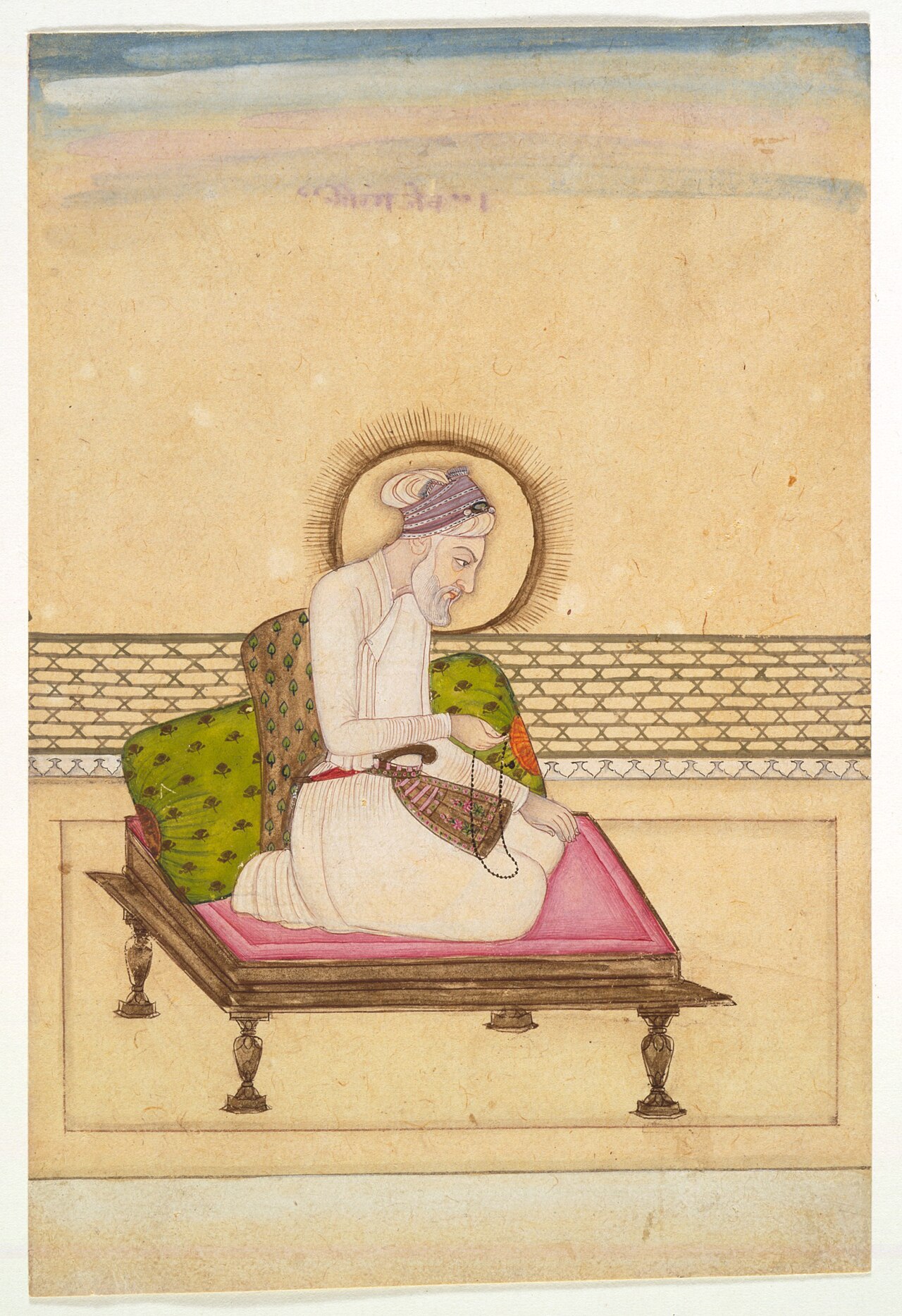
Painting of a seated man in a white robe and purple striped turban with a halo behind his head. He sits on a pink-cushioned low platform with a green patterned bolster and holds a prayer beads strand. A lattice wall is behind him.Painting

Secondary source

Emperor Aurangzeb

c. 1725

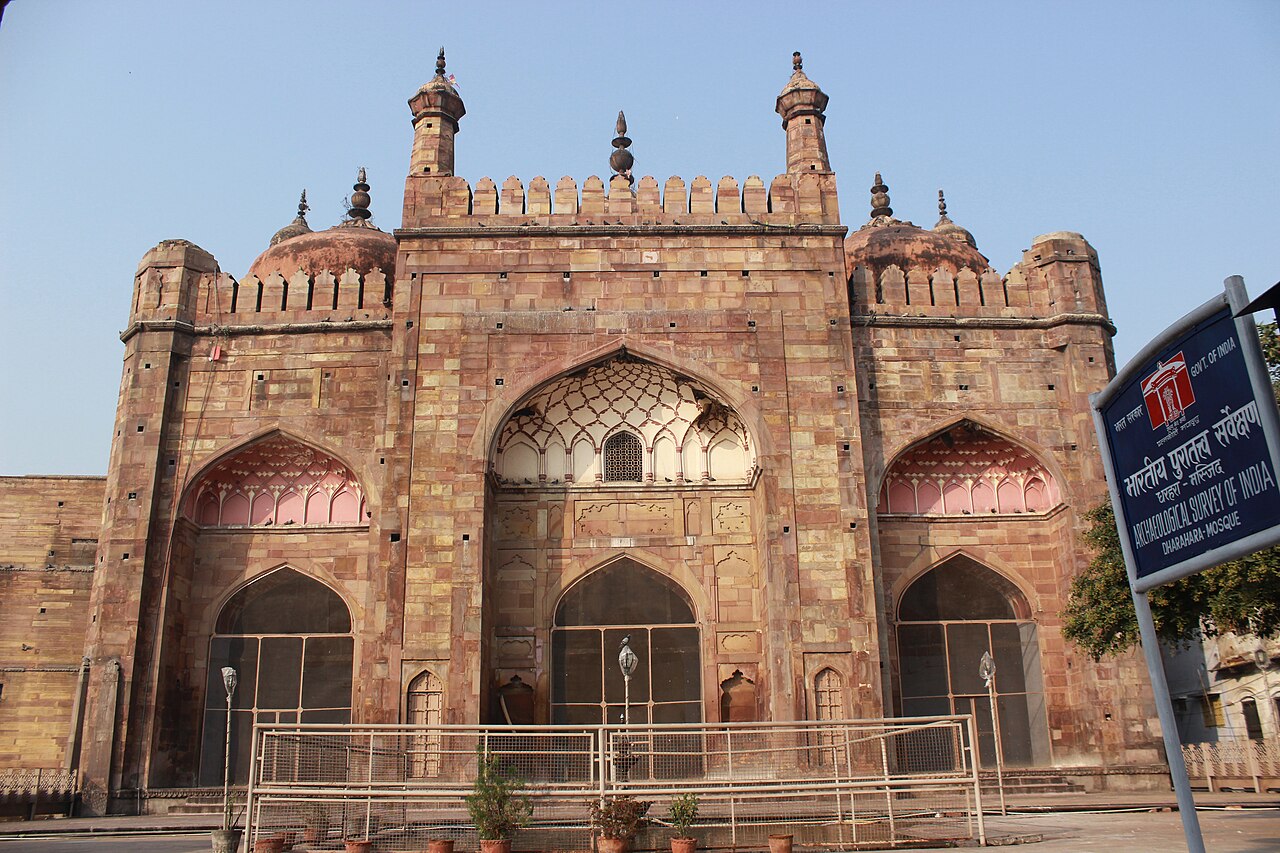
Front facade of a red sandstone building with pointed arched openings, a crenellated parapet, small domed kiosks with finials at the corners, and tall pillar-like turrets. An iron railing stands in front, and a blue Archaeological Survey of India sign is at the right.Artifact

Primary source

Alamgir Mosque

1669

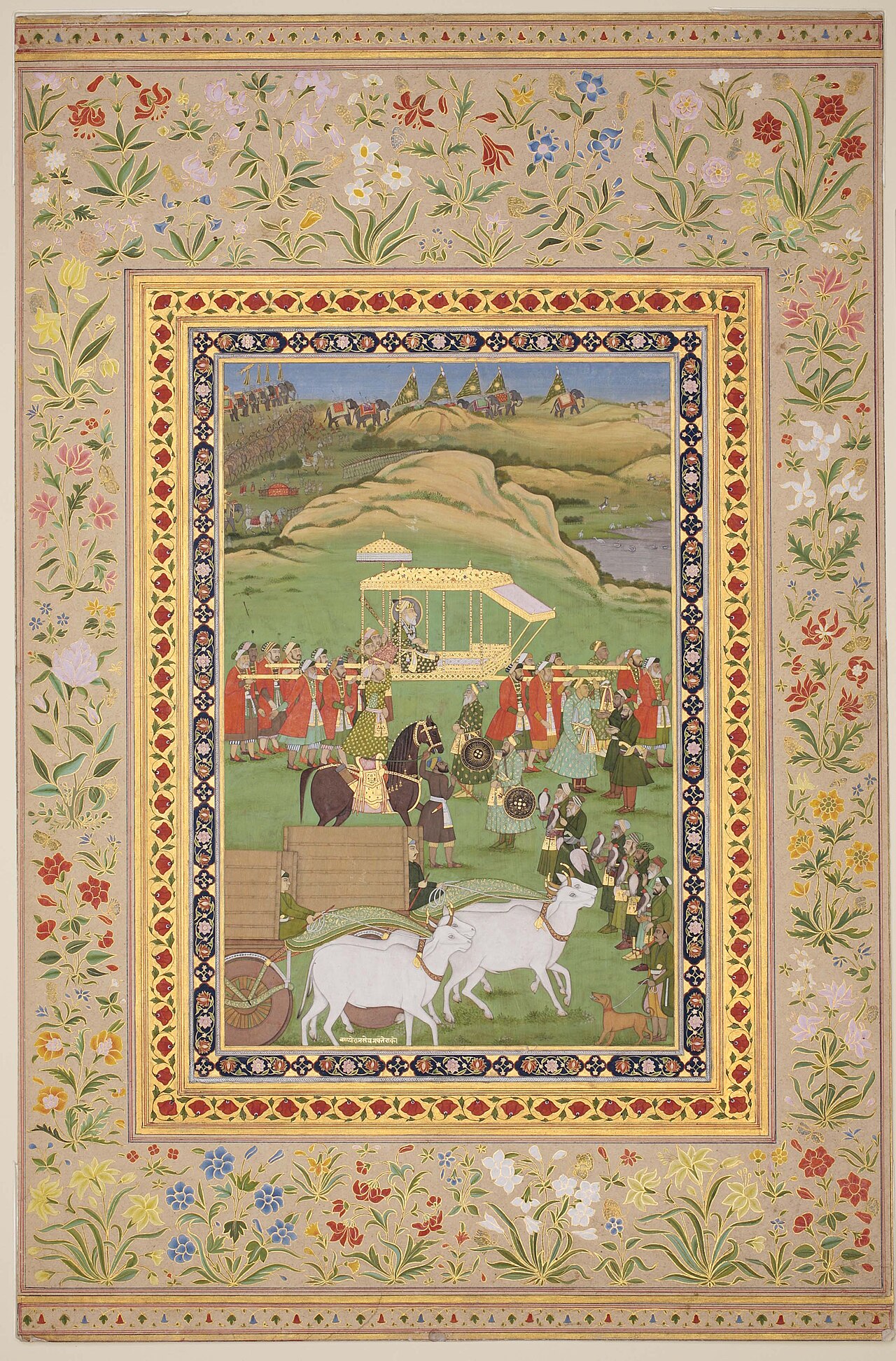
Miniature painting on an album page with a floral border. Inside a gold and patterned frame, a gilded palanquin carried by red-clad bearers moves across a green plain past hills and tents, with white oxen pulling a wooden cart in front.Painting

Secondary source

Album Page with the Mughal Emperor Awrangzeb Out Hunting

1725

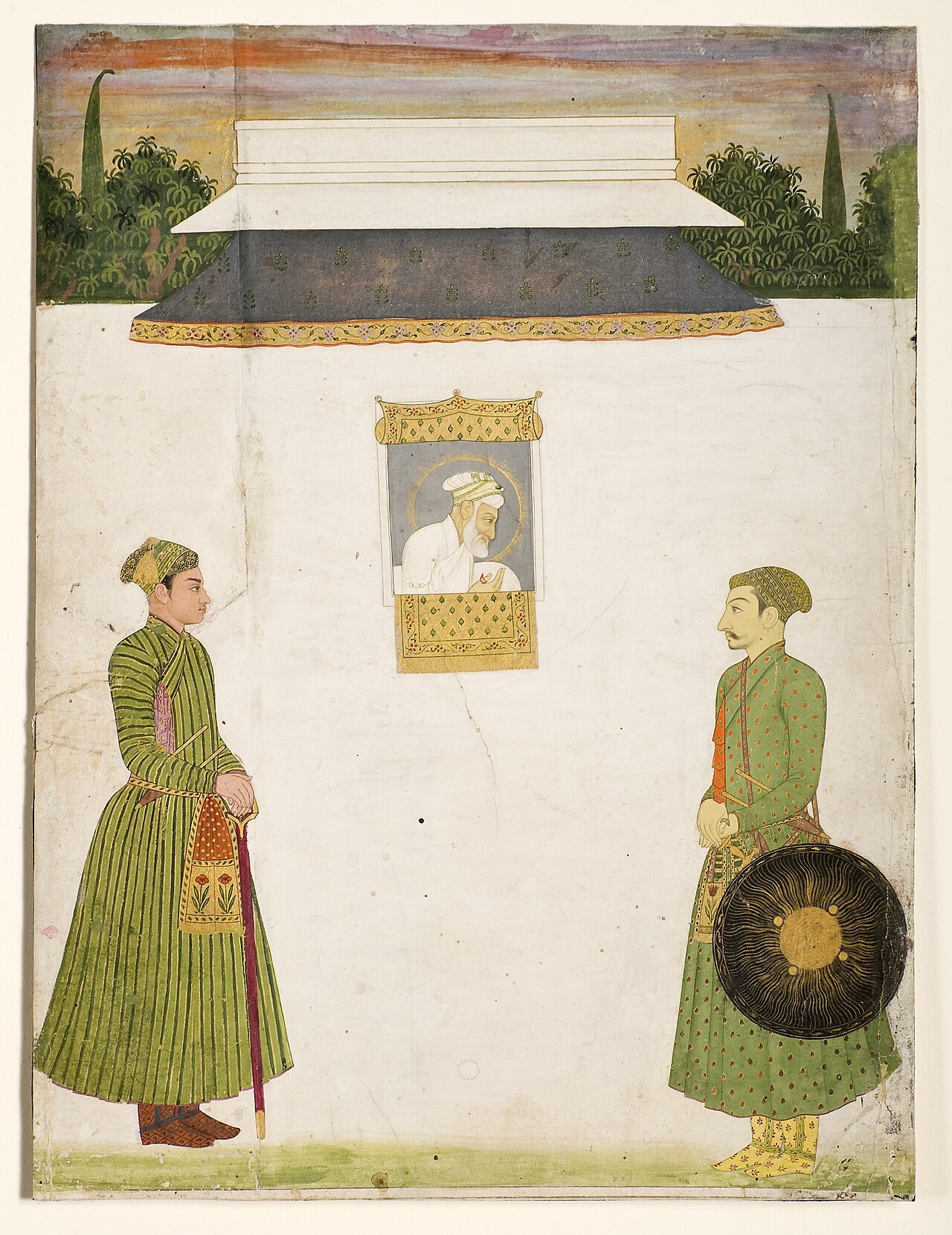
Painting on paper of two standing men in green robes in the foreground. The man on the left wears a striped green coat and holds a long staff. The man on the right wears a patterned green coat and holds a round dark shield with a gold centre. Above is a white and grey canopy with a gold border, and trees. At the centre, a small framed portrait of a bearded man in a white robe and turban with a halo appears within a gold-edged window.Painting

Secondary source

Emperor Aurangzeb at a Jharokha Window

1710

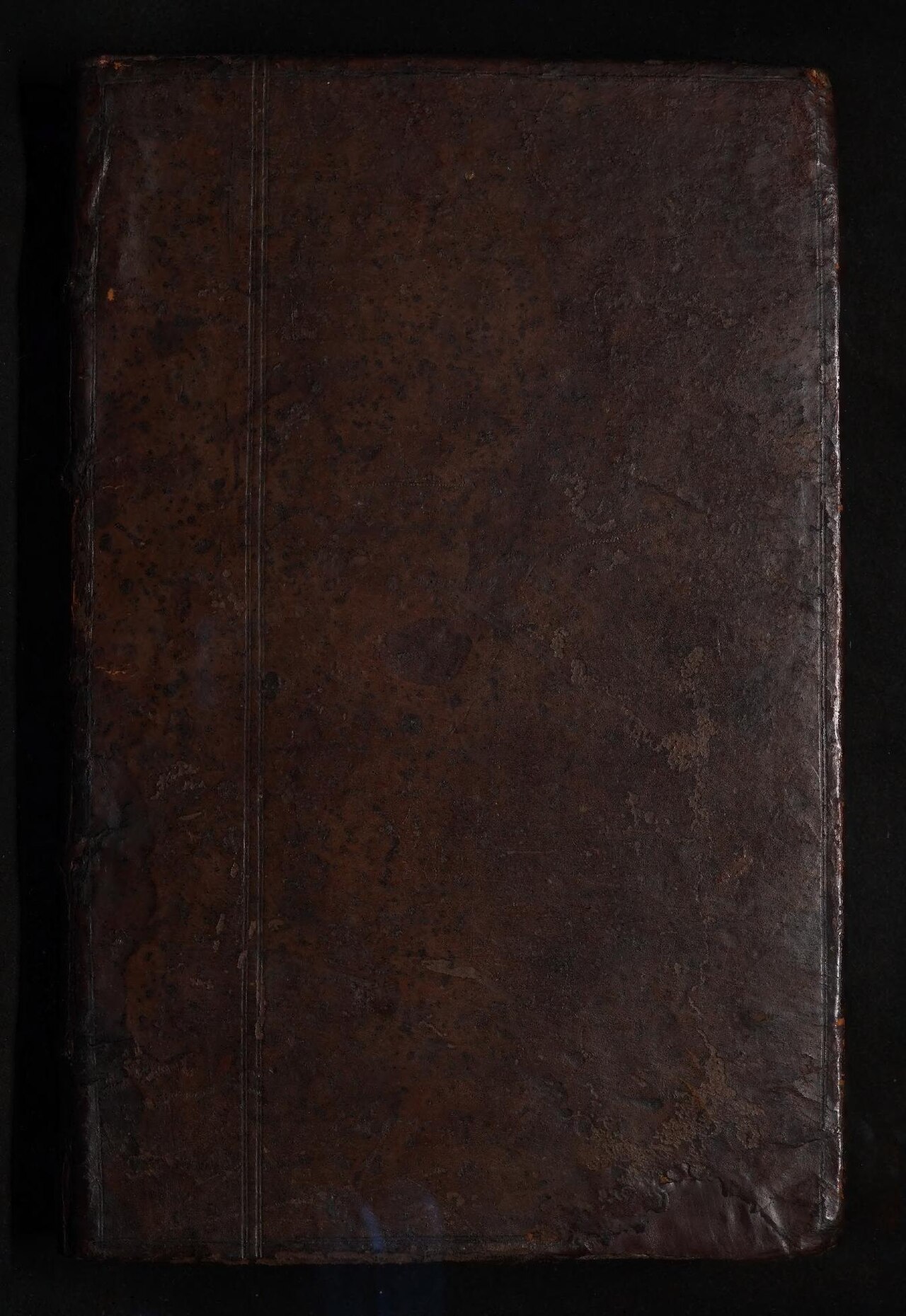
Dark brown leather book cover with mottled texture, two raised parallel lines running vertically near the left edge, photographed against a black background. No title or text is visible.Book

Primary source

A New Account of East India and Persia

John Fryer · 1698

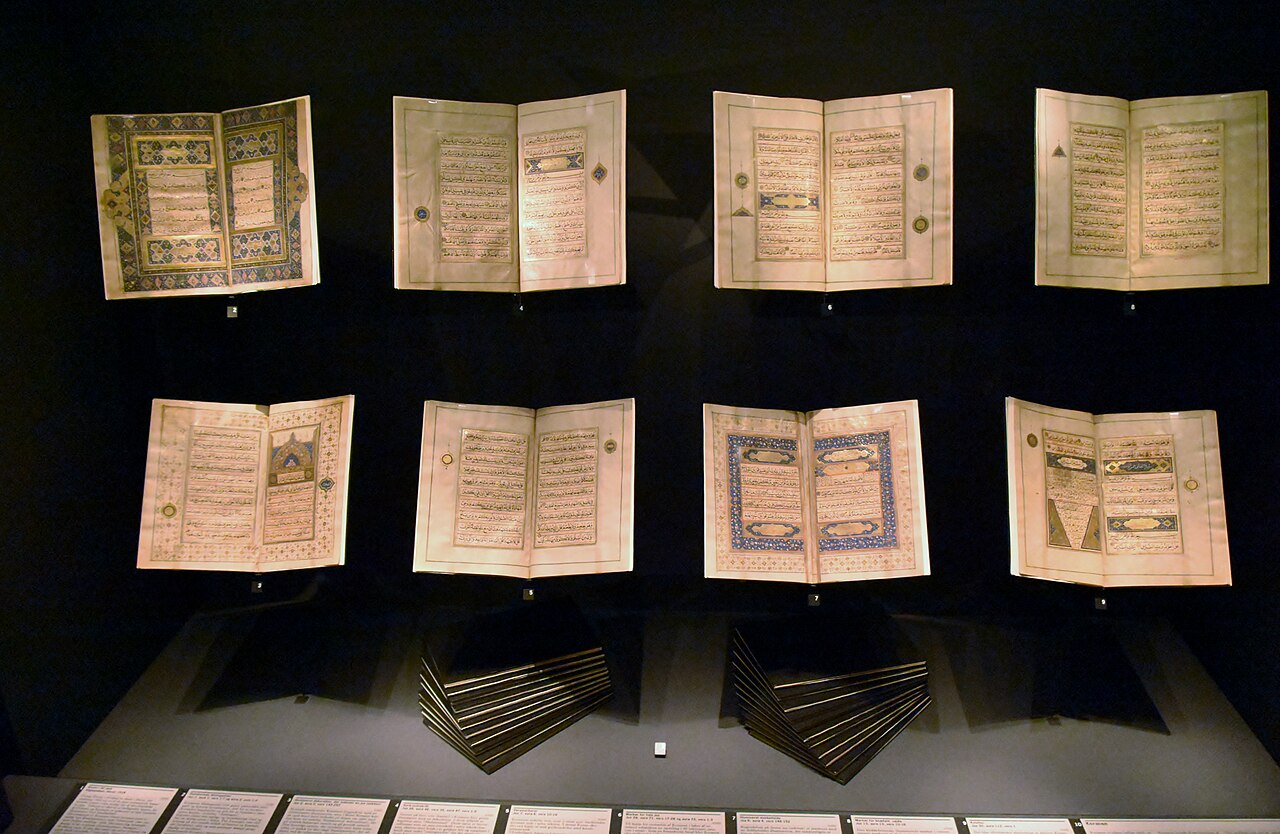
Eight open leaves of a manuscript Quran displayed in a dark case on a wall, written in Arabic script on pale paper, with some pages decorated with blue, gold, and floral illuminated borders. Stacked closed sections lie on a shelf below, with small placard labels along the bottom edge.Book

Primary source

A copy of a Koran in 30 parts, written in Naskh

1519

Book

Primary source

Travels in the Mogul Empire, A.D. 1656-1668

François Bernier · 1656-1668 (this edition 1916)

A Pepys of Mogul IndiaBook

Primary source

A Pepys of Mogul India

Niccolao Manucci · 1653-1708 (this edition 1913)

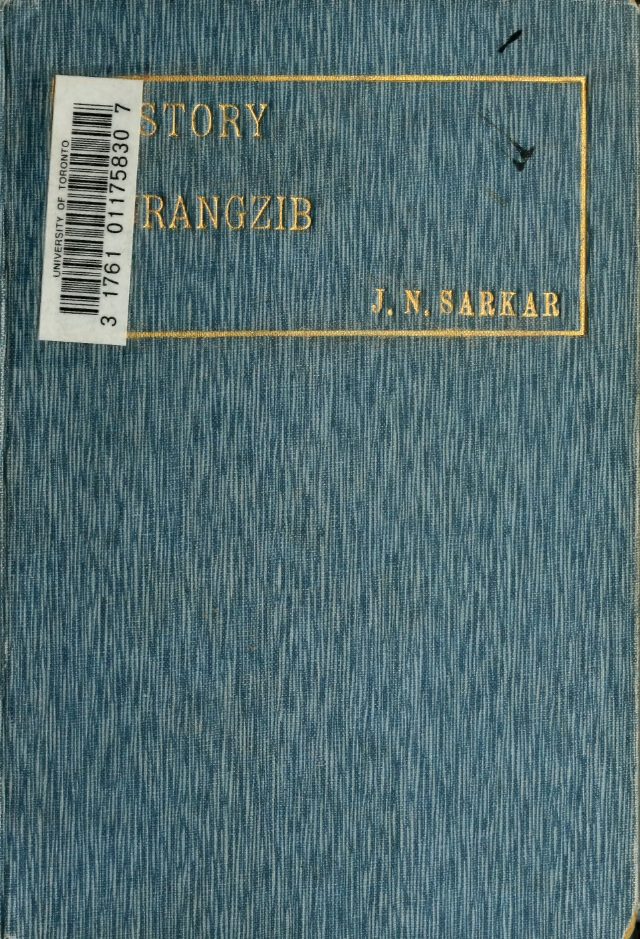
History of Aurangzib Based on Original Sources, Volume IBook

Secondary source

History of Aurangzib Based on Original Sources, Volume I

Jadunath Sarkar · 1912

Anecdotes of AurangzibBook

Secondary source

Anecdotes of Aurangzib

Jadunath Sarkar · 1917

Letter

Primary source

Letter from Aurangzeb to Prince Muhammad Muazzam

Aurangzeb · 1653

Letter

Primary source

Letter from Aurangzeb to Shaista Khan

Aurangzeb · 1659

Book

Secondary source

Aurangzib and the Decay of the Mughal Empire

Stanley Lane-Poole · 1896

Book

Secondary source

History of Aurangzib, Volume 1: Boyhood and Education

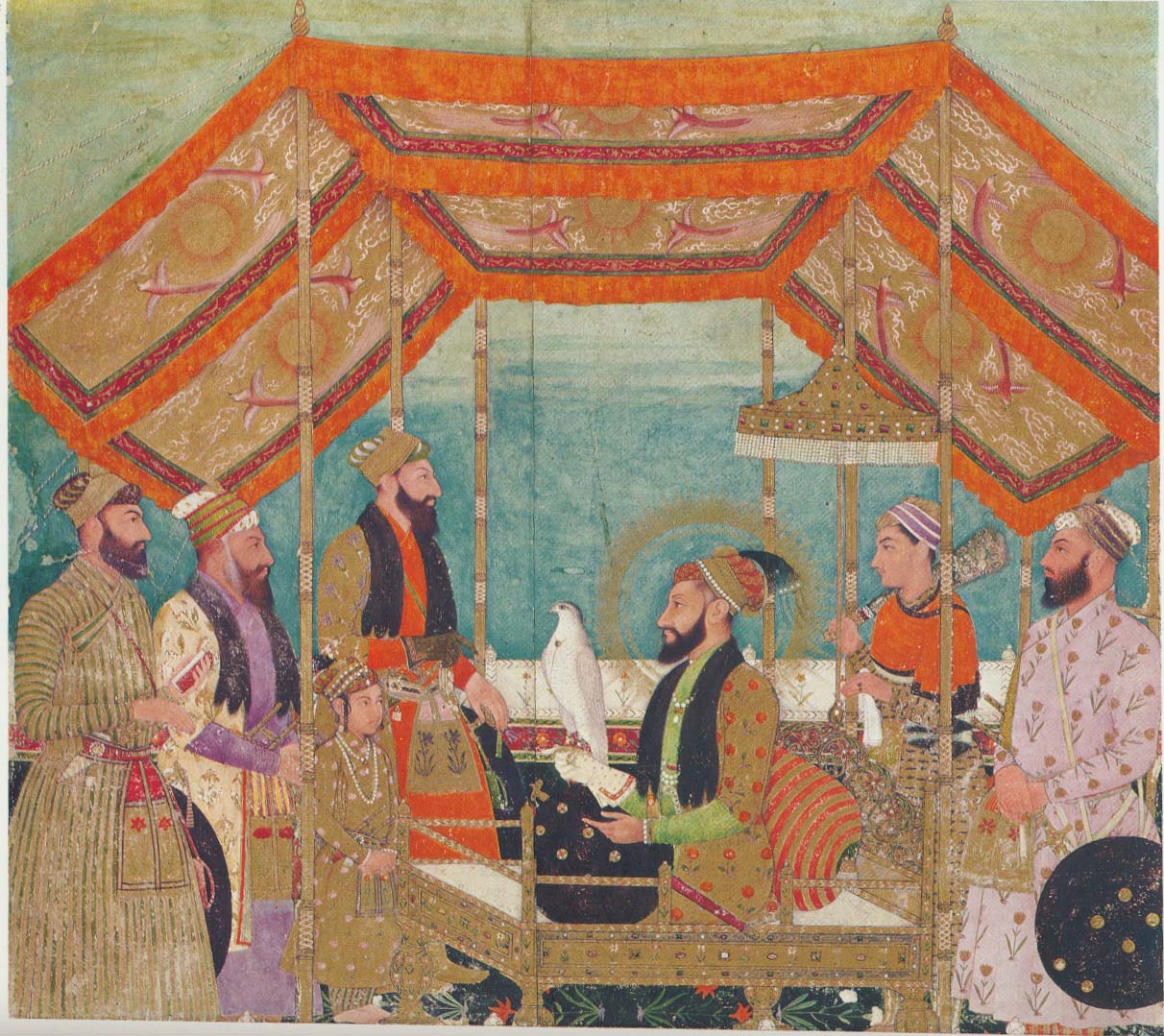
Mughal court painting: a seated bearded ruler with a halo, holding a white falcon on his gloved hand, under an orange and gold canopy. Attendants in turbans and robes stand on both sides, and a small boy stands at the front left.Painting

Primary source

Aurangzeb Holds Court

Attributed to Bichitr · c. 1660

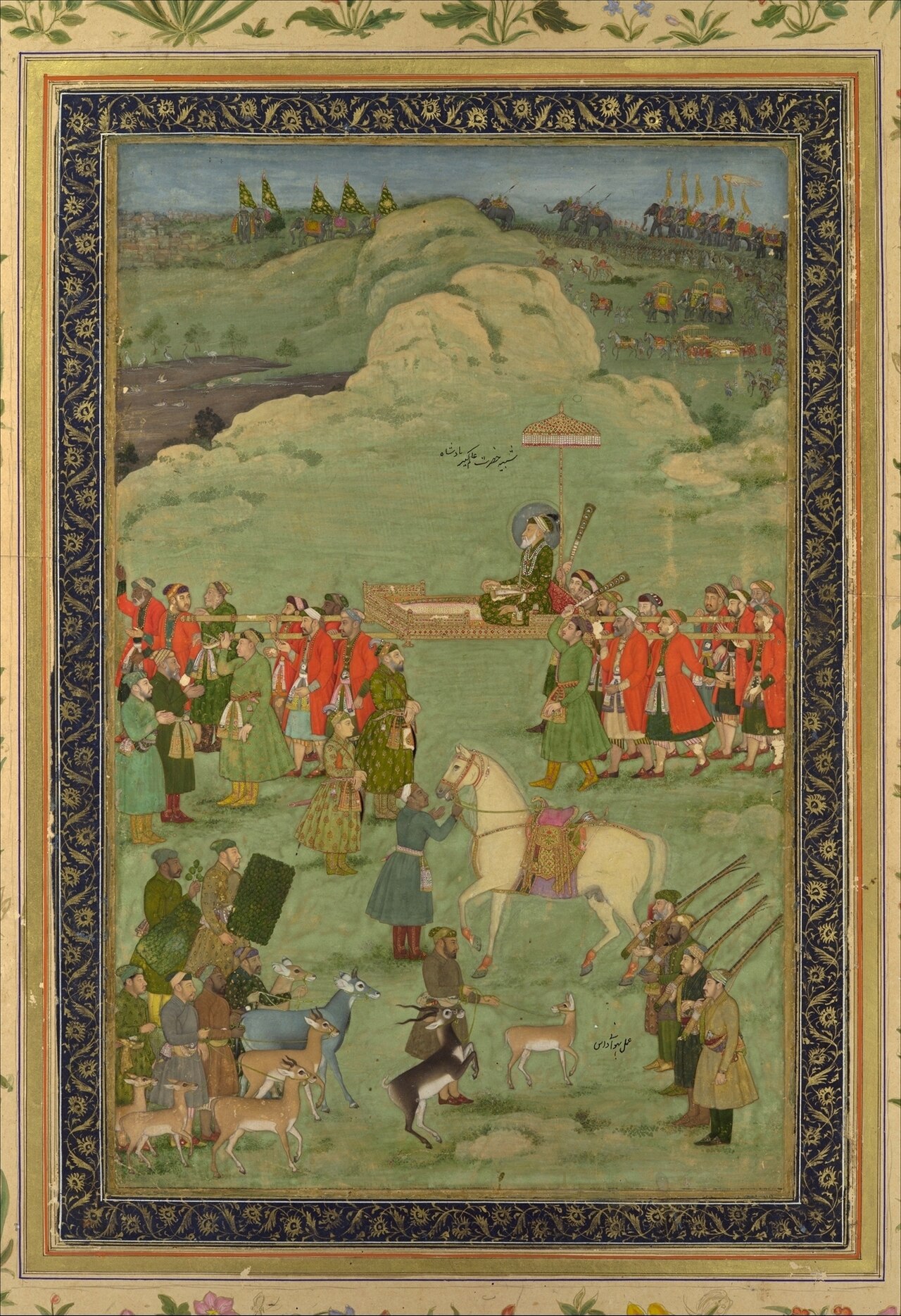
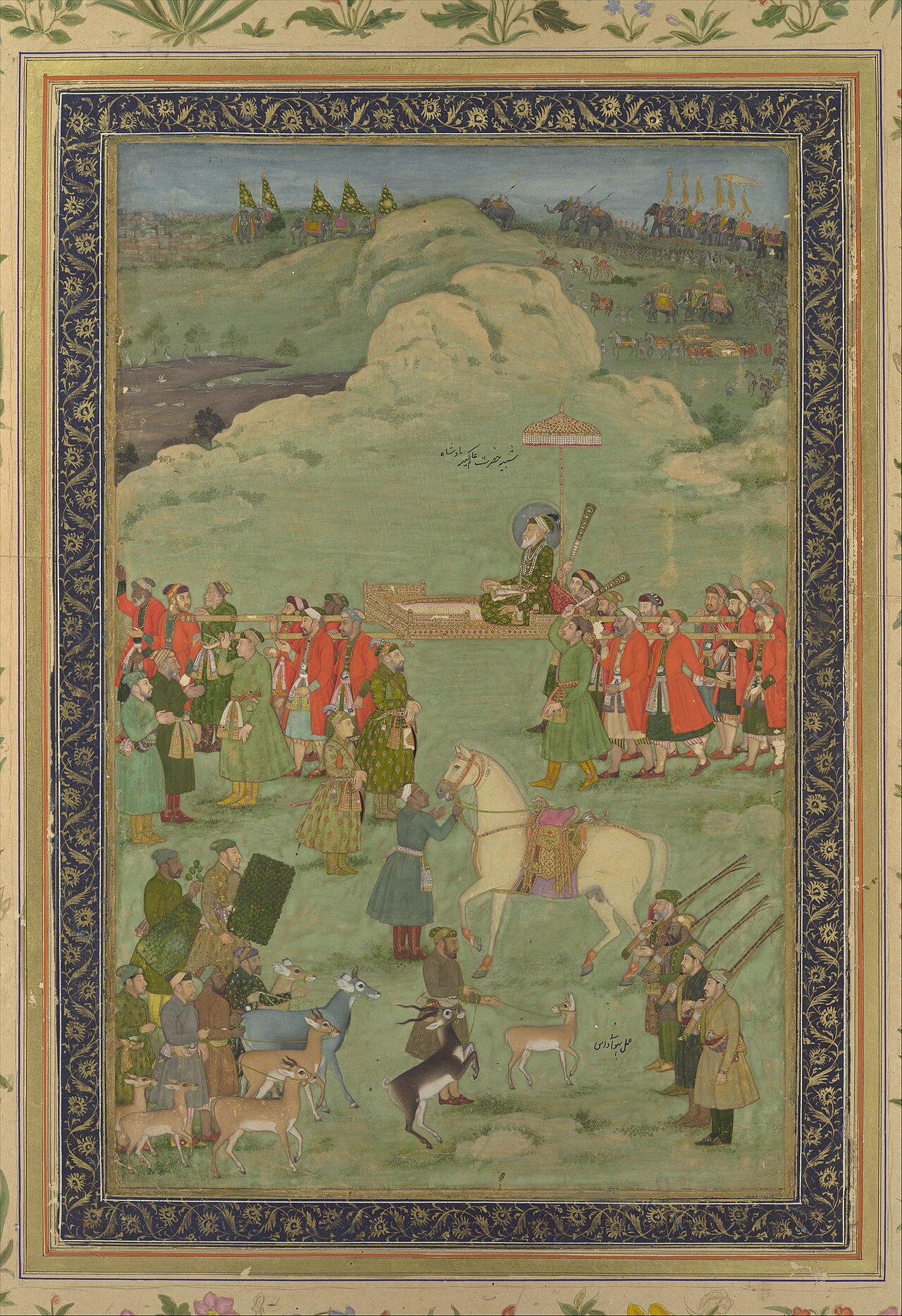
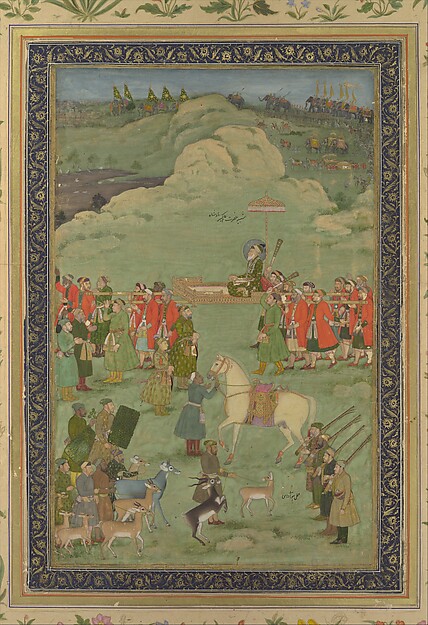
Mughal miniature painting in a dark blue and gold floral border. A seated bearded ruler under a golden canopy is carried on a gilded palanquin by red-coated bearers through a green landscape. Attendants, a white horse, deer, and armed guards surround the procession. Elephants and banners appear on a hill in the background. Persian inscriptions are visible.Painting

Primary source

The Emperor Aurangzeb Carried on a Palanquin

Bhavanidas · c. 1705-1720

Mughal miniature painting of a seated bearded ruler in a green and red robe with a halo, holding a white falcon, on a gilded throne canopy. A young attendant stands at left and another courtier at right, against a teal background.Painting

Primary source

Aurangzeb Enthroned with Son Azam Shah

Attributed to Bichitr · 17th century

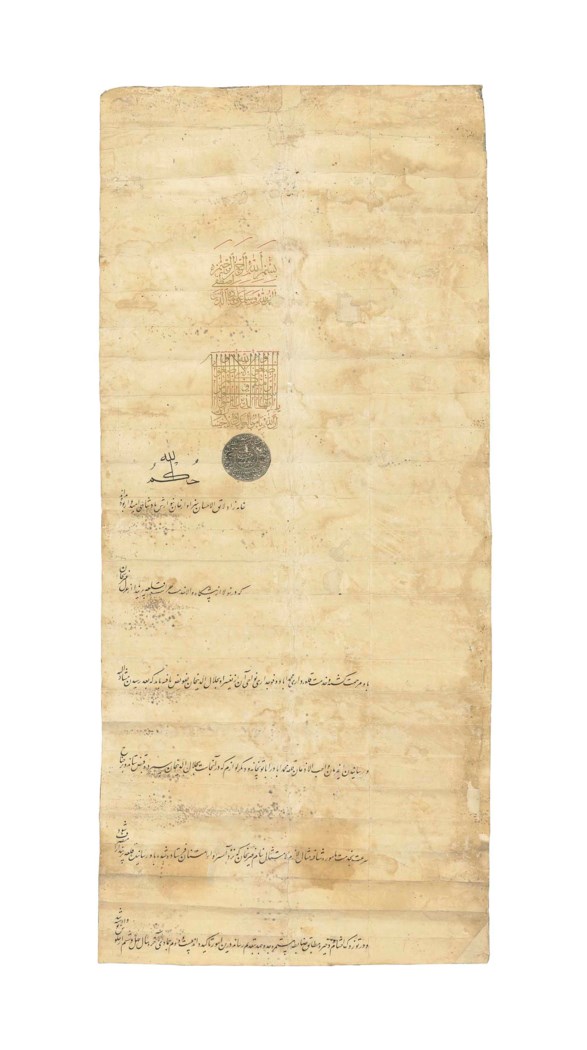
A long, narrow, aged cream-colored paper document with a gold calligraphic headpiece at top, a gold-ink rectangular block of script below it, a round dark seal, a small flourished signature mark, and several lines of black Persian script in the lower part.Document

Primary source

Imperial Firman of Aurangzeb, 1702

1702

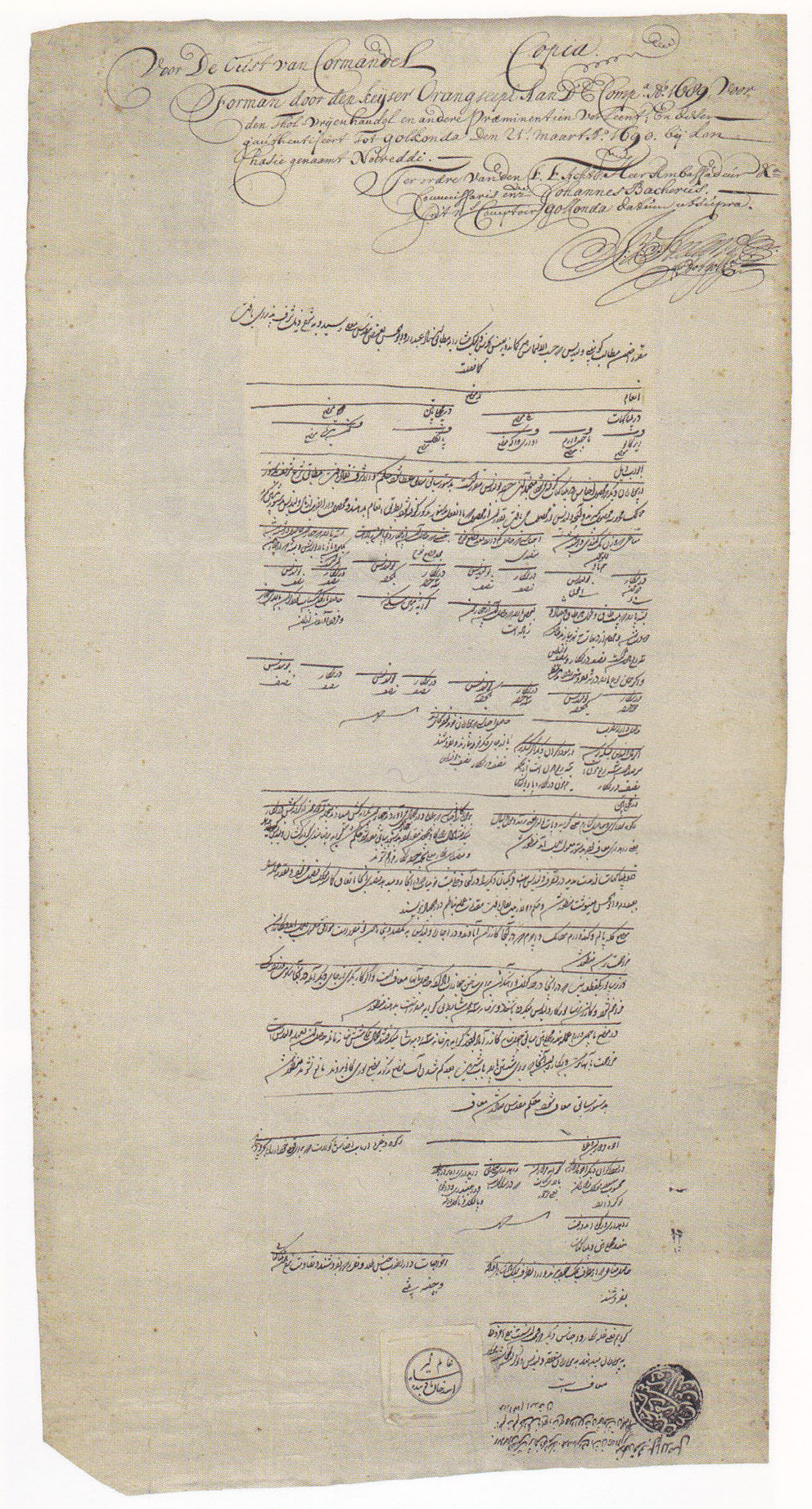
Scan of a 1690 document: a Dutch VOC copy header in ornate handwriting at top, above a page of dense Persian script in columns with rows of signatures and seal impressions at the bottom. Aged paper, grey-beige tone.Document

Primary source

Farman of Aurangzeb Granting Licence to the VOC

1690

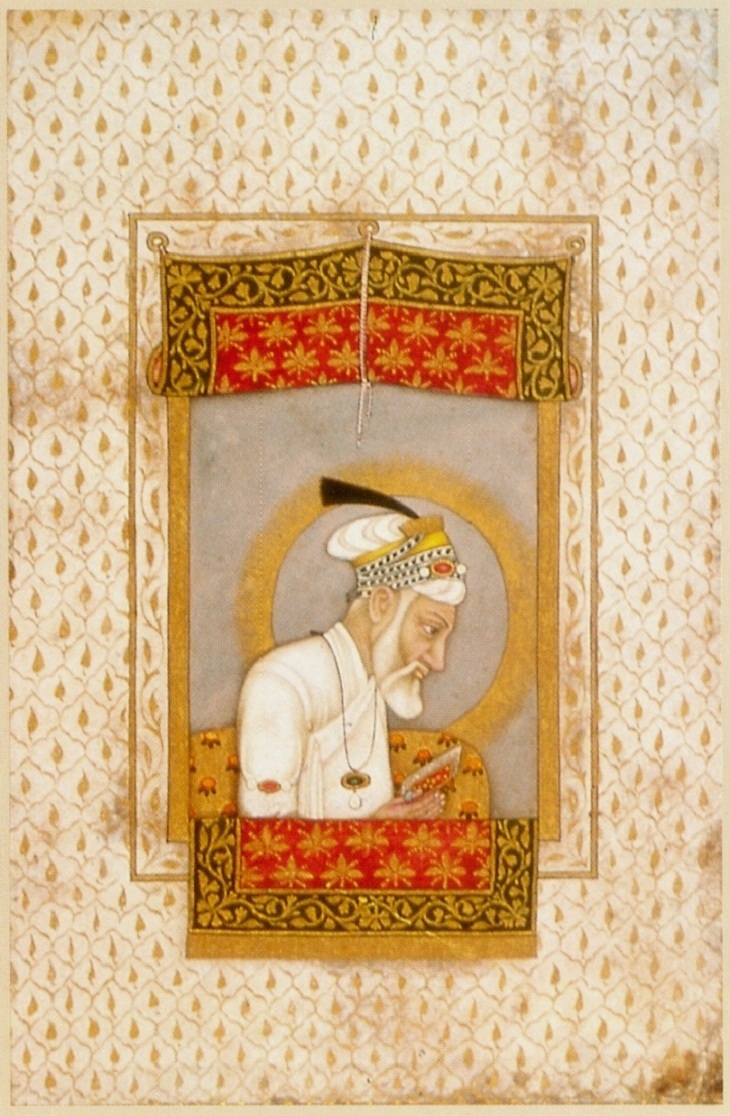
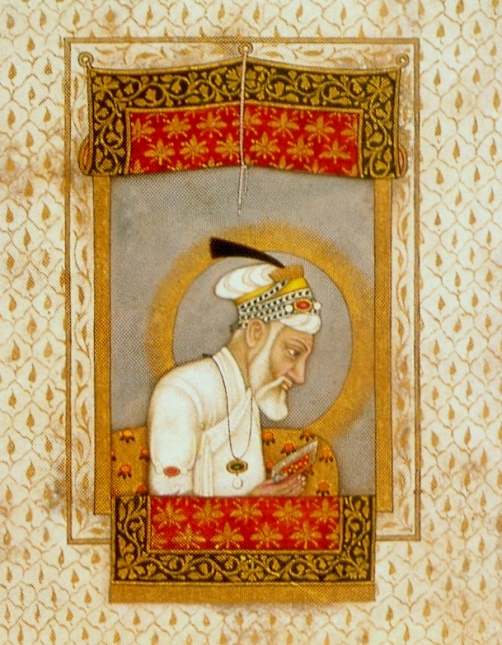
Small Mughal-style painting framed by a patterned gold and cream border with a red and gold canopy at top. A bearded older man in profile, wearing a white turban with a jeweled band and a white robe, holds a small object near his face, with a gray oval halo behind his head. He sits behind a red and gold cushioned ledge.Painting

Primary source

Aurangzeb in His Old Age

Unknown artist · c. 1700

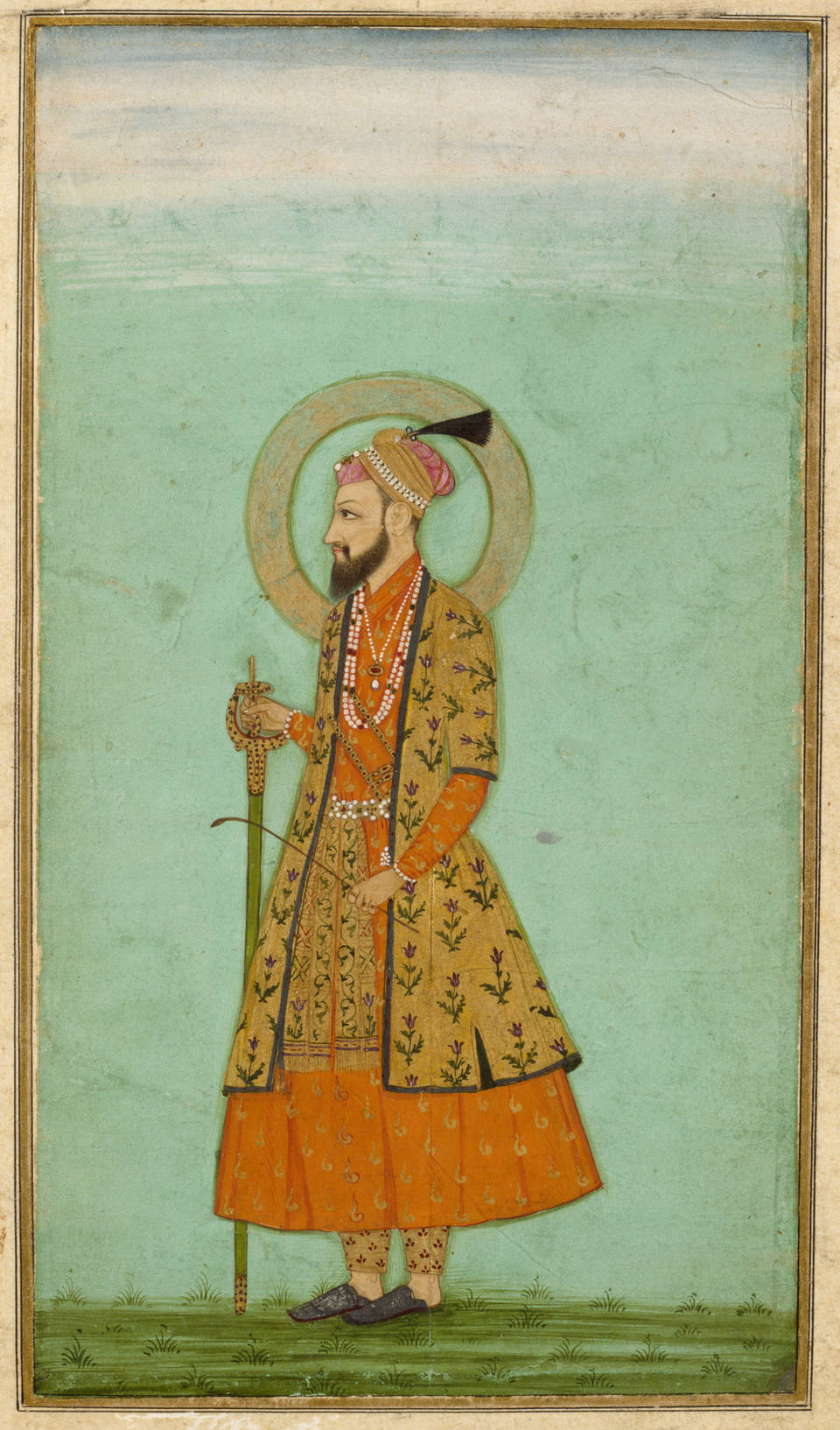
Mughal painting on paper of a bearded man standing in profile facing left, wearing a turban with a black plume, a gold patterned robe over orange, and many strings of pearls. He wears a golden halo and holds a sword with an ornate hilt. The background is pale green with a grass strip at the bottom.Painting

Primary source

Emperor Alamgir with a Halo

Unknown author · c. 1700

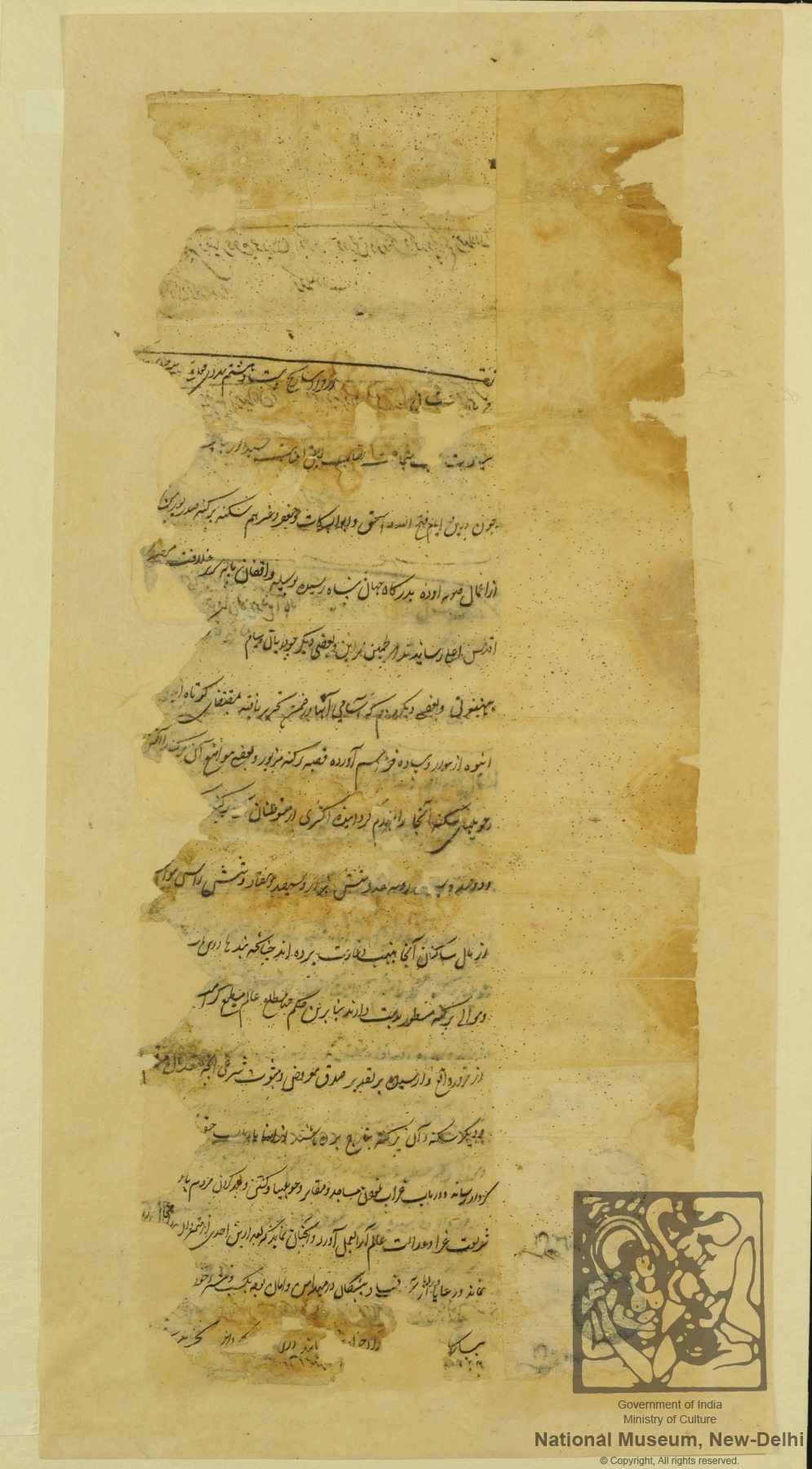
Photograph of a torn, yellowed handwritten Persian-script manuscript on paper, mounted in a frame. Several lines of dark ink calligraphy run vertically down the sheet, with ragged edges and faded stains. A decorative stamp appears in the lower right corner, with the National Museum New Delhi credit text below.Document

Primary source

Farman of Aurangzeb on Village Plunder

1671

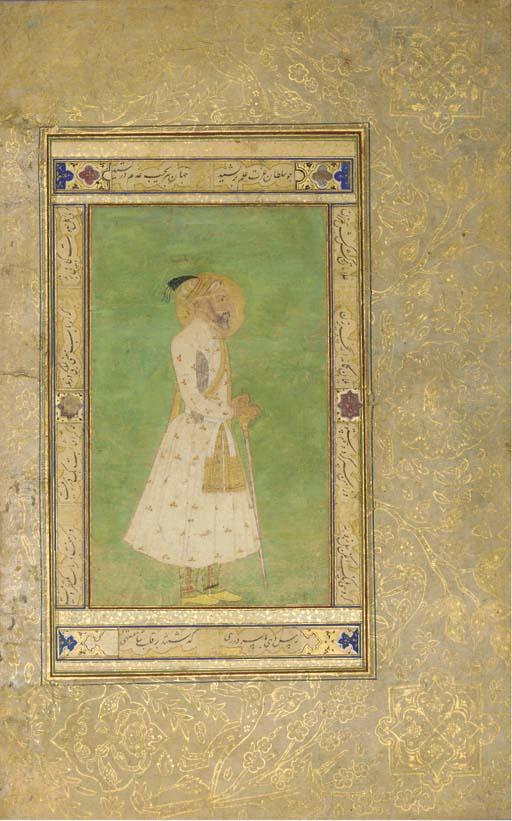
Mughal album leaf painting: a standing male figure in a white patterned robe and tall turban, holding a sword, against a green background, framed by calligraphic borders on a gold-decorated paper page.Painting

Primary source

Portrait of the Emperor Aurangzeb

'Abd al-Rashid al-Dailami · second half of the 17th century

Mughal miniature painting of a hunting scene in a green landscape with trees. A seated man with a halo-like green turban aims a long gun, attendants surround him, and blue-grey nilgai antelopes run through the scene. Mountains and a blue sky are in the distance.Painting

Primary source

Aurangzeb Hunts Nilgais

Hashim (attributed) · c. 1660

Mughal miniature painting in an ornate gold-and-blue border. An emperor sits on a raised canopied platform under a white canopy, wearing a pink robe and white turban, with a halo-like nimbus behind his head. Richly dressed attendants stand and kneel on the terrace and steps, including a figure in orange, a figure in purple, a figure in green holding a round shield, and a bearded figure in white robes presenting something with both hands. Patterned carpets and a floral background fill the scene.Painting

Primary source

Emperor Aurangzeb Receives Prince Mu'azzam

Attributed to Bhavanidas · c. 1707-1712

Rulers of India: AurangzibBook

Secondary source

Rulers of India: Aurangzib

Stanley Lane-Poole · 1893

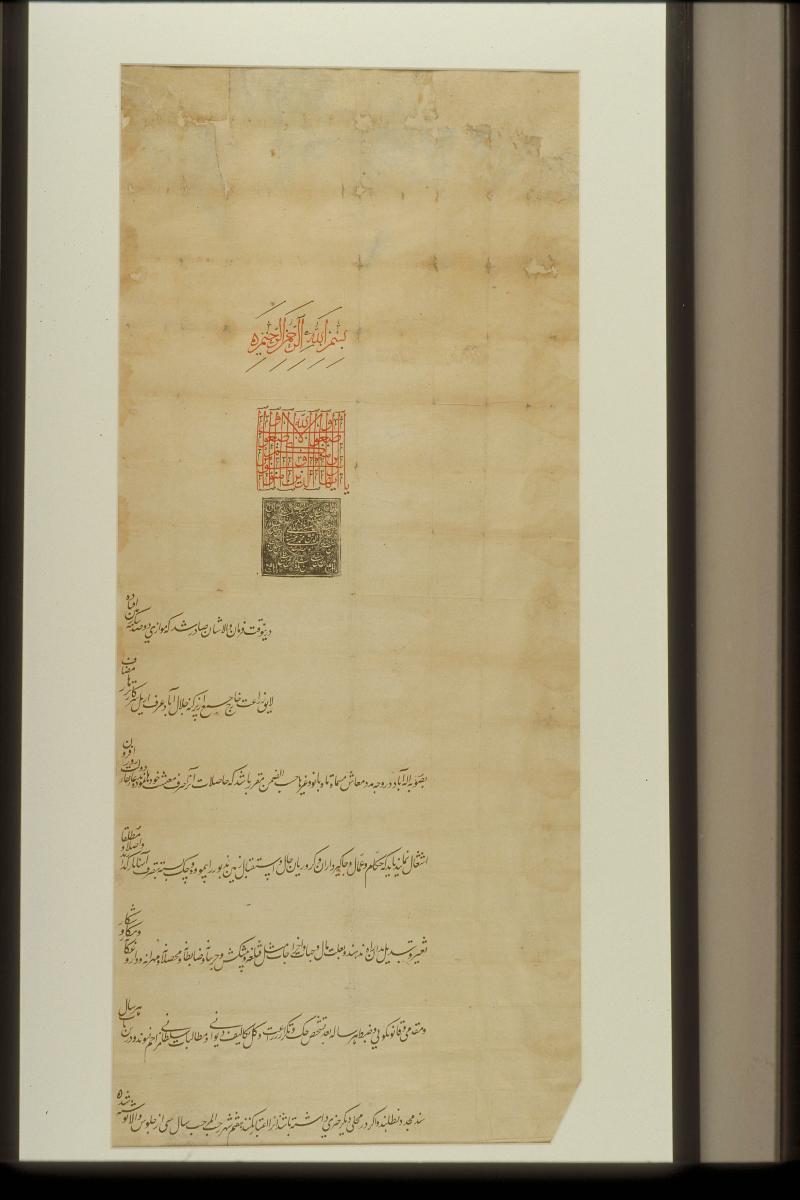
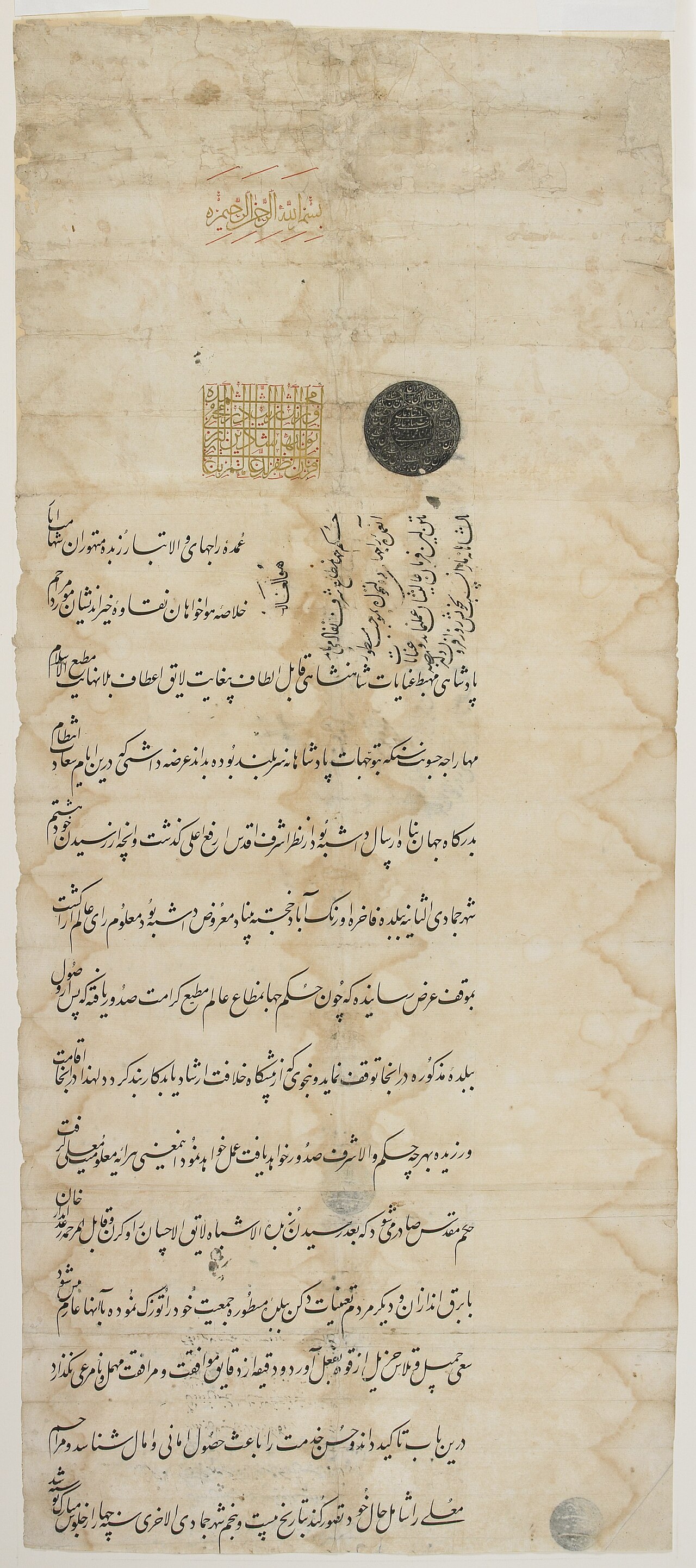
Scan of a long, narrow aged paper document framed behind glass. At top is red calligraphic invocation text, below it a red square seal with script and a dark square seal. Below are several lines of black Persian nasta'liq script running down the page.Document

Primary source

Firman of Aurangzeb Granting Land to Mah Banu

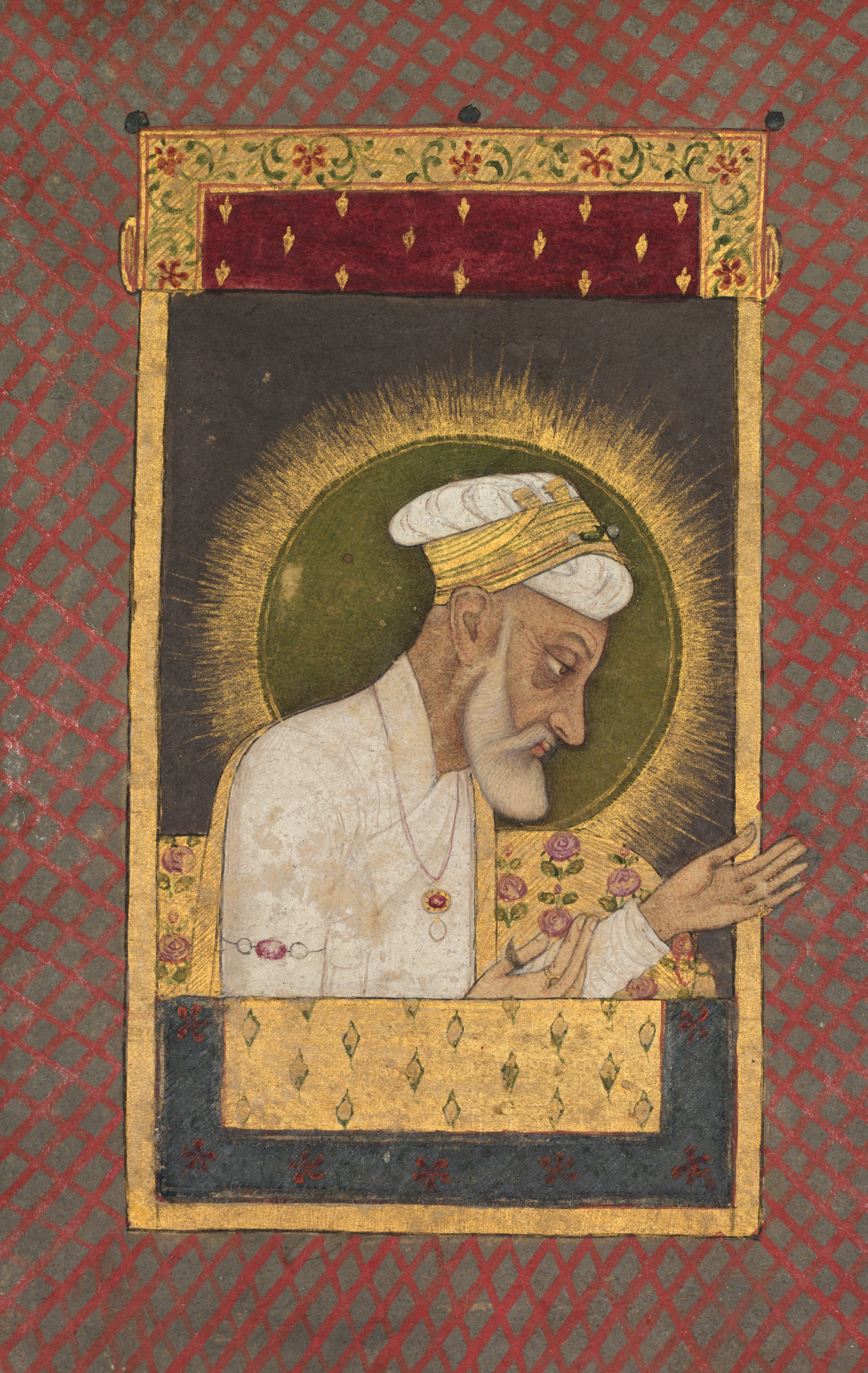
Painting of an elderly bearded man in a white turban with gold ornament and a white robe, seen in profile looking downward, one hand raised palm outward. He is framed by a gold-rayed green halo against a dark background, within a gold and red border with a red-and-gray lattice pattern around it.Painting

Secondary source

Portrait of Emperor Alamgir at a Jharokha Window

c. 1700

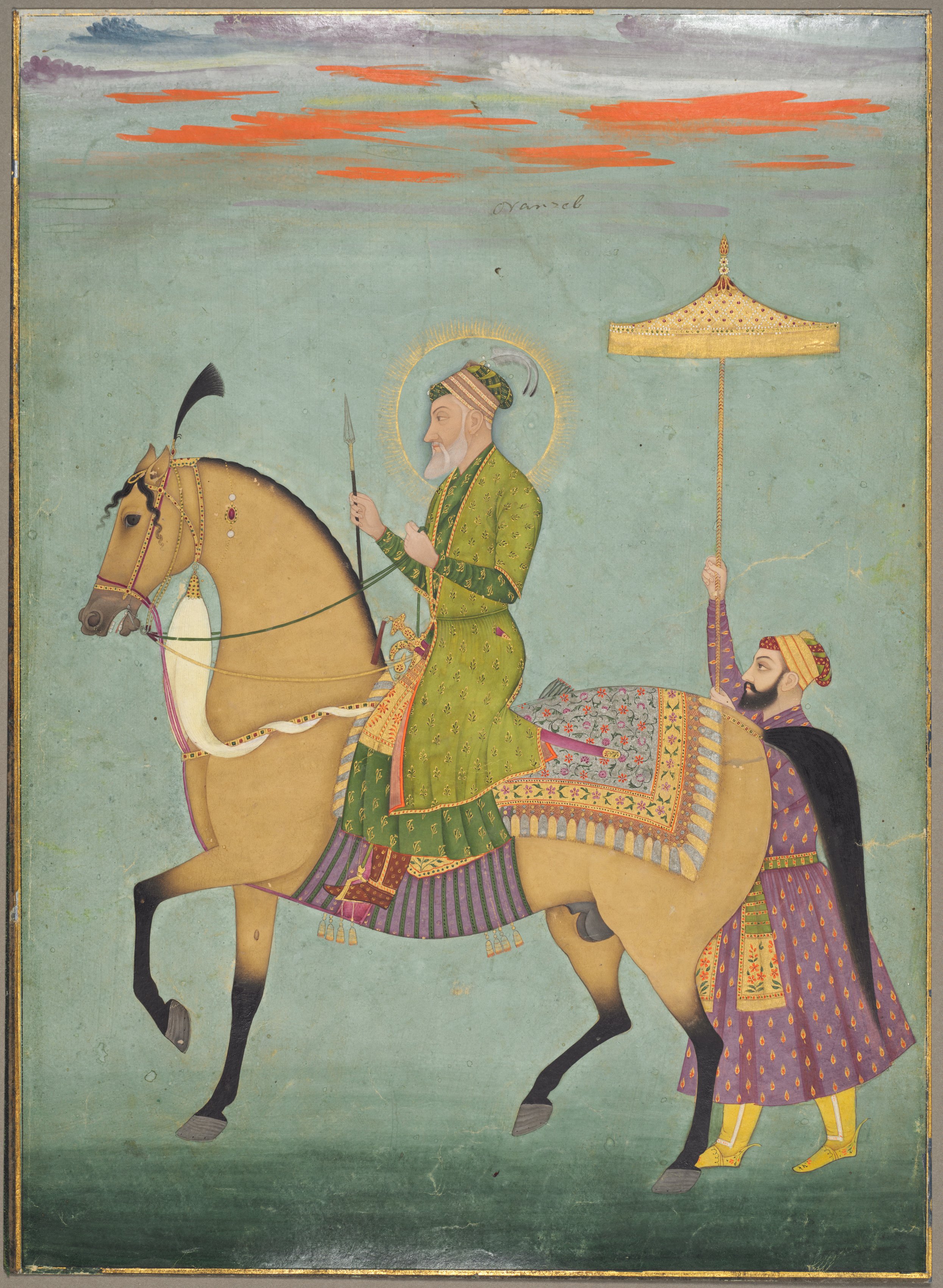
Painting of a bearded man in a green patterned robe and jeweled turban with a plume, riding a tan horse with black hooves and a jeweled bridle. A servant in purple robes and a black cape holds a gold, jewel-studded parasol over him. Pale teal sky with orange clouds; the rider has a gold halo.Painting

Secondary source

The Emperor Alamgir on Horseback

c. 1690-1710

Letter

Primary source

Letters of Aurungzebe to Muazzam and Shah Alam Bahadur

Aurangzeb · 1908 (English translation)

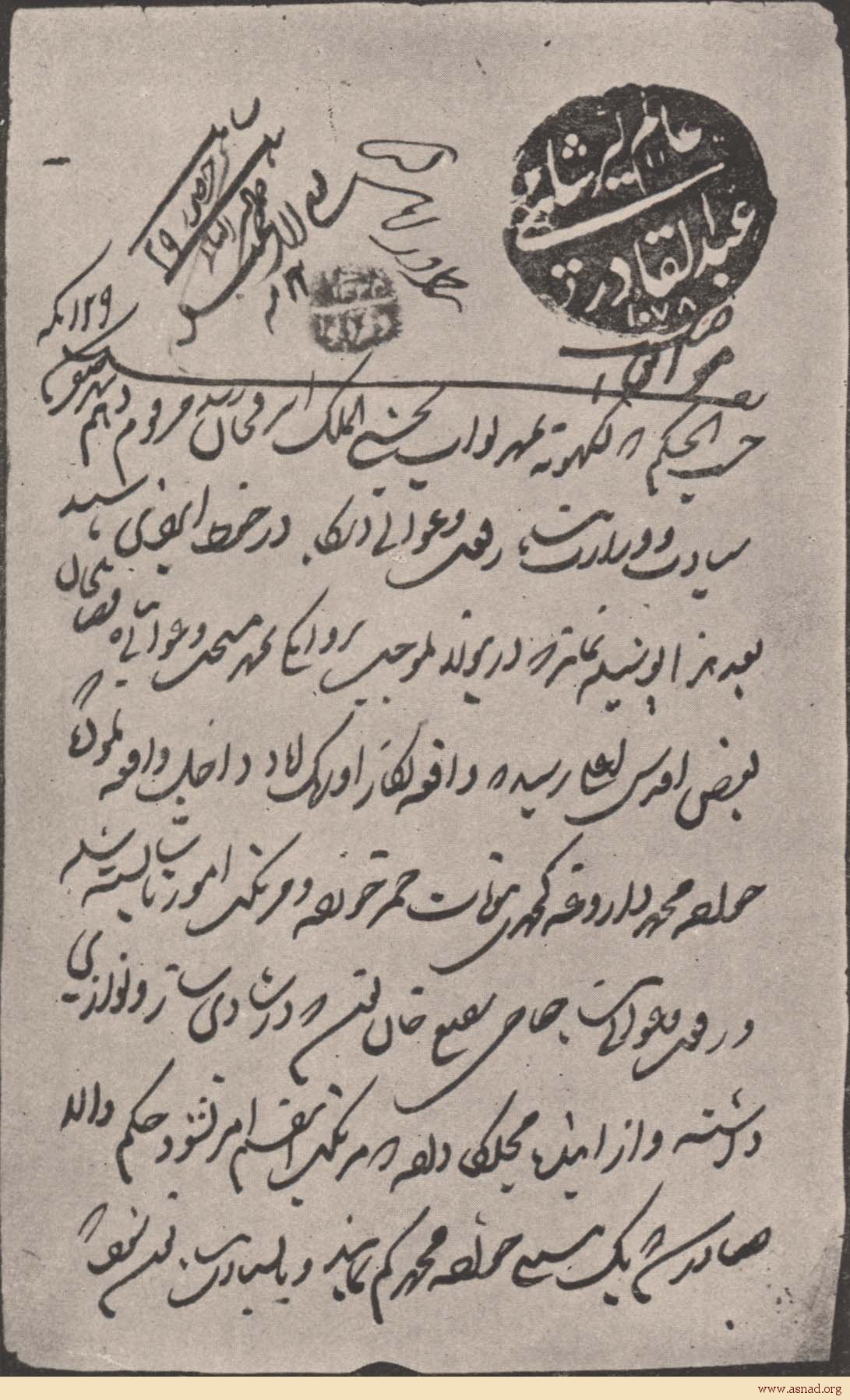
Scan of a handwritten Persian farman (imperial order) on aged paper, with a round black seal stamped in the upper right, a diagonal ink annotation with dates at the top left, and a smaller faded seal below it. The script runs in several lines.Document

Primary source

Imperial farman of 1686 demoting a darughah for misconduct

1686-01-06

Scan of a long, narrow Persian firman on aged paper. At top is a red and gold Arabic invocation, below it a gold square calligraphic tugra, and at right a dark circular seal. Fourteen lines of black nastaliq script run down the page.Document

Primary source

Firman of Aurangzeb to Jaswant Singh, 1662

15 February 1662 (A.H. 1072)

Book

Tertiary source

Aurangzeb entry, Encyclopaedia Britannica (1911)

1911

Book

Tertiary source

Alamgir I entry, Oriental Biographical Dictionary (1881)

Thomas William Beale · 1881

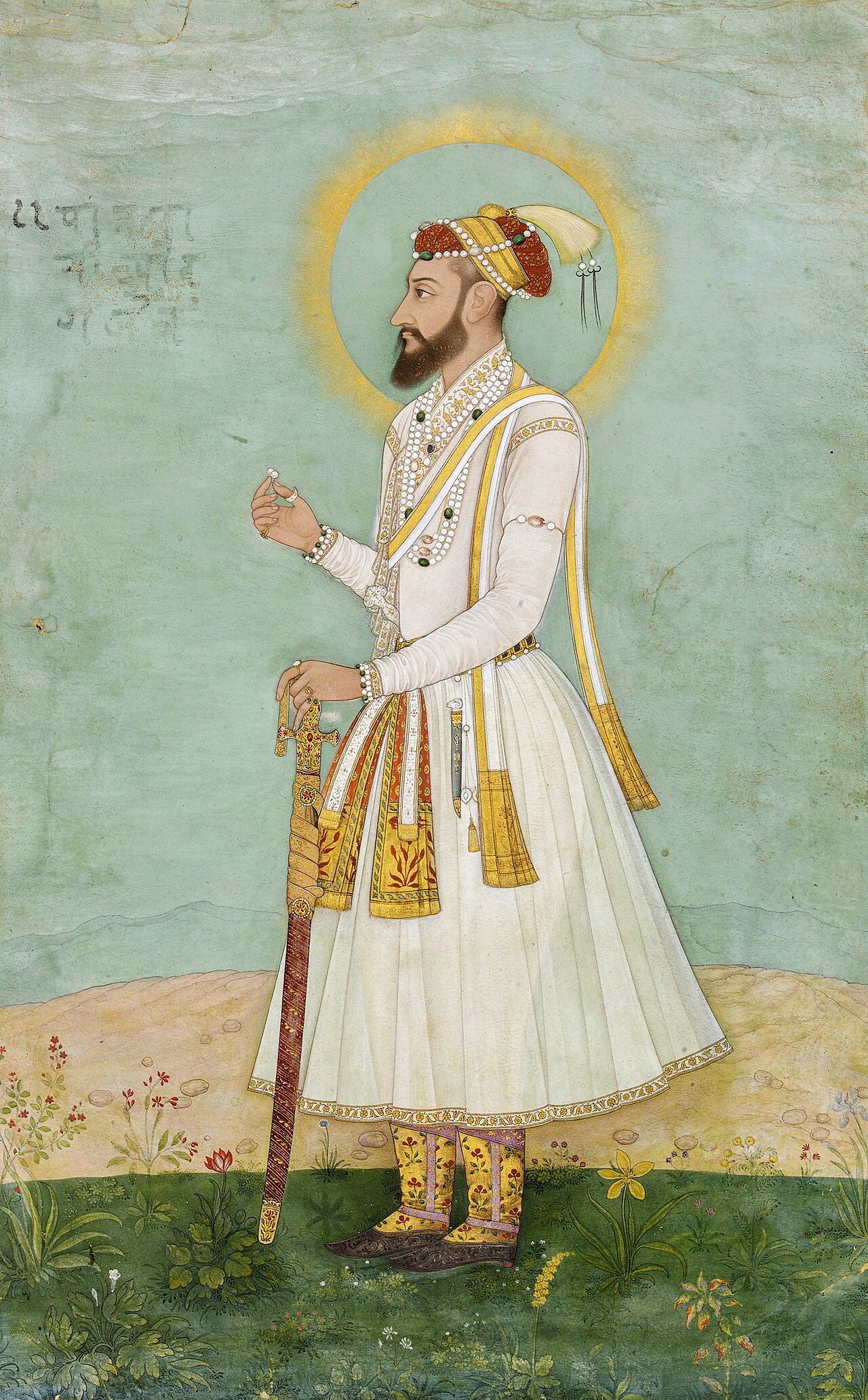
Mughal-style painting of a standing bearded man in profile facing left, wearing a red and gold turban with a white plume, a white robe with gold trim and jeweled necklaces, and holding a jeweled sword. A gold halo surrounds his head against a pale green sky, with grassy ground and flowers below. Faint inscription at upper left.Painting

Primary source

Padshah Aurangzeb (painting)

circa 1700

Miniature painting of a bearded man in a white robe and white turban with a gold-and-red jeweled band, seated within a golden halo. He gazes down at a small open book in his hands. Ornate gold and red border frames the figure against a grey background, set on a cream patterned page.Painting

Primary source

Mughal emperor reading the Quran

circa 1700

Mughal miniature painting in a decorated border showing a ruler seated cross-legged on an open gold palanquin carried on poles by red-coated bearers, under a small canopy. Attendants stand around, a white horse with a saddle is in the foreground, deer and an antelope are led by handlers, and a long procession with elephants and tents fills the green hillside behind.Painting

Primary source

Aurangzeb on an open palanquin

Bhavanidas · circa 1705

Miniature painting of a seated man in profile, facing left, wearing an orange robe with gold patterns, a white turban with a jewel, a pearl necklace, and a black beard. He sits on a patterned rug against a plain golden background.Painting

Primary source

Aurangzeb, 17th-century portrait

17th century (exact date uncertain)

Painted miniature of a bearded man in a white robe and a striped purple and white turban, seated in profile on a pink cushion, holding a dark prayer beads string and a fringed pouch. A pale golden halo surrounds his head, with a lattice screen and green patterned cushion behind him.Painting

Secondary source

Alamgir I of India, c. 1725

c. 1725

Oval miniature painting of a bearded older man in an ornate jeweled turban with a white plume, wearing a gold embroidered robe with fur trim and pearl necklaces, holding an open book against a grey background.Painting

Secondary source

Aurangzeb in old age reading the Koran

between c. 1860 and c. 1870

Mughal miniature painting of a siege scene: a large walled fortress with domed buildings sits behind a hillside crowded with soldiers, banners and cannon smoke. In the foreground, rows of armed horsemen and men in white robes face a central seated figure under a parasol, attended by servants and a group of musicians and footmen. A decorative gold and blue border frames the image.Painting

Secondary source

Aurangzeb au siège de Satara

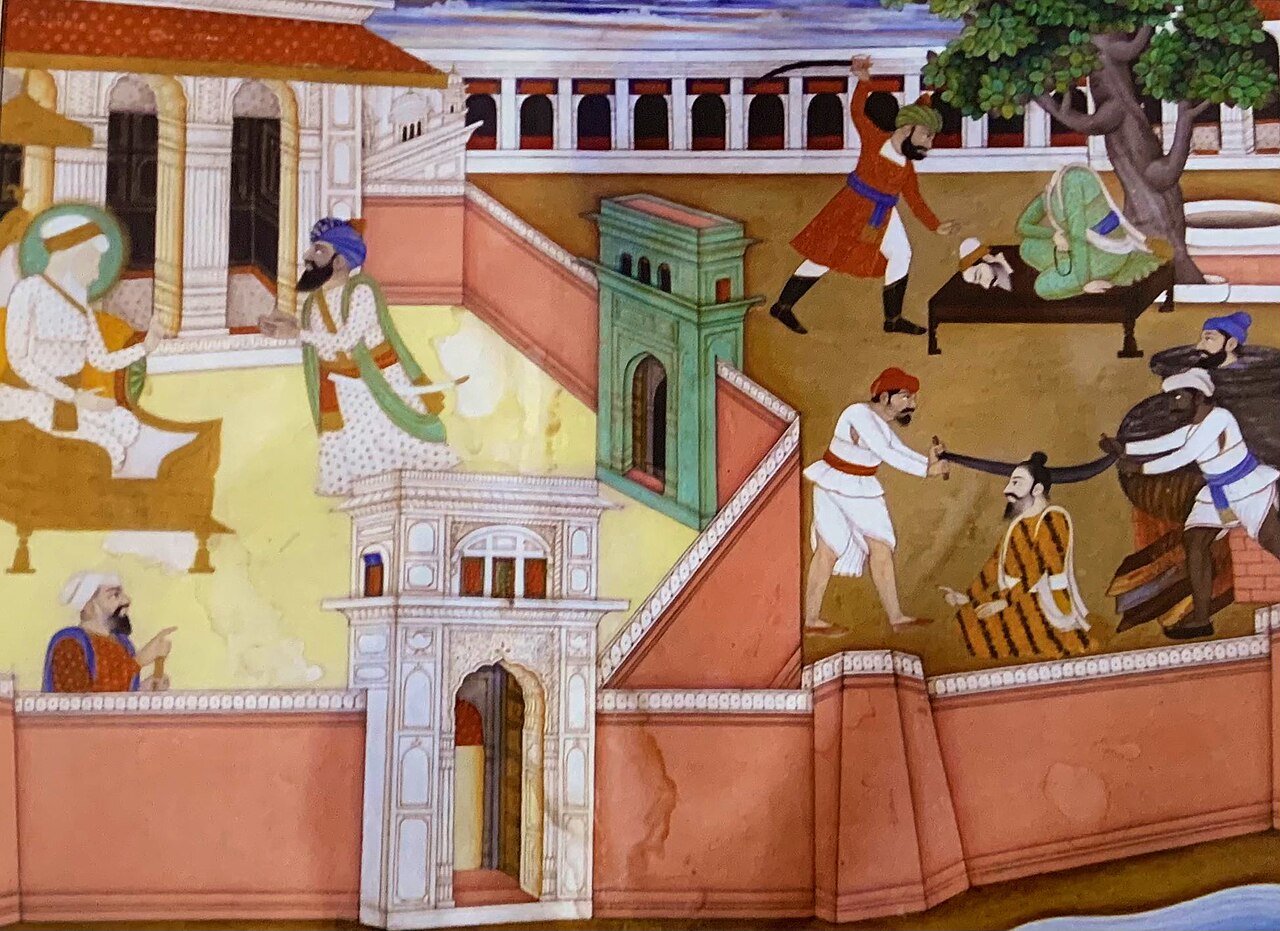
Painting of a multi-scene court narrative. At left, a turbaned ruler sits on a throne in a white-columned palace while a bearded courtier in blue turban gestures. At center, a red-robed executioner raises a sword over a figure lying on a wooden platform beneath a tree. At right, bearded men in turbans and white garments restrain a seated, bearded figure in a striped robe. A walled courtyard with a green gate lies below.Painting

Secondary source

Aurangzeb receives news of Guru Tegh Bahadur's execution

Basahatullah (Basharat Ullah) · circa late 19th century

Painting of a siege: a red-walled fort with domes and towers stands behind a dense army of elephants, horsemen and soldiers. In the lower right, a seated ruler under a gold canopy is surrounded by attendants and musicians. A rider on an elephant appears at lower left. Gold-patterned border frames the scene.Painting

Secondary source

Aurangzeb at the siege of Golconda, 1687

1750-1790

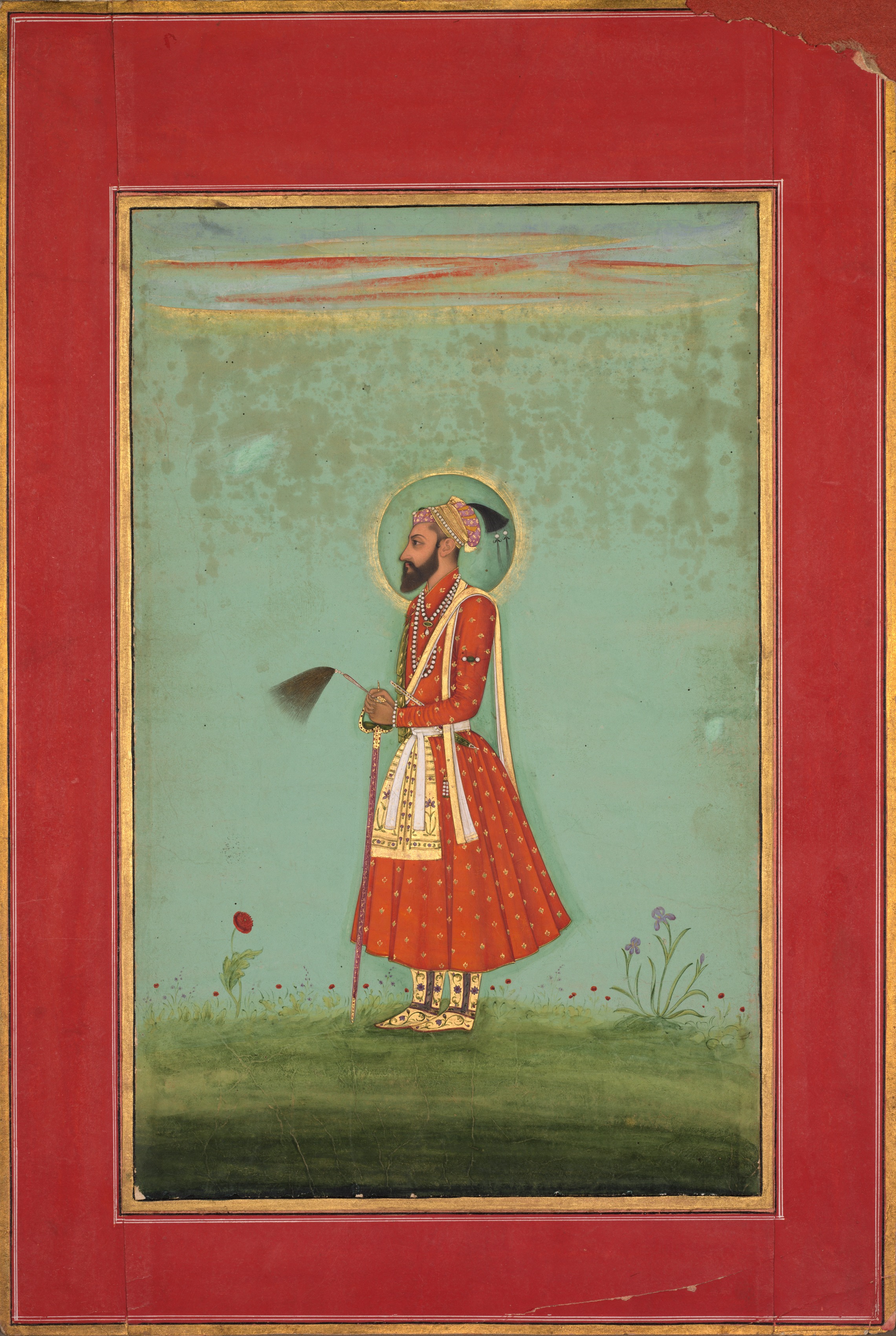
A Mughal-style painting of a bearded man in profile, wearing a red robe with gold floral motifs, a jeweled turban with a black plume, and pearl necklaces. He holds a fly whisk and a sword hilt against a pale green background with a gold halo, red flowers and green grass at the bottom, inside a red border with gold edging.Painting

Secondary source

Portrait of Aurangzeb

c. 1770

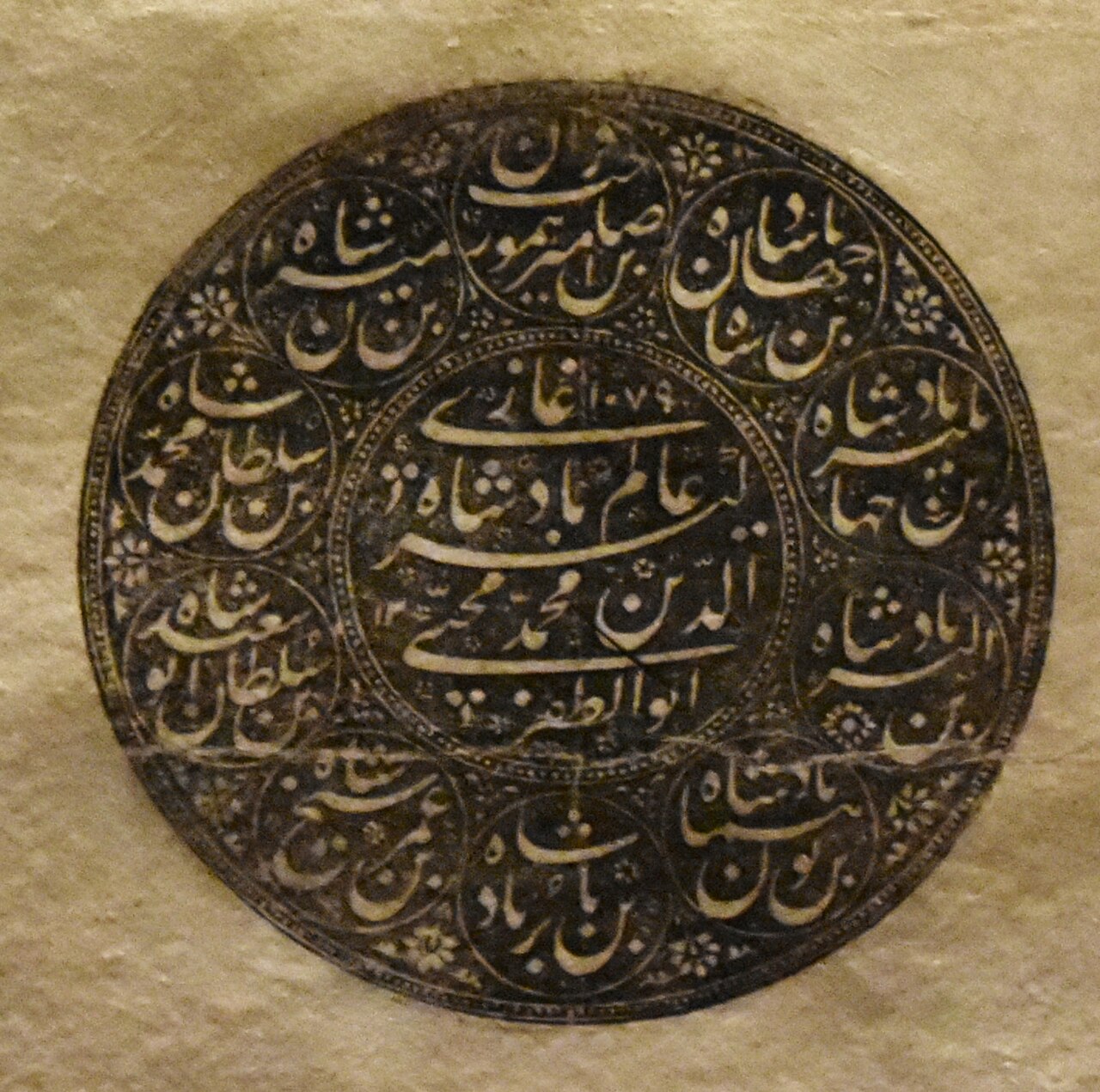
A circular dark metal seal with raised, light-colored Arabic-script inscriptions arranged in a central panel and eight surrounding medallions, set against a pale background.Document

Primary source

Imperial firman of Aurangzeb, 1689

Aurangzeb · 1689

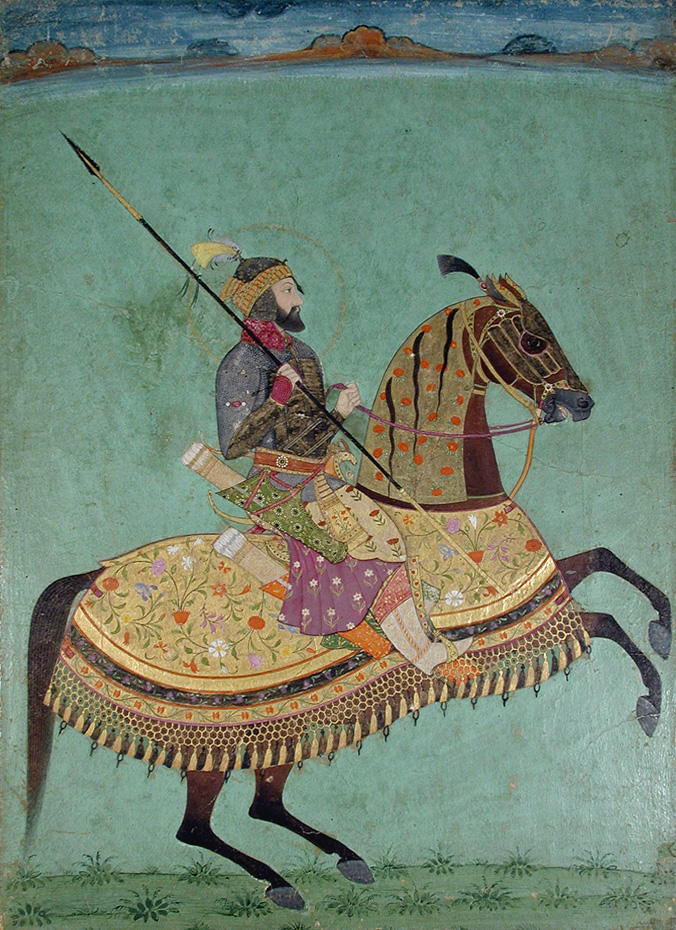
Painting of a mounted rider on a dark brown horse with a green background. The rider wears a feathered turban and armor, holds a long spear, and sits on a horse draped in an ornate gold and floral saddle cloth with tassels. Grass and a hilly horizon appear below and above.Painting

Primary source

Equestrian portrait of Aurangzeb

c. 1650

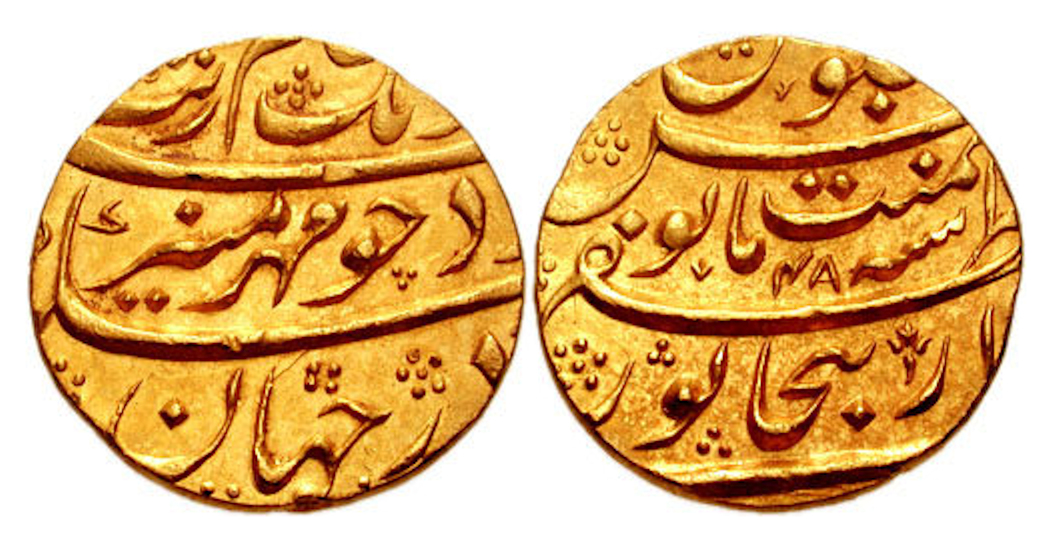
Two-sided gold coin with Persian-script inscriptions in calligraphy. The left side shows a horizontal band of text and a Persian word with a date-like mark; the right side shows a curved inscription and a numeral in the center. The coin has a plain golden surface.Artifact

Primary source

Gold mohur of Aurangzeb Alamgir, Bijapur mint

Regnal year 48 of Aurangzeb Alamgir's reign (1658-1707), Bijapur mint

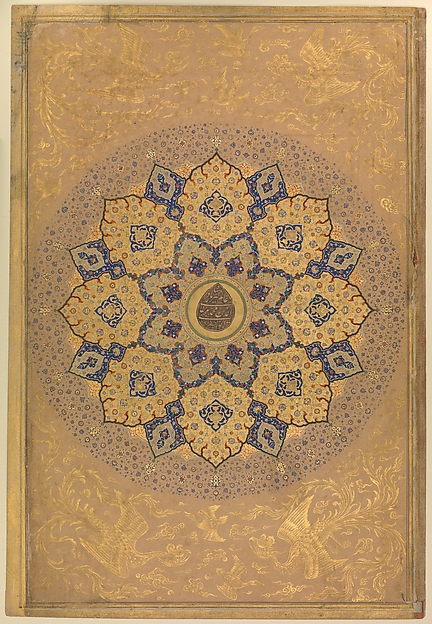
A full-page illuminated album folio with a large central rosette of stylized lotus-like petals in gold, blue, and cream, enclosing a central oval cartouche with inscribed calligraphy. Surrounded by a dotted field and gold-painted floral and cloud scrolls on a pale pink-lilac ground.Painting

Primary source

Rosette Bearing the Name and Title of Emperor Aurangzeb

Mir 'Ali Haravi · recto: ca. 1658; verso: ca. 1630-40

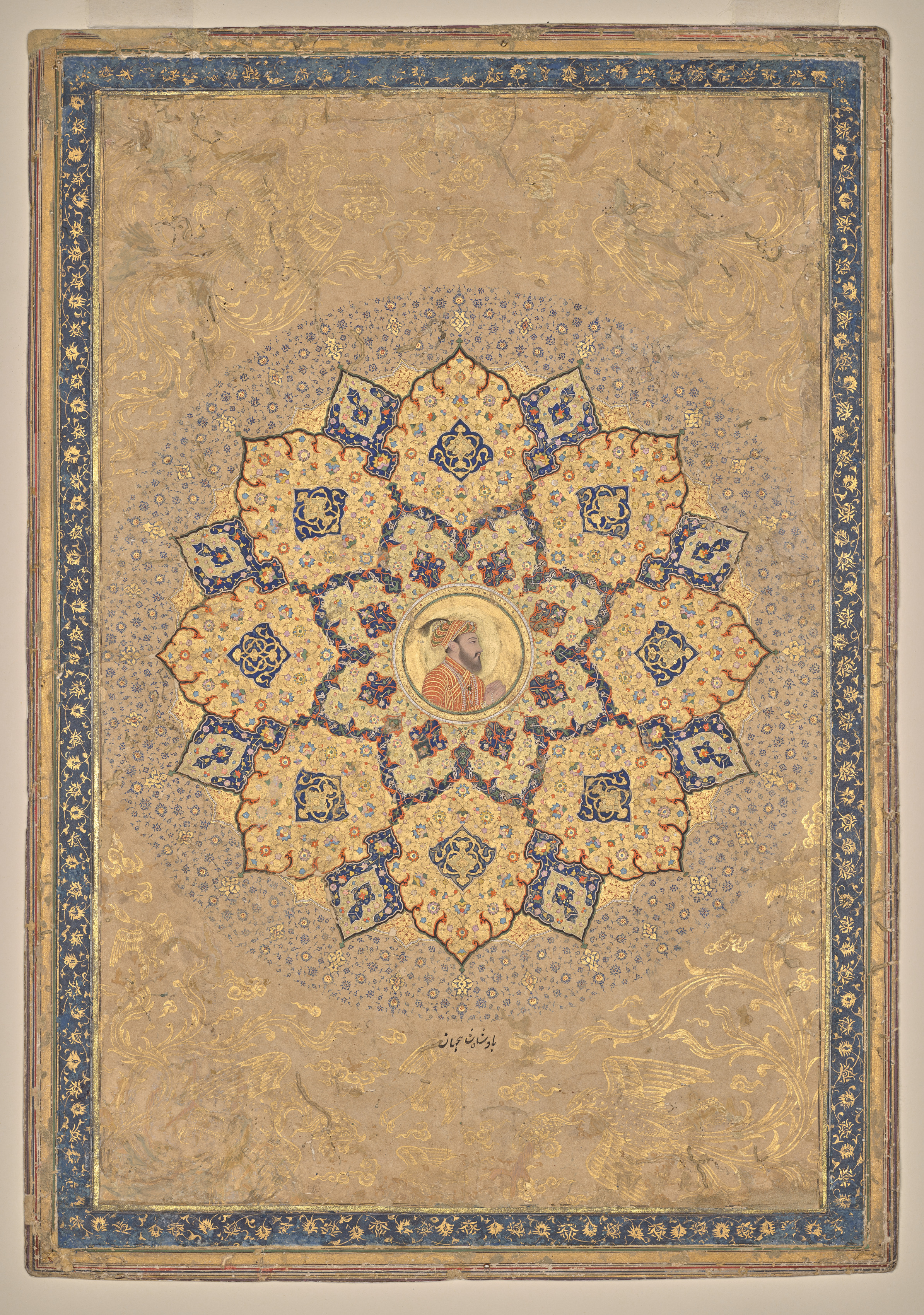
Full view of a Mughal shamsa, a circular sunburst-style illuminated page on gold-flecked paper with a blue and gold border. A central medallion holds a small painted portrait of a bearded man in a turban; radiating petals of floral and arabesque design surround it.Painting

Primary source

Shamsa with Portrait of Aurangzeb from the Emperor's Album

Bichitr · illumination 1640-55; original portrait c. 1640-50; altered after 1658

Profile painting of a bearded man facing left, wearing a blue and gold turban with a black plume and pearl ornaments, a gold embroidered robe with floral patterns, strands of pearls and jewels, on a sage green background.Painting

Primary source

Prince Aurangzeb

ca. 1653-55

Mughal miniature painting of a royal hunting procession on a green landscape. A ruler sits under a canopy on a palanquin carried by attendants in red coats, with a white horse, deer, dogs, and armed men with rifles around him. Tents and mounted riders appear on a hill in the background.Painting

Primary source

The Emperor Aurangzeb Carried on a Palanquin

Bhavanidas · ca. 1705-20

A gilded and jewelled miniature court scene under an ornate golden canopy, with many tiny enamelled figures, elephants, a fountain, and a jewelled throne, displayed in a museum case.Artifact

Primary source

Throne of the Great Mogul Aureng-Zeb

Johann Melchior Dinglinger · 1701-1708

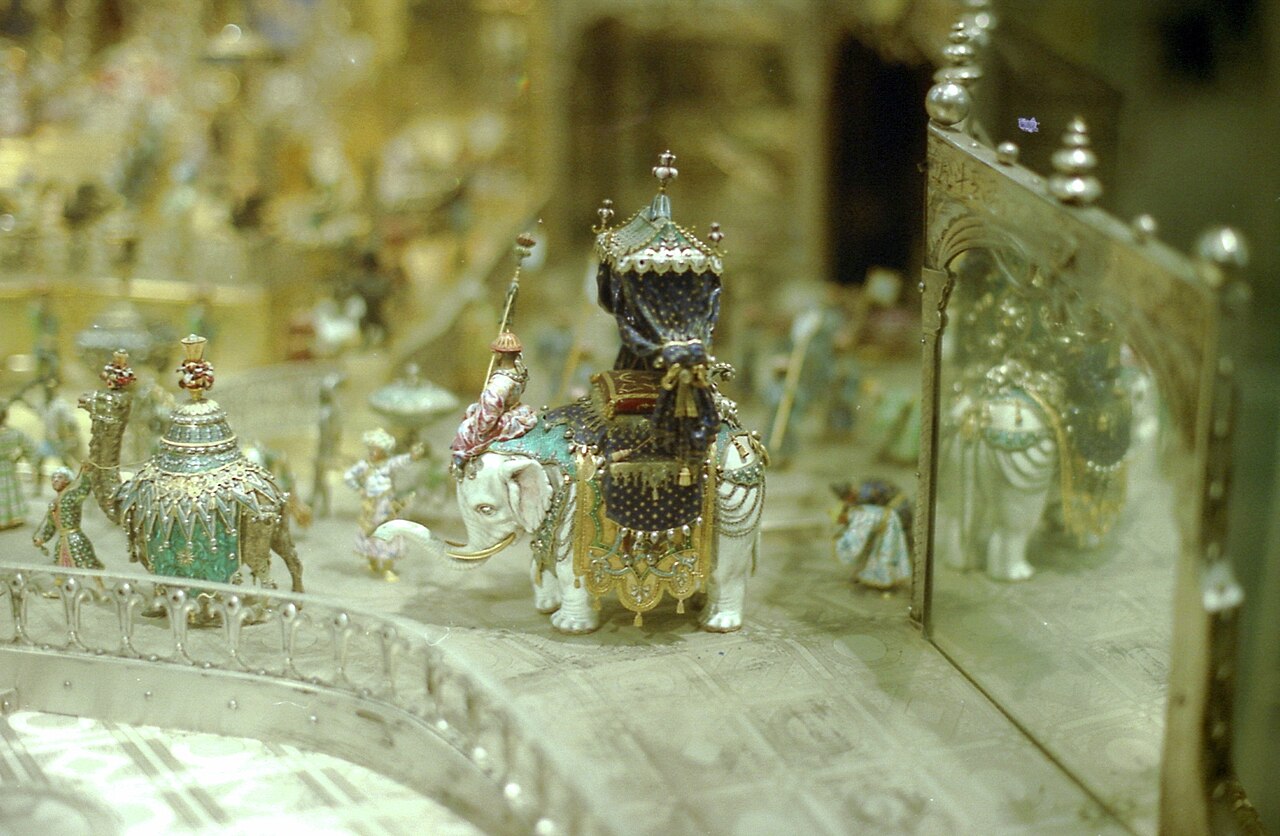
Close view of a miniature gilded court scene with enameled and jeweled figures: a white elephant with a blue-and-gold howdah and rider, a camel with a canopied saddle, and small attendants, displayed behind glass with mirrored panels.Artifact

Primary source

Court of Delhi on the Mughal Emperor's Birthday

Johann Melchior Dinglinger · 1701-1708

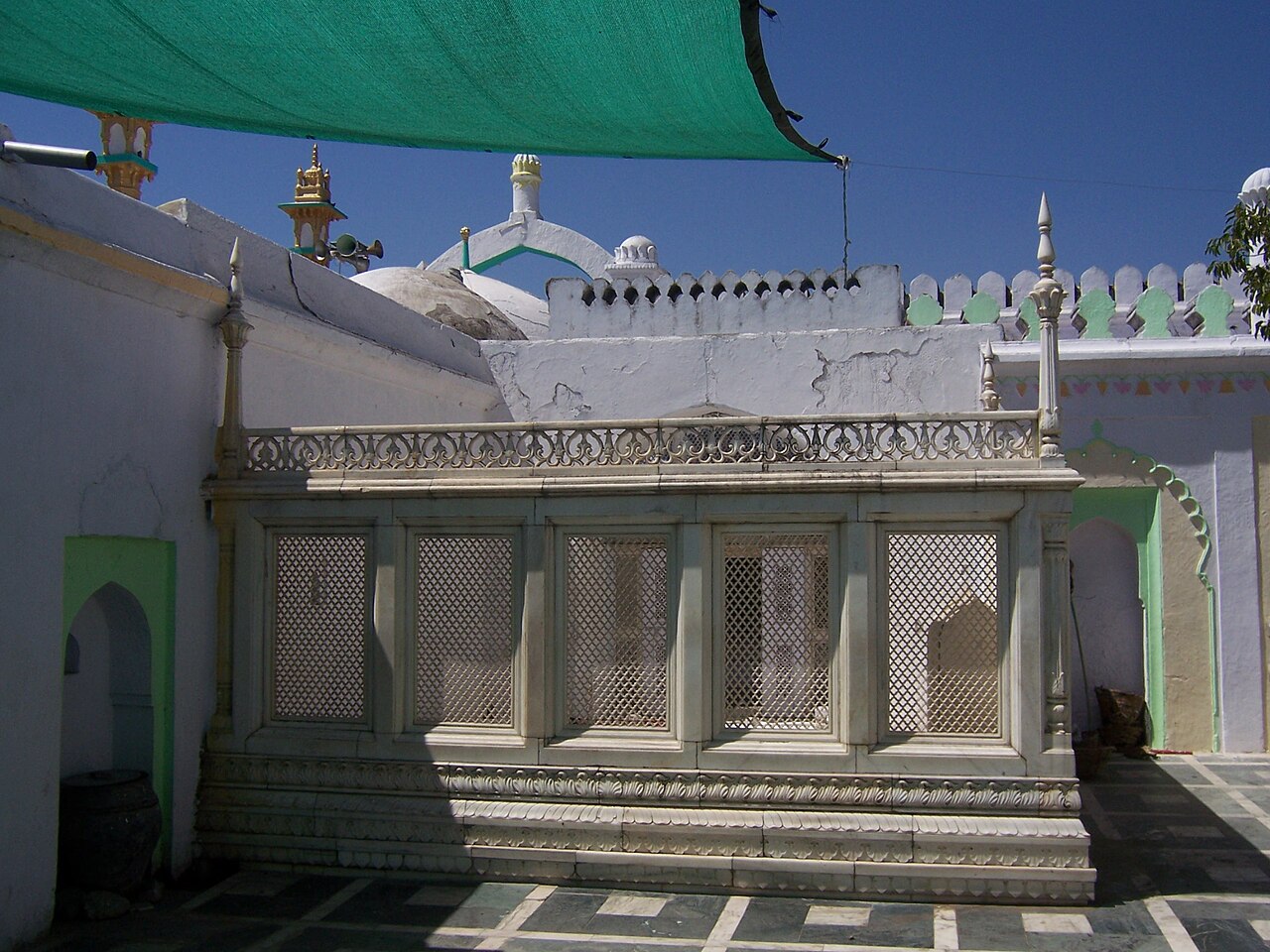
A white marble tomb enclosure with a pierced lattice screen panels and a carved ornamental railing along its top, set in a courtyard with dark tiled flooring. A green shade cloth covers the upper left, with white domed structures and a green-trimmed arched doorway behind.Photograph

Secondary source

Aurangzeb's Tomb, Khuldabad

Colomen · 2013-03-04

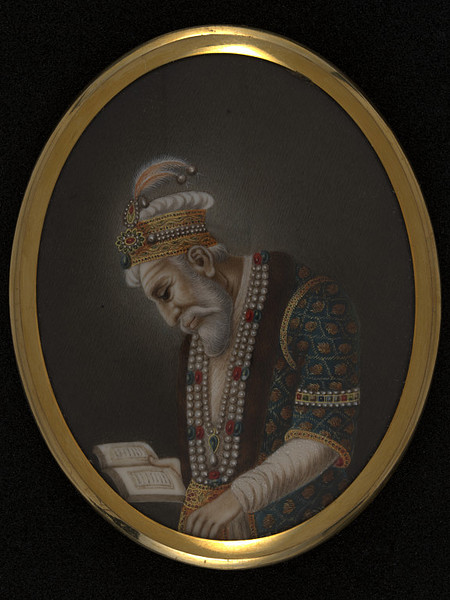
Oval miniature painting of an elderly bearded man in a jeweled white turban with a feather plume, wearing a brocade robe with a multi-strand pearl necklace, reading an open book held in his hands against a dark background, within a gold oval frame.Painting

Secondary source

Aurangzeb in Old Age

circa 1850

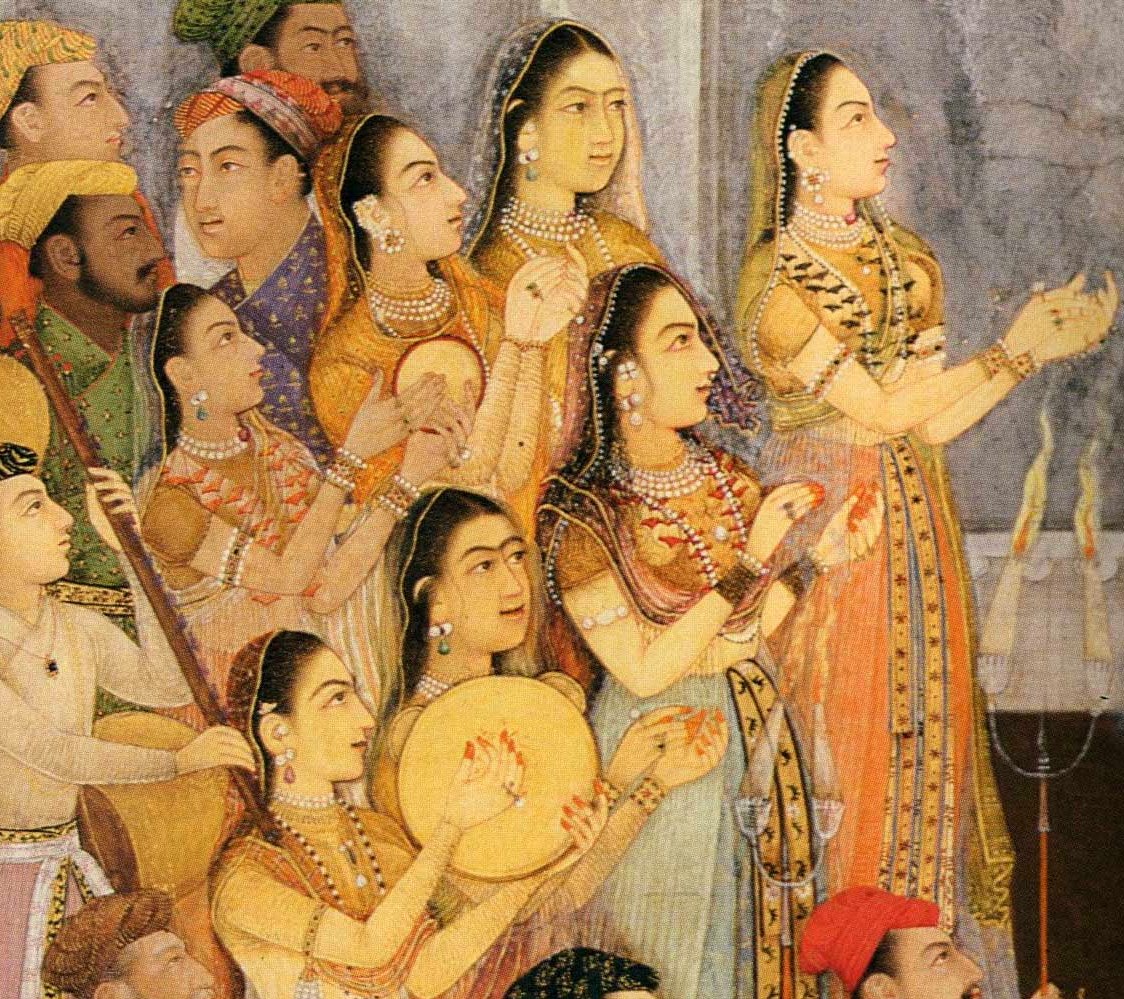
Detail of a Mughal painting of a group of women and men in ornate jewelry and headdresses. Several women hold a tambourine-like drum and look upward, with one woman at the right raising her hands. Background is a muted grey wall.Painting

Primary source

Female Musicians at the Wedding of Aurangzeb

1636

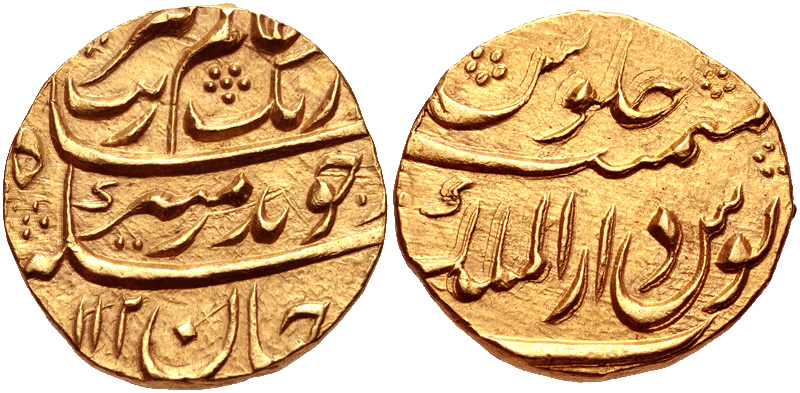
Two sides of a round gold coin. The left side shows Persian script in a central band with a date in digits at the bottom and small dots decorating the rim. The right side shows Arabic-script inscriptions in a horizontal band, with a small dotted ornament at the top and the rim edge visible.Artifact

Primary source

Gold Mohur of Aurangzeb, Kabul Mint

AH 1102 (1691/2)

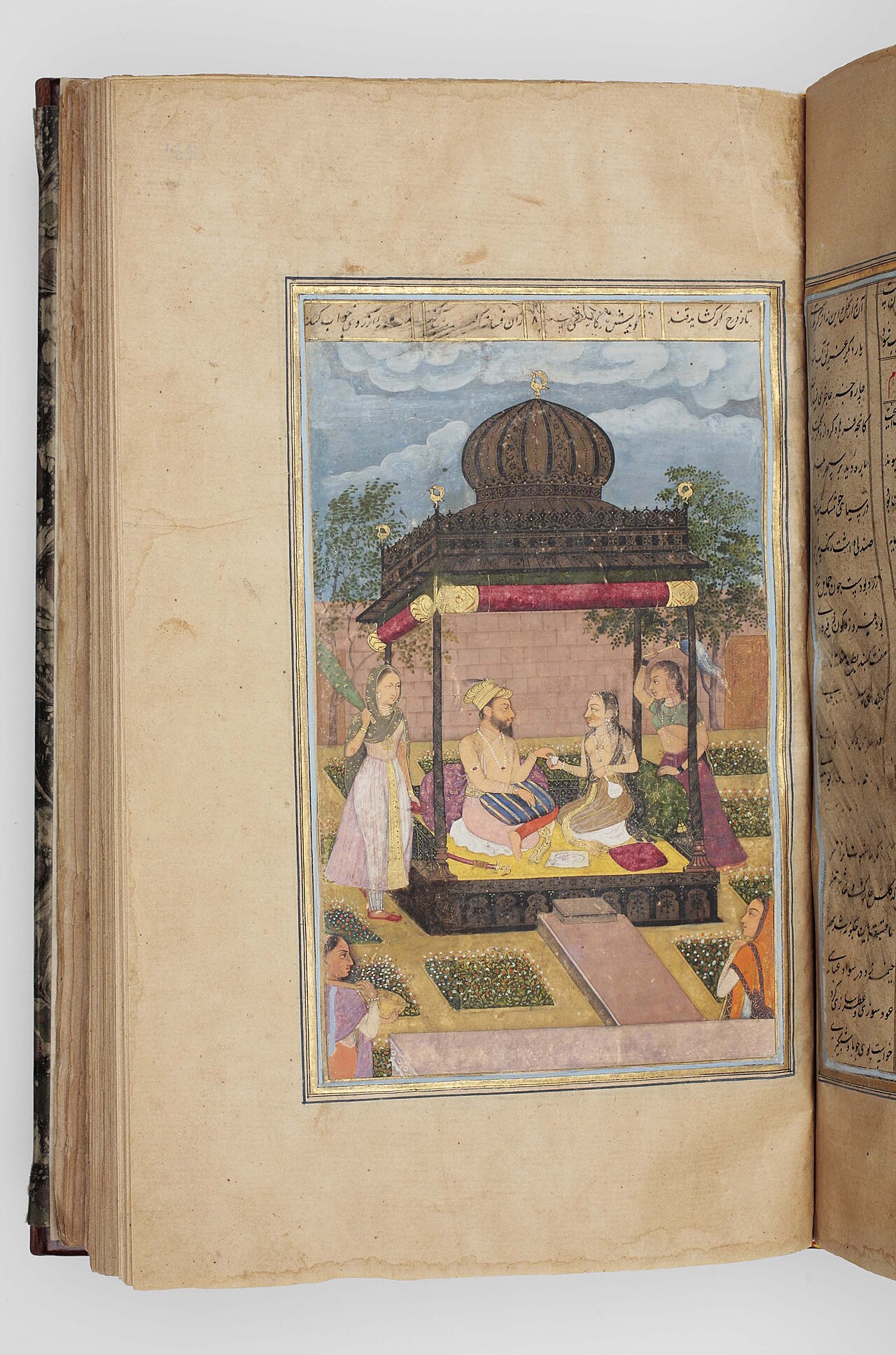
Open manuscript on a pale tan page with Persian script in a right-hand column and a painted miniature inset. The miniature shows a domed pavilion with a dark canopy over a seated man in a striped turban and a seated woman, with attendants standing nearby in a garden with flowering plants and a stone platform.Book

Primary source

Khamsah of Nizami, Folio 188a

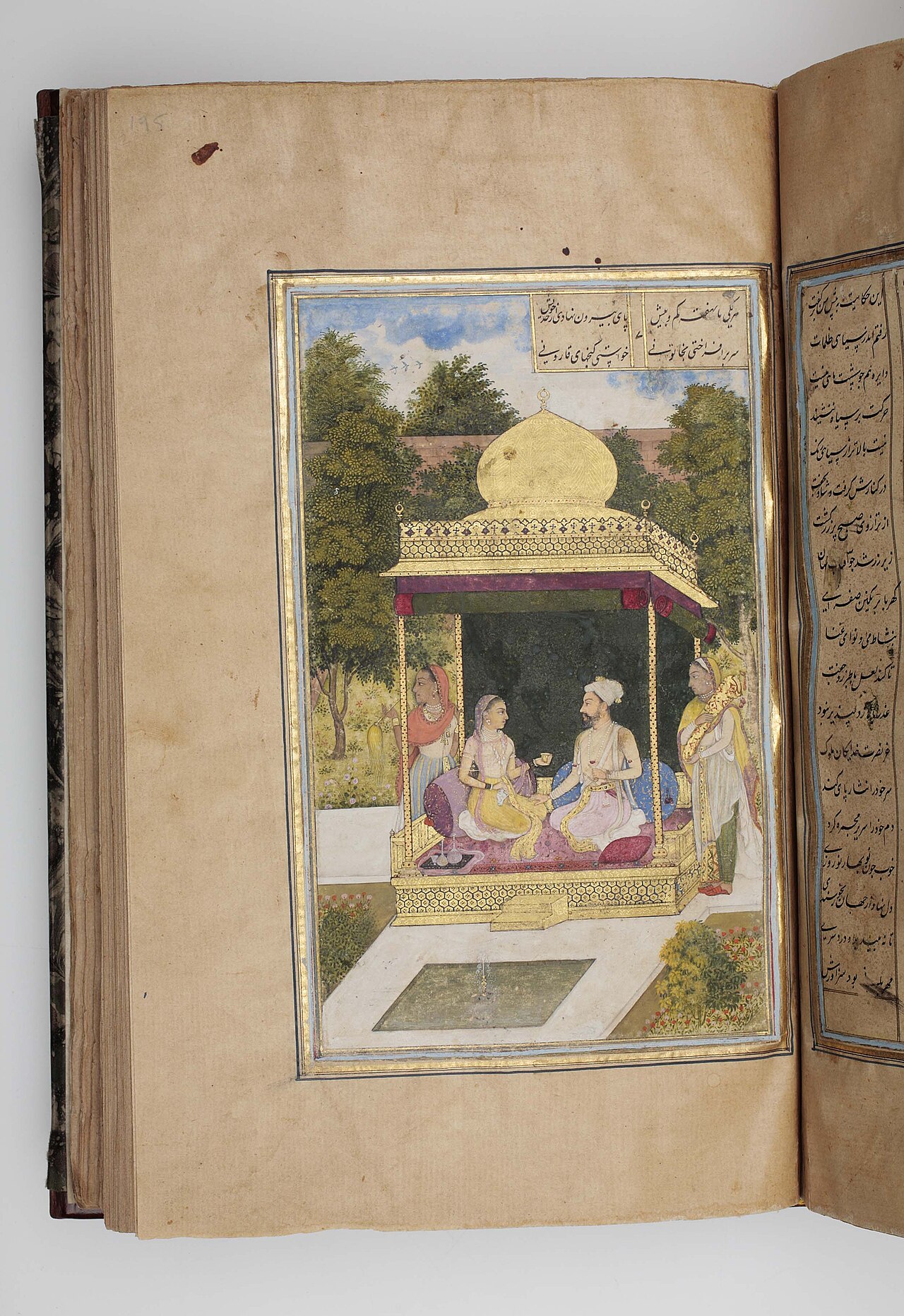
Open manuscript book showing folio 195 with a painted miniature in a gold-bordered frame. A golden domed canopy pavilion shelters a seated man and woman on cushions in a garden with trees; attendants stand nearby. Persian script text in a column fills the right page.Book

Primary source

Khamsah of Nizami, Folio 195a

Want the full shelf? Chat with Aurangzeb in the app and open the Sources panel — every quote links back to the original.

Use Aurangzeb in class

1 collection

A ready-made collection from the Humy team that features Aurangzeb. Preview it, then try it free.

Trusted by educators worldwide

Conversations
375,000+
Real exchanges between students and historical figures
Messages exchanged
4,142,000+
Across every figure, classroom and language
Historical figures
100,000+
Each informed by a curated biography and selected sources
Languages supported
50+
From English and Spanish to Arabic and Korean

Paying customers

Used by 98 schools and universities

Partner school logo
Tecnológico de Monterrey logo
Hyper Island logo
Partner school logo
Chambersburg Area School District logo
Broward County Public Schools logo
Nebo School District logo
National Louis University logo
South Florida PBS logo
Punahou School logo
University of Wisconsin–River Falls logo
Partner school logo
Partner school logo
Archbishop Mitty High School logo
Kingsburg High School logo
Norwalk Public Schools logo
Partner school logo
Connections logo
Partner school logo
Moore Public Schools logo
Partner school logo
Partner school logo
Partner school logo
Partner school logo
Robbinsville Public Schools logo
Partner school logo
Partner school logo
Partner school logo
Tecnológico de Monterrey logo
Hyper Island logo
Partner school logo
Chambersburg Area School District logo
Broward County Public Schools logo
Nebo School District logo
National Louis University logo
South Florida PBS logo
Punahou School logo
University of Wisconsin–River Falls logo
Partner school logo
Partner school logo
Archbishop Mitty High School logo
Kingsburg High School logo
Norwalk Public Schools logo
Partner school logo
Connections logo
Partner school logo
Moore Public Schools logo
Partner school logo
Partner school logo
Partner school logo
Partner school logo
Robbinsville Public Schools logo
Partner school logo
Partner school logo

What educators are saying

“We enjoyed the program last year and used it frequently.”
“My students say it’s a welcome change of pace. I’m not a fan of the “sage on the stage” model, so I try to incorporate research-oriented and self-paced activities. With Humy, students have to take charge of their learning. They’ve become more adept at critical thinking, forming better questions, and improving their reading comprehension. The interview feature has been my go-to tool. I create assignments where students must ask historical figures a set number of questions, then summarize the responses to ensure they’re truly absorbing the material. This approach lets them actively explore the past rather than passively consuming information.”
“Humy has helped me bring historical figures, sometimes long past, to life. When my students interact with these figures in real-time, it eliminates some of the perceived “ancient” characteristics of my curriculum. This has shifted my students’ thinking away from viewing history as abstract or irrelevant. Real-time interactions make historical figures relatable, even allowing students to ask off-topic questions that help put historical lives in a more relevant context for 13-year-olds. The feature I use the most is the interview feature. After teaching a topic, most recently Gandhi and Joan of Arc, I have the students ask pointed, focused questions. We practice good conversation techniques beforehand, teaching them to listen (or read) carefully and formulate thoughtful follow-up questions rather than just interrogating. It helps students practice effective conversation skills.”

FAQ

Frequently asked questions

Who is Aurangzeb?
Mughal emperor of India known for his expansion of the empire and imposition of Islamic orthodoxy. On Humy.ai you can chat with an AI version of Aurangzeb that draws on a short biography and 95 historical sources during the conversation — by text or voice, in 42 languages.
Is Aurangzeb AI free?
Aurangzeb is part of Humy's full library of more than 100,000 figures, which comes with a paid plan. A free account (no credit card) includes 20 messages a month with the free library's figures, so you can try how the conversations work first.
What sources does the Aurangzeb AI use?
It draws on a short biography and 95 historical sources (paintings, books and artifacts), including “Badshahi Mosque”, “Fatawa-i Alamgiri Manuscript” and “Maasir-i-Alamgiri”. Each source has its own page on Humy.ai.
How historically accurate is the AI version of Aurangzeb?
Each figure uses a short biography and a small set of selected historical sources as context (retrieval-augmented generation), so answers stay closer to known material than the model's general knowledge alone. It isn't a citation-grade research tool — like any LLM, the AI can get details wrong or extrapolate. Treat it as a strong starting point for inquiry and cross-reference important claims.
Can I talk to Aurangzeb by voice?
Yes. In addition to text chat, you can call Aurangzeb and hear their voice respond in real time — useful for auditory learners, interview practice and Socratic dialogue.
Is Humy.ai safe and compliant for schools?
Yes. Humy.ai is used by more than 100 schools, universities and organisations. The platform is FERPA- and GDPR-aligned, supports SSO, and offers an IT-approval pack tailored for school procurement teams.

Ready when you are

Start chatting with Aurangzeb now.

20 messages free · No credit card · Available in 50+ languages.