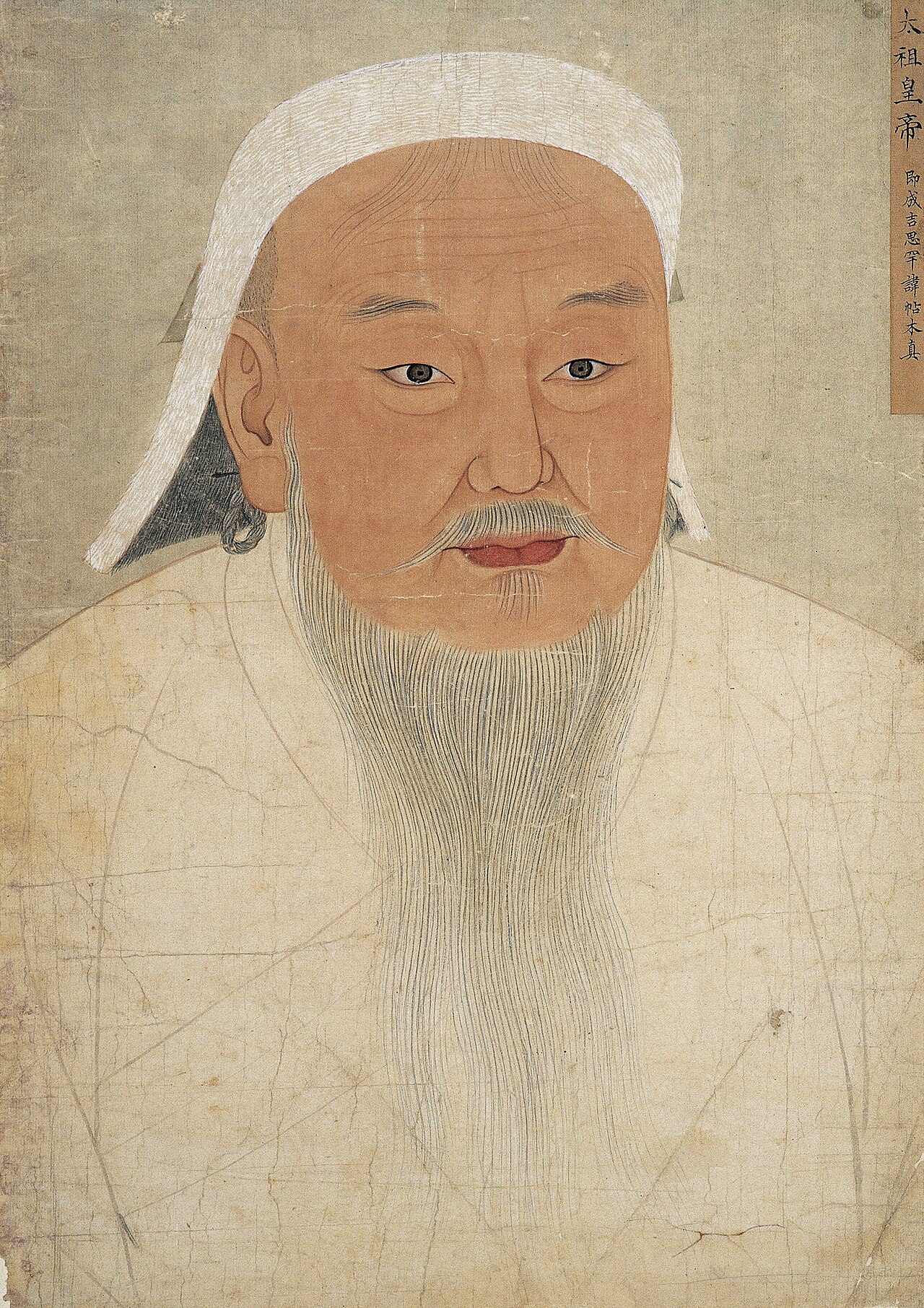

Portrait of Genghis Khan

AI Historical Figure

Genghis Khan

Sensitive

Founder of the Mongol Empire and one of the most successful military leaders in history.

Chat with Genghis Khan via text or voice — in 42 languages, drawing on a curated biography and 84 historical sources. Available 24/7.

Start chatting with Genghis Khan20 messages free · No credit card
Lived
c. 1162–1227
From
Mongolia
Known for
Rulers & royaltyPolitics & government
Genghis Khan

Genghis Khan

Online · responds in seconds

Hello — I'm Genghis Khan. Founder of the Mongol Empire and one of the most successful military leaders in history. What would you like to ask me?

20 messages free · No credit card · Powered by Humy.ai

Live preview · Switch between 42 languages above · Send a message to continue in the app

Multilingual

Talk to Genghis Khan in 42 languages

Ask Genghis Khan questions in any language below, and the rest of Humy's app speaks it too. Pick yours to open the chat in that language.

Also in German (Austria), German (Switzerland), English (UK), English (Australia), English (Canada).

The sources behind this AI

84 sources · 40 paintings · 22 books · 7 artifacts · 7 documents · 4 photographs · 2 sculptures · 1 letter · 1 documentary

Genghis Khan doesn’t improvise from thin air. The AI is grounded in 84 curated historical sources students can inspect. Open any of them to see what informs the conversation.

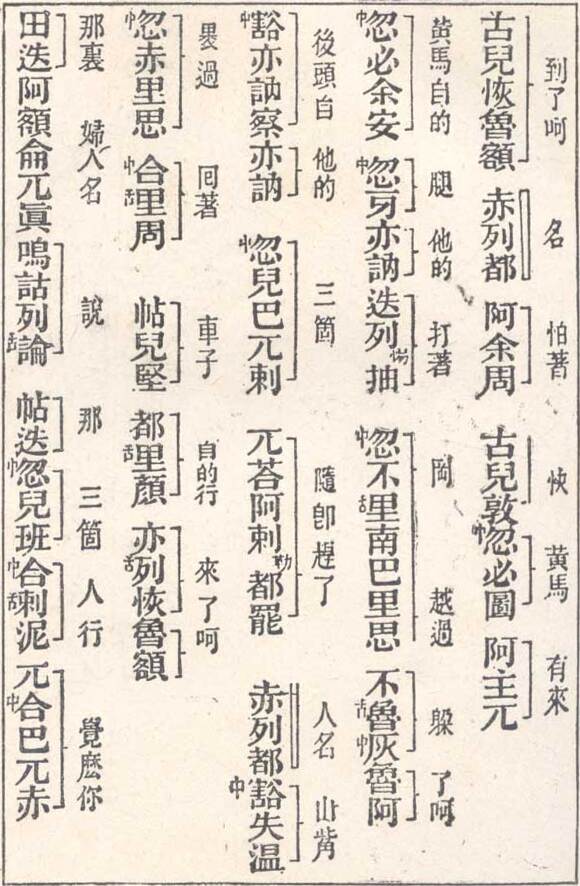
Page of a 1908 Chinese edition of the Secret History of the Mongols, printed in vertical columns of Chinese characters transcribing Mongolian text, with smaller interlinear glosses in Chinese beside them. Some characters are bracketed and marked with small annotations.Book

Secondary source

The Secret History of the Mongols

c. 1228 (completed after 1227)

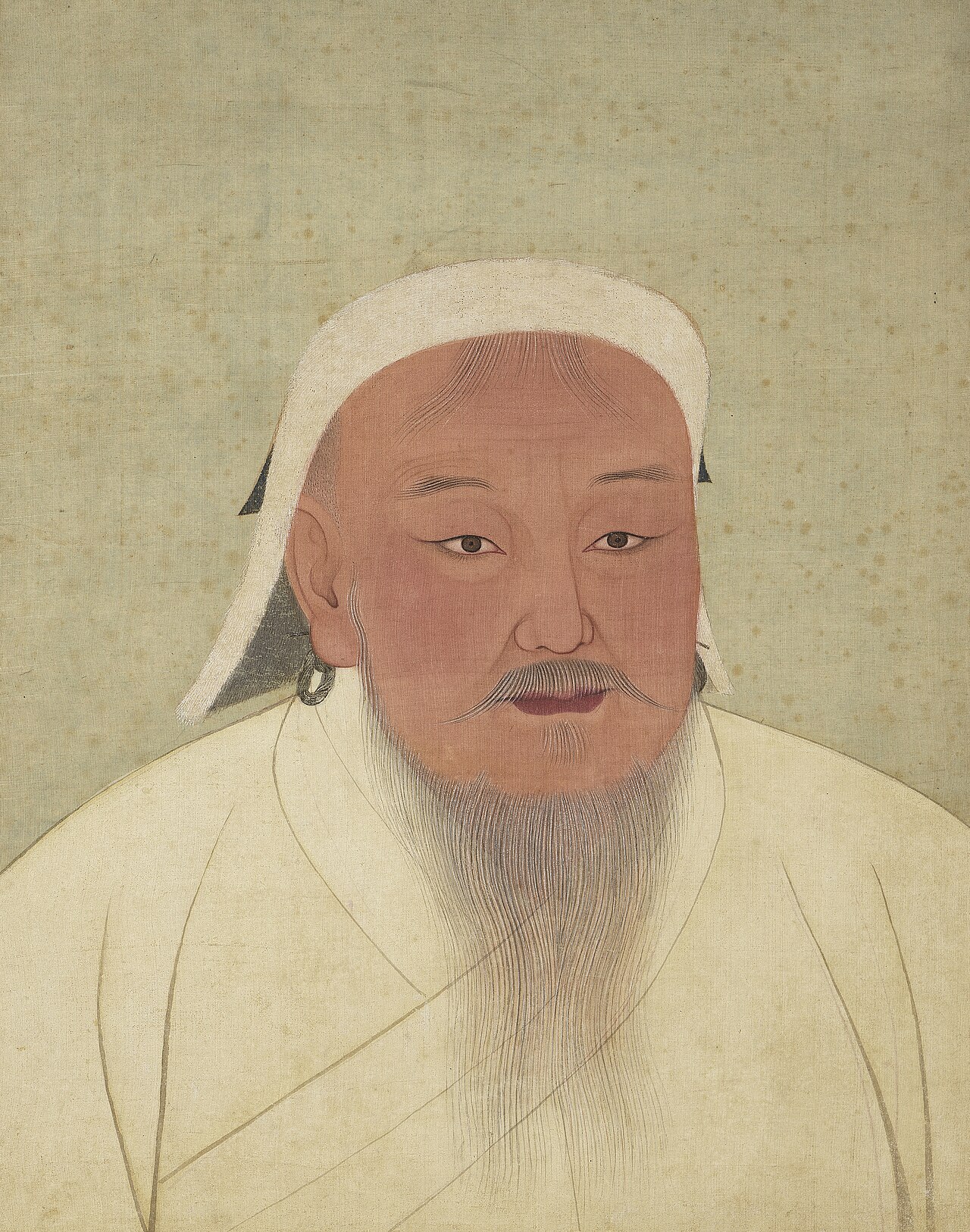
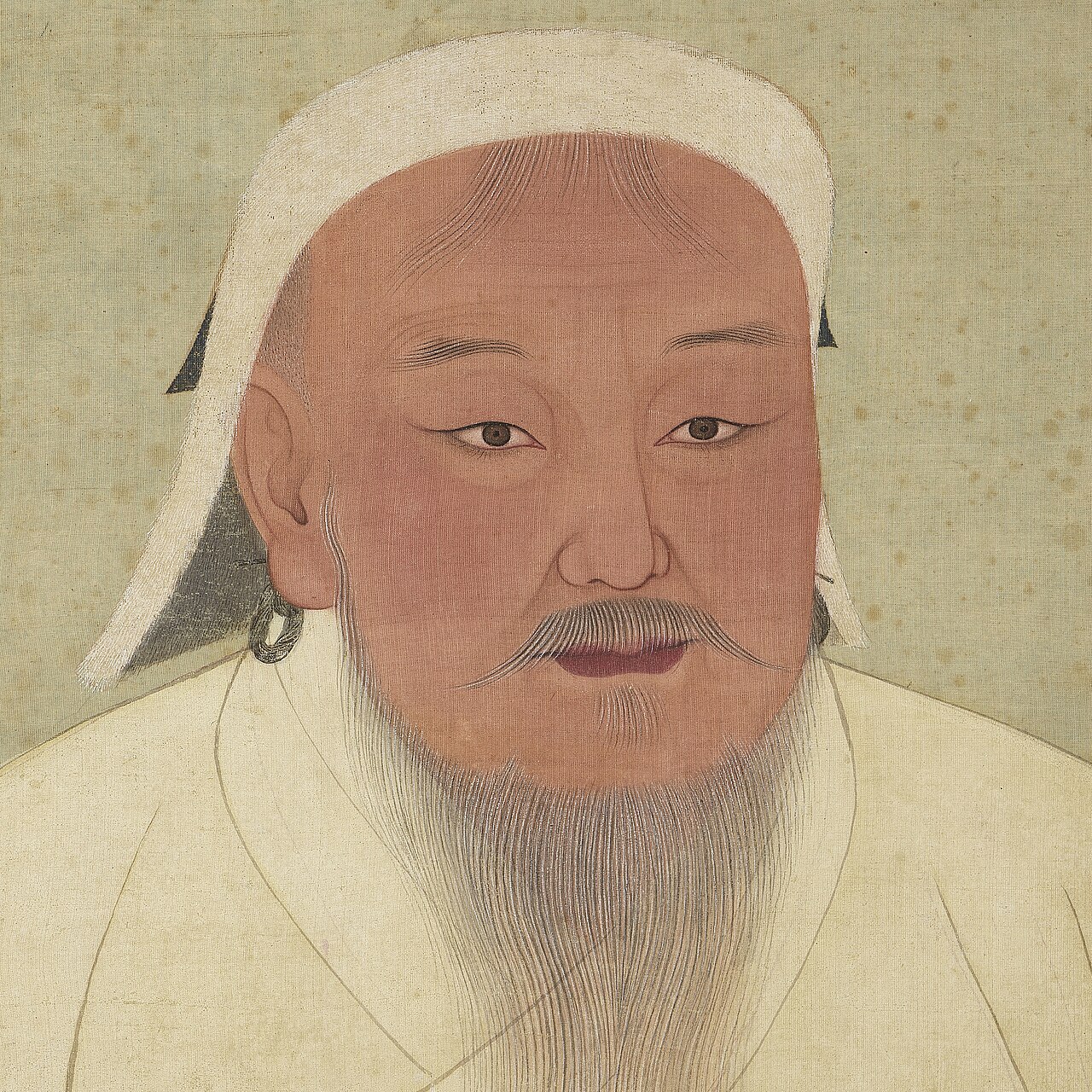
Painted portrait of a bearded man with a pale white head covering and a light cream robe against a muted sage-green background. He has a long, thin white beard and a mustache, and a small silver earring.Painting

Secondary source

Portrait of Genghis Khan

Unknown Yuan court painter

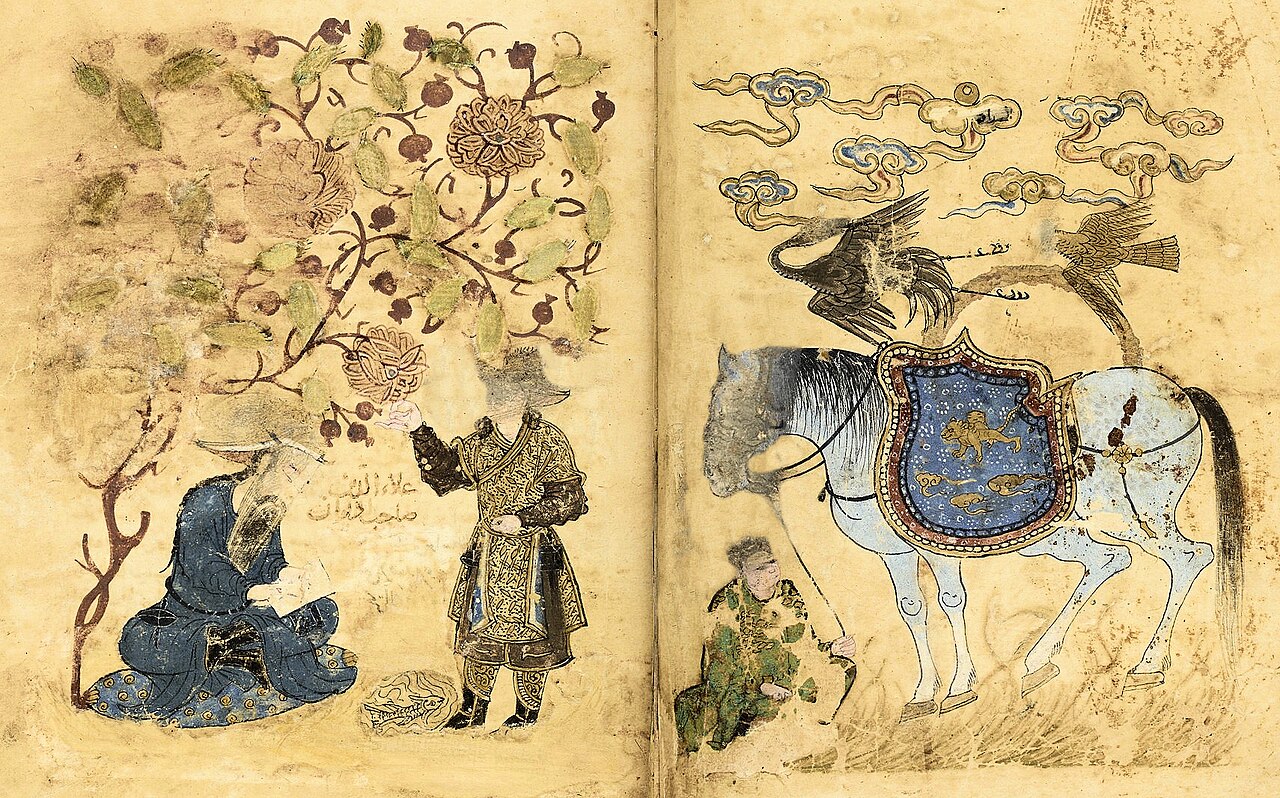
Painted manuscript frontispiece in gold, blue and green tones: on the left a seated bearded man in blue robes writes beside a flowering tree, while a standing figure in gold-patterned robes gestures toward it. On the right a white horse with a blue gold-decorated saddle cloth stands above a small seated figure, with stylized clouds and a bird-like motif above.Book

Secondary source

Tarikh-i Jahangushay-i Juvaini

Ata-Malik Juvayni

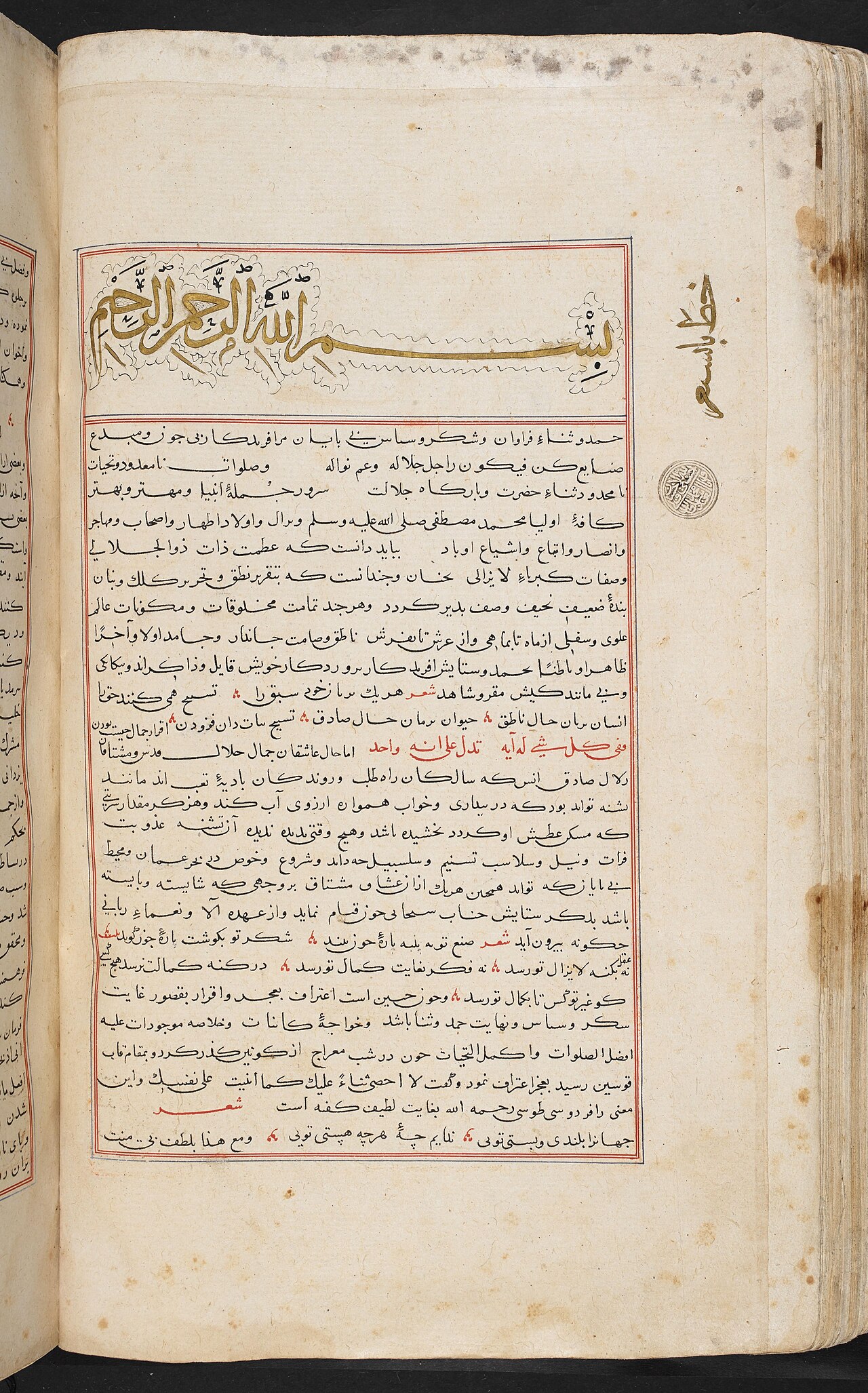
Manuscript page in Persian nastaliq script with an ornate gold-and-blue illuminated Bismillah heading at top, red-ruled borders, a marginal note in gold, and a round seal stamp in the margin on the right. Adjacent page edge visible at left.Book

Secondary source

Jami' al-tawarikh

Rashid al-Din Hamadani · c. 1400 (manuscript copy)

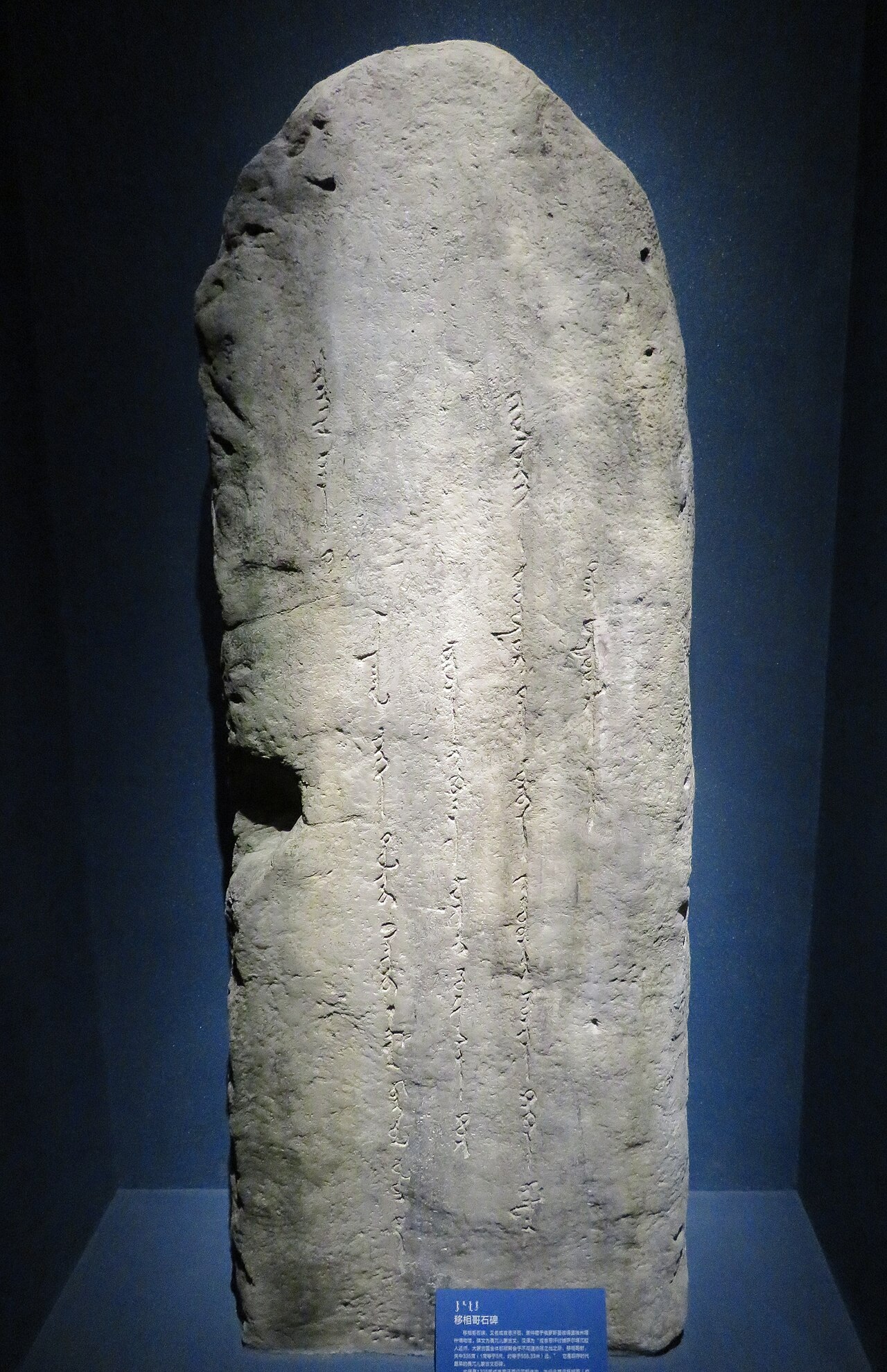
A tall, arch-topped grey stone stele standing upright in a display case against a dark blue background, with several vertical columns of carved inscription in an old script. A blue label sits at the bottom of the display.Artifact

Primary source

Stele of Genghis Khan

c. 1224-1225

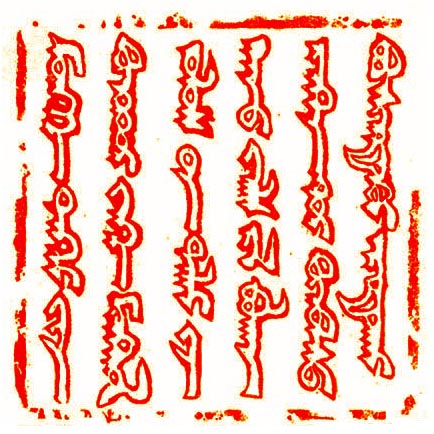
Red impression of a seal in vertical columns of stylized, angular Mongolian-script characters on a white background, with a red frame border along the edges.Letter

Primary source

Cum non solum

Pope Innocent IV · 13 March 1245

Book

Secondary source

Shengwu qinzheng lu

1369

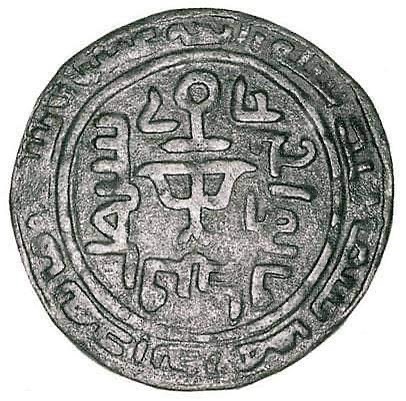
A round, dark silver-grey coin with raised Arabic-style inscriptions in a circular border and central field, showing a stylized emblem in the center. The coin is slightly worn.Artifact

Primary source

Genghis Khan Silver Coin of Samarkand

c. 1221

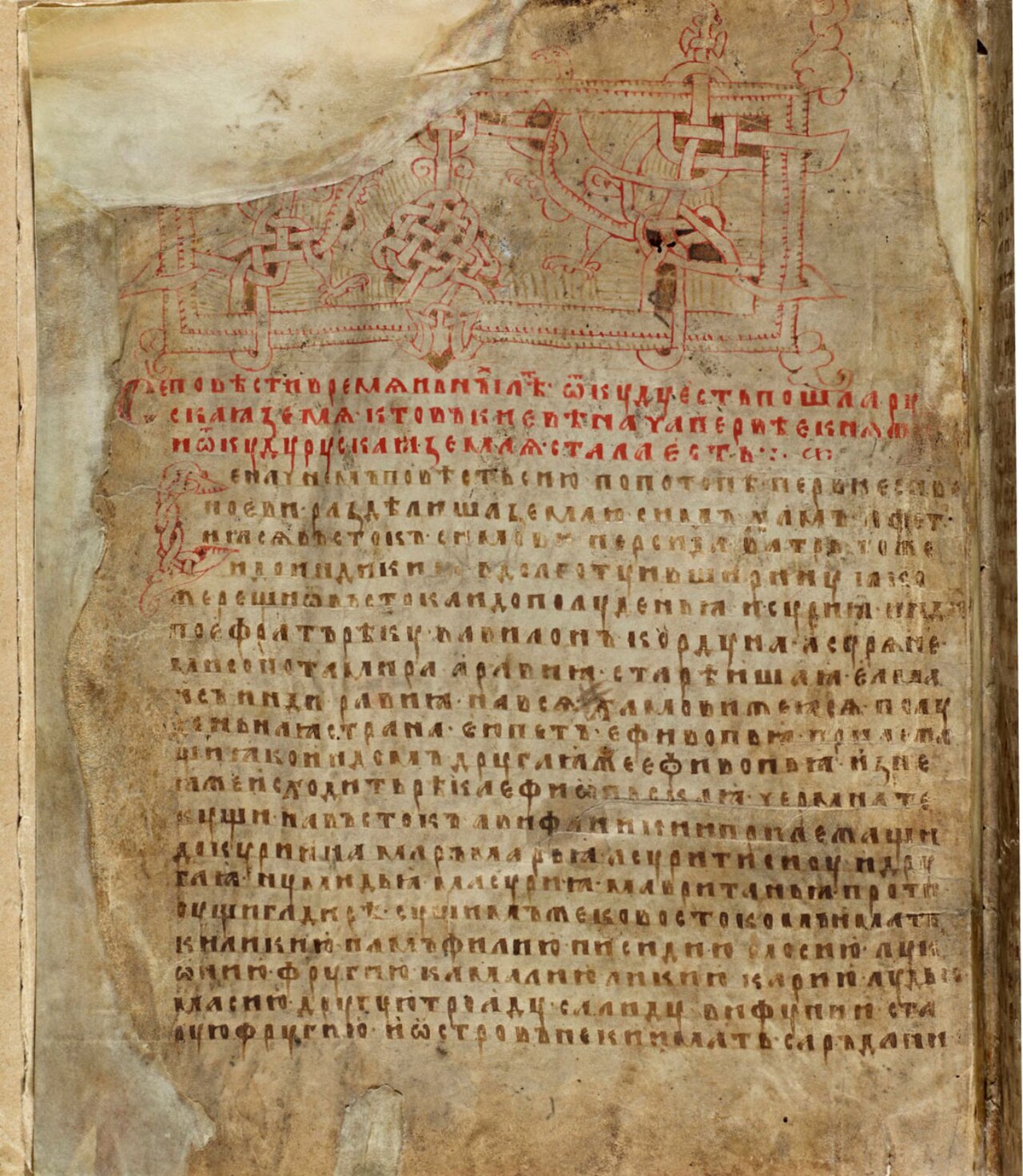
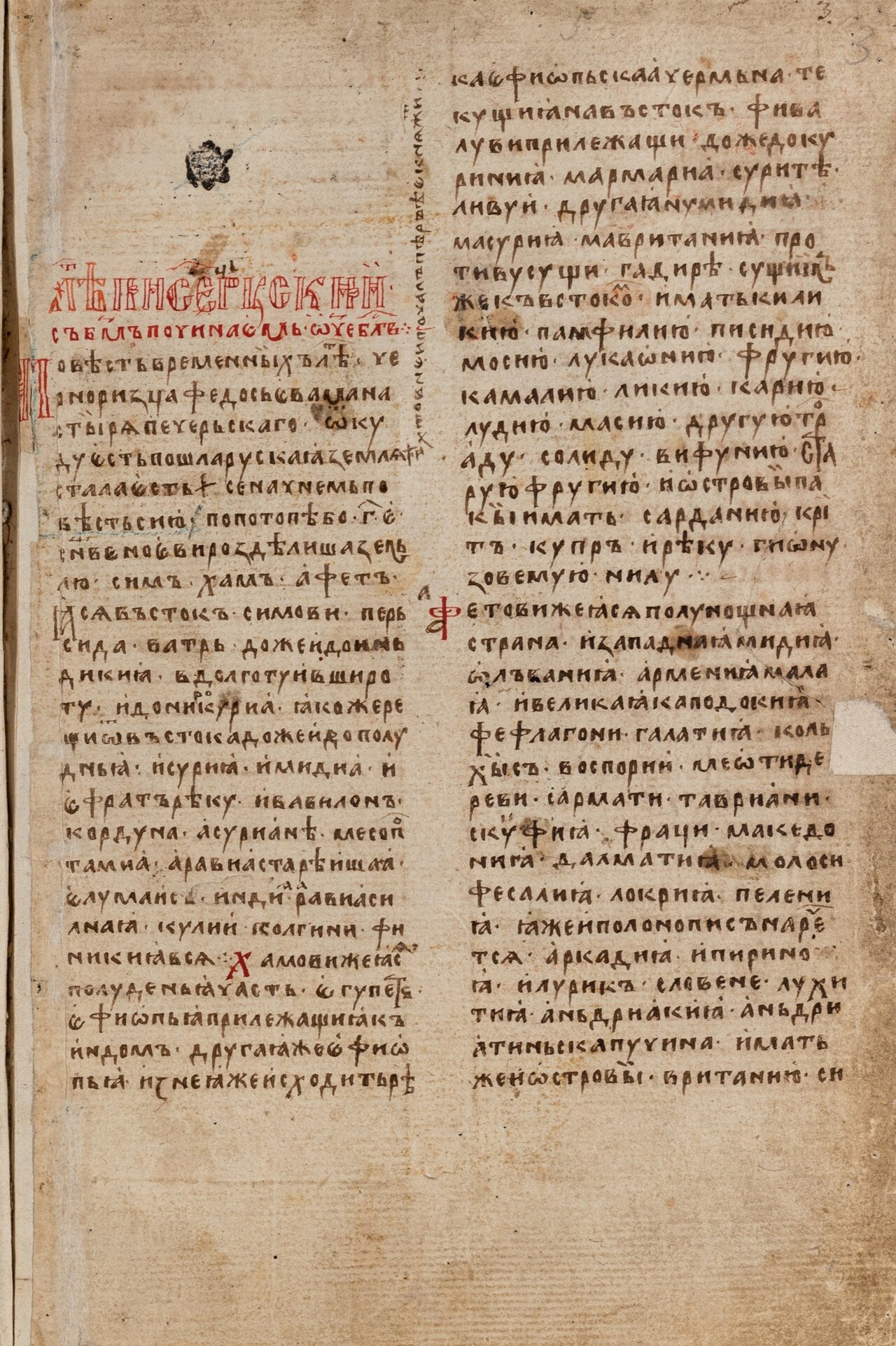
Scan of a manuscript page on aged, yellowed parchment. Decorative red ornamental interlace band with knotwork at the top. Below it, several lines of red headings and dense brown Cyrillic script in columns of text, with a red decorated initial letter on the left.Document

Secondary source

Laurentian Codex

Laurentius · 1377

Scan of a manuscript page in Cyrillic script on aged parchment, with red decorated headings at top left and two columns of brown handwritten text. Page number 3 appears at top right.Document

Secondary source

Hypatian Codex

c. 1425

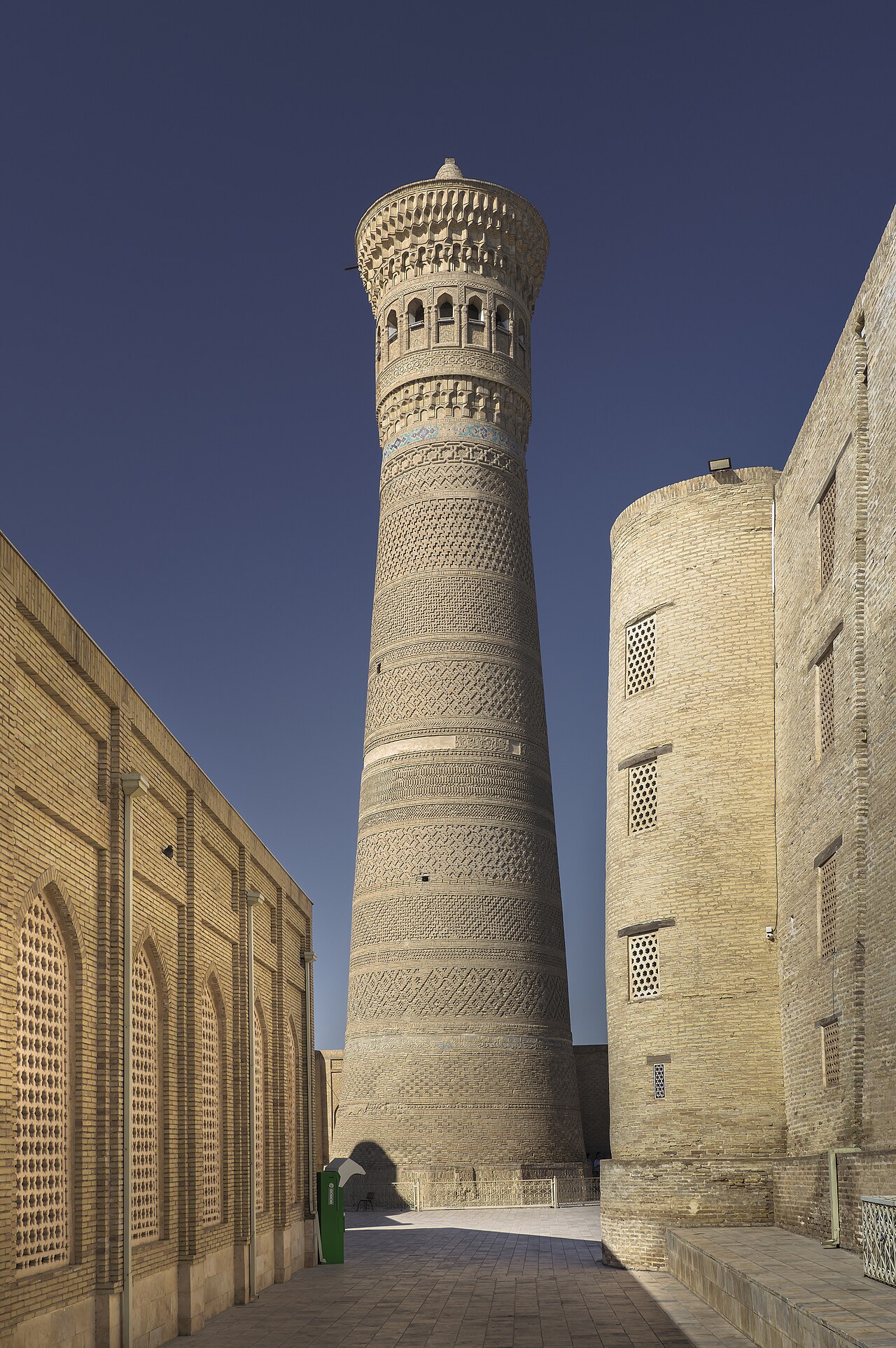
A tall, tapering brick minaret with decorative carved bands and a small arched gallery near the top, standing in a paved courtyard under a clear blue sky. A brick building wall is on the left and a cylindrical brick tower with lattice windows is on the right.Artifact

Secondary source

Kalyan Minaret

Bako · 1127

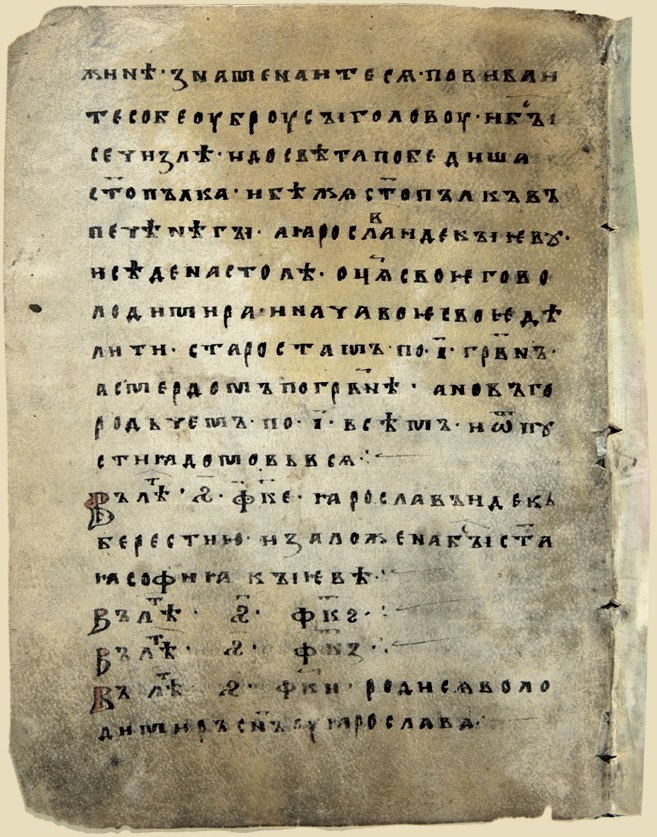
Scan of a parchment page covered in dark brown Cyrillic manuscript text in about twenty-five lines, with red initial letters at the left margin of the lower section. The page edge is darker and a binding strip runs along the right side.Document

Primary source

Novgorod First Chronicle

13th century (covering events from 1016)

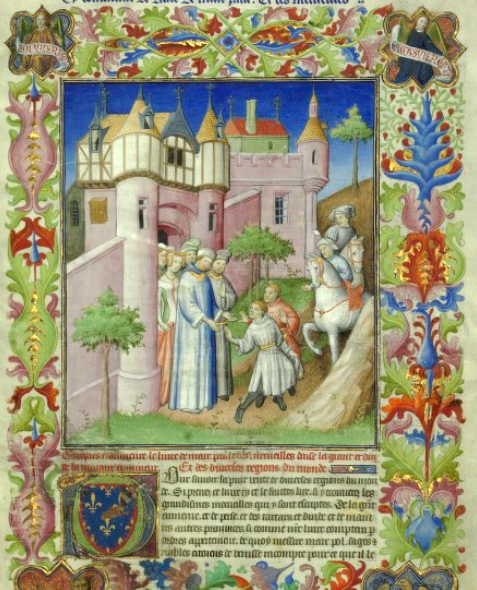
Illuminated manuscript page with a decorated border and a miniature painting of a medieval walled city with pink towers and a rider on a white horse greeting a group of robed men. Text in columns below.Book

Secondary source

The Travels of Marco Polo

Rustichello da Pisa · 1298

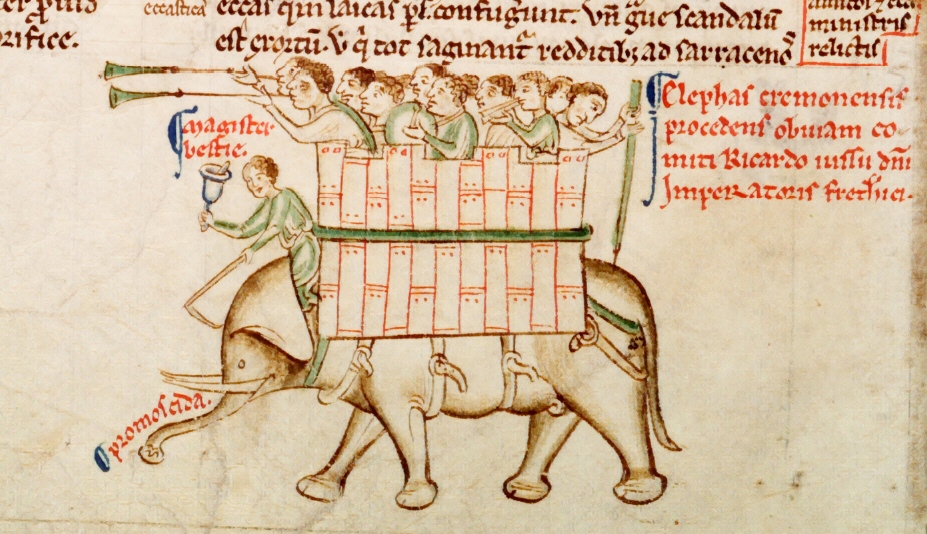
Medieval manuscript illustration of an elephant with a wooden tower on its back, carrying trumpeters and a rider holding a bell. Latin captions in red and black ink surround the drawing, which is painted on parchment.Book

Primary source

Chronica Majora

Matthew Paris · 13th century, to 1259

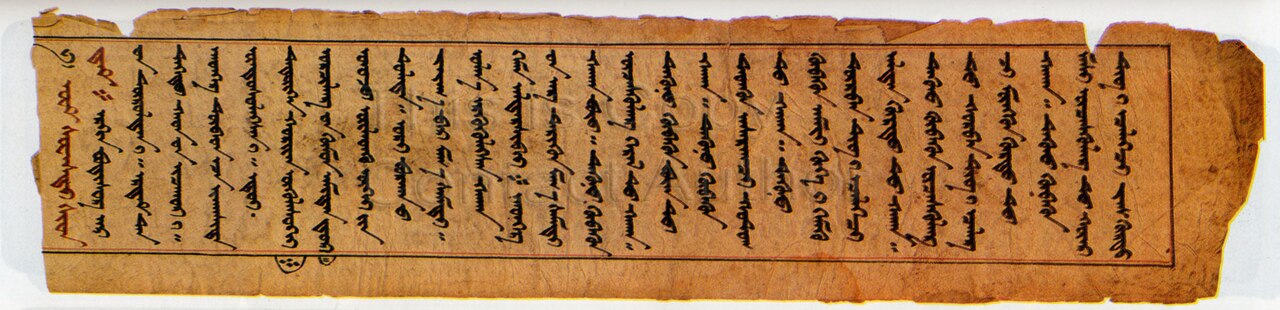
A long, narrow, aged brown paper manuscript page written in vertical columns of black Mongolian script, with red ink accents at the upper left and a ruled border framing the text.Book

Secondary source

Altan Tobchi

Guush Luvsandanzan · c. 1700

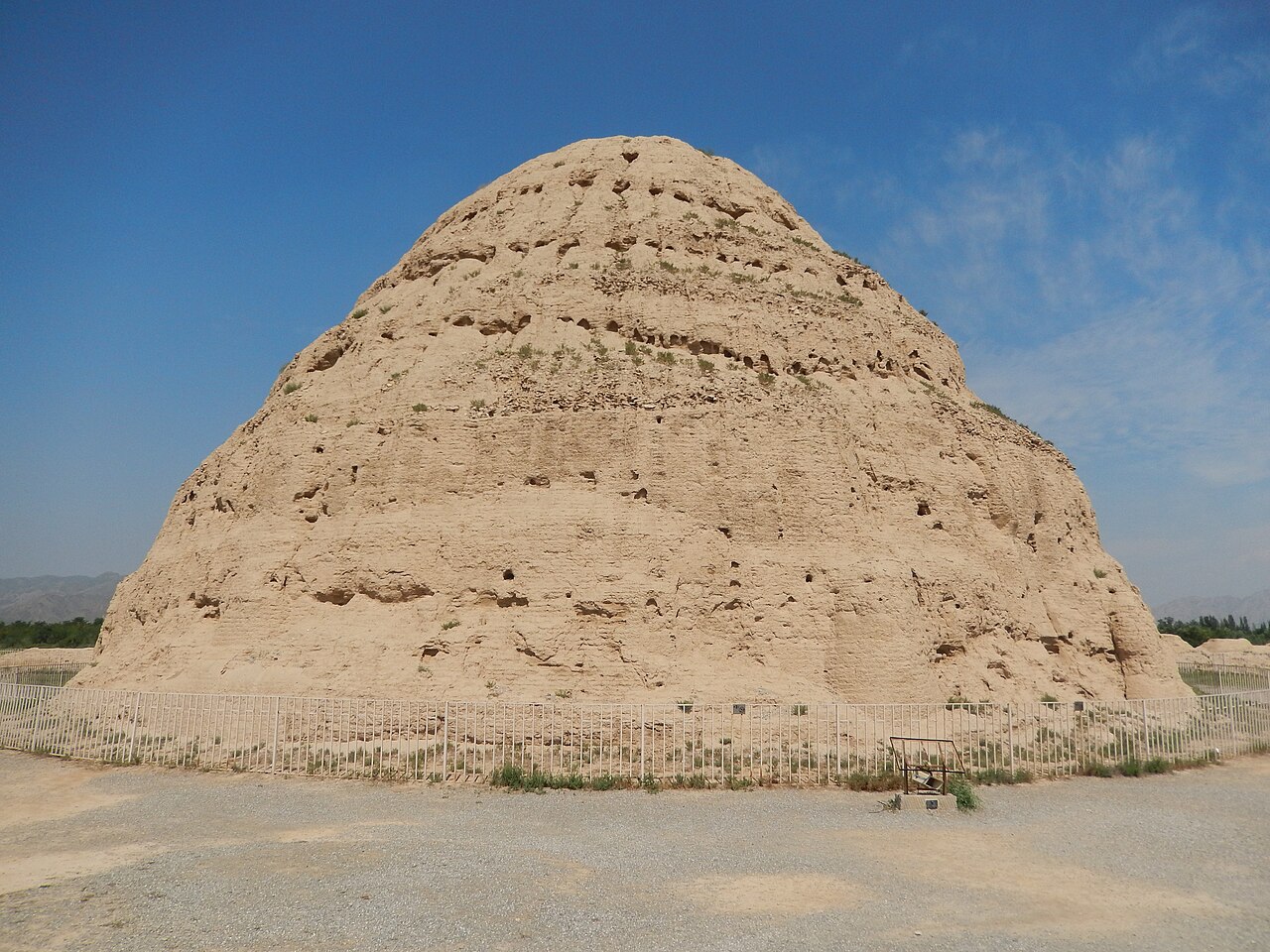
A large, dome-shaped earthen mound with eroded, weathered sides rises against a clear blue sky. A white metal fence and gravel ground surround its base, with low hills and green trees in the distance.Artifact

Secondary source

Western Xia Mausoleums

c. 1038-1227

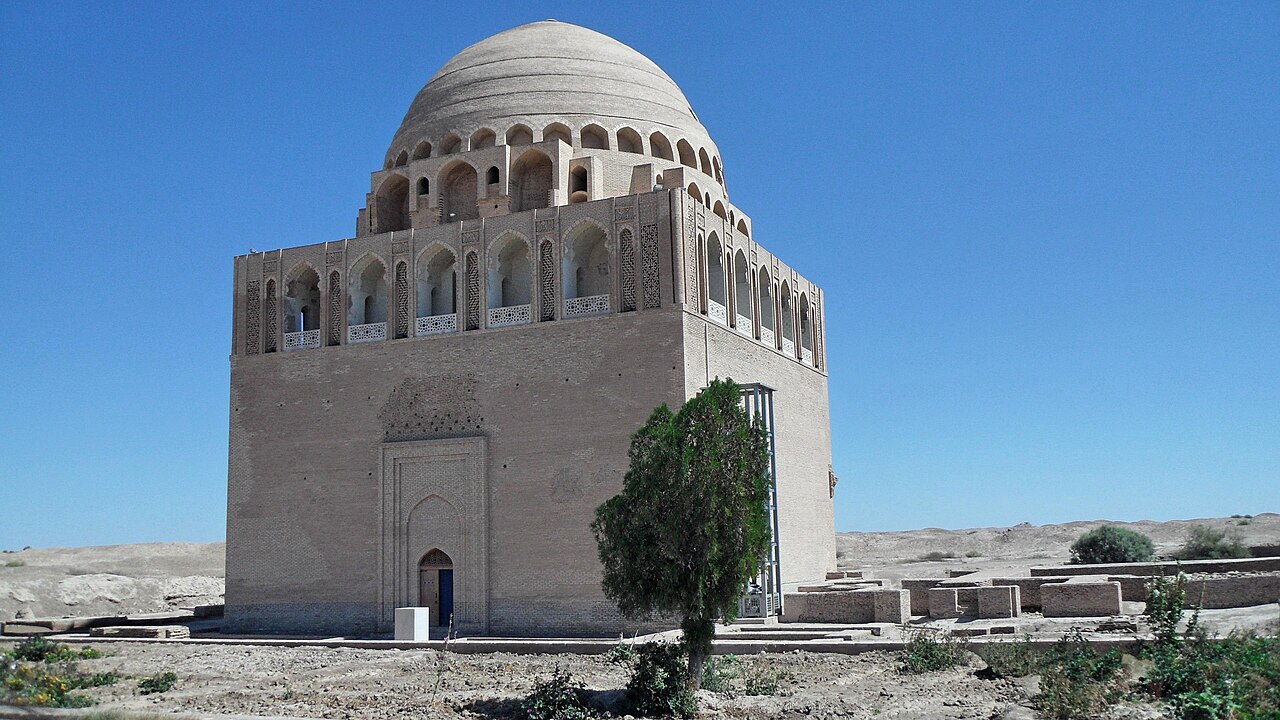
Exterior view of a domed brick mausoleum with a large ribbed dome, arched recesses in tiers, and a tall portal on the front wall, set in a dry desert landscape under a clear blue sky. A small tree stands in front and low ruined walls lie to the right.Artifact

Secondary source

Tomb of Ahmad Sanjar

1157

Black-and-white scanned page with a dark, ornate decorative border framing a white panel. Inside the panel is a small engraved emblem: a crowned or rayed figure above a banner with partly legible lettering and a scrolled monogram below.Book

Secondary source

Histoire du grand Genghizcan

François Pétis de la Croix · 1710

Genghis Khan, the Emperor of All MenBook

Secondary source

Genghis Khan, the Emperor of All Men

Harold Lamb · 1927

History of Genghis KhanBook

Secondary source

History of Genghis Khan

Jacob Abbott · 1860

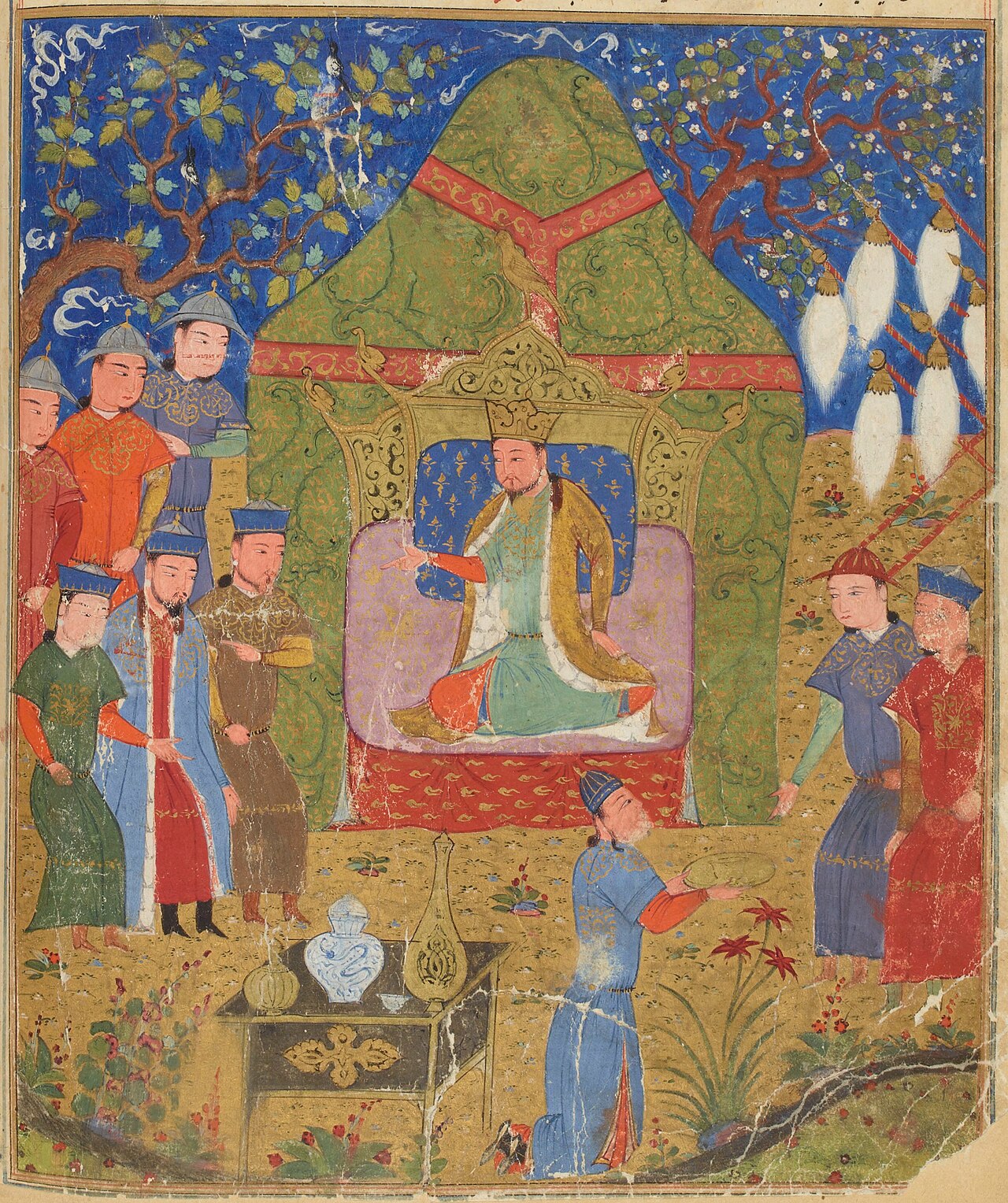
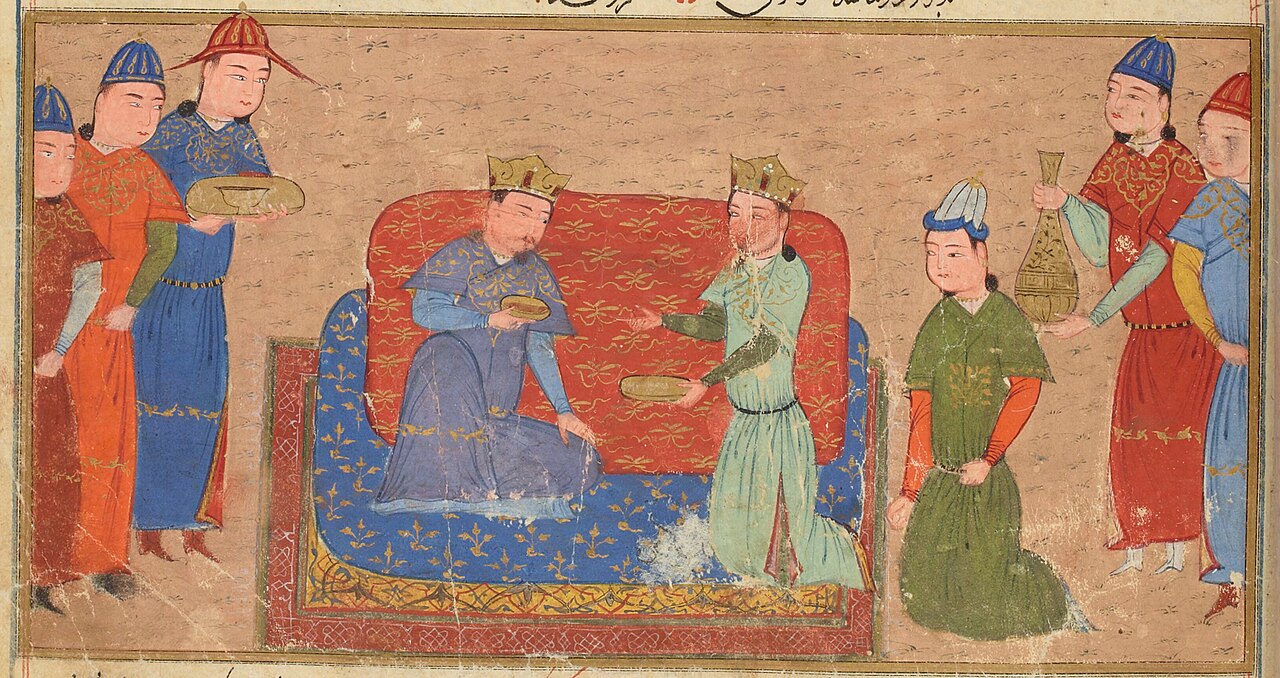
Miniature painting of a seated ruler on a gold and green throne under a green canopy, with a blue sky and flowering trees. Attendants in red, orange, blue and green robes and tall caps stand and kneel around him. A kneeling attendant holds a plate, and a table holds a blue and white vase and a gold ewer.Painting

Secondary source

Temujin proclaimed Genghis Khan in 1206

Sayf al-Vâhidî · 1430

Book

Secondary source

History of the Mongols

Henry H. Howorth · 1880

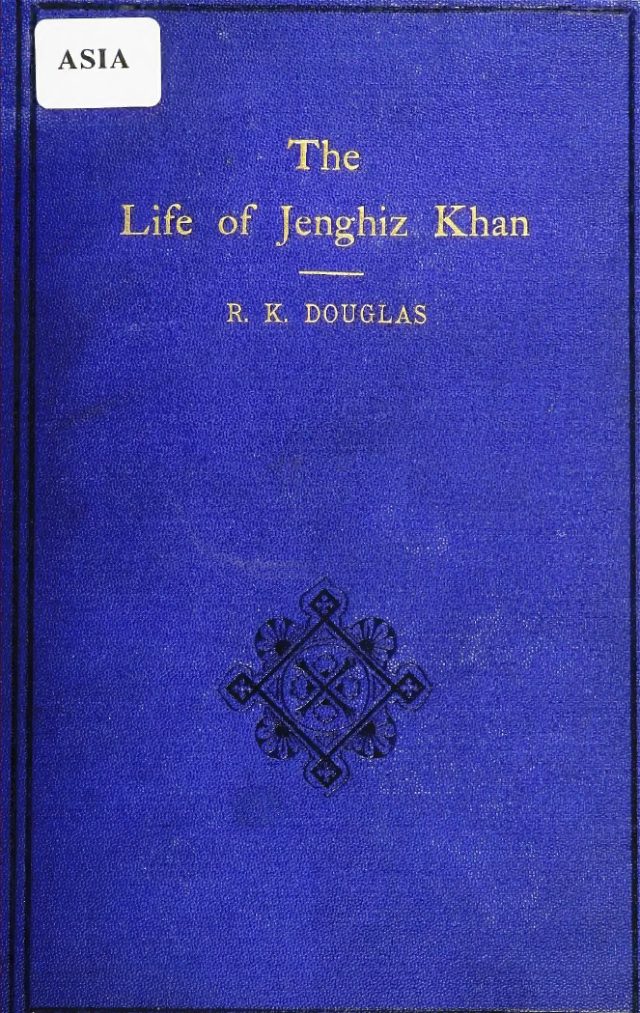
The Life of Jenghiz KhanBook

Secondary source

The Life of Jenghiz Khan

Robert K. Douglas · 1877

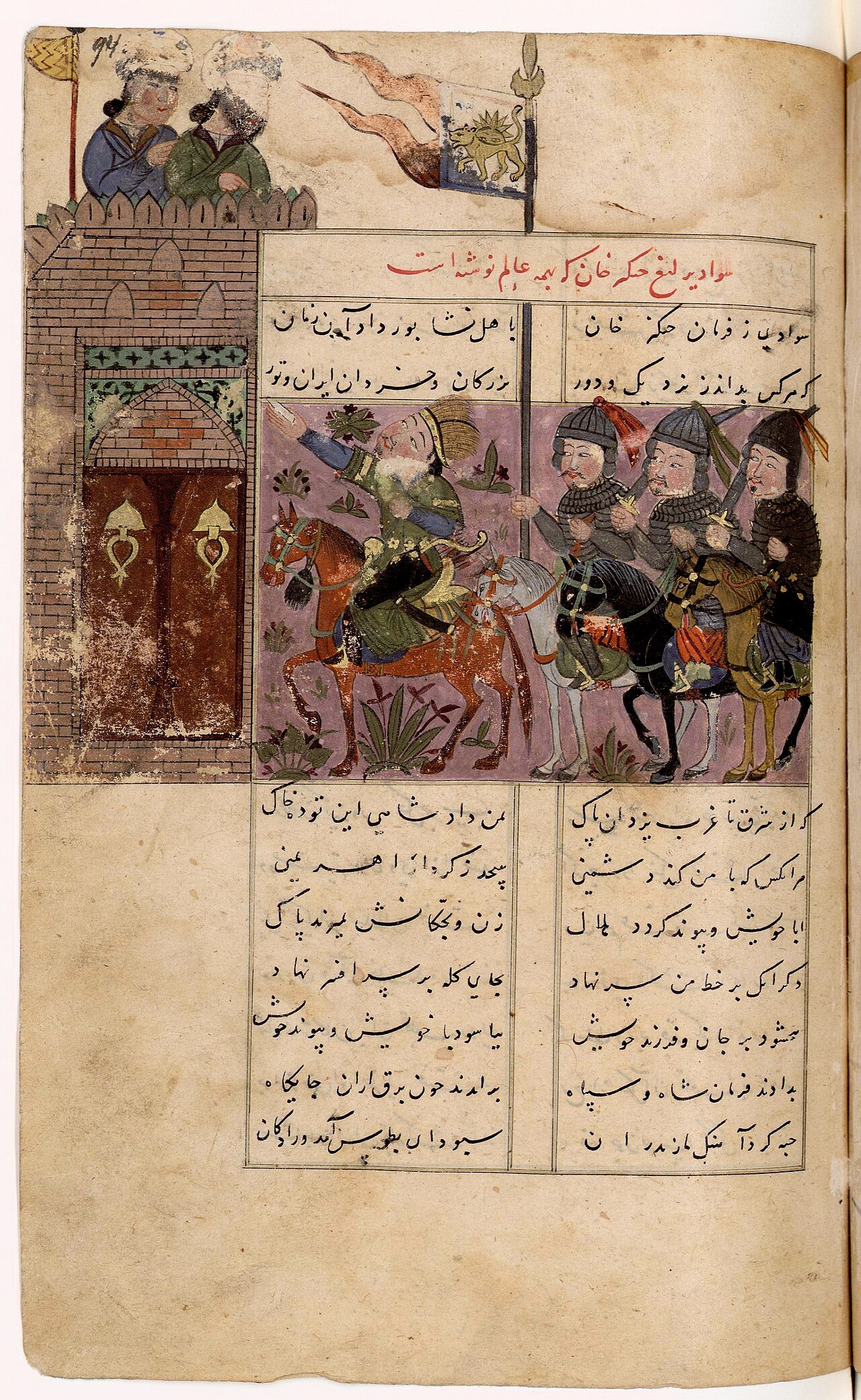
Manuscript page with a painted miniature showing a mounted rider in green robes pointing forward, followed by three helmeted mail-clad horsemen, beside a brick gate and walls with two figures looking down. Persian script in red and black fills the text panels.Painting

Secondary source

Messengers of Genghis Khan at Nishapur

Shams al-Dîn Kâshânî · 15th century

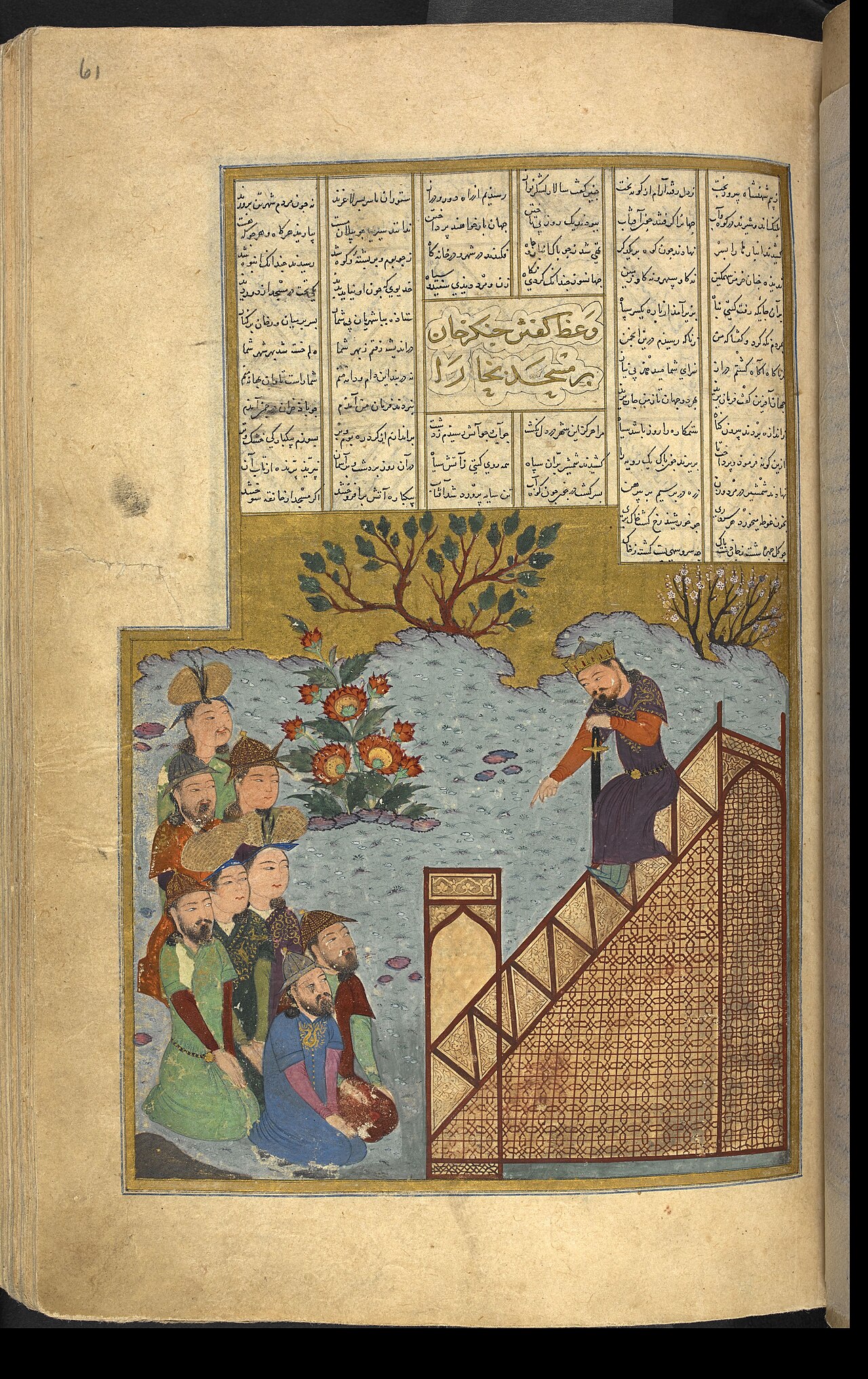
Manuscript page with a painted miniature showing a mounted-style ruler in red and purple robes and a crown standing atop a wooden pulpit with a latticed ornamental pattern, pointing toward a kneeling crowd of turbaned men in green and blue. Gold and blue background with flowering shrubs; Persian calligraphy in text columns above.Painting

Secondary source

Genghis Khan's Sermon at Bukhara

between 1397 and 1398

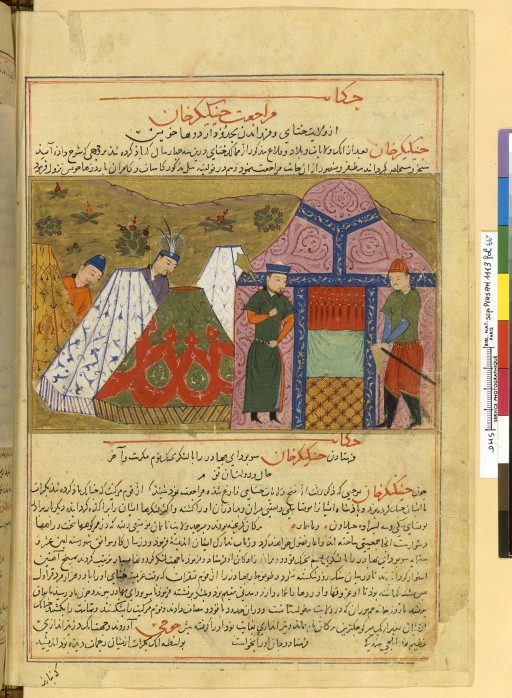
Illuminated manuscript page from a Persian chronicle. Above, a pink-walled tent with blue lattice panels and a red interior curtain shows two standing men; to the left, seated figures and a tent with white and blue fabric sit on green ground. Persian text in red and black fills the upper and lower sections, with a small caption in the middle band.Painting

Secondary source

Chinggis Khan's Encampment

Rashid al-Din · 15th century

Miniature painting from a manuscript page with Persian text above. A seated ruler in green robes and a gold-trimmed pink cushioned throne sits under a green canopy among blossoming trees. Standing attendants in colorful robes flank him, and a kneeling figure in blue is at lower right.Painting

Secondary source

Chinggis Khan Seated with Sons Jochi and Ogedei

Rashid al-Din · 14th century

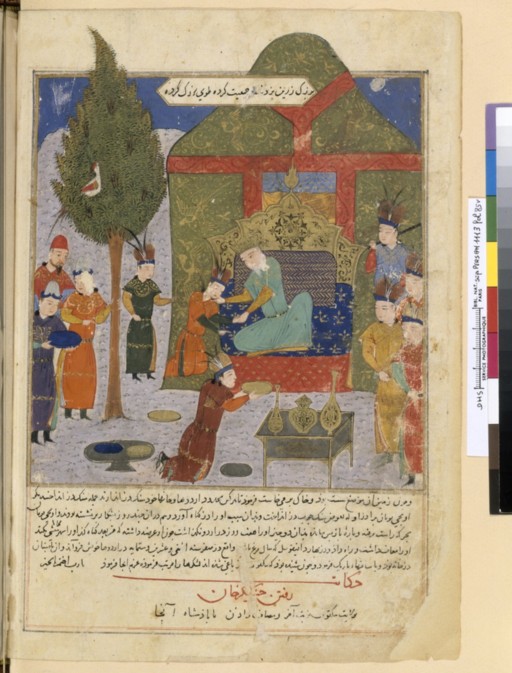
Manuscript page with a painted miniature showing a seated ruler on a golden throne under a green and red tent canopy, attended by standing courtiers in colorful robes and a kneeling attendant, with a tree at left. Persian script text fills the lower part of the page.Painting

Secondary source

Temujin Enthroned as Chinggis Khan

Sayf al-Vahid and Rashid al-Din workshop · c. 1430

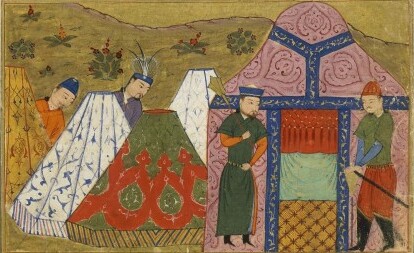
Miniature painting of a Mongol encampment with white and green tents decorated with patterns, set against a golden background with stylized hills. Figures in colorful robes stand near a pink-and-blue canopied tent, where a figure in a red hat stands beside a golden cushioned seat and another figure in green holds a staff.Painting

Secondary source

Chinggis Khan's Encampment

Rashid al-Din (workshop) · 15th century

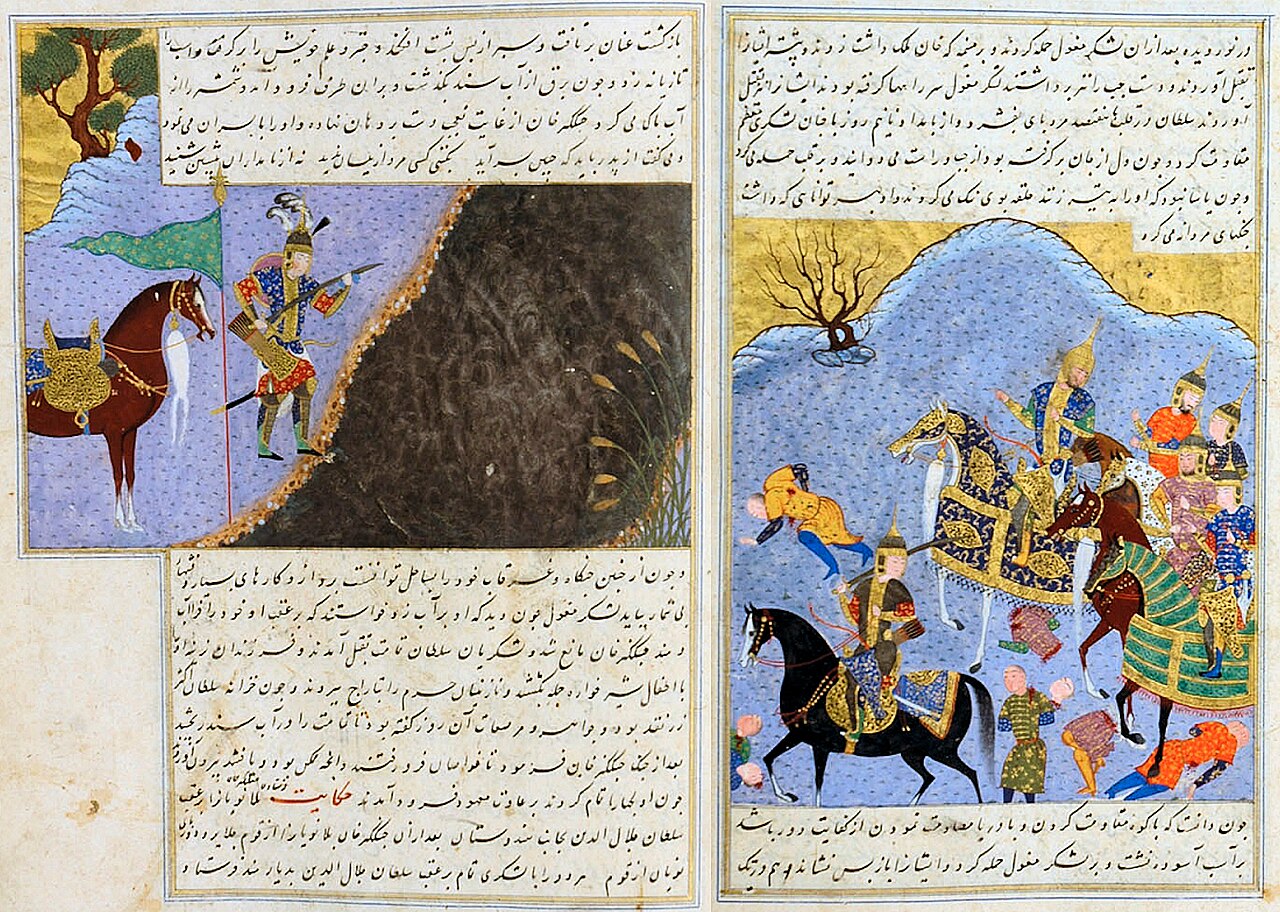
Two facing manuscript pages with Persian text in columns and painted miniatures. Left: a mounted warrior with a green banner and a horse stands by a dark rocky river bank. Right: a blue-hued scene of mounted riders in gold and red robes, with a figure on a black horse in the foreground and attendants below.Painting

Secondary source

Jalal al-Din Khwarazmshah Confronts Chinggis Khan at the Indus

Rashid al-Din (workshop) · copy dated 1529

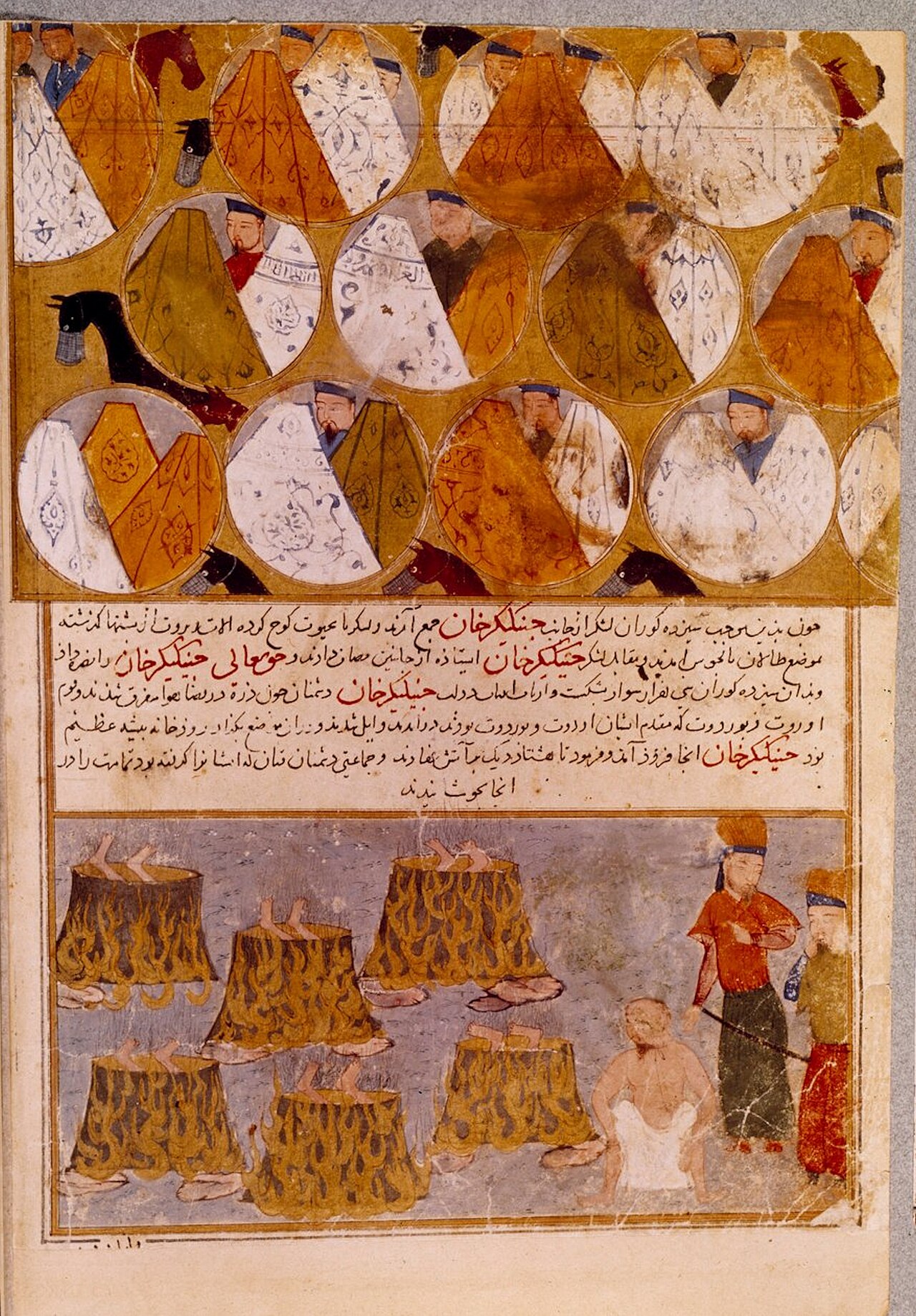
Persian miniature painting from the Jami al-tawarikh with Persian text panel. Top: rows of Mongol tents and seated figures in round medallions. Bottom: several cauldrons over flames, with figures inside, and two standing men in robes beside a kneeling naked prisoner.Painting

Secondary source

Genghis Khan Has Prisoners Thrown into Cauldrons

Rashid al-Din (workshop) · c. 1430

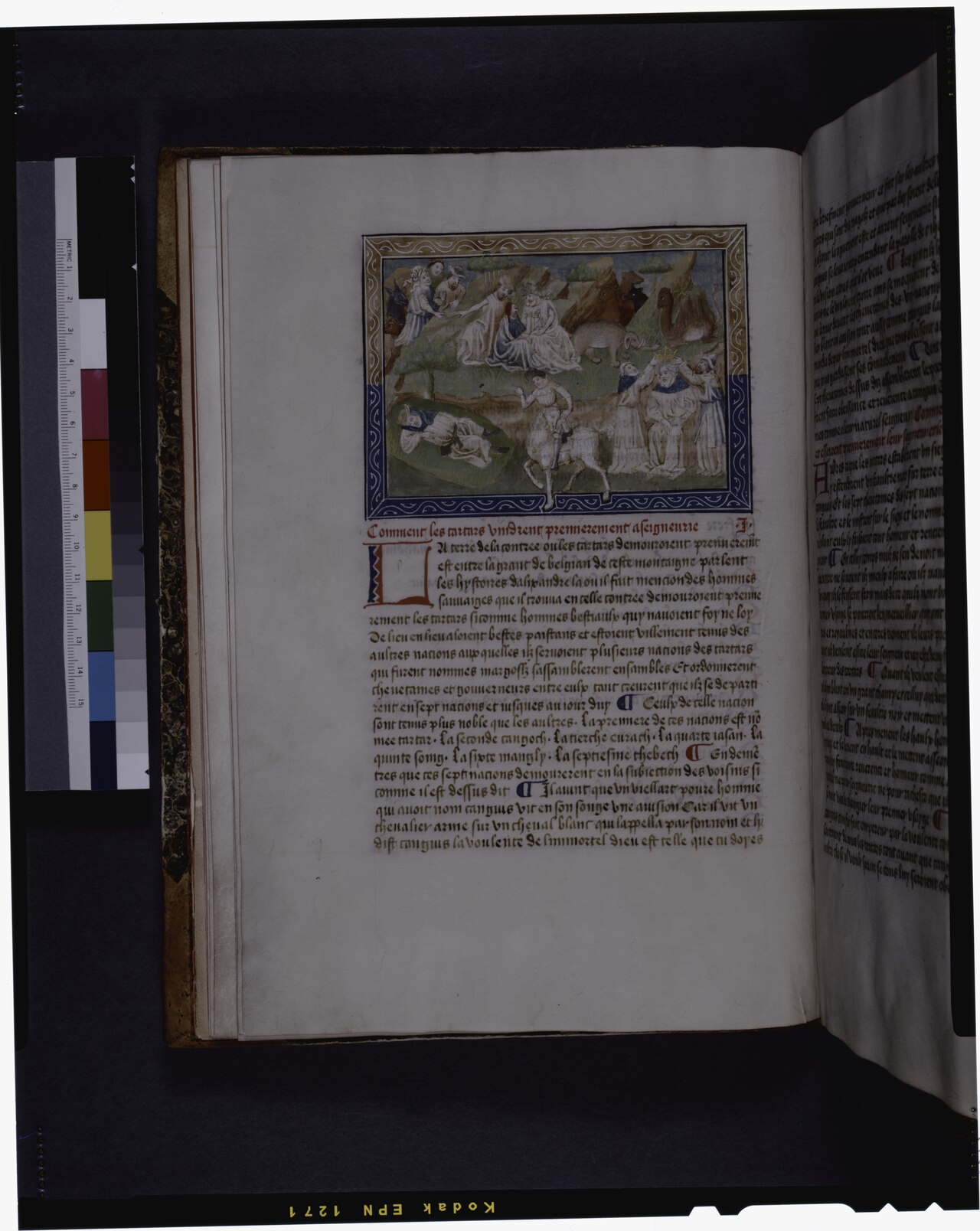
Photographic scan of a medieval manuscript page on a dark background with a color scale at left. The left page has a painted miniature in a gold and blue border showing figures on a green hillside, with a man on a white horse, and rows of red and black gothic text below. A facing page with dense text is at right.Painting

Secondary source

Dream-Vision of Genghis Khan Manuscript

Unknown · c. 1400

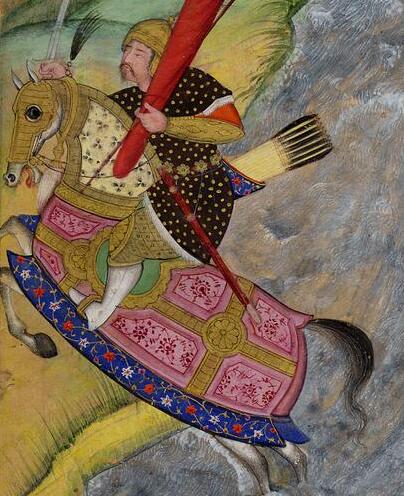
Painted miniature of a mounted rider in a gold-and-pink armored horse trapping, wearing a dark patterned robe and turban-like helmet, holding a long red pole and a sword, with a bow case on his back. The background is yellow-green with grey rocky water.Painting

Secondary source

Jalal al-Din Crosses the Indus

Banwari Khurd and Dharm Das · c. 1596-1600

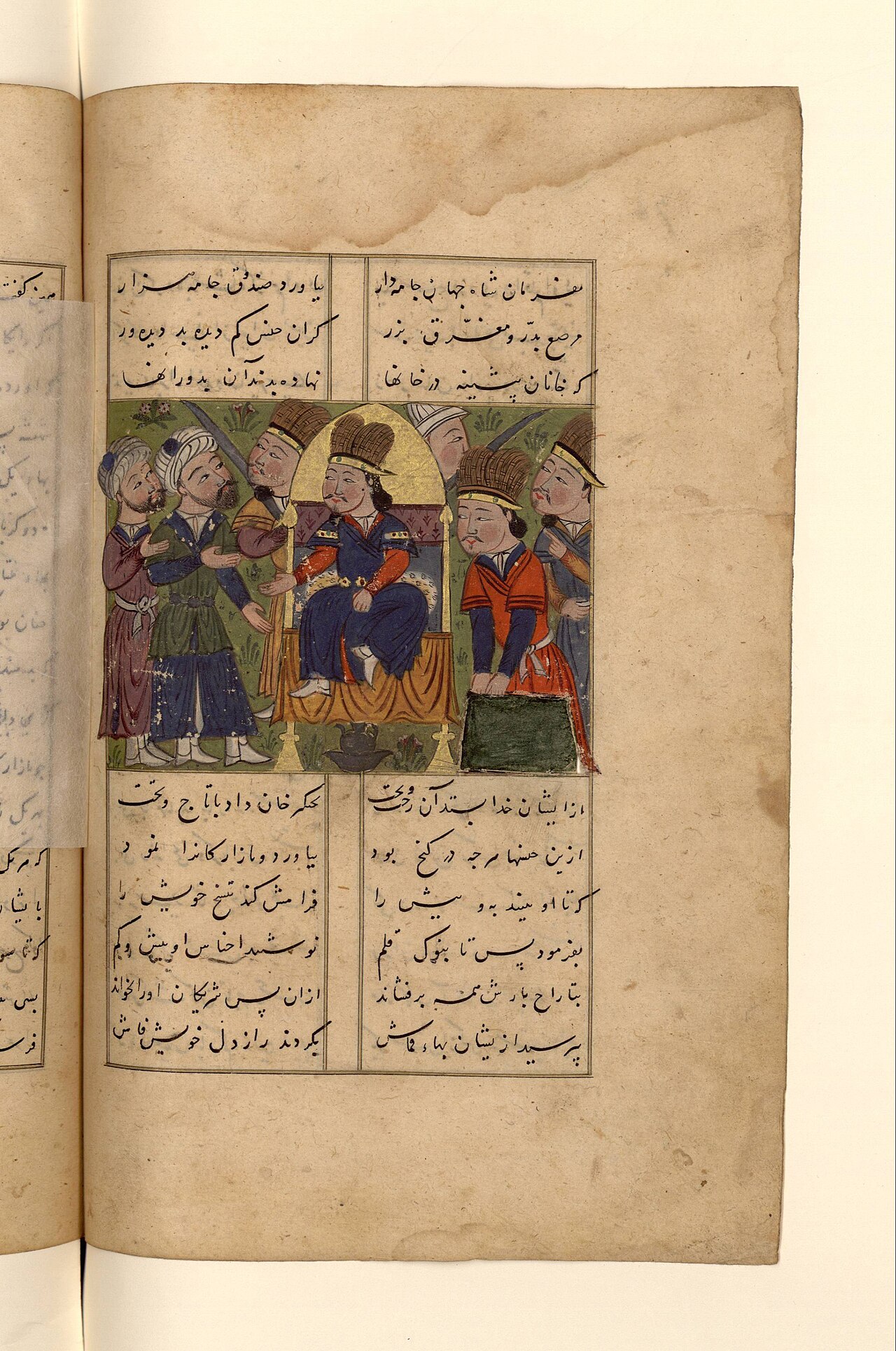
Manuscript page with Persian text in four panels framing a painted miniature. A seated ruler with a plumed crown sits on a golden throne, while bearded men in turbans and robes stand before him and a figure in red kneels beside a green box.Painting

Secondary source

Genghis Khan with Persian Merchants

1423

Close-up crop of a painted portrait of a bearded man with a pale face, thin arched eyebrows, a grey moustache and long grey beard. He wears a white cap with a flap down the side, a silver hoop earring, and a cream robe, against a faded greenish background.Painting

Secondary source

Portrait of Emperor Taizu of Yuan

Unknown · 14th century

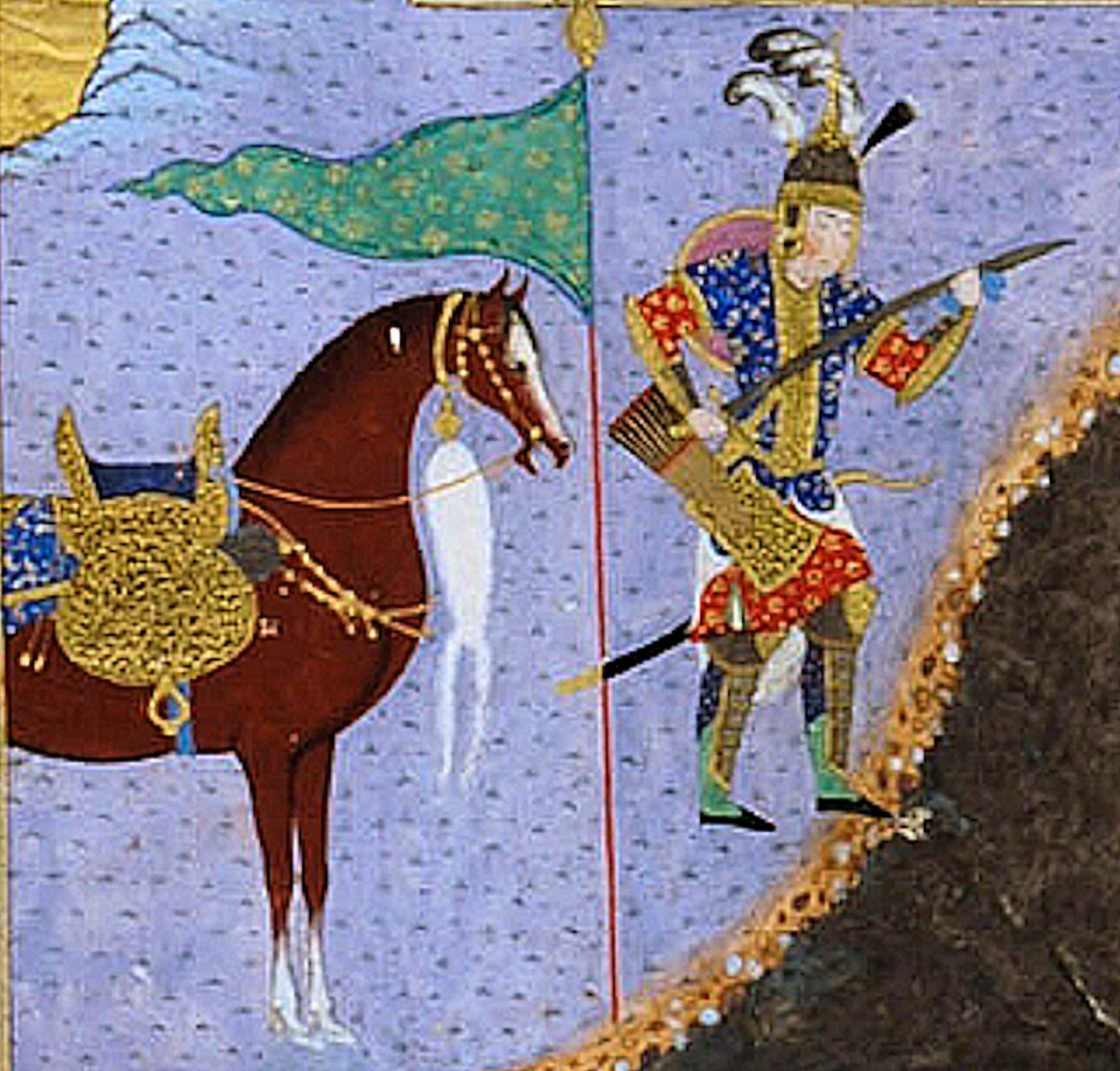
Detail of a painted miniature showing a rider on a chestnut horse with gold saddle and bridle beside a green flag on a red pole, and a mounted-style figure in gold and blue armor with a plumed helmet drawing a bow against a lavender background with a dark sloped edge.Painting

Secondary source

Jalal al-Din Confronts Genghis Khan Across the Indus

copy, 16th century

Back cover of a dark brown cloth-bound library book with worn, cracked tan leather corners and spine edge. A white barcode label reads 00035095 and a tan paper label stamped NOT TO BE ISSUED OUT OF THE LIBRARY.Book

Secondary source

Histoire des Mongols, Volume III

Baron d'Ohsson · 19th century

Document

Tertiary source

Genghis Khan Entry, The New International Encyclopædia

1902

Book

Secondary source

The Book of Ser Marco Polo

Henry Yule · 1871

Book

Secondary source

The History of Genghis Khan

Jacob Abbott · 1901 edition (text first published 1888)

Miniature painting of two seated rulers wearing gold crowns on a red and blue cushioned throne. Attendants in colorful robes and hats stand and kneel around them, holding dishes and a vase. Gold-patterned background.Painting

Secondary source

Genghis Khan and Wang Khan

Sayf al-Vâhidî · 1430

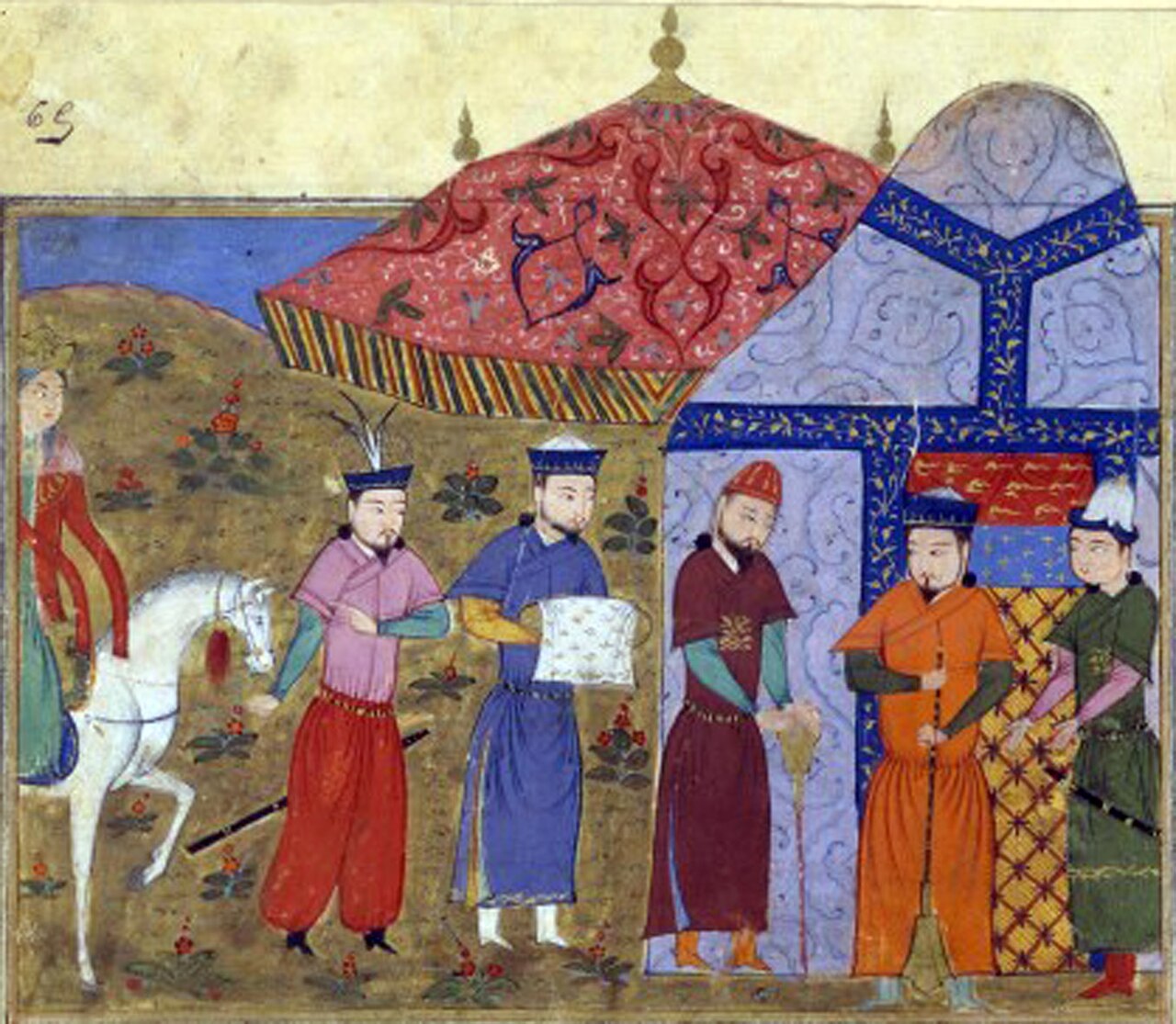
Persian miniature painting showing a tent with red patterned canopy and blue-and-gold panels. On the right, a bearded ruler in a maroon robe and red hat stands beside attendants in orange and green robes. On the left, two men in pink and blue robes, one carrying a folded white cloth, approach with a white horse and a rider.Painting

Secondary source

Genghis Khan Receives Chinese Envoys

Sayf al-Vâhidî · 1430

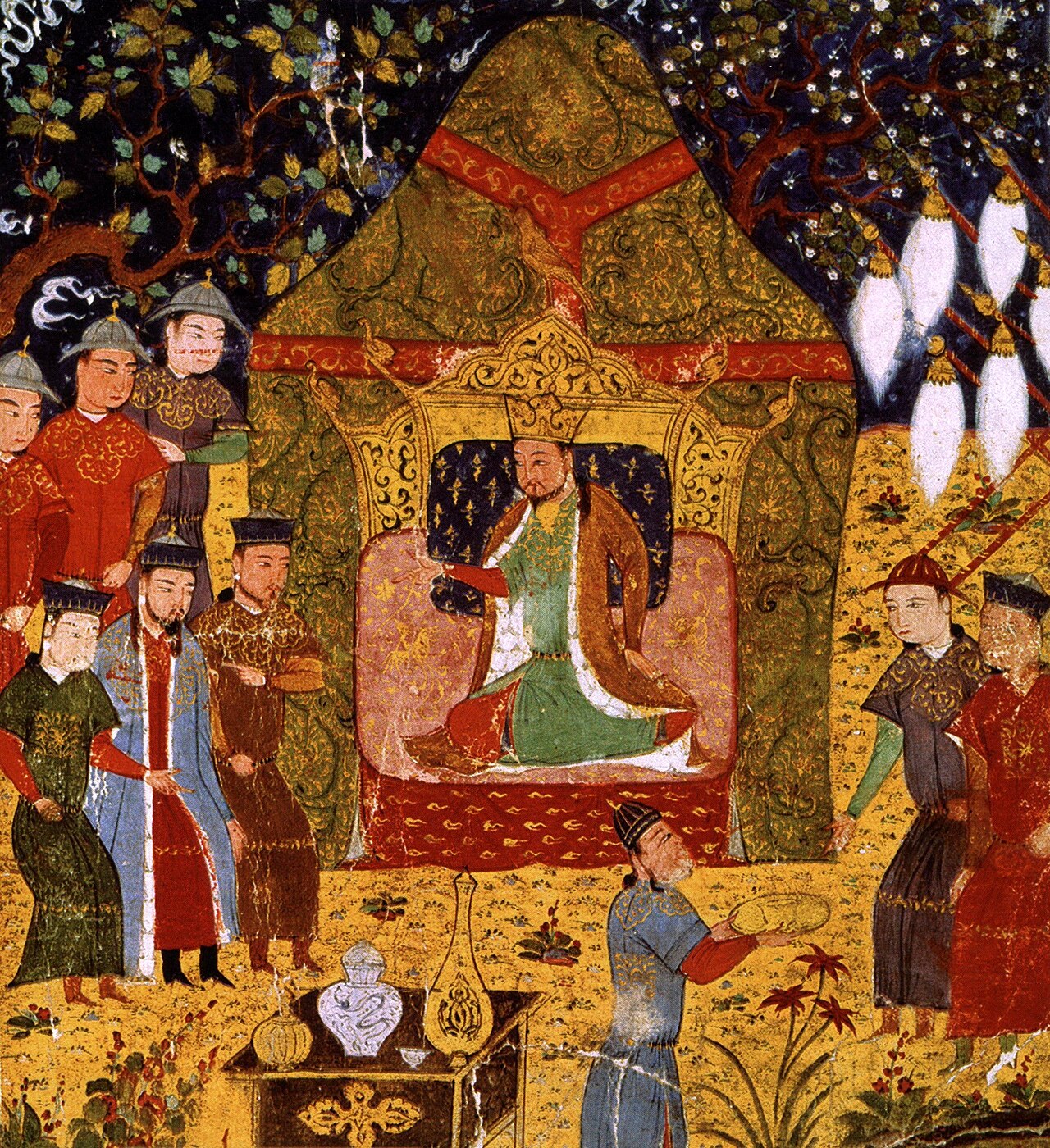
Painted miniature showing a seated bearded ruler on a golden throne under a green and gold canopy with red trim. Attendants in red, blue, green and brown robes and tall hats stand around him; one servant in blue carries a dish, and a table with vessels is in the foreground against a gold background with trees.Painting

Secondary source

Genghis Khan Enthroned at the Yeke Quriltay

Sayf al-Vâhidî · 1430

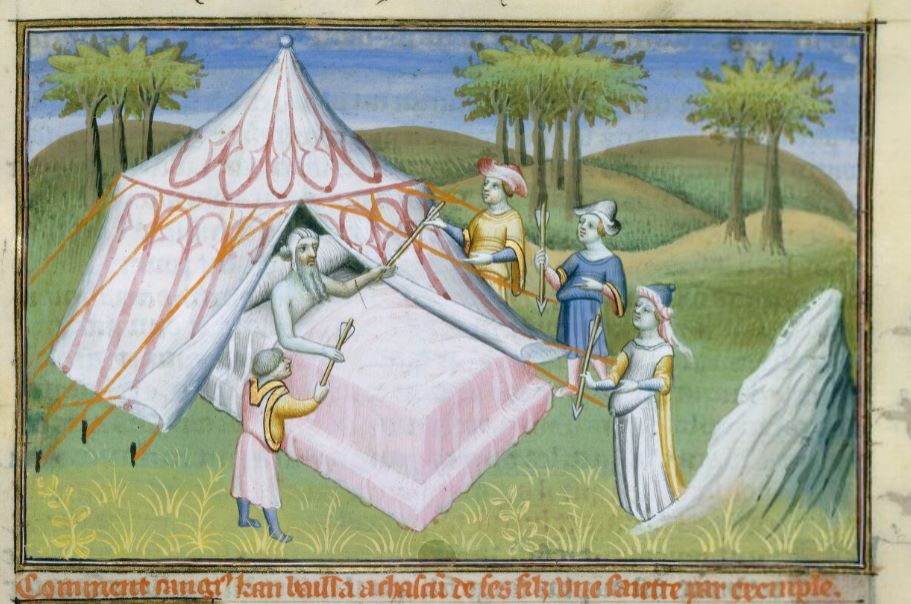
Medieval miniature in a tinted manuscript. An old bearded man reclines on a pink-covered bed inside a white tent with red patterning. He holds an arrow and gestures toward three younger figures outside: a helmeted man with a spear, a woman in a blue robe with a headdress, and a woman in white holding an arrow. A boy stands at the bed's left edge holding an arrow. Green grass and trees fill the background. French caption below.Painting

Secondary source

Genghis Khan Advising His Sons on His Deathbed

Atelier de Maître de la Mazarine · c. 1410-1412

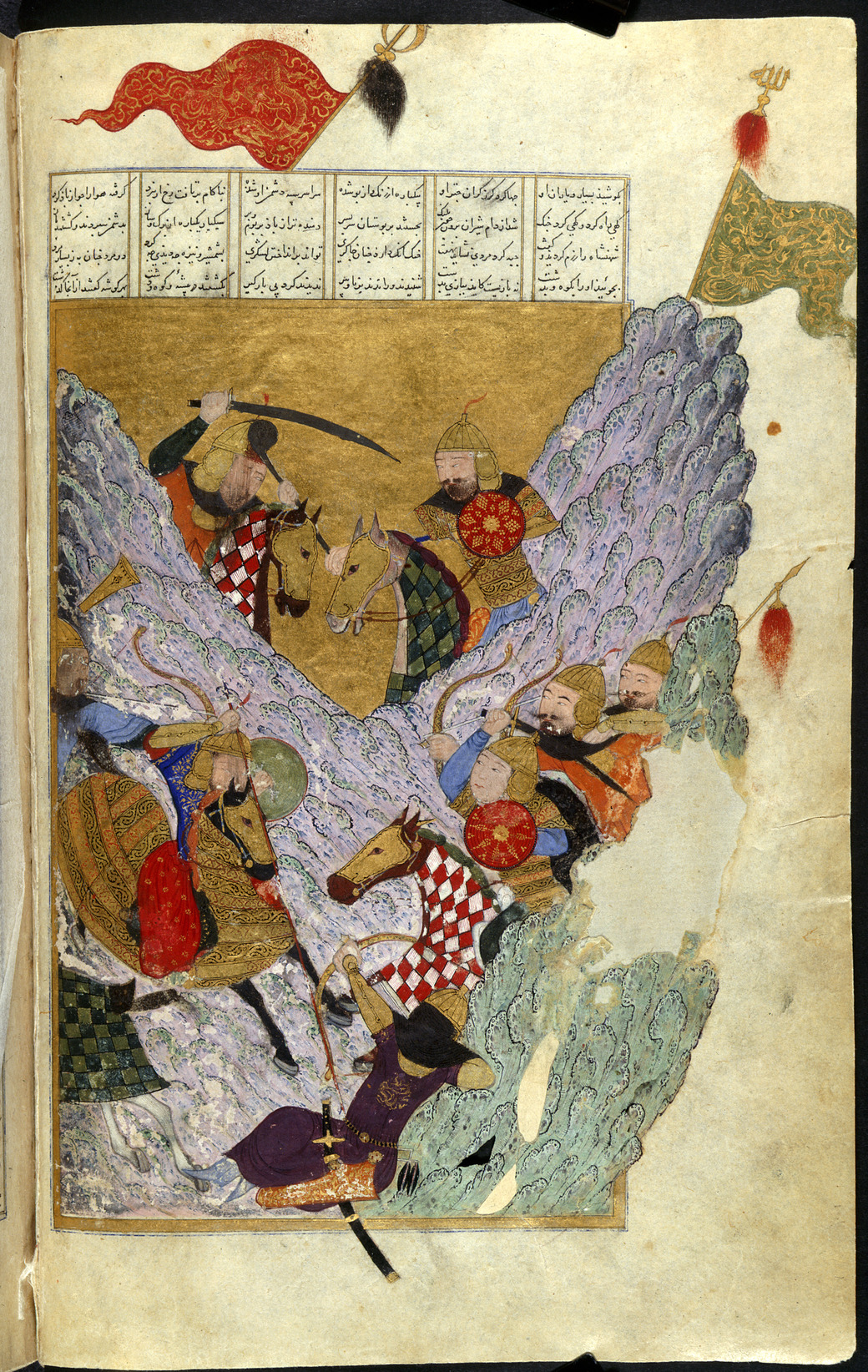
Manuscript miniature painting of a battle in a mountainous landscape with stylized blue-grey rocks and a gold background. Mounted warriors in helmets and armour wield swords and bows, with red and green banners above and Persian text in columns at the top of the page.Painting

Secondary source

Chingiz Khan Fighting the Chinese

1397-98

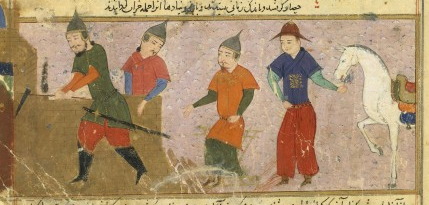
Miniature painting in a manuscript showing mounted and standing figures in medieval Persian style, with a fortified wall at left where a man in green and a figure in red are at work. Four men in pointed hats and colorful robes stand in a row at center and right, and a white horse is led at right. Arabic script runs across the top of the page.Painting

Secondary source

Genghis Khan and Sons at the Destruction of Laybalki

Rashid al-Din Fazlullah (text) · c. 1430

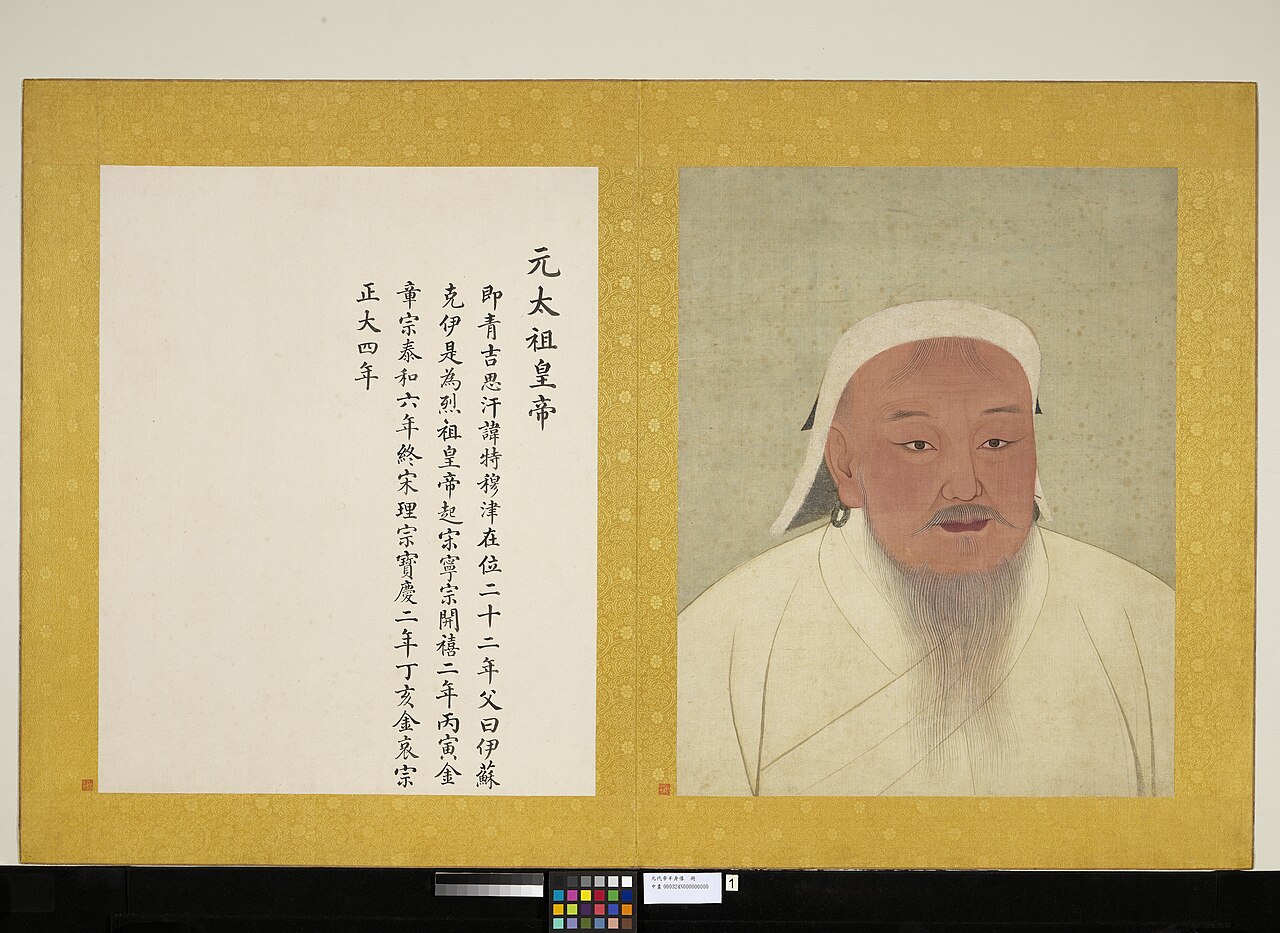
Album page with gold brocade border showing a Chinese calligraphy text column on the left and, on the right, a painted portrait of a bearded man in a white cap and pale robe with a gold earring, against a grey-green background. A color scale bar is visible below.Painting

Secondary source

Emperor Taizu of Yuan (Genghis Khan)

Unknown · 14th century

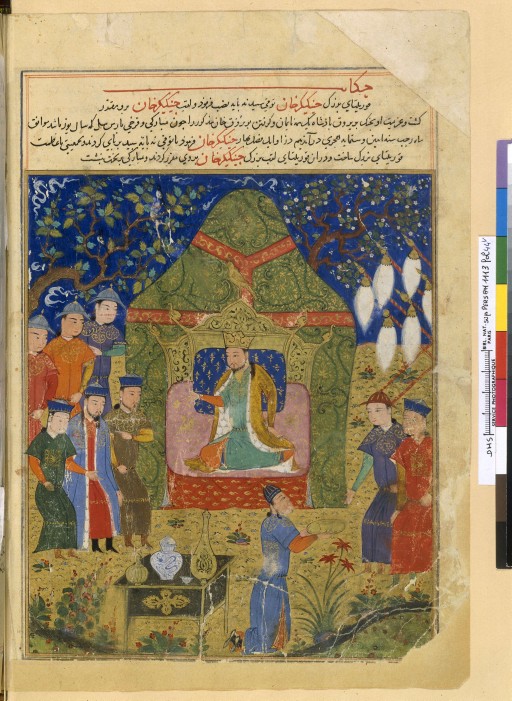
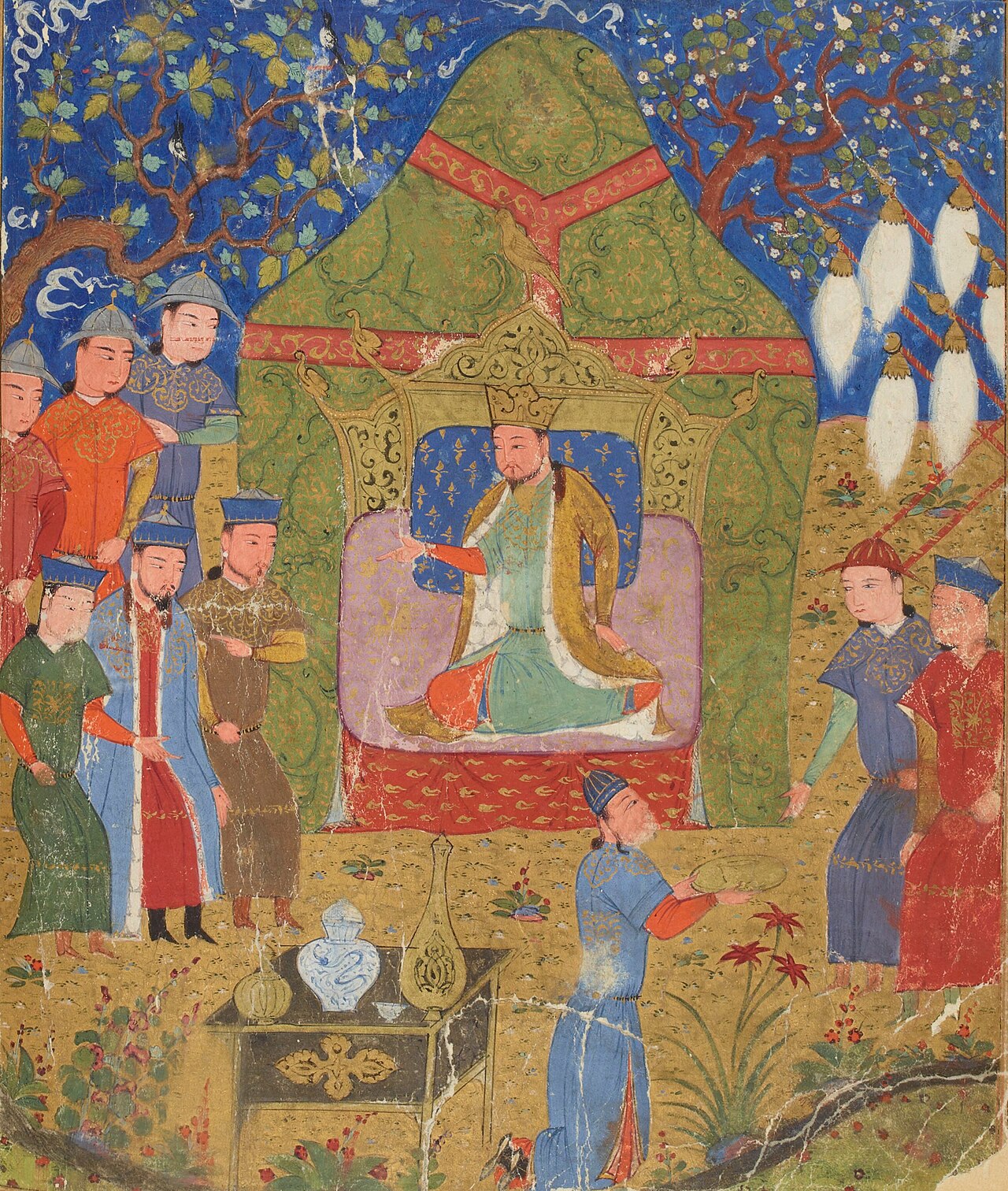
Painted miniature of a seated, crowned man on a cushioned throne under a green canopy with a red band, a bird perched on top. Robed attendants in blue, green, red and brown stand on both sides, and a kneeling man in blue holds a tray. A blue-and-white vase and a golden ewer sit on a low table. Trees with blossoms and white banners frame the scene against a blue sky.Painting

Secondary source

Temujin Proclaimed Genghis Khan in 1206

Sayf al-Vahidi · c. 1430

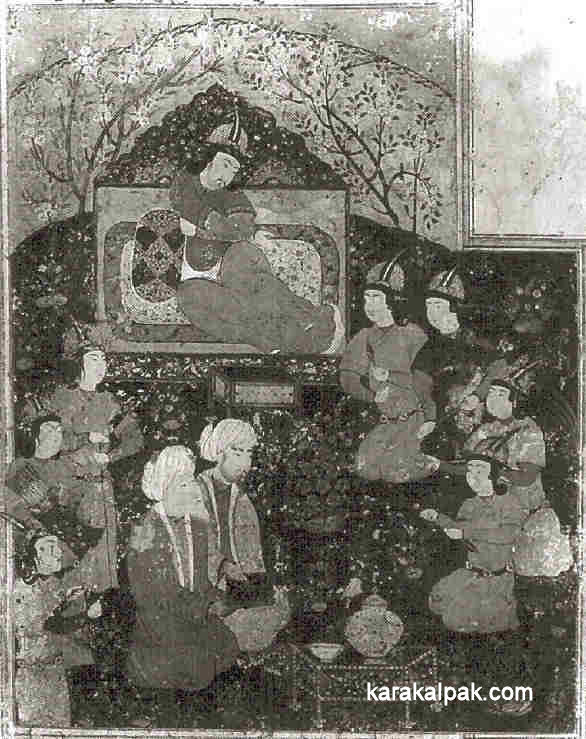
Miniature painting in muted colors showing a seated ruler on a raised platform under a tree, surrounded by attendants in tall hats and robes. Figures in the foreground sit in a flowered garden; a watermark reads karakalpak.com.Painting

Secondary source

Chinggis Khan Assigning Lands to His Four Sons

16th century

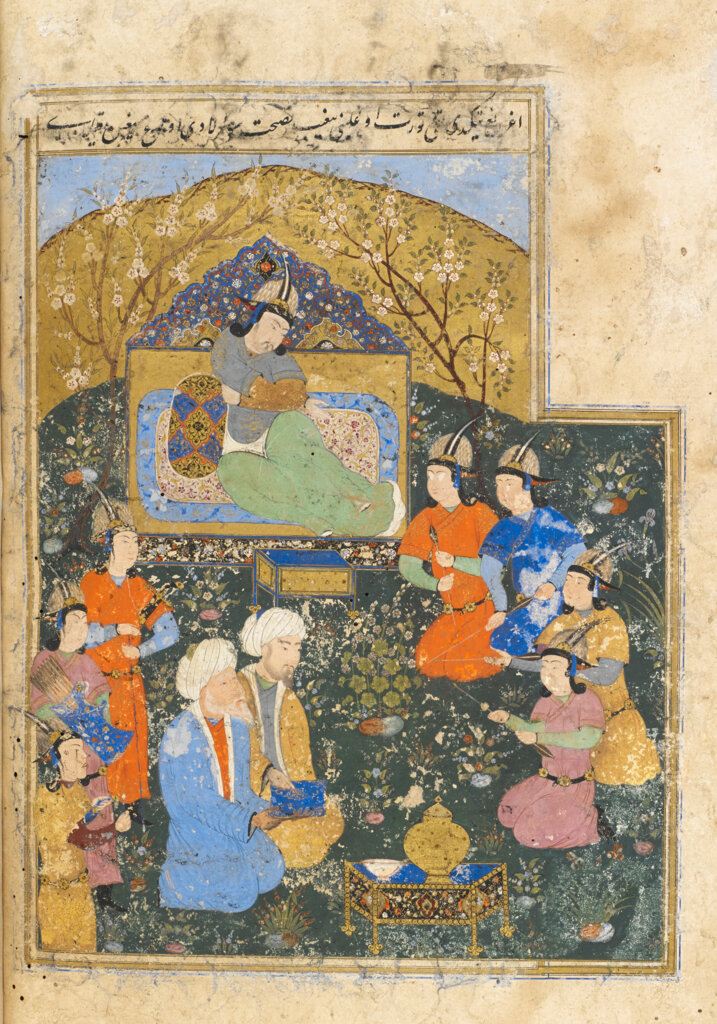
Persian-style miniature painting in a gold-bordered folio with Arabic-script text at top. A seated man in a blue-and-green robe and a turban-like headdress sits on a raised dais under a blue canopy, surrounded by flowering trees. Below, robed men and women in orange, blue, pink and yellow sit and stand on a dark flower-patterned ground, with a gold incense burner on a table.Painting

Secondary source

Chinggis Khan Advising His Sons

1562-1563

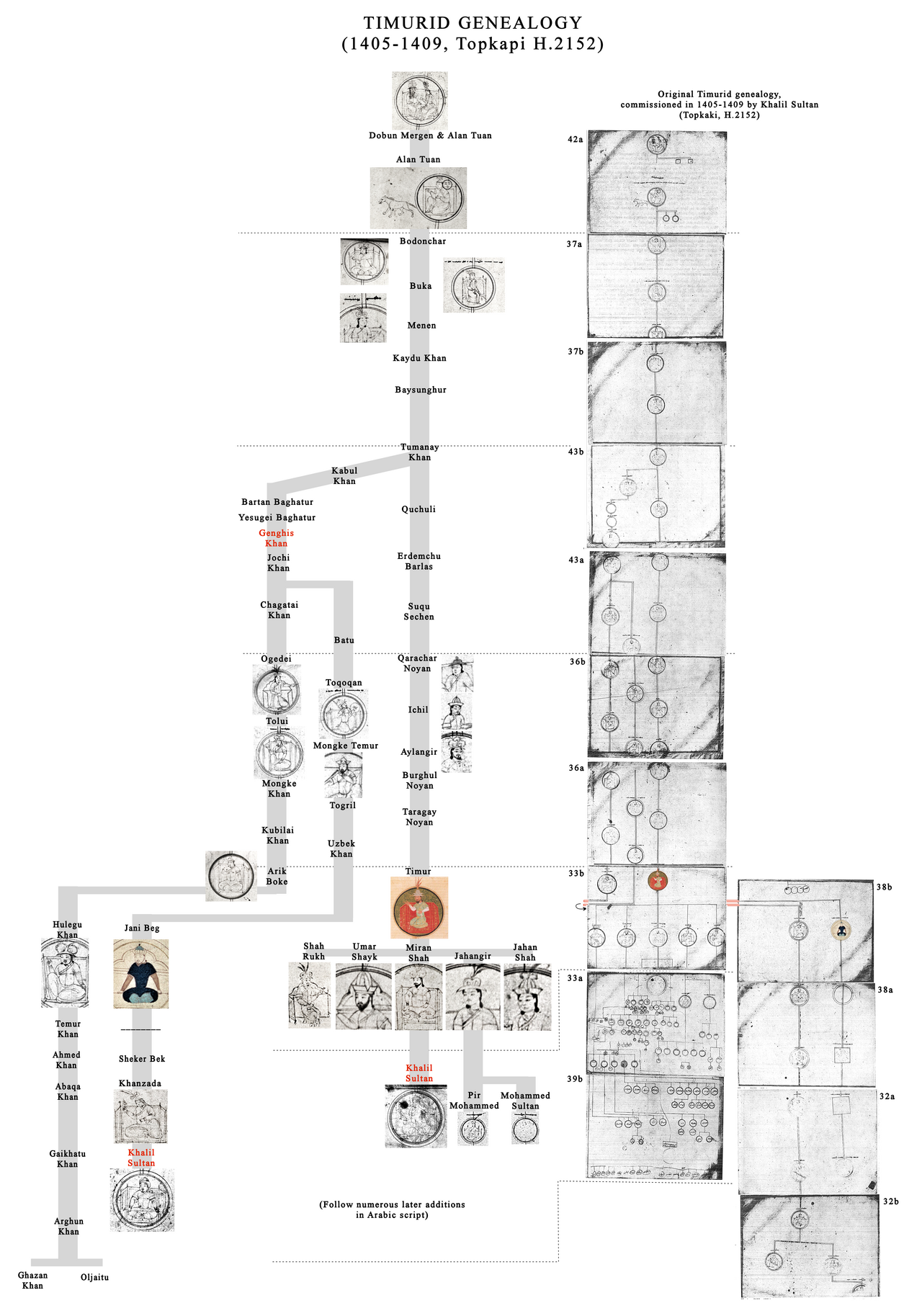
Composite chart titled Timurid Genealogy (1405-1409, Topkapi H.2152). Left side: a descent diagram of medallion portraits linking Dobun Mergen, Alan Tuan, Genghis Khan, Ogedei, Batu, Timur, and Khalil Sultan. Right side: pages of the original manuscript genealogy with circular portraits and connecting lines.Document

Secondary source

Timurid Genealogy Showing Descent from Genghis Khan

1405-1409

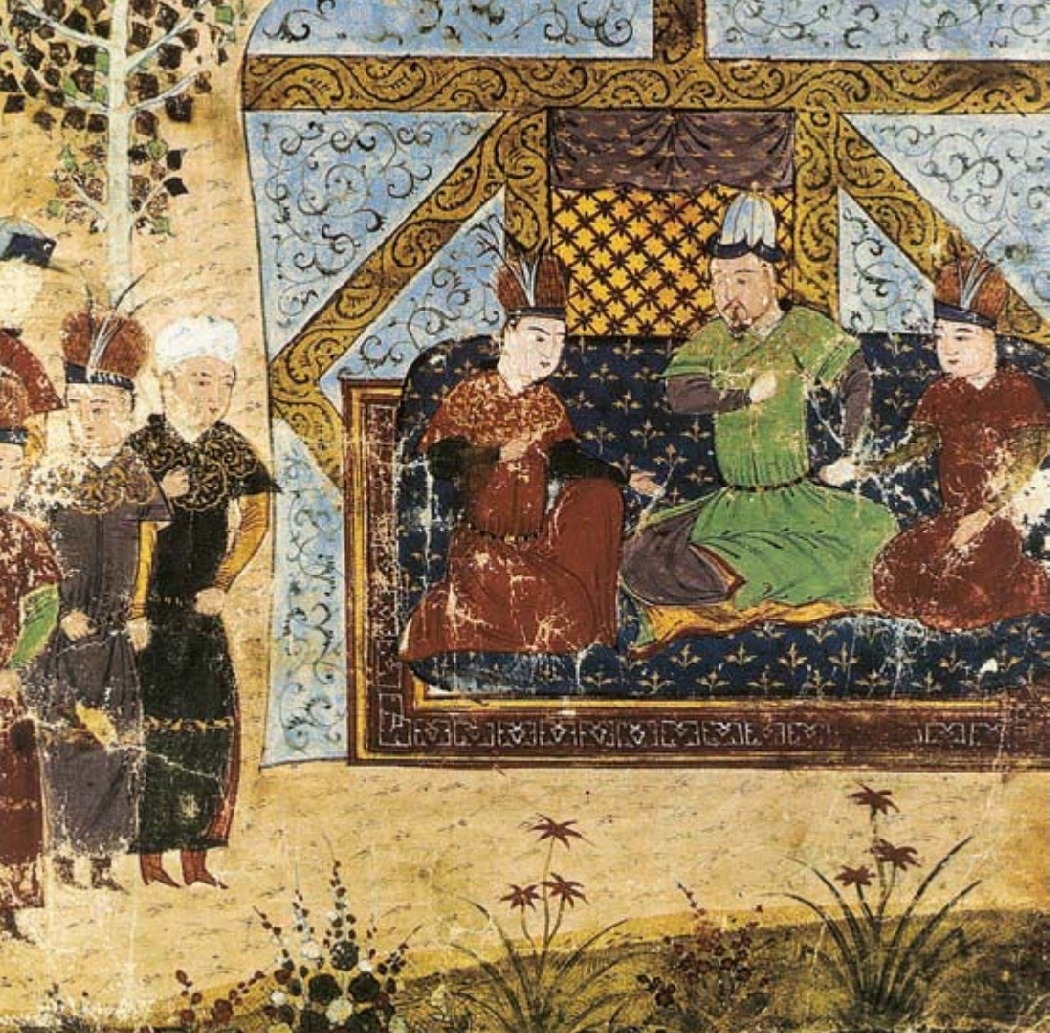
A detail of a painted Persian miniature: a seated man in a green robe and white turban on a blue patterned cushioned dais under a gold-framed canopy, flanked by seated figures in red robes and feathered hats, with standing attendants at left and small flowering plants in the foreground.Painting

Secondary source

Genghis Khan and His Sons

Unknown artist · 14th century

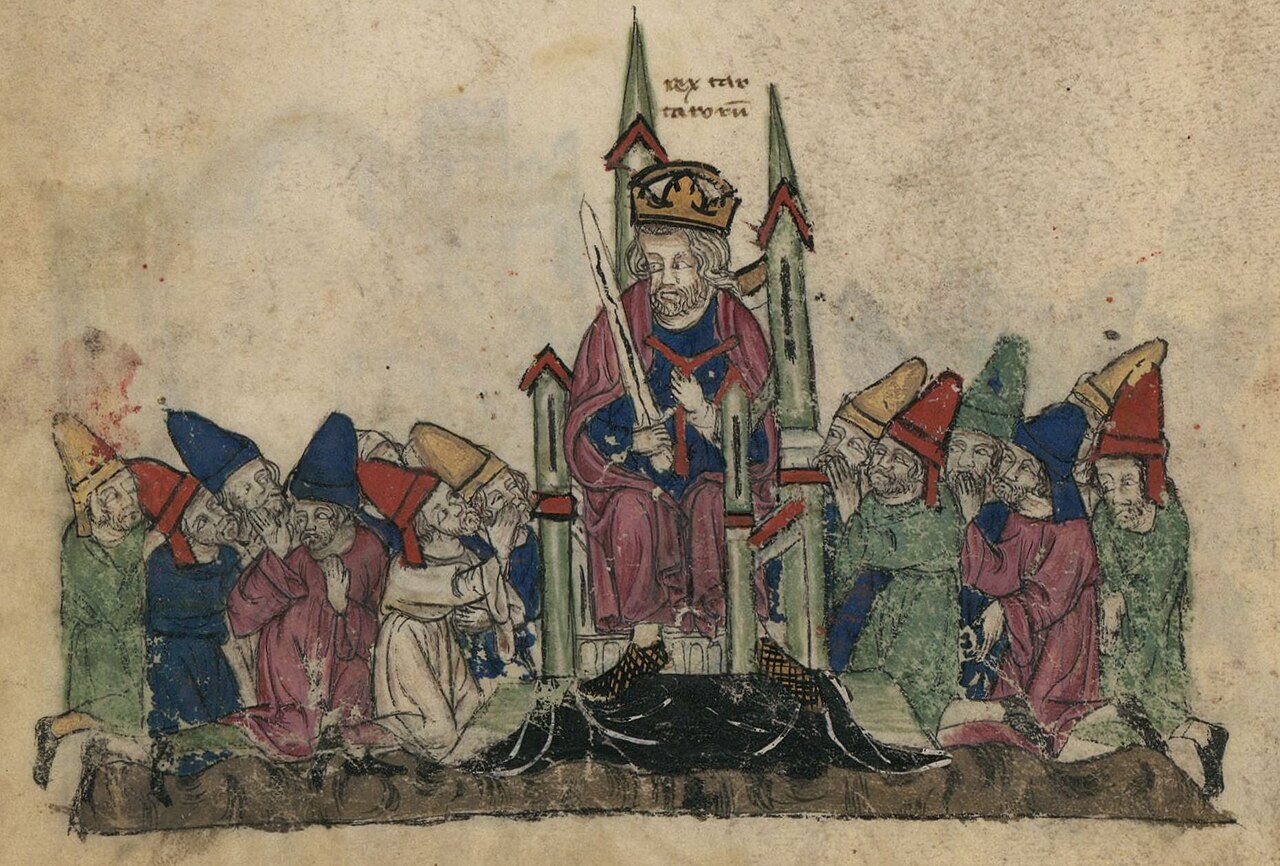
Medieval manuscript painting on parchment. A crowned, bearded king sits on a throne holding a sword across his lap, flanked by Gothic spires. Above him is Latin text reading 'rex tartarorum'. Kneeling figures in pointed hats, some in red and blue, bow with hands raised toward him on both sides, on a dark ground at the bottom.Painting

Secondary source

Homage to Genghis Khan, rex tartarorum

Unknown artist · 14th century

Painted portrait on aged silk or paper of a bearded man with a white cap-like headdress, long white beard, and light robe, facing forward. Vertical inscription in Chinese characters at upper right.Painting

Secondary source

Genghis Khan Portrait, Ming Dynasty

Unknown artist · Ming dynasty, 1368-1644

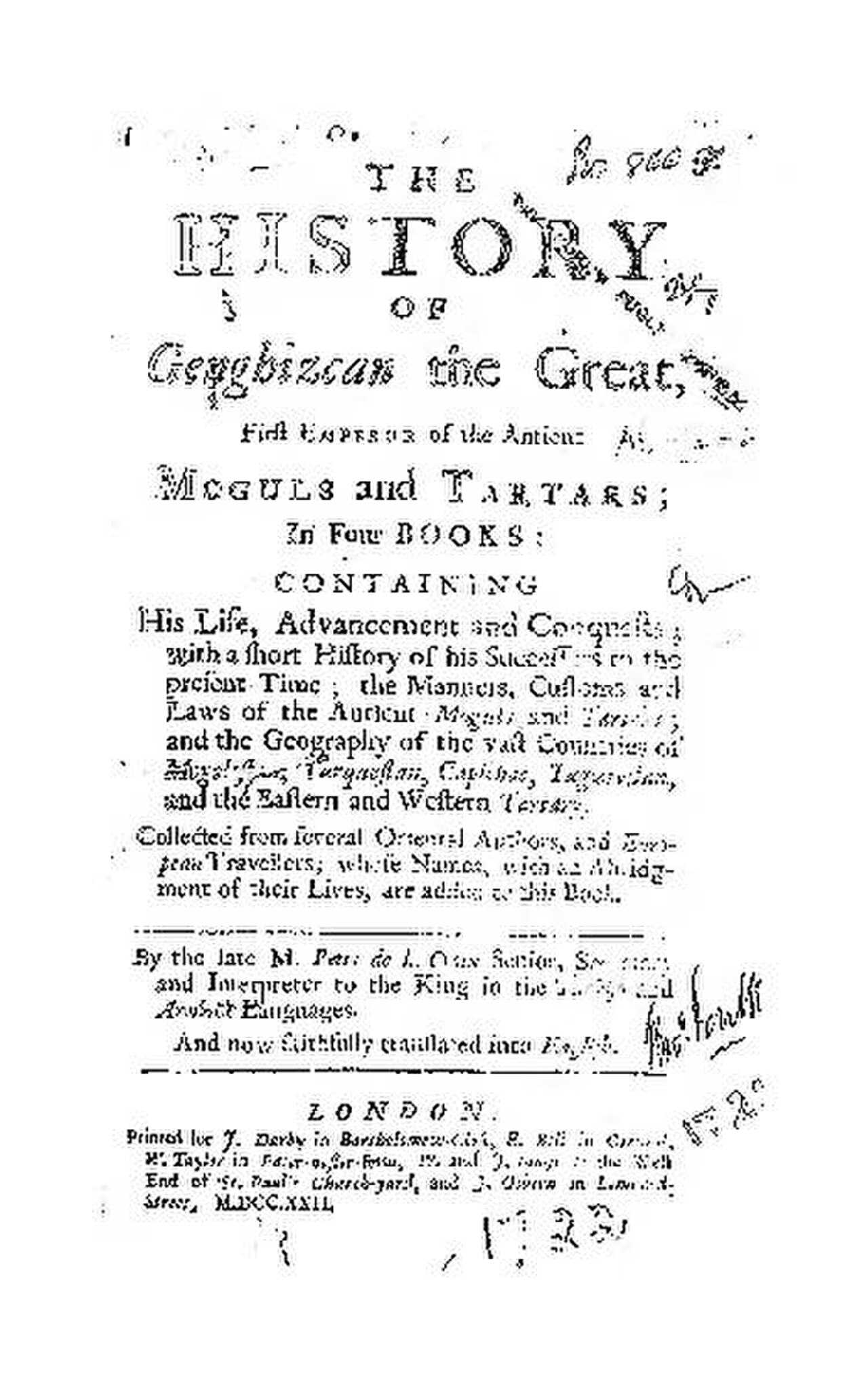
Title page of a book, printed in black text on white paper, reading 'The History of Genghizcan the Great, First Emperor of the Ancient Moguls and Tartars; In Four Books', with a note about collection from Oriental authors and translation by M. Petis de la Croix, and London printing details at the bottom. Handwritten marks and stamps appear in the margins.Book

Secondary source

The History of Genghizcan the Great

M. Petis de la Croix

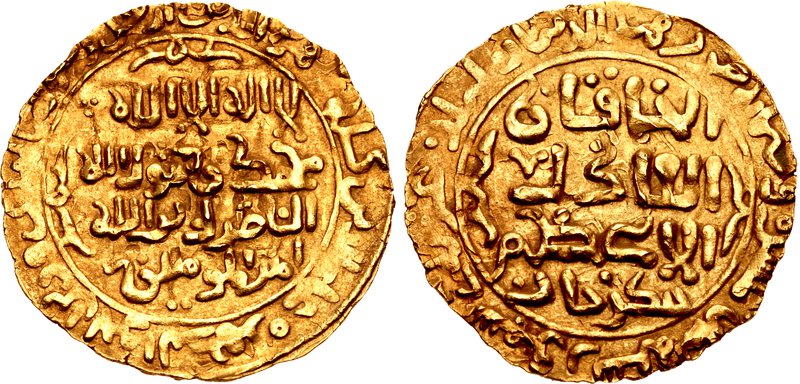
Two sides of a gold dinar coin. The left side has Arabic inscriptions in four lines within a circular border, with a decorative floral ornament. The right side has Arabic script in lines within a border, with a circular inscription band around the edge.Artifact

Primary source

Gold Dinar Struck in Genghis Khan's Name

AH 618 / AD 1221-1222

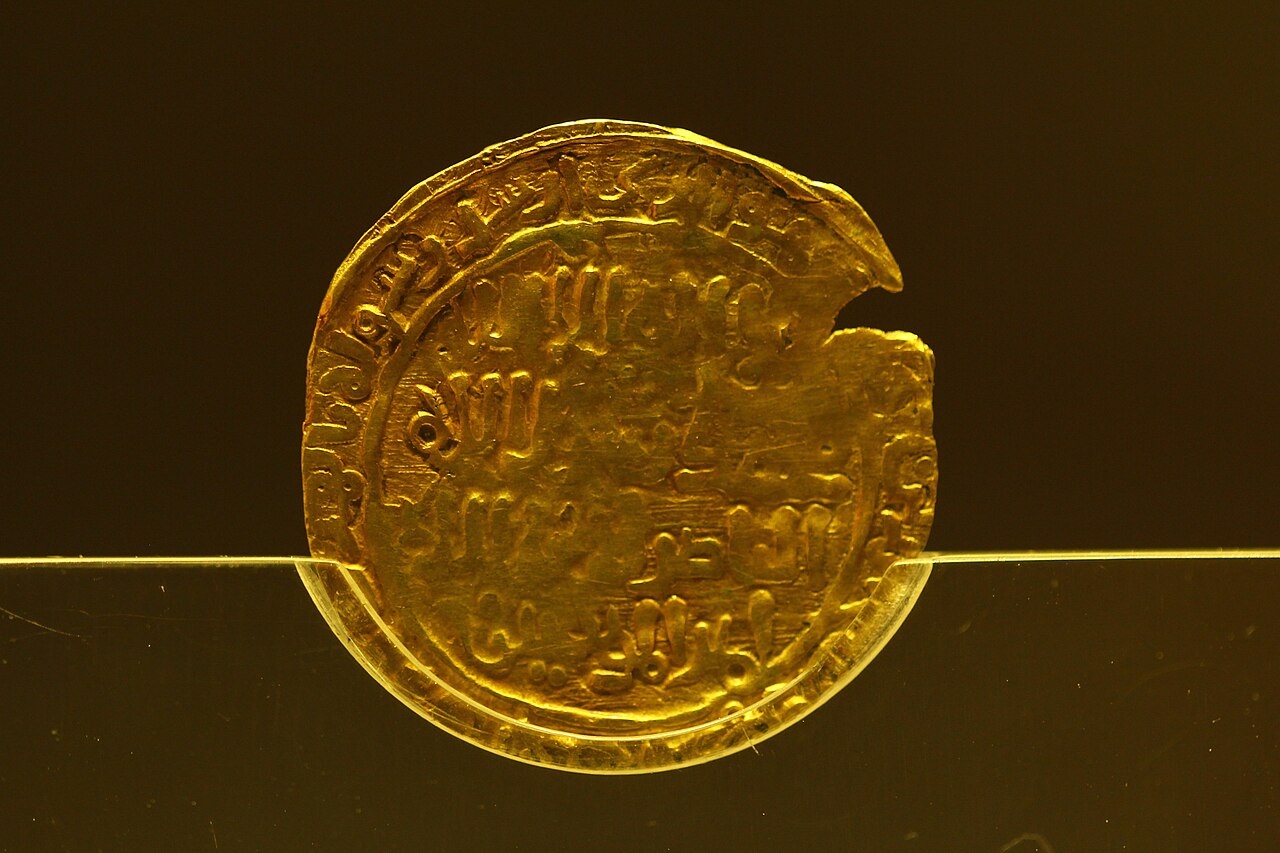
Photo of a small, irregularly shaped gold coin lit against a dark background, resting on a glass shelf. The coin has raised Arabic-style inscriptions in a circular border and central field. One edge is chipped or broken.Artifact

Primary source

Gold Coin of Genghis Khan

1221 (Islamic year 618)

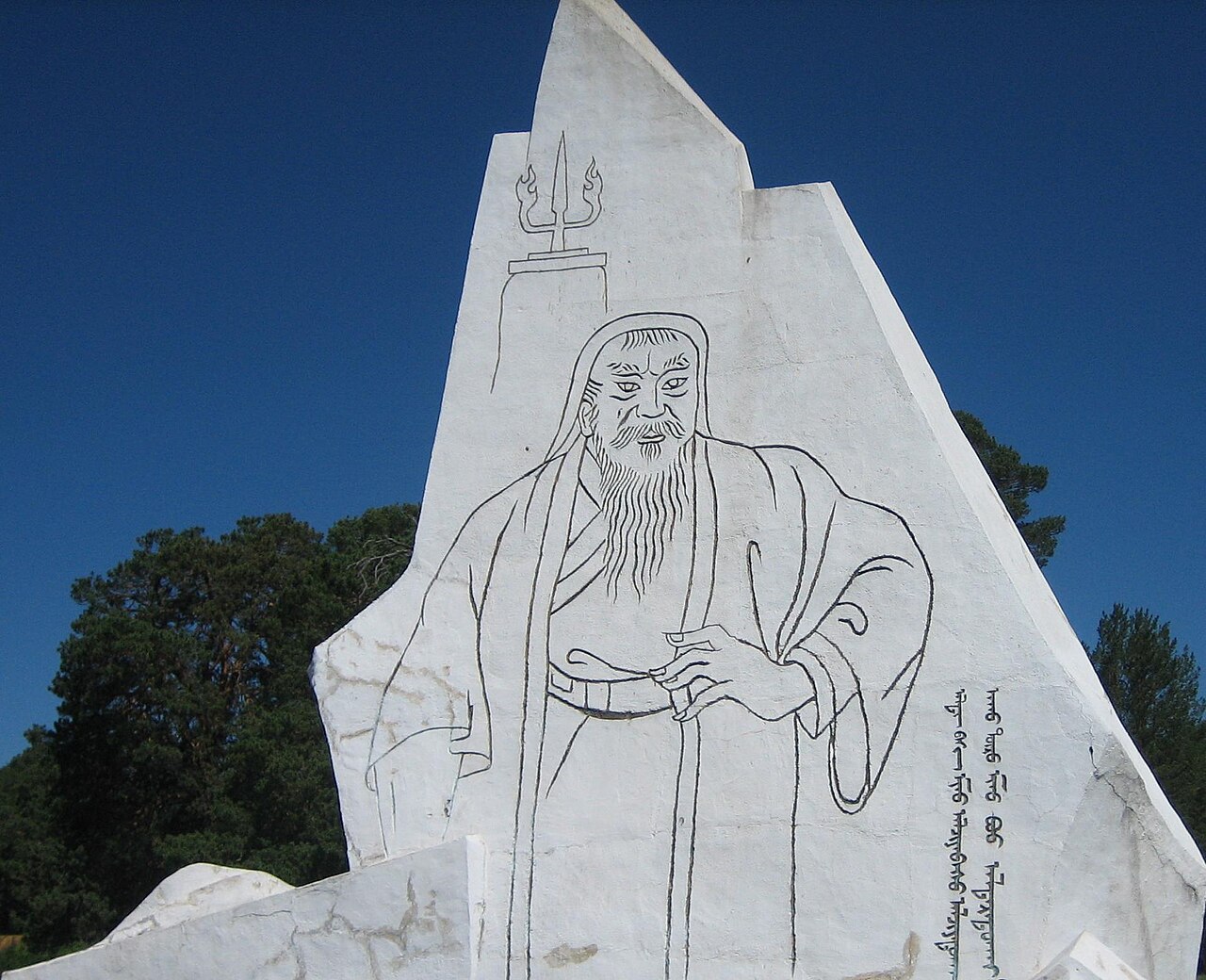
A white painted stone monument with black line-drawn outline of a bearded man in a long robe and belt, holding his hands together at the waist. Above him is a trident-like symbol on a pedestal. Mongolian script is inscribed on the right. Blue sky and green trees behind.Sculpture

Secondary source

Genghis Khan Statue at Dadal, Khentii

Chinneeb · Photographed 25 June 2007

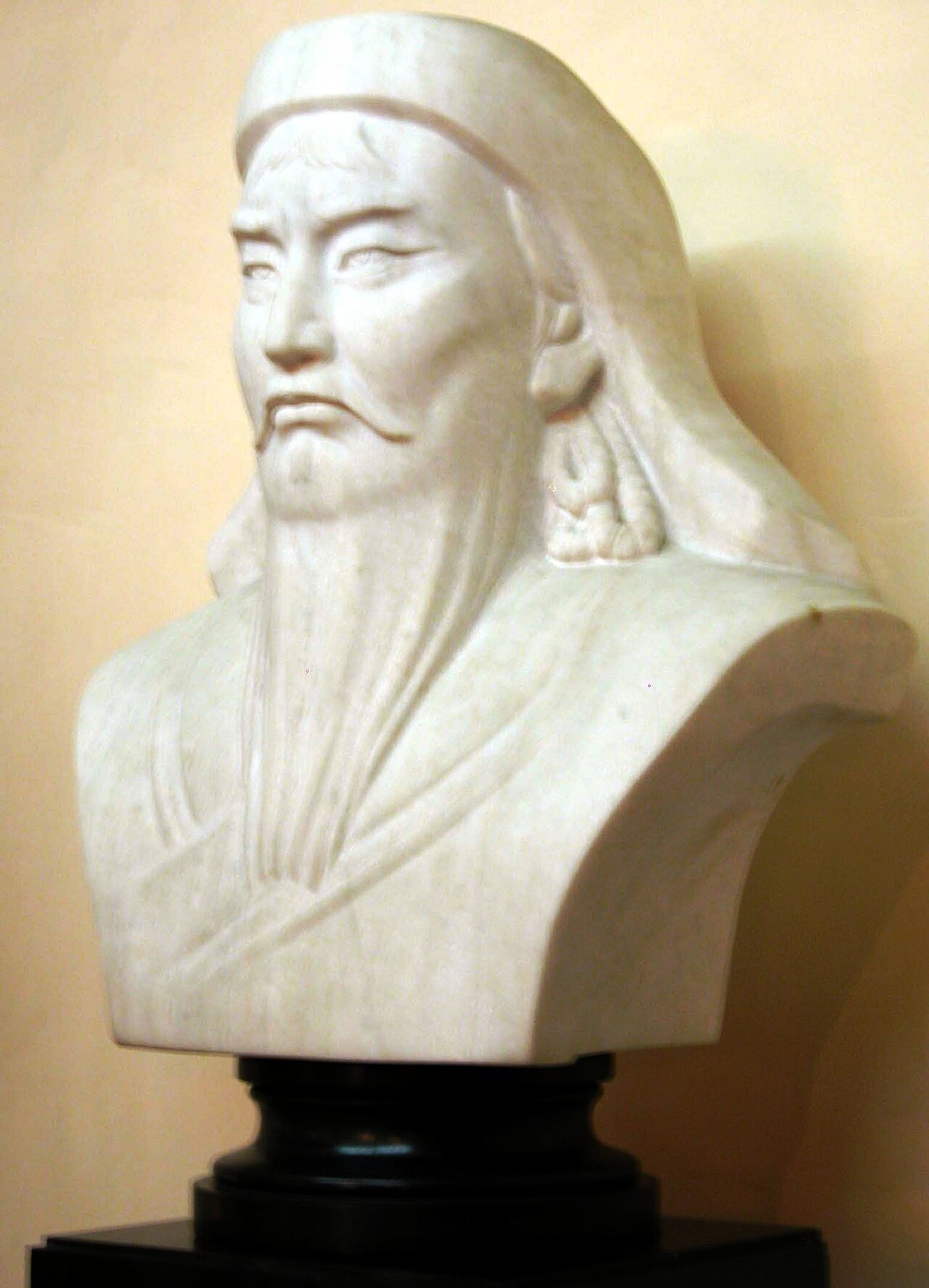
White marble bust of a bearded man wearing a tall hat with a long hair braid visible over the shoulder, set on a black pedestal against a cream wall. The face is carved in profile-leaning view, with a long beard.Sculpture

Secondary source

Genghis Khan Bust in the Ulaanbaatar Presidential Palace

Photographed 13 January 2004

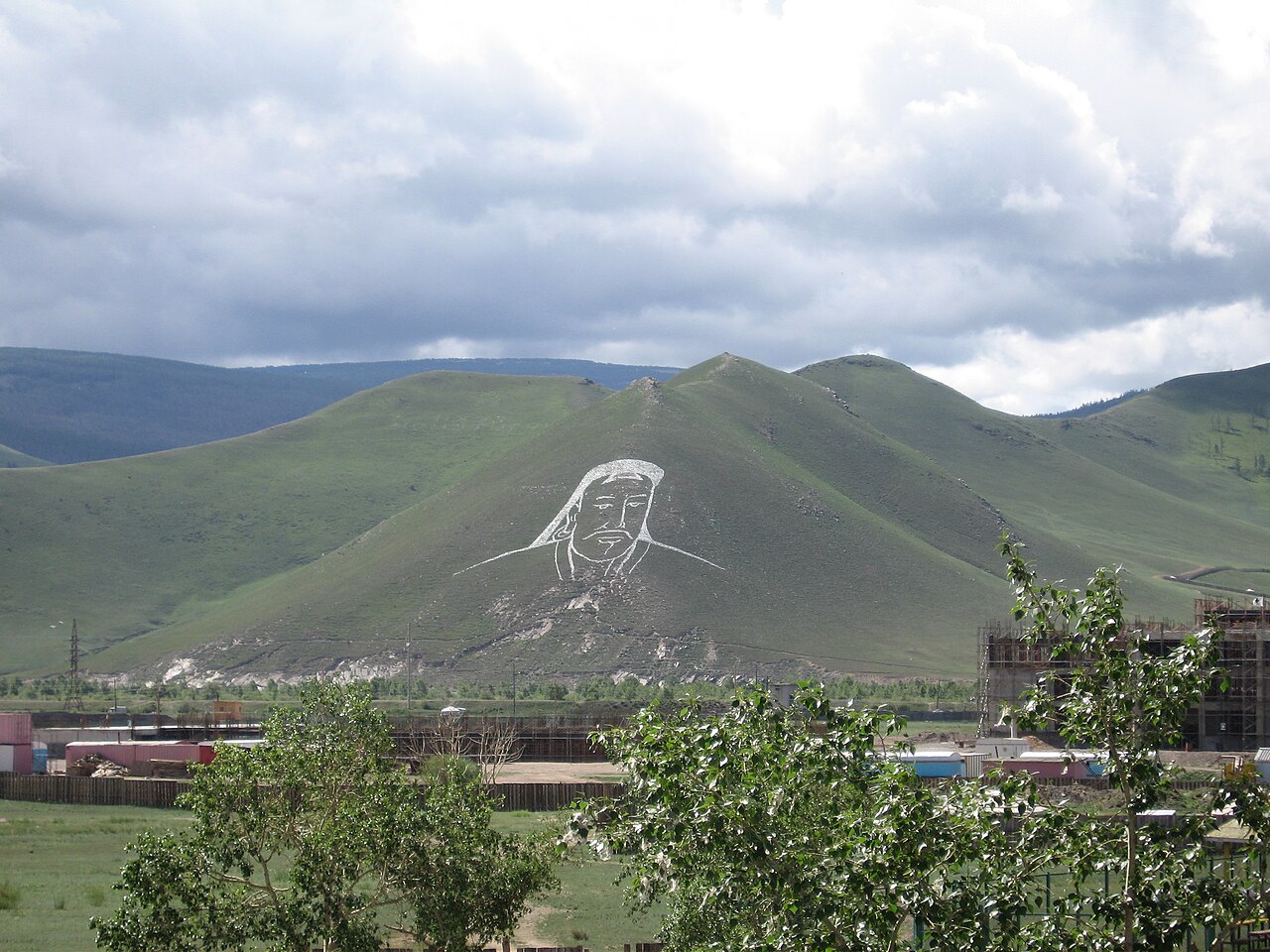
A green hillside with a large white outline of a man's face, with long hair, a headband and flowing lines. Grassy hills, cloudy sky, a building under construction and a tree in the foreground.Painting

Secondary source

Chinggis Khan Hillside Portrait for Naadam 2006

Vidor at English Wikipedia · 23 November 2006 (upload date, created for 2006 Naadam)

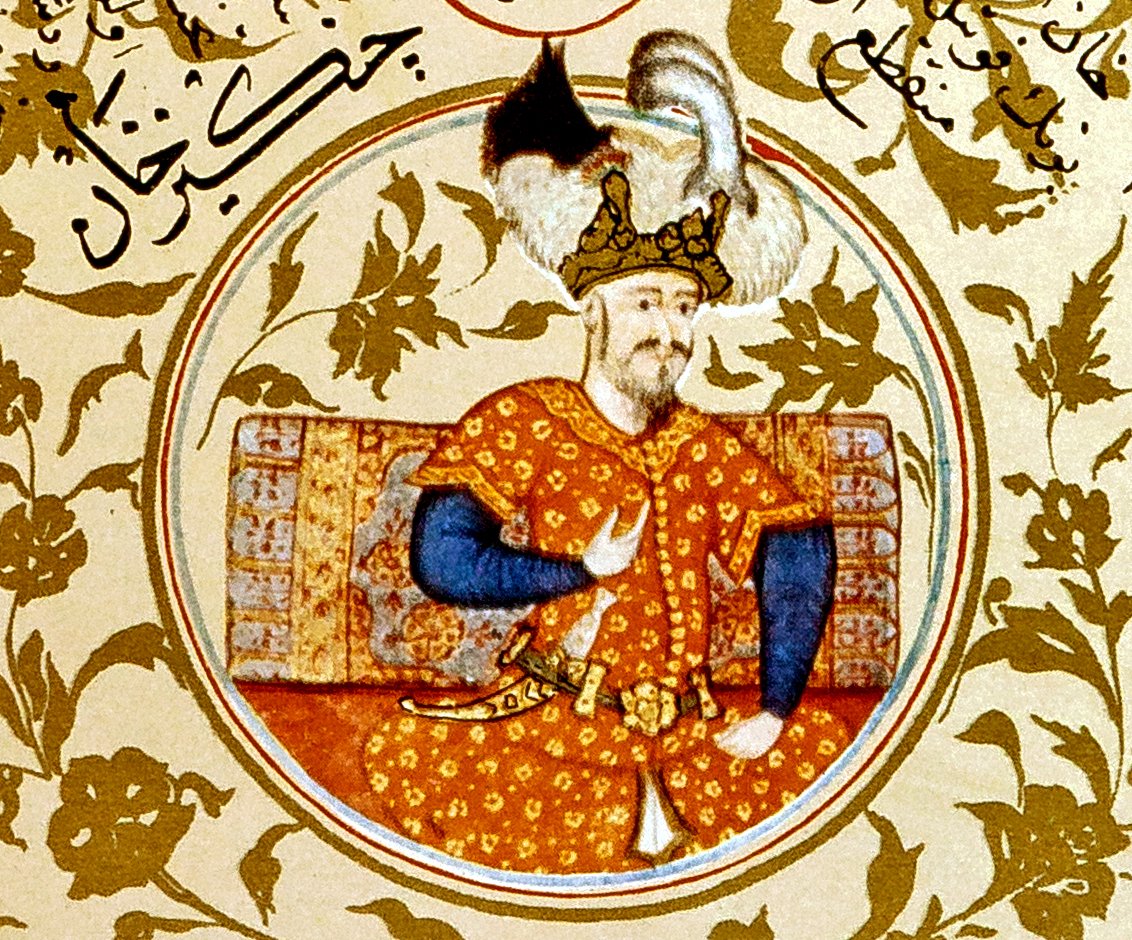
Circular framed miniature painting of a bearded man wearing a gold crown with white plumes, dressed in an orange patterned robe with blue sleeves, seated and holding a sword, against a gold floral background with Arabic-script inscription.Painting

Secondary source

Ottoman miniature of Genghis Khan

Derviş Mehmed Pasha

Book

Secondary source

Great Captains Unveiled

B. H. Liddell Hart · 1927

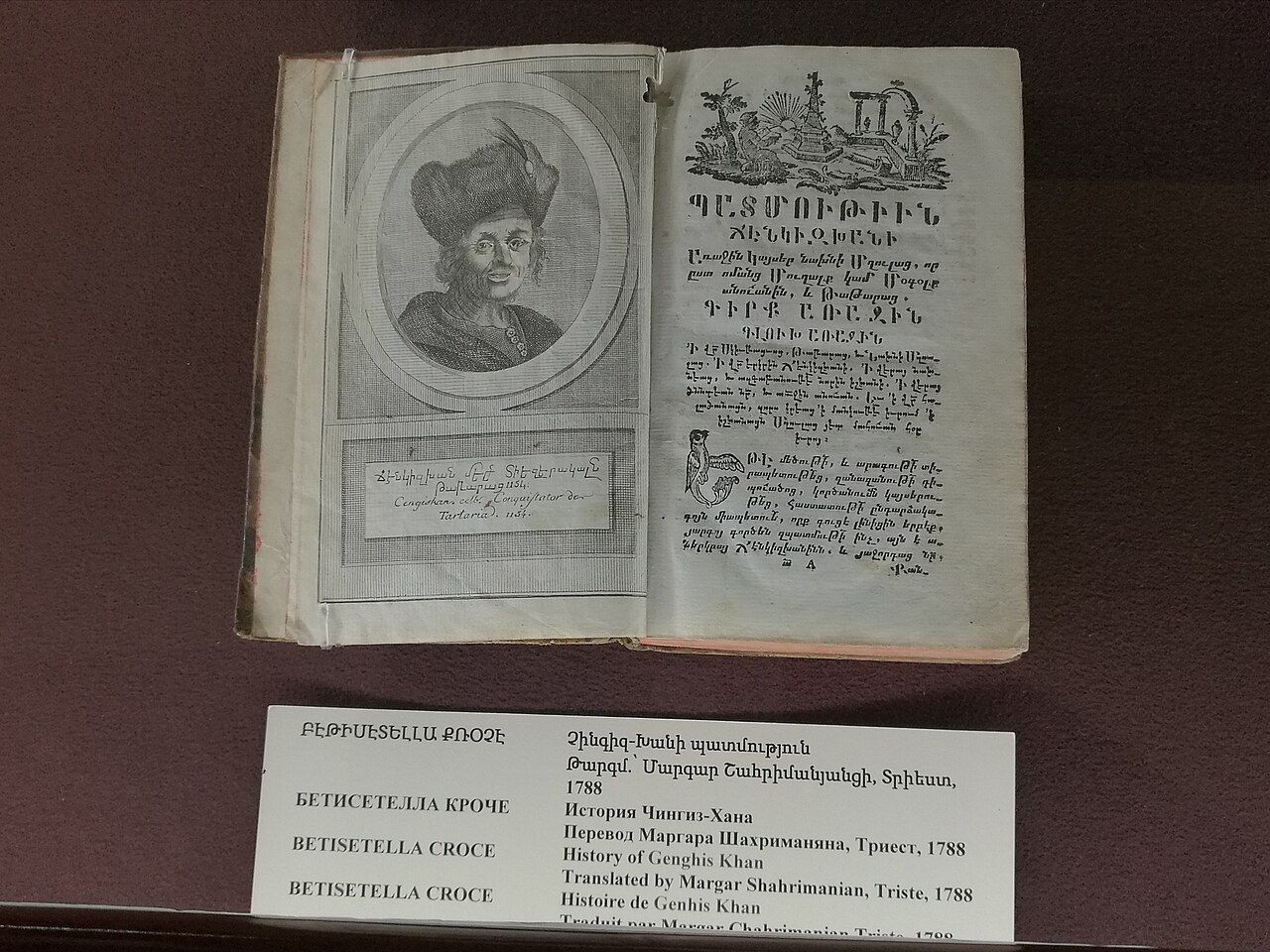
Open book in a display case showing an engraved frontispiece portrait of a man in a fur hat with a feather, inside an oval frame, with a caption below. The right page has a decorative header and Armenian title text. A museum label lies below.Book

Secondary source

Armenian edition of the Croce Genghis Khan history, 1788

Betisetella Croce · 1788

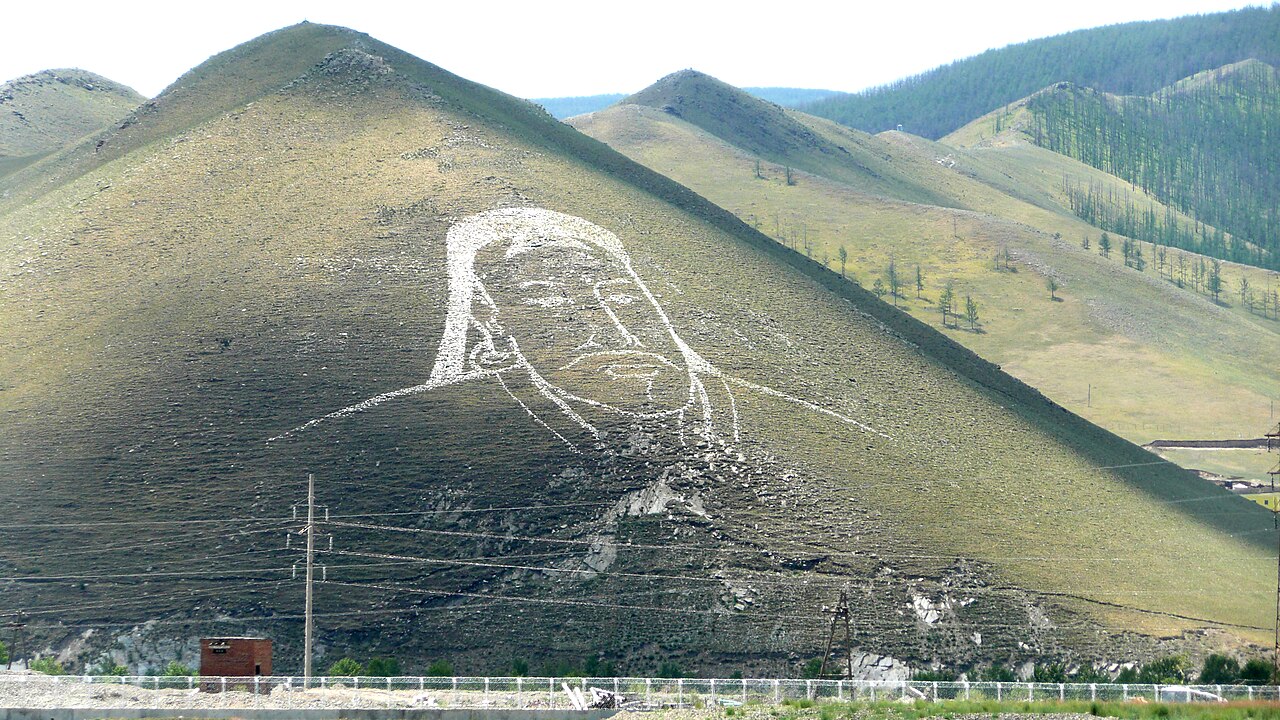
A large hillside with a giant white outline portrait of a man's face made of stones, shown in a wide view. Mountains, forest, a fence, power lines, and a small brick building are in the foreground.Photograph

Secondary source

Genghis Khan stone drawing near Ulaanbaatar

Brücke-Osteuropa · 25 June 2009 (photograph date)

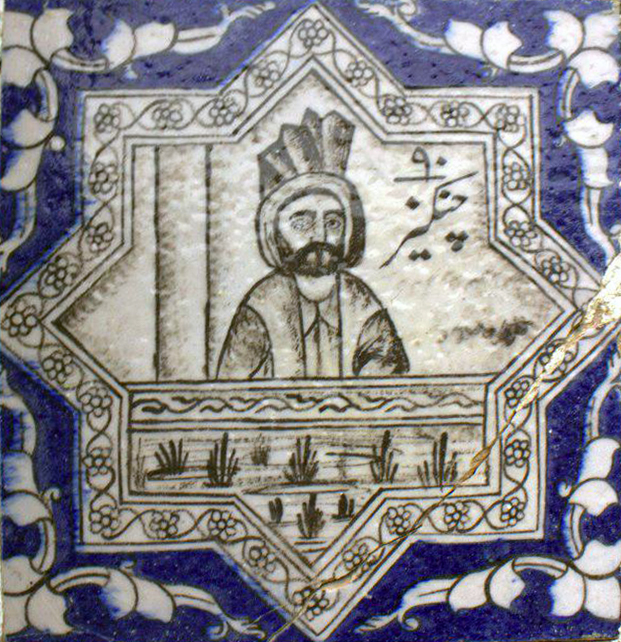
Glazed ceramic tile with a central star-shaped panel in grey-brown on white, showing a bearded man in a tall ornate headdress and robe, with Persian inscription beside him. Blue and white floral border surrounds it; a crack runs through the lower right.Photograph

Secondary source

Genghis Khan tile portrait, Moaven Almolk Tekiye

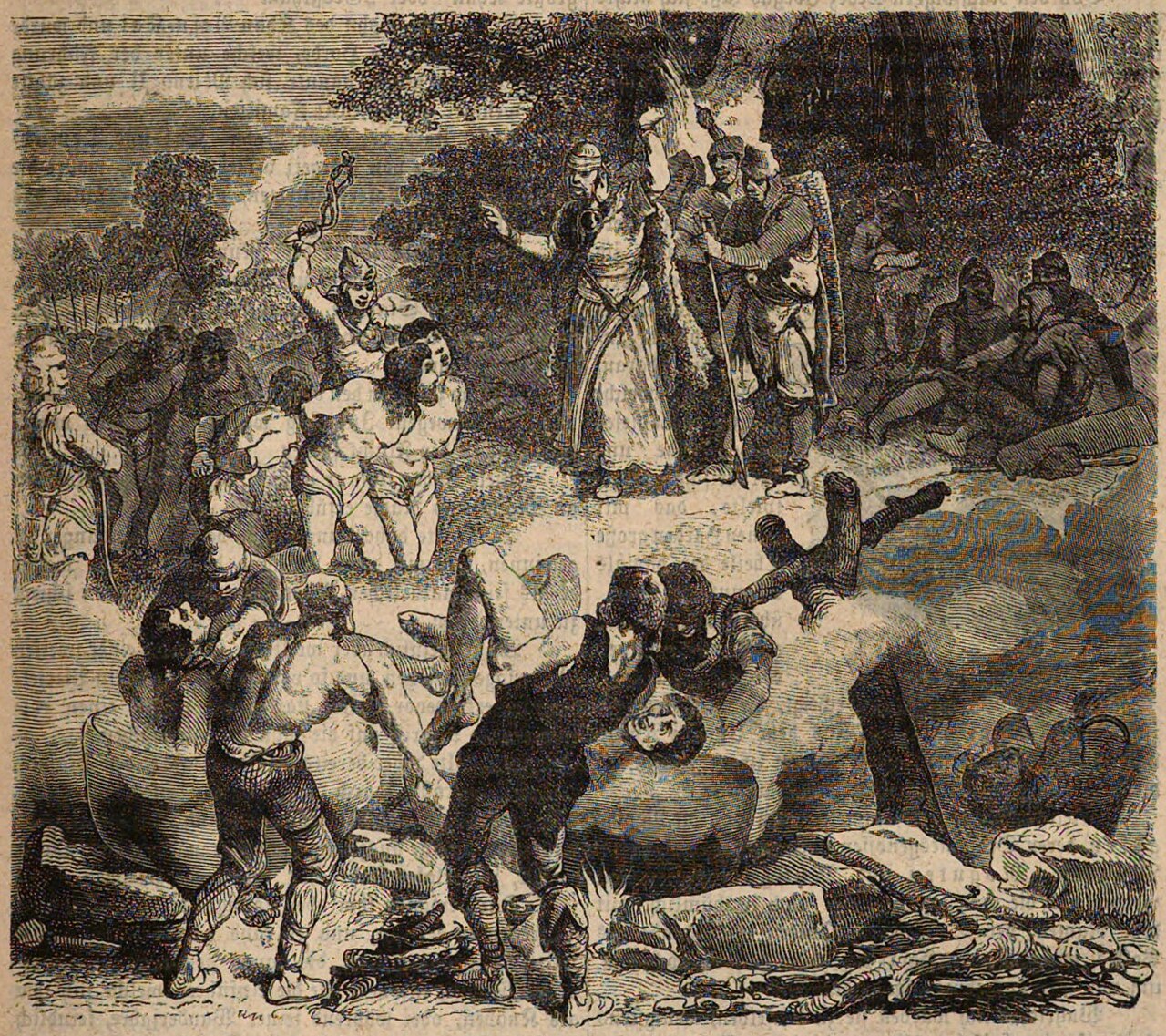
Engraved print of a historical scene: a robed figure with arms raised stands before a tree while armed soldiers look on. In the foreground, men are struggling and a person is dragged toward large cauldrons over a fire. Other figures and rocks fill the background.Painting

Secondary source

Genghis Khan lets the rebels boil

c. 1872

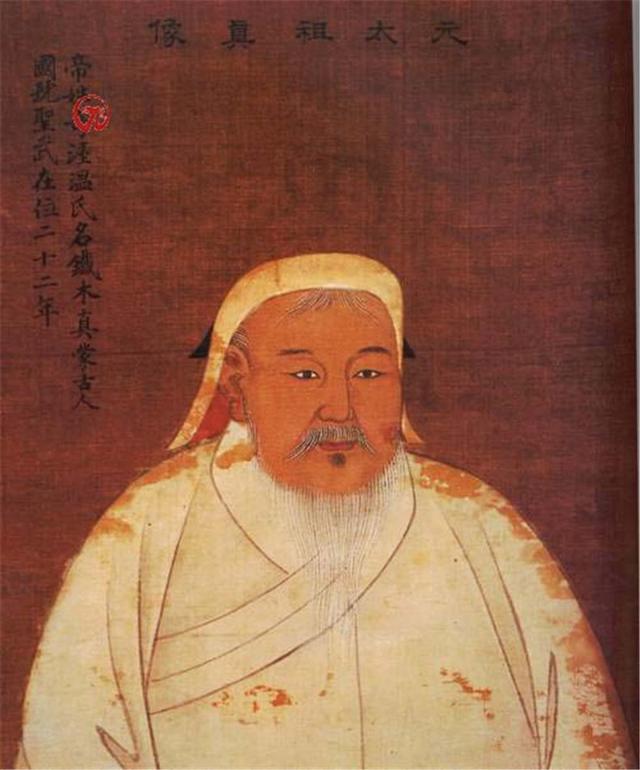
Painting of a bearded older man in a white robe and white headwear against a dark red background. Chinese characters appear at the top and along the left side, including the title 元太祖真像 and inscriptions naming the figure.Painting

Secondary source

Portrait of Genghis Khan (Yuan Taizu)

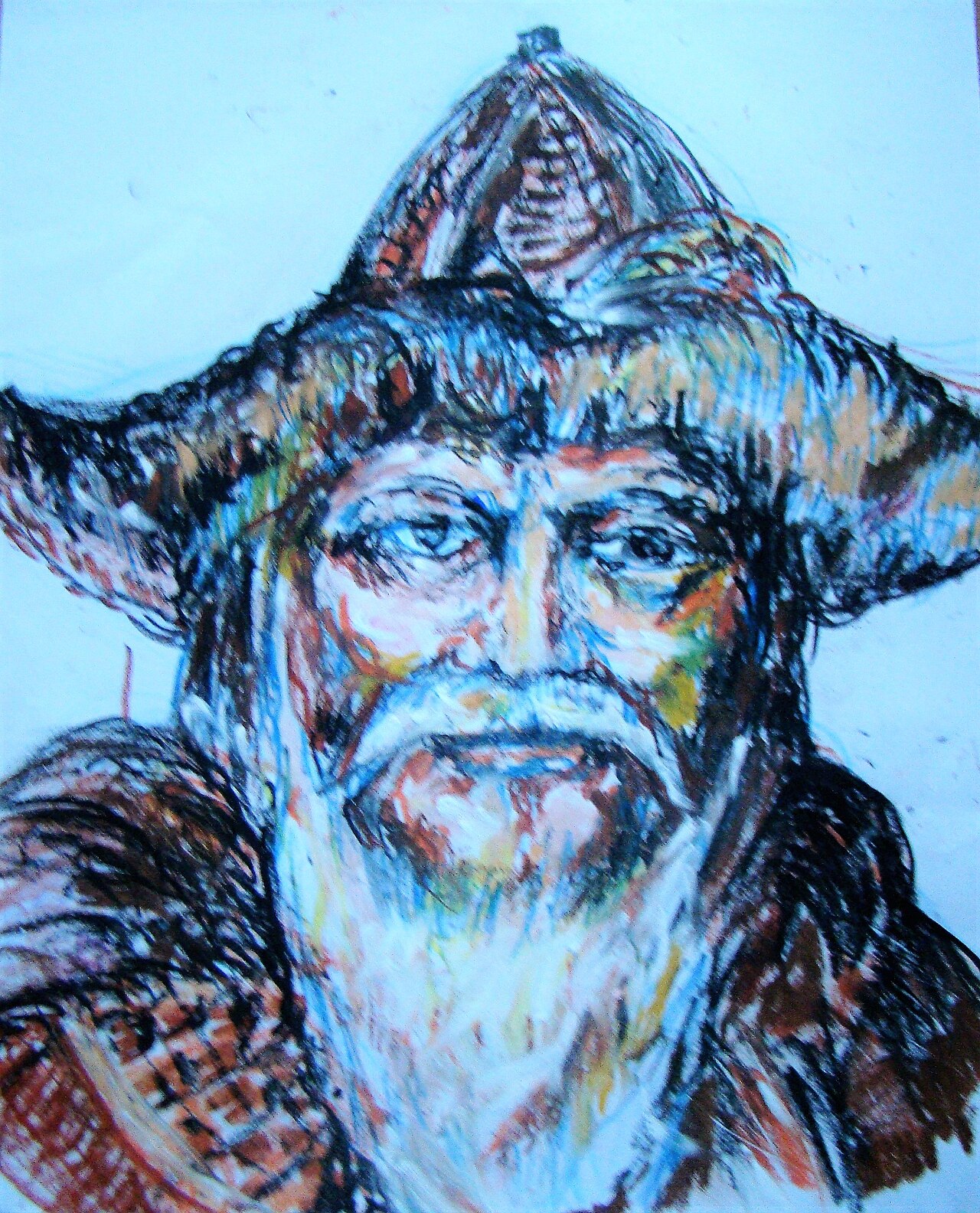
Expressive oil pastel portrait of a bearded, stern-faced man with deep-set eyes, wearing a wide-brimmed hat with a pointed crown and a dark coat. Bold strokes in blue, orange, yellow and brown on a pale blue background.Painting

Secondary source

Czyngis-chan (oil pastel portrait)

Edward Knapczyk · 2018

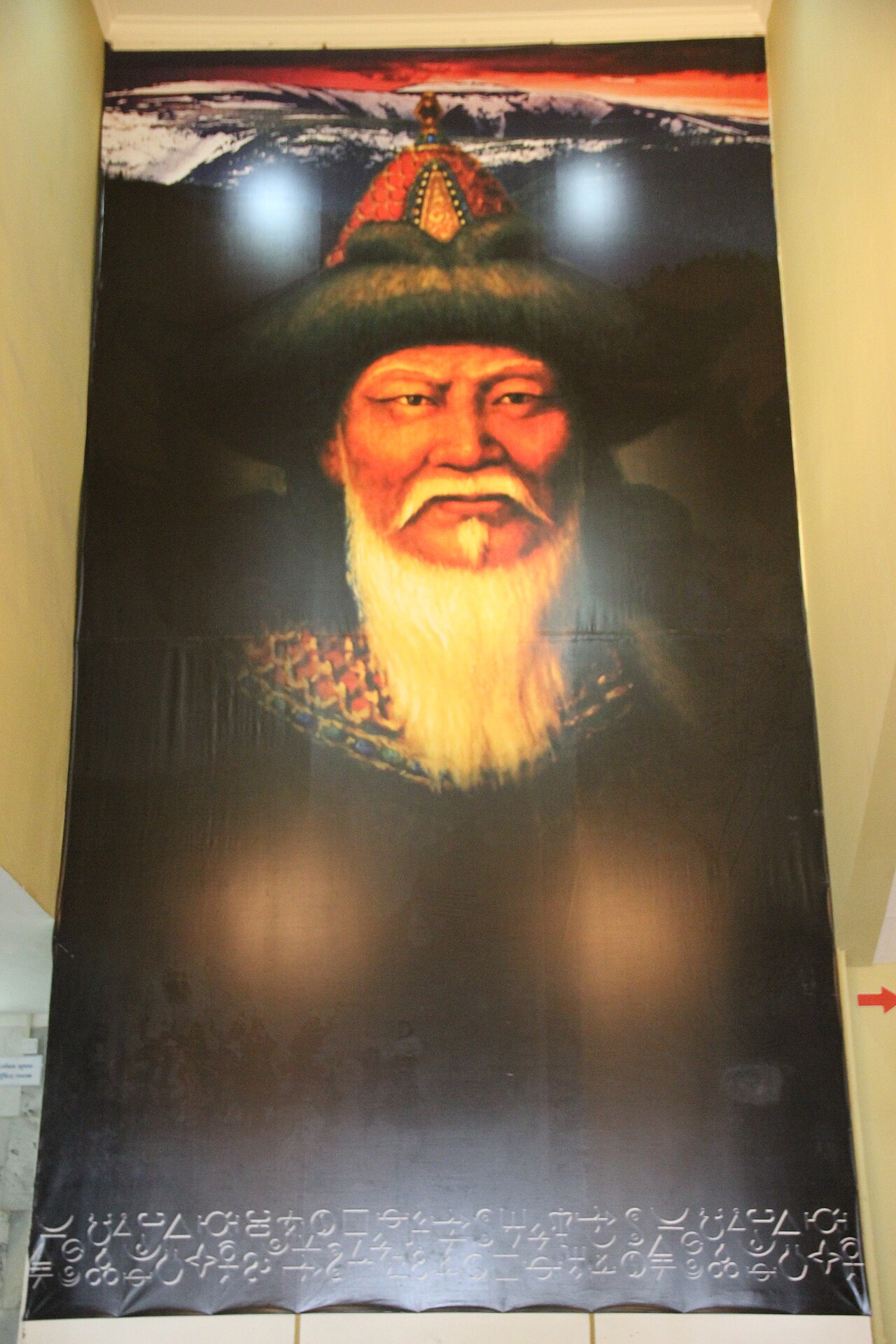
Large vertical painted portrait on a dark background of a bearded man in a fur-trimmed hat with a red jeweled finial, a long white beard, and an ornate patterned collar, set against snowy mountains, displayed on a wall in a stairway.Photograph

Secondary source

Portrait of Chenggis Khan, National Museum of Mongolia stairway

Gary Todd · 2017

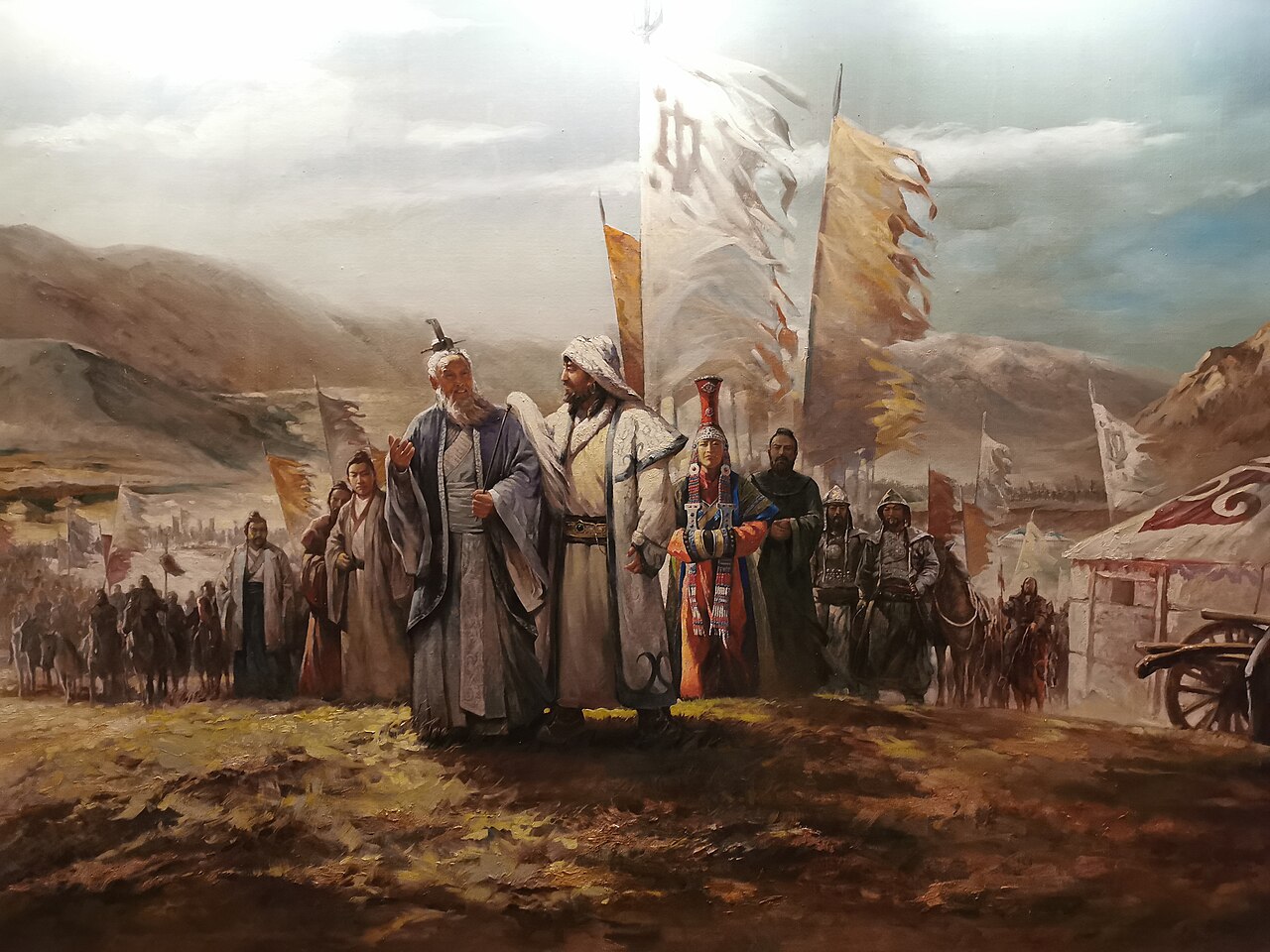
Oil painting of an elderly bearded Daoist monk in grey robes and a topknot gesturing beside a bearded man in a white turban and robe, with a Mongol ruler in red and blue regalia, retainers, banners, a yurt and hills behind them.Painting

Secondary source

Qiu Chuji meets Genghis Khan

Vitsuha · 2019

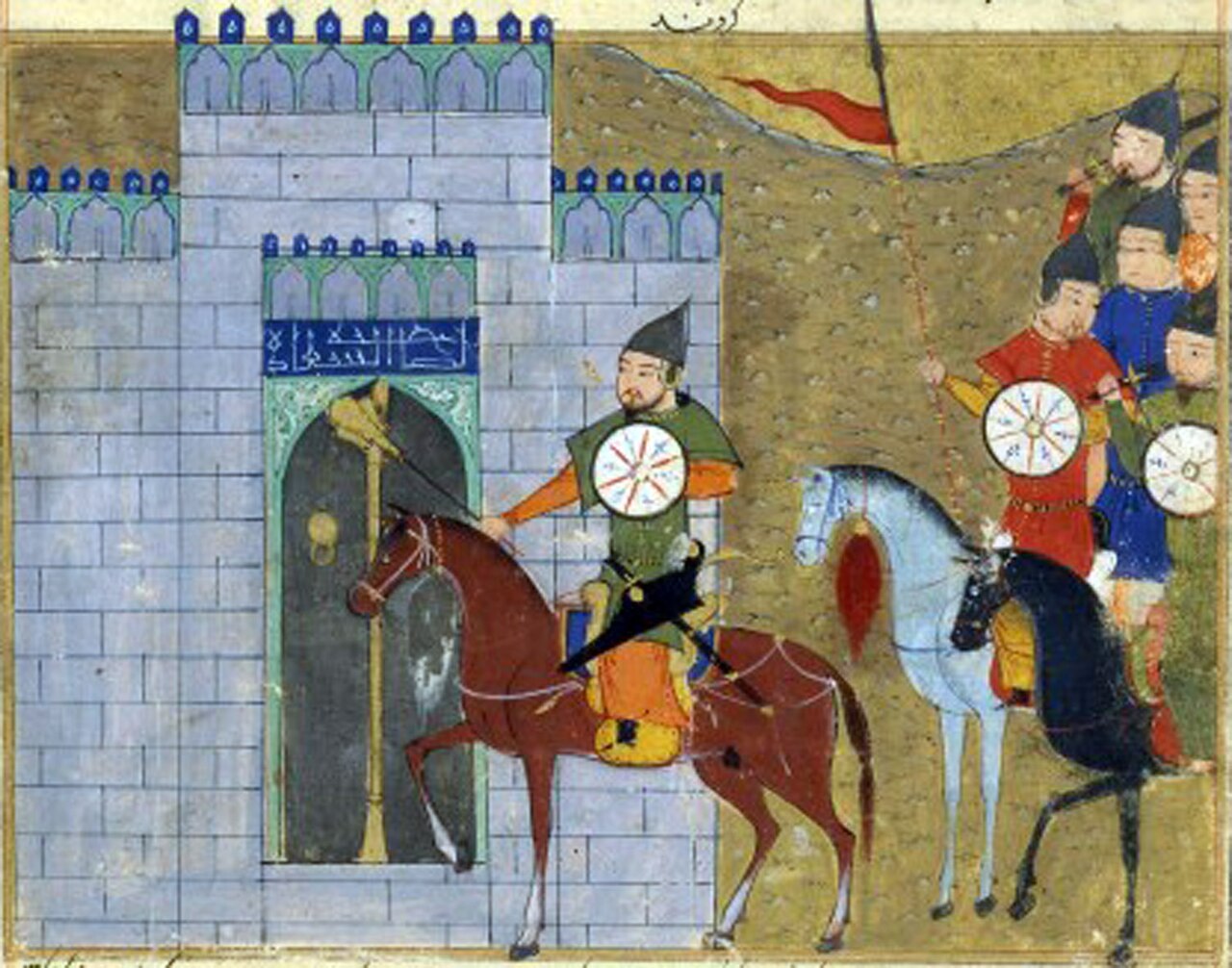
Painted miniature of a mounted warrior in green and orange armor and a pointed helmet, riding a reddish-brown horse before a gray walled city with blue-capped battlements and a gate. Behind him, a red-clad rider with a white round shield and a line of helmeted soldiers in blue and red stand on a golden hillside, under a red banner.Painting

Secondary source

Siege of Beijing 1213-1214 (Jami al-tawarikh miniature)

Sayf al-Vâhidî · 1430

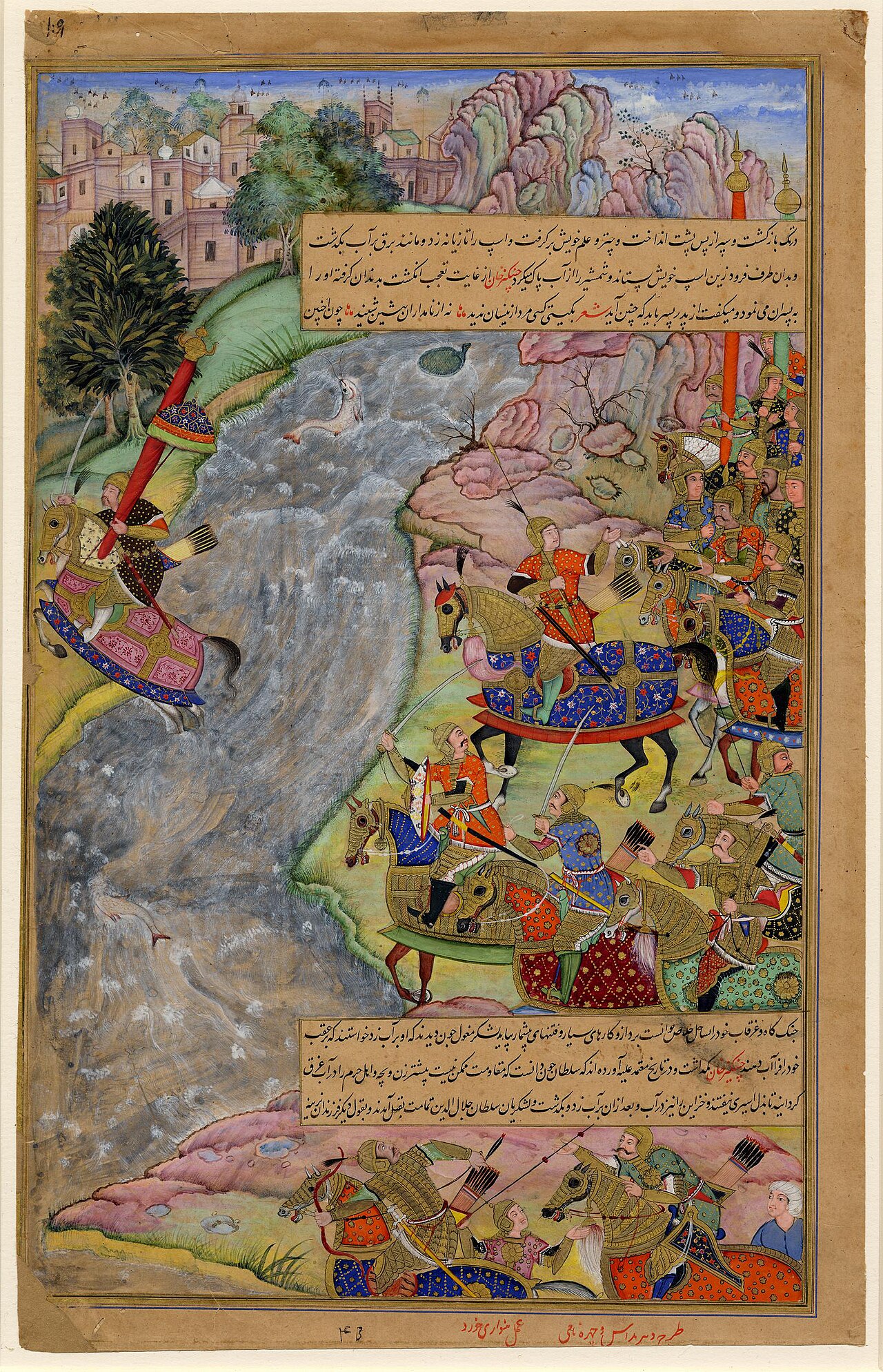
Miniature painting of a rider in a pink and blue robe on a grey horse at the left, holding a red-and-gold pole, leaving a rocky grey river; on the right, armoured mounted warriors with bows and spears fight on a grassy bank; a town with domed buildings sits at upper left; Persian text fills two panels and a small archer scene appears at the bottom.Painting

Secondary source

Jalal al-Din escapes across the Indus (Chinggiskhannama)

Banwarí Khúrd, Dharm Dás · between 1596 and 1600

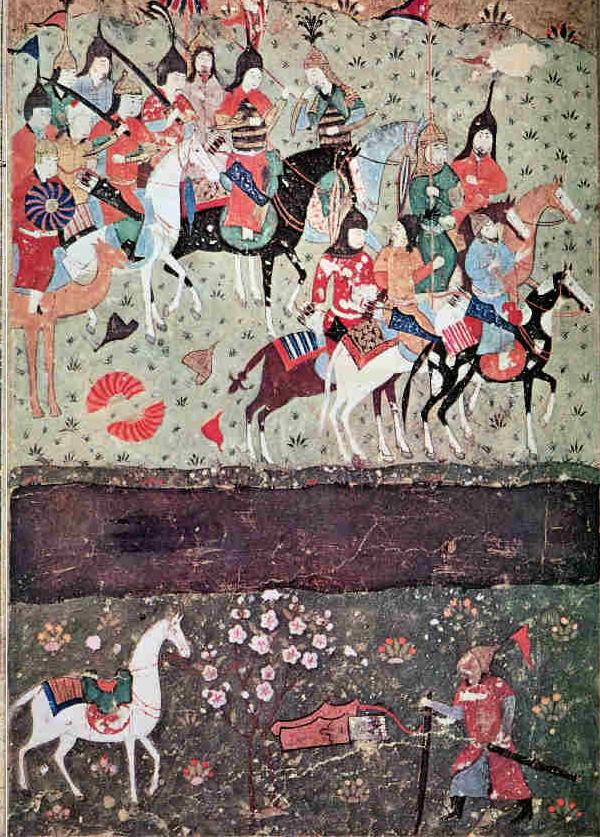
Persian-style miniature painting on a green patterned ground. Upper section shows mounted warriors in red, green and blue robes and tall hats, some with lances and banners, riding horses. A dark horizontal band separates the upper scene from a lower scene where a mounted rider on a white horse watches a figure in red who is near a pink flowering tree and a bundle of goods.Painting

Secondary source

Battle of the Indus, Chingis Khaan watching Jalal al-Din

Mas'ud b. Osmani Kuhistani · 1540s

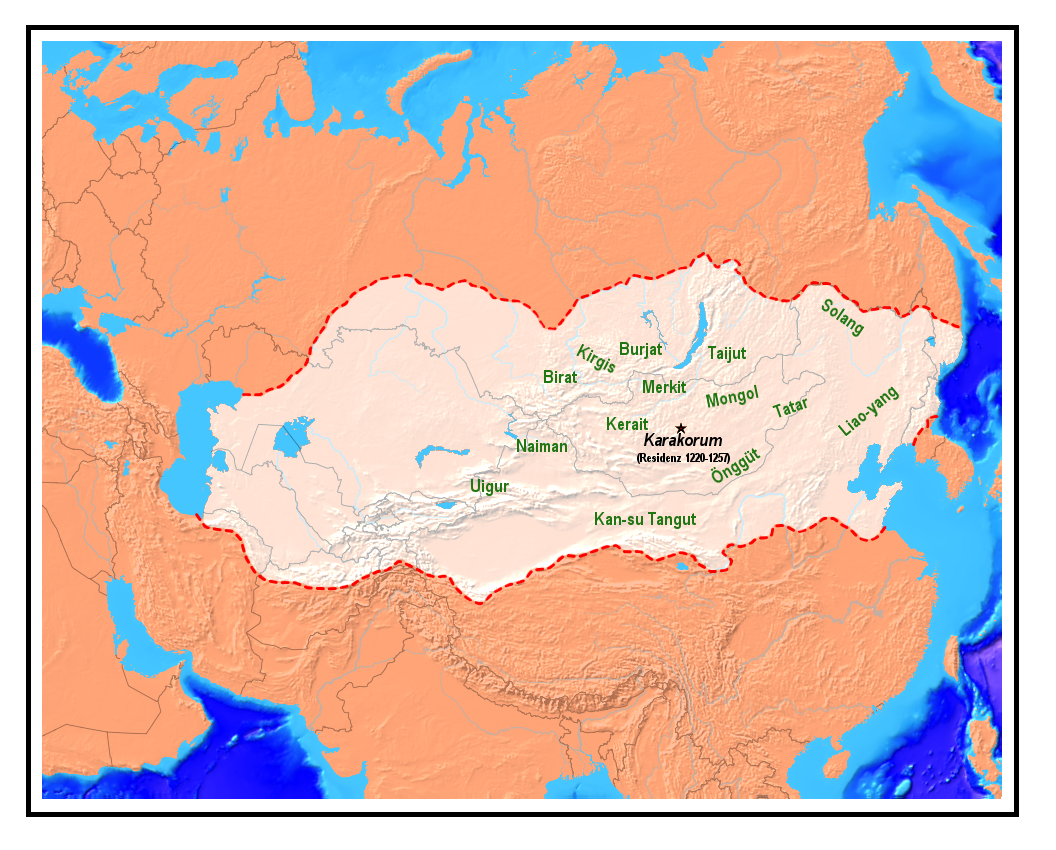
Map of Central Asia with a red dashed outline enclosing a pale area, labeled with green tribe names such as Kirgis, Burjat, Merkit, Taijut, Mongol, Tatar, Solang, Liao-yang, Kerait, Naiman, Uigur, Kan-su Tangut, and Önggüt. A star marks Karakorum, with the note Residenz 1220-1257. Seas and land are shaded orange and blue.Document

Secondary source

Empire of Genghis Khan at his death

Hardcore-Mike · 1 November 2012

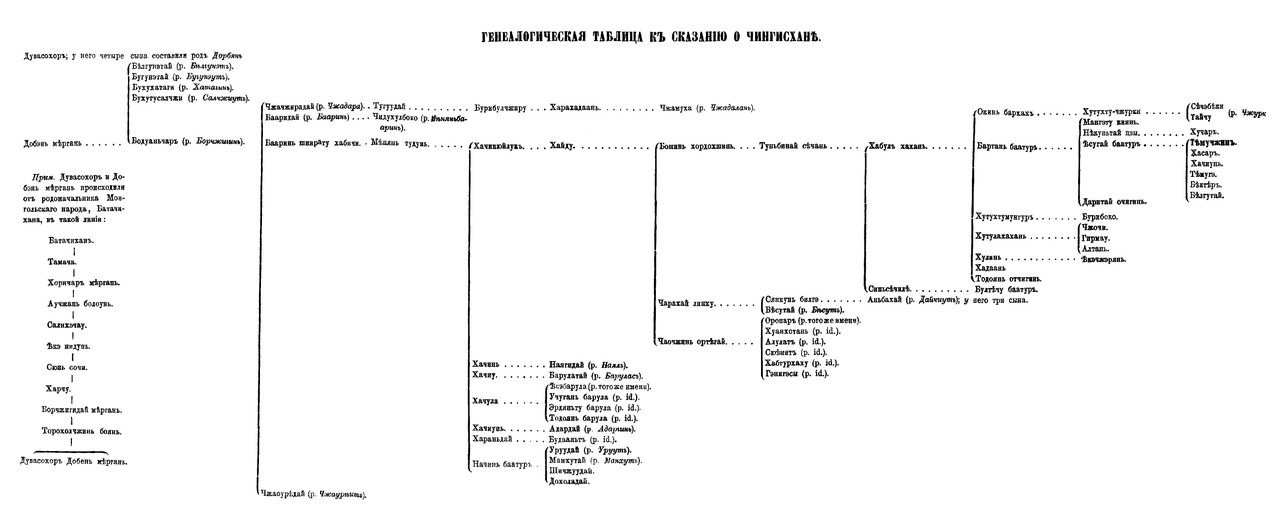
Printed genealogical chart in Russian titled 'Генеалогическая таблица к сказанию о Чингисхане'. Black-and-white branching lines link names in small Cyrillic and Mongolian-transliterated text, spreading from top-left to bottom, with footnotes.Document

Secondary source

Genealogy table of Genghis Khan's origins, Kafarov's edition of the Secret History

P. Kafarov · 1910

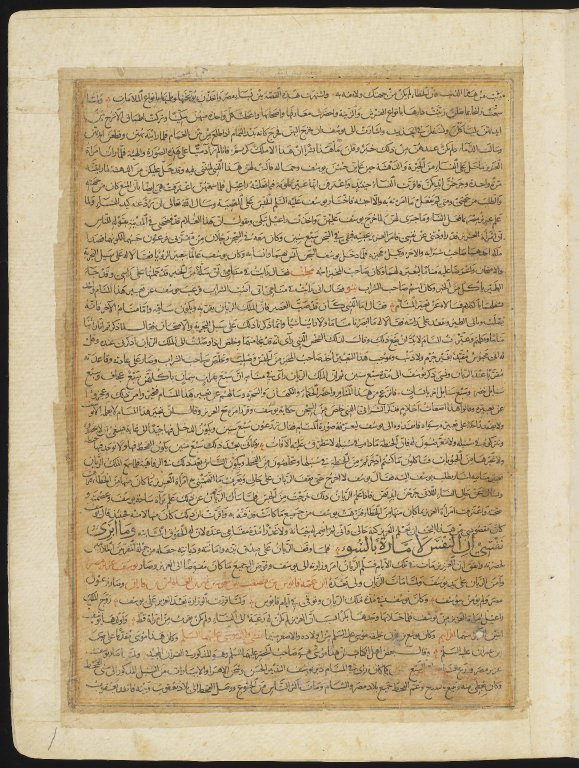
Scan of a manuscript page in Arabic script, written in black ink within a ruled text block with red-ink highlights, set on aged cream paper with a faded border.Book

Secondary source

Compendium of Chronicles page, Rashid al-Din, Edinburgh manuscript

Rashid al-Din

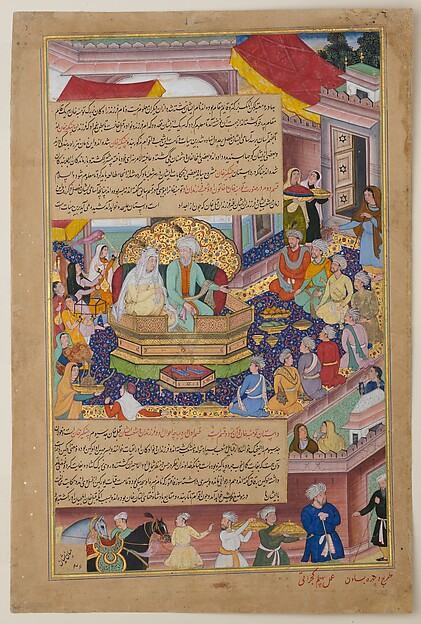
Mughal-style painted manuscript folio with Persian calligraphic text in blocks and gold-bordered margins. A central scene shows a seated couple on a raised golden throne platform surrounded by courtiers, attendants, and servants bearing dishes, with a richly patterned carpet and red and gold canopy above. Figures on horseback and servants appear in a lower registers, with a building and balcony at right.Book

Secondary source

Tumanba Khan, His Wife, and His Nine Sons, Chingiznama folio

Basawan · ca. 1596

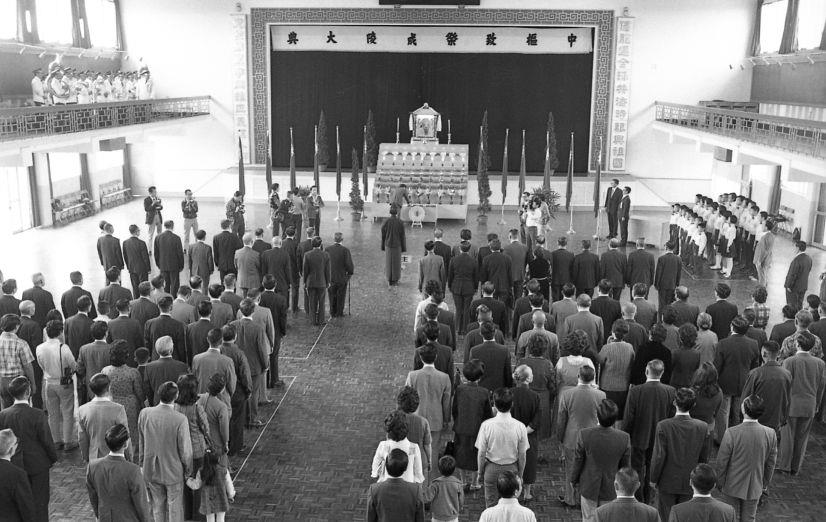
Black-and-white photo of a large indoor hall during a memorial ceremony. Standing rows of men in suits face a stage with a dark curtain and a Chinese-style banner above. Flags and a central altar with offerings are on the stage, and a uniformed group stands on a balcony at upper left.Photograph

Secondary source

Taipei memorial ceremony for Genghis Khan, 1976

台灣新生報 · 20 April 1976

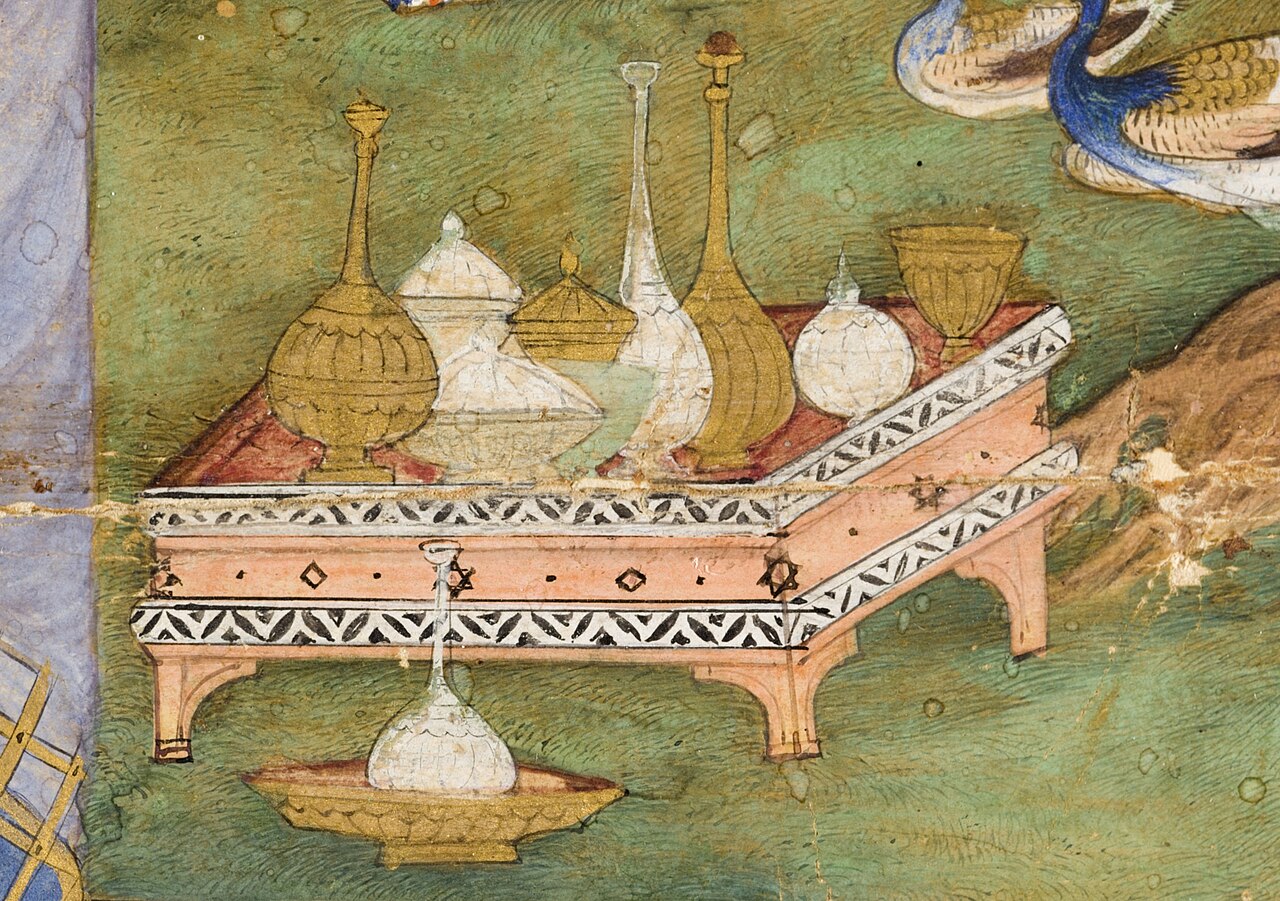
Detail of a painted table or platform with a white and black zigzag border, holding gold and white ewers, a covered bowl, and a goblet, with a bowl-shaped stand below. Green background with birds at upper right.Painting

Secondary source

Alanquva and Her Three Sons

1596

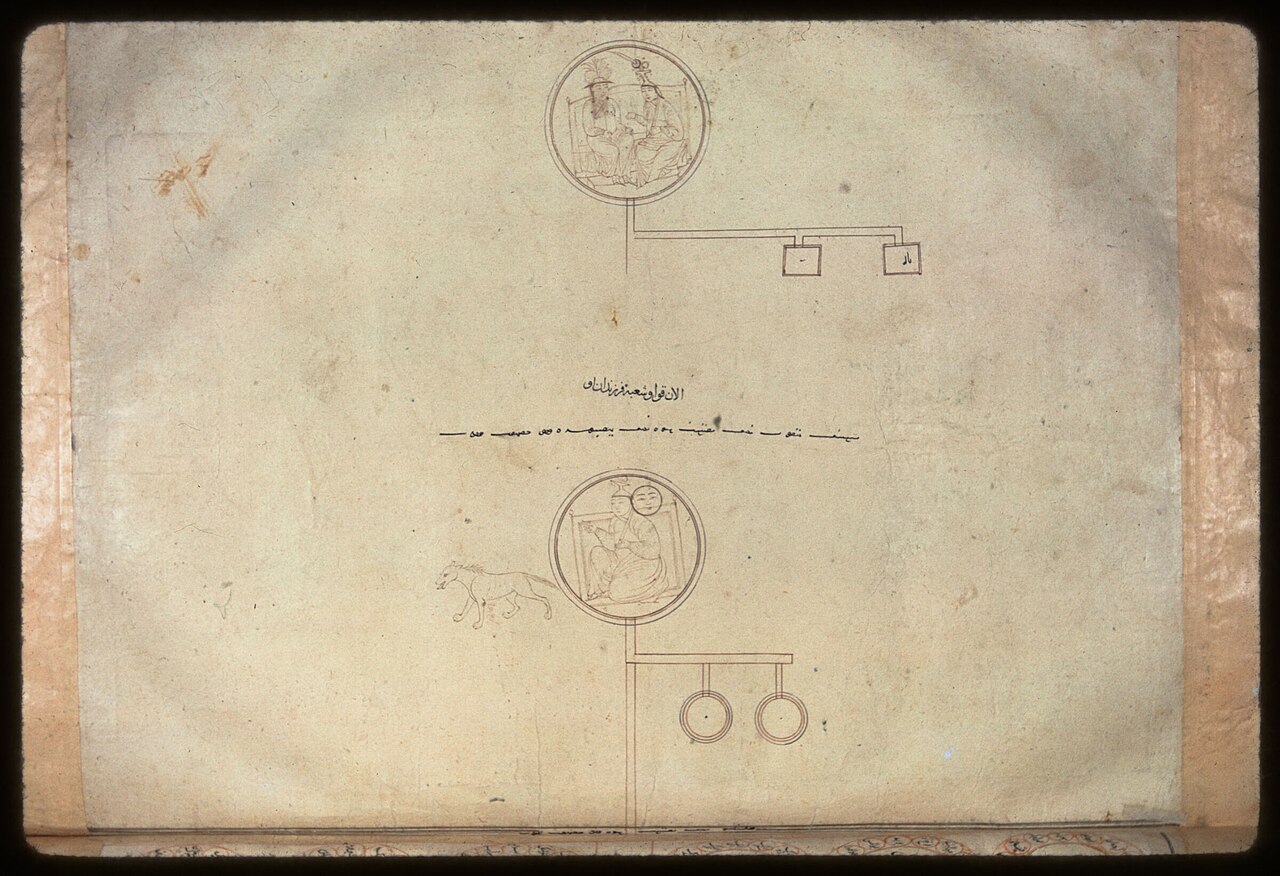
Photograph of a manuscript page with brown ink genealogical diagrams. At top, a circular medallion shows a seated figure with a companion; a line leads down to two small rectangular boxes with Arabic text. Centre has a line of Arabic script. Below, a second medallion shows a seated figure, with a dog beside it and a horizontal bar holding two rings. Page is cream-coloured with a pinkish border.Painting

Secondary source

Timurid genealogy folio 42a, Topkapi manuscript

between 1405 and 1409

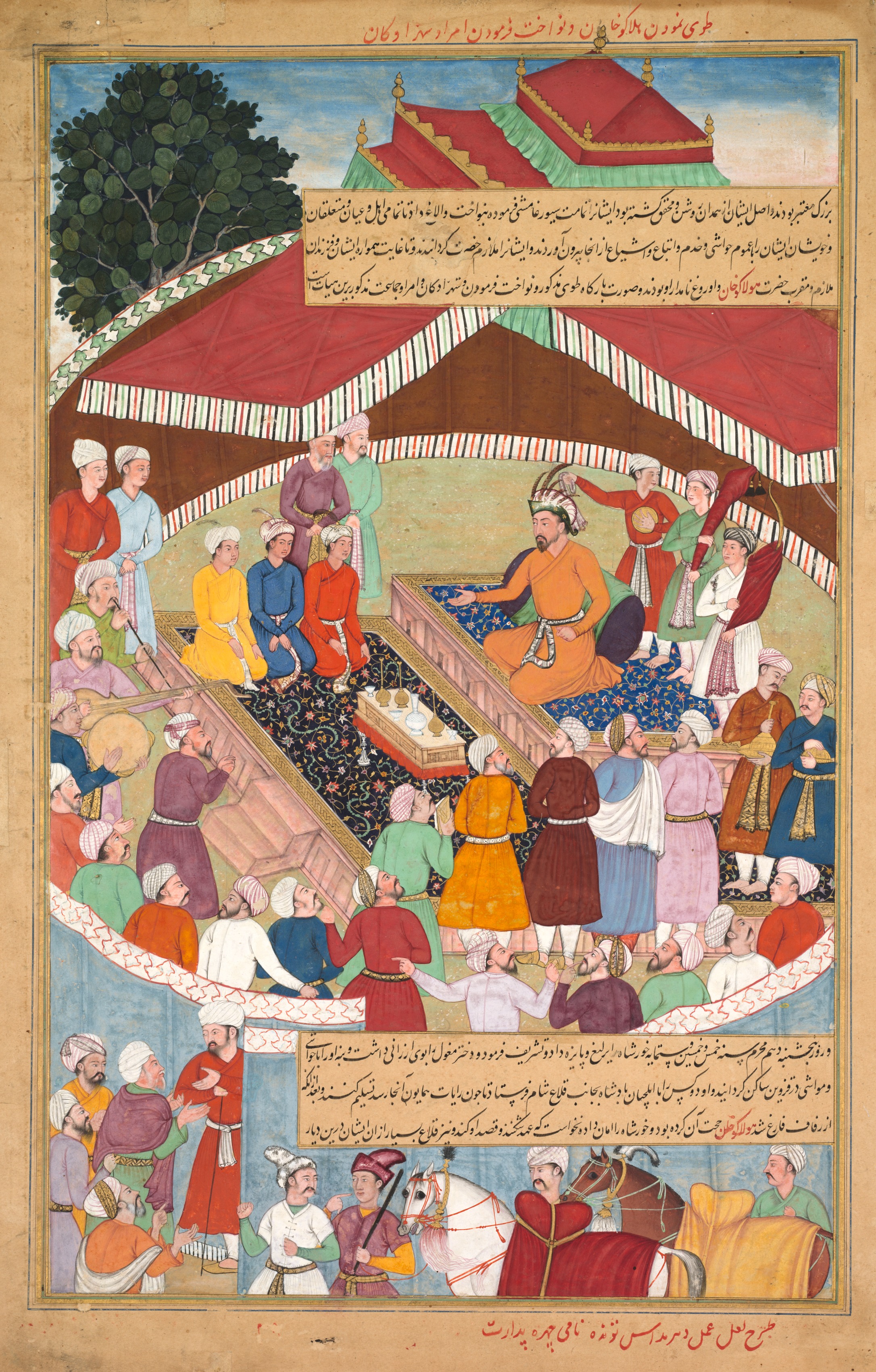
Miniature painting in red, orange, blue and green with gold accents. A seated man in orange robes and a feathered headdress receives guests under a red-and-brown striped tent. Attendants stand, musicians play, and Persian text fills two cartouches.Painting

Secondary source

Hulagu Khan feast, illustration from Jami al-tawarikh

Lal · c. 1596-1600

Documentary

Secondary source

Annual state memorial service for Genghis Khan, Taipei, 2013

Mongolian and Tibetan Affairs Commission, Government of Taiwan · 2013

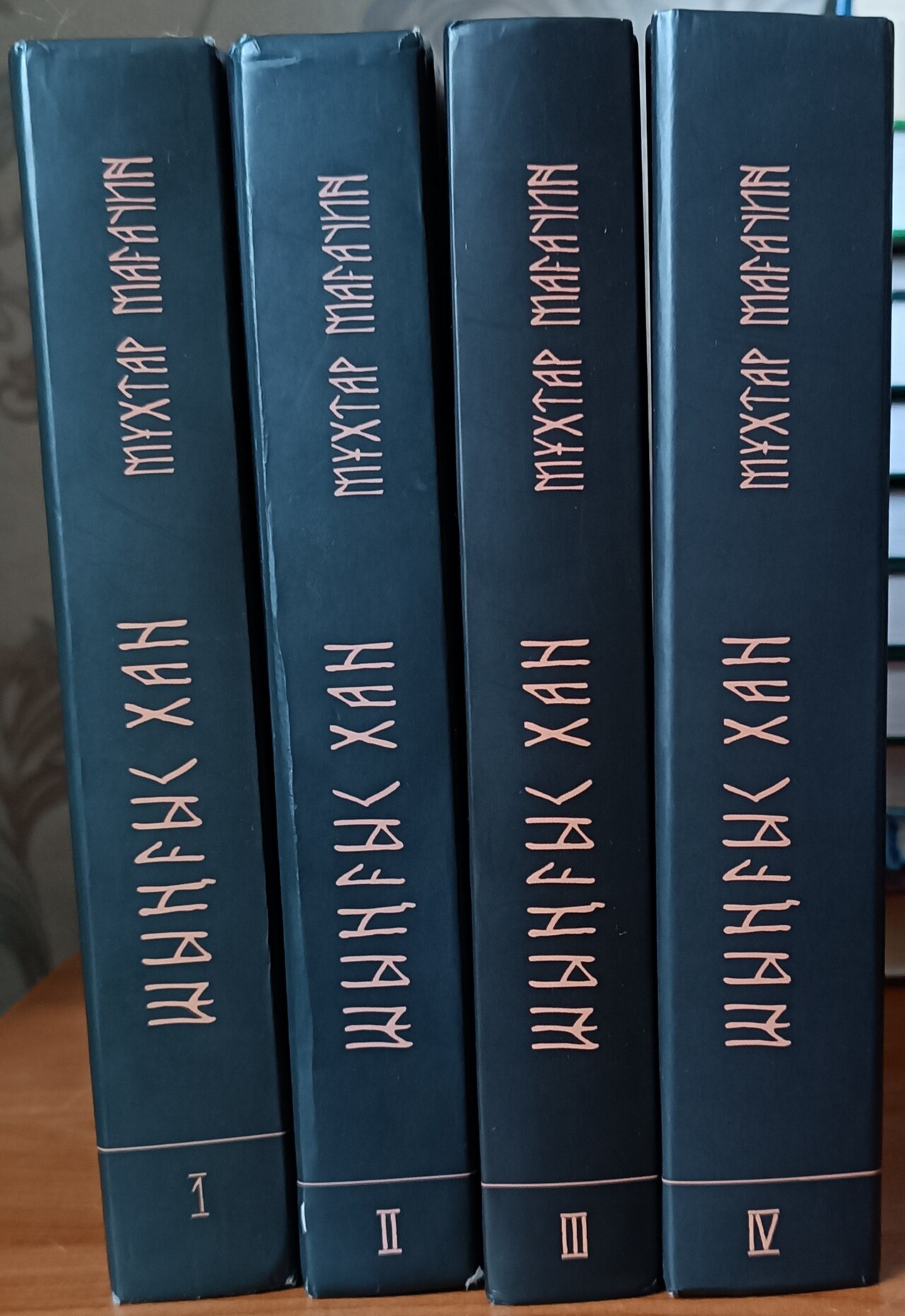
Four dark blue hardcover book spines standing side by side on a wooden surface, numbered 1, II, III, and IV in the bottom panels. Each spine carries the title Шыңғыс хан in pale gold Kazakh script and the author name Мұхтар Мағауин above it.Book

Secondary source

Shyngys Khan, illustrations from the Kazakh historical tetralogy

Мұхтар Мағауин · 2011-2016

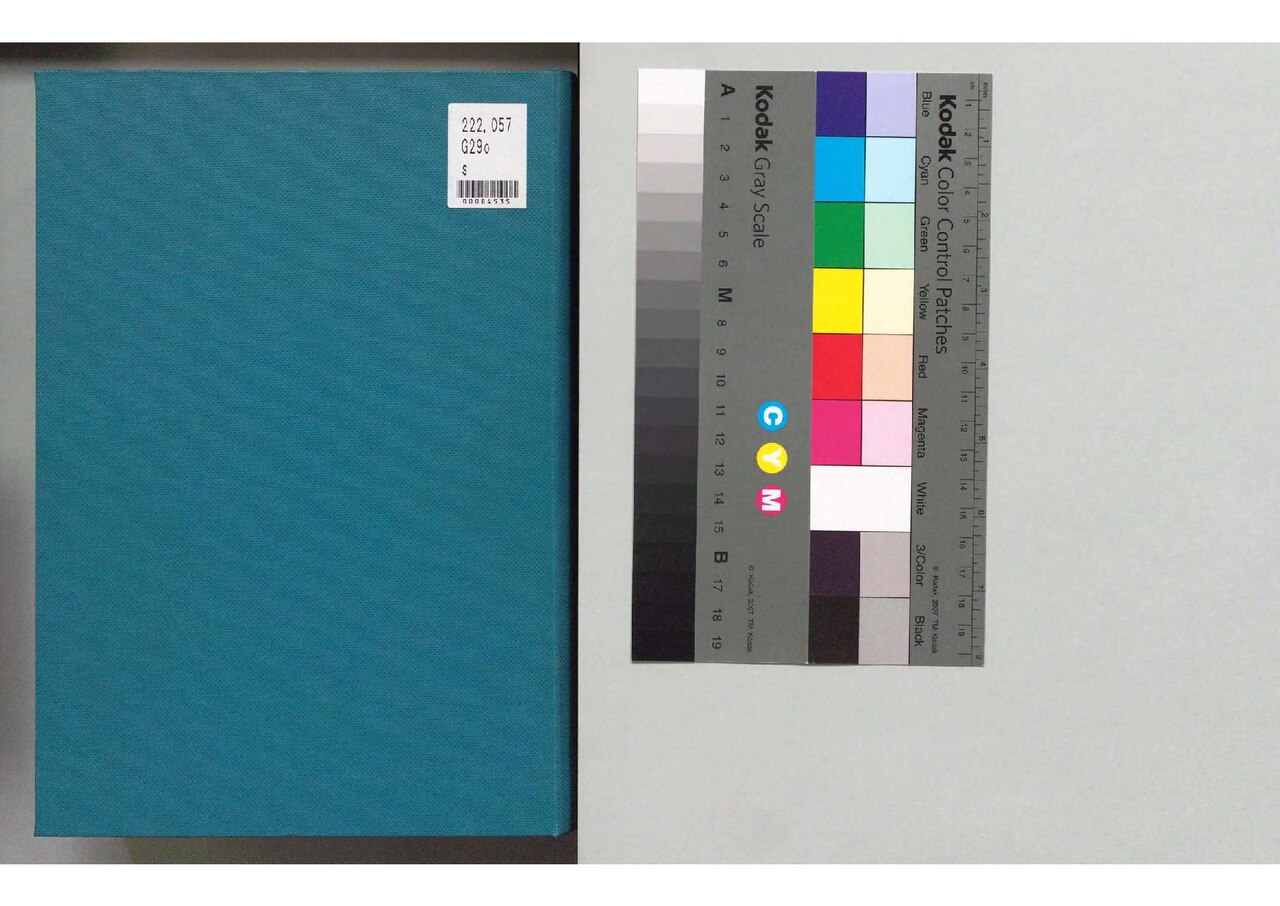
Photo of a teal cloth-bound book lying on a grey surface, with a white library call-number label reading 222.057 G29G on its upper front cover. A Kodak Gray Scale and Color Control Patches colour reference card sits beside it.Book

Secondary source

Romanised transliteration of the Secret History of the Mongols

Kurakichi Shiratori · 31 January 1943

Want the full shelf? Chat with Genghis Khan in the app and open the Sources panel — every quote links back to the original.

Use Genghis Khan in class

1 collection

A ready-made collection from the Humy team that features Genghis Khan. Preview it, then try it free.

Trusted by educators worldwide

Conversations
375,000+
Real exchanges between students and historical figures
Messages exchanged
4,142,000+
Across every figure, classroom and language
Historical figures
100,000+
Each informed by a curated biography and selected sources
Languages supported
50+
From English and Spanish to Arabic and Korean

Paying customers

Used by 98 schools and universities

Partner school logo
Tecnológico de Monterrey logo
Hyper Island logo
Partner school logo
Chambersburg Area School District logo
Broward County Public Schools logo
Nebo School District logo
National Louis University logo
South Florida PBS logo
Punahou School logo
University of Wisconsin–River Falls logo
Partner school logo
Partner school logo
Archbishop Mitty High School logo
Kingsburg High School logo
Norwalk Public Schools logo
Partner school logo
Connections logo
Partner school logo
Moore Public Schools logo
Partner school logo
Partner school logo
Partner school logo
Partner school logo
Robbinsville Public Schools logo
Partner school logo
Partner school logo
Partner school logo
Tecnológico de Monterrey logo
Hyper Island logo
Partner school logo
Chambersburg Area School District logo
Broward County Public Schools logo
Nebo School District logo
National Louis University logo
South Florida PBS logo
Punahou School logo
University of Wisconsin–River Falls logo
Partner school logo
Partner school logo
Archbishop Mitty High School logo
Kingsburg High School logo
Norwalk Public Schools logo
Partner school logo
Connections logo
Partner school logo
Moore Public Schools logo
Partner school logo
Partner school logo
Partner school logo
Partner school logo
Robbinsville Public Schools logo
Partner school logo
Partner school logo

What educators are saying

“We enjoyed the program last year and used it frequently.”
“My students say it’s a welcome change of pace. I’m not a fan of the “sage on the stage” model, so I try to incorporate research-oriented and self-paced activities. With Humy, students have to take charge of their learning. They’ve become more adept at critical thinking, forming better questions, and improving their reading comprehension. The interview feature has been my go-to tool. I create assignments where students must ask historical figures a set number of questions, then summarize the responses to ensure they’re truly absorbing the material. This approach lets them actively explore the past rather than passively consuming information.”
“Humy has helped me bring historical figures, sometimes long past, to life. When my students interact with these figures in real-time, it eliminates some of the perceived “ancient” characteristics of my curriculum. This has shifted my students’ thinking away from viewing history as abstract or irrelevant. Real-time interactions make historical figures relatable, even allowing students to ask off-topic questions that help put historical lives in a more relevant context for 13-year-olds. The feature I use the most is the interview feature. After teaching a topic, most recently Gandhi and Joan of Arc, I have the students ask pointed, focused questions. We practice good conversation techniques beforehand, teaching them to listen (or read) carefully and formulate thoughtful follow-up questions rather than just interrogating. It helps students practice effective conversation skills.”

FAQ

Frequently asked questions

Who is Genghis Khan?
Founder of the Mongol Empire and one of the most successful military leaders in history. On Humy.ai you can chat with an AI version of Genghis Khan that draws on a short biography and 84 historical sources during the conversation — by text or voice, in 42 languages.
Is Genghis Khan AI free?
Yes. Genghis Khan is in Humy's free library: a free account includes 20 messages a month with Genghis Khan and the other free figures, by text or voice. No credit card is needed.
What sources does the Genghis Khan AI use?
It draws on a short biography and 84 historical sources (paintings, books and artifacts), including “The Secret History of the Mongols”, “Portrait of Genghis Khan” and “Tarikh-i Jahangushay-i Juvaini”. Each source has its own page on Humy.ai.
How historically accurate is the AI version of Genghis Khan?
Each figure uses a short biography and a small set of selected historical sources as context (retrieval-augmented generation), so answers stay closer to known material than the model's general knowledge alone. It isn't a citation-grade research tool — like any LLM, the AI can get details wrong or extrapolate. Treat it as a strong starting point for inquiry and cross-reference important claims.
Can I talk to Genghis Khan by voice?
Yes. In addition to text chat, you can call Genghis Khan and hear their voice respond in real time — useful for auditory learners, interview practice and Socratic dialogue.
Is Humy.ai safe and compliant for schools?
Yes. Humy.ai is used by more than 100 schools, universities and organisations. The platform is FERPA- and GDPR-aligned, supports SSO, and offers an IT-approval pack tailored for school procurement teams.

Ready when you are

Start chatting with Genghis Khan now.

20 messages free · No credit card · Available in 50+ languages.