


Primary sourcePaintingc. 1600
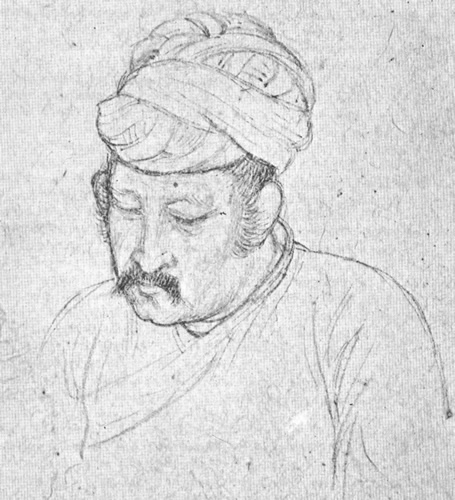
Study of Akbar's Head
Govardhan · c. 1600
A pencil sketch of the aged Akbar's head, attributed to the Mughal artist Govardhan, from an artist's sketchbook.
An intimate sketch of Akbar's face in old age, made from life or close observation by a court artist.
About this source
What it is
This is a pencil drawing on paper, a detail from a leaf of an artist's sketchbook, attributed to the Mughal painter Govardhan and dated to around 1600. It is held by the British Library. The drawing shows a man wearing a wrapped turban with his head bowed and eyes lowered, identified as a study of Akbar's head.
Why it matters
Unlike finished court portraits, this is a working sketch, likely made as practice or preparation by the artist Govardhan. It offers an unusually direct and informal image of Akbar in old age, without the symbols of power usually shown in official paintings, and reveals how Mughal artists studied their subjects.
Look closer
- Why might an artist make a simple pencil study like this rather than a full colour portrait?
- What mood does the bowed head and lowered eyes create, compared to formal portraits of rulers?
- What can a quick sketch tell us that a finished painting might not?
This painting is part of the curated material that grounds the AI version of Akbar the Great on Humy.ai — when students ask about related events, the AI can quote it and cite it.
More Akbar the Great sources
Meet the AI Akbar the Great →
Ready when you are
Start chatting with Akbar the Great now.
20 messages free · No credit card · Available in 50+ languages.