


Secondary sourcePhotographbefore 1927
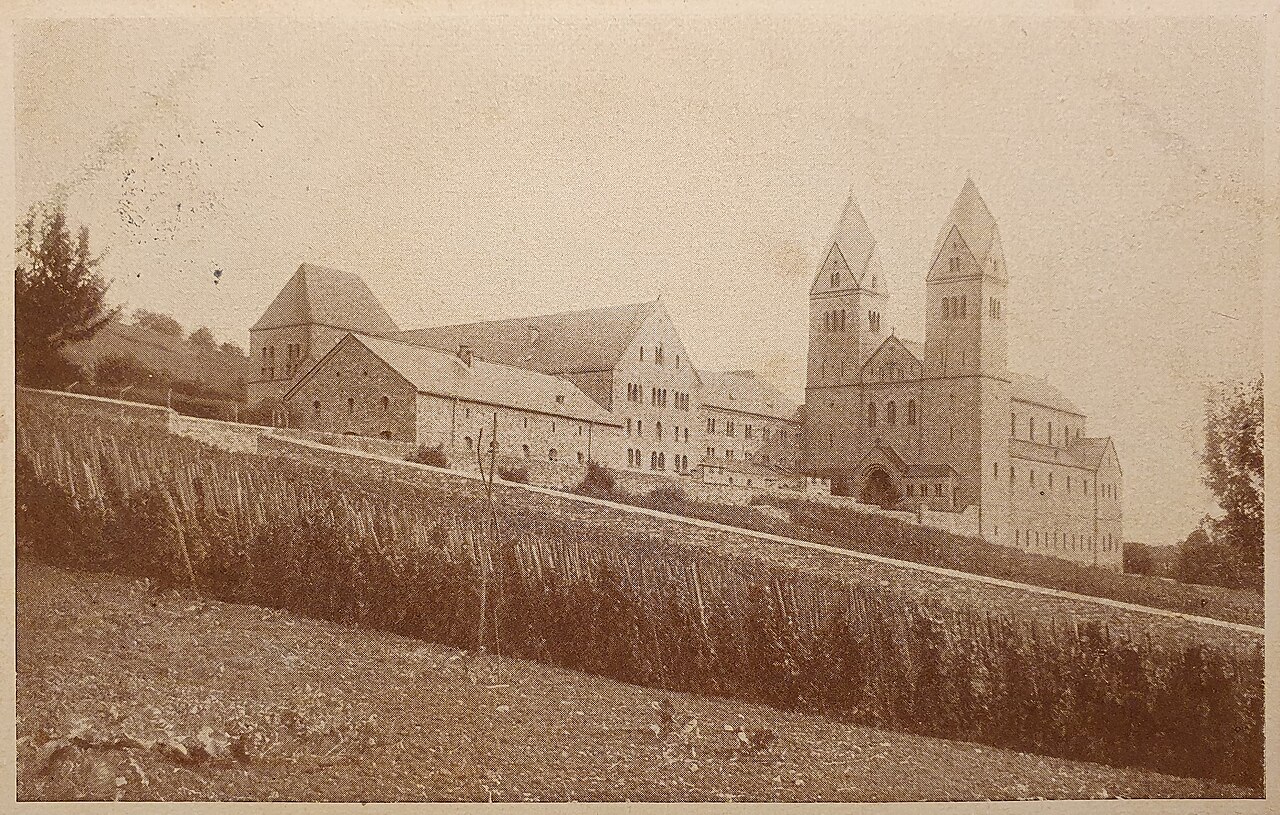
Abbey of St. Hildegard, Eibingen, Postcard
before 1927
A 1920s postcard showing the Benedictine abbey of St. Hildegard at Eibingen, founded in her memory.
This abbey bears Hildegard's name, showing how institutions continued her legacy long after her death.
About this source
What it is
This is a sepia-toned postcard photograph from the 1920s showing the Benedictine abbey of St. Hildegard in Eibingen. The postcard was mailed and stamped in September 1926. It shows a long stone monastery building with a gabled roof and a twin-towered church with pointed spires, set on a hillside behind a stone wall and terrace.
Why it matters
The abbey carries Hildegard's name and continues a monastic tradition connected to her life and legacy. This postcard, made centuries after she lived, shows how her memory was kept alive through institutions and how such places became part of everyday tourism and correspondence in the twentieth century.
Look closer
- Why might someone send a postcard of this abbey to a friend or family member?
- What does the architecture of the abbey suggest about its age and purpose?
- What can and can't a postcard tell us about the people who actually lived and prayed there?
This photograph is part of the curated material that grounds the AI version of Hildegard of Bingen on Humy.ai — when students ask about related events, the AI can quote it and cite it.
More Hildegard of Bingen sources
Meet the AI Hildegard of Bingen → Book
Primary source
Scivias
Hildegard of Bingen · 1151-1152
 Painting
Primary source
Scivias Frontispiece Miniature
12th century
 Book
Primary source
Wiesbaden Codex
Hildegard of Bingen · c. 1200
 Book
Primary source
Liber divinorum operum
Hildegard of Bingen · c. 1163-1174
 Document
Primary source
Dendermonde Codex
Hildegard of Bingen · c. 1175
Ready when you are
Start chatting with Hildegard of Bingen now.
20 messages free · No credit card · Available in 50+ languages.