


Primary sourceDocumentApril 18, 2007
Dissent in Gonzales v. Carhart
Ruth Bader Ginsburg · April 18, 2007
Ginsburg's 2007 dissent in an abortion-rights case, arguing reproductive rights rest on women's equality, not just privacy.
Ginsburg authored this dissent, articulating her equality-based approach to reproductive rights.
About this source
What it is
This is Justice Ruth Bader Ginsburg's dissenting opinion in Gonzales v. Carhart, decided by the Supreme Court on April 18, 2007, a case concerning a federal law restricting a specific abortion procedure. Ginsburg's dissent built on earlier rulings including Planned Parenthood v. Casey and Roe v. Wade.
Why it matters
Rather than framing abortion rights only around privacy, Ginsburg argued they are tied to women's equality and ability to control their own lives, a distinct legal approach she developed throughout her career. The dissent is studied as an example of how justices can reshape the reasoning behind a right even while on the losing side of a ruling.
Look closer
- How does grounding abortion rights in equality differ from grounding them in privacy?
- Why might the specific legal reasoning behind a right matter, even when the outcome is the same?
- What earlier cases does Ginsburg's dissent build on, and why?
This document is part of the curated material that grounds the AI version of Ruth Bader Ginsburg on Humy.ai — when students ask about related events, the AI can quote it and cite it.
More Ruth Bader Ginsburg sources
Meet the AI Ruth Bader Ginsburg →Primary source
Dissent in Ledbetter v. Goodyear Tire & Rubber Co.
Ruth Bader Ginsburg · May 29, 2007
 Photograph
Primary source
Ruth Bader Ginsburg Official SCOTUS Portrait
Steve Petteway
Primary source
Frontiero v. Richardson
1973
Primary source
Dissent in Bush v. Gore
Ruth Bader Ginsburg · December 12, 2000
 Document
Primary source
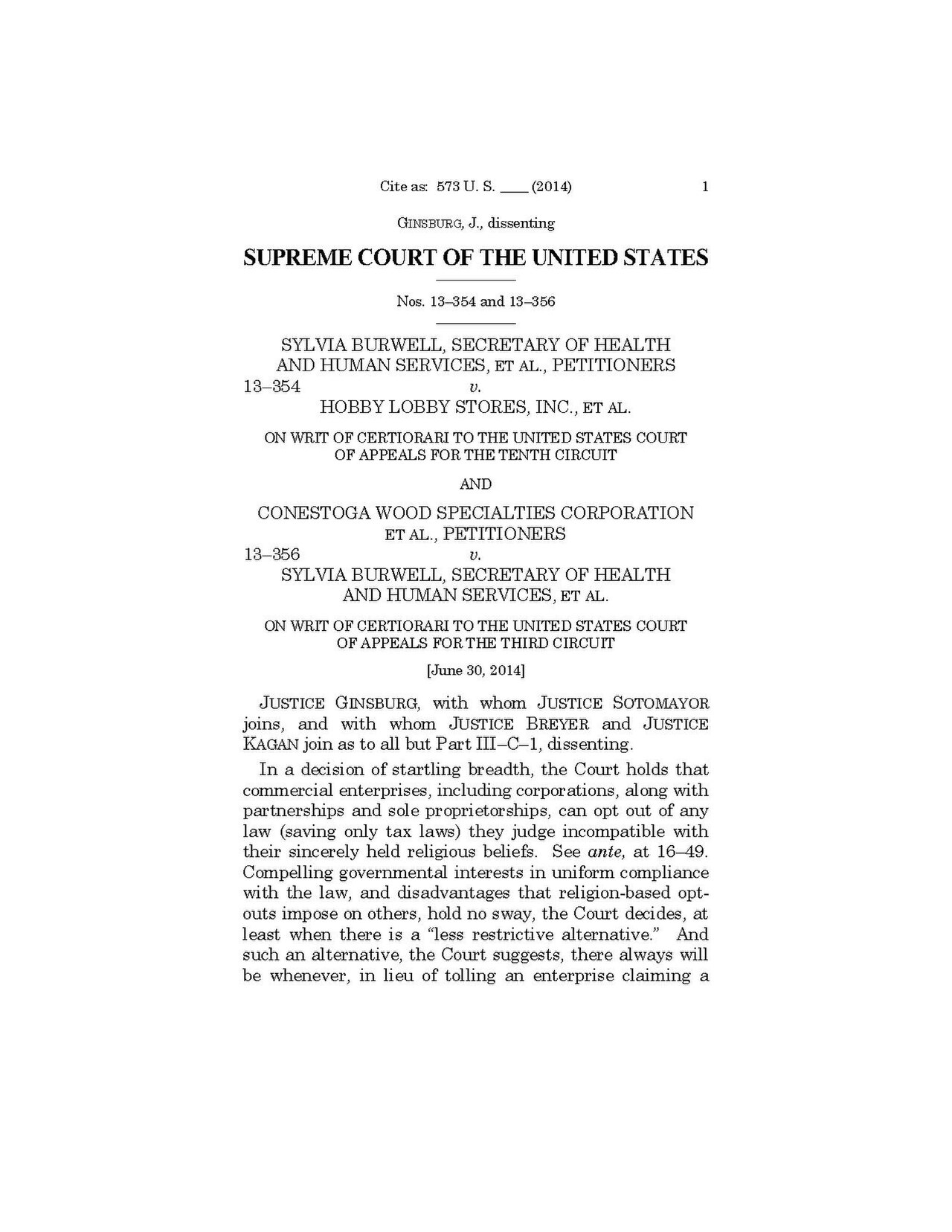
Dissent in Burwell v. Hobby Lobby Stores, Inc.
Ruth Bader Ginsburg · June 30, 2014
Ready when you are
Start chatting with Ruth Bader Ginsburg now.
20 messages free · No credit card · Available in 50+ languages.