


Primary sourcePainting1912
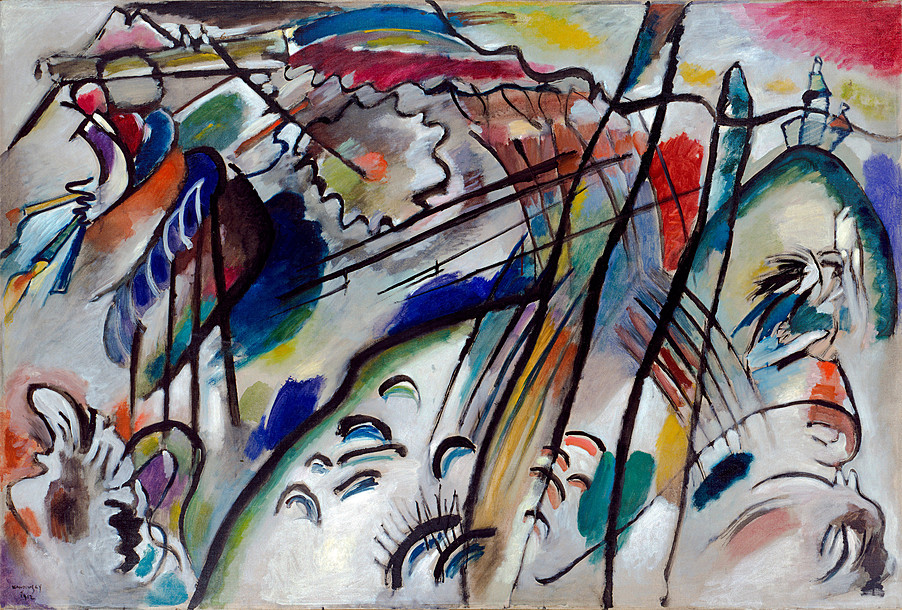
Improvisation 28 (second version)
Wassily Kandinsky · 1912
A 1912 painting by Kandinsky in which apocalyptic imagery dissolves into near-abstract colour and line, held by the Guggenheim Museum.
A key example of Kandinsky's own spontaneous 'improvisation' paintings, made at the height of his move into abstraction.
About this source
What it is
This is Improvisation 28 (second version), an oil painting made by Wassily Kandinsky in 1912. It is held today at the Solomon R. Guggenheim Museum.
Why it matters
Kandinsky called paintings like this 'improvisations' because he worked quickly and intuitively, letting apocalyptic and redemptive themes dissolve into colour and form rather than clear pictures. It shows how far he had moved toward abstraction just before the First World War, and how he used painting to express ideas rather than depict the world.
Look closer
- Can you find any shapes that remind you of real objects, or is everything abstract?
- Why might an artist choose fast, spontaneous brushwork instead of careful planning?
- What might the title 'Improvisation' tell us about how Kandinsky wanted viewers to react?
This painting is part of the curated material that grounds the AI version of Wassily Kandinsky on Humy.ai — when students ask about related events, the AI can quote it and cite it.
More Wassily Kandinsky sources
Browse all 93 →Primary source
Concerning the Spiritual in Art
Wassily Kandinsky · 1911 (dated 1912)
 Painting
Primary source
Composition VII
Wassily Kandinsky · 1913
 Painting
Primary source
The Blue Rider
Wassily Kandinsky · 1903
 Book
Primary source
Der Blaue Reiter Almanac
Franz Marc · 1912
Free account
Read every Wassily Kandinsky source
Sign up free →
Ready when you are
Start chatting with Wassily Kandinsky now.
20 messages free · No credit card · Available in 50+ languages.