


Primary sourcePainting1893
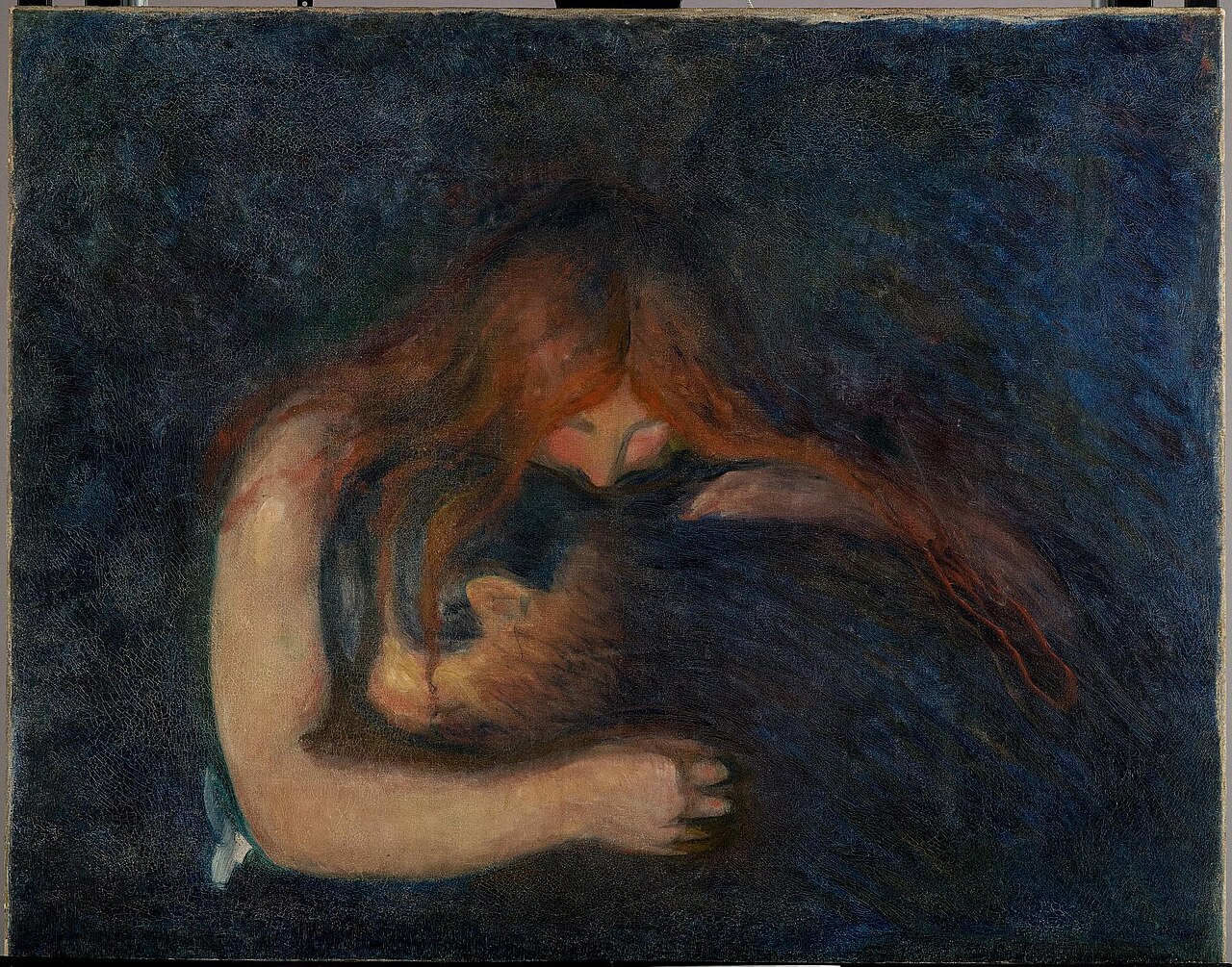
Love and Pain (Vampire)
Edvard Munch · 1893
A painting by Munch of an embracing couple, nicknamed 'Vampire' by a critic, exploring the pain and danger of love.
Painted by Munch, whose friend's nickname 'Vampire' shaped how this intimate scene was publicly understood.
About this source
What it is
Love and Pain, often called Vampire, is a painting by Edvard Munch made in several versions between 1893 and 1895. It shows a man and a woman embracing, with the woman's long red hair falling over the man's neck as she kisses him. Three versions are held by the Munch Museum in Oslo, one by the Gothenburg Museum of Art, and others are in private hands or unaccounted for.
Why it matters
The nickname came from Munch's friend, the critic Stanisław Przybyszewski, who described the scene as a vampire biting a submissive man, even though Munch himself insisted it showed only a woman kissing a man's neck. The gap between what Munch intended and how his circle in Berlin interpreted the image shows how his paintings of love and intimacy were read as dark and threatening by his contemporaries.
Look closer
- Why might the same image be read so differently by the artist and by his critics?
- What makes the embrace feel tender or threatening, depending on how you look at it?
- Why do titles given by other people sometimes change how we see an artwork?
This painting is part of the curated material that grounds the AI version of Edvard Munch on Humy.ai — when students ask about related events, the AI can quote it and cite it.
More Edvard Munch sources
Browse all 89 →
Ready when you are
Start chatting with Edvard Munch now.
20 messages free · No credit card · Available in 50+ languages.