


Primary sourcePainting1899–1900
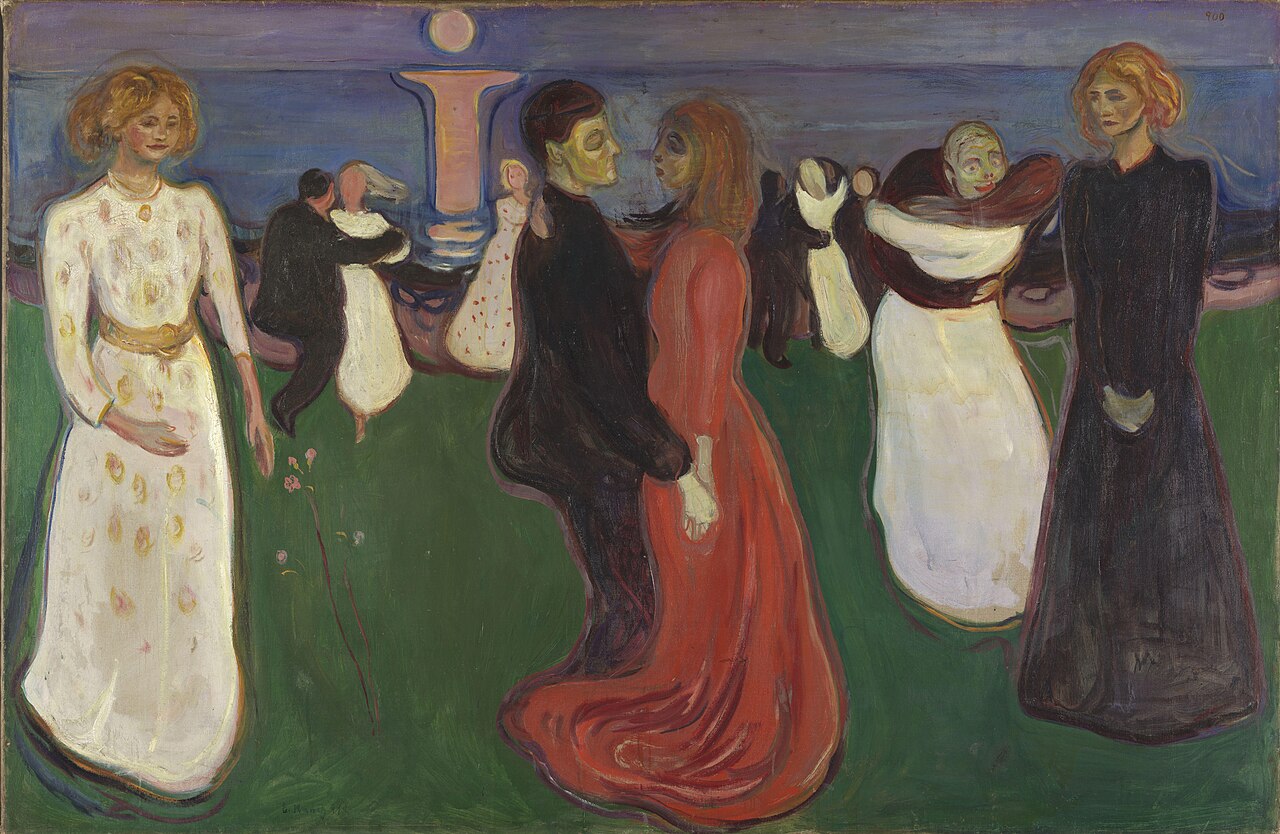
The Dance of Life
Edvard Munch · 1899–1900
A painting by Munch showing couples dancing by moonlit water, summing up stages of a woman's life and his own failed romances.
Painted by Munch as part of his Frieze of Life, reflecting his own history of love affairs.
About this source
What it is
The Dance of Life is a painting made by Edvard Munch around 1899–1900, now in the National Museum of Norway in Oslo. It was bought by Olaf Schou in 1910 and immediately given to the National Gallery. The painting shows several couples dancing on grass by the sea under a moon whose reflection falls across the water.
Why it matters
The painting was part of Munch's larger project The Frieze of Life, which explored love, sexual anxiety and death. It is thought to reflect Munch's own difficult love affairs. The three main women in the scene, dressed in white, red and black, are often read as representing youth, maturity and old age, making the painting both personal and symbolic of a woman's whole life.
Look closer
- What might the three women's different dress colours represent?
- Why do you think Munch placed the dancing couple at the centre, surrounded by solitary figures?
- How does the setting, by water under a moon, change the mood of the dance?
This painting is part of the curated material that grounds the AI version of Edvard Munch on Humy.ai — when students ask about related events, the AI can quote it and cite it.
More Edvard Munch sources
Browse all 89 →
Ready when you are
Start chatting with Edvard Munch now.
20 messages free · No credit card · Available in 50+ languages.