


Primary sourceDocument24 November 1832
Ordinance of Nullification
24 November 1832
South Carolina's 1832 declaration voiding federal tariffs, which provoked Jackson's proclamation threatening military enforcement.
This ordinance put Calhoun's nullification theory into practice, triggering the crisis most associated with his political career.
About this source
What it is
Passed by a South Carolina state convention on November 24, 1832, this ordinance declared the federal Tariffs of 1828 and 1832 null and void within the state, starting February 1, 1833.
Why it matters
The ordinance triggered the Nullification Crisis. In response, President Andrew Jackson issued his Nullification Proclamation and threatened to send troops to enforce the tariffs. South Carolina argued the tariffs favored the North and violated the Constitution, a dispute that sharpened the sectional divide between North and South ahead of the Civil War. Congress eventually lowered the tariff, and South Carolina repealed the ordinance.
Look closer
- What arguments does the ordinance use to justify South Carolina ignoring a federal law?
- Why might Jackson have seen this as a threat to the Union itself?
- How does this crisis connect to later conflicts between states and the federal government?
This document is part of the curated material that grounds the AI version of John C. Calhoun and Andrew Jackson on Humy.ai — when students ask about related events, the AI can quote it and cite it.
More John C. Calhoun sources
Meet the AI John C. Calhoun →Primary source
South Carolina Exposition and Protest
John C. Calhoun · 1828
Primary source
Slavery a Positive Good
John C. Calhoun · 6 February 1837
 Book
Primary source
A Disquisition on Government
John C. Calhoun · 1851
Primary source
Proclamation to the People of South Carolina
Andrew Jackson · 10 December 1832
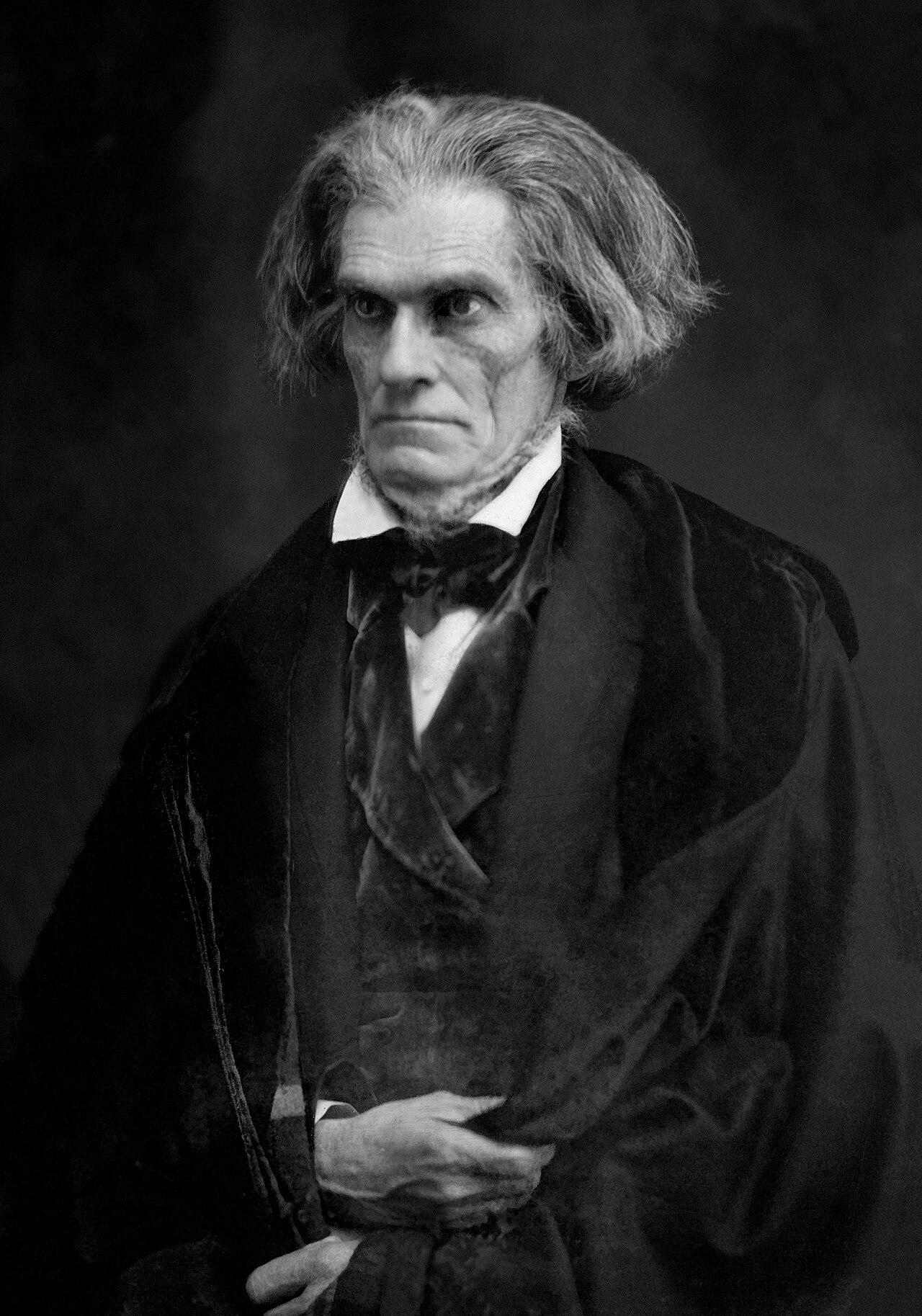 Photograph
Primary source
John C. Calhoun by Mathew Brady
Mathew Benjamin Brady · 1849
Ready when you are
Start chatting with John C. Calhoun now.
20 messages free · No credit card · Available in 50+ languages.