


Primary sourcePainting1923
Pain
Kahlil Gibran · 1923
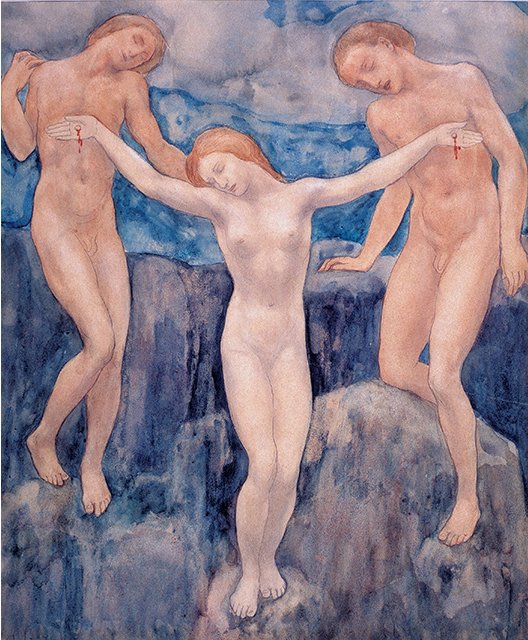
A watercolour illustration Gibran painted for his book The Prophet, showing three nude figures linked by shared suffering.
Gibran painted this watercolour himself as an illustration for his own book, The Prophet.
About this source
What it is
This is a watercolour painted by Kahlil Gibran in 1923 as one of his original illustrations for his book The Prophet. It is held at the Gibran Museum.
It shows three pale figures with red hair against a blue sky and rocky ground. The central figure stands with arms spread, supported by the two others, with small red marks on the hands and chest.
Why it matters
Gibran was both a writer and a painter, and he designed his most famous book as a union of text and image. This picture shows how he used symbolic, almost religious imagery to express ideas about pain found in his writing.
Look closer
- What mood does the colour of the sky and ground create?
- Why might Gibran have chosen three linked figures rather than one alone?
- What do the small red marks suggest, and why might he leave their meaning open?
This painting is part of the curated material that grounds the AI version of Kahlil Gibran on Humy.ai — when students ask about related events, the AI can quote it and cite it.
More Kahlil Gibran sources
Browse all 87 →
Ready when you are
Start chatting with Kahlil Gibran now.
20 messages free · No credit card · Available in 50+ languages.