


Secondary sourcePainting1753
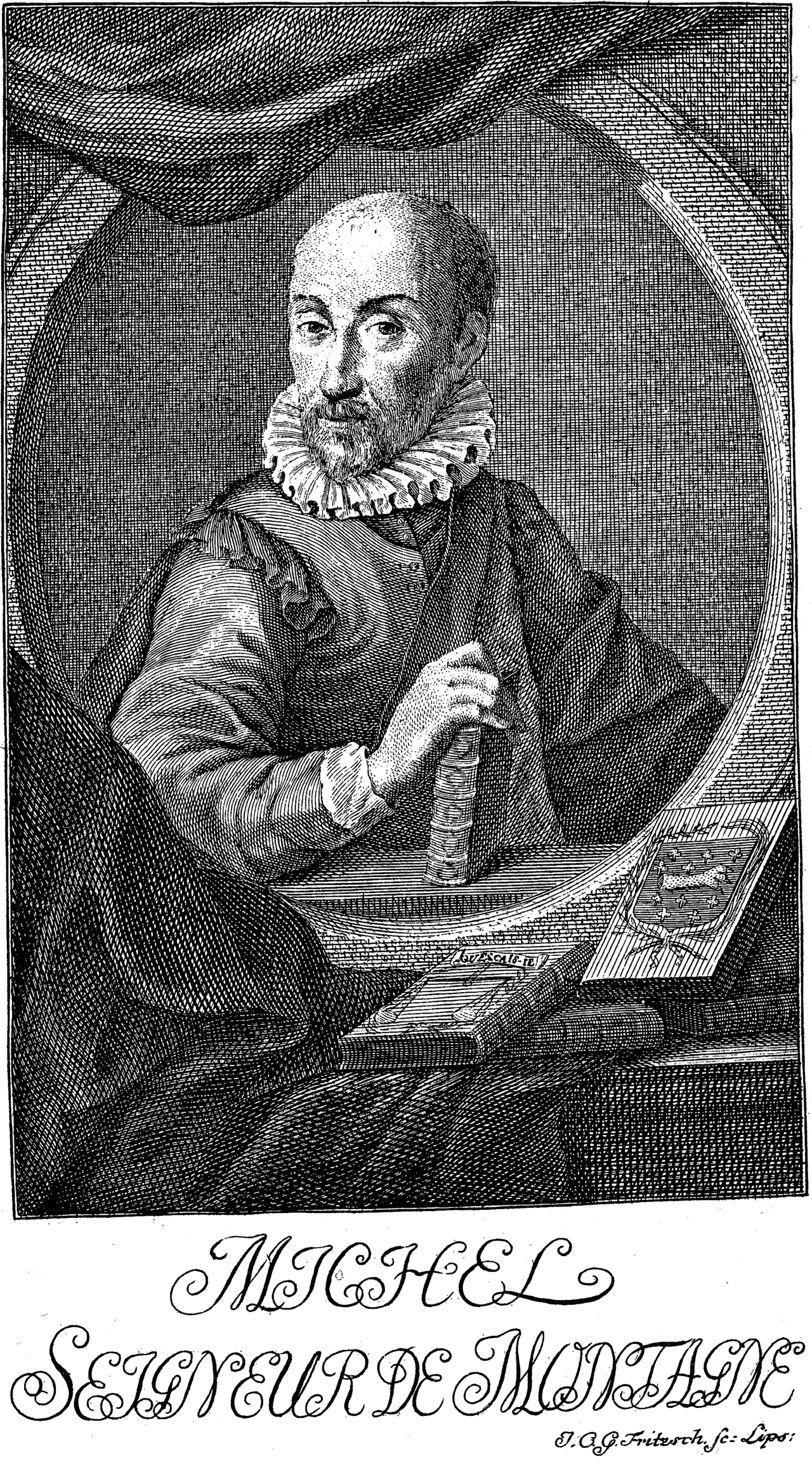
Portrait of Michel de Montaigne, engraving, Leipzig 1753
J. C. G. Fritzsch · 1753
A 1753 engraving of Montaigne used as the frontispiece of a German translation of his Essays. It was made long after his death.
Shows how Montaigne was presented to German readers as the frontispiece of a 1753 translation of his Essays.
About this source
What it is
This is a black and white engraving by J. C. G. Fritzsch. It shows a bald, bearded man in a high lace ruff and dark robe, seated at a table and holding a small rolled object. An oval frame surrounds him, and books and a crest appear on a tilted panel at the right. A caption below reads Michel Seigneur de Montaigne. The engraving was printed in Leipzig in 1753 as the frontispiece of Johann Daniel Tietz's German translation of the Essays.
Why it matters
The engraving is a secondary source. It was made more than 150 years after Montaigne died in 1592. Its purpose was to introduce readers of the German translation to the author, so it shows how his reputation had spread beyond France. The books and crest in the frame point to learning and status, the qualities an 18th-century publisher wanted readers to associate with the essayist.
Look closer
- What objects around Montaigne, such as the books and the crest, suggest about how he was meant to be understood?
- Why might a German publisher include a portrait of a French author in a translation?
- What does the engraver's version of Montaigne leave out about the man as he really was?
This painting is part of the curated material that grounds the AI version of Michel de Montaigne on Humy.ai — when students ask about related events, the AI can quote it and cite it.
More Michel de Montaigne sources
Browse all 90 → Book
Primary source
Essays
Michel de Montaigne · 1580–1595
 Book
Primary source
Bordeaux copy of the Essays
Michel de Montaigne · 1588–1592
Primary source
Apology for Raymond Sebond
Michel de Montaigne · c. 1580
 Painting
Primary source
Portrait of Michel de Montaigne
Unknown painter · c. 1578
Free account
Read every Michel de Montaigne source
Sign up free →
Ready when you are
Start chatting with Michel de Montaigne now.
20 messages free · No credit card · Available in 50+ languages.