


Primary sourcePainting
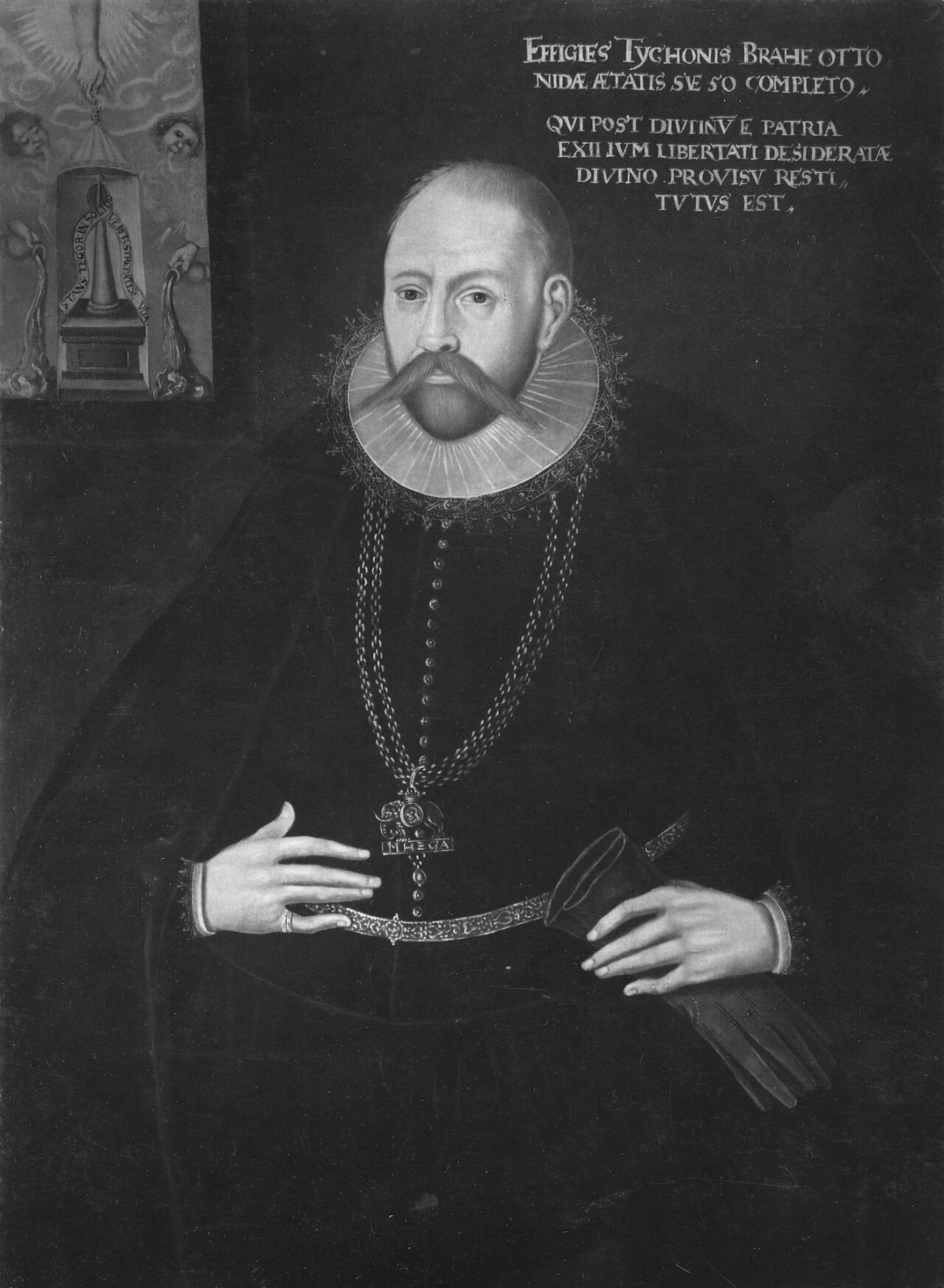
Portrait of Tyko Brahe
A portrait of Tycho Brahe in the Swedish Nationalmuseum, showing the reconstructed nose from his 1566 duel.
This portrait shows Tycho's famous reconstructed nose, the lasting mark of the 1566 duel that shaped his public image.
About this source
What it is
This is a reproduction of a 16th-century painted portrait of Tycho Brahe, held in the Swedish Nationalmuseum. It shows him bald and bearded, wearing a dark robe with a large ruff collar and a gold chain pendant, with one hand resting on a glove.
Why it matters
The portrait preserves the scarred, reconstructed nose Tycho gained after losing part of his own in a duel in 1566 — a detail that became part of his public image as both a nobleman and a scientist. An allegorical scene with a sundial-like emblem in the background ties his image to his astronomical work.
Look closer
- Why might Tycho have allowed such a personal detail as his damaged nose to appear in official portraits?
- What does the sundial emblem in the background suggest about how he wanted to be remembered?
- This image is a black-and-white reproduction of the original painting — what details might be lost compared to seeing the original in colour?
This painting is part of the curated material that grounds the AI version of Tycho Brahe on Humy.ai — when students ask about related events, the AI can quote it and cite it.
More Tycho Brahe sources
Meet the AI Tycho Brahe →
Ready when you are
Start chatting with Tycho Brahe now.
20 messages free · No credit card · Available in 50+ languages.