


Secondary sourceArtifact
Praise (Madh) to 'Ali
'Abd al-Bari al-Husayni
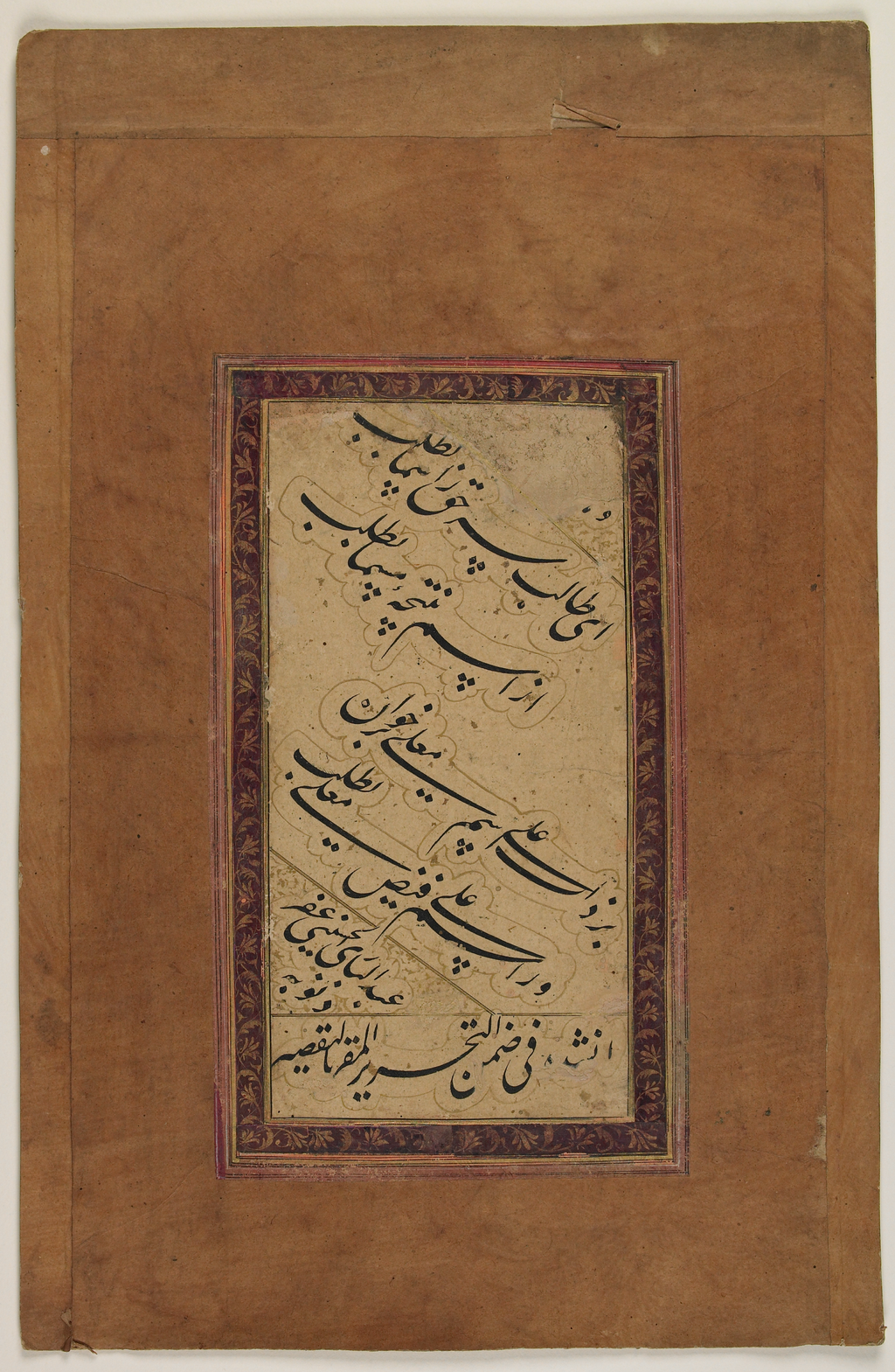
A calligraphic fragment of Persian Shi'i poetry praising Ali as the path to understanding God.
A devotional poem praising Ali shows how he became a central spiritual figure in later Shi'i literary tradition.
About this source
What it is
This is a calligraphic fragment written in black Nasta'liq script by the calligrapher 'Abd al-Bari al-Husayni, likely working in 19th-century India. It contains four lines of Persian poetry praising Ali, framed by decorative cloud bands and a floral border.
Why it matters
The poem presents Ali as a spiritual gateway to knowing God, reflecting Shi'i devotional traditions that grew up long after Ali's death. It shows how later generations of Muslims, especially in Persian and Indian contexts, turned Ali into a central figure of poetry, mysticism and art, not just history.
Look closer
- What does the elaborate decoration around the text suggest about how precious these words were considered?
- Why might a calligrapher sign his work and ask forgiveness for his sins?
- What does this poem tell us about Ali's role in later religious thought, centuries after he lived?
This artifact is part of the curated material that grounds the AI version of Alī ibn Abī Ṭālib on Humy.ai — when students ask about related events, the AI can quote it and cite it.
More Alī ibn Abī Ṭālib sources
Browse all 74 → Book
Secondary source
Nahj al-Balagha
Sharif al-Radi · c. 1000
 Artifact
Secondary source
Imam Ali Shrine
977
 Artifact
Secondary source
Great Mosque of Kufa
founded 638, completed 670s
 Book
Secondary source
Sahih Muslim
Muslim ibn al-Hajjaj · c. 900
Free account
Read every Alī ibn Abī Ṭālib source
Sign up free →
Ready when you are
Start chatting with Alī ibn Abī Ṭālib now.
20 messages free · No credit card · Available in 50+ languages.