


Secondary sourcePainting1740
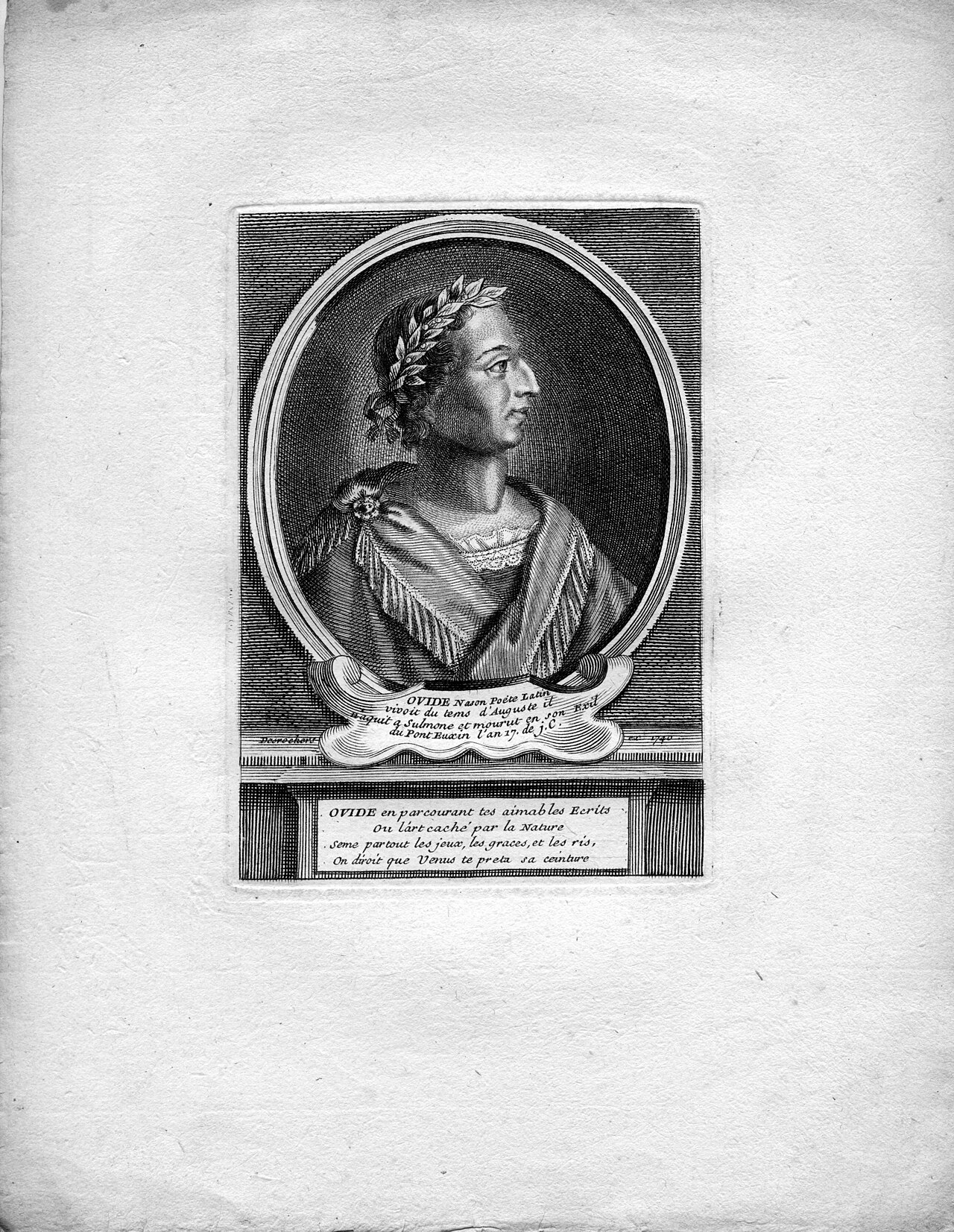
Publius Ovidius Naso, engraved portrait by Desrochers
Étienne-Jehandier Desrochers · 1740
An 1740 engraved portrait of Ovid by Étienne-Jehandier Desrochers, with a French inscription and verse. It shows how the poet was imagined in 18th-century France.
A later engraved portrait imagining Ovid's appearance, made long after his death and showing how he was remembered in 18th-century France.
About this source
What it is
This is an engraved portrait of Ovid made by Étienne-Jehandier Desrochers in 1740. It shows Ovid in an oval, in profile facing right. He wears a laurel wreath, a cloak with a fringed edge and a brooch on the shoulder. Below the oval is a cartouche with French inscription text and a panel with a four-line French verse.
Why it matters
Ovid died about seventeen centuries before this engraving was made. The French text and verse show that the print was made for readers who knew his poetry in translation or from school. Engravings like this one were a common way to present classical writers to a wide public. The image tells us as much about 18th-century taste as about Ovid himself.
Look closer
- What details of clothing and the wreath suggest that Ovid is being shown as an honoured classical author?
- What does the French verse under the portrait tell readers about how Ovid should be understood?
- Why might an engraver in 1740 choose a profile view rather than a full face?
This painting is part of the curated material that grounds the AI version of Ovid on Humy.ai — when students ask about related events, the AI can quote it and cite it.
Ready when you are
Start chatting with Ovid now.
20 messages free · No credit card · Available in 50+ languages.