


Secondary sourcePainting1632
Saint Peter
Rembrandt Harmensz. van Rijn · 1632
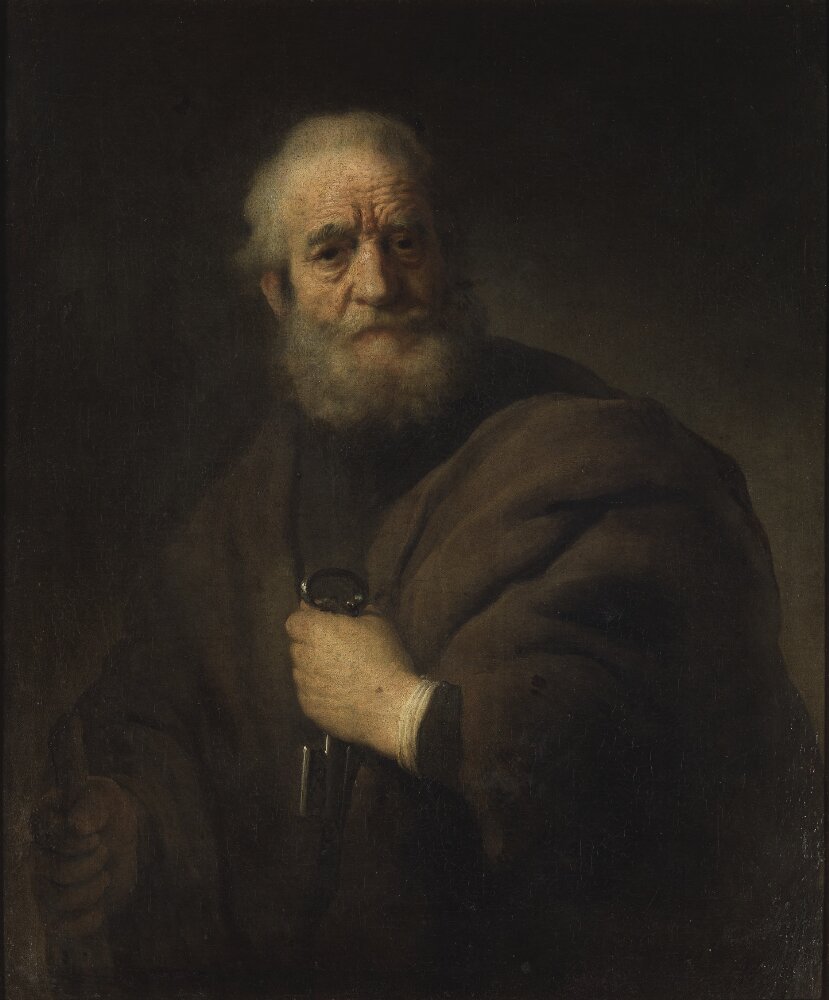
A 1632 painting by Rembrandt showing Peter with his key and a grave expression. It is a later artistic portrait of the apostle, held by the Nationalmuseum in Sweden.
Peter is shown with his key, the symbol of his role as the first pope, in Rembrandt's imagined portrait of the apostle.
About this source
What it is
This is a painting by Rembrandt van Rijn, dated 1632, held by the Nationalmuseum in Sweden. It shows an elderly bearded man with white hair and a furrowed brow, wearing a dark brown cloak. He holds a key in his right hand against his chest and a staff in his left, against a dark background.
Why it matters
The Nationalmuseum describes Peter as the first pope in Rome, and the key as his customary symbol. In the seventeenth century Peter was an important symbol for the papacy and the Catholic Church. The museum notes that Peter was a relatively unusual subject for Rembrandt, who is known for dramatic light that brings faces and hands out of darkness.
Look closer
- How does the strong contrast of light and dark shape the way you read the man's face?
- Why might a painter in Protestant Amsterdam choose to paint a Catholic symbol like the key?
- What does the direct stare at the viewer ask you to think about?
This painting is part of the curated material that grounds the AI version of Saint Peter on Humy.ai — when students ask about related events, the AI can quote it and cite it.
More Saint Peter sources
Browse all 95 → Book
Secondary source
Gospel of Matthew
Matthew the Apostle · late 1st century AD
 Book
Secondary source
Gospel of Mark
Mark the Evangelist · c. AD 66-75
 Book
Secondary source
Acts of the Apostles
Luke the Evangelist · c. 80-90 AD
 Letter
Primary source
Epistle to the Galatians
Paul the Apostle · c. AD 48

Free account
Read every Saint Peter source
Sign up free →
Ready when you are
Start chatting with Saint Peter now.
20 messages free · No credit card · Available in 50+ languages.