


Secondary sourceArtifact1577
San Sebastiano, Milan
Pellegrino Tibaldi · 1577
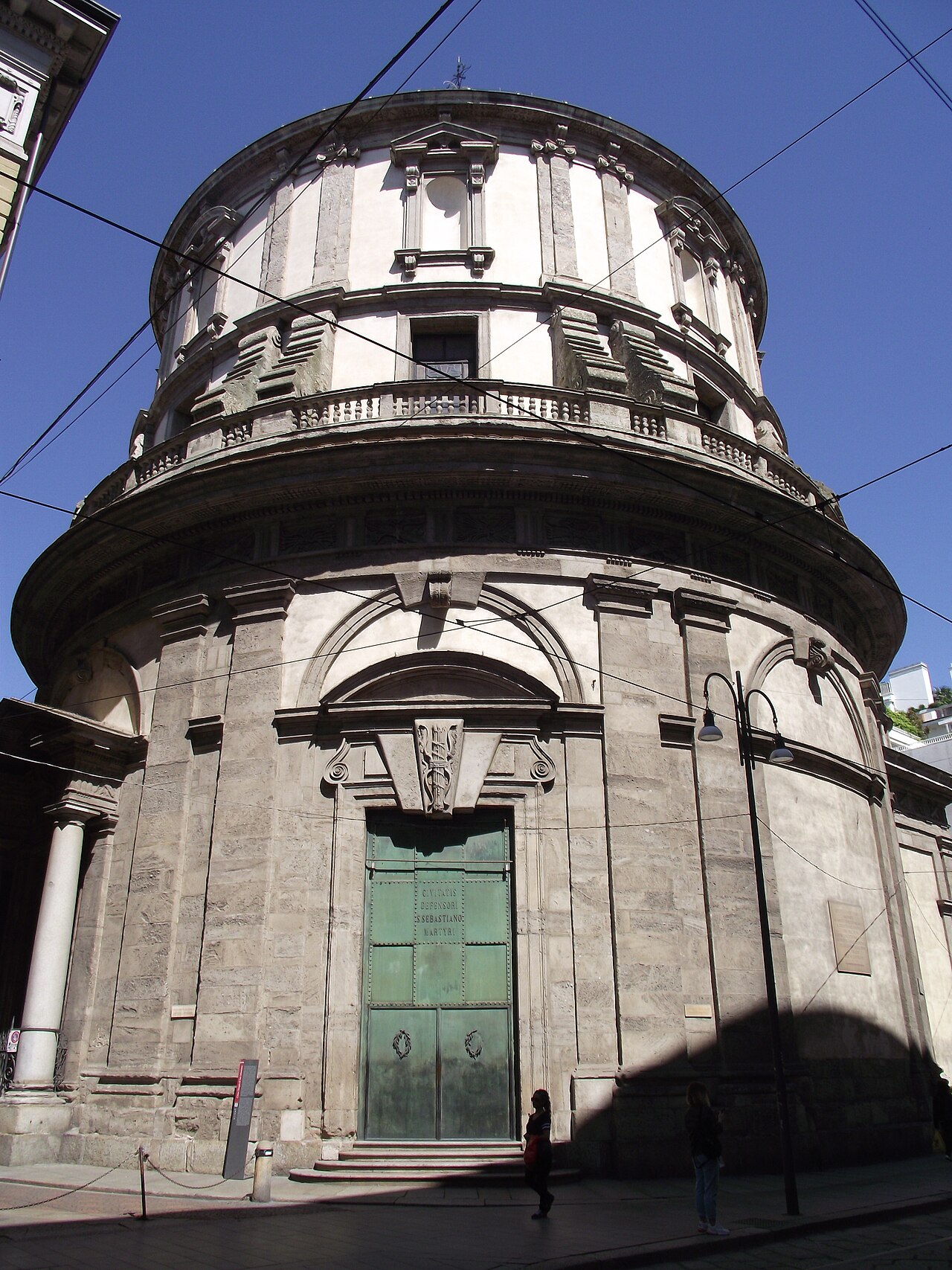
A circular church in Milan vowed by the city during the 1576 plague, whose foundation stone Borromeo laid.
Borromeo laid the foundation stone of this church, vowed by Milan during the 1576 plague, showing his civic leadership.
About this source
What it is
San Sebastiano is a late-Renaissance church in central Milan, designed by the architect Pellegrino Tibaldi and begun in 1577 after a season of plague in the city. It is cylindrical, capped with a dome, and dedicated to Saint Sebastian.
Why it matters
The city of Milan vowed to build this church during the 1576 plague, and Charles Borromeo, as archbishop, laid its foundation stone. It stands as a monument to his public leadership during the epidemic, when he took an active role in guiding the city through crisis. The building was later altered by other architects after Tibaldi left for Spain.
Look closer
- Why might a city choose to build a church as a response to a plague, rather than another kind of monument?
- What does the unusual round shape of the church suggest about the architect's influences?
- What role did Borromeo play in this building, and how does that compare to his role as a religious leader generally?
This artifact is part of the curated material that grounds the AI version of Charles Borromeo on Humy.ai — when students ask about related events, the AI can quote it and cite it.
More Charles Borromeo sources
Browse all 91 → Painting
Primary source
Portrait of Carlo Borromeo
Giovanni Ambrogio Figino · 1587
 Painting
Secondary source
Quadroni of St. Charles
Carlo Buzzi · 1603 (cycle begun)
 Artifact
Primary source
Collegio Borromeo
Pellegrino Tibaldi · 1561
Secondary source
Canons and Decrees of the Council of Trent
1545-1563 (council); 1851 (this translation)
Free account
Read every Charles Borromeo source
Sign up free →
Ready when you are
Start chatting with Charles Borromeo now.
20 messages free · No credit card · Available in 50+ languages.