


Primary sourcePainting1920
Second Illustration from The Forerunner
Kahlil Gibran · 1920
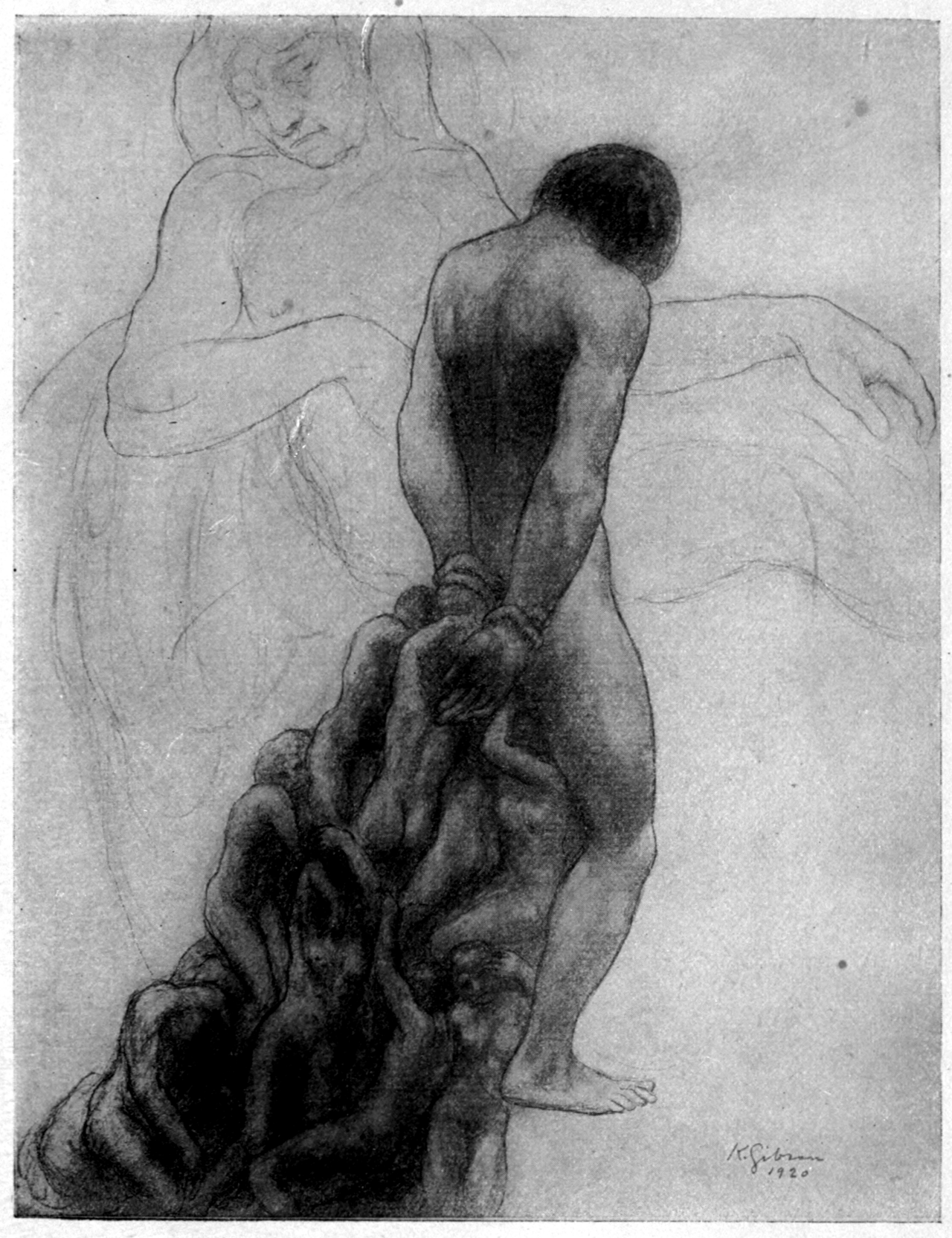
A charcoal drawing by Kahlil Gibran made for his 1920 book The Forerunner, showing a bound nude figure standing over a mass of writhing bodies.
Gibran drew this illustration himself for his own book, showing his work as both writer and visual artist.
About this source
What it is
This is a charcoal drawing by Kahlil Gibran, made in 1920 to illustrate his book The Forerunner, his parables and poems, published by Knopf in New York.
It shows a nude man with his head bowed and his hands bound behind his back, standing on a heap of intertwined, writhing figures. Above him floats a faint sketched figure with outstretched arms.
Why it matters
Gibran was not only a writer but also a trained visual artist, and he illustrated many of his own books. This drawing shows how he used symbolic, dreamlike imagery of the human body to express ideas about suffering, bondage and spiritual struggle, the same themes found in his writing.
Look closer
- What might the bound figure and the mass of bodies beneath him represent?
- Why do you think Gibran chose to illustrate his own writing rather than hire another artist?
- What feelings does the drawing create, and how does the faint figure above change the meaning?
This painting is part of the curated material that grounds the AI version of Kahlil Gibran on Humy.ai — when students ask about related events, the AI can quote it and cite it.
More Kahlil Gibran sources
Browse all 87 →
Ready when you are
Start chatting with Kahlil Gibran now.
20 messages free · No credit card · Available in 50+ languages.