


Primary sourceArtifact215-217 AD
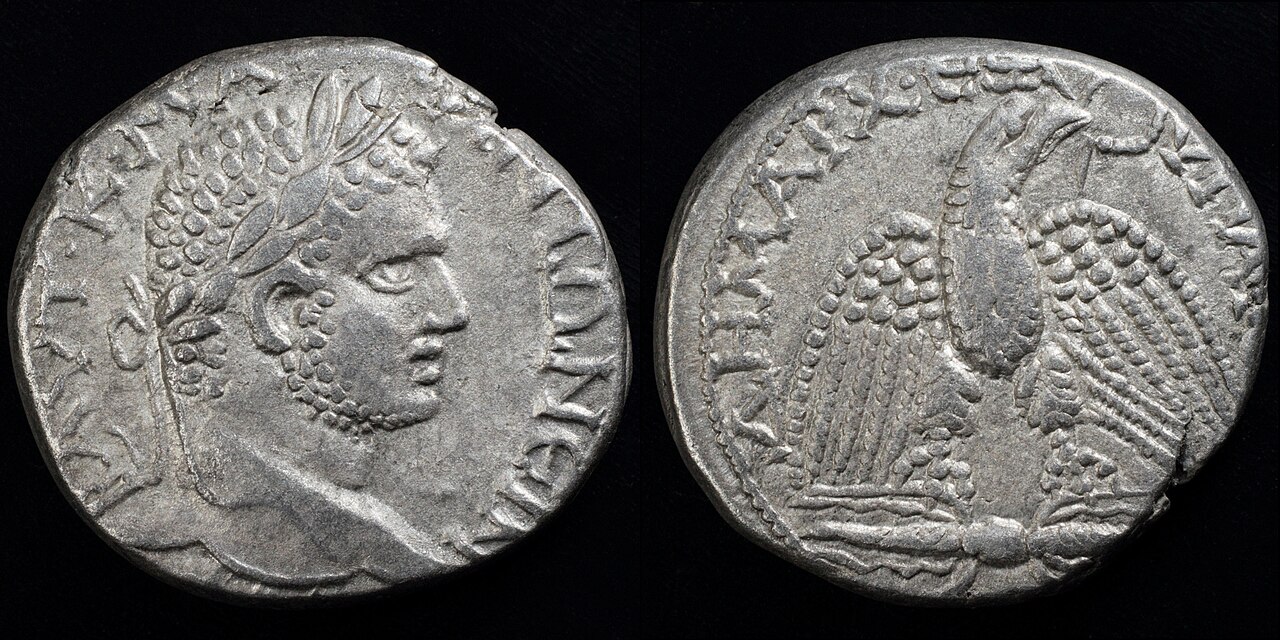
Silver tetradrachm of Caracalla, Seleucia Pieria
215-217 AD
A silver coin struck at Seleucia Pieria in Syria between 215 and 217, bearing Caracalla's head on one side and an eagle on the other. It shows how his image appeared on money in the eastern provinces.
A coin struck during Caracalla's reign that shows his laureate portrait and name in a provincial mint, showing how his rule was presented across the empire.
About this source
What it is
This is a silver tetradrachm, a large coin struck at Seleucia Pieria in Syria between 215 and 217 AD. The obverse shows a laureate head facing right, with Greek lettering around the edge that includes the emperor's name. The reverse shows an eagle standing on a thunderbolt, its head turned right and a wreath in its beak. The photograph of the coin is held on Wikimedia Commons, where the coin is catalogued as a provincial issue.
Why it matters
Coins were one of the most common ways that Roman rulers reached ordinary people. This piece shows that the emperor's image and titles were carried into a city far from Rome. The coin does not record who designed it or who used it, but it shows how imperial power appeared in everyday money in Syria.
Look closer
- Why might an emperor's portrait and name appear on money made in a provincial city?
- What might the eagle and thunderbolt on the reverse have been meant to suggest about power?
- What does the coin leave out, such as the people who struck it or the people who spent it?
This artifact is part of the curated material that grounds the AI version of Caracalla on Humy.ai — when students ask about related events, the AI can quote it and cite it.
More Caracalla sources
Browse all 81 →
Ready when you are
Start chatting with Caracalla now.
20 messages free · No credit card · Available in 50+ languages.